Monthly Archives: December 2014

Christie 1909 V-4 racer

Christie V-4 Engine 1909 Racer

By William Pearce

In late 1908, John Walter Christie set to work designing and building his last front-wheel drive race car. While the 1909 racer illustrated the continuing evolution of Christie’s front-wheel drive race cars, it also incorporated many features that were a departure from the previous racers (inline racers, 1906 V-4, and 1907 V-4).
Christie 1909 V-4 racer Firestone

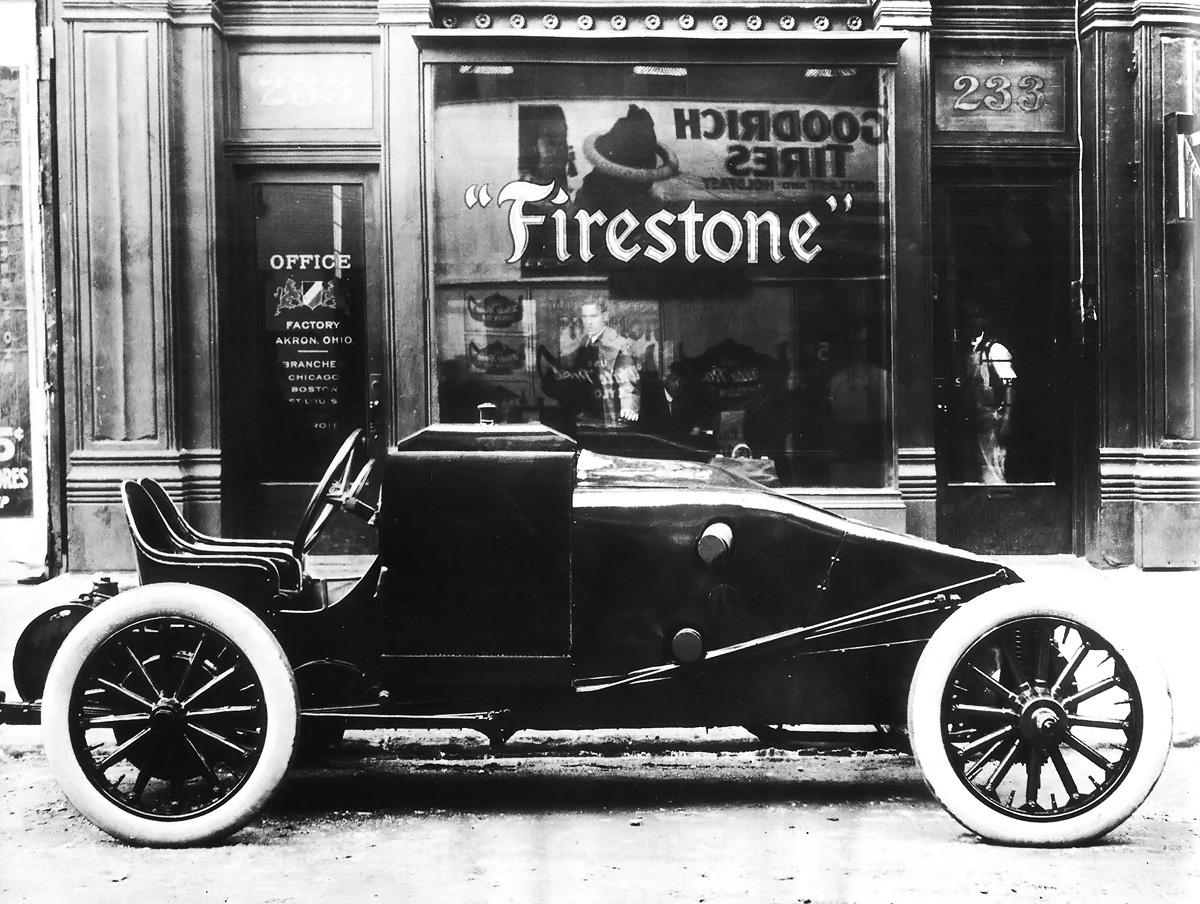
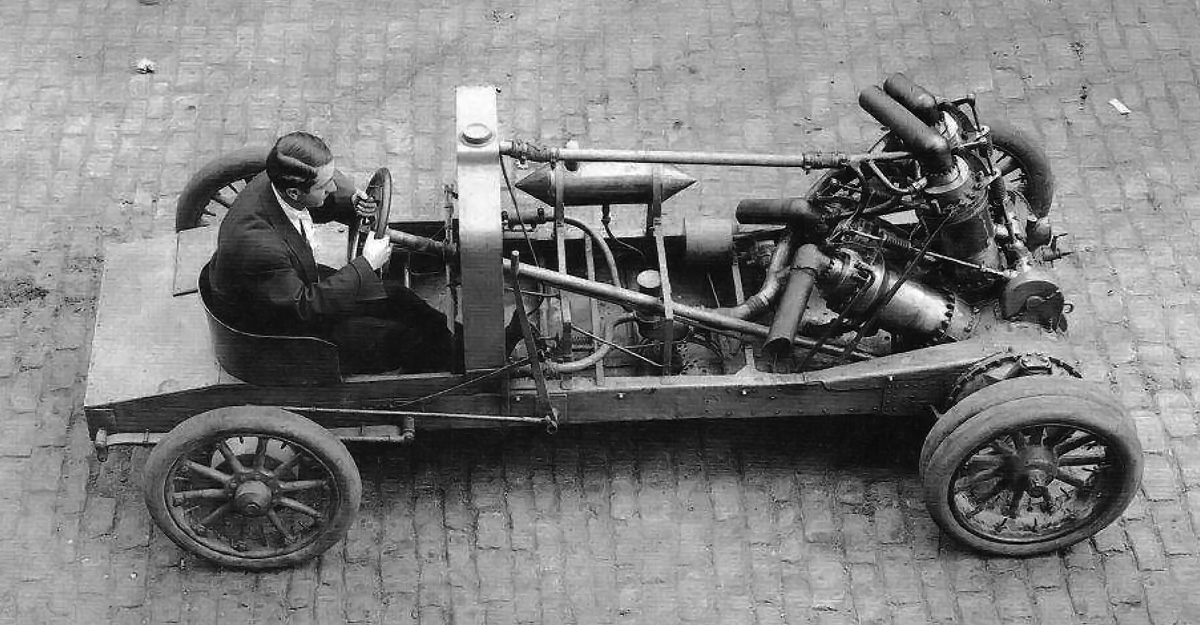
J. Walter Christie’s newly completed 1909 front-wheel drive racer in front of the Firestone office at 233 West 58th Street in New York. Note the cylindrical fuel tank at the rear of the vehicle.

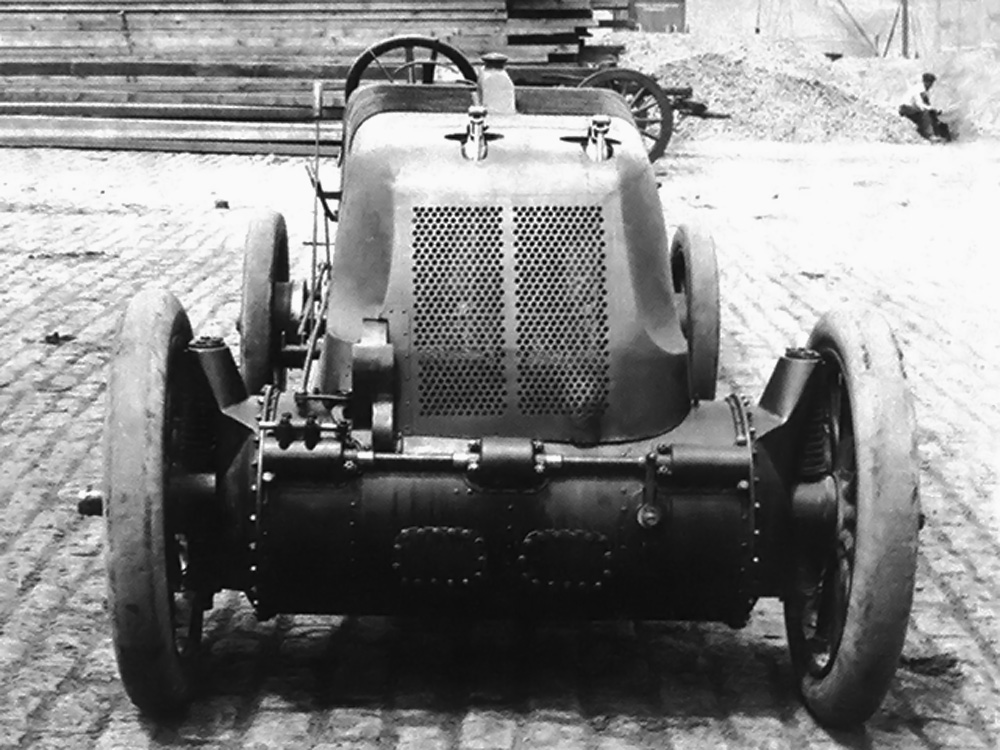
Like the previous racers, the 1909 car had its four-cylinder engine mounted transversely between the front drive wheels. The engine’s crankcase housed the transmission and formed the vehicle’s front axle. The cylindrical crankcase was 15.125 in (384 mm) in diameter and made of bronze. Behind the engine was a radiator shaped like an inverted “U” that extended from one side of the vehicle’s frame to the other. Above the vehicle’s rear axle were seats for the driver and passenger (or riding mechanic). The fuel tank was at the extreme rear of the car. The 1909 V-4 racer had a wheelbase around 102 in (2.59 m) and a track around 54 in (1.37 m).

Although the racer was powered by a V-4 like Christie’s previous two racers, the 1909 engine was an entirely new design. Extending from the crankcase toward the rear of the vehicle was a large block to which the individual cylinders were mounted. The sides of this block were integral with the vehicle’s frame. The cylinders of the 1909 V-4 engine were angled so far back that the rear row was just eight degrees from being completely horizontal. The front row of cylinders was angled 20 degrees from the rear row. The cylinders were slanted back to improve the vehicle’s weight distribution and aerodynamics.

Christie 1909 V-4 racer details

The photo on the left illustrates the 1909 Christie racer’s cross shaft (with notched drive gears at its ends) and accessory shaft. The long shaft leading back from the accessory shaft drove the camshaft. The photo on the right shows the overhead camshaft and its drive, the rocker arms, the valves, and the intake manifold. Note the large block between the crankcase and cylinders.

The forged steel crankshaft was 3.5 in (89 mm) in diameter and 19 in (483 mm) long. It had two throws and was supported by two main bearings. Attached to each crankshaft throw was one 30.5 in (775 mm) long (center-to-center) master connecting rod. The master rods served the rear row (lower) cylinders. Attached 7.0 in (178 mm) above each master rod’s big end was a 23.5 in (597 mm) long (center-to-center) articulated connecting rod. The articulated connecting rods served the front row (upper) cylinders. The incredibly long connecting rods allowed the mass of the engine to be placed toward the rear of the car in an effort to further equalize the vehicle’s weight distribution.

The engine’s cylinders had a 7.5 in (191 mm) bore and 7.0 in (178 mm) stroke, which gave the engine total displacement of 1,237 cu in (20.3 L). The engine’s output has been given as various numbers from 100 to 300 hp (75 to 224 kW), but 200 hp (149 kW) is probably close to the correct number. Each cylinder had one intake and one exhaust valve—both were 3.0 in (76 mm) in diameter and mechanically operated. The intake valves were placed on the inner side of the cylinders so that a common intake manifold could feed each row of cylinders. The upper and lower intake manifolds joined at the center of the engine, and the Christie-designed carburetor was bolted to the lower manifold.

Christie 1909 V-4 racer drive

Sectional drawing of the 1909 Christie V-4 racer’s crankcase with normal, high-speed drive engaged. The short drive shaft with universal joints on its ends can be seen coupled to the engine’s crankshaft. The front cross shaft is shown with its notched gear straddling the gear of the inner universal joint.

The exhaust valves were on the outer side of the cylinders and positioned so that the exhaust gases for each cylinder vented through a small stack. The valves were actuated by separate rocker arms driven by a single overhead camshaft situated between the two cylinder rows. The camshaft was driven via beveled gears by a long shaft on the left side (from the driver’s perspective) of the engine. The long shaft was driven from the left side of an auxiliary shaft positioned above the engine’s crankcase and in front of the cylinders.

A single spark plug was installed in each cylinder and just under the intake valve. In order to achieve proper timing with the odd cylinder angles, the spark plugs for each row of cylinders were fired by separate magnetos. The magnetos were driven from the extended end of the same long shaft that drove the camshaft.

For normal, high-speed front-wheel drive operation, each end of the crankshaft was coupled via disk clutches to a short drive shaft with universal joints at each end. The short drive shaft was constructed of solid steel and was 2.25 in (57 mm) in diameter. The spindles for the drive wheels were on the outer ends of these shafts. In this configuration, the drive wheels turned once for each revolution of the engine.

Christie 1909 V-4 racer

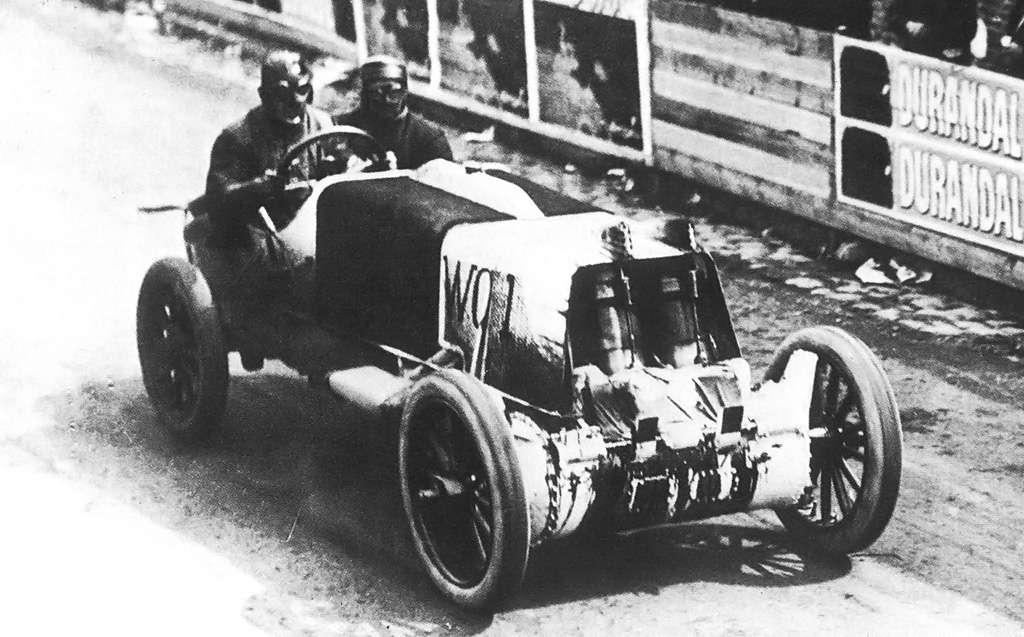
The 1909 Christie V-4 racer undergoing final checks before a run. Walter Christie is checking the water level in the radiator’s header tank. Note the thick radiator and the exhaust stacks protruding from the engine cowling.

Machined between the throws at the center of the crankshaft were 1.0 in (25 mm) wide spur teeth that drove the auxiliary shaft positioned above and slightly to the rear of the crankcase. Positioned in front of and driven by the right side of the auxiliary shaft was a cross shaft. This cross shaft could slide to decouple the drive wheels from the crankshaft and engage a reverse gear. In addition, the cross shaft could engage a low-speed gear via an intermediate gear.

Each end of the cross shaft had a notched gear that could mesh with teeth on the inner side of the short drive shaft. For normal, high-speed operation, the notch would align with the teeth on the short drive shaft, allowing for direct drive. For low-speed operation, the cross shaft would slide left, and one side of the notched gear would engage the teeth on the short drive shaft. For reverse, the cross shaft would slide right, mesh with the intermediate gear, and the other side of the notched gear would engage the teeth on the short drive shaft. Shifting levers operated various forks that slid the cross shaft and engaged or disengaged the clutches.

Christie 1909 V-4 Ormond Roberts

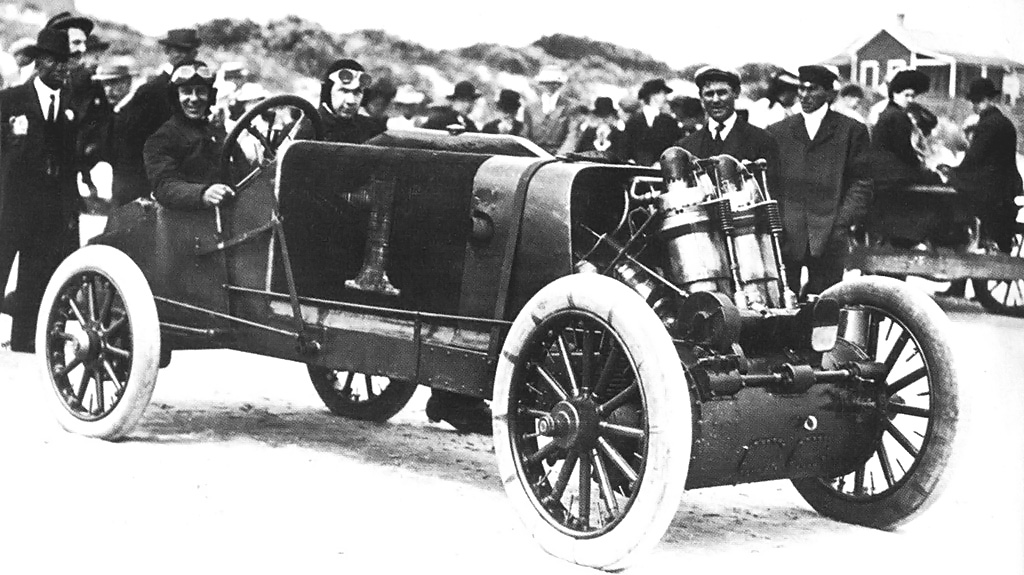
Walter Christie driving the 1909 V-4 racer on Dayton-Ormond Beach in Florida with George Robertson holding on. For the beach runs, special cowlings were installed, the passenger seat was removed, and the radiator’s header tank was altered.

The radiator was formed from 80 copper tubes in 10 sections. Five sections were positioned on each side of the vehicle, and the eight copper tubes of each section formed a half arch. The copper tubes were flattened to a width of 2.625 in (67 mm) and extended from one side of the vehicle’s frame to a header tank positioned at the upper center of the radiator. The complete radiator was 29.25 in (743 mm) high, 35 in (889 mm) wide, and 32.5 in (826 mm) long.

Three different tires sizes were intended to be used on the 1909 racer: 30 in (762 mm) tires for circle tracks, 32 in (813 mm) tires for road use, and 34 in (864 mm) tires for high speed operations. Christie estimated his racer was capable of 130 mph (209 km/h), which equates to an engine speed of 1,285 rpm with the 34 in (864 mm) tires. Christie proposed that an engine with a smaller bore of either 5.5 in (140 mm) or 6.0 in (152 mm) could be used in a touring car version of the racer. These bores would give engine displacements of 665 cu in (10.9 L) and 792 cu in (13.0 L) respectively. However, it is doubtful that engines of these sizes were ever made.

Christie 1909 V-4 racer Oldfield

Barney Oldfield in the 1909 Christie racer at one of the many race exhibitions he staged. By this time, the racer had a new radiator and a square fuel tank. The dangerous aspects of the racer were embellished by Oldfield and subsequent owners; the car was even called the “Killer Christie.” It is safe to assume that no car in the 1910s was safe at over 100 mph (160 km/h).

Christie’s new V-4 racer made its public debut on 8 July 1909 at the Blue Bonnets track in Montreal, Canada, but Christie did not find the success he had hoped for. Experiencing some engine trouble, he was able to run a 59.6 second mile (60.4 mph / 97.2 km/h) on the circle track. In the next race, Christie’s car caught fire, taking him out of the event. In early August, the car ran at Grosse Pointe, Michigan where Christie ran a 54.6 second mile (65.9 mph / 106.1 km/h)—a new record for that circle track. Christie’s speed was limited by the track’s insufficient banking, which resulted in him coasting through the turns.

For the remainder of 1909, Christie raced at several tracks but was always plagued by trouble. On the Indianapolis Motor Speedway in mid-December, Christie ran a half mile in 17.53 seconds (102.7 mph / 165.2 km/h). He was slowed again by the turns, completing a mile in 42.58 seconds (84.5 mph / 136.0 km/h). Christie’s former partner (and nephew) Lewis Strang ran a few seconds faster in his 200 hp (149 kW) FIAT.

Christie 1909 V-4 Oldfield Beachey

Oldfield on the Ascot track in Los Angeles, California leading Lincoln Beachey in his Curtiss Pusher in 1913.

George Robertson was hired to drive Christie’s V-4 racer at Ormond-Daytona Beach, Florida in March 1910. The car was fitted with special, aerodynamic front and rear cowlings, and the passenger seat was removed. While the racer did a respectable 32.36 second mile (111.2 mph / 179.0 km/h), it could not approach the 27.33 second mile (131.723 mph / 211.988 km/h) Barney Oldfield had previously run in the 200 hp (149 kW) Blitzen Benz. Robertson went out to make another attempt despite the Christie racer constantly overheating. In the middle of what he felt would be a record-setting run, the engine seized. Once the engine stopped, the drive wheels froze and slid along the sand. This destroyed the tires and damaged the wheels. After much work to repair the vehicle, overheating issues and carburetor problems continued to plague the racer.

Christie had grown tired of all the issues with his racer. He announced that he was done racing and exited the automobile business altogether. The V-4 racer sat until 1912 when Oldfield bought it for $750. A new radiator was installed by either Christie or Oldfield, and the original body was put back on.

Oldfield campaigned the car for four years, putting on show after show. For some of his exhibitions, Oldfield raced against aviation pioneer Lincoln Beachey in his Curtiss Pusher airplane. Oldfield did achieve some success, setting a number of records with the Christie racer. On 20 June 1915, Oldfield set a new American record when he lapped the 2 mile (3.2 km) Speedway Park track in Chicago, Illinois in 64.6 seconds (111.5 mph / 179.4 km/h). On 28 May 1916, Oldfield became the first person to exceed 100 mph (161 km/h) on the 2.5 mile (4.0 km) Indianapolis Motor Speedway track when he completed a lap in 87.7 seconds at 102.623 mph (165.156 km/h). He then upped his 2 mile (3.2 km) American record in Chicago on 5 June 1916 when he completed a lap in 63.75 seconds (112.9 mph / 181.8 km/h).

Christie 1909 V-4 racer Oldfield IMS

Oldfield and his crew by the Indianapolis Motor Speedway for their record-setting run in 1916. Leather straps are now used to secure the racer’s cowling, and what appear to be grease cups protrude from the cowl.

Damaged during the run in Chicago, Oldfield sold the car mid-June 1916. The Christie was then used in Ernest Moross’ traveling auto race shows. During World War I, the Christie racer and the rest of the show toured Canada. At some point during this time, the racer was fitted with a new cowl and body. In March 1918, the car was sold to racer Louis Disbrow and continued to be used in various shows. Some of the shows included driver Jerry Wonderlich racing against aviatrix Ruth Law in her Curtiss Pusher aircraft. Outdated and unwieldy, the last of Christie’s front-wheel drive racers was scrapped in Chicago, Illinois around April 1919. All of the bronze parts proved to be the racer’s last payout: $450.

After parting with his racer in 1910, Christie had a short stint in aviation. He then built a series of front-wheel drive fire trucks. These trucks replaced the horses of existing horse-drawn units. This business venture proved quite lucrative. Christie then moved into designing tanks, which occupied his remaining days. Unfortunately, the money faded as the years went by, and Christie died nearly broke on 11 January 1944.

Christie 1909 V-4 Law Old Motor

The Christie 1909 racer with its new cowl and body circa 1918. Ruth Law’s Curtiss Pusher is in the background, and her mechanic Bob Westover sits behind the wheel. Note the 300 hp claim and that the racer is still prominently labeled as a “Christie.” (Lee Stohr image via TheOldMotor.com)

Sources:
– “The Front-Wheel-Drives of John Walter Christie, Inventor” by Stan Grayson Automobile Quarterly Volume 14, Number 3 (1976)
– “Christie’s New 100-Horsepower Racer” The Automobile (5 August 1909)
– “Montreal Sees Two-Man Meet” The Motor World (15 July 1909)
– “Christie the Bright Star at Grosse Pointe” The Automobile (5 August 1909)
– “Furious Driving at Fort Erie” The Motor World (12 August 1909)
– “Under the Spell of Speed” The Motor World (26 August 1909)
– “Basle Finishes Miles Ahead” The Motor World (2 September 1909)
– “Oldfield Smashes Florida Beach Records” Automobile Topics (26 March 1910)
– “Rain Cuts Short Florida Record Breaking” Automobile Topics (2 April 1910)
– “Delay Only Increases Race Interest” Motor World (23 June 1915)
– “Oldfield Breaks Record” Motor Age (8 June 1916)
– “Barney’s Christie Junked” Motor Age (24 April 1919)
Barney Oldfield by William F. Nolan (1961/2002)
http://www.stohrdesign.com/christie-automobiles-1903-1909-a-blog (various pages)
http://theoldmotor.com/?p=114991
http://theoldmotor.com/?p=130800
http://theoldmotor.com/?p=2798
Christie 1907 V-4 Oldfield

Christie V-4 Engine 1907 Racer

By William Pearce

Shortly after John Walter Christie wrecked his V-4-powered racer practicing for the 1906 running of the Vanderbilt Cup, he went to work on his next front-wheel drive race car. He took what he learned from his first V-4 racer and from all his inline racers and applied this knowledge while building the new car. Christie planned to take his new racer to Europe as the first American vehicle to compete in the French Grand Prix. At the same time, Christie wanted to expand his Christie Direct Action Motor Car Company and start producing various automobiles of his design.

Christie 1907 V-4 build

J. Walter Christie’s 1907 V-4 racer under construction at his shop in New York. The drive shaft for the water pump can be seen behind and to the right of the front wheel and extending toward the bottom of the radiator. This shaft was driven from the bevel gear visible in front of the first row of cylinders.

While the 1907 V-4 racer closely resembled the 1906 V-4 racer, it was an entirely new design. The car’s configuration followed that of the previous Christie racers in which the engine was mounted transversely between the two front wheels. The engine’s crankcase formed the car’s front axle and housed its transmission. The car had two forward gears: a normal gear for high-speed operation and a low gear. There was also a reverse gear. Behind the engine was a large radiator in which individual copper tubes were shaped in an inverted “U” and extended from one side of the frame to the other. A header tank was at the upper center of the tubes. The driver and passenger (typically a riding mechanic) sat over the rear axle with the fuel tank behind them.

The engine’s circular crankcase was made of nickel steel and formed an integral part of the chassis. The individual steel cylinders were mounted in two staggered rows on the crankcase. The first row of cylinders leaned back about 10 degrees from vertical, and the second row was angled about 45 degrees from the first row. Each cylinder was surrounded by a copper water jacket. Cooling water exited the top of each cylinder and flowed through a common manifold to the radiator’s header tank. After flowing through the radiator, the cooled water was pulled through a circulation pump and then flowed into the lower part of the cylinder water jacket. The water pump was driven from the camshaft via a long shaft with beveled gears.

Christie 1907 V-4 engine

Detail view of the V-4 engine and how its crankcase was an integral part of the car’s frame. The cross shaft on the front of the crankcase drove low and reverse gears. Note the camshaft housing in front of the cylinders and the exhaust valve train. The camel hair lining can just be seen on the outer diameter of the flywheel housed in the crankcase. The clutch would be installed between the flywheel and the crankcase.

Each cylinder had one large, mechanically operated exhaust valve. Via a rocker arm and pushrod, all exhaust valves were actuated by a single camshaft mounted on the outside of the crankcase and in front of the first row of cylinders. From the driver’s position, the right side of the camshaft was geared to the crankshaft, and its left side was geared to the water pump drive shaft. Surrounding the exhaust valve were eight atmospheric (automatic) intake valves mounted in a manganese bronze inlet chamber. The incoming air/fuel charge flowed from the Breeze carburetor, which was positioned behind the engine, into a manifold that branched into separate intake pipes for each cylinder. This configuration gave each cylinder a different induction pipe length and led to unequal air/fuel distribution.

Many sources list the bore and stroke as 7-9/32 in (185 mm) and the total displacement as 1,214 cu in (19.9 L). However, the engine actually had a 7.25 in (184 mm) bore and stroke that gave a total displacement of 1,197 cu in (19.6 L). The 185 mm (7-9/32 in) figure probably originated from the European press rounding up the true 7.25 in (184 mm) number. Regardless, the car’s displacement was the largest of any Grand Prix racer before or since. The V-4 engine reportedly produced around 130 hp (97 kW), but it was probably closer to 100 hp (75 kW).

Christie 1907 V-4 front cowl

Christie’s V-4 racer with its full engine cowling. It seems the cowling’s grill was quickly cut away to increase airflow through the radiator. Each cylinder had short exhaust stacks, and the front cylinders expelled their exhaust through the top of the cowl.

The stagger of the cylinders allowed the use of a two-throw crankshaft. Two hollow steel connecting rods were attached to each throw. The crankshaft was supported by three main bearings. The steel pistons had concave heads and five rings; three rings were above the wrist pin, and two bronze rings were below. The underside of the piston had cooling fins to help dissipate heat. For each cylinder, a single spark plug was mounted on its Vee side near the pushrod guide. The spark plugs were fired by a battery-powered Heinz coil and communicator (distributor). The engine used splash lubrication and also a Petersen pressure feed oiler.

On each end of the crankshaft was a manganese bronze flywheel. The outer diameter of the flywheel was lined with woven camel hair to provide a friction surface. Covering the flywheel was a chrome steel cone clutch. Shafts and universal joints connected the drive wheels to the clutches and allowed for steering and independent coil spring suspension. Normal gear would lock the flywheel, clutch, and shaft together so that there was no reduction between the engine and drive wheels; for every revolution of the engine, the drive wheels turned one revolution. Normal engine speed was 1,000 to 1,200 rpm. With its 34 in (864 mm) by 4.5 in (114 mm) front tires, the car was capable of 120 mph (193 km/h) at 1,200 rpm. Of course, different size tires could be used to alter the vehicle’s acceleration and top speed. The rear tires were 34 in (864 mm) by 4 in (102 mm).

Christie 1907 V-4 French Grand Prix

Christie and Lewis Strang running in the French Grand Prix in 1907. The car was painted white for the race, the engine cowl had been cut back, exhaust valve covers had been added to the top of the cowl, engine exhaust was now piped out of the cowl and into a muffler (of sorts) seen just behind the front wheel, and crankcase breathers had been added to the front of the car. Note the oil leaking from the camshaft and cross shaft housings.

Low and reverse gears were enabled by a cross shaft on the front of the crankcase. As the cross shaft slid laterally, gears on the shaft meshed with teeth cut into the outside of the clutch drums; at the same time, the clutch disengaged from the flywheel, allowing the speed of the drive wheels to be dictated by the speed of the cross shaft. The cross shaft was geared to the crankshaft at a reduced speed.

The car was only fitted with rear brakes, but two sets were employed. One set of rear brakes acted upon the inner surface of the brake drum while the other set acted upon the drum’s outer surface. The inner and outer brakes were controlled by individual foot pedals; however, the pedals were situated so that both could be pressed simultaneously by one foot.

The rear axle was a hollow steel tube and attached to the frame by semi-elliptic leaf springs. The 25 gal (95 L) fuel tank was easily removed so that it could be inspected by the Grand Prix committee. The car used a pressed steel, channel-section frame. It had a 110 in (2.79 m) wheelbase and a 53 in (1.35 m) track (some sources say a 100 in / 2.54 m wheelbase and a 56 in / 1.42 m track). The car weighed around 1,780 lb (807 kg).

Christie 1907 V-4 GP racer

This photo was most likely taken soon after the racer returned from Europe (possibly at Morris Park, New York). The cross shaft, mufflers, and crank case breathers have been removed, but the rest of the car is still in its Grand Prix configuration—apparently still wearing white paint from the Grand Prix. Christie is in the driver’s seat. Note the oil still leaking from the front of the crankcase.

Completed in late April, the Christie racer was tested out on the streets of Long Island, New York at 4 AM. Lewis Strang, who was Christie’s ridding mechanic and nephew, accompanied Christie on this first run. Reportedly, the car broke down after about 20 mi (32 km), but the issues were not severe. The car was repaired and underwent further testing and refinement in May. The racer originally had a cowling that covered the entire engine. Due to cooling issues, the front of this cowling was removed to increase airflow through the radiator. This cowling was continually modified throughout the racer’s life.

In June, Christie, Strang, and the V-4 racer left for France. Thirty-eight cars were entered in the French Grand Prix to be run on 2 July 1907. The race consisted of 10 laps on a 77 km (47.8 mi) course laid out near Dieppe in Northern France. Christie’s racer was the lightest and one of the most powerful racers. It was allocated the race designation WC1 (for Walter Christie 1) and the 12th starting position. The Christie Direct Action Motor Car Company had arranged for several locals to assist with the racer. However, upon arriving in France, Christie and Strang discovered that the helpers were nowhere to be found. Christie and Strang spent their time repainting the car in the white and red colors required for United States racers. They then needed to register the racer in France. With all the administrative work completed, Christie and Strang did not have much time to practice and only made one test lap around the course. This session revealed a sticking exhaust valve, but there was no time for repairs.

Christie 1907 V-4 Oldfield

Barney Oldfield in the 1907 Christie V-4 racer. It is not known when or where this photo was taken, but a new engine cowling has been installed and the cross shaft has been reinstalled.

Christie and Strang started the race at 6:12 AM and had a tire failure less than two miles later; it was not a good start. Repairs were quickly made, but the car was struggling. Christie picked up the pace and ran a lap in 48 min and 49 sec (58.8 mph / 94.6 km/h). However, this was several minutes slower than the leader. Adding to the trouble of the sticking exhaust valve were a jammed clutch and an overheated main bearing. Christie and Strang retired the V-4 racer on the fifth lap.

Upon return to the United States, Christie was ridiculed for his poor showing at the Grand Prix. He responded that he had spent his own money on his effort, and, unlike other American auto manufactures, he “at least did something.” Christie went on to challenge his critics to a race “for any distance and for any amount of money, and at any time, on any road or track anywhere.” No one stepped up to accept his challenge.

Christie and Strang ran the racer at various tracks to prove its capabilities and those of the Christie Direct Action Motor Car Company. In August, Christie ran a 52.2 second mile (69.0 mph / 111.0 km/h) on the dirt track at Morris Park, New York. He then ran a 52 second lap (69.2 mph / 111.4 km/h) in Boston, Massachusetts followed by the same time at St. Paul, Minnesota. On 9 September, Christie and Strang were running at speed on the Brunots Track near Pittsburg, Pennsylvania when they struck a wrecked racer from a previous crash on the track. Christie lost control of the car, and both men were thrown from their racer. Strang was uninjured, but Christie was hospitalized with a broken wrist, a sprained back, a lacerated head, and abdominal injuries.

Christie 1907 V-4 Blakely Ormond

Ned Blakely sits behind the wheel of the Christie racer at Ormond Beach, Florida in March 1908. Although Christie made a 109 mph (175 km/h) test run, the car did not finishing any official race.

The V-4 racer was repaired, and Christie and Strang took the car to Birmingham, Alabama. Christie was still recovering from his injuries and did not drive much. The next stop was New Orleans, Louisiana, but the meet was delayed. Christie made arrangements to send the car back to New York and returned there himself. However, the car never arrived. Subsequently, Christie discovered that Strang had taken the car back to Birmingham, Alabama were he set a record on 16 October, lapping the mile track in 51.6 seconds (69.8 mph / 112.3 km/h). Strang also ran the V-4 racer at a few other events.

This unauthorized use of his car deeply upset Christie, and it was the end of his association with Strang. Some of Strang’s behavior can be attributed to the negative influence of his and Christie’s manager, William Pickens. To make matters worse, before Christie knew the car was missing, he had sold it to William Gould Brokaw. The arrangement allowed Christie to continue to drive the 1907 V-4 racer so long as he kept it in good repair. When Christie finally tracked down the missing racer and had it returned to his shop in New York, the engine had a cracked cylinder and other damage.

Christie 1907 V-4 late

An undated photo illustrating the many changes made to the 1907 V-4 racer. The cross shaft on the front of the crankcase and the engine cowling have been completely removed. A more conventional radiator has been installed along with new exhaust stacks. A much smaller fuel tank (just in front of the radiator) has replaced the original tank. Note the twin front tires on the right drive wheel. Race promoter Ernest Moross is behind the wheel.

Repairs (which included a new crankcase) were made, and Ned Blakely was tasked with racing the car at Ormond Beach, Florida in March 1908. Unfortunately, in a 100 mi (161 km) race on the first day of the event, a valve broke and took the car out of the race. Repairs were completed, but during a 256 mile (412 km) race on the third day, a spark plug broke off and damaged a cylinder, ending the racer’s participation at the event. Sometime during this event, Christie covered a mile in 33 seconds (109.1 mph / 175.5 km/h) on a test run, but it was not officially timed.

The car was again repaired. In early June, Morton J. Seymour was behind the wheel of the racer practicing for an event on Long Island, New York when he crashed and most likely overturned the car. The radiator was destroyed, but Christie managed to repair the car enough to run without cooling water for an attempt on the 1 km (.62 mi) record. Seymour covered the km in 26.6 seconds (84.1 mph / 135.3 km/h)—not fast enough for a new record.

Christie 1907 V-4 late track

Another view of the modified 1907 racer. The car still has the twin right drive wheels. Christie is in the driver’s seat. Note how the steering column passes through the radiator.

The racer was repaired yet again and further modified. A new (more conventional) radiator was installed. A small fuel tank was installed in front of the radiator, and the large, rear tank was removed. The low and reverse gears and the engine cowling were completely removed. Seymour and Christie went on to drive the car at a few events. After this, Christie and his good friend Barney Oldfield toured the country and made many appearances at various tracks.

At some point, after the new radiator, the V-4 racer had twin front right wheels installed to help the front-wheel drive vehicle on the circle tracks. It is not clear how often the car ran in this configuration. In December 1908, the racer was running at Tanforan Park near San Francisco, California, but a cracked cylinder took it and its driver Hughie Hughes out of competition. In January 1909, Hughes crashed the car at a race in Phoenix, Arizona, and that was the last known event for Christie’s 1907 V-4 racer; the car’s final disposition is not known. By this time, the Christie Direct Action Motor Car Company had fallen into receivership. Undaunted, Christie had established the Walter Christie Automobile Company in September 1908 and went to work on another V-4 racer.

Note: Some sources state that Blakely ran a 35 second mile in the 1907 V-4 racer at “a beach near Atlantic City” prior to March 1908. However, I was unable to find specifics to this event and feel it may have been confused with the 35.2 second run Christie made at Ventnor Beach, which is near Atlantic City, in 1905.

Christie 1907 V-4 DePalma Clark

A photo from the 1908 Minnesota State Fair with Christie, DePalma, and Clark. The fair was held in St. Paul from 31 August to 5 September. Note that the Christie racer has only one front right drive wheel.

Sources:
– “The Front-Wheel-Drives of John Walter Christie, Inventor” by Stan Grayson Automobile Quarterly Volume 14, Number 3 (1976)
– “America’s Candidate for the Grand Prix” by W. F. Bradley The Automobile (11 April 1907)
– “Grand Prix Failures 6. The 1907 Grand Prix Christie” The Bulletin of the Vintage Sports-Car Club No. 281 (Autumn 2013)
– “Christie Racer for the Grand Prix” The Automobile (21 February 1907)
– “The Grand Prix” The Automobile (11 April 1907)
– “Christie Racer is Being Tried Out” The Automobile (2 May 1907)
– “Florida’s Meet Supplied More Records than Races” by John C. Wetmore The Automobile (12 March 1908)
– “Christie’s New 100-Horsepower Racer” The Automobile (5 August 1909)
http://www.stohrdesign.com/christie-automobiles-1903-1909-a-blog (various pages)
http://blog.hemmings.com/index.php/2010/05/31/how-strang-met-his-death/
http://www.findagrave.com/cgi-bin/fg.cgi?page=gr&GRid=112329874
http://hclib.tumblr.com/post/9466387511/auto-racing-at-the-minnesota-state-fair-1908