Monthly Archives: July 2015

Wedell-Williams Model 45

Wedell-Williams Model 45 Racer

By William Pearce

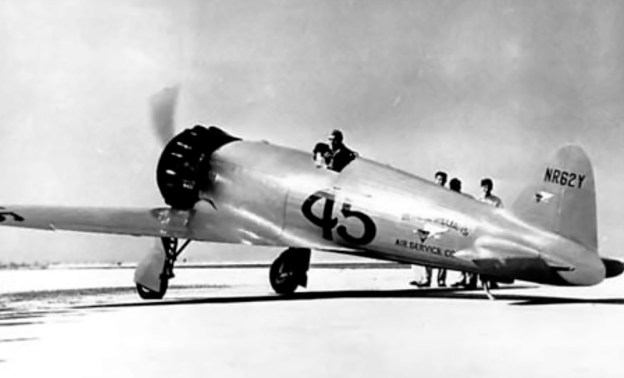
In 1932, the Wedell-Williams Air Service Model 44 established itself as one of the premier air racers. The Model 44 was a fast, sleek monoplane with fixed gear. The aircraft was designed by Jimmie Wedell, an experienced pilot and air racer. The Weddell-Williams company was founded in 1929 when Jimmie Wedell and his brother Walter gained the financial backing of millionaire Harry Williams. Operating out of Patterson, Louisiana, Wedell-Williams Air Service was established to provide a wide range of aeronautical services that included constructing new aircraft, flight instruction, and passenger and mail service. The best way to prove one’s aircraft design abilities and gain publicity was to create a record breaking air racer—the Model 44 was exactly that. However, progress in aviation was swift, so it was in 1933 that Wedell began to design his next racer: the Model 45.
Wedell-Williams Model 45 side

The Model 45 followed the Wedell-Williams design concept that was so well executed in their Model 44 racer. It was a simple concept: a big engine in a sleek airframe resulting in a fast aircraft.

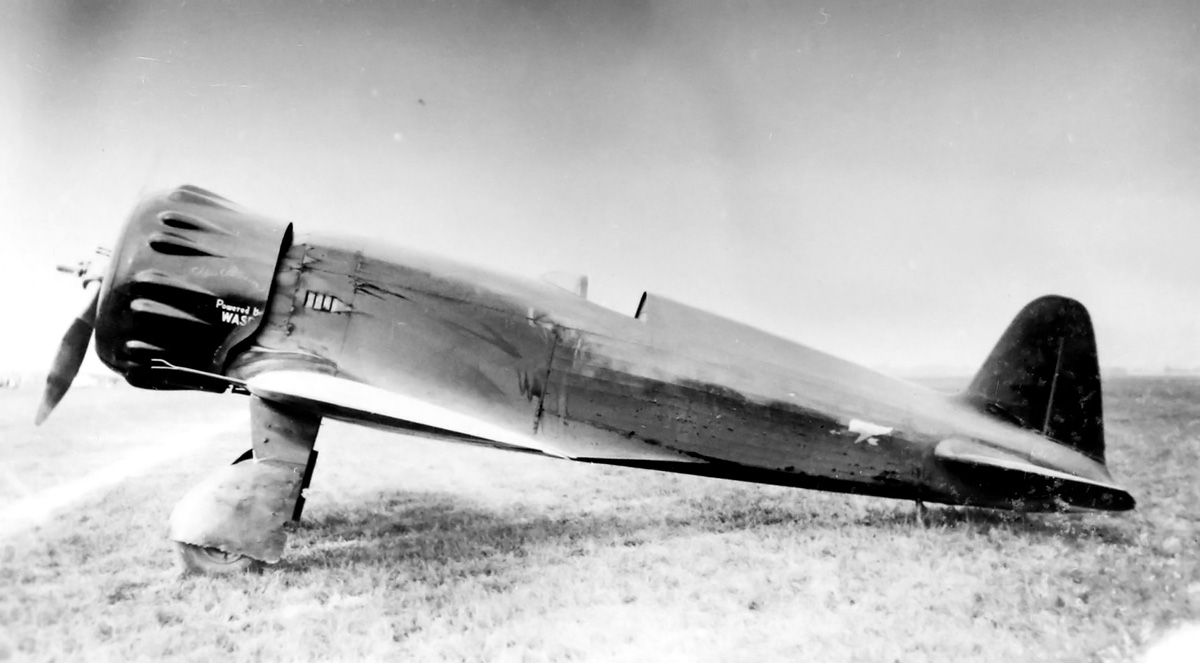
The Model 45 followed the same conventional layout as the Model 44, but the aircraft was further refined with a cantilever wing and retractable undercarriage. The Model 45 consisted of a welded chrome-molybdenum steel tube fuselage. The front and tail of the aircraft were skinned in aluminum. Fabric covered the rest of the fuselage, from in front of the cockpit back to the tail. The Model 45’s wing had a wooden spar; the rest of the structure was made from metal and skinned with aluminum. The main gear retracted inward to be fully enclosed within the wing. The aircraft’s tail skid retracted into the fuselage. Each side of the cockpit had a plexiglass panel that could slide up to fully enclose the pilot.

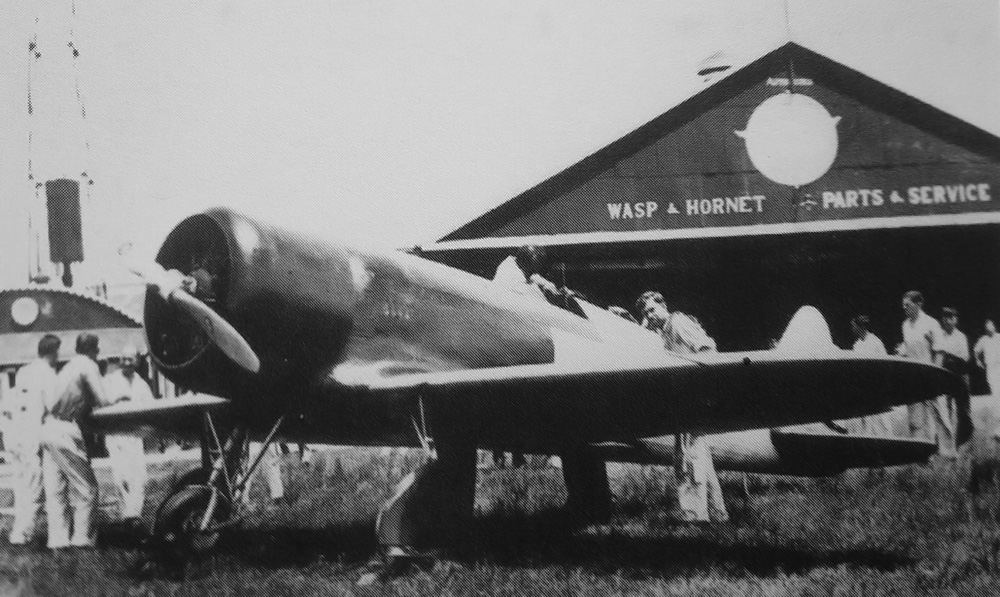
The Model 45 had a 26 ft 8.5 in (8.1 m) wingspan and was 24 ft long (7.3 m). The aircraft had a race weight of around 3,000 lb (1,360 kg). The Model 45 was intended to have a 14-cylinder Pratt & Whitney (P&W) R-1535 Twin Wasp radial engine of 825 hp (615 kW), and its top speed was anticipated to be over 300 mph (483 km/h). However, the R-1535 engine was not ready, so a nine-cylinder P&W R-985 Wasp Jr. engine of 535 hp (399 kW) was installed in its place.
Wedell-Williams Model 45 early

This photo of the Model 45 was taken shortly after the aircraft was built in Patterson, Louisiana in 1933. Note the smooth cowling covering the R-985 engine. Jimmie Wedell stands by the side of the aircraft.

Wedell took the Model 45 (registered as NR62Y) up for its first flight on 28 June 1933. The R-985 engine caused the aircraft to be underpowered and tail-heavy. Very little flight testing was accomplished because Wedell had entered the Model 45 in the Bendix Trophy Race, which was scheduled for 1 July. The 1933 race was run from New York to Los Angeles. Departing for New York, Wedell made it from Patterson, Louisiana to Atlanta, Georgia (about 500 miles / 805 km) before he turned back. Wedell decided the aircraft would not be competitive with its current engine. Instead, he flew a Model 44 (No. 44) and finished the race in second place, behind Roscoe Turner in his Wedell-Williams Model 44 (No. 2).

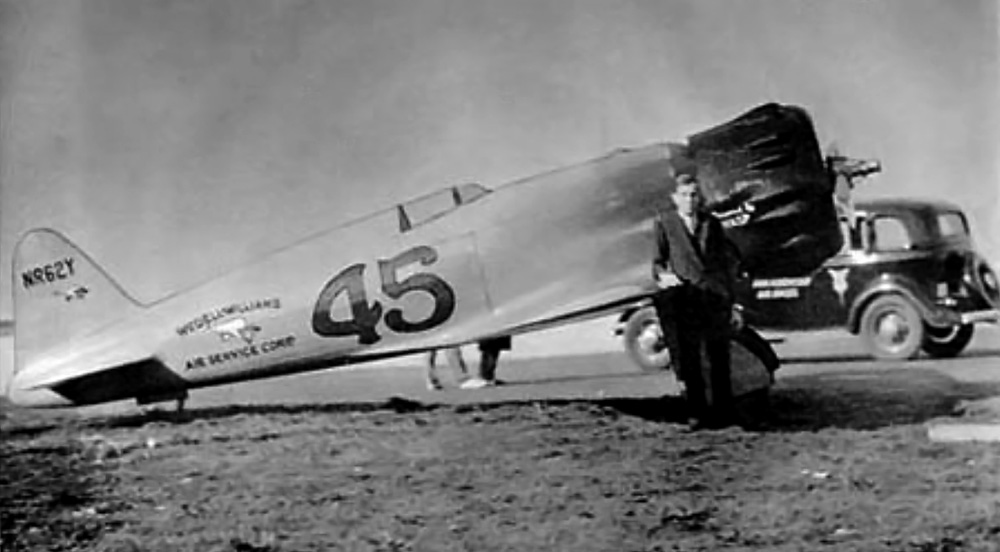
With the R-1535 still delayed, a nine-cylinder, 800 hp (597 kW) P&W R-1340 Wasp Sr. engine was installed on the Model 45 in place of the smaller engine. The R-1340 provided sufficient power for the aircraft and restored its proper balance. While the two engines used the same mounts, the R-1340 had a larger diameter than the R-985 and required a new cowling. The smooth cowling covering the R-985 engine was replaced by a larger cowling with bumps around its diameter to provide clearance for the engine’s rocker covers. The same engines were used in the Model 44, so the entire engine package (including cowling) could be swapped between the aircraft. An 8 ft 2 in (2.5 m) diameter, variable-pitch propeller was also installed.

Wedell-Williams Model 45 front

The Model 45 with its R-1340 engine installed. Note the bumps on the cowling that provided clearance for the engine’s rocker covers. The engines used in the Model 45 and Model 44 (No. 44) racer were interchangeable.

The Model 45 made its race debut at the Pan American Air Races held during the dedication of Shushan Airport (now New Orleans Lakefront Airport) in February 1934. Wedell flew the Model 45 to a new speed record over a 100 km (62 mi) course, averaging 264.703 mph (425.998 km/h), with the fastest lap over 266 mph (428 km/h). Wedell reported that he flew the distance at less than full power.

After the record run, Wedell-Williams Air Service began work to prepare their aircraft for the 1934 Bendix and Thompson Trophy Races, respectively scheduled for 31 August and 4 September. But disaster struck on 24 June 1934; Jimmie Wedell was killed when the de Havilland Gypsy Moth he was piloting crashed shortly after takeoff. Wedell was with a student pilot but had control of the aircraft. The student escaped with only minor injuries. The loss of head designer Jimmie Wedell was a major blow to Wedell-Williams Air Service, but the company continued to plan for the upcoming races.
Wedell-Williams Model 45 Jimmie

Jimmie Wedell stands by the Model 45. Note the doors for the retractable tail skid.

Experienced Wedell-Williams pilot John Worthen flew the Model 45 in the Bendix Trophy Race from Los Angles, California to Cleveland, Ohio. Worthen led the race, followed by Doug Davis flying Wedell-Williams Air Service’s other racer, a Model 44 (No. 44). Worthen, in the Model 45, had a comfortable lead when he became lost and overflew Cleveland by 100 miles (160 km). Worthen landed and refueled in Erie, Pennsylvania and then flew to Cleveland; he landed 36 minutes behind Davis. Had he not overflown Cleveland, Worthen and the Model 45 would have easily won the Bendix race; the trip to Erie added over 50 minutes to his total time. Even with the delay, the Model 45 had averaged 203.213 mph (327.040 km/h) in the Bendix Trophy Race.

In the Shell Speed Qualification heat (Group 3) for the Thompson Trophy Race, Worthen and the Model 45 placed third at 292.141 mph (470.156 km/h), coming in behind the Model 44 racers of Davis (No. 44) at 306.215 mph (492.805 km/h) and Roscoe Turner (No. 57) at 295.465 mph (475.505 km/h). In the Shell Speed Dash Unlimited race, Worthen and the Model 45 achieved 302.036 mph (486.080 km/h).

Wedell-Williams Model 45

The size and weight of the Wedell-Williams Model 45 was more suited for cross-country racing than pylon racing. It would have won the 1934 Bendix race had it not been for a navigation error. The Model 45 is barely an aviation footnote since it was flown fewer than two years and never won a major race.

The Wedell-Williams Air Service team decided that the Model 44 (No. 44) had the greatest potential for the Thompson Trophy Race. This decision was made because of some instability the Model 45 exhibited in the pylon turns—perhaps because the aircraft was not fully refined due to Wedell’s death. The team had been swapping the R-1340 and R-985 engines between racers for various events, and now the R-1340 engine was installed in the Model 44 for the Thompson Trophy Race. The Model 45 would not be competitive with the R-985 engine, and it was withdrawn from the race.

During the Thompson Trophy Race, Davis and the Model 44 were comfortably in the lead when he cut a pylon. He went back to circle the pylon when the aircraft either stalled or experienced a structural failure. The Model 44 smashed into the ground, killing Davis instantly. The shocked Wedell-Williams Air Service team disassembled the Model 45 and shipped it back to Paterson; it never flew again.

Wedell-Williams Air Service was never able recover because tragedies continued to plague the company. On 18 July 1935, Walter Wedell and his passenger were killed in a crash while flying in a Brewster Aristocrat. On 19 May 1936, Harry Williams and John Worthen were killed in a crash after the engine in their Beech Staggerwing quit shortly after takeoff.

Wedell-Williams Model 45 Cleveland side

The Model 45 at the National Air Races in Cleveland, Ohio in September 1934. The unfortunate death of Jimmie Wedell seemingly cut short the aircraft’s development, and the Model 45 never reached its true potential. Its predecessor, the Model 44, continued to race until 1939, the last year of the races until after World War II.

The Model 45 was donated to Louisiana State University in 1936, but what happened to it is not known. It was most likely scrapped at some point. A full-scale replica Model 45 is in the Wedell-Williams Aviation and Cypress Sawmill Museum in Patterson, Louisiana.

Early in 1934, the Army Air Corps expressed interest in the Model 45 design suitably modified into a military pursuit aircraft. Initially, the Wedell-Williams Air Service proposal was rejected, but a subsequent proposal was approved, and a contract was issued on 1 October 1935 for detailed design work. The Wedell-Williams Air Service fighter was designated XP-34. The XP-34 had a wingspan of 27 ft 9 in (8.5 m) and a length of 23 ft 6 in (7.2 m). The 4,250 lb (1,928 kg) aircraft was forecasted to have a top speed of 286 mph (460 km/h) with a 750 hp (559 kW) P&W R-1535 or 308 mph (496 km/h) with a 900 hp (671 kW) P&W R-1830. The design of the XP-34 progressed until the aircraft was cancelled after the death of Williams in 1936, by which time its performance had been surpassed by other fighters.

Wedell-Williams Model 45 replica

The Wedell-Williams Model 45 replica in the Wedell-Williams Aviation and Cypress Sawmill Museum in Patterson, Louisiana. (Steffen Kahl image via Flickr)

Sources:
Wedell-Williams Air Service by Robert S. Hirsch and Barbara H. Schultz (2001)
Aircraft of Air Racing’s Golden Age by Robert S. Hirsch and Ross N. Hirsch (2005)
The Golden Age of Air Racing Pre-1940 by S. H. Schmid and Truman C. Weaver (1963/1991)
They Flew the Bendix by Don Diggins (1965)
Racing Planes and Air Races 1909-1967 by Reed Kinert (1967/1969)
http://www.crt.state.la.us/louisiana-state-museum/online-exhibits/louisiana-aviation-since-1910/jimmie-and-walter-wedell/

Duesenberg Milton LSR Beverly Hills Murphy

Duesenberg-Milton Land Speed Record Car

By William Pearce

After winning the Elgin National Road Race, held in Elgin, Illinois on 23 August 1919, Duesenberg race car driver Tommy Milton began to focus on one of his top goals: establishing a new land speed record at Daytona Beach, Florida. The current record was held by Milton’s rival Ralph De Palma at 149.875 mph (241.001 km/h). Milton had been contemplating a land speed record (LSR) car for a long time. In December 1916, he and Fred Duesenberg entered into an agreement* to build a car to Milton’s specifications provided Milton would partially fund the vehicle. With his share of the Eglin winnings, Milton was one step closer to building the LSR car.

Duesenberg Milton LSR Indy

Tommy Milton sits in the Duesenberg-Milton LSR car at the Indianapolis Motor Speedway (most likely in May 1920). The burnt paint on the engine cowl was a result of a fire during its speed runs in April 1920. (RacingOne image via Getty Images)

Milton was born in St. Paul, Minnesota on 14 November 1893. From birth, he was blind in his right eye, but he never let that slow him down. At the age of 19, in 1913, Milton was given his family’s old car, and he quickly set to work to make it a faster. He began entering the car in local races and stood out with obvious potential. Milton’s natural abilities were noticed by race promoter Alex Sloan, who offered Milton a job. Sloan ended up firing Milton in 1915 for winning staged races he was supposed to lose. Milton did not mind; he had already made arrangements to race for Duesenberg during the 1916 season.

Even without any victories, Milton did well enough through the 1916 season to finish in seventh place in the AAA national points standings. A world at war interrupted the 1917 and 1918 seasons, but Milton was back behind the wheel of a Duesenberg for 1919. After the Elgin, Milton headed to Uniontown, Pennsylvania for the next race.

It was at Uniontown on 1 September 1919 where Milton met disaster while hunting for his fourth win in a row. In first place and with only 10 laps to go, fuel from a ruptured line ignited, causing an intense fire. The car ablaze, Milton expertly spun the car 180 degrees, putting the flames away from himself and his riding mechanic, Dwight Kessler. Driving backward, Milton headed toward the inner guard rail and help. Milton was able to extricate himself from the car but required hospitalization for his badly burned right leg. Kessler, also burned, escaped with less severe injuries.

Duesenberg Milton LSR build

The Duesenberg-Milton LSR car under construction at The Duesenberg factory in Elizabeth, New Jersey in late 1919 or early 1920. (Eddie Miller image via King of the Boards: The Life and Times of Jimmy Murphy)

While in the hospital, a semi-conscious Milton interrupted the doctors who were discussing the need to amputate his burned leg. Before he fell back into unconsciousness, Milton made it very clear that he wanted to keep his leg. The doctors were able to avoid amputation, but Milton needed months of hospitalization to recover. Jimmy Murphy often visited Milton in the hospital. Murphy was also a driver for Duesenberg, and the two had become good friends. Murphy had been Milton’s riding mechanic for the Elgin race, and Milton, who was the Duesenberg team captain, continued to encourage the novice Murphy.

As Milton lay in his hospital bed, he had a lot of time to think of his land speed record ambitions. As World War I was drawing to a close, Fred and Augie Duesenberg designed a new straight, eight-cylinder engine for when racing resumed. This new engine was a departure from previous Duesenberg designs; gone were the long rocker arms and horizontal valves of their previous engines. In their place was a single overhead camshaft that actuated two exhaust valves and one intake valve positioned at the top of each cylinder. The engine’s camshaft was driven from the crankshaft via a vertical shaft at the front of the engine.

The crankcase and cylinders were a single casting to which the cylinder head was attached. All castings were iron. Two intake manifolds were positioned on the left side of the engine, and each manifold fed the air/fuel mixture to four cylinders from a single Miller updraft carburetor. On the right side of the engine, the exhaust gases were collected in a common manifold. The engine had a 3.0 in (76 mm) bore and 5.25 in (133 mm) stroke. It displaced 297 cu in (4.86 L) to conform to the 300 cu in (4.91 L) limit imposed on race engines at the time. The engine produced around 92 hp (69 kW) at 3,800 rpm.

Duesenberg Milton LSR Daytona Chassis

Picture taken in Daytona Beach, Florida showing the bodiless Duesenberg-Milton LSR car. Each eight-cylinder engine drove its own drive shaft which led back to the rear axle. Note the hollow steering column and the position of the exhaust manifold for the left engine.

Unfortunately for Duesenberg, this new “300 cu in” engine was soon made obsolete by a rule change that stipulated a 183 cu in (3.0 L) displacement limit for the 1920 Indianapolis race. With no other application for the 300 cu in engines, Milton envisioned using them for his LSR car. Over his two months of hospitalization, Milton solidified the LSR car design to include two completely separate 300 cu in engines positioned side by side at the front of the racer. Via a cone clutch, each engine directly drove a drive shaft. At the end of each drive shaft was a pinion that engaged a ring gear on the special, solid, live axle.

The chassis for the Duesenberg LSR car was encased by a sheet-metal body, including an undertray. The front of the car was slanted and had a large opening for the radiator. A long tail tapered back beyond the rear wheels to form the rear of the car. The exhaust pipe from the left engine passed through the cockpit on its way to the outside of the car.

In November 1919, Milton was out of the hospital and, although still recovering, was back behind the wheel of a race car; he continued to win races and break records. Milton also worked on the LSR car whenever he could at Duesenberg’s shop in Elizabeth, New Jersey.

Duesenberg Milton LSR Daytona Engines

Another view of the twin-engine set up in the Duesenberg-Milton LSR car. Just below the steering column is a reversing gear that was quickly added to the racer at Daytona to comply with Automobile Association of America rules.

The first race of the 1920 season was the inaugural race at the Los Angles Speedway in Beverly Hills, California. Since this race would be the last for the 300 cu in engines, the LSR car was shipped with the other racers to Beverly Hills. Once the races were over, the 300 cu in engines could be installed in the LSR car and tested at the track.

The race was held on 28 February 1920, and it was Murphy’s first victory. Milton had dropped out with engine trouble. Another race was run a month later on 28 March. Milton and Murphy both won separate sprint races. As planned, the 300 cu in engines were removed from Milton and Murphy’s cars and installed in the LSR car. The LSR car, sometimes referred to as the “Double Duesy,” was tested around the track, where Milton reportedly covered the one mile (1.6 km) circuit in 37 seconds—a speed of over 97 mph (156 km/h).

The Duesenberg LSR car still needed many finishing touches. Murphy, Harry Hartz, and the LSR car were sent to Daytona Beach, Florida to be prepped for a record attempt in April. Milton went to Havana, Cuba to participate in an “all-star” race in which he hoped to earn some much needed winnings, as the LSR car had drained his finances. Before he left, Milton gave explicit instructions that the LSR car was not to make any high-speed runs without him behind the wheel.

Duesenberg Milton LSR Beverly Hills Murphy

The completed Duesenberg-Milton LSR car at the Los Angles Speedway in Beverly Hills, CA. Jimmy Murphy sits behind the wheel ready to take the car out on the track. The picture was taken before the car was sent to Daytona Beach in April 1920.

When Milton arrived in Florida from Cuba on 18 April 1920, he read in a newspaper that Murphy had driven the Duesenberg LSR car to 153 mph (246 km/h), unofficially surpassing De Palma’s speed of 149.875 mph (241.201 km/h). Milton’s outrage with Murphy’s speed run was obvious to everyone once he arrived at Daytona Beach. Fred Duesenberg attempted to take the blame for putting Murphy in the LSR car, but Milton was beyond being reasoned with, and Murphy left the beach. This event marked the end of Milton and Murphy’s close friendship, and Milton would also be done with Duesenberg when he got the chance. The issue was not that Murphy tested the car, but that a record speed had been run. The recording of a record speed was not Murphy or Duesenberg’s fault; an intrepid reporter with a stopwatch was most likely the catalyst for all the turmoil.

Milton was determined to go faster in the LSR car for the official runs. Milton and Fred Duesenberg believed the car was capable of 180 mph (290 km/h). However, Milton ran into trouble with mechanical issues, bad sand, bad weather, and the wrong gear ratio. Despite his best efforts, Milton was not able to better Murphy’s speed. On the beach, Milton and Hartz worked on the car to clear it of sand that had gotten everywhere during previous runs.

Duesenberg Milton LSR Daytona Engines

The Duesenberg-Milton LSR car under power on Daytona Beach. Many sources indicate Milton was driving the car at the time, but it was very likely Murphy behind the wheel.

With the Duesenberg LSR car back together and with favorable conditions, Milton made progressively faster runs down Daytona Beach. On 25 April 1920, Milton set seven new speed records, for everything from 0.5 to 5.0 miles (0.8 to 8.0 km). Milton covered a mile at 153.846 mph (247.593 km/h), but he felt the LSR car could go even faster. On 27 April 1920, Milton rocketed atop the sand when suddenly the car caught fire. Perhaps the extreme heat generated by the twin engines (especially the exhaust of the left engine) ignited fuel and oil that had pooled on the undertray. Heat and fumes traveled through the hollow steering column situated between the two engines and blew into Milton’s face. With the burns of his Uniontown fire still healing, Milton knew his situation was not a good one. He pressed on to finish the run but thought about driving the car into the ocean to extinguish the flames. Fortunately, that was not necessary. Milton and onlookers were able to put out the fire out using sand once he came to a stop at the end of the course. Milton’s speed on that run was recorded at 156.046 mph (251.131 km/h).

Milton suffered burns and impaired vision and again needed time to recover. The Duesenberg LSR car was in need of repair, and the period of good weather was over. It was time to leave the beach. Because Milton’s record run was only one way, it would not be an officially recognized international record. However, the 156.046 mph (251.132 km/h) speed would stand as a United States record, and the speed would not be surpassed internationally until 1926.

Duesenberg Milton LSR Daytona Beach

The Duesenberg-Milton LSR car with Milton in the cockpit. This picture was taken at Daytona Beach, most likely after Milton’s speed run. The paint on the engine cowling has been burned off, but the car appears to be in otherwise good condition, similar to how it looks in the picture from Indianapolis. Note the fabric wheel covers that Milton added to improve the vehicle’s aerodynamics and increase its speed.

Milton left the Duesenberg team at the end of the 1920 season. Murphy was killed in a race on 15 September 1924. Despite whatever friction may have existed between the two men, Milton always respected and thought highly of Murphy. Milton helped get Murphy’s affairs in order after his death, even signing Murphy’s death certificate. The LSR car was retained by Duesenberg and later repainted and displayed in their Indianapolis factory showroom. However, it is not clear what happened to the car after the 1926 merger with the Cord Company.

*Milton and Duesenberg’s agreement specified the use of a V-12 aircraft engine. The intended engine could very well have been the 1,568 cu in (25.7 L) V-12 Duesenberg aircraft engine of 350 hp (261 kW) first run that same year (1916).

Note: Many sources present conflicting information regarding the history of the Duesenberg LSR car, the record runs, and the perceived conflict between Milton and Murphy. This article is an attempt to present the story without magnifying or ignoring its primary details.

Duesenberg Milton LSR 1924

The Duesenberg-Milton LSR car at the Duesenberg Indianapolis plant in 1921. Note that the LSR car has been repainted and branded the “Duesenberg World Record Car.” In the foreground are some of the cars Duesenberg sent to France to participate in the Grand Prix at Le Mans, which Murphy won (Murphy’s number 12 racer is not pictured).

This article is part of an ongoing series detailing Absolute Land Speed Record Cars.

Sources:
King of the Boards: The Life and Times of Jimmy Murphy by Gary Doyle (2002)
The Golden Age of the American Racing Car by Griffith Borgeson (1966/1998)
– “The Incomparable Milton” by Al Bloemker Automobile Quarterly Vol. 8 No. 2 (Fall 1969)
Land Speed Record by Cyril Posthumus and David Tremayne (1971/1985)
– “Papa Time Gets Trimmed Again Down on Daytona Beach” Touring Topics (May 1920)
Duesenberg Aircraft Engines by William Pearce (2012)
https://en.wikipedia.org/wiki/Tommy_Milton
https://en.wikipedia.org/wiki/Beverly_Hills_Speedway