Monthly Archives: June 2018

Vickers Type 432 in flight

Vickers Type 432 High-Altitude Fighter

By William Pearce

In March 1939, The British Air Ministry issued Specification F.6/39 for a 400 mph (644 km/h) two-seat fighter. The aircraft was to carry four 20-mm cannons, with the possibility of later mounting two 40-mm cannons. Under a design team led by Rex Pierson, Vickers-Armstrongs Ltd. (Vickers) had been working on a fighter with a single flexibly-mounted 40-mm cannon installed in the aircraft’s nose. The twin-engine aircraft was powered by Rolls-Royce Griffon engines and met the requirements of F.6/39, aside from its armament. Vickers met with the Air Ministry in April 1939 to discuss the aircraft’s potential. The Air Ministry was sufficiently impressed and issued Specification F.22/39 that covered the Vickers fighter, which carried the internal designation Type 414. Specification F.6/39 was subsequently cancelled in November 1939.
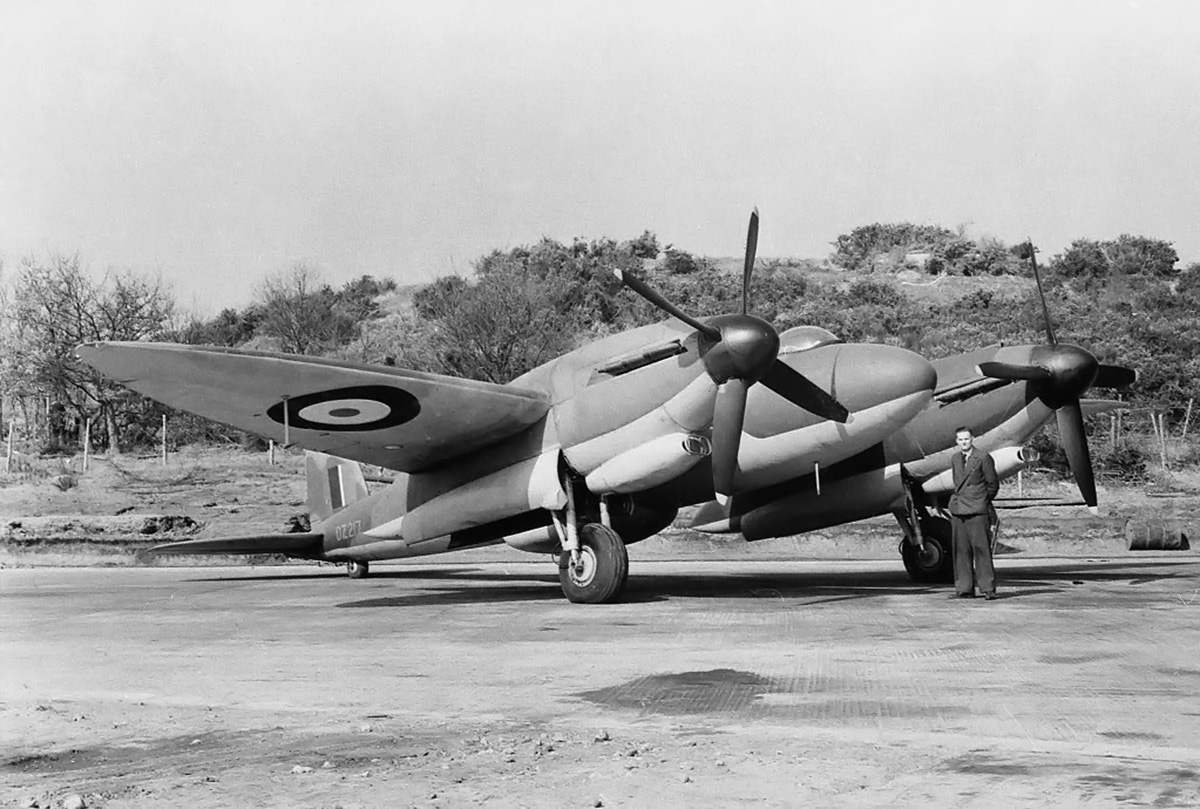
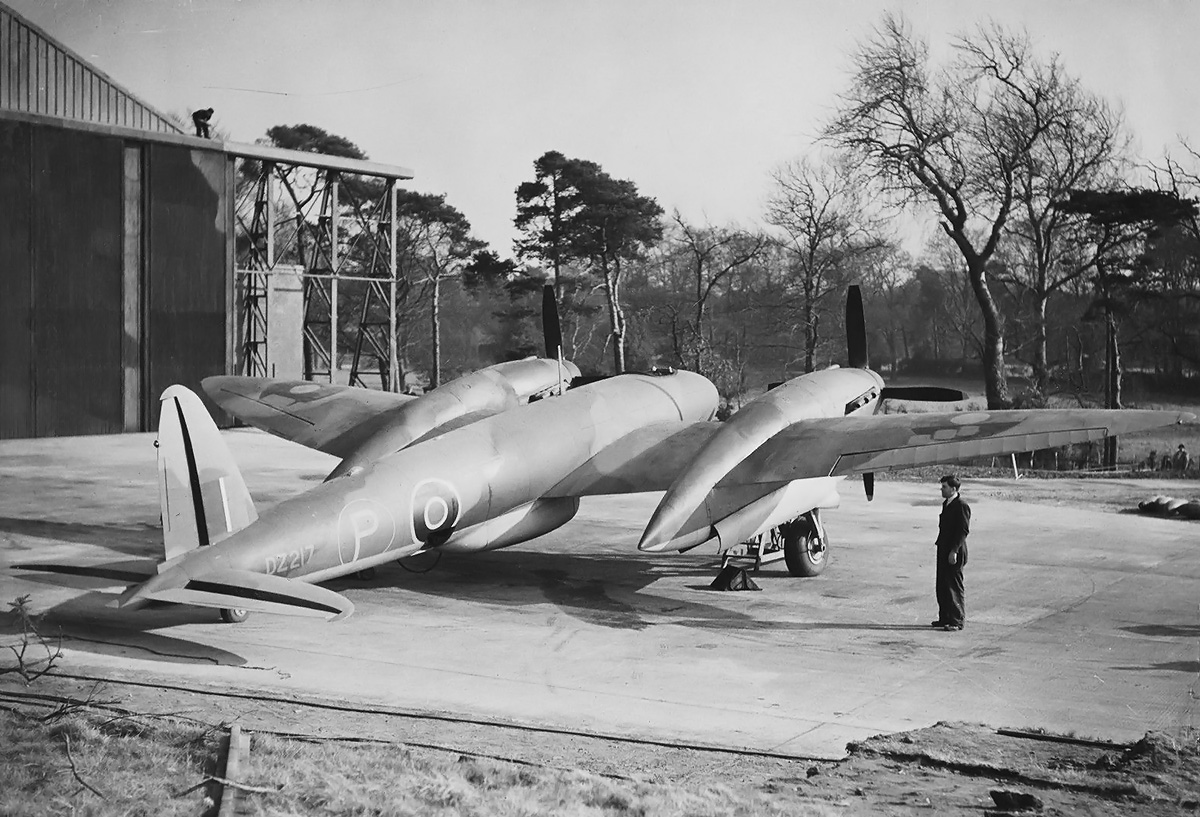
Vickers Type 432 front right

The Vickers Type 432 prototype DZ217 appears shortly after its completion at Foxwarren. The bystander gives some indication to the aircraft’s size. Note the bubble canopy.

Two Type 414 prototypes were ordered on 30 August 1939, and they were assigned serial numbers R2436 and R2437. After inspection of the Type 414 mockup in early February, the Air Ministry inquired about the possibility of installing several 20-mm cannons in place of the single 40-mm cannon. Vickers responded with aircraft proposals incorporating eight 20-mm cannons or two 40-mm cannons.

Vickers designated the fighter with 20-mm cannons as the Type 420. Two cannons were positioned in the aircraft’s nose, and three were on each side of the cockpit. Vickers and the Air Ministry discussed the Type 420 in June 1940, and Specification F.16/40 was issued for the aircraft’s development. The Type 420 was given a high priority, and an order for two prototypes was expected. The order for two Type 414 prototypes was still in place. However, the Type 420 took precedence, and work on the Type 414 slowed substantially.

In early January 1941, the Air Ministry requested a design change to reduce the number of 20-mm cannons to six. At the same time, Vickers had designed a high-altitude fighter that used many components from the Type 420. The high-altitude aircraft was armed with four 20-mm cannons and powered by two Rolls-Royce Merlin engines. The Air Ministry was interested in Vickers’ proposal, as they felt there was an urgent need for a heavily armed, high-altitude fighter aircraft to intercept high-altitude German bombers that were expected in the skies over Britain. However, high-altitude German bombing raids were never undertaken en masse and did not present a significant threat to Britain during World War II.
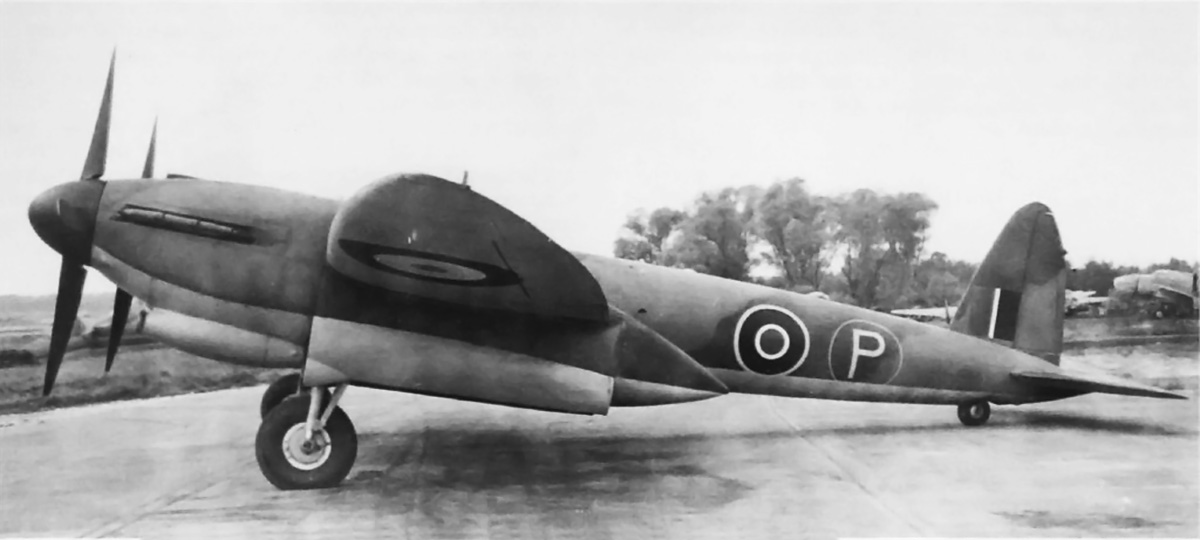
Vickers Type 432 rear right

Rear view of the Type 432 displays the aircraft’s long engine nacelles and ventral pod for the six 20-mm cannons. Note how the aircraft’s tail resembles that of a de Havilland Mosquito. The completed aircraft was disassembled at Foxwarren and taken to Farnborough for flight testing.

In March 1941, work on the Type 414 was stopped completely, and discussions with Rolls Royce commenced regarding the acquisition of Merlin engines. In May 1941, Vickers detailed the specifics of the high-altitude aircraft, which it had designated as Type 432. Specification F.22/39 was cancelled, thus halting work on the Type 420. Design work on the Type 432 continued, resulting in the switch to a single-seat cockpit placed in the nose of the aircraft and six 20-mm cannons installed in a ventral fairing. Each cannon had 120 rounds of ammunition. The Air Ministry ordered two Type 432 prototypes on 9 September 1941, and the aircraft would be built to the new Specification F.7/41. The two Type 432 prototypes were issued serial numbers DZ217 and DZ223.

The fuselage of the Vickers Type 432 was made of stressed-skin aluminum panels that were flush-riveted to the closely-spaced circular structures that made up the airframe. The forward part of each wing was made of a similar stressed-skin construction. The thick skins and their supports created a torsion box of sufficient strength so that conventional wing spars and ribs were omitted. Fabric covered the aft section of the wings and the aircraft’s control surfaces. The wings had a unique elliptical planform with a slight forward-sweep outside of the engines. The wing leading edges between the engines and fuselage housed the coolant radiators.

The aircraft was powered by two-stage, two-speed Merlin 61 engines capable of 1,580 hp (1,178 kW) at 23,500 ft (7,163 m). The engines were housed in long, streamlined nacelles mounted to each wing. The main landing gear retracted rearward into the nacelle behind the engine. The cockpit consisted of a pressure cabin topped by a small canopy that hinged to the side for entry.

The Type 432 was a rather large aircraft with a wingspan of 56 ft 10 in (17.3 m), a length of 40 ft 7 in (12.4 m), and a height of 13 ft 9 in (4.9 m). Forecasted top speeds were estimated at 320 mph (515 km/h) at sea level, 435 mph (700 km/h) at 28,000 ft (8,534 m), and 400 mph (644 km/h) at 40,000 ft (12,192 m). Cruise speed was estimated at 400 mph (644 km/h) at 29,500 mph (8,992 m). The aircraft had a 2,750 fpm (14.0 m/s) initial climb rate and a service ceiling of 43,500 ft (13,259 m). The Type 432 weighed 16,373 lb (7,427 kg) empty and had a maximum takeoff weight of 20,168 lb (9,148 kg). With 506 gallons (421 Imp gal / 1,914 L) of fuel, the aircraft had a 1,500 mi (2,414 km) range.
Vickers Type 432 left side

During its initial taxiing tests at Farnborough, the Type 432 exhibited tracking issues and snaked from side-to-side. The landing gear was moved aft 3 in (76 mm) to improve handling. Flight tests revealed other undesirable characteristics, and modifications were made to the aircraft’s ailerons and tail to improve its handling.

The Type 432 mockup was inspected in late December 1941, and the first prototype, DZ217, was built throughout 1942. The aircraft was built at Foxwarren, a special Vickers dispersal site for experimental work near Brooklands in Surrey, England. The site did not have an airfield, so the Type 432 was disassembled and transported to Royal Aircraft Establishment Farnborough for its first flight. The Type 432 was first flown on 24 December 1942, piloted by Tommy Lucke. On 29 December, the Ministry of Aircraft Production cancelled the partially-built second prototype. This decision was not made official until 1 May 1943. The entire Type 432 program was cancelled at the end of 1943.

The sole Type 432 aircraft continued to fly occasionally until November 1944. Some efforts were made throughout the aircraft’s existence to improve its handling and flight qualities, as the Type 432 was noted as having heavy controls. Only 28 flights were made, and the aircraft was never submitted for official trials or tested to its maximum performance. Additionally, the 20-mm armament and the pressurized cabin were never installed. Although the Type 432 exceeded 400 mph (644 km/h) in a slight dive, the highest speed obtained in level flight was 380 mph (612 km/h), recorded on 14 May 1943. One of the factors that limited flight testing was that the Merlin engines installed in the Type 432 did not run well above 23,000 ft (7,010 m). Since the Type 432 had no future as a production aircraft, the performance issues of its Merlins were never fully investigated.

Aircraft observers were a regular fixture during World War II, keeping an eye out for any enemy action in the skies over Britain. The rarely-seen and oddly-shaped Type 432 was only listed as “AP1480” in the recognition handbooks. This non-descript designation led the spotters to dub the Type 432 as the “Tin Mossie” on account of the aircraft’s resemblance to the wooden de Haviland Mosquito. Some source list the aircraft as being referred to as “Mayfly,” but the origin of this name has not been found.
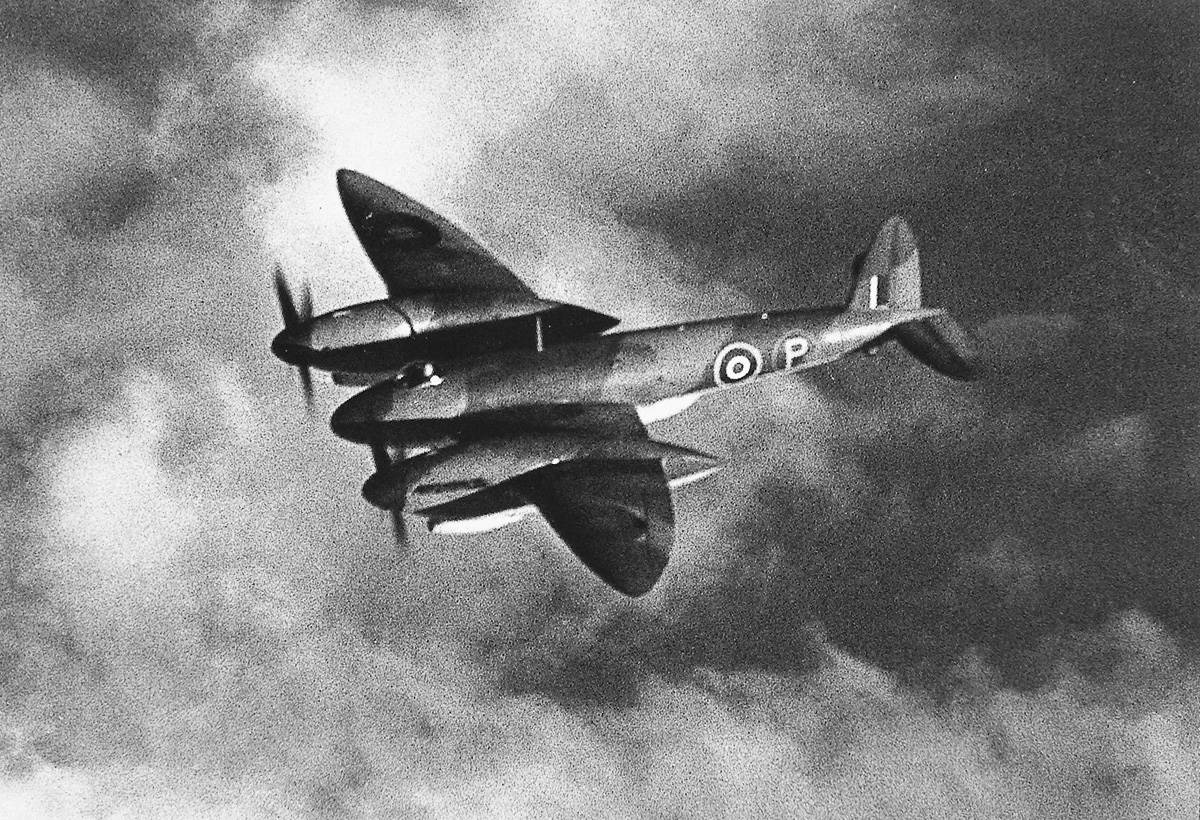
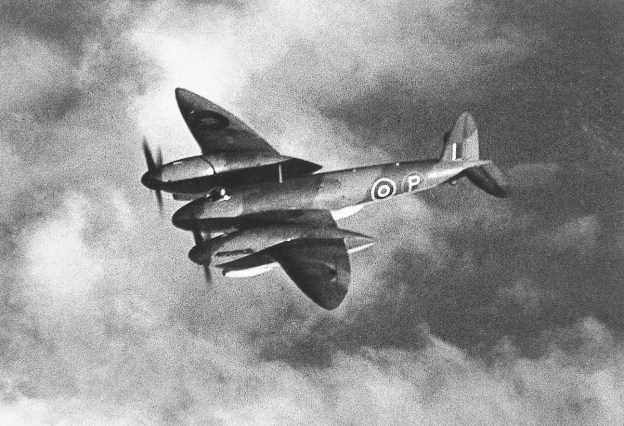
Vickers Type 432 in flight

The Type 432 made only 28 flights in its two-year life. The aircraft was noted as having some handling deficiencies that were never completely resolved, because the project was a dead end. Note the slight forward sweep of the Type 432’s outer wing panels.

Sources:
British Secret Projects: Fighters & Bombers 1935-1950 by Tony Buttler (2004)
Vickers Aircraft since 1908 by C. F. Andrews and E. B. Morgan (1988)
RAF Fighters Part 3 by William Green and Gordon Swanborough (1981)
The British Fighter since 1912 by Francis K. Mason (1992)
Aircraft of the Fighting Powers Volume VII by Owen Thetford (1946)
Sunbeam Silver Bullet debut Kaye Don

Sunbeam Silver Bullet LSR Car

By William Pearce

During the 1920s, race cars built by the Sunbeam Motor Car Company in Wolverhampton, England captured the World Land Speed Record (LSR) five times. The last record for the company was set by the Sunbeam 1,000 hp Mystery Slug, a specially-built LSR car designed by John Irving that Henry Segrave used to achieve 203.793 mph (327.973 km/h) on 29 March 1927. Segrave and Irving then parted ways with Sunbeam, and the record held by Sunbeam was broken in 1928. Segrave recovered the record on 11 March 1929, hitting 231.362 mph (372.341 km/h) in the Irving-Napier Golden Arrow. Wanting to recapture the record, Sunbeam went to work on a new LSR car to push the record up to 250 mph (402 km/h).

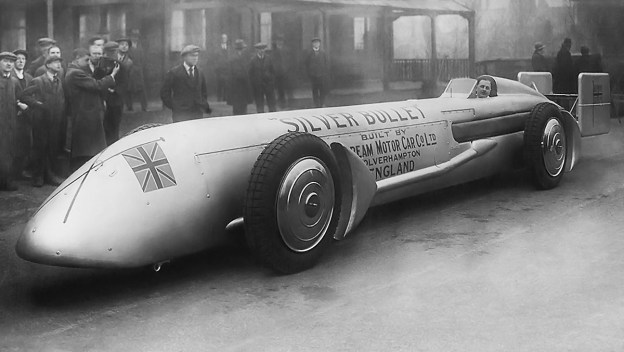
Sunbeam Silver Bullet debut Kaye Don

The Sunbeam Silver Bullet with Kaye Don in the cockpit during the car’s public debut in February 1930. Exhaust from the engines was collected in the long black manifold that ran along the side of the cockpit. The bulge along the lower side of the body covered the steering drag link.

Designed by Sunbeam’s chief engineer Louis Coatalen and chief designer Hugh Rose, the new Sunbeam LSR car was specially-built and powered by two engines. The car was named Silver Bullet, most likely a retort to Segrave and Irving’s Golden Arrow. Unlike the 1,000 hp Mystery Slug that was built using what was available at the Sunbeam factory, construction of the Silver Bullet was an entirely scratch-built affair. The car’s design was refined by model testing in the Vickers Aviation Department’s wind tunnel.

The Sunbeam Silver Bullet was composed of very stout steel frame rails that were 13.5 in (343 mm) in height at their tallest point. The frame rails were joined by various crossmembers and supports that arched from rail to rail. The body of the LSR car was made up of streamlined aluminum panels, and an underbody enclosed the bottom of the chassis. The wheels sat outside of the Silver Bullet’s body and were trailed by aerodynamic fairings. The Dunlap tires were 37 in (940 mm) tall and 6 in (152 mm) wide. Steering was achieved by separate drag links that extended from the cockpit at the rear of the car to the front wheels. A long bulge on each side of the body covered the drag link. Twin fins at the rear of the car helped stabilize the racer at high speeds. A horizontal member between the fins rotated down to act as an air brake. The car used water-cooled hydraulic brakes at all four wheels.

Sunbeam Silver Bullet no body

The incomplete Silver Bullet with engines installed. Note the routing of the induction pipe from the supercharger and around the rear (left) engine. The empty space in front of the forward (right) engine was for the ice tank. The steering drag link for the right wheel can be seen on the outside of the right frame rail.

The Silver Bullet was powered by two water-cooled V-12 engines built especially for the racer. To keep the engine and the car as narrow as possible, the engine’s bank angle was set at 50-degrees. The engine was made of aluminum and had four valves per cylinder. Two overhead camshafts actuated the valves for each cylinder bank. Each cylinder bank was composed of two three-cylinder blocks. The single spark plug per cylinder was positioned between the valves in the top of the combustion chamber. The two engines in the Silver Bullet were installed in tandem, with the front of both engines toward the rear of the racer. A secondary shaft integral with the crankcase and positioned under the crankshaft of each engine coupled the engines together and transferred their combined power to the transmission. Engine exhaust for each cylinder bank was collected in separate manifolds that extended back along both sides of the Silver Bullet and under the engine cowling. Just behind the rear engine, the exhaust manifolds on each side of the car joined into a single manifold and emerged from under the cowling. These large exhaust manifolds ran alongside the cockpit and extended back to just before the Silver Bullet’s tail.

Sunbeam Silver Bullet supercharger

Detail view of the Silver Bullet’s single supercharger. The two carburetors are on the left, with the steering box just below. Note the relatively sharp bends of the induction pipe.

The engine had a 5.51 in (140 mm) bore and a 5.12 in (130 mm) stroke. It displaced 1,465 cu in (24.01 L) and produced 490 hp at 2,400 rpm normally-aspirated, but a supercharger was incorporated into the Silver Bullet’s design. Initially, four Roots-type superchargers were to provide each engine with induction air, and this configuration was tested on one engine in November 1929. However, the final supercharging system was a single unit of the centrifugal type providing air to both engines. The supercharger was driven at up to 17,000 rpm by the rear engine and provided around 7 psi of boost. Separate induction pipes extended from the supercharger along both sides of the rear engine. The pipes connected to an induction manifold positioned in the Vee of the front and rear engines. Exactly how much power the engines produced with supercharging is not known. It is entirely possible that a true power test was never undertaken. Regardless, Coatalen had no problem claiming the engines would produce 2,000 hp (1,491 kW) each at 3,000 rpm, making the Silver Bullet a “4,000 hp car.” Both the peak engine output and rpm seem to be rather optimistic figures. Two carburetors fed fuel into the air as it was drawn into the supercharger.

The secondary shaft from the engines to the transmission spun at over twice engine rpm. The higher speed decreased torque and allowed the use of a smaller diameter shaft. At 2,600 rpm engine speed, the three-speed transmission had theoretical top speeds of 135 mph (217 km/h) in first gear, 180 mph (290 km/h) in second gear, and 266 mph (428 km/h) in third gear. While Sunbeam wanted to break the record of 231 mph (372 km/h) and planned to reach 250 mph (402 km/h), it was hoped that the car would ultimately hit 265 mph (426 km/h). The output of the transmission was in the form of two drive shafts that extended back on either side of the cockpit to the rear axle. The two-drive-shaft arrangement lowered the driver’s seat and the overall height of the Silver Bullet.

Sunbeam Silver Bullet test

The Silver Bullet chassis with both engines installed undergoing a test run. By all accounts, there was no time for any serious testing of the engines or the car before it was shipped to the United States. The reinforced structure on the right sits just before the cockpit.

An 11.5 cu ft (.33 m3) ice tank that held 616 lb (279 kg) of ice was installed in the nose of the Silver Bullet. Water from the engines was cooled by the ice and then returned to the engines. The 30-gallon (25-imp gal / 114 L) fuel tank was positioned in the streamlined fairing behind the cockpit. The cockpit was sized specifically for Kaye Don (Kaye Ernest Donsky), who raced for Sunbeam and had shown exceptional talent on the Brooklands race track, setting numerous records. The steering wheel was detachable for cockpit entry and exit. A fireproof bulkhead was positioned between the engines and the cockpit.

The Silver Bullet was 31 ft 1 in (9.47 m) long and 6 ft (1.83 m) across at its widest point. However, the body was under 3 ft (.91 m) wide. The car had a 4 ft 11 in (1.50 m) track, a 15 ft 5 in (4.70 m) wheel base, and 7.75 in (197 mm) of ground clearance. The top of the cowling over the engines was 44 in (1.12 m) tall, and the highest point of the car, just behind the cockpit, was around 53 in (1.35 m) above the ground. The Silver Bullet weighed around 6,000 lb (2,722 kg) dry and around 7,500 lb (3,402 kg) record-ready.

Sunbeam Silver Bullet rear air brake

Rear view of the Silver Bullet illustrates the air brake in the deployed position. It is interesting to consider how much drag the horizontal member created when it was in its normal position.

The engines were installed by 1 February 1930, and the Silver Bullet made its public debut on 21 February. Very little testing was done before the car left for Daytona Beach, Florida on 26 February. The Silver Bullet and crew arrived in Daytona on 8 March and immediately began work on the car. The Silver Bullet was started on 13 March and was ready for a run the next day. However, the timing equipment was not ready, and no run was made. The first test run was made on 15 March, and the Silver Bullet recorded an unofficial speed of around 150 mph (240 km/h).

An attempt was made on 17 March, but serious trouble was encountered when the air/fuel mixture self-ignited due to excessive heat in the long induction manifolds. This phenomenon created a backfire that routinely damaged the supercharger housing and its impeller. Part of the issue was that the induction pipes from the supercharger ran in close proximity to the exhaust manifolds, including a point where the intake crossed under the exhaust from the front engine. This created a localized area of high temperature in the induction system.

Sunbeam Silver Bullet rear

On first glance, the Silver Bullet gives the impression of a sleek and powerful vehicle that is ready to set speed records. On closer inspection, one begins to wonder just how much drag was created by the complex drag link covers, elaborate exhaust ducting, irregular body panels, and exposed fasteners. At the time, the science of aerodynamics was in its infancy.

The single supercharger arrangement and its complex piping left no way to cure the issue without significant modifications. Regardless, the Silver Bullet team tried to fix what they could and strove for a decent run up and down the beach. Modifications were made to vent exhaust from the front engine out the cowling rather than collecting it in the manifolds, but induction issues persisted. To make matters worse, the course was rough, and Don had to fight the car the whole way. Don tried again on 18 March, recording an official and disappointing two-way average speed of 171.019 mph (275.229 km/h). However, the Silver Bullet did manage to set a new American record for the flying 5 miles (8 km), averaging 151.623 mph (244.014 km/h).

Bad weather, poor course conditions, underperforming engines, and other teething issues on the untested LSR car all combined to delay further record attempts. During this time, various modifications were applied to the Silver Bullet. Another attempt was finally made on 31 March. The speed recorded for one direction was 186.046 mph (299.412 km/h), but issues caused further runs to be aborted. More delays were encountered and modifications undertaken. The next significant run occurred on 10 April, with 175.72 mph (282.79 km/h) speed in one direction being recorded.

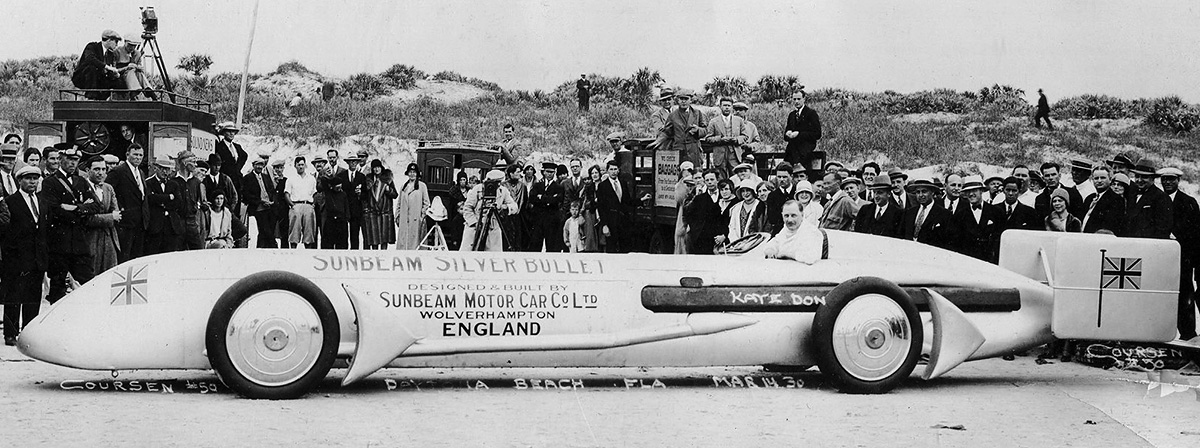
Sunbeam Silver Bullet Daytona 14-03-1930

Don sits in the Silver Bullet on Daytona Beach. The image was taken on 14 March 1930, before any real issues with the car had been encountered. Note the slight exhaust staining just before the tail fin. It is doubtful that the wheel fairings improved aerodynamics much, given their distance from the tires.

After over 18 record attempts, the Silver Bullet’s issues proved to be too much to overcome, and the timing crews could not stay on the beach indefinitely. Coatalen ordered a return to England on 13 April. Sunbeam was struggling financially, and little further effort or expense was expended on the Silver Bullet.

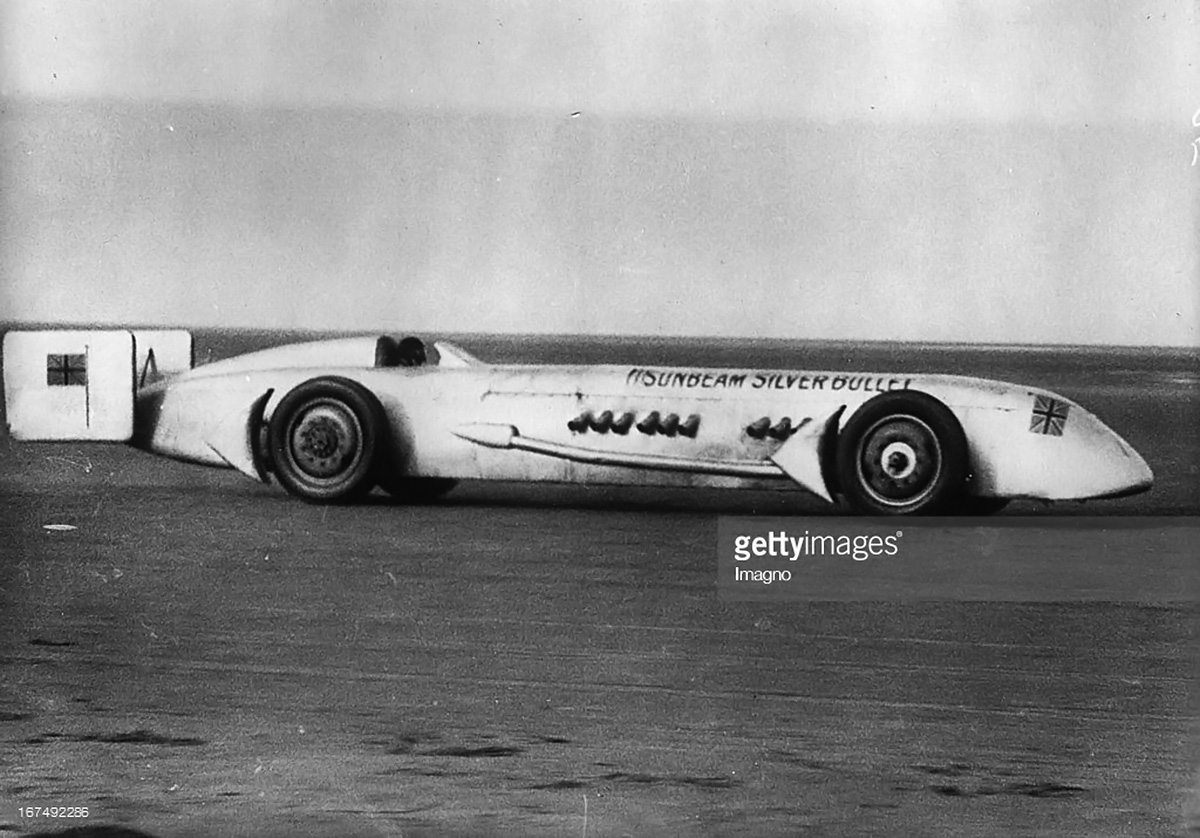
The Silver Bullet was sold to Jack Field, a hotel and garage owner and gentleman racer. Field modified the car to resolve its issues and improve its reliability. All of the modifications are not known, but the exhaust manifolds running along the car’s sides were completely discarded in favor of 12 individual exhaust stacks that protruded from the cowling. Incidentally, the eight Roots-type superchargers originally planned for the car were included with the spare parts sold to Field. On 21 March 1934, Field made an attempt to capture the British absolute speed record (top speed achieved on British Empire soil), which then stood at 218.54 mph / 351.71 km/h (set by Malcolm Campbell at Verneuk Pan, South Africa on 21 April 1929). Field averaged 174.09 mph (280.17 km/h) in one direction on Southport beach, but the Silver Bullet caught fire, and further attempts were abandoned. Field sold the damaged car to famed motorcycle racer Freddie Dixon. Reportedly, the sale price was only £10, and adult beverages were involved. Dixon later determined that the car possessed little that he could use, and the Silver Bullet was scrapped.

Sunbeam Silver Bullet Jack Field Getty

Jack Field campaigning the Silver Bullet on Southport beach in 1934. Note the individual exhaust stacks protruding from the engine cowling. Field did not have any better luck than Don, and the Silver Bullet soon caught fire. (Getty image)

This article is part of an ongoing series detailing Absolute Land Speed Record Cars.

Sources:
The Land Speed Record 1930-1939 by R. M. Clarke (2000)
The Land Speed Record 1920-1929 by R. M. Clarke (2000)
Land Speed Record by Cyril Posthumus and David Tremayne (1971/1985)
Sunbeam Aero-Engines by Alec Brew (1998)
https://www.motorsportmagazine.com/archive/article/april-1976/46/inside-story-sunbeam-silver-bullet
https://www.motorsportmagazine.com/archive/article/february-1990/45/racing-cars-jack-field
http://www.historywebsite.co.uk/Museum/Transport/Cars/Sunbeam/Bullet.htm