Monthly Archives: June 2015

Roscoe Turner Howard Bendix 1933

Air Racing Was Like This – by Roscoe Turner

Roscoe Turner

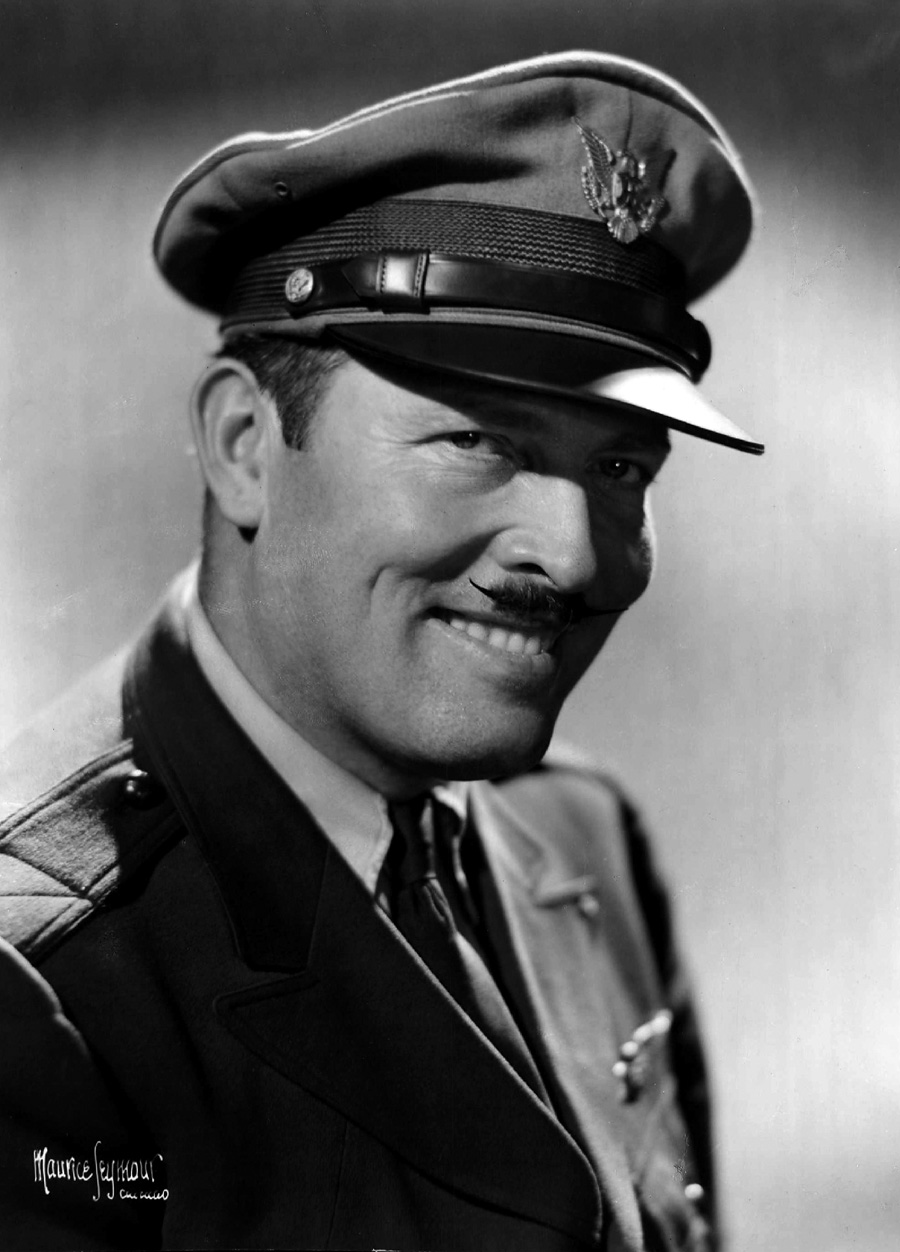
Roscoe Turner, ever the showman, with his impeccable custom uniform and well trimmed mustache. Turner once admitted that he did not like wearing his uniform but used it to stand out and get publicity wherever he went.

Roscoe Turner (29 September 1896 – 23 June 1970) was the preeminent aerial showman of the 1930s, and perhaps of all time. From 1929 to 1930, Turner set numerous cross-country speed records and won many air races. He was awarded the Harmon Trophy in 1933 and 1939 and the Henderson Trophy in 1933, 1938, and 1939. He won the Bendix Trophy in 1933 and the Thompson Trophy in 1934, 1938, and 1939. Turner also placed second in the MacRobertson International Air Race from London to Melbourne. To raise publicity while he was flying for the Gilmore Oil Company in the early 1930s, Turner adopted a lion cub and flew with him until he became too large. A lion’s head was the logo for the Gilmore Oil Company, and Turner named the cub Gilmore. Turner retired from air racing in 1939, but continued to be involved in aviation until his death, which, unlike for so many early aviators, was from natural causes.

The following was originally from the August 1956 edition of Pegasus, the Fairchild Engine and Airplane Corporation’s magazine.

Ten… Nine… Eight… Seven seconds, the clock on the dash panel says, ticking them off. And you sit there in the cramped cockpit and sweat. Waiting for the starter to drop the flag.

The tiny racing plane trembles. The propeller clatters. The skin throbs.

You’re in No. 2 position, next to the orange job with the taper wing, second from the end of the line. There are nine others, wing-tip to wing-tip, all rarin’ to go. Stinging, snorting little hornets.

And you’ve got to fly each one of them besides your own. Because you never know what the other guy is going to do.
Roscoe Turner Lockheed Vega 1929

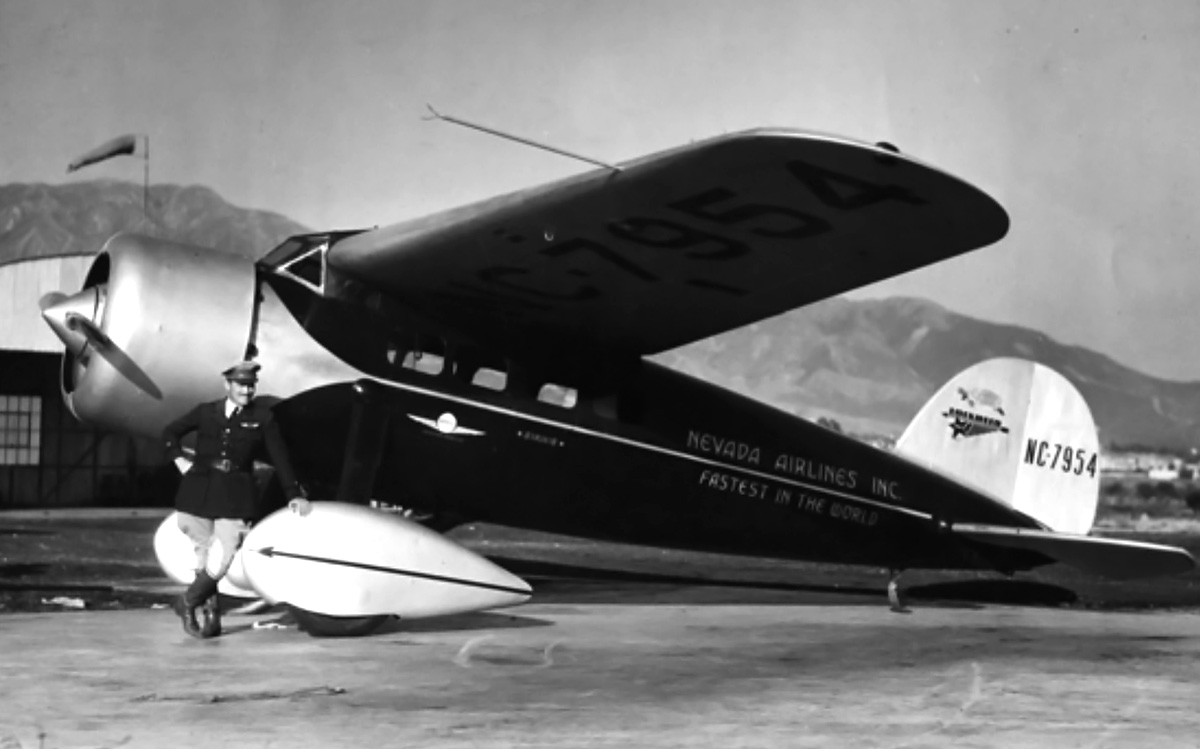
Turner stands in front of the Nevada Airlines Lockheed Vega (NC7954) in which he set various cross-country speed records and flew in the 1929 Thompson Trophy Race.

This is the Thompson Trophy Race. The big one. The National Air Races. The one that really counts. Aviation’s “Kentucky Derby.” You’ve got to win. Everything you own is wrapped up in this trim and powerful little racer. Everything. Even your spare watch is in hock.

For 365 days, since the race last year, you’ve been getting the ship ready. Wings clipped to cut through the air faster. Engine souped up to get more power. One thousand two hundred horsepower in your lap and a feather in your tail. That’s what it amounts to. Enough to make any aeronautical engineer beat himself to death with his slide rule.

For what? For fame and glory and headlines and the prize money. So you can pay off your debts and come back next year.
Roscoe Turner Gilmore 1930

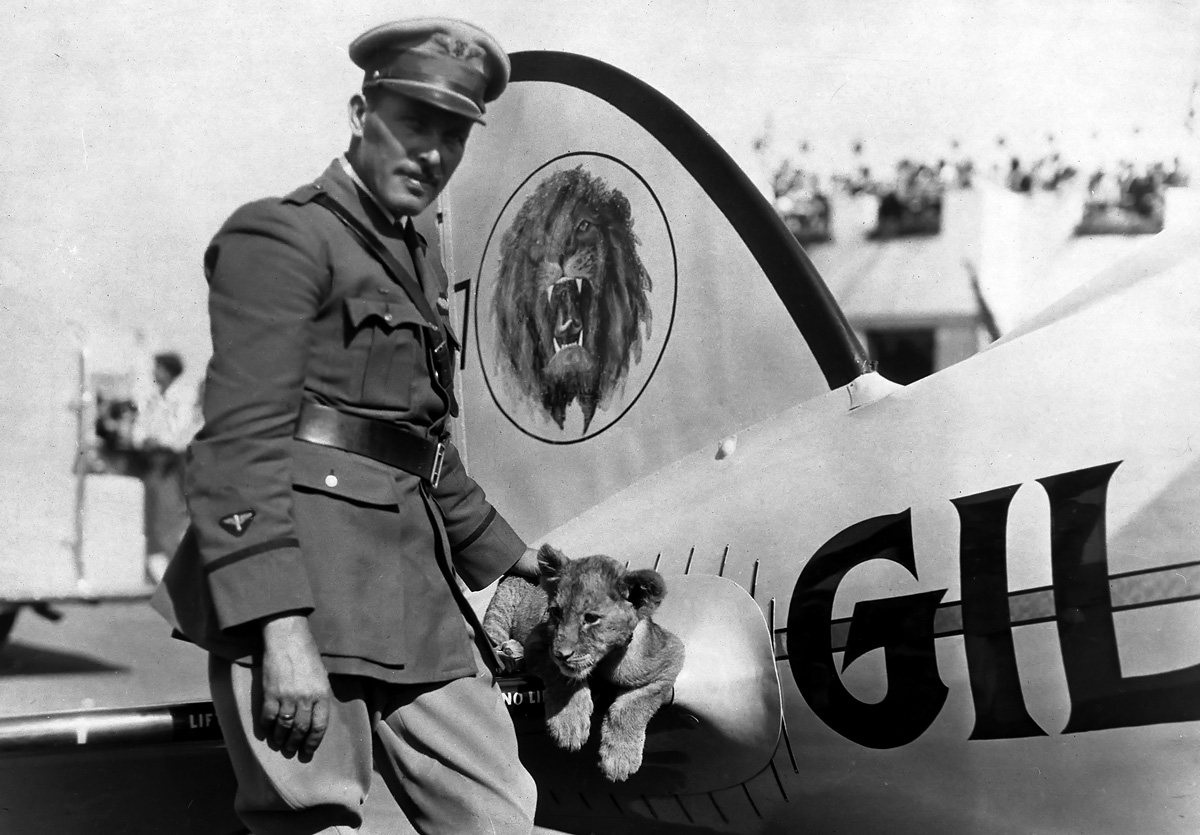
Turner poses with Gilmore the lion cub on the tail of the Gilmore Oil Company sponsored Lockheed Air Express in 1930. Turner made a custom parachute for the lion cub, and the pair flew together until the lion had grown too big (150 lb / 68 kg). Turner funded Gilmore’s care until the lion died in 1952. Gilmore was then stuffed and kept by Turner until he passed away in 1970. Gilmore is preserved and in storage at the National Air and Space Museum.

Check your instruments, fuel gauge. Pressure gauge. Oil temperature. Tachometer. Cylinder head temperatures. Glance at the chronometer. The clock has stopped. No, it’s still running.

Six… Five… Four… Why is a second a year? Tick, tick, tick, it sounds like the bong of Big Ben in your ears. Tension, nerves, fear. It drowns out the roar of the crowd.

The grandstand; a kaleidoscope of colors. It’ll be a blurred ribbon the next time you see it flash by.

See that black and yellow job down the line? Keep your eyes on him. He’s the guy to beat. Get out in front of him and try to stay there. No. 8, that’s him. Number Eight… Number Eight… Beat him… Beat him… The engine sings it. A battle cry. Remember what your mechanic said – “They’re ganging up on you. Look out! They’re going to try and box you in.” Just like they do at a horse race.
Roscoe Turner Gilmore Lockheed W-W 44 1932

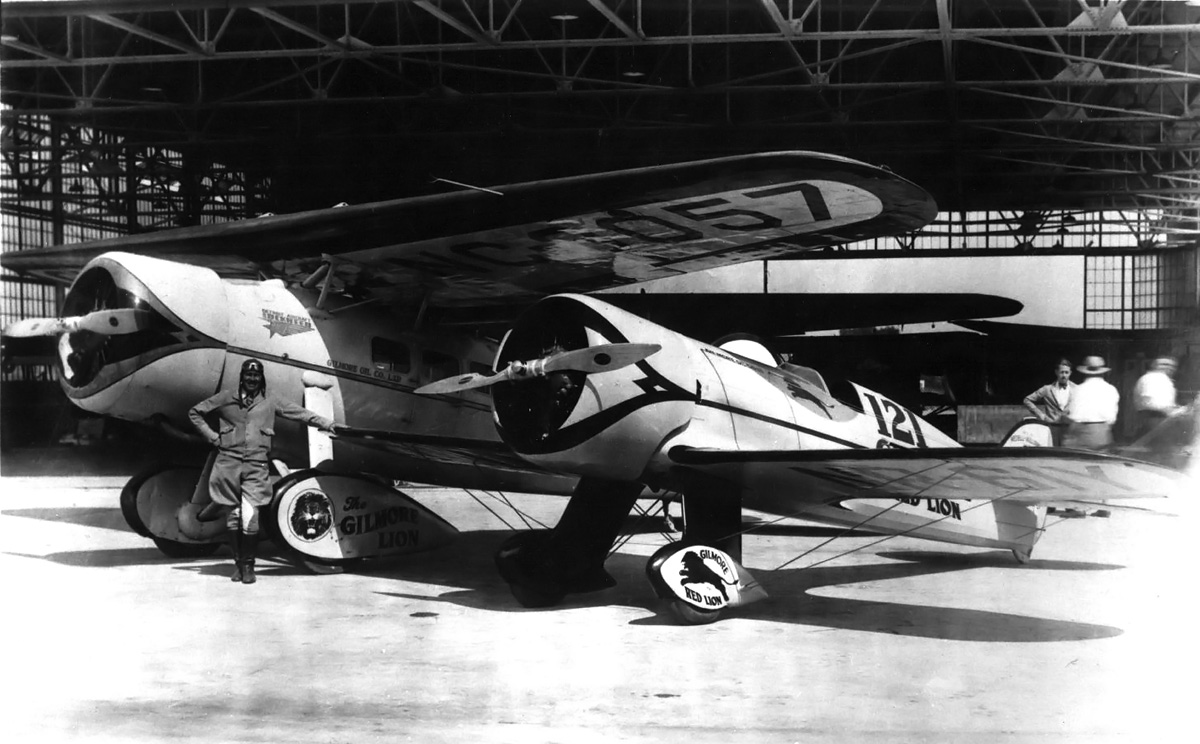
Turner poses with his Gilmore Oil Company sponsored Lockheed Air Express (NR3057) and Wedell-Williams Model 44 (NR61Y) racer in 1932. At the time, the Model 44 had its original 535 hp (399 kW) Pratt & Whitney R-985 Wasp Jr engine. A replica of the racer is at the Wedell-Williams Aviation and Cypress Sawmill Museum in Patterson, Louisiana.

Three… Two… One second now to go!

Why won’t your feet be still? They’re jumping up and down on the rudder pedals. Dammit! You can’t stop them. And your hands? Sticky, trembling on the stick and throttle. Shaking like you’ve got the DTs. Goggles streaming with perspiration. Your clothes are soaked. They’re soggy. Itchy. Hell fever, that’s what you’ve got. Scared-to-hell fever. You always catch it right about now with one second to go. It’ll go away. As soon as… There’s the flag.

Slap the throttle. Werrummm! The ship leaps forward. Your feet stop jumping. Hands? Cold and steady. Now, crouched in the cockpit, this is your world. Nothing else matters. It’s up to you.

Faster, faster, faster, shooting across the field. Pull back on the stick. Not too fast. Easy does it. You’re free. The ship leaps forward again, like a shot from a gun. No more ground drag. Too much speed. You’ll rip the wings off if you don’t slow down the propeller.
Roscoe Turner Wedell-Williams 44 1933

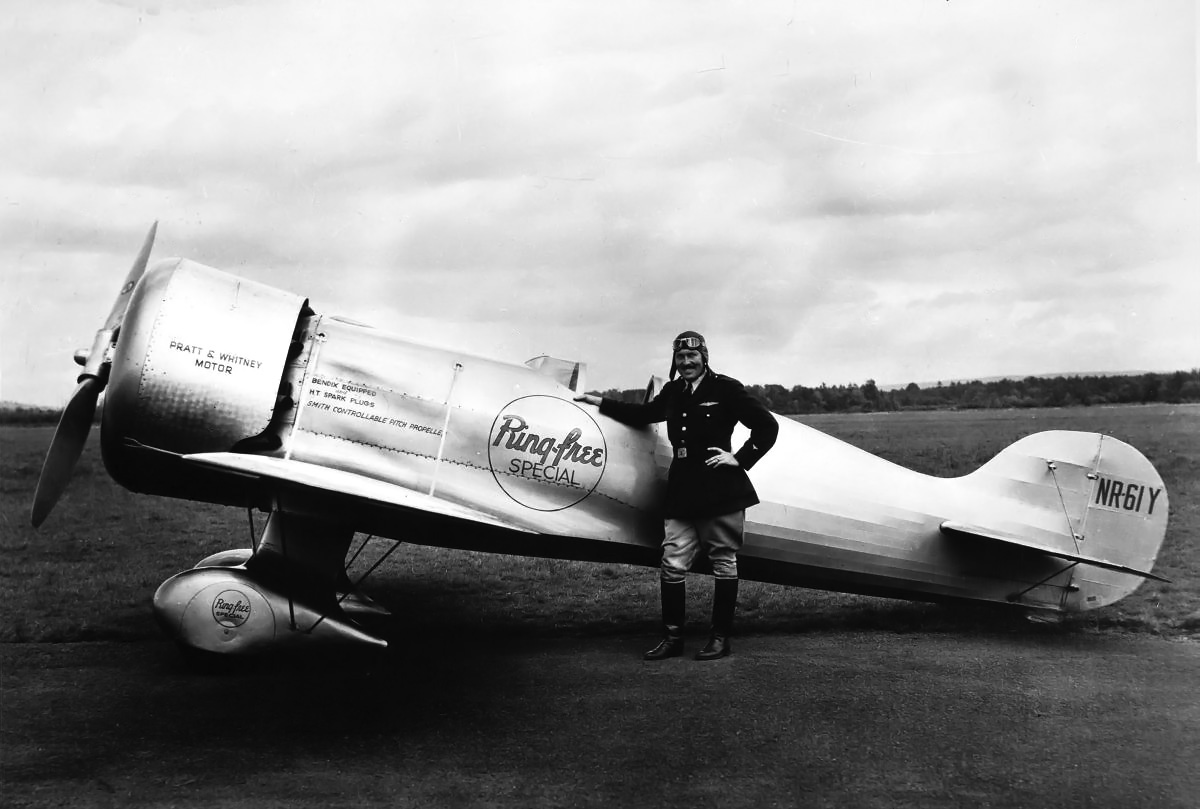
Turner with his Wedell-Williams Model 44 in late 1933. An 800 hp (597 kW) Pratt & Whitney R-1340 Wasp Sr engine has now been installed in the racer.

Where are the others? Count ’em… one… two… three… they’re all up. Don’t get too close. One error and it’s curtains for both of you.

You’re no longer human. You’re a machine. Every move is timed to the split second… There’s the red roof. Pylon coming up. Left rudder. Left stick. Moving up. Wing down. You’re around. The straightaway. More throttle. The wind whistles in your ears.

Brown roof. Big tree. Another turn. Here comes the others. Who’s that on the left wing? He’s cutting in too close. You’ll get his prop wash on the next turn… Here it comes, boy… Hang on!

Too sharp. Take ’em wider next turn. Don’t try to cut so short. Let the other guy kill himself. You’re doing all right. There’s the grandstand again. Swoosh!

Pull off a strip of tape from the dashboard. That’s how you count the laps. Thirty laps. Thirty pieces of tape. Twenty-nine now… Check it the next time you go by the crowd. The guy will have the big numeral card out. It should read 28.
Roscoe Turner Boeing 247 1934

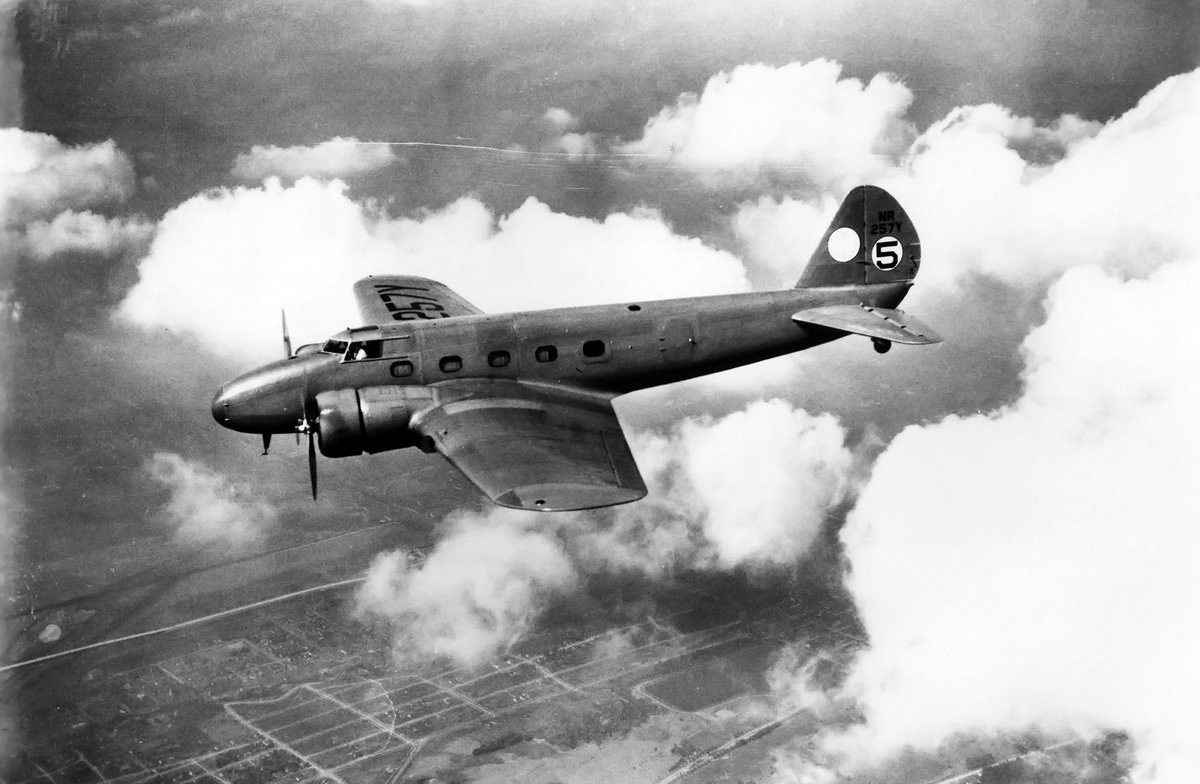
In 1934, this Boeing 247 (NR257Y) was flown by Turner, Clyde Pangborn, and Reeder Nichols to a second place finish in the Transport category of the MacRobertson Race, covering some 11,300 miles (18,200 km). The aircraft was borrowed from United Airlines and fitted with extra fuel tanks in the fuselage. After the race, it was returned to service by United. This aircraft is currently preserved in the National Air and Space Museum in Washington, DC.

Where is No. 8? You can’t see him. Red roof again… turn… straightaway… throttle… brown roof… big tree… pylon… The grandstand. Okay, it says 28.

There he is! Just ahead. You’re gaining on him. Faster, faster… Pour it on. Pray this thing will hold together… Red roof coming up… Try to cut it real short this time… Take the chance… Maybe you can get him on the turn… NOW… Wing down deep… Snap back… jerk… Shake, tremble, roar! But you made it. There’s nobody in front of you.

Instruments?… Oil pressure… Supercharger… Gas… Speed… Okay… If they only stay like that. Remember what happened last year- when the supercharger blew. It was only doing 2000 rpm then… Now it’s doing 3000. You improved it. But that much?

Pylon. Grandstand. Tape. Round and round going nowhere. Brown roof. Red roof. Big tree. Straightaway. Pylon. Zoom, zoom, zoom. Wing up. Wing down. Level off. More pylons. More trees, more roofs. It’s hot. Like an oven. Is something on fire? Glance around? No, don’t, you mustn’t. At this speed you can’t take your eyes off what’s coming up ahead… Grandstand… Tape… There’s one piece left. One more lap.

You’re still out in front. If you could only look back and catch that number card for a recheck. It was so blurred. Maybe you missed a pylon. Maybe they’ll disqualify you. No, not that, please. And let’er hang together another two minutes.
Roscoe Turner Howard Bendix 1933

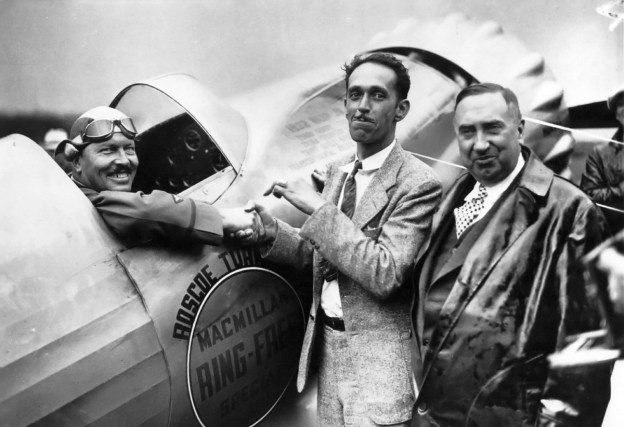
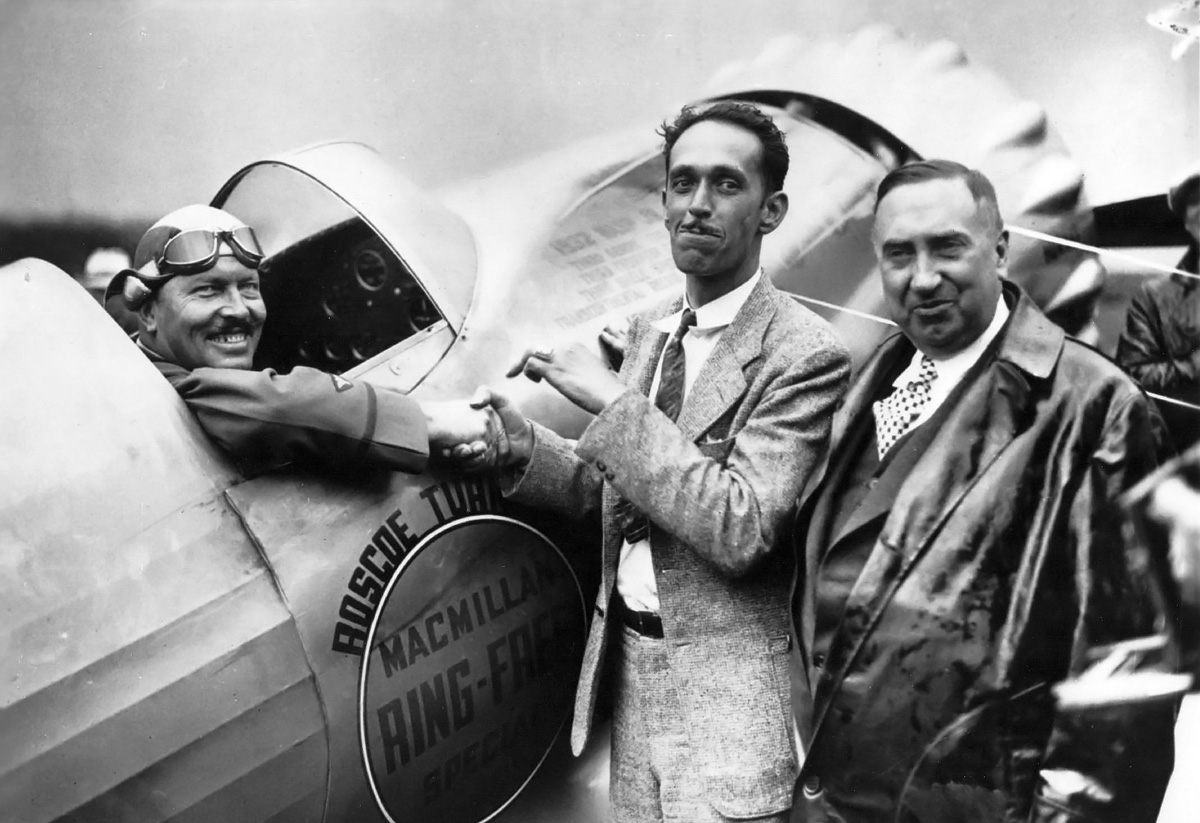
Turner and Benny Howard shake hands as Vincent Bendix looks on after the 1935 Bendix Trophy Race. Turner finished 23 seconds behind Howard in the cross-country race. Turner’s Wedell-Williams Model 44 racer now had its final power plant, a 1,000 hp (746 kW) Pratt & Whitney R-1690 Hornet engine housed in a close-fitting cowling.

It’s over.

You won!

You’re shaking again. You can hardly control the ship after she’s on the ground. Your heart beats louder than the engine. Uniform soaked, sopping wet. Hands tremble. Knees buckle as you climb out to meet the reporters and photographers with a big, forced smile… Headache. Muscle ache. Exhaustion. Oh, for a great big soft bed.

Air racing is like that. It’s the toughest test of all on men and machines. I know. For ten years I was pushing pylons in the Thompson. For ten years I was smashing records across the country in the big Bendix Transcontinental. Three times winner of the Thompson, many times loser. But it gets in your blood, and it stays.

It’s the most dangerous profession in the world.
Roscoe Turner Turner-Laird 1938

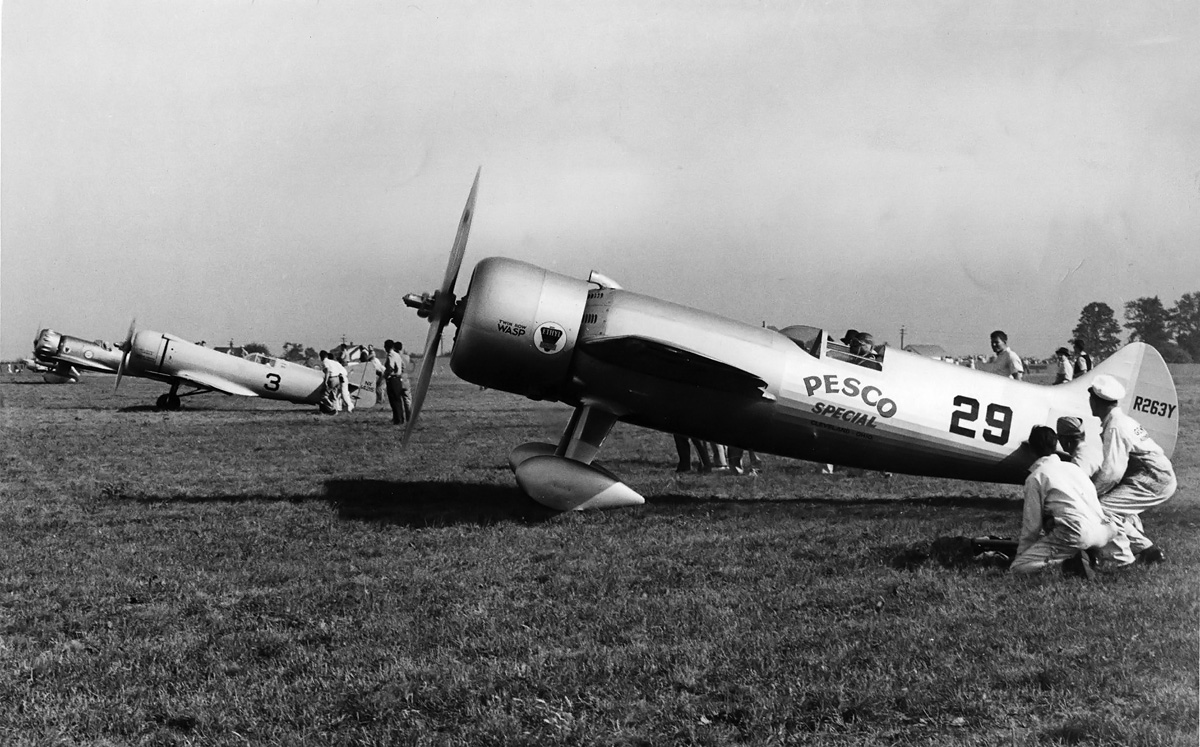
Turner applies power to the 1,000 hp (746 kW) Pratt & Whitney R-1830 Twin Wasp engine in his Turner-Laird RT-14 Meteor racer (Race 29, NR263Y) at the start of the 1938 Thompson Trophy Race in Cleveland, Ohio. Beyond the Keith Rider R-3/Marcoux-Bromberg Special (Race 3) flown by Earl Ortman is Turner’s Wedell-Williams Model 44 (Race 25) flown by Joe Mackey. All of these aircraft are preserved: the Meteor is in the Steven F. Udvar-Hazy Center of the National Air and Space Museum; the Model 44 is part of the Crawford Auto-Aviation Collection in Cleveland, Ohio; the R-3 is in the New England Air Museum in Windsor Locks, Connecticut.

More on Roscoe Turner:
Roscoe Turner: Aviation’s Master Showman by Carroll V. Glines (1995)
CAC CA-15

Commonwealth Aircraft Corporation CA-15 ‘Kangaroo’

By William Pearce

In July 1942, Australia’s Commonwealth Aircraft Corporation (CAC) endeavored to improve the performance of their CA-12 (and CA-13) Boomerang fighter by installing a 1,700 hp (1,268 kW) Wright R-2600 engine in place of the 1,200 hp (895 kW) Pratt & Whitney (P&W) R-1830. However, the needed modifications to the Boomerang airframe proved to be too substantial. Since the need for an improved fighter was still pressing, CAC embarked to design an entirely new aircraft in November 1942. This new fighter aircraft was designated CA-15.

CAC CA-15 flight

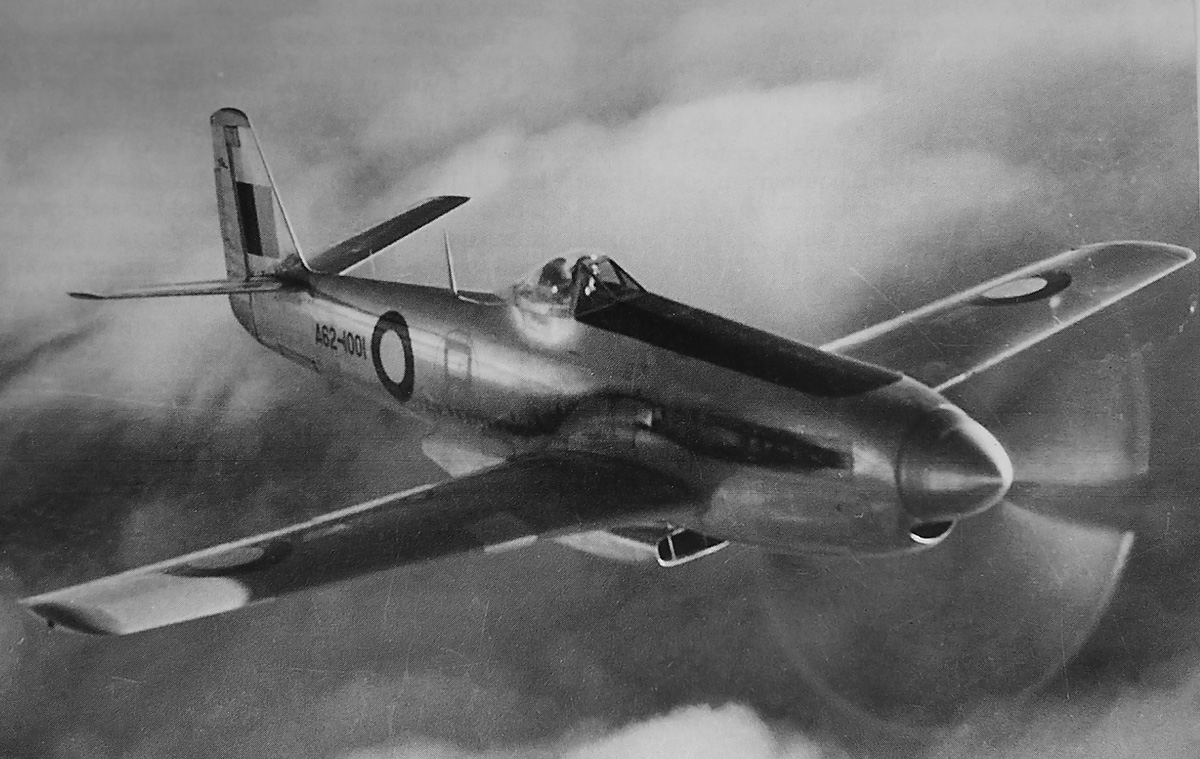
The impressive Commonwealth Aircraft Corporation CA-15 on a test flight. Note the patches on the wings that replaced the gun ports for the .50 cal machine guns.

The preliminary design of the CAC CA-15 incorporated a Pratt & Whitney R-2800 engine, and the aircraft somewhat resembled a cross between a Boomerang and a Focke-Wulf Fw 190A. As the design was developed, the CA-15 changed to resemble a Hawker Tempest II with squared-off wings and tail, but with a General Electric (GE) C turbosupercharger installed in the rear fuselage, similar to the Republic P-47 Thunderbolt.

By mid-1943, a redesign was needed because the proposed power plant, the 2,000 hp (1,491 kW) R-2800-21, was not available. CAC selected the 2,200 hp (1,641 kW) R-2800-10W with a two-stage, two-speed supercharger as the new engine. With the engine change, the turbosupercharger was deleted, and a water-cooled intercooler was added in a large fairing under the engine. A geared cooling fan would help draw air in through the tight-fitting cowling. By December 1943, the R-2800-10W-powered CA-15 was estimated to have a maximum speed of 365 mph (587 km/h) at sea level, 436 mph (702 km/h) at 25,000 ft (7,620 m), and an initial climb rate of 4,200 fpm (21.3 m/s).

CAC CA-15 R-2800-21

The Pratt & Whitney R-2800-21-powered CA-15, with cutaway to show the fuselage fuel tank. The turbosupercharger installation in the rear fuselage is not visible. In this early 1943 drawing, the CA-15 has a passing resemblance to the Hawker Tempest II.

The switch to the R-2800-10W engine also shifted the CA-15’s area of maximum performance from high altitude to low/medium altitude. At the time, CAC had obtained a license to produce the North American P-51D Mustang as the CA-17 and CA-18; CA-17s would be assembled from parts, and CA-18s would be CAC-produced aircraft. Lawrence Wackett, CAC’s General Manager, envisioned the CA-17/CA-18 filling the high altitude fighter role and the CA-15 covering low and mid altitudes. From mid-1943, CAC was focused on CA-17 assembly and CA-18 production, and progress on the CA-15 slowed as a result.

With many components for the prototype CA-15 under construction, CAC was disappointed to learn in May 1944 that the R-2800-10W was no longer in production. CAC found a suitable replacement in the form of the 2,800 hp (2,088 kW) R-2800-57. With this engine change, the CA-15 was back to incorporating a turbosupercharger—now a GE CH-5 housed in a deeper fairing under the engine. The R-2800-57-powered CA-15 was estimated to have a maximum speed of 400 mph (644 km/h) at sea level, 480 mph (772 km/h) at 28,000 ft (8,534 m), and an initial climb rate of 5,700 fpm (29.0 m/s).

CAC CA-15 R-2800-57

A mid-1944 drawing of the CA-15 powered by a R-2800-57 engine. While the top view of the aircraft has not changed much, the bulky fairing under the engine has been added to house the intercooler and turbosupercharger.

By August 1944, the CA-15 prototype was around 50 percent complete. It was at this time that CAC was informed that supplies of the R-2800-57 could not be guaranteed. CAC again looked for an engine suitable for the CA-15 fighter. CAC found a new engine in the Griffon 125, then being developed by Rolls-Royce (R-R). The water-cooled Griffon 125 had a two-stage, three-speed supercharger and turned a single rotation propeller. The engine was capable of producing 2,440 hp (1,820 kW). A redesign of the CA-15 cowling was completed, and a scoop to house radiators for the engine coolant and oil was incorporated under the aircraft. With these changes, the CA-15 resembled a P-51D Mustang, but the resemblance was coincidental. The Griffon 125-powered CA-15 was estimated to have a maximum speed of 405 mph (652 km/h) at sea level, 467 mph (752 km/h) at 18,000 ft (5,487 m), and 495 mph (797 km/h) at 26,500 ft (8,077 m). The initial climb rate dropped slightly to 5,500 fpm (27.9 m/s).

Unfortunately, the Australian War Cabinet cancelled the CA-15 in September 1944. However, CAC continued work on the CA-15 at a reduced pace while it worked with the War Cabinet to reinstate the program. This was done in December, pending the approval of the Aircraft Advisory Committee, which followed in February 1945.

Work on the CA-15 now continued at a quicker pace, but engine issues surfaced again. R-R would not be able to provide a Griffon 125 until late 1945 at the earliest (but probably later). The CA-15 was ready for its engine, and CAC did not want to wait. As a substitute, two 2,035 hp (1,517 kW) Griffon 61s were loaned to CAC, the first being shipped in April 1945. The Griffon 61 had a two-stage, two-speed supercharger. As the CA-15 neared completion in December 1945, R-R informed CAC that the Griffon 125 would not be produced. The CA-15 used the Griffon 61 as its final engine, and the aircraft was completed in early 1946.

CAC CA-15

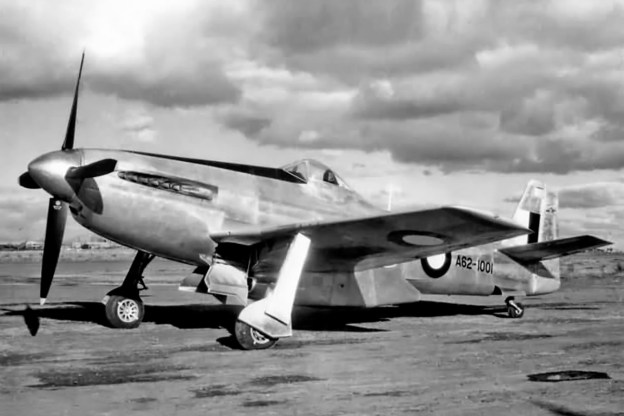
The completed CA-15 with its Griffon 61 engine bore a striking resemblance to the P-51D Mustang. However, the aircraft’s general layout changed little from the early 1943 drawing completed before CAC obtained a license for P-51 (CA-17/CA-18) production. Note the recessed engine exhaust stacks for improved aerodynamics.

The CA-15 was an all-metal aircraft of stressed-skin construction. The flaps and fully retractable gear were hydraulically operated. Various offensive armament combinations were considered, including four 20 mm cannons with 140 rpg, but six .50 cal machines guns were ultimately fitted with 250 rpg (various sources, including CAC documents, list 260, 280, or 290 rpg). The guns were not installed until a few months after the aircraft’s first flight. Underwing provisions existed for two 1,000 lb (454 kg) bombs or two 120 gal (100 imp gal / 454 L) drop tanks or 10 rockets.

In its final form, the CA-15 had a 36 ft (11 m) wingspan and was 36 ft 3 in (11 m) long. The aircraft’s internal fuel capacity was 312 gal (260 imp gal / 1,182 L), and it had a maximum range of 2,540 mi (4,088 km) with two drop tanks. The CA-15 weighed 7,540 lb (3,420 kg) empty, 10,764 lb (4,882 kg) with a normal load, and 12,340 lb (5,597 kg) at maximum overload. The Griffon 61-powered CA-15 had a maximum speed of 368 mph (592 km/h) at sea level, 448 mph (721 km/h) at 26,400 ft (8,047 m), and 432 mph (695 km/h) at 32,000 ft (9,754 m). The aircraft’s initial climb rate was 4,900 fpm (24.9 m/s), and it had a ceiling of 39,900 ft (12,162 m). The Griffon engine turned a 12 ft 6 in (3.81 m) diameter Rotol four-blade, wooden, constant-speed propeller. Initially, a 12 ft 1 in (3.68 m) propeller was used, the result of a damaged tip necessitating the blades being cut down. But a full-size propeller was fitted later during the flight test program.

CAC CA-15 side

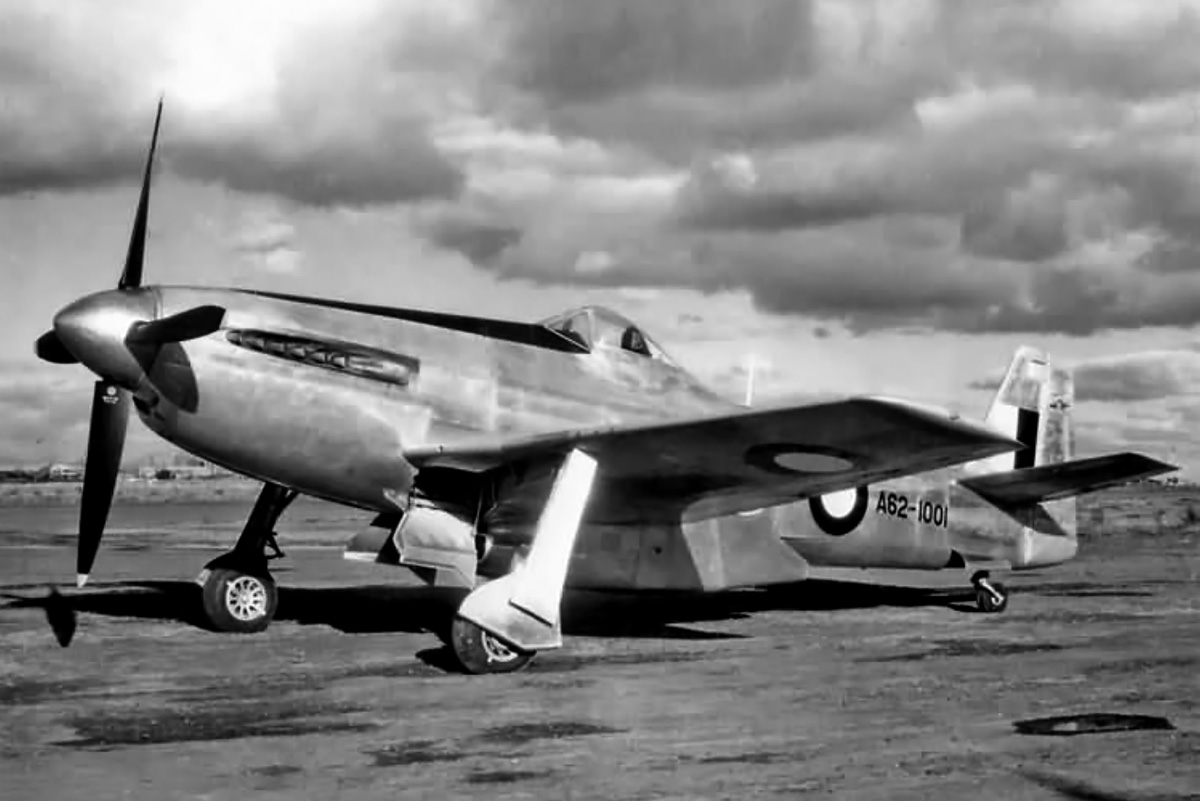
This photo of the CA-15 illustrates the tailplane’s 10 degrees of dihedral and the relatively good view the pilot had over the nose of the aircraft.

Assigned serial number A62-1001, the CA-15 began taxi tests in February 1946. After a few modifications, the aircraft first flew on 4 March 1946 with Jim Schofield at the controls. The initial test flights went well, although the ailerons were noted as being heavy. Aileron control was improved, and numerous other refinements were made. Throughout the test flights, the CA-15 proved itself as an easy to fly aircraft with excellent performance and very good visibility.

After 16.5 hours of flying time, the CA-15 was handed over to the Royal Australian Air Force (RAAF) Aircraft Performance Unit (APU) No. 1 on 2 July 1946 for further flight testing. While at APU No. 1, the landing gear struts were over-pressurized, causing the CA-15 to bounce badly during taxi tests. The hopping action of the aircraft earned it the unofficial nickname “Kangaroo,” which has lasted over the years. Unfortunately, on 10 December 1946, a test gauge failed and resulted in the loss of all hydraulics. With no flaps and the unlocked gear partially extended, Flt. Lt. Lee Archer was forced to make an emergency landing that damaged the aircraft’s scoop and destroyed the wooden propeller. The failed gauge should have been removed before the aircraft was handed over to the RAAF. At the time, the CA-15 had 43.25 flying hours, and the damage was not too severe. However, with the war over and jets coming into service, there was no possibility of the CA-15 going into production. As a result, repairs to the one-off prototype were slow, after finally being approved in April 1947.

CAC CA-15 taxi

The CA-15 after a test flight. Note the scoop’s partially open cooling air exit flap. The aircraft in the background are most likely CAC-assembled CA-17s (P-51Ds), as the first CA-18 was not completed until 1947 (after the CA-15 was damaged).

CAC had repaired the CA-15’s airframe by October 1947, and the aircraft awaited a new propeller and radiator, which were the responsibility of the RAAF. The radiator was ready by February 1948, and the propeller followed in March. The CA-15 was returned to APU No. 1 on 19 May 1948. Later that month, the CA-15 grabbed headlines by achieving 502 mph (808 km/h) in a test flight over Melbourne, Victoria, Australia on 25 May 1948. This speed was recorded after Flt. Lt. Archer had leveled off at 5,000 ft (1,524 m) following a modest dive from 9,000 ft (2,743 m).

By February 1950, R-R wanted the two Griffon 61 engines back. In addition, there was no inventory of spare parts or any practical reason to continue flight testing of the CA-15. The engine was removed, and the CA-15 was scrapped, bringing an end to the highest performance aircraft ever designed and built in Australia.

CAC CA-15 rear

The CA-15 “Kangaroo” was a powerful fighter with performance rivaling that of the best piston-powered aircraft. Sadly, it was built too late for action in World War II and at a time when jet aircraft were the undeniable future.

Sources:
Wirraway, Boomerang & CA-15 in Australian Service by Stewart Wilson (1991)
Wirraway to Hornet by Brian L Hill (1998)
– “Commonwealth CA-15: The ‘Kangaroo’ Fighter” by David Donald Wings of Fame Volume 4 (1996)
R-2800: Pratt & Whitney’s Dependable Masterpiece by Graham White (2001)