Monthly Archives: July 2019

Fisher P-75A top

Fisher (General Motors) P-75 Eagle Fighter

By William Pearce

Donovan (Don) Reese Berlin had worked as the Chief Engineer for the Curtiss-Wright Corporation. He had designed the company’s successful P-36 Hawk and P-40 Warhawk fighters. Berlin also designed a number of unsuccessful fighters. He left Curtiss-Wright in December 1941 in frustration because he felt the company was not sufficiently supporting his efforts to develop a new fighter. At the request of the US government, Berlin was quickly hired by General Motors (GM) in January 1942 as the Director of Aircraft Development at the Fisher Body Division (Fisher).

Fisher XP-75 43-46950

The Fisher P-75 Eagle was supposed to be quickly and inexpensively developed by utilizing many existing components. However, many resources were expended on the aircraft. The first XP-75 (43-46950) had a uniquely pointed rear canopy. It was also the only example that used a relatively unaltered Douglas A-24 empennage. Note the fixed tailwheel and the fairings that covered the machine gun barrels in the aircraft’s nose.

Fisher was already engaged by the government to build large assembles for the North American B-25 Mitchell bomber, and plans for the manufacture of other aircraft components were in the works. It made sense to have a prominent aeronautical engineer as part of Fisher’s staff. In March 1942, Fisher was tasked to build various components (engine cowlings, outer wing panels, ailerons, flaps, horizontal stabilizers, elevators, vertical stabilizers, rudders) of the Boeing B-29 Superfortress and 200 complete aircraft. A new plant in Cleveland, Ohio would be built to support this order. Beyond Fisher, a number of other GM divisions were involved in building aircraft and aircraft engines under license from other manufacturers. However, GM wanted to design and manufacture its own products to support the war effort. Berlin was a believer in applying automotive methods to produce aircraft, which was a good match for the automotive giant GM.

On 10 September 1942, GM, through Fisher, submitted a proposal to the Army Air Force (AAF) for a new interceptor fighter. The proposal was based on an AAF request from February 1942 for such an aircraft with exceptional performance. The aircraft from Fisher was designed by Berlin, powered by an Allison V-3420 24-cylinder engine, and constructed mainly of components from other aircraft. The aircraft offered impressive performance with a top speed of 440 mph (708 km/h) at 20,000 ft (6,096 m), a 5,600 fpm (28.5 m/s) initial climb rate, a service ceiling of 38,000 ft (11,582 m), and a range of 2,240 miles (3,605 km) with only internal fuel. All of this came with a promise to deliver the first aircraft within six months of the contract being issued.
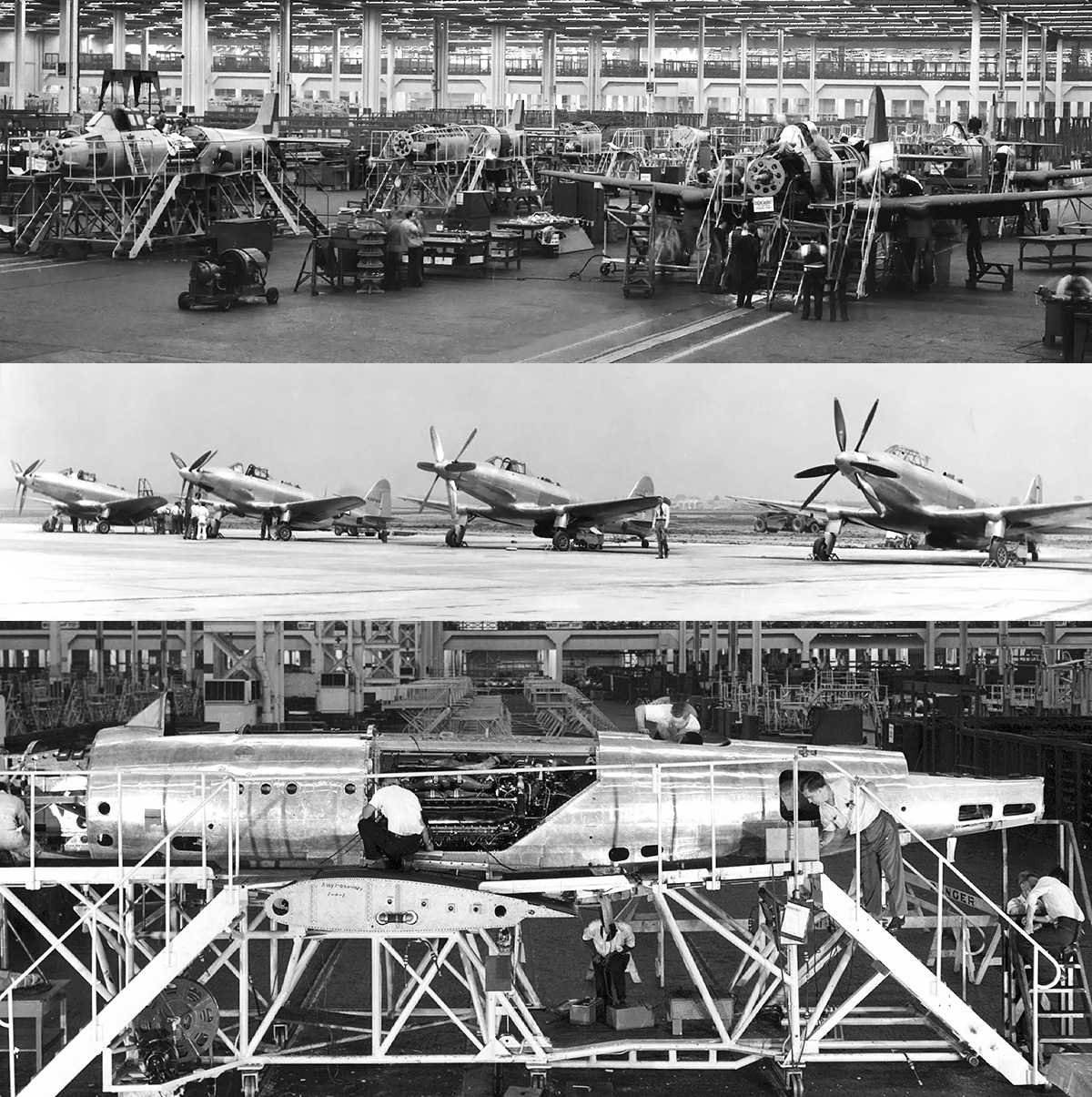
Fisher XP-75 line

The top image shows at least five XP-75A aircraft under construction. The middle image, from right to left, shows the first two XP-75 aircraft (43-46950 and 43-46951) and the first two XP-75A aircraft (44-32161 and 44-32162). The second XP-75 (second from the right) has the wide H-blade propellers installed, while the other aircraft have the narrow A-blade propellers. The bottom image is a P-75A under construction. Note the V-3420 engine. (Veselenak Photograph Collection / National Museum of the US Air Force images)

Back in February 1941, the Army Air Corps (name changed to AAF in June 1941) had considered the Allison V-3420 as a possible replacement for the Wright R-3350 engine intended for the B-29. The Allison Engineering Company was a division of GM, and at the time, development of the V-3420 was focused on creating the basic engine and not much more. However, the priority of the V-3420 program was scaled-back after the Japanese attacked Pearl Harbor on 7 December 1941.

GM had been searching for an application for its Allison V-3420 engine, and the AAF had tried to entice other manufactures to incorporate the engine in a fighter design. Fisher’s fighter project offered a solution for both entities. The AAF was sufficiently impressed with Fisher’s proposal, and they approved the construction of two prototypes (serials 43-46950 and 43-46951) on 10 October 1942. The aircraft was given the designation P-75 Eagle, with the prototypes labeled XP-75. Some believe the pursuit number “75” was issued specifically at Berlin’s request, as his “Model 75” at Curtiss-Wright became the successful P-36 and led to the P-40. Although there were some reservations with the aircraft’s design, it was believed that a team working under the experienced Berlin would resolve any issues encountered along the way.
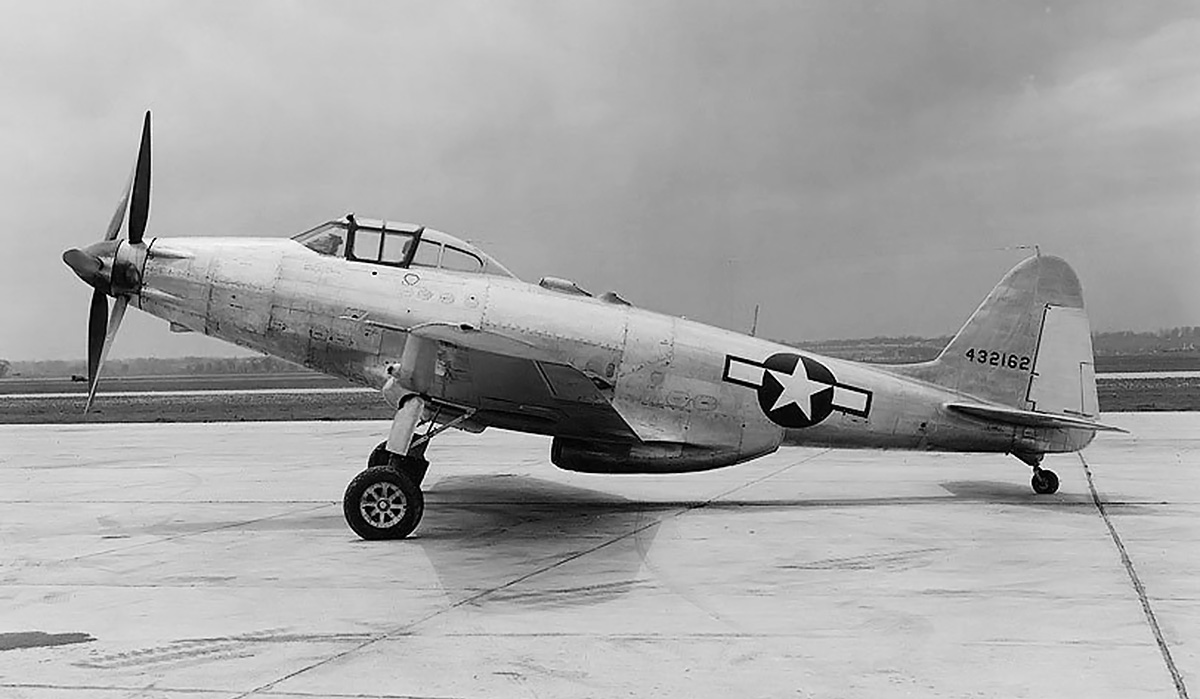
Fisher XP-75A long-range side

Aircraft 44-32162 was the fourth of the XP-75-series and the second XP-75A with additional wing fuel tanks. Note the revised canopy and tail compared to the first prototype. The aircraft has narrow A-blade propellers, and the 10-gun armament appears to be installed.

The XP-75 was of all metal construction with fabric-covered control surfaces. The cockpit was positioned near the front of the aircraft and provided the pilot with good forward and downward visibility. The pilot was protected by 177 lb (80 kg) of armor. The cockpit canopy consisted of front and side panels from a P-40. The aircraft’s empennage, with a fixed tailwheel, was from a Douglas A-24 Banshee (AAF version of the Navy SBD Dauntless). Initially, North American P-51 Mustang outer wing panels would attach to the inverted gull wing center section that was integral with the fuselage. However, the P-51 wings were soon replaced by wings from a P-40 attached to a normal center section. The main landing gear was from a Vought F4U Corsair, and it had a wide track of nearly 20 ft (6.10 m). Four .50-cal machine guns were mounted in the aircraft’s nose and supplied with 300 rpg. Each wing carried three additional .50-cal guns with 235 rpg. Under each wing, inside of the main gear, was a hardpoint for mounting up to 500 lb (227 kg) of ordinance or a 110-US gal (416-L) drop tank.

The 2,600 hp (1,939 kW) Allison V-3420-19 engine with a two-stage supercharger was positioned in the fuselage behind the pilot. Each of the engine’s four cylinder banks had an air-cooled exhaust manifold with two exhaust stacks protruding out of the fuselage. Two extension shafts passed under the cockpit and connected the engine to the remote gear reduction box for the Aeroproducts six-blade contra-rotating propeller. Two different types of propellers were used. Initially, a 13 ft (3.96 m) diameter, narrow, A-blade design was used. Many sources state that this propeller was used on the first 12 aircraft. However, some of these aircraft flew with the second design, a 12 ft 7 in (3.84 m) diameter, wide, H-blade. The gear reduction turned the propeller at .407 crankshaft speed.
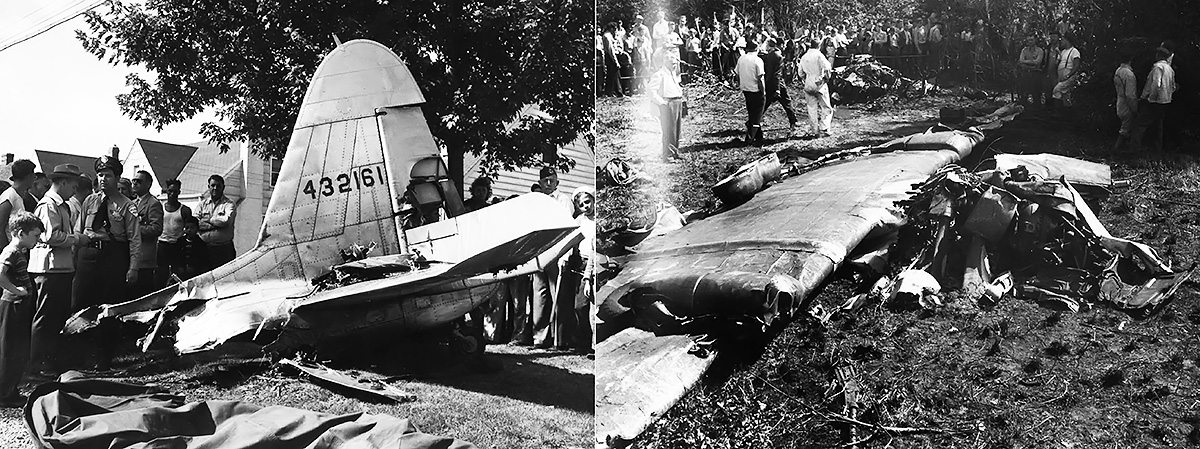
Fisher XP-75A 44-32161 crash

The empennage (left) and inverted wings and fuselage (right) of XP-75A 44-32161 after its crash on 5 August 1944. An engine explosion and inflight fire led to the empennage separating from the rest of the aircraft. Russell Weeks, the pilot, was able to bail out of the stricken aircraft. (Veselenak Photograph Collection / National Museum of the US Air Force images)

A two-section scoop was located under the fuselage, just behind the wings. The left section held an oil radiator, and coolant radiators were positioned in both the left and right sections. The aircraft’s oil capacity and coolant capacity were 28.5 US gal (108 L) and 31.5 US gal (119 L) respectively. A 485-US gal (1,836-L) fuel tank was positioned in the fuselage between the cockpit and engine. The tank was made of two sections with the extension shafts passing between the sections.

An XP-75 mockup was inspected by the AAF on 8 March 1943. On 6 July, six additional prototypes (serials 44-32161 to 44-32166) were ordered with some design modifications, including changes to the cockpit canopy, the use of a 2,885 hp (2,151 kW) V-3240-23 engine, and additional fuel tanks in each wing with a capacity of 101 US gal (382 L). The extra fuel enabled the P-75 to cover the long-range escort role, something that the AAF was desperately seeking. The long-range fighter prototypes are often referred to as XP-75As, although this does not appear to be an official designation.

Fisher XP-75A assembly

This image shows either 44-32165 or 44-32166 being completed in the Cleveland plant. These two aircraft, the last of the XP-75As, had a bubble canopy, retractable tailwheel, and a new, tall rudder and vertical stabilizer. Note the P-40-style rounded wings. (Veselenak Photograph Collection / National Museum of the US Air Force image)

Since the need for interceptors had faded, many in the AAF were optimistic that the long-range P-75 would be able to escort bombers all the way into Germany and that the aircraft would be able to outperform all German fighters for the foreseeable future. The P-75 also served as insurance if the P-51 and Republic P-47 Thunderbolt could not be developed into long-range escort fighters.

On 8 July 1943, a letter of intent was issued for the purchase of 2,500 P-75A aircraft (serials 44-44549 to 44-47048), but a stipulation allowed for the cancellation of production if the aircraft failed to meet its guaranteed performance. A definitive contract for all of the XP-75 work was signed on 1 October 1943 and stipulated that the first XP-75 prototype would fly by 30 September 1943, and the first long-range XP-75A prototype would fly by December 1943. The first production aircraft was expected in May 1944, and production was forecasted to eventually hit 250 aircraft per month. The production costs for the 2,500 P-75A aircraft was estimated at $325 million.
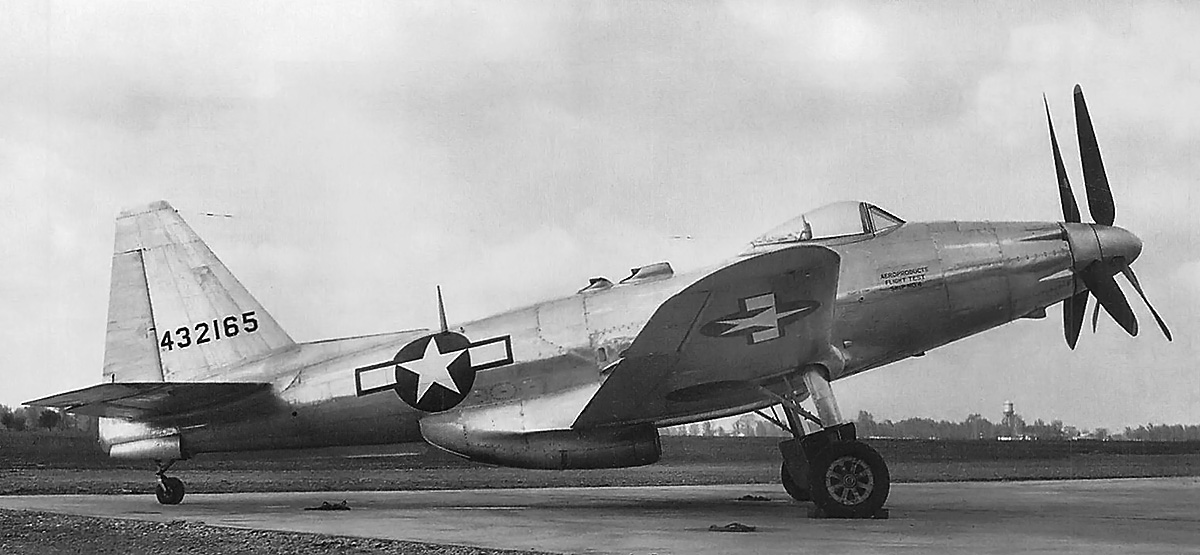
Fisher XP-75A 44-32165 side

XP-75A 44-32165 with the new (and final) large, angular tail and horizontal stabilizer. However, the aircraft retained the rounded wings. Note the ventral strake behind the belly scoop, and the wide H-blade propellers. The same modifications were applied to 44-32166. The stenciling under the canopy says “Aeroproducts Flight Test Ship No 4.”

The Fisher XP-75A had a wingspan of 49 ft 1 in (14.96 m), a length of 41 ft 4 in (12.60 m), and a height of 14 ft 11 in (4.55 m). The aircraft’s performance estimates were revised to a top speed of 434 mph (698 km/h) at 20,000 ft (6,096 m) and 389 mph (626 km/h) at sea level. Its initial rate of climb was 4,200 fpm (21.3 m/s), with 20,000 ft (6,096 m) being reached in 5.5 minutes, and a service ceiling of 39,000 ft (11,887 m). The aircraft had an empty weight of 11,441 lb (5,190 kg) and a fully loaded weight of 18,665 lb (8,466 kg). With the fuselage tank, a total of 203 US gal (768 L) of fuel in the wings, and a 110-US gal (416-L) drop tank under each wing, the XP-75A had a maximum range of 3,850 miles (6,196 km).

The AAF gave the XP-75 priority over most of Fisher’s other work, particularly that of constructing 200 B-29 bombers. Construction of the first two prototypes was started at Fisher’s plant in Detroit, Michigan. The other six XP-75 aircraft were built at the new plant in Cleveland, Ohio, which opened in 1943. Production of the aircraft would occur at the Cleveland plant.
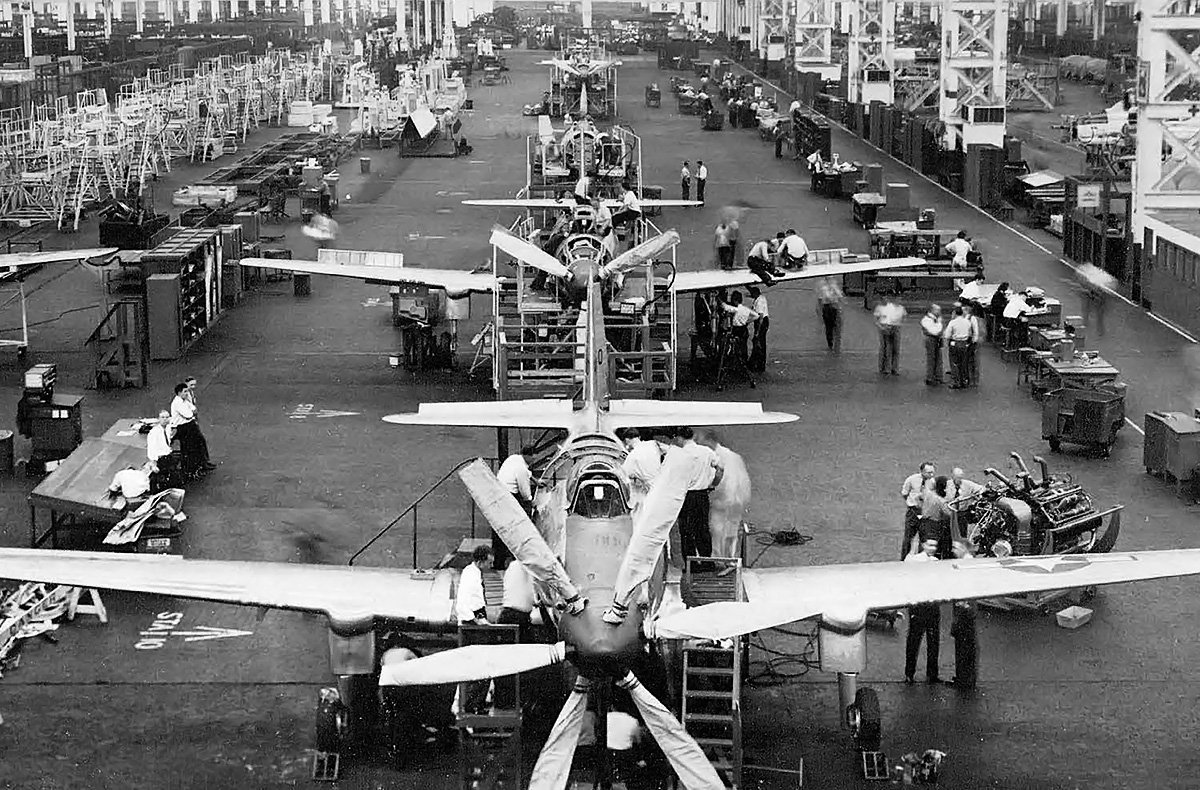
Fisher P-75A assembly line

The production line with P-75A numbers two through four (44-44550 through 44-44553) under construction. While the aircraft have square wingtips, at least the first one still has the rounded horizontal stabilizer. Note the V-3420 engine by the first aircraft. The wing of an XP-75A is visible on the far right.

Flown by Russell Thaw, the XP-75 prototype (43-46950) made its first flight on 17 November 1943, and it was the first aircraft to fly with the V-3420 engine. Almost immediately the aircraft ran into issues: the center of gravity was off; the ailerons were heavy; the controls were sluggish; the aircraft exhibited poor spin characteristics; and the V-3420 engine was down on power and overheating. The trouble is not very surprising considering the aircraft consisted of parts from other aircraft and was powered by an experimental engine installed in an unconventional manner. The V-3420’s firing order was revised for smoother operation. Modifications to the second prototype (43-46951) included changes to the ailerons and a new rear canopy. The size of the rudder was decreased, but the surface area of the vertical stabilizer was increased by extending its leading edge. The second XP-75 prototype was completed in December 1943 and made its first flight on 27 January 1944.

The first of the six XP-75A long-range aircraft (44-32161) flew on 24 January 1944. The last two of these aircraft, 44-32165 and 44-32166, were finished with a bubble canopy and a new empennage. The new empennage had a retractable tailwheel and a taller vertical stabilizer and rudder. Lateral control was still an issue, and these two aircraft were later modified with larger and more angular vertical and horizonal stabilizers. These changes were also incorporated into most of the P-75A production aircraft.
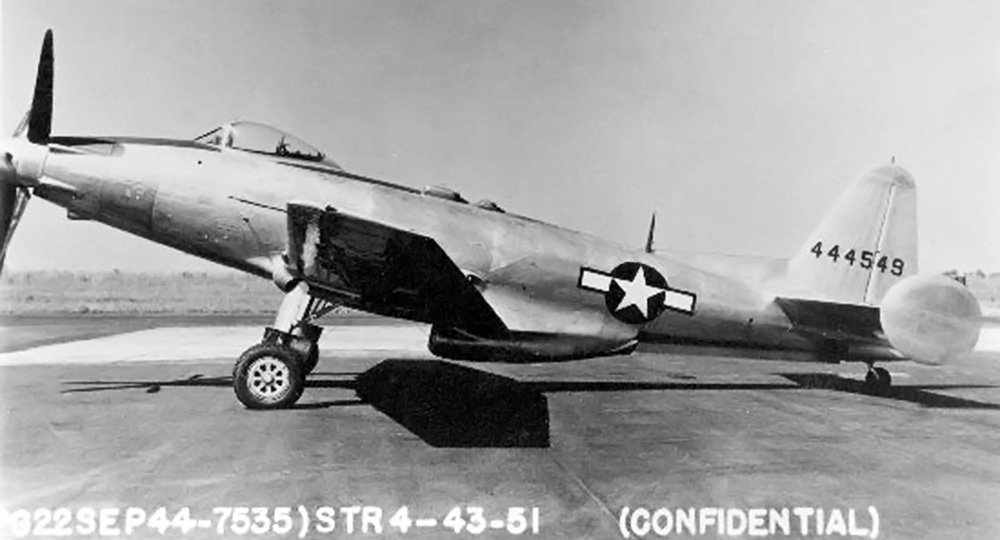
Fisher P-75A 44-44549

The first production P-75A (44-44549) with its square wingtips and original rounded tail. Note the ventral strake and the fins attached to the horizontal stabilizer. It is not known when the picture was taken (possibly 22 September 1944), but the aircraft and pilot were lost on 10 October 1944.

The third long-range XP-75A aircraft (44-32163) crashed on 8 April 1944, killing the pilot, Hamilton Wagner. The crashed may have been caused by the pilot performing unauthorized aerobatics. On 7 June 1944, the AAF issued the contract for 2,500 P-75A aircraft. Official trials were conducted in June 1944 and indicated that the XP-75A aircraft was well short of its expected performance. A top speed of only 418 mph (673 km/h) was achieved at 21,600 ft (6,584 m), and initial climb rate was only 2,990 fpm (15.2 m/s). However, the engine was reportedly not producing its rated output. On 5 August 1944, XP-75A 44-32161 was lost after an inflight explosion, which separated the empennage from the rest of the aircraft. The pilot, Russell Weeks, successfully bailed out.

In addition to other changes made throughout flight testing of the prototypes, the P-75As incorporated extended square wingtips with enlarged ailerons, the controls were boosted to eliminate the heavy stick forces, and a ventral strake was added that extended between the scoop exit doors and the tailwheel. The P-75A had a wingspan of 49 ft 4 in (15.04 m), a length of 41 ft 5 in (12.62 m), and a height of 15 ft 6 in (4.72 m). The aircraft’s performance estimates were revised down, with a top speed of 404 mph (650 km/h) at 22,000 ft (6,706 m). Its initial rate of climb dropped to 3,450 fpm (17.5 m/s), and the service ceiling decreased to 36,400 ft (11,095 m). The aircraft had an empty weight of 11,255 lb (5,105 kg) and a fully loaded weight of 19,420 lb (8,809 kg).
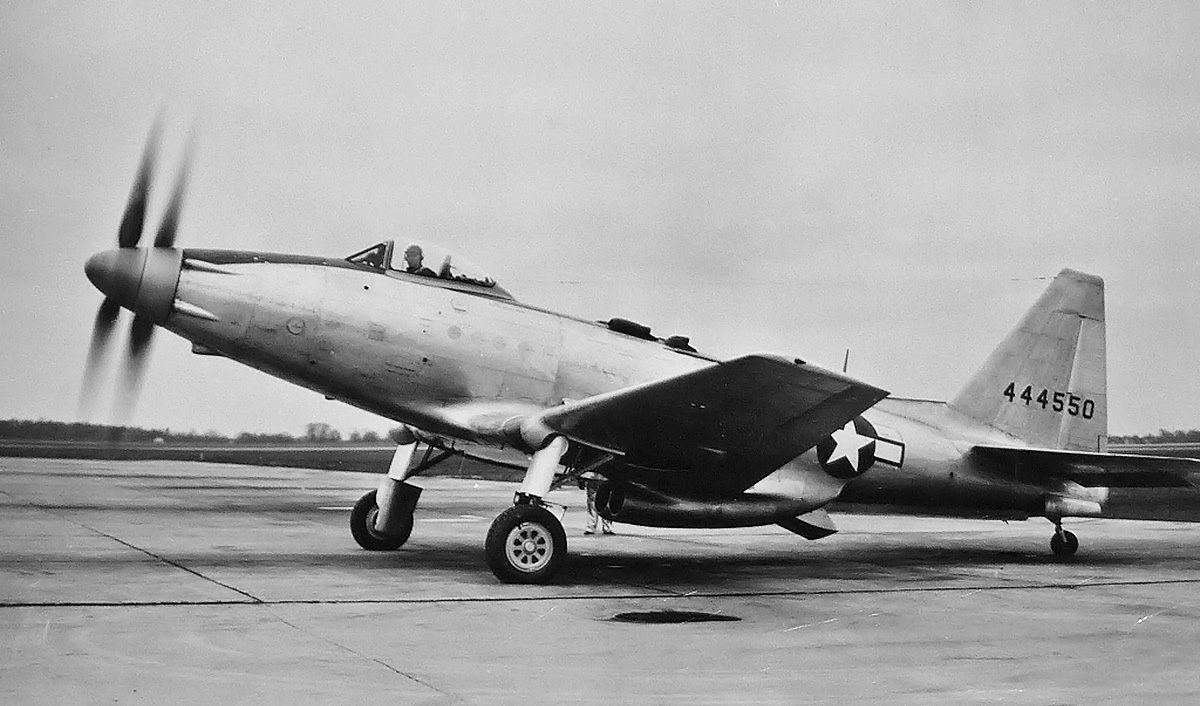
Fisher P-75A runup

P-75A 44-44550 with the new (and final) square tail and horizontal stabilizer. Note the two-section belly scoop and the F4U main landing gear.

The first two P-75As (44-44549 and 44-44550) were not originally finished with the latest (angular) empennage. Rather, they used the tall, round version that was originally fitted to the last two XP-75A prototypes. A dorsal fillet was later added to the vertical stabilizer. The first Fisher P-75A (44-44549) took flight on 15 September 1944, with the second aircraft (44-44550) following close behind. Aircraft 44-44550 was later altered with the enlarged, square-tipped vertical and horizontal stabilizers, but it is not clear if 44-44549 was also changed. At some point (possibly late September 1944), aircraft 44-44549 had stabilizing fins added to the ends of its horizontal stabilizer. Both aircraft were sent to Eglin Field, Florida for trials. On 10 October 1944, aircraft 44-44549 was lost with its pilot, Harry Bolster. The crash was caused by the propellers becoming fouled by either a nose-gun tube failure or by part of the spinner breaking free. The damaged propellers quickly destroyed the gear reduction, and once depleted of oil, the propeller blades went into a flat pitch. Bolster attempted a forced landing but was not successful.

By the time of the last crash, the AAF had realized it would not need the P-75A aircraft. The P-51B/D and P-47D/N had proven that they were up to the task of being long-range escort fighters, and the war’s end was in sight. The P-75A was larger, heavier, slower, and sluggish compared to fighters already in service. The production contract for the 2,500 P-75As was cancelled on 6 October 1944, and further experimental work was stopped on 8 November. Five P-75A aircraft were completed, with an additional, nearly-complete airframe delivered for spare parts. Construction of approximately 20 other P-75A production aircraft had started, with some assemblies being completed.

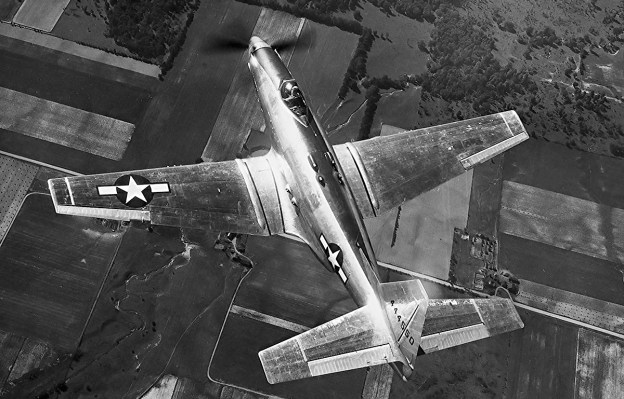
Fisher P-75A top

A top view of 44-44550 provides a good illustration of the square wingtips and horizontal stabilizer. The wings were only slightly extended, but the area of the ailerons was increased by a good amount. The square extensions to the horizontal stabilizer increased its area significantly. Note that the machine gun armament is installed.

P-75A 44-44550 was later transferred to Moffett Field, California where it underwent tests on the contra-rotating propellers. The aircraft was scrapped after the tests. In an attempt to produce more power, a new intercooler was installed in 44-44551, and the aircraft was lent to Allison on 28 June 1945. Later, a 3,150 hp V-3420 was installed. Aircraft 44-44552 and 44-44553 were sent to Patterson Field, Ohio and stored for further V-3420 development work. None of the aircraft were extensively flown. The last completed P-75A, 44-44553, was preserved and is currently on display in the National Museum of the US Air Force in Dayton, Ohio. The aircraft went through an extensive restoration in 2008. All other P-75 aircraft were eventually scrapped.

The eight prototype aircraft had cost $9.37 million, and the manufacturing contract, including the six production aircraft, construction of the Cleveland plant, and tooling for production, had cost $40.75 million. This gave a total expenditure of $50.21 million for the 14 P-75 aircraft. In the end, the expeditious and cost-saving measure of combining existing components led to delays and additional costs beyond that of a new design. It turned out that the existing assemblies needed to be redesigned to work together, essentially making the P-75A a new aircraft with new components.
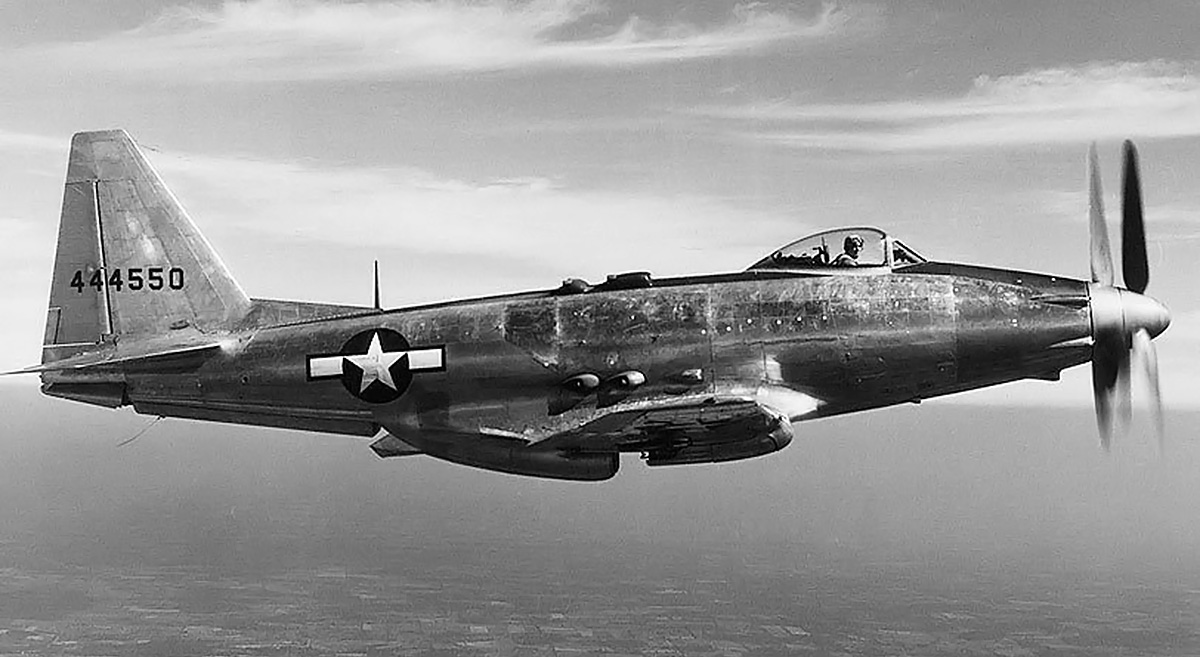
Fisher P-75A side

The pilot under 44-44550’s bubble canopy helps illustrate the aircraft’s rather large size. The P-75’s sluggish handling and lateral instability did not endear the aircraft to test pilots. Note the nearly-wide-open rear shutter of the belly scoop.

An often-cited story states that then Col. Mark E. Bradley, Chief of Aircraft Projects at Wright Field, was so dissatisfied with the XP-75 after making a test flight, that he requested North American add a large fuel tank in the fuselage of the P-51 Mustang. This act led to the ultimate demise of the XP-75 and the ultimate success of the P-51. However, that sequence of events is not entirely accurate.

Bradley initiated North American’s development of the P-51 fuselage tank in July 1943, after evaluating the XP-75’s design. Experiments with the P-51’s 85-gallon (322-L) fuselage tank were successfully conducted in August 1943. In early September 1943, kits to add the tank to existing P-51s were ordered, and about 250 kits arrived in England in November. At the same time, the fuselage tank was incorporated into the P-51 production line. These events preceded the XP-75 prototype’s first flight on 17 November 1943. Bradley’s later flight in the XP-75 solidified his view that the P-51 with the fuselage tank was the best and quickest option for a long-range escort, and that the XP-75, regardless of its progression through development, would not be superior in that role.
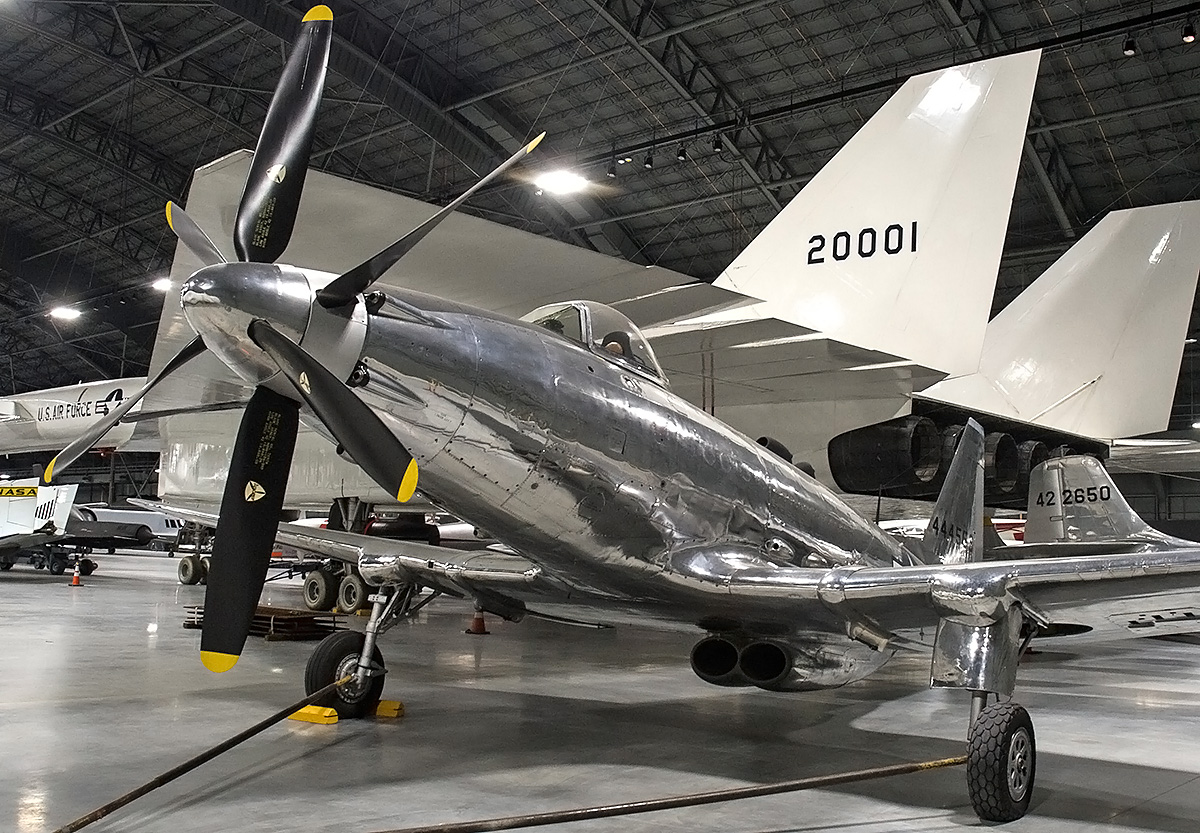
Fisher P-75A USAFM

Fisher P-75A 44-44553 has been preserved and is on display in the National Museum of the US Air Force. (US Air Force image)

Sources:
U.S. Experimental & Prototype Aircraft Projects Fighters 1939–1945 by Bill Norton (2008)
Vees For Victory!: The Story of the Allison V-1710 Aircraft Engine 1929-1948 by Dan Whitney (1998)
P-75 Series Airplanes Advance Descriptive Data (20 May 1944)
P-51 Mustang: Development of the Long-Range Escort Fighter by Paul A. Ludwig (2003)
Development of the Long-Range Escort Fighter by USAF Historical Division (1955)
– “Le Fisher XP-75 Eagle” by Alain Pelletier, Le Fana de l’Aviation (August 1996)
– “A Detroit Dream of Mass-Produced Fighter Aircraft: The XP-75 Fiasco” by I. B. Holley, Jr. Technology and Culture Vol. 28, No. 3 (July 1987)
http://usautoindustryworldwartwo.com/Fisher%20Body/fisherbodyaircraft.htm
http://www.alexstoll.com/AircraftOfTheMonth/3-00.html
https://en.wikipedia.org/wiki/List_of_accidents_and_incidents_involving_military_aircraft_(1943%E2%80%931944)

Campbell-Railton-R-R 2013 National Motor Museum

Blue Bird LSR Car Part 4: Campbell-Railton-Rolls-Royce (1933-1935)

By William Pearce

Starting in 1925, Malcolm Campbell had established himself as a notable record breaker, setting new absolute World Land Speed Records (LSRs) six times. The development of his Blue Bird cars, from the Sunbeam 350HP, to the Napier-Campbell, and to the Campbell-Napier-Railton, demonstrated a steady improvement in speed and design.

Campbell-Railton-R-R 1933 no body

With the Rolls-Royce R engine fitted, the chassis of the Campbell-Railton-Rolls-Royce Blue Bird is shown nearly completed in December 1932. It was fundamentally the same as when powered by the Napier Lion. Note the new coolant tank (just forward of the engine) shaped to fill up the empty space in the car’s body.

Shortly after setting an LSR over the flying mile (1.6 km) at 253.968 mph (408.722 km/h) on 24 February 1932, Campbell considered ways to exceed 300 mph (483 km/h). Campbell’s then-current car, the Campbell-Napier-Railton Blue Bird, was powered by a 1,450 hp (1,010 kW) Napier Lion VIID W-12 engine. After returning to England from the record runs in Daytona Beach, Florida, Campbell started negotiations with Rolls-Royce to acquire an R racing engine. The 1,900 hp (1,417 kW) R engine was originally developed for the 1929 Schneider Trophy Contest, and its output was increased to 2,350 hp (1,752 kW) for the 1931 contest. The engine powered the winner of both races—the Supermarine S.6 in 1929 and the S.6B in 1931. On 29 September 1931, a special 2,500 hp (1,864 kW) sprint version of the R engine was used to power a S6.B to a new absolute speed record of 407.5 mph (655.8 km/h).

Beyond the personal satisfaction these records offered Campbell, there was a fair amount of national prestige involved. In April 1932, Rolls-Royce agreed to loan engine R37 to Campbell. Campbell approached Reid Railton to redesign his car to accommodate the R engine. The Blue Bird car was soon taken to the Thomson & Taylor shop at Brooklands for modifications, which were overseen by Railton and Leo Villa. Because of the new engine, the car is often referred to as the Campbell-Railton-Rolls-Royce Blue Bird.

The Rolls-Royce R was a 60-degree V-12 that was supercharged by a double-sided impeller. The engine had a 6.0 in (152 mm) bore and a 6.6 in (168 mm) stroke. It displaced 2,239 cu in (36.7 L) and produced 2,350 hp (1,752 kW) at 3,200 rpm and 20 psi (1.38 bar) of boost. The 2,500 hp (1,864 kW) sprint version of the R made its power at the same rpm, but it used strengthened internal components and special fuels. The R37 engine sold to Campbell is often cited as a 2,500 hp (1,864 kW) sprint version which could operate at 3,400 rpm.

Campbell-Railton-R-R 1933 Malcolm Donald

Malcolm Campbell and his son Donald pose next to the completed Blue Bird on 9 January 1933. Note the car’s new nose and the cowling humps for the engine’s cylinder banks. The intake for the engine stuck out prominently from above the radiator.

The R engine was longer, taller, and heavier than the Lion it was replacing. These differences necessitated changes to the Blue Bird’s chassis and body, but much of the car was unchanged. The engine was mounted to a subframe, which was then installed into the car’s frame. The three-speed gearbox was strengthened, and its ratios were updated to a 2.74 to 1 first gear, a 1.55 to 1 second gear, and a 1.00 to 1 third gear. The bevel pinion and a crown gear of the rear axle were driven at 1.2 to 1. The cockpit was still offset to the right, and the driveshaft was offset 7 in (178 mm) to the left. The left suspension had stiffer springs installed to help negate the engine’s torque.

The radiator was mounted to a new forward extension of the frame and enlarged to dissipate the extra heat generated by the more powerful engine. A new coolant tank, mounted directly forward of the engine, was made to conform to the shape of the engine and the car’s body. The car’s cooling system had a capacity of 36 US gal (30 Imp gal / 136 L). A forward-facing intake scoop positioned above the radiator increased engine boost by approximately 2 psi (.14 bar). The scoop ducted air under the coolant tank and to the engine’s four carburetors, located at the bottom of the supercharger housing. The 28 US gal (23 Imp gal / 105 L) fuel tank was still located behind the cockpit in the Blue Bird’s tail.

Campbell-Railton-R-R 1933 rear

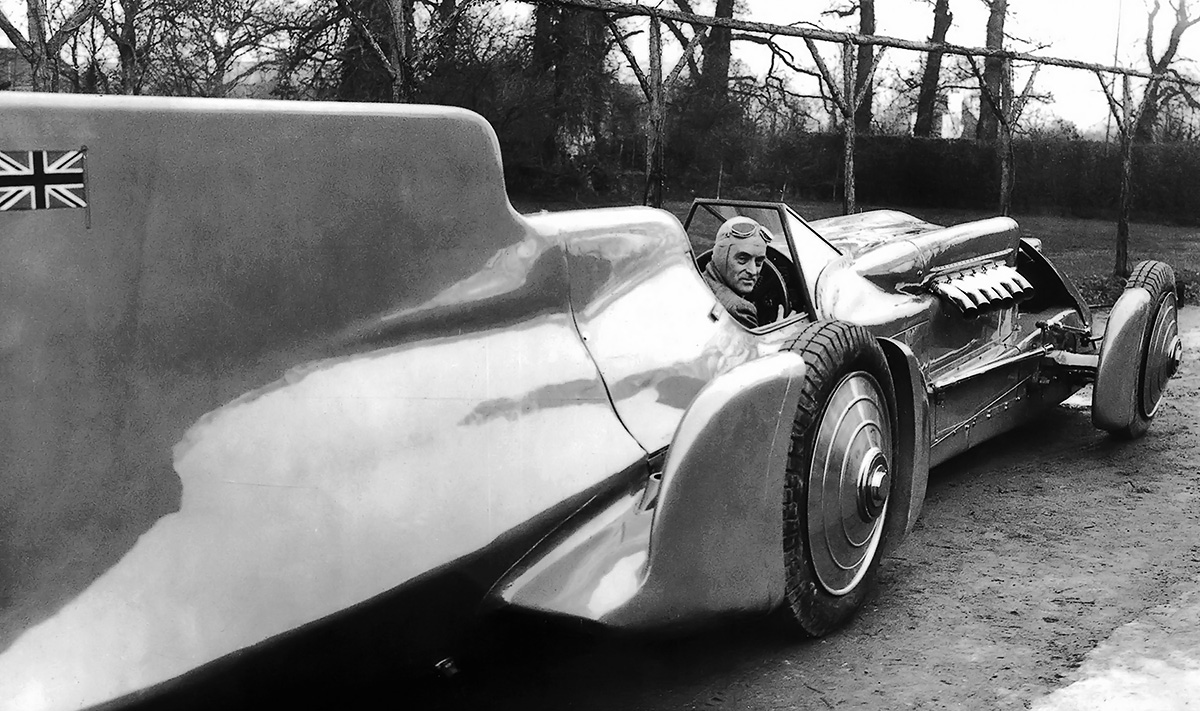
Malcolm Campbell in the Blue Bird’s cockpit. The right-side exit for the radiator cooling air is visible in front of the engine.

Modifications to the body were tested in the Vickers Ltd wind tunnel by Rex Pierson, and the chosen design was built by J Gurney Nutting & Co. The aluminum body sloped up from behind the radiator housing and formed two humps to cover the engine’s valve covers. The valve covers were actually exposed, forming the top of the engine cowling. The outer sides of the humps constituted the sides of the car’s body and had an exposed exhaust stack for each cylinder. The large cowling humps restricted visibility from the low cockpit, which was raised about 3 in (76 mm) to elevate the driver’s view.

The wheels, tires, and brakes were unchanged from the previous Blue Bird version. The front tires were 35 x 6 in (889 x 152 mm), and the rear tires were 37 x 6 in (940 x 152 mm). The tires were made by Dunlop, mounted to steel rims, and inflated to 125 psi (8.62 bar). Each tire and rim weighed approximately 224 lb (102 kg) and was secured to the car by 10 lug nuts. An aerodynamic disc made of aluminum covered each rim. Each wheel had a drum brake that was 18 in (457 mm) in diameter, 1.625 in (41 mm) wide, and machined with cooling fins around its exterior.

The Campbell-Railton-Rolls-Royce Blue Bird had a front track of 5 ft 3 in (1.60 m) and a rear track of 5 ft (1.52 m). The car’s wheelbase was increased 17.25 in (438 mm) to 13 ft 8 in (4.19 m), and its overall length was approximately 27 ft (8.23 m). It weighed around 9,000 lb (4,082 kg), which included approximately 1,450 lb (658 kg) of lead ballast by the rear axle intended to improve traction. With the more powerful R engine, wheelspin on the sandy beach was a serious concern.

Campbell-Railton-R-R 1933 Donald

Donald Campbell in the Blue Bird’s cockpit. The lettering “Campbell Special” can be seen above the Union Jack. Note the screw jack mounting point by the left rear tire.

The car was finished in December 1932 and had “Campbell Special” written on the tail fin. Campbell, his team, and the Blue Bird left for Daytona Beach in January 1933. When Campbell arrived on 2 February, the beach was found to be in such a poor state that only nine miles of course were available, and all testing was put on hold in the hope that conditions would improve. After delaying two weeks for a better course, a trial run was made on 14 February that ended with an overheated gearbox after the first pass. Campbell reported a very unsteady ride on the beach and lots of wheelspin; he also injured his left hand and forearm while shifting. Work was done on the gearbox to improve oil circulation, and another week passed with Campbell recovering from his arm injury.

On 22 February 1933, the weather and beach conditions were decent, and Campbell decided to make an attempt on the record. The R engine roared to life as the Blue Bird set off south down Daytona Beach. Speeds for the run were recorded as 273.464 mph (440.098 km/h) for the km (.6 mi), 273.556 mph (440.246 km/h) for the mile (1.6 km), and 263.540 mph (424.004 km/h) for 5 km (3.1 mi). The Blue Bird was serviced, and its tires, damaged by shells on the beach, were replaced. On the return north, the speeds were 271.473 (436.893 km/h) mph for the km (.6 mi), 270.676 mph (435.611 km/h) for the mile (1.6 km), and 251.340 mph (404.493 km/h) for 5 km (3.1 mi). New records were set at an average of 272.465 mph (438.490 km/h) for the km (.6 mi), 272.108 mph (437.915 km/h) for the mile (1.6 km), and 257.295 mph (414.076 km/h) for 5 km (3.1 mi). Campbell broke his own record by 18 mph (29 km/h).

Campbell-Railton-R-R 1933 Daytona

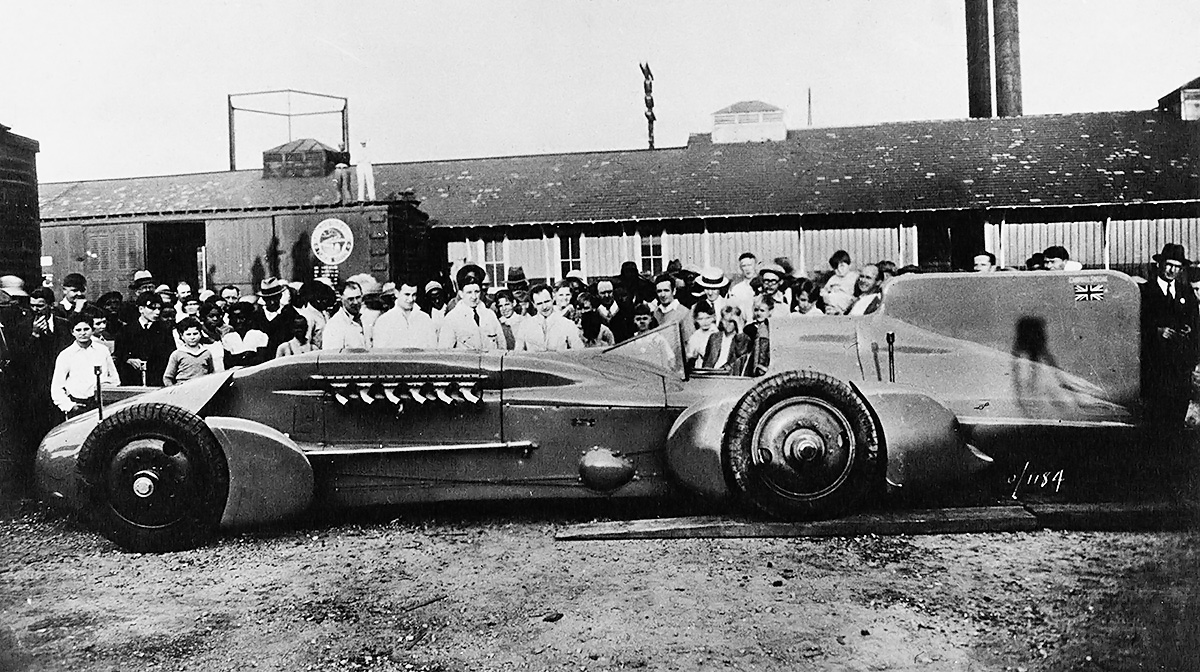
The Blue Bird arriving at Daytona Beach in 1933. The jack screws are installed. Campbell’s crew is behind the engine and in while coveralls. From left to right are Harry Leech, Steve MacDonald (Dunlap), Alf Poyser (Rolls-Royce), and Leo Villa.

Campbell was disappointed with the speed and felt it was the worst ride he had ever had in his life. The tires had been cut by sharp shells, and the wheelspin made the car very difficult to control. Campbell planned to make another attempt on 23 February 1933 but cancelled his plans as a result of his injured hand and the poor beach conditions. Before the team returned to England, plans were in motion to redesign the Blue Bird to achieve 300 mph (483 km/h). Ideally, a longer and better course could be found that had more consistent conditions. Also, Campbell officially stated that he planned to retire from LSRs once he surpassed the 300-mph (483-km/h) mark.

Campbell and crew returned to England on 8 March 1933, but work at the Thomson & Taylor shop to modify the Blue Bird did not begin until April 1934. There was no question that Campbell was going to stick with the Rolls-Royce R engine, and he purchased R37 for £5,800. The car’s gearbox was fine, but the rear axle was damaged. A new axle was designed that incorporated dual rear wheels. The hope was that having twice the contact surface driving the car forward would lessen the wheelspin and improve traction. The rear wheels used 110 psi (7.58 bar) of air pressure, while the front wheels used 125 psi (8.62 bar). The new axle used two pinions on the same axis, with each engaging a separate axle shaft. This would decrease the tooth load but resulted in staggered axles, with the left 1.5 in (38 mm) behind the right. The new gear ratio for the rear end was 1.19 to 1. The axle was resprung equally, and ballast weight was positioned on the left side of the car to counteract engine torque.

A vacuum air cylinder was positioned behind the cockpit to operate air brakes, located behind the rear wheels. Each of the two air brakes offered 2 sq ft (.19 m2) of surface area that would be presented nearly perpendicular to the airstream. The fuel tank was relocated to the left side of the car, outside of the frame rail and between the front and rear tires. Its capacity was 48 US gal (40 Imp gal / 182 L). The steering system was revised to incorporate a more conventional design with a single steering box and interconnected front wheels.

Campbell-Railton-R-R 1935 debut

The newly completed Blue Bird making its debut on 9 January 1935. The car’s streamlining was much improved. Note the relative positions of the cooling-air exit slot and the engine’s intake—this would later result in turbulent airflow into the intake. The right air brake can be seen behind the double-rear tires.

A new radiator was built that spanned the front of the car. Its new housing formed a wedge with an open slit at the front to draw in air. Using a lever in the cockpit, the slit could be closed for short periods of time to cut down wind resistance as the car traveled through the flying mile. The shape of the new radiator housing flowed into the new body, which was again developed through wind tunnel tests. The sides of the car now extended out to encompass the space between the front and rear wheels. A new tail fin extended back and up from the headrest behind the cockpit.

With the changes, and keeping all of the previous Blue Bird versions in mind, the press occasionally referred to the car as the Blue Bird V. The car had a track of 5 ft (1.52 m) and a wheelbase of 13 ft 8 in (4.19 m). Its overall width was 6 ft 11 in (2.11 m), and its overall length was 28 ft 3 in (8.61 m). The revised Blue Bird weighed around 10,450 lb (4,740 kg), including ballast.

During 1934, while the Blue Bird was being rebuilt, Ab (David Abbot) Jenkins was doing all he could to make the racing world aware of the Bonneville Salt Flats in Utah. Eventually, Railton met with Jenkins and visited the Salt Flats. Railton was impressed with that he saw and realized the LSR potential that the vast expanse offered. Campbell was also interested in the location. However, the Salt Flats were only usable in the summer and early fall, and the Blue Bird would not be finished until the winter. Because of the timing, the decision was made to take the car to Daytona Beach in January 1935. The Blue Bird’s chassis was finished in November 1934, and the body was completed in early January 1935.

Campbell-Railton-R-R 1935 debut front

Front view of the Blue Bird illustrates the car’s reworked lines. The radiator intake slot is open, and its shutter door can be seen below the opening.

Arriving in Daytona Beach on 31 January 1935, the team went to work to test the newly revised car. Test runs were made on 14 February, but the main issue affecting the team was bad weather and unfavorable conditions on the beach. Jenkins heard of the wait and traveled to Daytona Beach to speak with Campbell about the Bonneville Salt Flats. He also showed a film of speed runs on the flats. Jenkins spent three weeks in Daytona, and by the time he left, Campbell was planning to be on the Salt Flats in August 1935.

Conditions had improved enough for another test run on 2 March 1935. Issues were encountered with body panels warping next to the exhaust stacks and allowing fumes into the cockpit. Also, the car’s speed actually decreased when the radiator shutter was closed—it seemed like the engine would lose power with the radiator closed. The following day, after modifications had been made, the Blue Bird recorded a one-way speed of 270.473 mph (435.284 km/h). During the run, the beach was so rough that Campbell was lifted out of his seat and his goggles were pushed down, leaving his eyes with no protection against the speeding airstream. Campbell decided against making the return run.

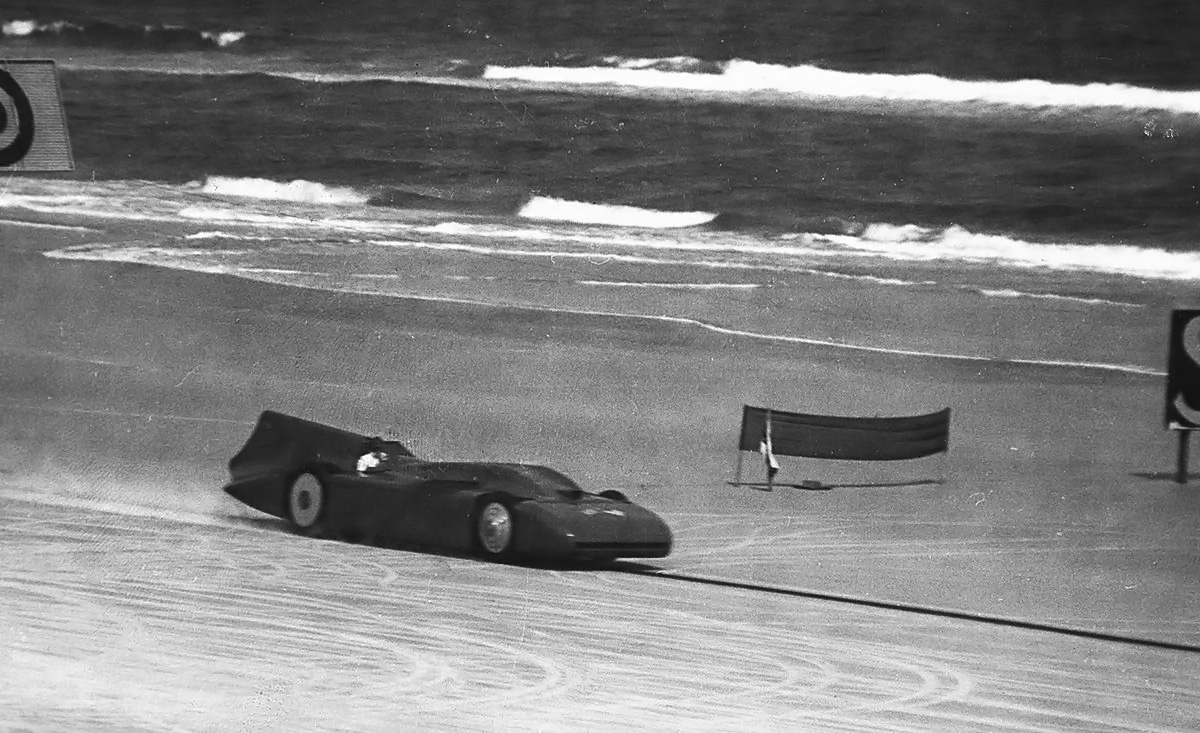
It was not until 7 March that Campbell attempted another record run. The mile (.6 km) run south was completed at 272.727 mph (438.912 km/h). The return north was much rougher, but the Blue Bird covered it at 281.030 mph (452.274 km/h). The average was a new record of 276.816 mph (445.492 km/h) over the mile (1.6 km), 276.160 mph (444.436 km/h) over the km (.6 mi), 268.464 mph (432.051 km/h) over 5 km (3.1 mi), and 251.396 mph (404.583 km/h) over 5 miles (8 km). The speeds were well short of the 300-mph (483-km/h) goal Campbell had set. This was the last absolute LSR set on Daytona Beach.

Campbell-Railton-R-R 1935 Daytona

Campbell in the Blue Bird speeding south along Daytona Beach on 7 March 1935. The thick, black line of diesel oil marked the center of the course.

Part of the reason Campbell wanted to run on the Bonneville Salt Flats was to see if the sand at Daytona Beach was causing the discrepancy between the forecasted speed of over 300 mph (483 km/h) and the realized speed of 275 mph (443 km/h). While at speed, Campbell did not have time to look at the gauges and was unable to see if the engine boost pressure decreased when the radiator was closed. Back in England, A duplicate set of instruments were positioned in the right-side fairing. A light illuminated the instruments, and they would be recorded during runs with a Kodak movie camera to be reviewed later. Also, wind tunnel tests indicated that when the radiator slot was closed, the airstream was being deflected over the induction scoop, resulting in a decrease of engine power. The issue was solved by extending the scoop forward, past the opening for the radiator air exit. The Blue Bird was demonstrated at Brooklands on 21 April 1935 and then made ready for another LSR attempt.

The team arrived on the Bonneville Salt Flats in August 1935. Rolls-Royce had even loaned Campbell a spare engine, R39, to ensure the best possible outcome for the record attempt. Testing was done to make sure the rough salt surface would not damage the tires, and a perfectly straight and level 13-mile (21-km) course was completed on 1 September. A test run was completed on 2 September to make sure everything was in order and allow Campbell to become acclimated to the different surface. Some minor modifications were made to the Blue Bird, including increasing the clearance between the tires and wheel fairings to prevent the accumulation of salt.

Campbell-Railton-R-R 1935 Bonneville

The Blue Bird after the test run at the Bonneville Salt Flats on 2 September 1935. Note the accumulation of salt between the tires and the wheel fairings. The elongated intake scoop can barely be seen. Donald Campbell is on the far side of the car by the front tire.

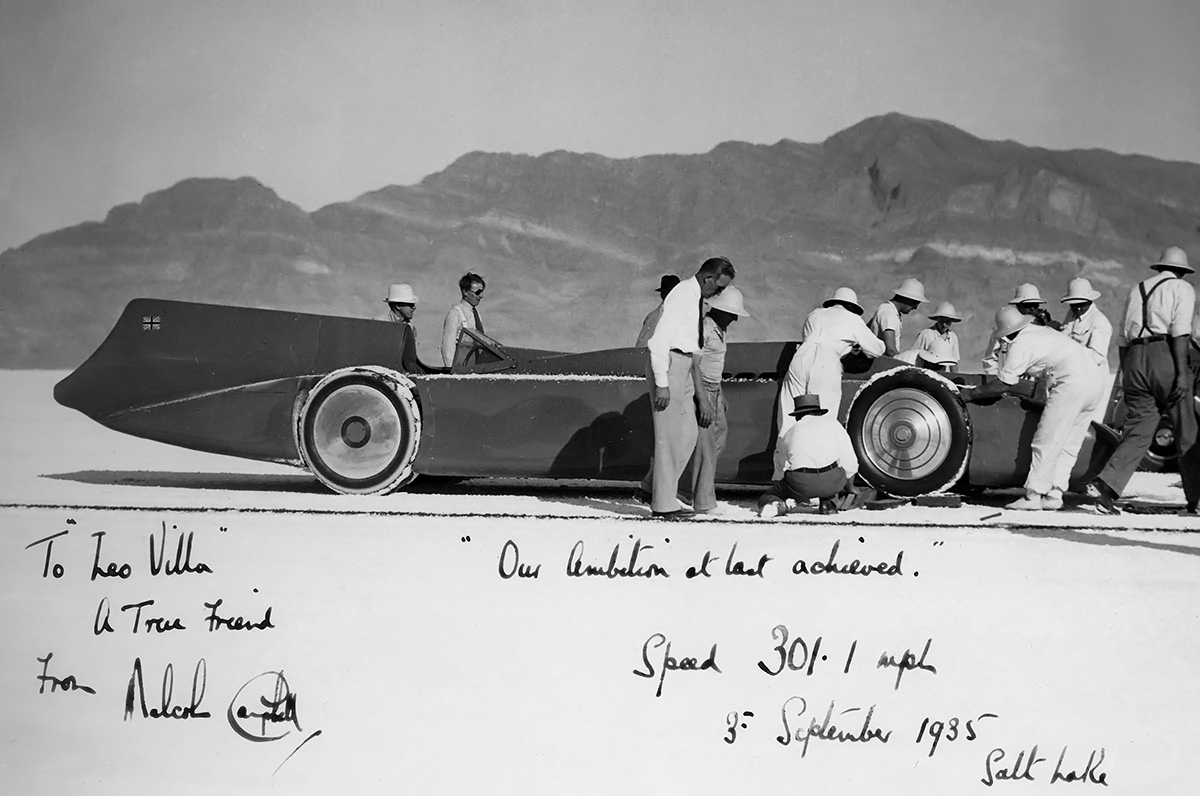
On 3 September 1935, Campbell climbed into the Campbell-Railton-Rolls-Royce Blue Bird for an attempt on the LSR. Flying northeast across the open expanse of salt, he covered a mile in 11.83 seconds at 304.311 mph (489.741 km/h). When he closed the radiator opening, exhaust fumes filled the cockpit, and an oil mist covered the windscreen. At the end of the measured mile (1.6 km), the left front tire blew out at around 280 mph (450 km/h). Campbell had a rough time keeping the car under control; the tire caught fire, and Campbell stopped about half a mile (.8 km) short of where his crew was stationed. The crew loaded up their equipment and hurried to the car to prepare it for the return run. All six tires were changed, but the still-smoldering burst tire took much longer than the others. Barely within the hour time limit, Campbell was on the return trip southwest and covered the mile (1.6 km) in 12.08 seconds at 298.013 mph (479.605 km/h). He kept the radiator shutter open on this run and experienced a skid while braking.

Campbell exited the Blue Bird quite convinced that he had surpassed the 300-mph (483-km/h) mark. Moments later, the timekeeper informed Campbell that his speed averaged to 301.1 mph (484.6 km/h). An elated Campbell grinned broadly as the crew cheered. A few minutes later, while the team was tending to the Blue Bird, the timekeeper came back and said that an error had occurred. Campbell’s time was really 299.874 mph (482.600 km/h). Campbell was very disappointed but quickly recovered and said that he would make another attempt the next day. The team set to work preparing the car for another run. To solve the problem of exhaust fumes in the cockpit and gain some extra speed, an aluminum cockpit cover was quickly being made.

During dinner later that night, the timekeeper approached Campbell and took him aside. The timekeeper explained that a miscalculation had been made, and that he had actually gone 301.129 mph (484.620 km/h)—the initial calculation was correct. Campbell’s run in the Blue Bird was the first absolute LSR set on the Bonneville Salt Flats. Other records that Campbell set were 1 km (.6 mi) at 301.473 mph (485.174 km/h) and 5 km (3.1 mi) at 292.142 mph (470.157 km/h).

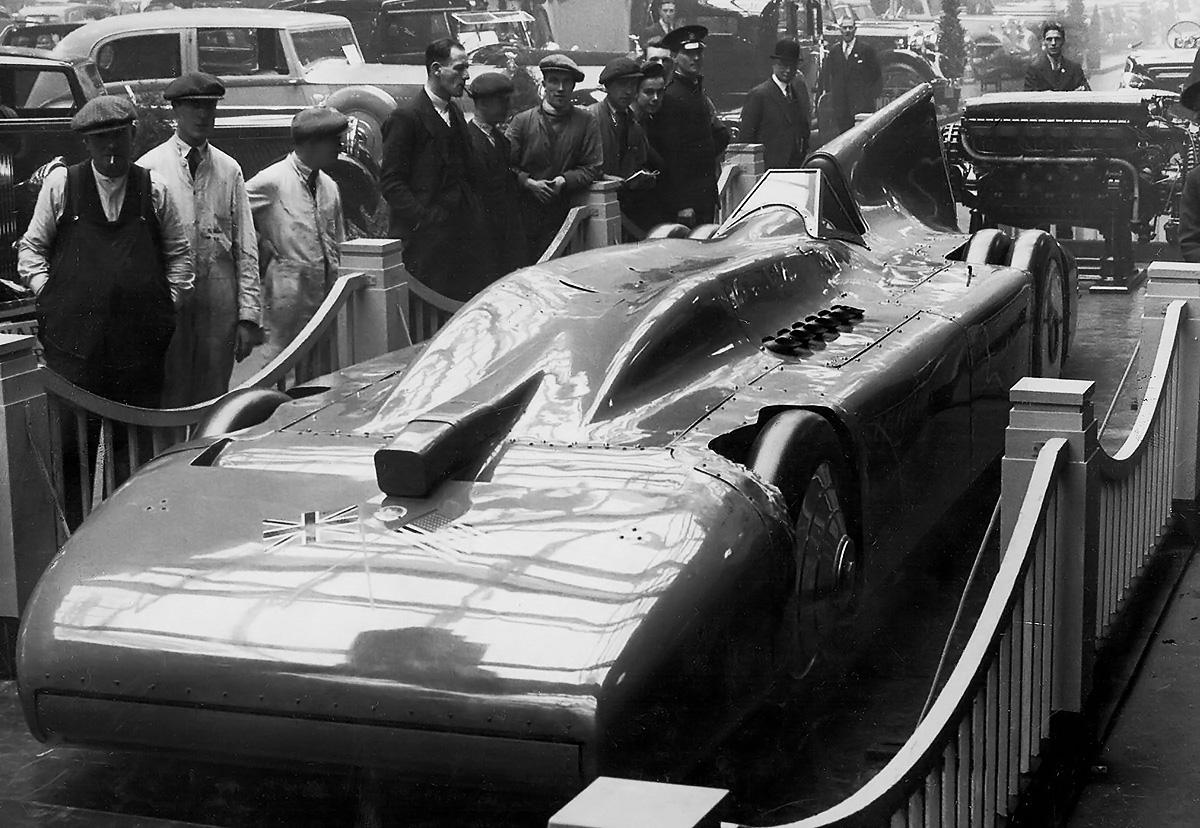
Campbell-Railton-R-R 1935 Scottish Motor Show

After setting the record at 301.129 mph (484.620 km/h), the Blue Bird was displayed in various locations. Seen here at the Scottish Motor Show in Glasgow in November 1935, the car is in the same condition as when it left the Bonneville Salt Flats. Note the extended engine intake and the front left body damage from the burst tire. The radiator slot is closed, and a Rolls-Royce R engine is in the background. (The Herald image)

Campbell was upset that the moment of his crowning achievement had effectively been taken away. True to his word, he retired from LSRs, and his run for the following day was cancelled. In a span of 11 years, Campbell had set nine LSRs, raising the record from 146.16 mph (235.22 km/h) to 301.129 mph (484.620 km/h). Within two years, Campbell would take on the even more dangerous challenge of setting Water Speed Records.

Campbell, his team, and the Blue Bird returned to England. The car was displayed in a number of exhibits and returned to the United States in 1937. It returned across the Atlantic in 1946. After Malcolm Campbell passed away on 31 December 1948, the car was purchased by his son Donald. Donald sold the Blue Bird in 1949 to acquire parts to complete the K4 hydroplane for an attempt on the water speed record. The Blue Bird returned to the United States and passed through a few owners and museums until it was acquired by the International Motorsports Hall of Fame and Museum in Alabama, which restored the car in 1996 to the Daytona 1935 standard (no extended intake). The Blue Bird returned to England in 2004 and 2013 when it was displayed at the British National Motor Museum in Beaulieu with the Sunbeam 350HP and Donald Campbell’s Bluebird CN7. The Blue Bird is currently displayed in the Motorsports Hall of Fame of America, located at Daytona International Speedway in Daytona Beach, Florida. A replica of the Campbell-Railton-Rolls-Royce Blue Bird is displayed at the Lakeland Motor Museum in Cumbria, England.

Campbell-Railton-R-R 2013 National Motor Museum

The restored Blue Bird at the British National Motor Museum at Beaulieu in 2013. Note the original engine intake, not the extended version used at Bonneville. (National Motor Museum image)

This article is part of an ongoing series detailing Absolute Land Speed Record Cars.

Sources:
The Land Speed Record 1920-1929 by R. M. Clarke (2000)
Reid Railton: Man of Speed by Karl Ludvigsen (2018)
The Record Breakers by Leo Villa (1969)
The Unobtainable: A Story of Blue by David de Lara (2014)
My Thirty Years of Speed by Malcolm Campbell (1935)
The Fast Set by Charles Jennings (2004)
Land Speed Record by Cyril Posthumus and David Tremayne (1971/1985)
Leap into Legend by Steve Holter (2003)