Monthly Archives: March 2013

Wright Aeronautical R-4090 Cyclone 22 Aircraft Engine

By William Pearce

In the early 1940s, Wright Aeronautical decided to utilize their 18-cylinder R-3350 engine as the basis for a new engine to compete with the Pratt & Whitney R-4360. The new engine developed by Wright was the R-4090 Cyclone 22 (Wright model no. 792C22AA). It used 22 R-3350 cylinders arranged in two rows of 11 cylinders. The R-4090 is one of only a few radial engines with 11 cylinders per row. It is also one of only three 22-cylinder aircraft engines ever built.

The 22-Cylinder Wright R-4090 engine. (Aircraft Engine Historical Society image)

The 22-Cylinder Wright R-4090 engine of 3,000 hp (2,237 kW). (Aircraft Engine Historical Society image)

The air-cooled Wright R-4090 had a 6.125 in (155.6 mm) bore and 6.3125 in (160.3 mm) stroke. Total displacement was 4,092 cu in (67.05 L) and the engine’s compression ratio was 6.85 to 1. The Cyclone 22 had a two-speed, single-stage supercharger and gave 3,000 hp (2,237 kW) at 2,800 rpm for takeoff. For continuous output, the engine produced 2,400 hp (1,790 kW) at 2,600 rpm. However, increased performance was expected with further engine development. The R-4090 had a diameter of 58 in (1.47 m), was 91 in long (2.31 m), and weighed 3,230 lb (1,465 kg).

The crankcase was a steel forging, following a construction practice pioneered by Wright and used on other Cyclone engines. The three-piece crankshaft was built up through the two one-piece master connecting rods. Ten articulating rods were attached to each master rod. Each cylinder was constructed in typical Wright fashion and had 3,900 sq in (2.52 sq m) of cooling fin area. Each cylinder’s hemispherical combustion chamber had two valves; the exhaust valve was sodium-cooled. It appears that the .333 to 1 propeller gear reduction was provided by Wright’s standard, multi-pinion planetary gear system. The supercharger and accessory drive section was very similar to that used on the R-3350 engine. However, the supercharger had a 14 in (356 mm) impeller and gear ratios of 5 to 1 and 7 to 1.
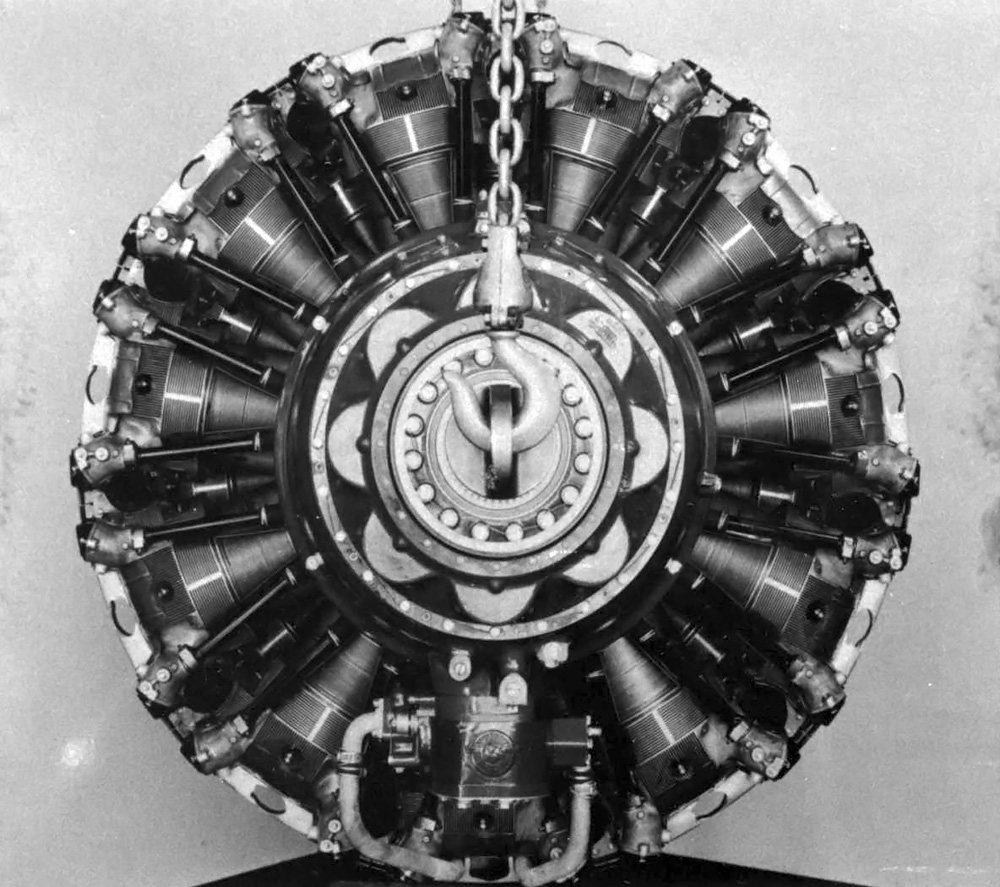
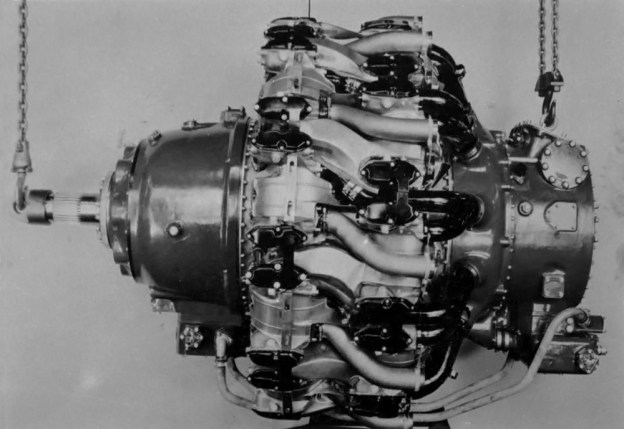
Front of view of the Cyclone 22 showing the 22 R-3350 cylinders tightly packed around the forged steel crankcase. (Aircraft Engine Historical Society image)

Front of view of the Cyclone 22 showing the 22 R-3350 cylinders tightly packed around the forged steel crankcase. (Aircraft Engine Historical Society image)

The R-4090 possessed similar power and weight characteristics to early Pratt & Whitney R-4360 engines. While developing the Cyclone 22, Wright was preoccupied with serious developmental issues of the very high priority R-3350 engine and ongoing development of the 42-cylinder R-2160 Tornado; not much time or manpower remained for the R-4090. As a result, only a few examples of the Cyclone 22 were built, and it is doubtful that the engine ever flew. Perhaps three R-4090 engines were completed: two XR-4090-1 engines with a single propeller shaft and one XR-4090-3 engine with a coaxial shaft for contra-rotating propellers. The XR-4090-3 weighed an additional 30 lb (13.6 kg) for a total of 3,260 lb (1,478 kg). In addition, the XR-4090-3 was to have a two-speed nose case to maximize propeller and engine speed efficiency for maximum power and cruise power. Ultimately, the R-4090 Cyclone 22 was abandoned so that more resources could be used for the R-3350 Cyclone 18.

Radial engines with 11-cylinder per row are very rare. With so many cylinders, the engine diameter becomes very large, and the valve train can be crowded and complex. In addition, difficulties can arise with so many power pulses on each crankpin.
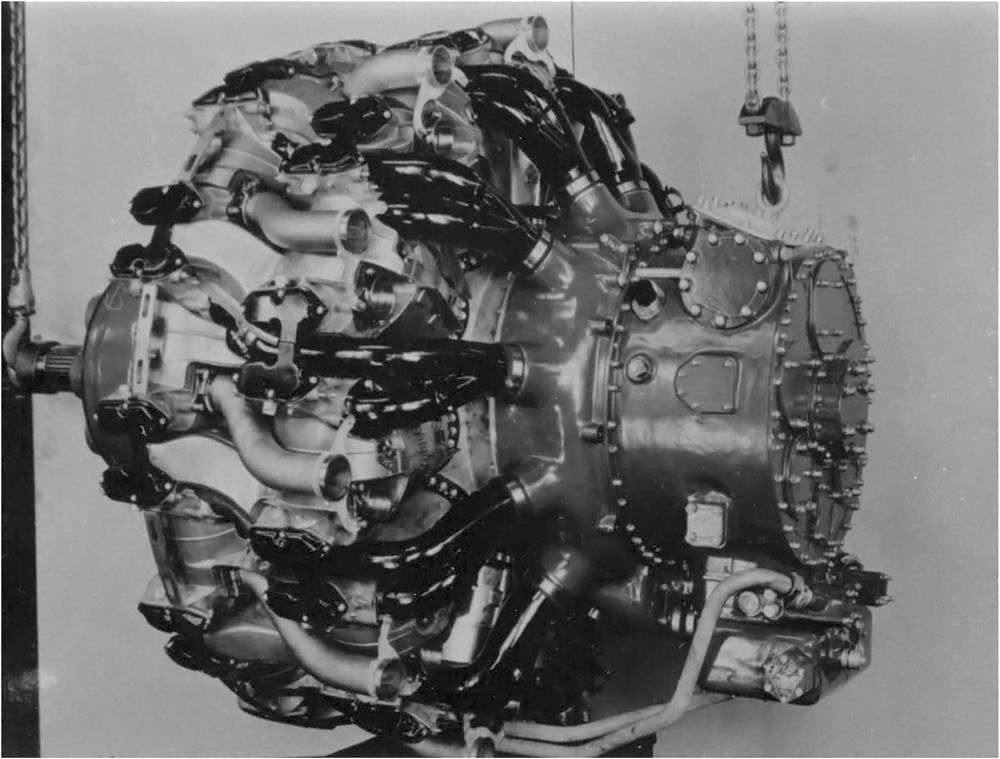
The R-4090 was very close to the same power and weight as the Pratt & Whitney R-4360 at this stage of development.(Aircraft Engine Historical Society image)

The R-4090 was very close to the same power and weight as the Pratt & Whitney R-4360 at this stage of development. (Aircraft Engine Historical Society image)

During World War I, Clerget developed an 11-cylinder rotary engine of 200 hp (149 kW), designated the 11E. Another World War I-era 11-cylinder rotary of 200 hp (149 kW) was developed by Siemens-Halske and designated the Sh.III. The Sh.III was unusual in that its crankshaft rotated one direction within the engine while the crankcase, with propeller attached, rotated in the opposite direction. The result was 1,800 rpm of engine speed with only 900 rpm of propeller speed—an ideal speed in the days of fixed-pitch propellers and no gear reduction. Far removed from aviation, Nordberg Manufacturing Company made a successful 11-cylinder, two-stroke, diesel, stationary, radial engine of 1,655 hp (1,234 kW) at 400 rpm for industrial use.

Other examples of 22-cylinder, twin-row radial engines include the Mitsubishi A21 (Ha-50), with a displacement of 4,033 cu in (66.1 L) and an output of 2,600 hp (1,939 kW) and the Hitachi/Nakajima [Ha-51], with a displacement of 2,673 cu in (43.8 L) and an output of 2,450 hp (1,827 kW). Both of these engines were developed by the Japanese during World War II and, like the Wright R-4090, never entered production. Clerget also studied a 22-cylinder engine between the wars, but it never progressed beyond the design phase.
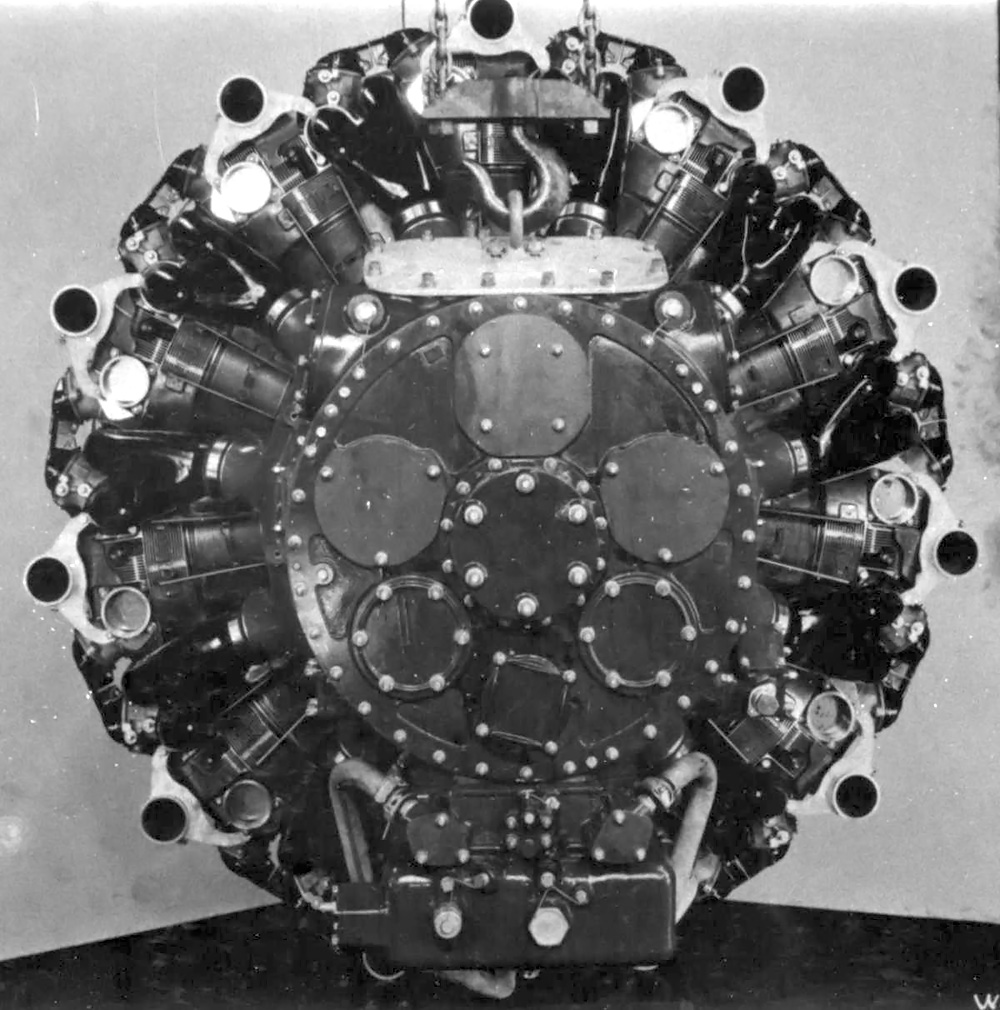
Rear view of the R-4090 showing the suppercharger and accessory section that appears to be the same as that found on the R-3350. (Aircraft Engine Historical Society image)

Rear view of the R-4090 showing the supercharger and accessory drive section which is very similar to that found on the R-3350. (Aircraft Engine Historical Society image)

Sources:
http://www.enginehistory.org/Piston/Wright/R-4090/Curtiss-WrightR-4090.shtml
Allied Aircraft Piston Engines of World War II by Graham White (1995)
R-4360: Pratt & Whitney’s Major Miracle by Graham White (2006)
http://www.ww2aircraft.net/forum/engines/11-22-cylinders-radials-33342.html
Model Designation of U.S.A.F. Aircraft Engines (1950)
The Wright Cyclones by Wright Aeronautical Corporation (1942)
Duesenberg W-24 Marine Engine

By William Pearce

Although his father was a co-founder of the Dodge Brothers Company, progenitor to today’s Dodge automobile company, Horace Elgin Dodge Jr. did not follow his father into the automobile business. But like his father, he was very interested in watercraft. In 1923, after his father had passed, he founded Dodge Boat Works in Detroit, Michigan. This venture was backed by a $2 million investment from his mother, Anna Thompson Dodge.

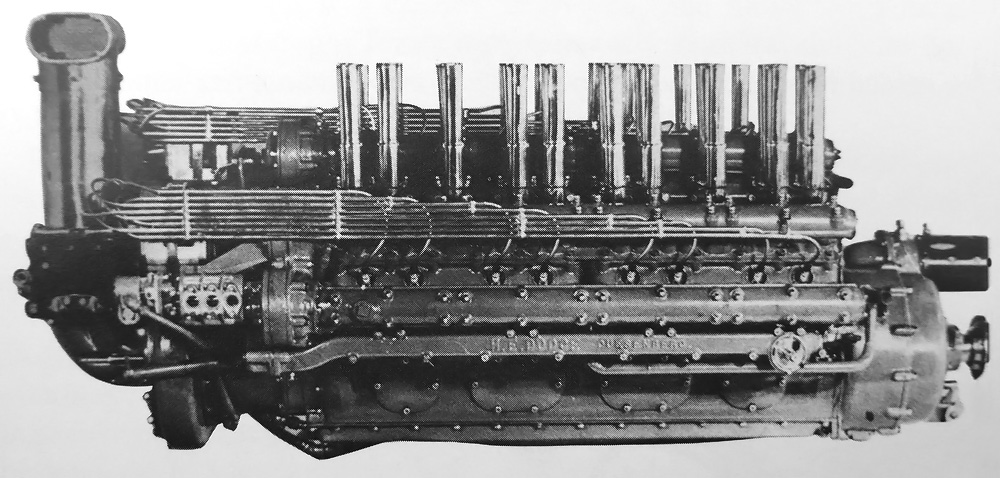
Side view of the J. Paul Miller-developed Duesenberg W-24 engine.

Side view of the J. Paul Miller-developed Duesenberg W-24 engine.

Dodge was very involved in boat racing, and he wanted to create a boat that would be unbeatable. In 1925, Dodge approached Duesenberg Brothers Racing to build an engine to propel him to victory in the Gold Cup race. An agreement was made, and a contact was signed on 27 January 1926—$32,500 for the construction of two complete engines with enough spare parts to build a third. The first engine was to be delivered on 15 June 1926, with the second following on 6 July 1926. Although Fred Duesenberg was involved with the engine project, it was most likely Augie Duesenberg who did the majority of the work.

The contracted engine was essentially three straight-eight engines on a common aluminum crankcase, creating a W-24. Why a “W” engine configuration was chosen is not known, but it does provide for a powerful engine in a fairly compact space. At this same time in history, the Napier Lion W-12 engine was powering record-setting air, land, and marine speed machines, and it is easy to see how the Lion could have served as inspiration.

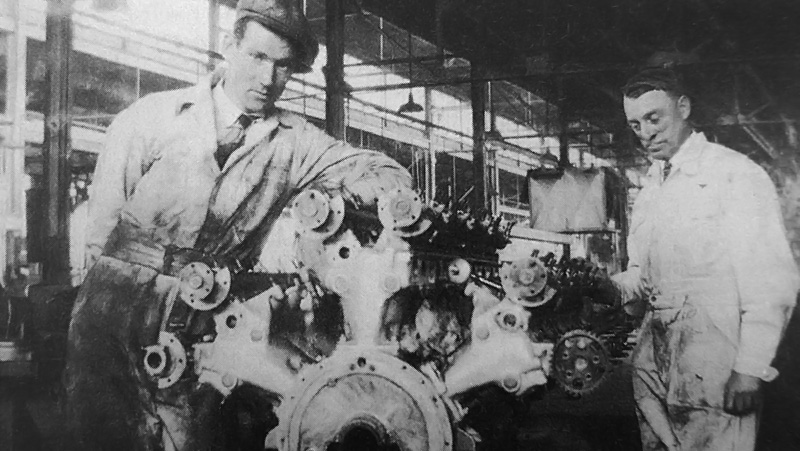
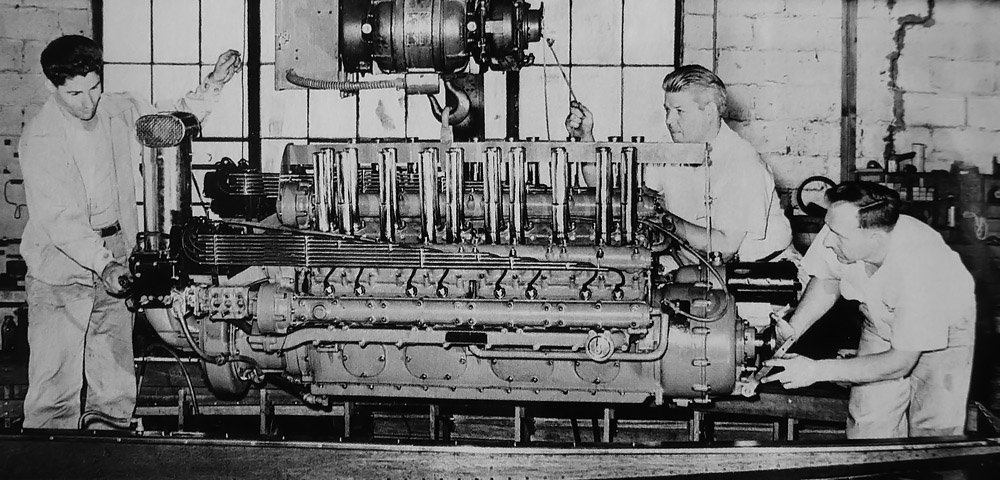
Front view of the Duesenberg W-24 under construction.

View of the Duesenberg W-24 under construction.

The engine’s bore was 2.875 in (73 mm) and stroke was 4.0 in (102 mm), giving a total displacement of 623 cu in (10.2 L). The two side banks were angled 60 degrees from the center vertical bank. Each of the W-24’s engine banks was made up of two four-cylinder blocks with integral heads. The first four-cylinder blocks were supposedly made of cast iron, but later cylinder blocks were cast aluminum with steel cylinder liners. The engine’s single crankshaft was supported by five main bearings. The connecting rods were of the tubular type, with the master rod in the center bank and an articulated rod for each outer bank.

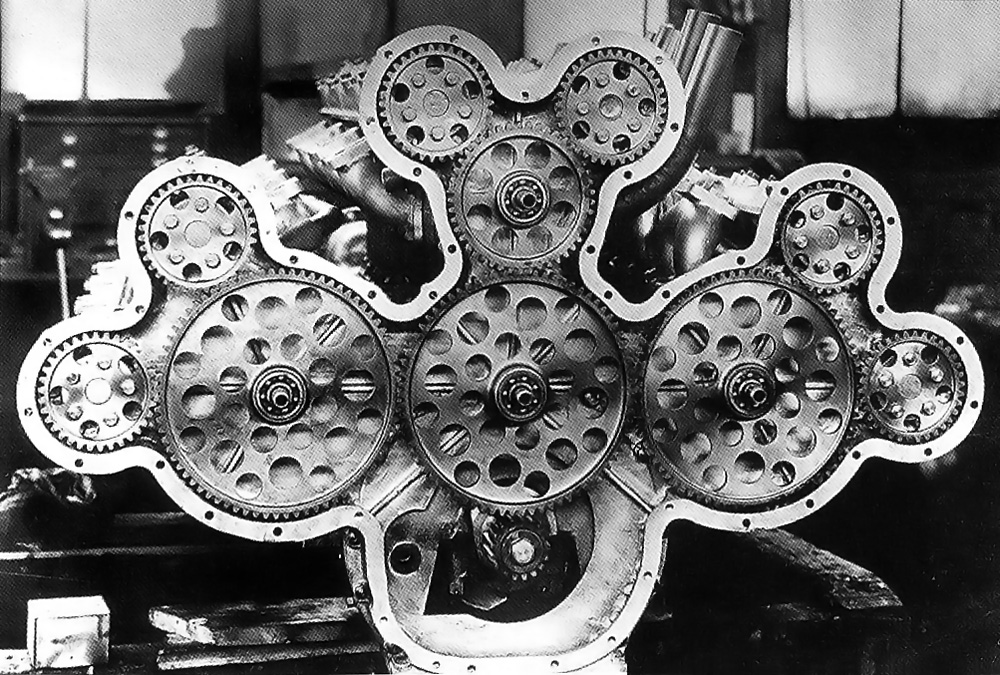
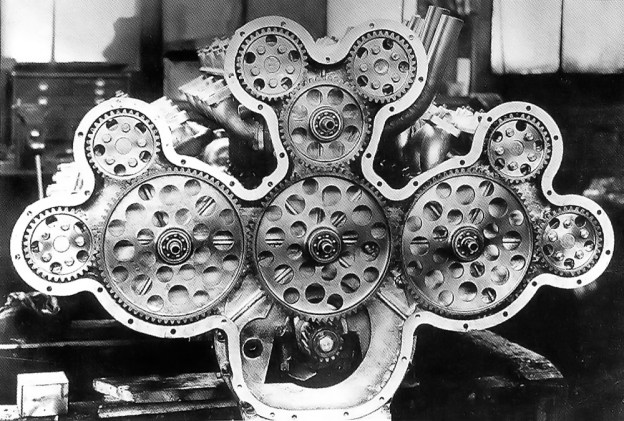
Four valves per cylinder operated in a pentroof combustion chamber. All together, the engine’s 96 valves took about a week of labor to adjust. The valves were actuated in each engine bank by dual overhead camshafts that extended the length of the engine. The camshafts were geared to the crankshaft via idler gears. Each block of four cylinders had five exhaust ports. The three middle exhaust ports each shared two exhaust valves. Exhaust from each bank was collect in a single water jacketed manifold. One spark plug was installed in each cylinder and fired by a camshaft-driven Delco distributor mounted at the rear of each cylinder bank.

The complex gear-drive arrangement for the camshafts at the rear of the 24-cylinder Duesenberg.

The complex gear-drive arrangement for the camshafts at the rear of the 24-cylinder Duesenberg. The pinion on the crankshaft had 17 teeth, the intermediate gears had 74 teeth, and the camshaft gears had 34 teeth. The center intermediate gear engaged an idler gear that had 45 teeth. The gearing drove the camshafts at half engine speed.

Initially, one updraft carburetor fed air to each of the six four-cylinder blocks. Poor fuel distribution resulted, and the engine never ran well. The updraft carburetors were replaced with downdraft carburetors, and the W-24’s running improved, but it was still not perfect. The six downdraft carburetors were replaced by 12 Zenith downdraft carburetors, improving performance yet again. Finally, 12 Holley downdraft carburetors replaced the Zeniths, and the engine began to run smoothly. Although running better than ever, the W-24 only produced a disappointing 475 hp (354 kW).

The first engine was delivered to Dodge in 1927. Earlier that year, J. Paul Miller began working at the Duesenberg factory and was involved with W-24 engine for many years. Some of Miller’s first changes were installing I-beam connecting rods in place of the tubular ones and replacing the Delco distributors with Bosch magnetos. From 1929 to 1935, Miller worked for Dodge and continued to develop the engine. Unfortunately for Dodge, the 24-cylinder engines brought nothing but frustration. As a result, he never paid Duesenberg the last $2,000 for the engines.

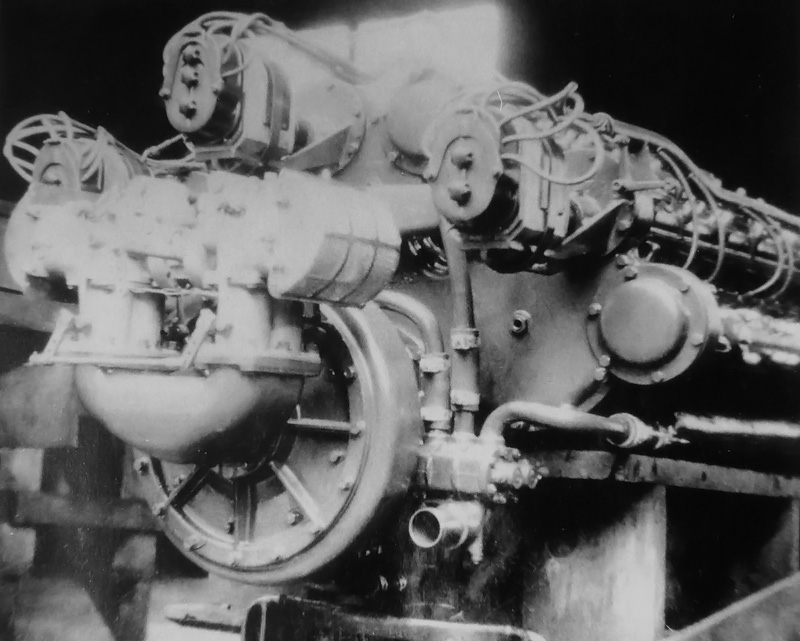
Rear of the 24-cylinder Duesenberg showing two two-barrel carburetors feeding the supercharger. Note the Bosch magnetos mounted driven by the camshafts.

Rear of the 24-cylinder Duesenberg showing two two-barrel carburetors feeding the supercharger. Note the camshaft-driven Bosch magnetos.

The 1931 Gold Cup race was held on Lake Montauk in New York, and the W-24 engine was installed in Dodge’s Miss Syndicate III boat. Miss Syndicate III failed to finish the first heat. In 1932, Miss Syndicate III had been renamed Delphine V. Dodge Sr. had named a yacht after his daughter, and Dodge Jr. continued the “Delphine tradition,” naming numerous boats after his sister. Again, the Gold Cup race was held on Lake Montauk in New York. During the first heat race, the W-24-powered Delphine V dropped out after three laps. Dodge entered five boats for the 1933 Gold Cup race held on the Detroit River. A 24-cylinder Duesenberg was installed in two of the entries: the new Delphine VIII and the new Delphine IX. That year, Delphine VIII failed to start, and Delphine IX did not finish a single heat. In 1934, in disgust, Dodge sold one (but probably both) W-24 engine to Herb Mendelson.

Before the sale, Dodge was inspired by the performance of the supercharged Packard engine in one of this other boats, Delphine IV. Since a rule change allowed superchargers to be used starting in 1935, Dodge had commissioned Miller to design a supercharger for the W-24. This unfinished project was sold to Mendelson, and Miller was retained by Mendelson to continue the work on the engine. It was Miller’s refinements of the supercharged engine that really brought the W-24 to life. The supercharger used an 8 in (203 mm) impeller and spun at 6.5 times crankshaft speed (32,500 rpm at 5,000 rpm engine speed), creating 15 psi (1.03 bar) of boost. Initially, two two-barrel carburetors were used on the supercharged engine, but these were replaced by a single four-barrel Stromberg carburetor. Along with new Miller-designed intake manifolds, the fuel distribution problems were finally solved. The exhaust manifolds were discarded and replaced by 30 vertical exhaust stacks extending into the air. With the changes, the engine weighed 1,400 lb (635 kg) and was referred to as the “Mendelson-Duesenberg W-24.” The engine began to run like a champion and now produced over 850 hp (634 kW) at 5,000 rpm. Reportedly, at full song the engine produced a sound like nothing else on earth.

The W-24 being installed in in the Arena-designed Notre Dame by Gene Arena, Walter Schmid, and Bert MacKenzie.

The W-24 being installed in in the Arena-designed Notre Dame by Gene Arena, Walter Schmid, and Bert MacKenzie.

Mendelson installed the W-24 into his boat, the Clell Perry-designed rear-engined Notre Dame (the first). Its first competition was the 1935 President’s Cup race on the Potomac River. Perry was the driver and won the race. In 1937, Perry was again at the controls when the W-24-powered Notre Dame won the Gold Cup race, held on the Detroit River, averaging 63.68 mph (102.48 km/h) over the 90 mile (145 km) course.

While making a high speed run on the Detroit River in preparation for the 1938 Gold Cup race, Perry was injured when the new Notre Dame (the second) boat went out of control and flipped over. (This accident possibly destroyed one of the W-24 engines.) The new Notre Dame was repaired, and Dan Arena took over the driving duties. He finished second in the President’s Cup race but did not like the boat’s stability. Mendelson asked Arena what he thought was needed to cure the stability issues, and Arena said, “Build another boat.” Mendelson agreed, and Arena designed a new 22 ft (6.7 m) boat, again named Notre Dame (the third), with the W-24 engine placed in front of the driver.

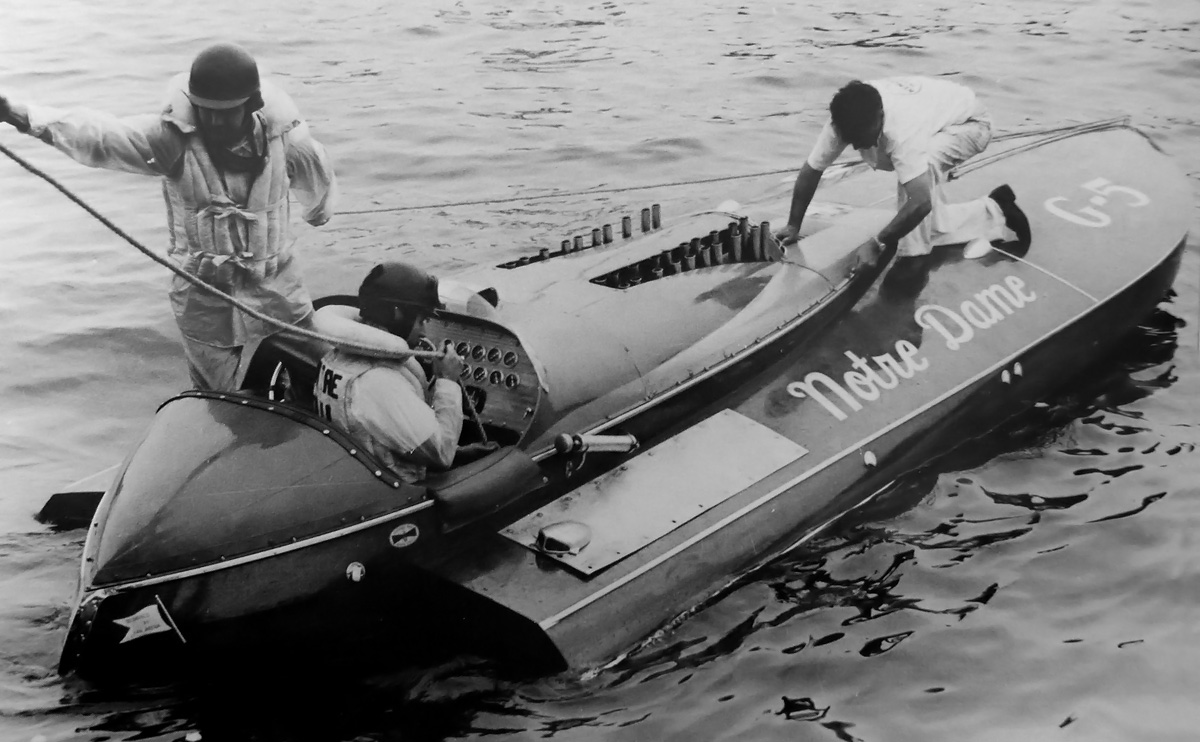
Dan Arena (standing) preparing to run the W-24-powered Notre Dame with his brother Gene as the riding mechanic, as Bert MacKenzie makes final preparations.

Dan Arena (standing) preparing to run the W-24-powered Notre Dame with his brother Gene as the riding mechanic, as Bert MacKenzie makes final preparations.

After a bit of a rough start, Arena won the 1939 and 1940 President’s Cup races in the new Notre Dame. In 1940 on the Detroit River, the W-24 powered the Notre Dame to a new class speed record of 100.987 mph (162.523 km/h). The boat was placed in storage during World War II but was taken out in 1947 and won the Silver Cup race on the Detroit River and finished second in the President’s Cup race. By this time, competitors were installing WWII surplus Allison engines in their boats, and the Duesenberg W-24 could no longer compete. The engine was removed and placed in storage.

At least one Duesenberg W-24 engine survives along with many spare parts. As of 2013, the engine is owned by Gerard Raney and has been rebuilt for installation in a Notre Dame (the third) replica that is under construction. In the mid-1990s, Miller and Arena were both involved in the project, which is based out of the San Francisco Bay Area. Undoubtedly, the engine and boat combination will be quite a sight when the project is finished.

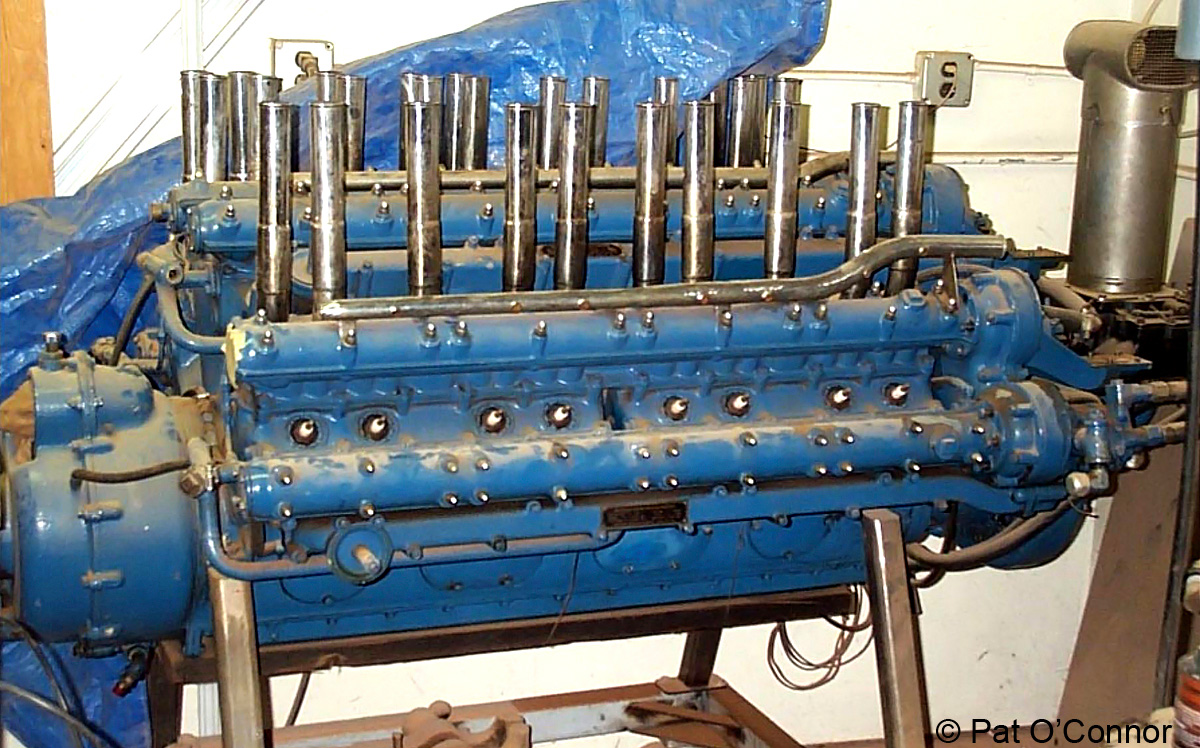
Duesenberg W-24 1996 copy

The surviving Duesenberg W-24 engine owned by Gerard Raney as seen in 1996. Note that each cylinder bank is made up of two four-cylinder blocks; the gap between the blocks is visible on the bank nearest the camera. The camshaft housings extend the length of the engine. (Pat O’Connor image)

Sources:
– “The Duesenberg W-24” by Dean Batchelor, Road & Track, August 1992
– “That Kid From Oakland” by Frank Gudaitis, Nautical Quarterly, No. 40, Winter 1987
– “They Always Called Him Augie” by George Moore, Automobile Quarterly, Vol. 30, No. 4 (1992)
The Classic Twin-Cam Engine by Griffith Borgeson (1979/2002)
Classic American Runabouts: Wood Boats, 1915-1965 by Ballantyne and Duncan (2005)
http://www.vintagehydroplanes.com/apba_history/notebook/1996_08.html
The Dan Arena Story by Fred Farley – ABRA Unlimited Historian
The Notre Dame Story by Fred Farley – ABRA Unlimited Historian
1933 – The Year of the Dodge Navy by Fred Farley – ABRA Unlimited Historian
http://www.findagrave.com/cgi-bin/fg.cgi?page=sh&GRid=14820517