Monthly Archives: November 2017

Riout 102T wings up

Riout 102T Alérion Ornithopter

By William Pearce

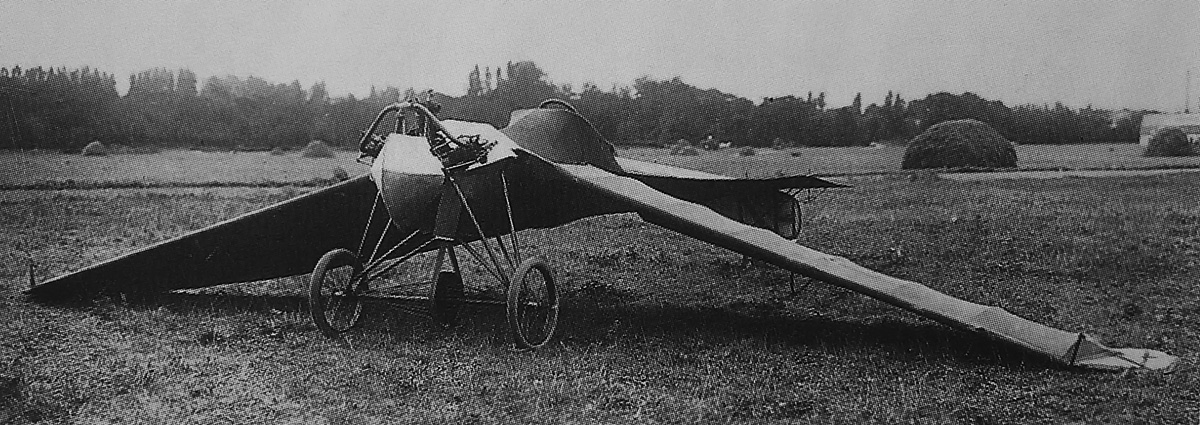
French engineer René Louis Riout was interested in ornithopters—aircraft that used flapping wings to achieve flight. His first ornithopter, the DuBois-Riout, was originally built in 1913, but testing was delayed because of World War I. The aircraft never achieved sustained flight and was destroyed in an accident in 1916.
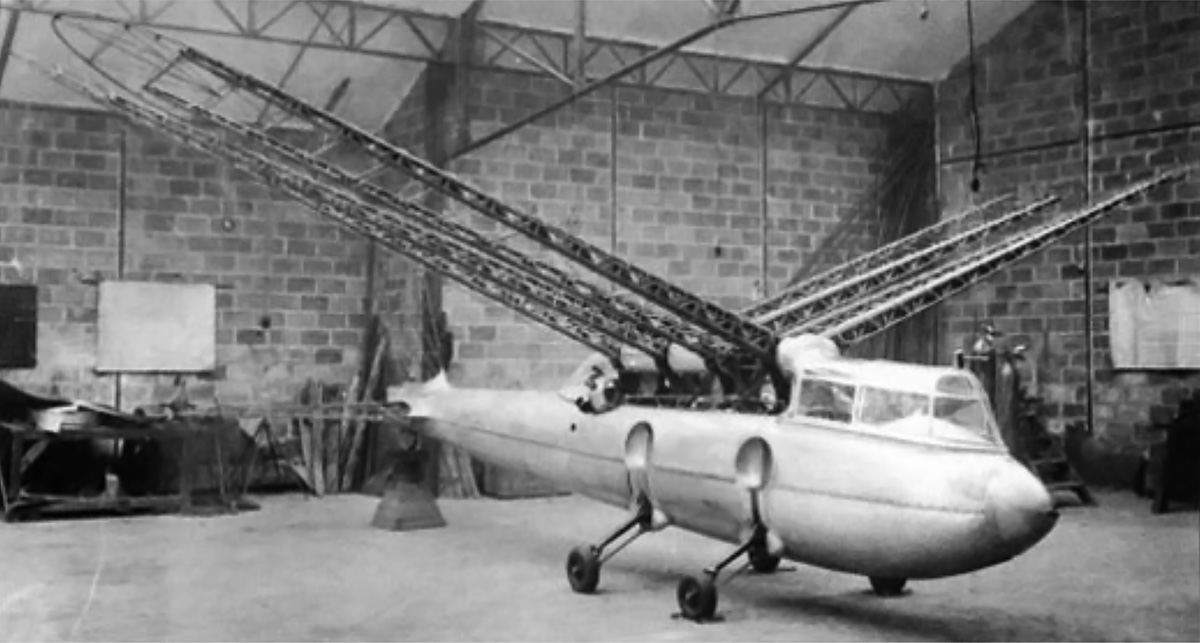
Riout 102T wing frame

The nearly-finished Riout 102T Alérion is just missing the fabric covering for its wings and tail. Note the wing structure and how the spars are mounted to the fuselage.

After the war, Riout designed a new ornithopter that had two sets of flapping wings. He continued to refine his ornithopter design, but no one was interested in producing such a machine. Riout worked for a few other companies, including a time with Société des Avions Bernard (Bernard Aircraft Company) from 1927 to 1933. While at Bernard, Riout was involved with their Schneider Trophy racer projects.

In 1933, Riout presented his ornithopter designs and research to the Service Technique de l’Aéronautique (STAé or Technical Service of Aeronautics). Riout’s presentation included designs and models of two- and four-wing ornithopters. The models weighed 3.5 and 17.6 oz (100 and 500 g) and performed flights up to 328 ft (100 m). As a result of these tests, STAé ordered a 1/5-scale model with wings powered by an electric motor.

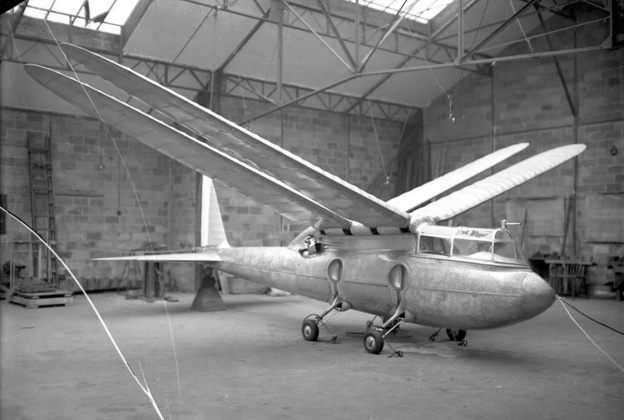
Riout 102T wings up

Completed, the Riout 102T ornithopter resembled a dragonfly. An engine cylinder and its exhaust stack can be seen behind the rear wing. Note the enclosed cockpit; the rear section slides forward for entry.

The 1/5-scale model was built in 1934. From 11 November 1934 to 1 February 1935, the model underwent 200 hours of testing in the wind tunnel at Issy-les-Moulineaux, near Paris, France. The successful tests established the feasibility of Riout’s design and indicated the ornithopter would be capable of 124 mph (200 km/h) if it were powered by a 90 hp (67 kW) engine. Based on the test results, STAé ordered a full-scale ornithopter to be built and tested in the wind tunnel for research purposes. On 23 April 1937, Riout was awarded a contract for the construction of an ornithopter prototype.

The ornithopter was designated Riout 102T Alérion. The word alérion, or avalerion, is the name of a mythical bird about the size of an eagle. The single-place ornithopter had a cigar-shaped fuselage. Its frame was made of tubular-steel and skinned with aluminum. The enclosed cockpit occupied the nose of the aircraft. Two wheels on each side of the aircraft retracted into the fuselage sides. The landing gear had a 4 ft 3 in (1.3 m) track.

Behind the cockpit were two pairs of flapping wings. The two-spar wings had metal frames and were fabric-covered. A hinge at each spar mounted the wing to a large structure in the center of the fuselage. Immediately behind the wings, a 75 hp (56 kW) JAP (John Alfred Prestwich) overhead valve V-twin engine was installed with its cylinders exposed to the slipstream for air-cooling. The exact engine model has not been found, but the 61 cu in (996 cc) JAP 8/75 is a good fit. The 102T ornithopter had conventional vertical and horizontal stabilizers that were made of tubular steel frames and covered with fabric.
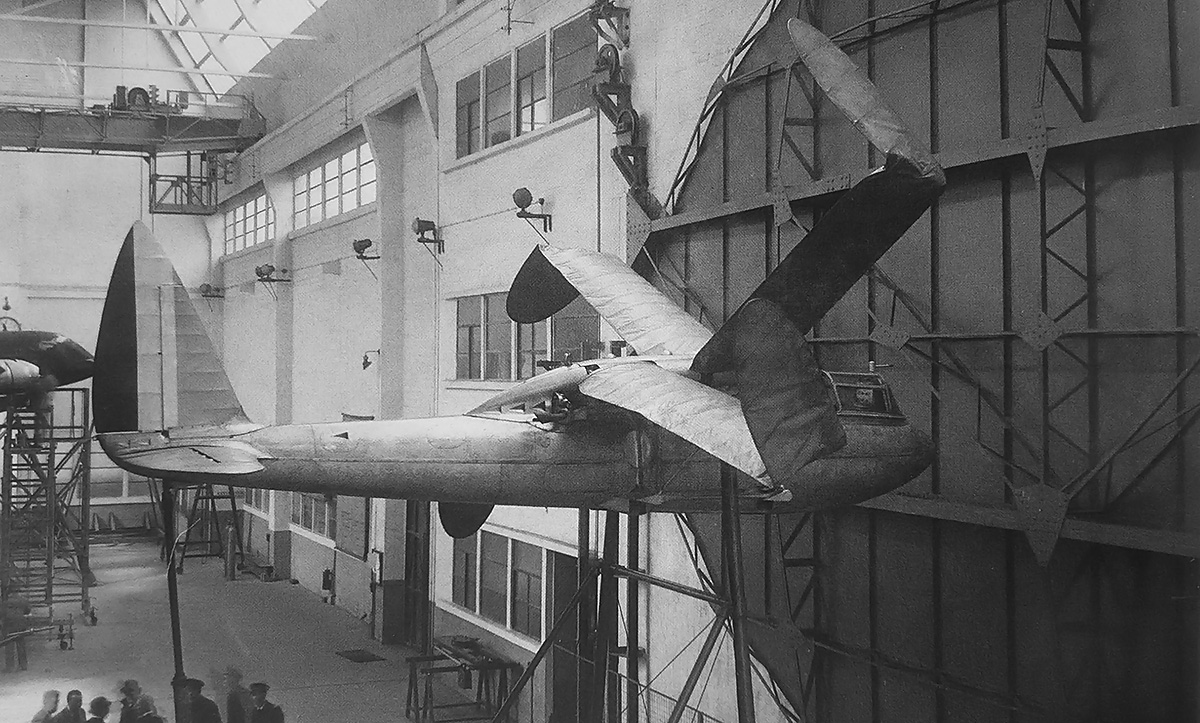
Riout 102T wind tunnel

On 12 April 1938, the wings of the 102T failed during a wind tunnel test. Stronger wings could have been designed and fitted, but the impractically of the ornithopter left little incentive to do so. The landing gear was removed for the tests. Note the engine cylinder behind the rear wing.

A drawing indicated the wings had 50 degrees of travel—40 degrees above horizontal and 10 degrees below. However, a detailed description of how the wings were flapped has not been found. The method appears to be somewhat similar to the system used on the DuBois-Riout ornithopter of 1913, in which the engine was geared to a crankshaft that ran between the wings. A connecting rod joined each wing to the crankshaft, but each wing was on a separate crankpin that was 180 degrees from the opposite wing. However, images of the 102T show both sets of wings in the up position, as well as one set of wings up and the other down. If a crankshaft was used for the wings, it must have employed clutches and separate sections for each pair of wings. It appears the standard operating configuration was for the wings to be on different strokes: one pair up and one pair down. Wing warping was used to achieve forward thrust, with the portion of the wing behind the rear spar moving.

The Riout 102T had a 26 ft 3 in (8.0 m) wingspan and was 21 ft (6.4 m) long. At its lowest position, the wing had 2 ft 2 in (.67 m) of ground clearance. At its highest point, the wingtip was 13 ft 5 in (4.1 m) above the ground. The aircraft’s tail was 8 ft 2 in (2.5 m) tall. The ornithopter weighed 1,102 lb (500 kg) empty and 1,389 lb (630 kg) fully loaded.

The aircraft was built in Courbevoie, at the company of coachbuilder Émile Tonnelline (often spelled Tonneline). Final assembly was completed in late 1937 by Bréguet (Société des Ateliers d’Aviation Louis Bréguet or Luis Bréguet Aviation Workshop) in Villacoublay. With its four wings and side-mounted landing gear, the completed ornithopter resembled a dragonfly.

Riout 102T frame

Restoration efforts provide a good view of the Riout 102T’s frame. Note how neatly the landing gear folded into the fuselage. The ornithopter’s aluminum body was saved, but the original wings were lost. (Shunn311 image via airport-data.com)

After some preliminary testing, the 102T was moved to the wind tunnel at Chalais-Meudon in early 1938. First, tests lasting two minutes with the wings stationary were conducted. These tests were followed by wing flapping tests. Eventually, the ornithopter test sessions lasted a continuous 20 minutes, but all tests were conducted without the wings warping (providing thrust). It was noted that the engine was only producing around 60 hp (45 kW), but the tests were continued. On 12 April 1938, the 102T was in the wind tunnel undergoing a flapping test with a wind velocity of 81 mph (130 km/h). When the engine speed was increased to 4,500 rpm, one wing folded, quickly followed by the other three. The outer third of all the wings bent, with the right wings folding up and the left wings folding down. At the time of the mishap, the ornithopter had operated in the wind tunnel for around three hours and had satisfied initial stability tests.

Before the wings failed, Riout had notified the STAé of some modification he would like to make to the ornithopter. However, there was no interest to fund repairs or continue the project after the aircraft was damaged. The damaged wings were discarded, but the fuselage of the 102T was somehow preserved. Today, the Riout 102T Alérion is undergoing restoration and is on display at the Espace Air Passion Musée Régional de l’Air in Angers, France. While a few manned ornithopters flights have been made, the aircraft type has been generally unsuccessful.
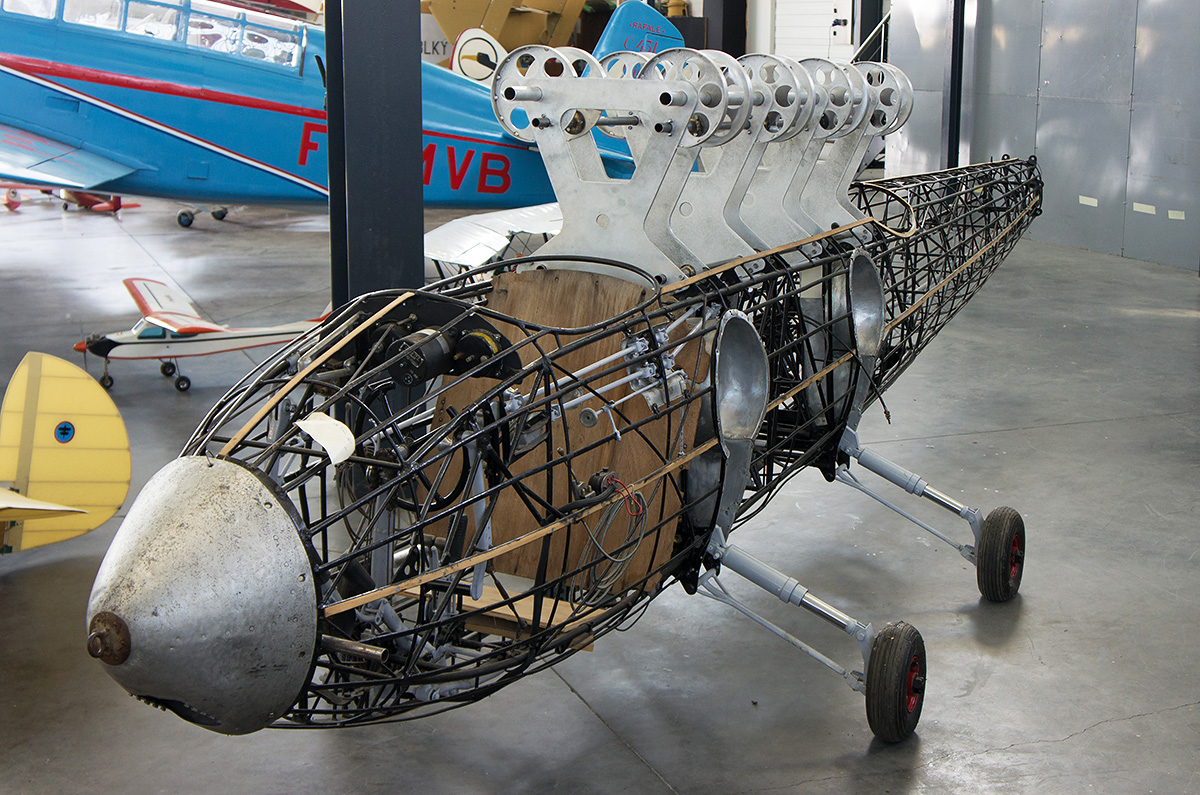
Riout 102T frame restoration

The frame of the ornithopter consisted of small diameter steel tubes that were welded together. The aluminum wing supports may not be original. The Riout 102T is currently on display in the Espace Air Passion Musée Régional de l’Air. (Jean-Marie Rochat image via flikr.com)

Sources:
– “Avion à ailes battantes Riout 102T” by Christian Ravel Le Trait D’Union No 225 (January-February 2006)
Les Avions Breguet Vol. 2 by Henri Lacaze (2016)
http://www.secretprojects.co.uk/forum/index.php?topic=18681.0
– “Flying Machine with Flapping Wings” US patent 1,009,692 by René Louis Riout (granted 21 November 1911)
Dubois Riout front wings down

DuBois-Riout Ornithopter

By William Pearce

When humans began to contemplate heavier-than-air flight, it was only natural to emulate birds. However, the complications of an ornithopter—using flapping wings to achieve flight—proved to be insurmountable. By 1900, most aviation pioneers focused their efforts on propellers and fixed wings; however, some persisted with the ornithopter.

Riout 1911 Patent

Drawings from René Riout’s US patent of 1911. Fig 1 shows the ornithopter design, which had a passing similarity to the aircraft built in 1913. Fig 2 and Fig 3 show the wing flapping mechanism. Fig 4 and Fig 5 show the wing in a gliding position. Fig 6 and Fig 7 show the wing warped for thrust.

In the early 1900s, French engineer René Louis Riout shifted his focus from automobiles to aviation. Initially, Riout designed models of gliders and propeller-driven aircraft, but his attention soon turned to ornithopters. By 1907, Riout was successfully flying his model ornithopter designs. In 1909, one of Riout’s models flew 164 ft (50 m) at an altitude of 10 ft (3 m). In 1910, his ornithopter model was flying 558 ft (170 m), and the distance expanded to 722 ft (220 m) in 1911.

In late 1910, Riout was granted French patent 419,140 for his flapping wing mechanism and ornithopter design. The same invention was patented in Great Britain (191117951) and the United States (1,009,692) in 1911. Riout’s patent described how power from an engine was geared at a reduced speed to a crankshaft. The crankshaft had two crankpins that were positioned 180 degrees apart. A connecting rod linked each crankpin to the pivoting mechanism of one wing. As the crankshaft turned and the crankpin moved to the horizontal position nearest the wing, the wing was moved to its highest position. As the crankpin moved to the horizontal position farthest from the wing, the wing moved to its lowest position. Thus, the up and down movement of the wing was controlled by the speed of the engine. The drive system incorporated a heavy flywheel to smooth out power pulses from the engine. For small aircraft, a heavy spring could be substituted for the flywheel.

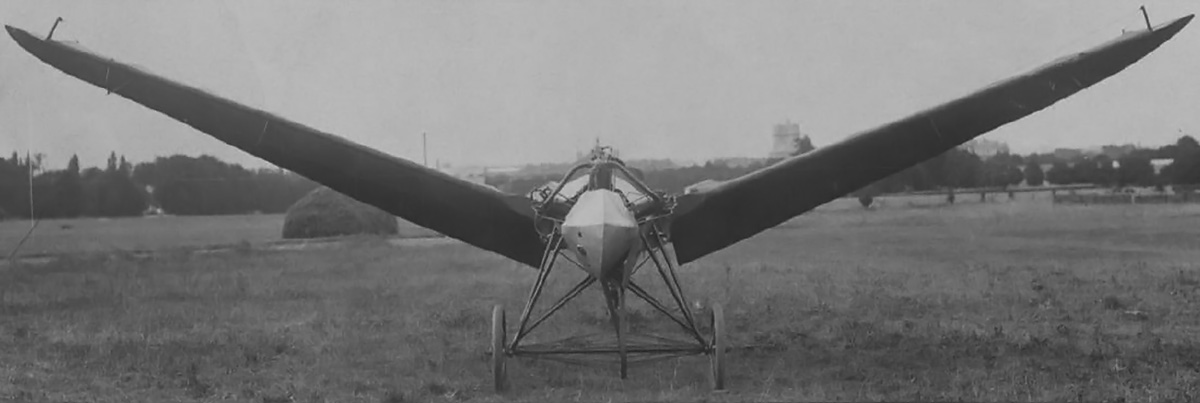
Dubois Riout front

Front view of the DuBois-Riout ornithopter with the three-cylinder Viale engine. The engine cylinders can be seen protruding above the cowling. The wings are positioned around 20 degrees above horizontal. Note the quarter-turn belt drive for the wheel axle.

The patent details how the wings would warp as they moved. The upstroke was made in a neutral, gliding position. On the downstroke, the wing’s trailing edge would deflect up to provide thrust. Springs in the wing regulated the warp to match the power of the downstroke. A slow downstroke would result in the wing maintaining its glide form. The warp of the wing was greatest at the tip, tapering to very little warp at the root.

By 1913, Riout had partnered with Jean Marie DuBois, and a full-scale ornithopter was built. Exactly what role DuBois played in the creation of the ornithopter has not been found, but the resulting machine was known as the DuBois-Riout monoplane. The DuBois-Riout ornithopter had a slender, streamlined airframe that was made from tubular-steel and covered in fabric. A vertical stabilizer with a rudder protruded from below the fuselage. A horizontal stabilizer extended to the sides from the top of the fuselage and incorporated an elevator. The single-place cockpit was positioned between the ornithopter’s wings. The wings had a tubular-steel frame and were fabric-covered. The aircraft was supported by taildragger landing gear.

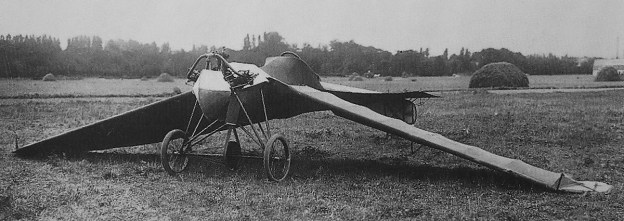
Dubois Riout front wings down

The ornithopter’s wings in the down position were about 20 degrees below horizontal, which was enough to make them contact the ground. This is why wing flapping would only be initiated after the aircraft was airborne, having been propelled to takeoff speed by the wheels. A shroud can be seen covering the top part of the drive belt.

The ornithopter was powered by a three-cylinder Viale Type A engine. The three cylinders were spaced 65 degrees apart in a fan configuration. The air-cooled engine had a 4.13 in (105 mm) bore and a 5.12 in (130 mm) stroke. Its total displacement was 206 cu in (3.4 L), and it produced 35 hp (26 kW) at 1,500 rpm. The engine was positioned in the nose of the ornithopter and encased in a cowling, but its cylinders protruded into the air stream for cooling. The engine drove a crankshaft to flap the wings, just like the patent described.

A major problem facing ornithopter designs was how to start the takeoff roll and gain enough forward speed to achieve flight. Via a belt, the DuBois-Riout used engine power to drive the main wheels during the takeoff run. The drive pulley was positioned behind the engine, and the follower pulley was positioned on the main wheels’ axle and perpendicular to the drive pulley. The follower pulley was offset to the left so that its front edge was directly below the left side of the drive pulley. As the belt came off the rear of the follower, it traveled to the right to reconnect with the right side of the drive pulley. The belt twisting 90 degrees enabled the longitudinal rotation of the engine’s crankshaft to be converted to transverse rotation for the aircraft’s wheels. Once the ornithopter was up to speed, the machine was glided off the ground. Via clutches, engine power was transferred from the pulley to the flapping wings for sustained flight. The DuBois-Riout ornithopter had a 34 ft 5 in (10.5 m) wingspan and a predicted max speed of 84 mph (135 km/h). The machine weighed 794 lb (360 kg).

Dubois Riout side

Side view of the DuBois-Riout ornithopter illustrates the vertical stabilizer under the fuselage and the elongated horizontal stabilizer. Note the large pulley on the wheel’s axle.

In late 1913 or early 1914, Riout initiated tests of the ornithopter but encountered issues with the engine. It is not clear if the engine was not running correctly or if more power was needed. Before the issues were resolved, Riout left to serve in World War I. In 1916, Riout was granted permission to restart tests on the ornithopter. A 50 hp (37 kW) Gnome-Rhône engine was acquired and installed in the aircraft. No information has been found as to what modifications were made to the ornithopter to handle the rotary engine or its gyroscopic torque. Reportedly, the ornithopter made it into the air but quickly came down hard and was wrecked. No one was injured in the mishap, but Riout needed to return to the war, and no further work was done on the ornithopter.

One might think that with the destruction of the DuBois-Riout machine and conventional aircraft proving their worth throughout World War I, Riout would move away from the ornithopter design. However, he persisted, but 20 years passed before his next ornithopter, the Riout 102T Alérion, was built.

Dubois Riout rear

The ornithopter’s rudder can be seen in this rear view. Note the large control wheel in the cockpit and the fabric gap between the wings and fuselage.

Sources:
– “Flying Machine with Flapping Wings” US patent 1,009,692 by René Louis Riout (granted 21 November 1911)
– “French Monoplane with Flapping Wings” Popular Mechanics (February 1913)
French Aeroplanes Before the Great War by Leonard E. Opdycke (2004)
Rotary Wing Aircraft Handbooks and History Volume 11: Special Types of Rotary Wing Aircraft by Eugene K. Liberatore (1954)
– “Avion à ailes battantes Riout 102T” by Christian Ravel Le Trait D’Union No 225 (January-February 2006)