Monthly Archives: June 2019

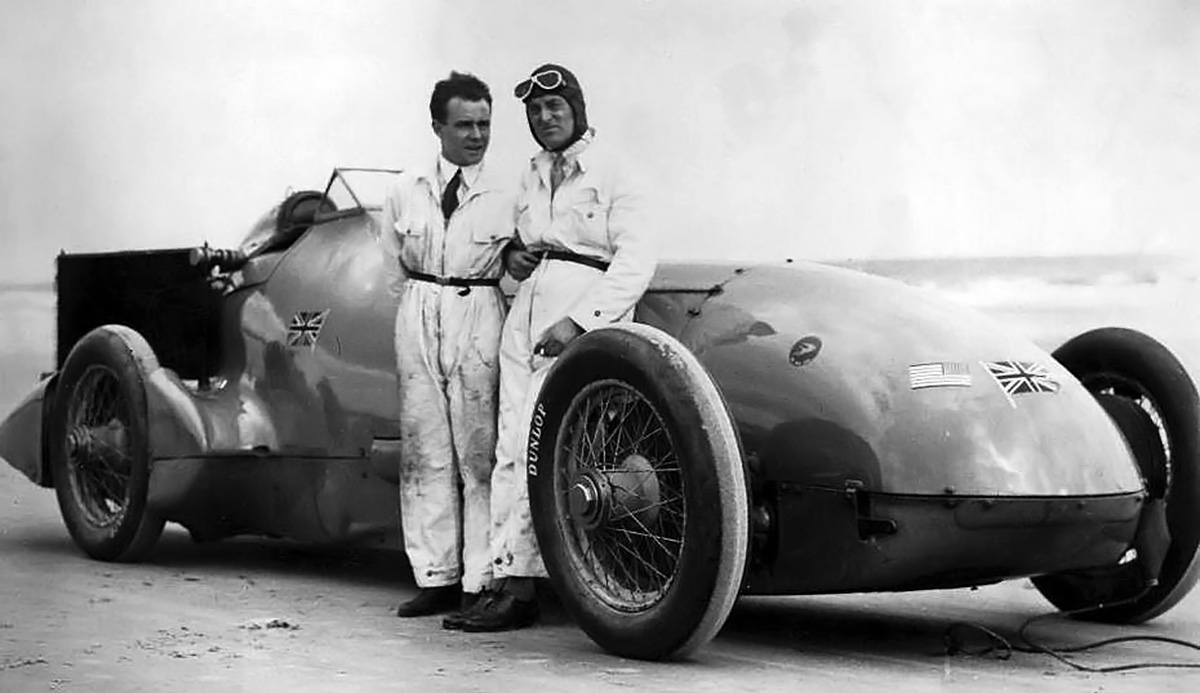
Campbell-Napier-Railton Blue Bird Malcolm 1931

Blue Bird LSR Car Part 3: Campbell-Napier-Railton (1931-1932)

By William Pearce

Malcolm Campbell got his start in setting Land Speed Records (LSRs) in 1924 with the Sunbeam 350HP. His next LSR car, the Napier-Campbell Blue Bird, had reached its peak in 1928. Campbell knew his car needed a redesign to beat Henry Segrave’s 231.362 mph (372.341 km/h) run in the Irving-Napier Golden Arrow. In late 1929, Campbell called in Reid Railton to see what more could be done to improve the Blue Bird’s speed. Railton was an automotive engineer who worked for Thomson & Taylor at Brooklands. The Thomson & Taylor shop started out as Thomas Inventions Development, founded by John Godfrey Parry-Thomas and Ken Thomson. After Parry-Thomas, a friend and former co-worker of Railton, was killed during an LSR attempt in 1927, Ken Taylor joined the company, and it was renamed Thomson & Taylor.

Campbell-Napier-Railton Blue Bird Malcolm 1931

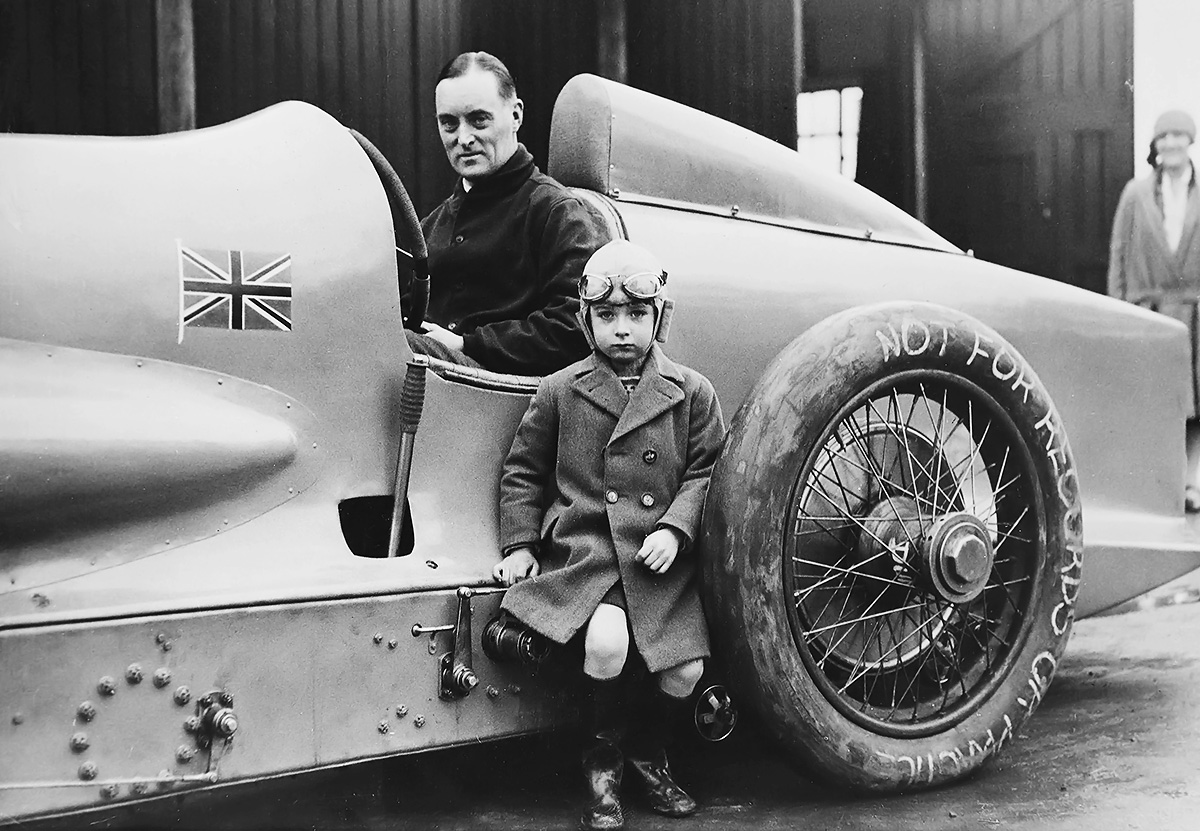
Malcolm Campbell in the newly completed Campbell-Napier-Railton Blue Bird in January 1931. The car was powered by a 1,450 hp (1,010 kW) Napier Lion VIID W-12 engine.

Railton had the Napier-Arrol-Aster Blue Bird sent to the Thomson & Taylor shop. A few weeks later, Railton advised Campbell that if he could acquire a 1,500 hp (1,119 kW) engine, the car could be modified to reach 250 mph (400 km/h). Campbell would need the speed. Sunbeam was finishing construction of its Silver Bullet LSR car with the goal of reaching 250 mph (400 km/h), and the car was expected to make a record attempt later in 1930.

Campbell went to the British Air Ministry seeking the loan of the latest Napier Lion engine. However, the Air Ministry was reluctant to lend an engine and required a £5,000 deposit per engine. Campbell was not prepared for this expenditure, but his friend and powerboat racer Marion Barbara (Joe) Carstairs donated £10,000 to cover the cost. Campbell returned to the Air Ministry and was able to acquire two Napier Lion VIID engines. The supercharged W-12 engine produced 1,450 bhp (1,010 kW) at 3,600 rpm and was the same type that powered the Gloster IV floatplane, an entrant in the 1929 Schneider Trophy Contest.

Once the engines were delivered, the Blue Bird was built at the Thomson & Taylor shop. The frame, front axle, rear axle center section, steering system, and brakes were all retained. A new flywheel, clutch, gearbox, and rear axle shafts were installed. The Railton-designed three-speed gearbox had a 4.01 to 1 first gear, a 2.27 to 1 second gear, and a 1.24 to 1 third gear. The gearbox was offset 7 in (178 mm) to the left and allowed the driver’s seat to be offset to the right and lowered to about 10 in (254 mm) above the ground. The lower driver’s seat allowed the height of the entire car to be kept to a minimum. The enclosed drive shaft ran along the left side of the cockpit to the rear axle, which was also offset. The rear axle was encased in an aluminum housing and driven at 1.27 to 1 via a bevel pinion and a crown gear.
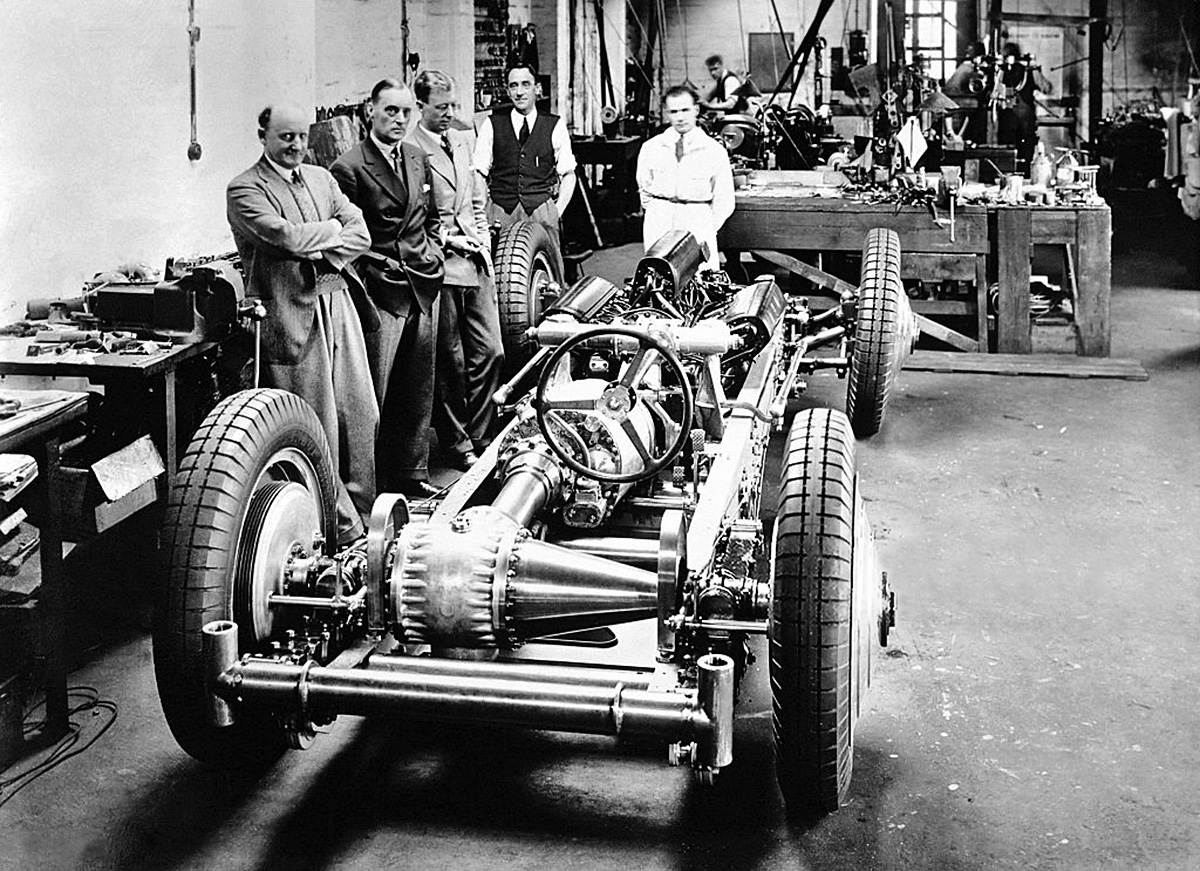
Campbell-Napier-Railton Blue Bird build 1930

The Campbell-Napier-Railton being built in the Thomson & Taylor shop at Brooklands. Note the offset of the gearbox and driveshaft. From left to right are Ken Thomson, Malcolm Campbell, Reid Railton, Ken Taylor, and Leo Villa.

The chassis’ half-elliptic spring suspension was altered so that the left side of the car was more heavily sprung than the right. This resulted in the left side of the car sitting slightly higher than the right when the vehicle was at rest. However, under power, the torque of the engine would level the suspension so that the car was at an even ride height. Provisions for screw jacks were added to all four corners of the chassis. Having the simple jacks built into the car would decrease the time needed to change tires between record runs.

All tires were made by Dunlop, mounted to stamped-steel rims, and inflated to 120 psi (8.27 bar). An aerodynamic disc made of aluminum covered each rim. The front tires were 35 x 6 in (889 x 152 mm), and the rear tires were 37 x 6 in (940 x 152 mm). Each tire and rim weighed approximately 224 lb (102 kg) and was secured to the car by 10 lug nuts. The 18 in (457 mm) diameter and 1.625 in (41 mm) wide drum brakes with machined fins used on the previous Napier-Campbell Blue Bird were retained, but they were operated solely by a foot pedal and used a vacuum booster.

The body designed by Railton was tested and refined by Rex Pierson in the wind tunnel at Vickers-Armstrongs Ltd. The aluminum body was built by J Gurney Nutting & Co in 36 days. A new radiator was built to conform to the car’s new body. The radiator was mounted and cowled in its own housing at the front of the car. Air would pass through the radiator and be swept upward over the engine cowling. Having the radiator separate helped keep air out of the car’s body. The coolant tank was located in the main body of the car, just in front of the engine. The cooling system held 26 US gal (22 Imp gal / 100 L) of water. A 6 US gal (5 Imp gal / 23 L) oil tank was mounted next to the engine.

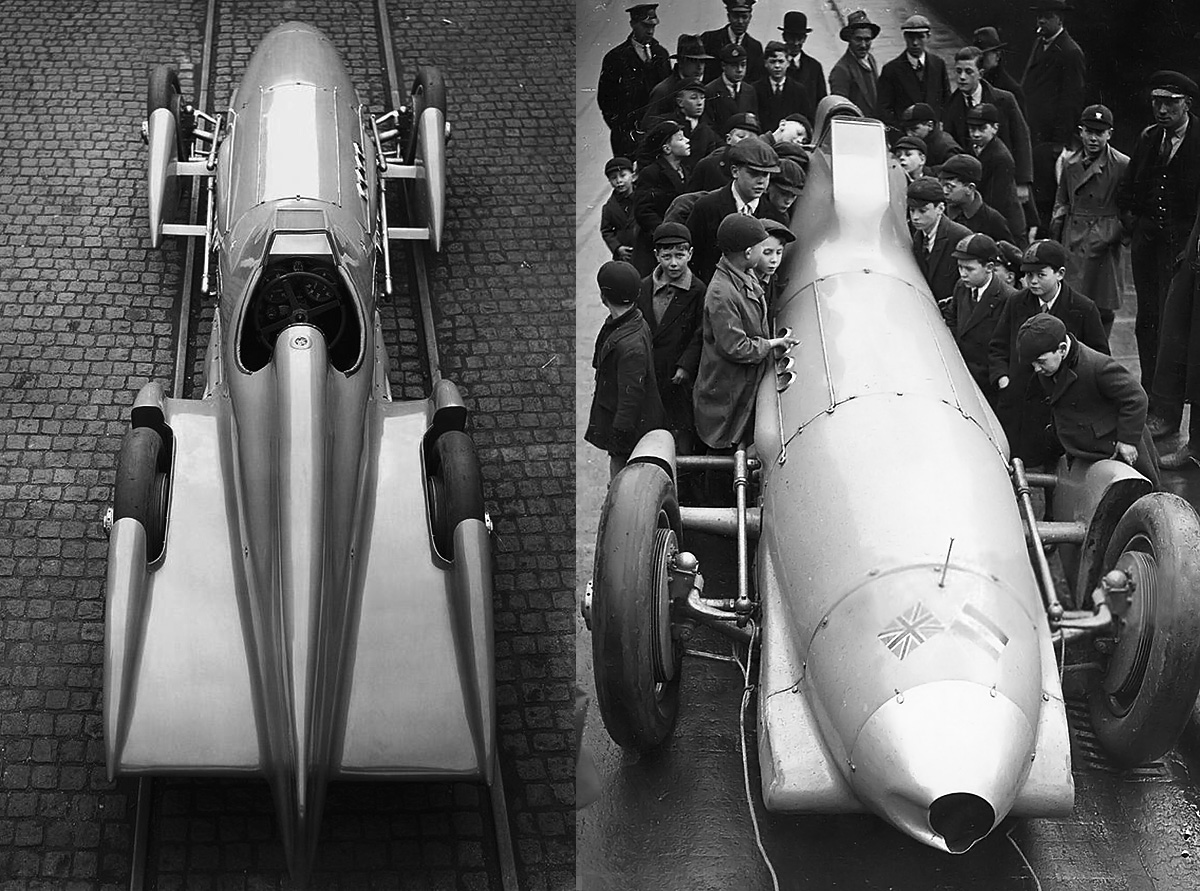
Campbell-Napier-Railton Blue Bird build rear 1931

The body panels of the Campbell-Napier-Railton were removable, except for the tail fin. A screw jack can be seen supporting the car. Note the “Napier-Campbell” lettering on the fin.

Just forward of the engine was a tachometer mounted to the cowling and covered with a fairing. This was installed to enable the driver to keep his eyes on the course and see the engine speed at the same time. It could also be used as a sight when the vehicle was at speed. The car’s wheel fairings were so large that they would contact the ground if a tire went flat. As a result, the bottom of the fairing was made of thin aluminum and designed to crumple without damaging the rest of the fairing in the event of a flat tire.

A small scoop “ventilator” was installed in front of the cockpit. It drew air into the cockpit, increasing its relative air pressure. This was done to prevent exhaust gases from accumulating in the cockpit and to prevent a back draft working to lift the driver out of the cockpit. A headrest positioned behind the offset cockpit tapered back into a large tail fin, which was also offset to the left of the car’s center. Behind the cockpit was a 28 US gal (23 Imp gal / 105 L) fuel tank. The filler for the gas tank was accessed by removing the headrest pad in the cockpit.

The car was finished in early January 1931 and had “Napier-Campbell” written on the tail. The car is often called the Campbell-Napier-Railton to eliminate confusion with other Blue Bird versions, and it is occasionally referred to as the Blue Bird IV. However, some publications continued to credit the car as Blue Bird III, and the American press mistakenly referred to it as the Blue Bird II. Campbell and his team continued to simply call the car “Blue Bird,” as they had done with the previous versions. The Campbell-Napier-Railton Blue Bird had a front track of 5 ft 4 in (1.63 m) and a rear track of 5 ft 2 in (1.57 m). The car had a wheelbase of 12 ft 2.75 in (3.73 m) and was over 25 ft (7.62 m) long. The top of the cowling was 45 in (1.14 m) from the ground, and the car had 5 in (127 mm) of ground clearance. It weighed around 7,950 lb (3,606 kg), which included approximately 1,450 lb (658 kg) of lead ballast by the rear axle intended to improve traction.
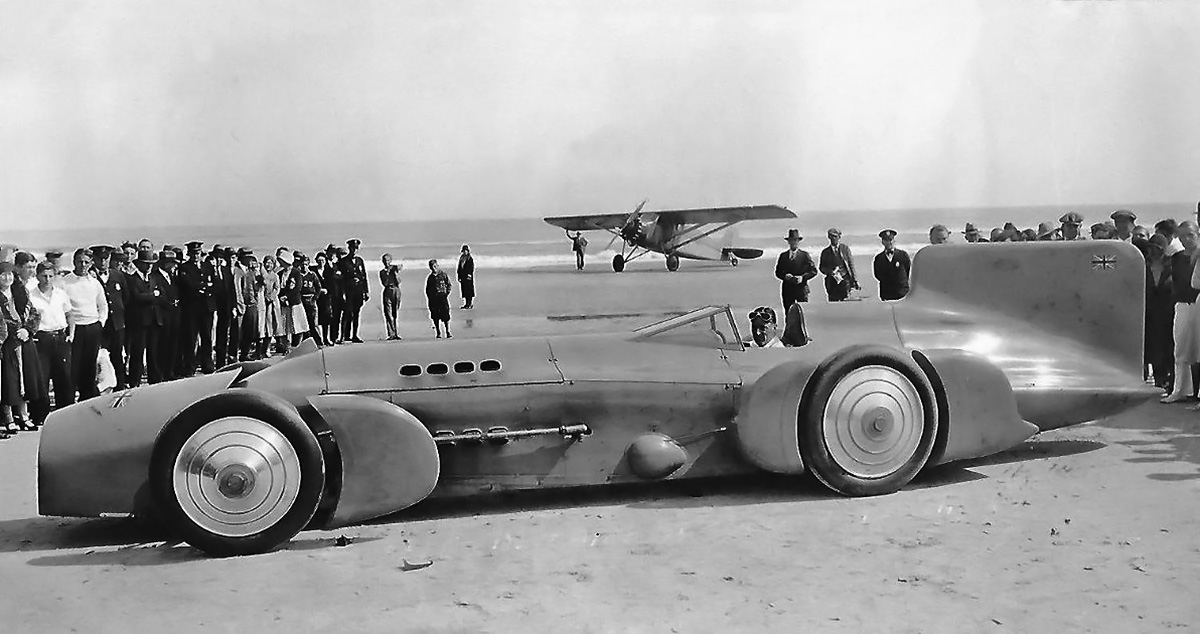
Campbell-Napier-Railton Blue Bird Daytona Beach 1931

Campbell sits in the Blue Bird on Daytona Beach in 1931. Note the cowl-mounted tachometer just in front of the engine. The aircraft (Stinson SM-2 Junior) in the background was hired by Campbell to fly Leo Villa from the start of the course to the turnaround after the first run. As the event played out, Villa watched the Blue Bird on the return run from the aircraft since Campbell did not stop between runs.

While the Campbell-Napier-Railton Blue Bird was being built, engine and gearbox issues caused the Sunbeam Silver Bullet to fall well short of its speed goal. But a new contender, an Australian named Wizard Smith, was working on the Fred H. Stewart Enterprise and intended to reach the 250 mph (400 km/h) mark. Smith planned to run his car on Ninety Mile Beach in New Zealand, which was of much interest to Campbell. However, after the trouble in Verneuk Pan, South Africa, Campbell was sticking with Daytona Beach in Florida until someone else found a better location. Campbell left for Daytona Beach in mid-January 1931 and arrived on the 29th, hoping to set a new LSR before anyone else could.

The car was quickly prepared, and Campbell’s first test run was on 31 January 1931. This was the first time the new Blue Bird got up to any serious speed, around 200 mph (322 km/h), as there was no reasonable way to test the car at high-power in England. During the run, in thick mist and haze, the spectating crowd had pushed onto the course and were nearly hit by Campbell making his return. On 2 February, Campbell hit 240 mph (386 km/h). The next day, he had reached around 260 mph (418 km/h) when the gearbox slipped out of third gear and the engine overrevved, potentially causing damage. A quick inspection found no issues with the engine, and the team decided against swapping it out for the spare Lion. Some images show the car with the tachometer on the cowling, while others show that it was removed and covered over. However, it is not clear if the tach was missing for the practice runs and added for the record attempt, or vice versa.

The car was ready for another run on 5 February 1931, which was another imperfect day with mist and fog and rough spots on the beach. With the Blue Bird pointed to the south, Campbell gained speed and shifted into second at 80 mph (129 km/h). He noted that the car did not accelerate as quickly as it had in the past, most likely a result of some engine damage from the over-rev. Once he hit 150 mph (241 km/h), Campbell shifted into third and kept his foot firmly on the accelerator, recording a speed of 246.575 mph (396.824 km/h) over the measured mile (1.6 km). Campbell immediately turned around and started the second pass without stopping. On his return trip north, the Blue Bird reached 244.897 mph (394.124 km/h). The average of the two runs over the flying mile (1.6 km) was 245.736 mph (395.474 km/h), a new LSR. Campbell bettered Segrave’s speed in the Golden Arrow by over 14 mph (22 km/h). Campbell also set a flying km (.6 mi) speed record of 246.086 mph (396.037 km/h).

Campbell-Napier-Railton Blue Bird Daytona Pier 1931

Again in 1931, the cowl-mounted tachometer has been removed and covered. Note the opening between the radiator housing and the car’s body. The Daytona Beach pier is in the background, as is the Austin that Campbell drove to a Class H (under 750 cc / 45 cu in) record of 94.031 mph (151.328 km/h) on 6 February 1931.

Campbell and the rest of the team returned to England on 20 February 1931 and received many accolades. Campbell was knighted on 21 February by King George V, but Campbell knew that the Blue Bird could achieve faster speeds under better conditions. The Enterprise in New Zealand was still under construction and a possible contender for the absolute LSR. Although Campbell was the first person to exceed 240 mph (four miles per minute) on land, the 250 mph (400 km/h) mark was just a few mph away. After Daytona, the Blue Bird was sent on a brief trip to Buenos Aires, Argentina for a British Empire Exhibition. Once back in England, the Blue Bird was demonstrated at Brooklands on 24 May, and preparations were soon underway to return to Daytona Beach in 1932.

No significant changes were made to the Blue Bird for its LSR attempt in 1932. The radiator was slightly decreased in size and covered with a new cowling that had a smaller, extended opening. The cowl-mounted tachometer was removed, and the spare Lion engine was installed. However, some changes had occurred at Daytona Beach. The beach was a little over 23 miles (37 km) long, but a pier was positioned near its center, cutting the beach into two 10-mile (16-km) sections. Ten miles (16 km) had been enough room to set flying km (.6 mi) and mile (1.6 km) records, but it was a challenge to set 5-mile (8-km) records, and very difficult to set 10-km (6.2-km) records. As the absolute LSR was pushed higher, even the 10-mile (16 km) stretch of beach was becoming inadequate. To work toward a solution, some pilings were removed from the pier, creating a 50-ft (15-m) gap for LSR cars to speed through. However, even the most courageous of men, like Campbell, felt that trying to thread the 50-ft (15-m) needle at high-speeds was asking for trouble. The end result was that the course was extended beyond the pier, but not much. LSR cars would go under the pier at around 100 mph (160 km/h) while accelerating or under braking, depending on the direction of travel. No attempts were made to pass through the pier at top speed, and this left attempts on the 10-mile (16-km) record highly inadvisable for Daytona Beach.

Campbell-Napier-Railton Blue Bird Brooklands track 1931

Campbell demonstrates the Blue Bird at Brooklands on 24 May 1931. Note that the disc covering the rear wheel has been removed. The exhaust ports for the upper and left cylinder banks of the Napier Lion are visible.

Whenever possible, Campbell liked to set records on the same course and at the same time, with different sets of timing equipment recording the times for different distances. With the changes extending the course to 12 miles (19 km), Campbell and the Blue Bird would attempt LSRs up to the flying 10 km (6.2 mi). Campbell and team arrived at Daytona Beach on 10 February 1932—the Blue Bird was in perfect condition, but the beach was not. The pressure was on, as Wizard and the Enterprise were already in New Zealand and had set a 10-mile (16-km) record at 164.084 mph (264.077 km/h) on 26 January. The Enterprise was being prepared for an attempt on the absolute LSR as well as record attempts for longer distances.

After waiting for some time, the conditions on Daytona Beach had improved but were still far from perfect. On 20 February 1932, Campbell made a preliminary test run in the Blue Bird with rather rough results. On 24 February, while conditions were still improving, Campbell decided to make another test run south before a record attempt. Campbell liked what he saw and felt during the test run and decided to give the southbound leg all that he had. Aided by a 20-mph (32-km/h) tailwind, the Blue Bird covered the flying mile at 267.459 mph (430.434 km/h). The northbound return against the wind was at 241.773 mph (389.096 km/h), giving an average of 253.968 mph (408.722 km/h) over the flying mile (1.6 km). New records for the 1 km (.6 mi) and 5 km (3.1 mi) were set at 251.340 mph (404.493 km/h) and 241.569 mph (388.768 km/h) respectively. Speeds for the 5 mile (8 km) and 10 km (6.2 mi) were not recorded due to a malfunction with the timing equipment.
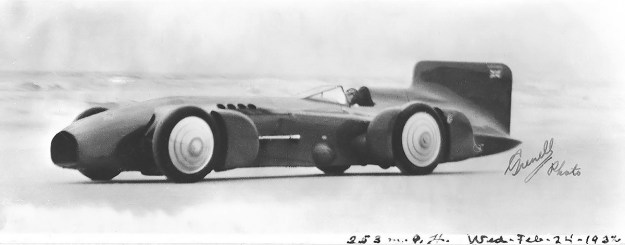
Campbell-Napier-Railton Blue Bird Daytona 1932

Campbell and the Blue Bird rocket north along Daytona Beach on 24 February 1932. The revised nose was somewhat sleeker and well-matched with the rest of the large car’s aerodynamic body.

Campbell was a little disappointed with the speeds, and decided to try again. Rain prevented any record attempts on 25 February 1932, and although the 26th was clear, the wind had kicked up, and the beach was deteriorating. Campbell decided to make a run for fear that the conditions would continue to get worse. The speeds for the km (.6 mi) and mile (1.6 km) were slower, but he set new records for 5 km (3.1 km) at 247.941 mph (399.023 km/h), 5 mile (8 km) at 242.751 mph (390.670 km/h), and 10 km (6.2 mi) at 238.669 mph (384.101 km/h).

Just after breaking the 250 mph (400 km/h) mark, and even before returning to England, Campbell was considering what it would take to reach 300 mph (483 km/h). If the Blue Bird could reach 250 mph (400 km/h) with the 1,450 hp (1,081 kW) Napier Lion, then surely 300 mph (483 km/h) would be possible with a 2,500 hp (1,864 kW) Rolls-Royce R engine. It was not long before Campbell acquired an R engine and work on fitting it into the car began. This led to the Campbell-Railton-Rolls-Royce Blue Bird.

Campbell-Napier-Railton Blue Bird Brooklands side 1932

Campbell sits in the Campbell-Napier-Railton Blue Bird at Brookland on 28 March 1932. Note the Thomson & Taylor sign in the background.

This article is part of an ongoing series detailing Absolute Land Speed Record Cars.

Sources:
The Land Speed Record 1930-1939 by R. M. Clarke (2000)
The Record Breakers by Leo Villa (1969)
The Unobtainable: A Story of Blue by David de Lara (2014)
Napier: The First to Wear the Green by David Venables (1998)
My Thirty Years of Speed by Malcolm Campbell (1935)
Reid Railton: Man of Speed by Karl Ludvigsen (2018)
The Fast Set by Charles Jennings (2004)
Land Speed Record by Cyril Posthumus and David Tremayne (1971/1985)

Napier-Campbell Blue Bird 1929

Blue Bird LSR Car Part 2: Napier-Campbell (1927-1929)

By William Pearce

When Malcolm Campbell set his first Land Speed Record (LSR) at 146.16 mph (235.22 km/h) on 25 September 1924, he knew the record would not stand for long. The Sunbeam 350HP Blue Bird that he was driving was an old design, and faster cars, like the Djelmo, were in the works. Campbell decided to start designing a car capable of 180 mph (290 km/h). However, there was still a little speed left in the 350HP, and Campbell upped his own record to 150.869 mph (242.800 km/h) on 21 July 1925. The car was then sold, and work concentrated on the new LSR car.

Napier-Campbell Napier-Campbell Blue Bird 1927 no bodyBlue Bird 1929

View of the bodyless Napier-Campbell Blue Bird at Pendine Sands. Note the exhaust manifold for the center cylinder bank, the coolant (water) tank above the steering column, the size of the gearbox, and the oil and fuel tanks behind the rear axle.

Campbell had used his connections with the British Air Ministry to acquire a 450 hp (356 kW) Napier Lion VA aircraft engine, which resulted in the car often being referred to as the Napier-Campbell Blue Bird, but it was also called the Blue Bird II. The Lion had a “broad arrow” configuration made up of three cylinder banks, each with four cylinders. One cylinder bank was in the vertical position, and it was flanked on the left and right by the other cylinder banks at a 60 degree included angle. The W-12 engine had a 5.5 in (140 mm) bore and a 5.125 in (130 mm) stroke. Total displacement was 1,461 cu in (23.9 L), and the Lion produced 450 hp (356 kW) at 2,000 rpm and 502 hp (374 kW) at 2,200 rpm.

With the engine on hand, Campbell turned to Amherst Villiers, a well-respected British engineer, to design the Napier-Campbell LSR car around the Lion engine. However, the relationship soured, and Villers left the project after the frame was designed. Italian engineer Joseph Maina, a friend of Campbell’s head mechanic Leo Villa, took up the project and designed the rest of the future record-breaker.

The Napier-Campbell LSR car was of a fairly conventional layout. The car’s C-channel frame rails were made by Vickers Ltd using a special steel with three-percent nickel. The frame’s four cross members were machined from solid forgings. The engine was installed near the front of the vehicle and behind a custom-made radiator. The 12 US gal (10 Imp gal / 45 L) coolant reservoir tank was positioned behind the engine and around the steering column. The steering column led to a cross-shaft with two steering boxes, each operating a drag link that extended along the side of the car to a front wheel.

Napier-Campbell 1927 M-D Campbell

Malcolm Campbell sits in the cockpit of the newly-completed Napier-Campbell as a serious-looking Donald prepares for his own record-braking future. Note that the windscreen has not been installed.

The special three-speed epicyclic (planetary) gearbox was designed by Maina and Forster Brown. Part of Maina’s agreement with Campbell was that the Napier-Campbell LSR car would use his gearbox, as Maina and Brown were trying to market the design to the automotive industry. The forward speed gear ratios were a first gear of 3.0 to 1, a second gear of 1.5 to 1, and a third gear of 1 to 1. A reverse gear was also included. The shift lever extended from the right side of the gearbox. An enclosed drive shaft (torque tube) led from the gearbox to the rear axle. The rear axle was encased in an aluminum housing and driven at 1.27 to 1 via a bevel pinion and a crown gear. Behind the rear axle was a 12 US gal (10 Imp gal / 45 L) oil tank and a 24 US gal (20 Imp gal / 91 L) fuel tank.

The car was supported with half-elliptic spring suspension. The front tires were 33 x 5 in (838 x 127 mm), and the rear tires were 35 x 5 in (889 x 127 mm). The Dunlop tires ballooned to 5.85 in (149 mm) wide when filed with air. All four wheels used 18 in (457 mm) diameter drum brakes that were 1.625 in (41 mm) wide. The drums were machined with fins around their circumference to dissipate heat. The brakes could be operated by either a foot pedal or a hand lever. The Napier-Campbell had a front track of 5 ft 5.25 in (1.66 m) and a rear track of 4 ft 9 in (1.45 m). The car had a wheelbase of 12 ft 1.5 in (3.70 m) and was 15 ft (4.57 m) long. It weighed around 6,000 lb (2,722 kg).

The car’s Lion engine, Villers frame, and Maina gearbox were delivered to Robinhood Engineering Works, which was founded by Kenelm Lee Guinness. Here, the chassis was completed and made ready for the body. The car was then transported to Campbell’s Povey Cross estate where it could be completed under the watchful eye of Leo Villa.

Napier-Campbell Blue Bird 1927 Pendine early

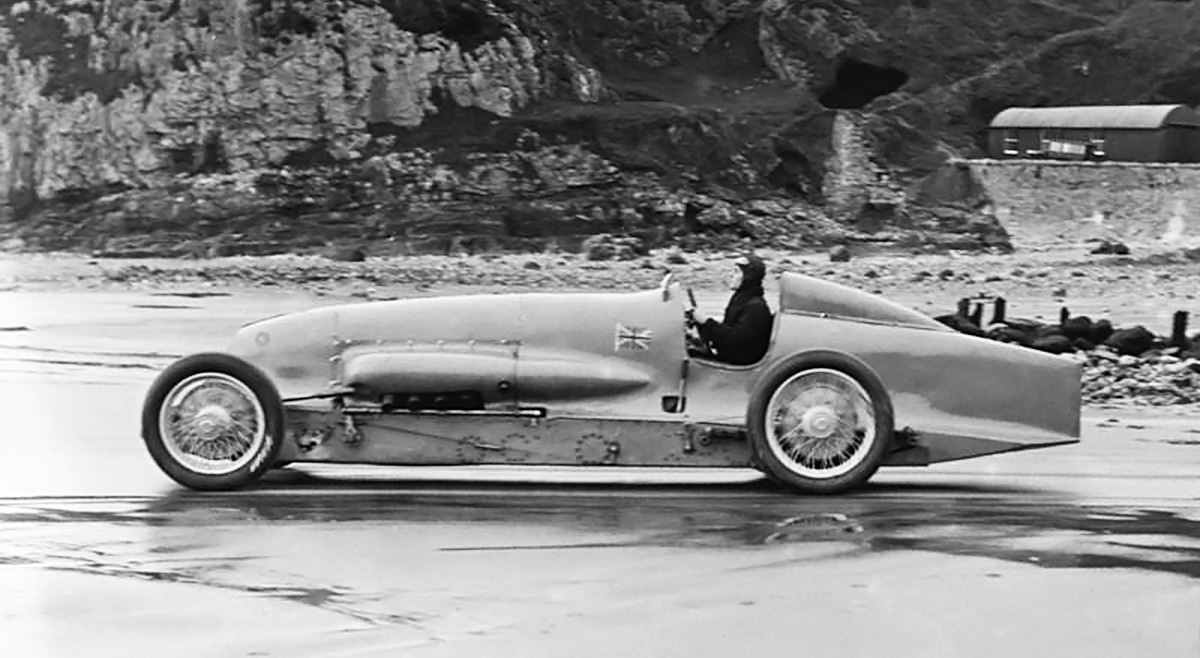
The Napier-Campbell at Pendine Sands in early January 1927. The engine cowling has no louvers. A small windscreen sits ahead of the cockpit, and there are no wind deflectors by the cockpit sides. Note the water on the sand.

The aluminum body of the Napier-Campbell was made by workers from Jarvis & Sons and fitted as close to the chassis as possible. A large opening at its front provided cooling air to the radiator. Individual exhaust stacks for the left and right cylinder banks protruded from bulges in the engine’s cowling. Exhaust for the center cylinder bank was collected in a manifold that split into two pipes behind the engine, with one pipe exiting the left side of the cowling and the other pipe exiting the right side. The cockpit was positioned above the drive shaft, and the driver’s legs straddled the gearbox and its shifter. Two large tachometers dominated the dashboard, with one indicating the engine rpm and the other the driveshaft rpm. A small windscreen was positioned in front of the cockpit, and an aerodynamic headrest extended behind the cockpit. Behind the rear wheels, the car’s body tapered into an extended tail. When Campbell went to sit in the nearly completed car, it was found that the steering wheel needed to be removed for him to get in and out of the cockpit.

While the Napier-Campbell Blue Bird was being constructed, Henry Segrave, driving a modified Sunbeam racer, slightly increased the LSR to 152.33 mph (245.15 km/h) on 16 March 1926. The record was then decisively smashed by John Godfrey Parry-Thomas in the Liberty V-12-powered Babs on 27 April 1926 at a speed of 168.074 mph (270.489 km/h). Parry-Thomas upped the record to 170.624 mph (274.593 km/h) the following day. Parry-Thomas was looking to push his car further, and others were quickly closing in on Napier-Campbell’s target speed of 180 mph (290 km/h). To make matters worse, Sunbeam was constructing a special 1,000 hp car designed to propel Segrave to over 200 mph (322 km/h). If an LSR was in his future, Campbell and his Blue Bird would need to act fast.

The Napier-Campbell Blue Bird was completed on 30 December 1926 and taken to Pedine Sands for its first test on 2 January 1927. Running on the very wet beach, the gearbox was hard to shift, the brakes were very inadequate, and the cockpit design resulted in wet sand flying into Campbell’s face and covering his goggles. The car was returned to Povey Cross where work was done on the gearbox and brakes. A larger windscreen was installed, and wind deflectors were added just in front of the cockpit sides. A significant amount of air had been blowing out of the cockpit, and the updraft made Campbell uncomfortable. To redirect the airflow, vents were added to the car’s tail, and louvres were added to the previously smooth engine cowling. Some sources indicate a new racing version of the Napier Lion VA was installed. This engine had a higher compression ratio and produced 585 hp (436 kW) at 2,350 rpm. It was built for the Gloster II floatplane intended for the 1924 Schneider Trophy Contest, which was postponed.

Napier-Campbell Blue Bird 1927 Pendine Record

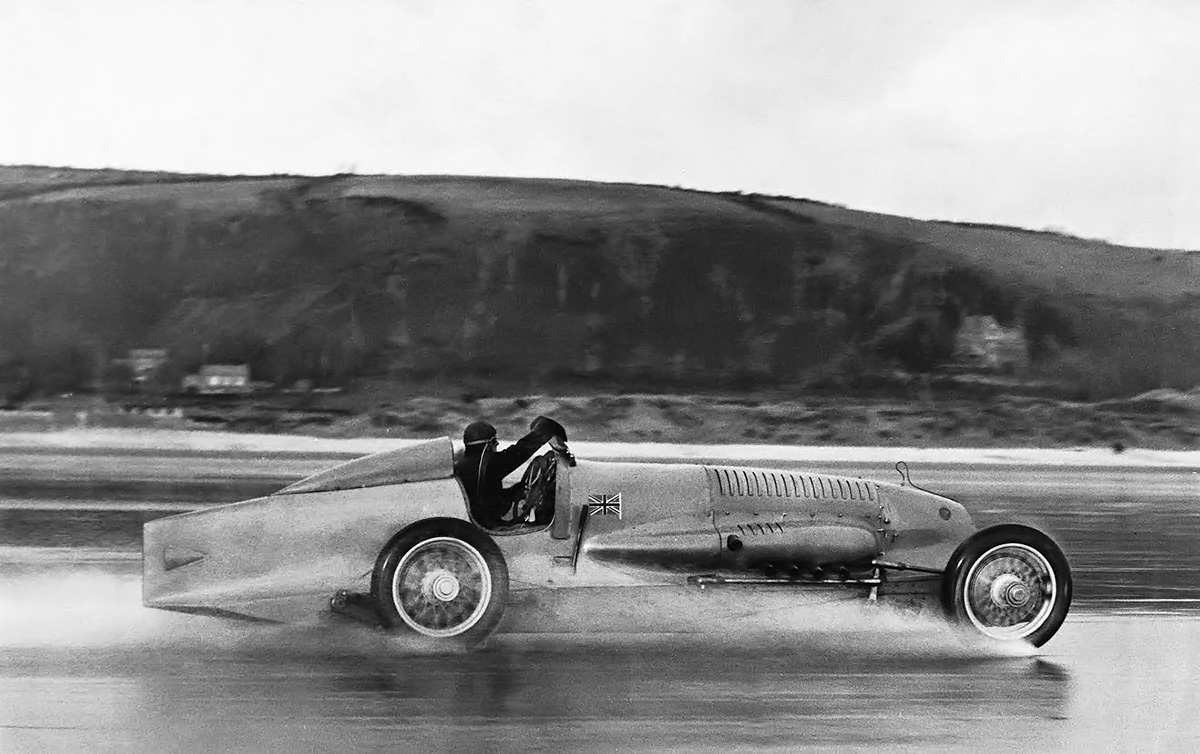
Campbell running at Pendine Sands in late January or early February 1927. The Napier-Campbell now has louvers on the cowling, a larger windscreen, wind deflectors by the cockpit, and vents on both sides of the tail. Note the single exhaust stack for the center bank protruding from the bulge in the cowling. Another stack is located on the other side of the car.

Later, in mid-January, Campbell returned to Pendine Sands but could only reach approximately 160 mph (257 km/h), not fast enough to set a record. The poor conditions caused part of the issue, but the car was still experiencing difficulties. Work continued on the Napier-Campbell while everyone waited for better weather. On 20 January, Campbell made a record attempt and achieved 166.38 mph (267.76 km/h) against the wind and 171.30 mph (275.68 km/h) with it. The average of 168.84 mph (271.72 km/h) was not sufficient for a new record. Campbell made two more attempts on the record, but the beach conditions prevented him from bettering his speed.

The Napier-Campbell was returned to Povey Cross for more work and in the hope that better conditions would soon prevail at the beach. Campbell and the car returned to Pendine Sands on 30 January 1927, but conditions were still far from ideal. On 3 February, Campbell had two furrows plowed along the beach to help drain water and make a strip of dry sand. The work was somewhat successful, and on 4 February, Campbell felt that the weather was tolerable and the beach sufficiently dry to attempt a record. On his first run, he covered the km (6 mi) at 179.157 mph (288.325 km/h). On the return, a bump lifted Campbell out of his seat, and his head hit the slipstream. The wind pushed Campbell’s goggles up his forehead, and he had to drive squinting and with one hand while he pulled them down. The mishap decreased Campbell’s speed to 169.291 mph (272.448 km/h). However, it was still enough to set new records, averaging 174.883 mph (281.447 km/h) in the flying km (.6 mi) and 174.224 mph (280.386 km/h) in the flying mile (1.6 km).

Although Parry-Thomas congratulated Campbell on the new record, he also wanted to win it back. On 3 March 1927, Parry-Thomas in Babs was trying to regain the record, when the car went out of control and crashed. Parry-Thomas was killed in the accident, becoming the first person to die while attempting a LSR. On 29 March 1927, Campbell’s record was obliterated when Segrave averaged 203.793 mph (327.973 km/h) over the flying mile (1.6 km) at Daytona Beach, Florida in the Sunbeam 1,000 hp Mystery Slug.

Napier-Campbell Blue Bird 1928 Daytona

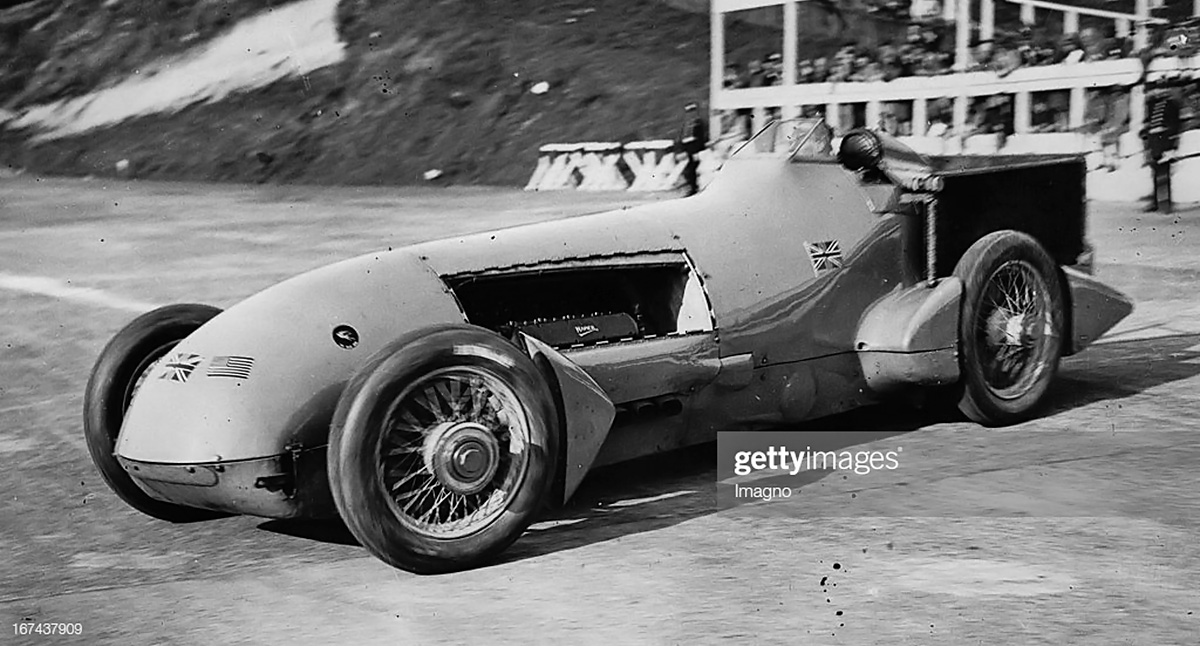
The Napier-Campbell Blue Bird at Daytona Beach. The angle gives a good view of the two surface radiators on each side of the car, the rear wheel fairings, and the steering links. The front wheel fairings are not installed.

Campbell was not pleased that he had been beaten to 180 mph (290 km/h) and 200 mph (322 km/h). He knew the Blue Bird in its then-current form would not be able to exceed Segrave’s record, but with so much invested and now having become completely obsessed with setting LSRs, Campbell decided to rebuild the Napier-Campbell to surpass the 200 mph (322 km/h) mark.

The results of the rebuild left the basic chassis unchanged, but a new Lion VIIA engine was installed at the Napier works in Acton Vale. The engine produced 900 hp (671 kW) at 3,300 rpm and was similar to the one used in the Supermarine S5 floatplane that won the 1927 Schneider Trophy Contest. The Lion VIIA engine was considered “Secret,” and Campbell had negotiated conditions with the British Air Ministry for its use. Other changes included updating the rear axle to a 1.5 to 1 drive ratio. A completely new body was designed by Rex Pierson, chief designer at Vickers-Armstrongs Ltd, and based on results achieved in their wind tunnel. The front radiator was discarded, and a set of two surface radiators were installed on each side of the car, just behind the cockpit. The radiators were built by Fairey Aviation, and each panel contained 122 cooling elements and was 4 ft 7 in (1.40 m) long and 1 ft 7 in (.48 m) tall. The four panels had a total of approximately 2,400 ft (732 m) of tubing. Water entered the radiators by the cockpit and exited the lower rear side.

The car’s new body was built of 18-gauge aluminum by Barkers Ltd. The nose of the body was rounded and enclosed. It extended back to completely encompass the engine, without the bulges of the previous body. Exhaust from the center cylinder bank was now expelled via individual stacks protruding through the right side of the cowling. The scuttle and cockpit sides were built up to limit the amount of air and sand entering to cockpit. The cockpit sides slid down for driver entry and exit. Fairings were added behind the front wheels, and the rear suspension was completely enclosed in fairings. Two different size tail fins were made that could be added behind the cockpit to improve directional stability. The larger fin rose to a height about 8 in (200 mm) above the headrest, and the smaller fin extended back from the headrest fairing at a slight decline. As a result of the changes, the car’s length was extended by 3 ft (.91 m) to 18 ft (5.49 m), and its weight was reduced by a couple hundred pounds to around 5,820 lb (2,640 kg). The updated car was sometimes referred to as Blue Bird III.

Napier-Campbell Blue Bird 1928 Getty

Campbell demonstrating the Napier-Campbell at Brooklands on 9 April 1928, after returning from Daytona Beach. The front wheel fairings are installed, as is the smaller tail fin. Note the space under the cowling between the new updated Lion engine and the car’s new body. (Getty image)

The rebuilt Napier-Campbell racer was completed in January 1928, and Campbell and the car arrived in Daytona Beach, Florida on 12 February. The smaller tail fin was fitted for the record runs. During a test run on 16 February, the car struck some bumps at speed and became airborne. Campbell was lifted out of his seat, and when the car came back down, the underpan caught on the sand and was ripped off. The suspension was also damaged. The car was repaired, and on 19 February 1928, Campbell ran with the wind and covered a mile at 214.797 mph (345.682 km/h). Campbell noted the steering as very heavy, and he lost control immediately after the end of the run as the car slewed to the side. Fortunately, a quick recovery was made, but Campbell was quite shaken from the experience. Campbell decided not to change tires during the turn around for fear that he would not get back into the car. His return leg against the wind was a bit smoother and run at 199.667 mph (321.333 km/h). The average of the runs gave Campbell a new record at 206.956 mph (333.064 km/h), but he was so exhausted after setting the record that he needed help getting out of the car.

Campbell felt the updated Blue Bird could achieve a higher speed if the beach were in a better condition—a top speed of 220 mph (354 km/h) had been anticipated. Campbell also knew that his record would not stand long, as others, like Ray Keech and Frank Lockhart, were at Daytona to set records of their own. Segrave was also having another car built, the Irving-Napier Golden Arrow, scheduled to run in early 1929. On 22 April 1928 Keech broke Campbell’s record when he averaged 207.553 mph (334.024 km/h) in the White Triplex—a brute force, three-engine monster. On 25 April 1928, Lockhart lost his life in the Stutz Black Hawk when a tire blew at over 200 mph (322 km/h).

Napier-Campbell Blue Bird 1928 Villa

Leo Villa, Malcolm Campbell, and the Napier-Campbell racer on the beach at Daytona. The sliding side of the cockpit can be seen in the down position. Note the Blue Bird logo on the car’s nose.

Campbell wanted to find a better course. The lack of traction in beach sand resulted in a lot of wheelspin, and a breeze always blew across beach courses, particularly at Daytona, that did nothing but cost speed. Among other places, there had been rumors of a large dry lake at Verneuk Pan, South Africa that would be ideal for LSRs. Campbell had searched various locales, even traveling to the Sahara Dessert, for an adequate speed record course, but he never found what he was looking for. An associate of Campbell’s had evaluated Verneuk Pan and believed it had potential.

During the search for a new course, Leo Villa had overseen work on another new body for the Naiper-Campbell racer. Again, wind tunnel test results were used to design the new body, which was built by Arrol-Aster and installed at their shop in Dumfries, Scotland. The surface radiators had proved not to be entirely effective and were removed. A new, conventional radiator was installed in the car’s nose. The front of the body was redesigned to incorporate a large opening for the radiator, which was later elongated and reduced in size. The front and rear wheel fairings were enlarged, as was the cockpit windscreen and cockpit opening. The sides of the cockpit were fixed, as was the tail fin, which was a redesign of the smaller fin used on the Daytona record runs. The revised car was called the Napier-Campbell-Arrol-Aster Blue Bird, but it is often just called the Napier-Arrol-Aster.

Once the Napier-Arrol-Aster was completed, the car, spare parts, and crew set off for South Africa. They soon discovered that Verneuk Pan was in the middle of nowhere, 400 miles (645 km) northeast of Cape Town, South Africa. The dry lake sat at 2,500 ft (760 m) above sea level, and there were no developed roads to the lakebed and no near-by workforce to build a course. But Campbell liked the huge, flat, open surface and the fact that the dominion of South Africa was part of the British Empire. Work on a 12-mile (19-km) course had started at the beginning of 1929, before Campbell arrived in South Africa (on 2 February). Once the course was prepared, small but sharp slivers of shale that would cut tires were found protruding from the surface. The top of the lake bed was scraped up, sifted to remove the sharp rocks, and then laid back down to dry into a hard surface under the scorching sun. As soon as the course was ready, massive rains came and flooded the area. It had not rained for five years, but suddenly there were 6 in (152 mm) of water covering the course.

Napier-Campbell Blue Bird 1929

The Napier-Campbell with its third body fresh out of the Arrol-Aster shop. Note the revised wheel fairings, cockpit, and tail fin. The “bird cage” radiator opening was soon revised. The lettering on the tail reads “Napier-Arrol-Aster.”

On 11 March 1929, while a new course was being prepared at Verneuk Pan, Segrave in the Golden Arrow set a new LSR at 231.362 mph (372.341 km/h) on Daytona Beach. Campbell knew that he could not beat Segrave’s speed, but he was going to give a run all he had. The Napier-Arrol-Aster Blue Bird was brought out to the course on 18 April, and a record run was attempted on 21 April 1929. Campbell recorded 224.58 mph (361.43 km/h) on the outbound leg and 212.51 mph (342.00 km/h) on the return. The average speed of the runs was 218.54 mph (351.71 km/h), well short of the absolute LSR record, but enough for a British speed record (top speed achieved on British Empire soil).

The heavy Blue Bird broke through the surface as it ran, resulting in the destruction of eight tires. After some course improvements were made, on 25 April, Campbell set a new flying 5-km (3.1-mi) record at 216.04 mph (347.68 km/h) and a new flying 5-mi (8.0 km) record at 211.49 mph (340.36 km/h). That was all Verneuk Pan and the Napier-Campbell Blue Bird had to offer. The team returned to England, and after a six-week tour of South Africa, so did Leo Villa and the car.

Campbell wanted the LSR back, and before the car had returned from South Africa, he had been considering whether a new car should be built or if the Napier-Arrol-Aster Blue Bird could be rebuilt. The new speed goal was 240 mph (386 km/h) and beyond. At the end of 1929, Campbell enlisted Raid Railton to see what more could be done with the Napier-Arrol-Aster Blue Bird. Railton had some ideas, which led to the car being rebuilt as the Campbell-Napier-Railton Blue Bird.

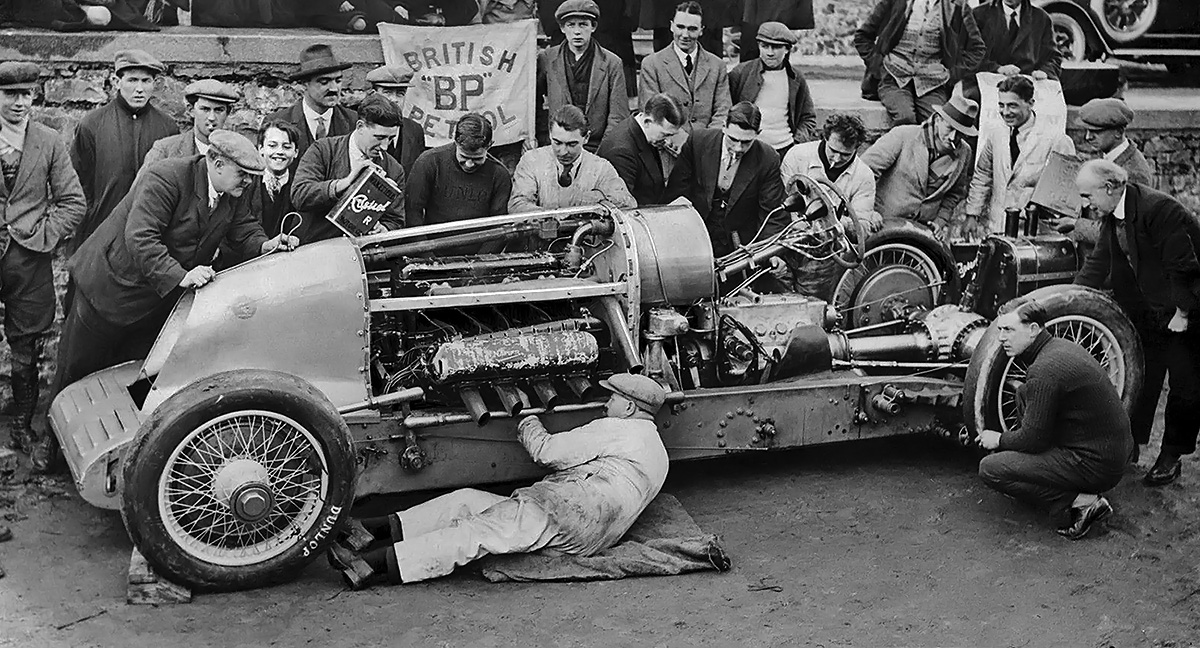
A tribute to the 1927 Napier-Campbell was built by Lorne Jacobs using a 1921 Napier chassis (No. 14097). The Lion was acquired in 1930 by Lorne’s grandfather Gordon, long before Lorne was born. The two-seat car is registered for street use.

Napier-Campbell Blue Bird 1929 r-f

Views of the Napier-Arrol-Aster Blue Bird before (left) and after (right) its adventure at Verneuk Pan. Note the then flag of South African on the car’s nose and the revised radiator opening, which has been damaged. Pictures from Verneuk Pan show the smaller opening undamaged. Most likely, the thin aluminum nose was damaged while the car was on tour in South Africa. The rod protruding from the nose was used as a sight while at speed on the large open lake bed.

This article is part of an ongoing series detailing Absolute Land Speed Record Cars.

Sources:
The Land Speed Record 1920-1929 by R. M. Clarke (2000)
The Record Breakers by Leo Villa (1969)
My Thirty Years of Speed by Malcolm Campbell (1935)
The Unobtainable: A Story of Blue by David de Lara (2014)
Napier: The First to Wear the Green by David Venables (1998)
Land Speed Record by Cyril Posthumus and David Tremayne (1971/1985)
https://drive-my.com/en/test-drive/item/2605-1927-napier-blue-bird-homage.html