Category Archives: Automotive

Djelmo Foresti Dark Blue

Djelmo Land Speed Record Car

By William Pearce

On 17 May 1922 at Brooklands, England, Kenelm Lee Guinness set an official world land speed record* of 133.75 mph (215.25 km/h). This record was set in a Sunbeam racer, powered by a 350 hp (261 kW) Sunbeam Manitou V-12 engine of 1,118 cu in (18.3 L) displacement. This car was later sold to Malcolm Campbell and became the first Blue Bird land speed record car. The Sunbeam Motorcar Company was very involved in record-breaking and racing at this time. At Sunbeam, Louis Coatalen and Vincenzo Bertarione designed a Grand Prix car, but it was never built. The design ended up being sold to Prince Djelaleddin (sometimes spelled Djelalledin).
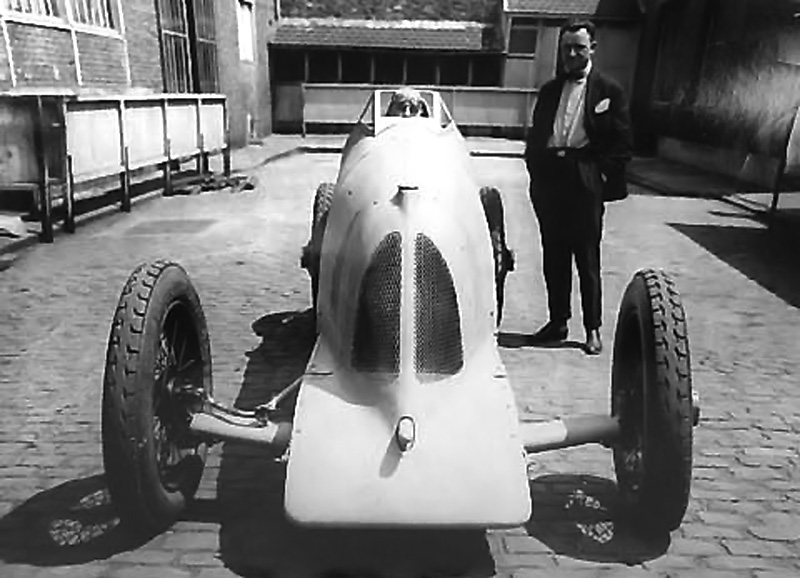
Djelmo Djelaleddin Foresti 1924

A picture from 1924 of the Djelmo racer with Price Djelaleddin behind the wheel and Giulio Foresti at right. The racer was painted light blue. Note the narrow track of the rear wheels.

The Egyptian Prince Djelaleddin lived in Paris, France and had an interest in setting a new land speed record. He hired Edmond Moglia, an Italian engineer living in Paris, to build the Sunbeam-designed racer for an attempt on the record. This new car was named Djelmo (a combination of Djelaleddin and Moglia’s names) and was built under a fair amount of secrecy.

The Djelmo was a narrow and streamlined racer of a conventional layout, with the engine in front of the driver. The car was powered by a straight eight-cylinder engine with a 4.2 in (107 mm) bore and a 5.5 in (140 mm) stroke, for a total displacement of 615 cu in (10.1 L). Aluminum pistons were used, and the engine had a compression ratio of six to one. The cylinders were cast in two blocks of four. The two intake and two exhaust valves per cylinder were actuated by dual-overhead camshafts. The one-piece crankshaft was supported by nine main bearings. On the right side of the engine, one carburetor fed each pair of cylinders. On the left side, the eight exhaust stacks converged into one large pipe that exited low and just before the cockpit. Even though this engine was much smaller than the Manitou, it produced 355 hp (265 kW) when run at 3,000 rpm.
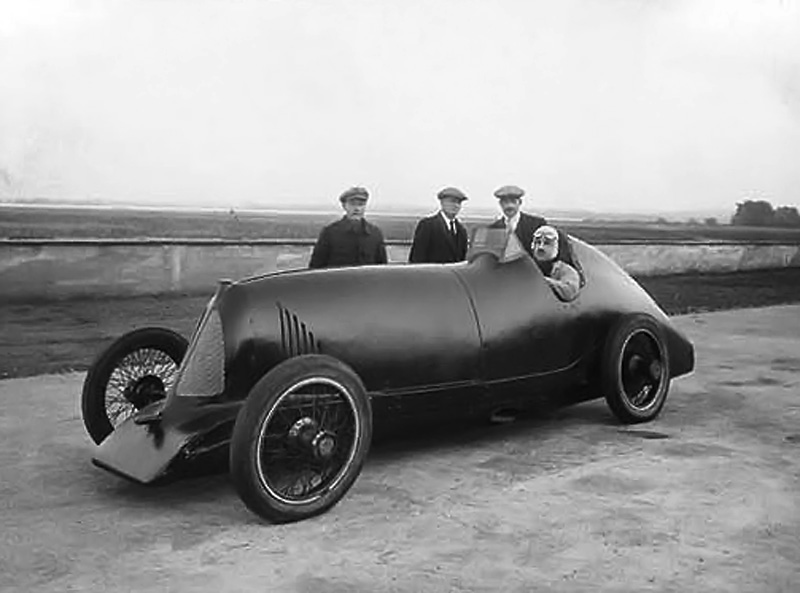
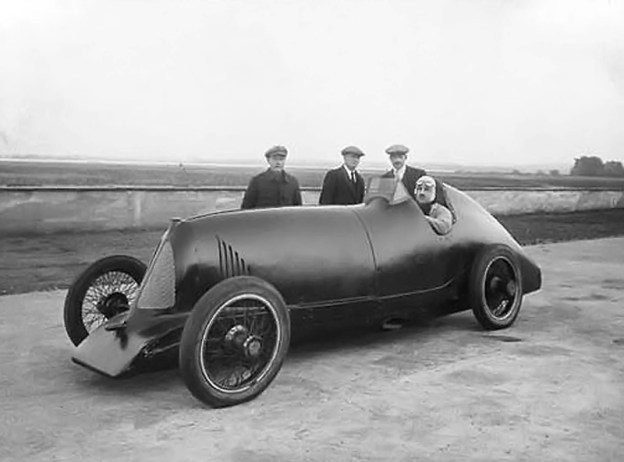
Djelmo Foresti Dark Blue

The Djelmo racer during what is believed to be its first public appearance. This image predates the one above, and reportedly, the racer was painted dark blue.

Three mounts were cast on each side of the engine’s crankcase. The rear mounts acted as the clutch housing to which the gearbox was mounted. The gearbox had two forward speeds and one reverse speed—the reverse gear was to satisfy French regulations. From the gearbox, power was sent to the rear wheels via a driveline geared directly to the rear axle; there was no differential. The rear wheels had a narrow track of only 37.4 in (.95 m). The front wheels had a much wider track of 58.3 in (1.48 m). The steering box and steering wheel were mounted to the top of the gearbox. To slow the Djelmo, a pedal worked a drum brake on the left rear wheel, and a hand lever worked a similar brake on the right rear wheel. The racer’s wheel base was 10.2 ft (3.1 m) and it weighted 2,006 lb (910 kg).

A few pictures of the seemingly complete racer were circulated in 1924. The Italian Giulio Foresti was selected as the driver, and the Djelmo was supposed to be ready for a record run in the United States in 1925. However, the car’s development was protracted, and its performance did not live up to expectations. A few test runs were conducted at sites in France, but these were just tuning sessions, not record attempts. The Djelmo underwent modifications to improve its performance and handling. Various carburetor set-ups were tried, a new windscreen was installed, and the Djelmo’s cowl and rear deck were reworked. The installation of a remote supercharger driven from the driveline was considered but never carried out.
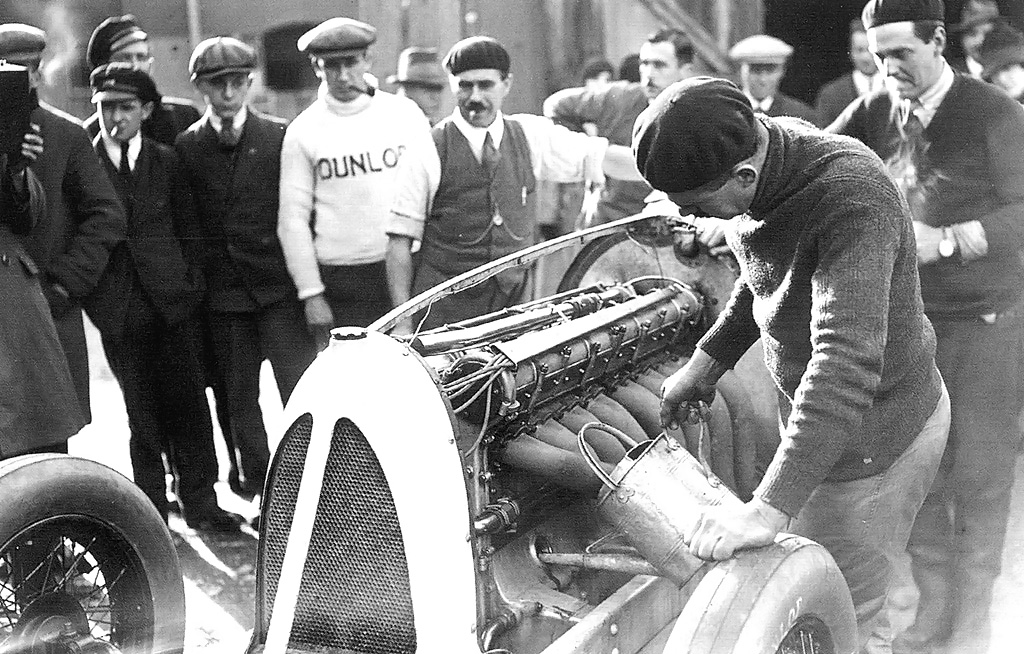
Djelmo engine Pendine

Foresti (at right) oversees oil being added to the Djelmo’s engine at Pendine Sands before a run on the beach. The integral front engine mount can be seen just below the oil can spout. Note the changes to the grill from the earlier images above.

By 1926, John Godfrey Parry-Thomas, in Babs, had increased the land speed record to 171.02 mph (275.23 km/h). It would be hard for the Djelmo to better this speed. In late 1926, Prince Djelaleddin set out to build a new car. The design was a progression of the Djelmo and called for two of the eight-cylinder engines to be placed in tandem with the driver in between. The front engine was to drive the front wheels and the rear engine the rear wheels. A double clutch and gear shift mechanism was to be used, all actuated by single controls. The estimated top speed of this racer was 250 mph (402 km/h).

By late 1927, Henry Segrave, in the Sunbeam 1000 HP “Mystery Slug,” had increased the land speed record to 203.79 mph (328.0 km/h). This speed was far beyond anything the Djelmo could hope for, despite its engine now producing between 400-450 hp (300-355 kW). Foresti had brought the Djelmo to Pendine Sands, Wales earlier that summer for some speed runs. He now focused on breaking the current British record of 174.88 mph (281.44 km/h) held by Campbell in his Napier-powered Blue Bird. Foresti was basically on his own and had no proper facilities in which to work on the Djelmo. This delayed the record attempt several months, as even minor replacement parts took hours or days to acquire. All the same, he became a fixture in the area and was welcoming to all visitors.
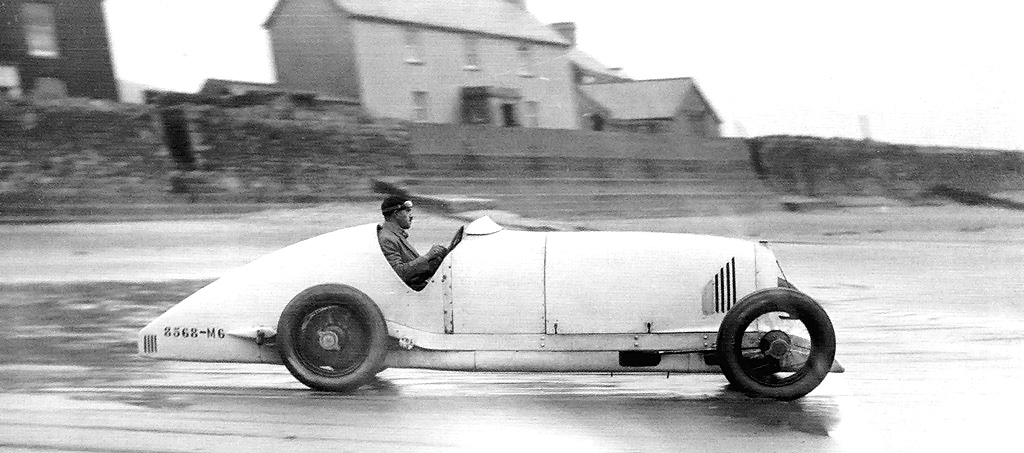
Djelmo before Foresti crash

Foresti taking the Djelmo out on the beach. Note the racer’s revised windscreen and rear deck compared to the images from 1924.

On 26 November 1927, Foresti took the Djelmo out on the sands to make a few runs. As was typical, Foresti wore only goggles and no other protection. The Djelmo had exhibited a tendency to fishtail at high speeds. While travelling on the beach at around 150 mph (240 km/h), Foresti lost control. The Djelmo rolled several times, and Foresti was ejected from the racer. Miraculously, Foresti suffered only minor injuries and walked toward rescuers. The fact that he was ejected clear of the rolling Djelmo and into the soft sand probably saved his life. The Djelmo was destroyed. Prince Djelaleddin had lost interest in these speed projects: the Djelmo was never repaired and the twin-engine racer was never built.

*Tommy Milton set a United States speed record at 156.046 mph (251.132 km/h) in a twin straight-eight-powered Duesenberg on 27 April 1920. His accomplishment was not officially recognized as a world record.
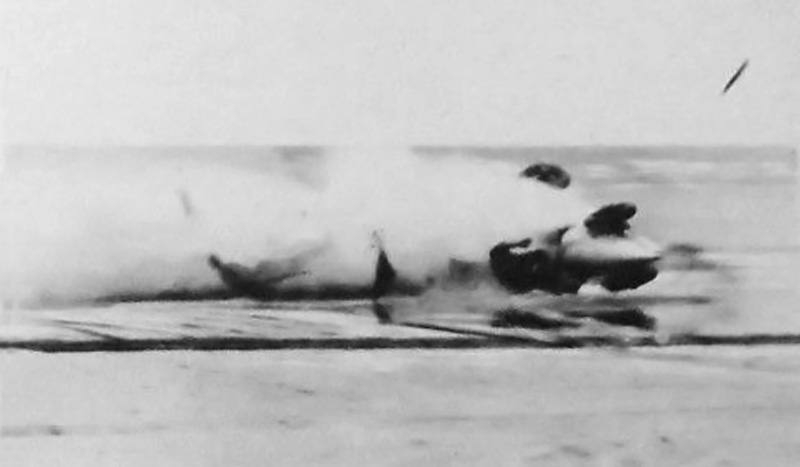
Djelmo crash Foresti eject

Foresti, just leaving the cockpit, is ejected from the Djelmo as it rolls on the beach. Amazingly, Foresti suffered only minor injuries.

This article is part of an ongoing series detailing Absolute Land Speed Record Cars.

Sources:
Land Speed Record by Cyril Posthumus and David Tremayne (1971/1985)
The Land Speed Record 1920-1929 by R. M. Clarke (2000)
– “Prince Designs Sixteen Cylinder Racer,” The Ogden Standard-Examiner, 24 October 1926
– “An Amazing Escape,” The Illustrated London News, 3 December 1927
http://en.wikipedia.org/wiki/Sunbeam_350HP
Lockhart Stutz Black Hawk Indy

Lockhart Stutz Black Hawk LSR Car

By William Pearce

Perhaps the only thing faster than Frank Lockhart’s phenomenal rise on the early auto racing scene, was the tragic end of his career. Nicknamed “Boy Wonder” by the press, Lockhart only raced at the Indianapolis 500 twice. His first run was in 1926 when he took the place of an injured driver in a 183 cu in (3.0 L) Miller race car. During practice, he set a one-lap track record of 115.488 mph (185.86 km/h). During the race, he passed 14 cars on the fifth lap as he made his way to the front from starting 20th. He went on to win the race with over a two lap lead.

Lockhart and Stutz Black Hawk

Frank Lockhart and the Stutz Black Hawk Special at Daytona Beach, Florida in April 1928.

At Indianapolis in 1927, Lockhart qualified first, at 120.100 mph (193.28 km/h). At the time, it was the fastest lap ever recorded on the track. He led the first 81 laps of the race, a record that would stand for 64 years. After a pit stop, he regained the lead on lap 91, only to have a connecting rod break on lap 120 and take him out of the race. Of the 280 laps he ran at Indy, he led 205 (73.21%) of them. Lockhart is one of only three drivers to have led more than 45% of their laps at Indy, and he has the second highest percentage overall (Juan Pablo Montoya has the highest percentage of laps led at 83.50%, for 167 laps led of 200 run).

In May of 1927, Lockhart set a qualifying record of 147.729 mph (237.74 km/h) on the 1.5-mile (2.4 km) board track at Atlantic City, New Jersey in his 91 cu in (1.5 L) Miller race car. It wasn’t until 1960, 33 years later, that another driver turned a faster lap at an American speedway. In his short American Automobile Association (AAA) career, Lockhart started 61 races, won 27 of them and finished in the top three 37 times.

Lockhart Stutz Black Hawk Indy

Lockhart sits in the Stutz Black Hawk LSR car during its unveiling at the Indianapolis Motor Speedway.

But Lockhart was more than just a race car driver; he was an innovator with the mind of an experimental engineer. Between the 1926 and 1927 season, Lockhart and his team, which included Zenas and John Weisel and Ernie Olsen, developed an intercooler for Lockhart’s supercharged 91 cu in (1.5 L) Miller engine. They had noticed that while the supercharger pressurized the air, it also heated it, making it less dense. If the air could be cooled, the denser air would allow the engine to create more power. Later in the year on 13 June 1927, Lockhart filed a patent for his intercooler, and U.S. patent no. 1,807,042 was issued on 26 May 1931.

On 11 April 1927, Lockhart took his standard Miller race car to the Muroc Dry Lake in California for an International Class F record attempt. This race car was powered by a supercharged Miller 91 cu in (1.5 L) engine equipped with Lockhart’s intercooler. Lockhart established a new class record, averaging 164.009 mph (263.947 km/h). At that speed, Lockhart became the fourth fastest driver ever, behind only Henry Segrave’s 203.793 mph (327.973 km/h) run in the Sunbeam 1000 HP Mystery (The Slug), Malcolm Campbell’s 174.883 mph (281.447) run in the Napier-Campbell Blue Bird, and J.G. Parry-Thomas’s 171.019 mph (275.229 km/h) run in Babs. All of the faster vehicles were purpose-built Land Speed Record (LSR) cars powered by large, powerful aircraft engines.

Lockhart Stutz Black Hawk side

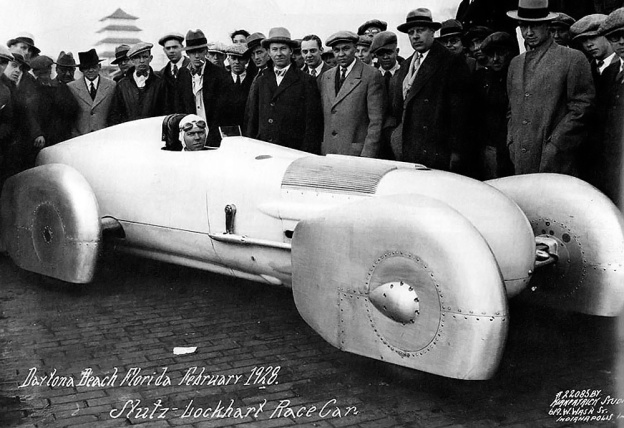
Lockhart ready for a run in the Black Hawk at Daytona Beach in February 1928, as spectators look on. The hole on the top of the car, in front of the cockpit, was the carburetor inlet for the right engine bank. There was another hole on the other side for the left engine bank.

By mid-1927, Lockhart had become focused on building a LSR car to break Segrave’s current world speed record of 203.793 mph (327.973 km/h). Lockhart partnered with Fred Moskovics, President of the Stutz Motor Car Company, to build the special LSR car. Lockhart and the Weisel brothers designed the LSR car. The Stutz Company funded about half of the project, so the LSR car would wear the Stutz name. Lockhart funded the rest of the project from his race winnings.

A team was assembled in Indianapolis to build the LSR car. What emerged on 12 February 1928 was the Stutz Black Hawk Special—a comparatively small streamlined car powered by a 180.4 cu in (2.96 L) Miller V-16 (more accurately a U-16) engine with intercooled twin superchargers. The intercooler was formed into the engine cover, allowing air flowing over the car’s body to cool the air/fuel mixture before it entered the engine. The car was made up of a central body, with each wheel housed in its own streamlined fairing. The Black Hawk was perhaps the first car to be designed with the aid of a wind tunnel. Scale models were tested in both the Curtiss and the Army Air Services wind tunnels. Reportedly, the car’s wind resistance was measured as .0061 lb/mph². The Black Hawk was 15 ft 9 in (4.80 m) long with a 112 in (2.84 m) wheelbase. The body was only 24 in (0.61 m) wide, and the car’s total width including the wheels was around 60 in (1.52 m).

Lockhart Stutz Black Hawk engine

Seen here are the two Miller straight-eight engines mounted on a common crankcase that made up the Black Hawk’s 16-cylinder engine. In this rear view, one can see the gears of the crankshafts are geared to the lower, central gear.

The engine was basically two 91 cu in (1.5 L) Miller inline-eight engines installed 30-degrees apart on a common crankcase. Each straight-eight engine’s crankshaft was geared to a central gear at the rear of the engine. The flywheel was attached to the central gear. To cool the engine, a tank in the font of the car held a radiator that was cooled with 80 lb (36 kg) of ice. The engine’s bore was 2.1875 in (55.56 mm), stroke was 3.0 in (76.2 mm), and weight was around 630 lb (286 kg). The engine produced more than 550 hp (410 kW) at 8,300 rpm and, utilizing the wind tunnel data, was predicted to propel the 2,800 lb (1,270 kg) Black Hawk LSR car to a maximum speed over 280 mph (450 km/h). The estimated cost of the LSR car was between $70,000 and $100,000 ($0.9 to $1.3 million in 2013 USD).

Lockhart joined Campbell and other racers at Daytona Beach, Florida in mid-February 1928 for speed record runs sanctioned by the AAA. On 19 February, Campbell set a new record at 206.956 mph (333.064 km/h) in the now more-streamlined Napier-Campbell Blue Bird. The next day, Lockhart made one run against the wind at 200.222 mph (322.226 km/h). This was slightly faster than Campbell’s against the wind run from the previous day. Unfortunately, clutch issues prevented Lockhart from making the return run.

Lockhart Stutz Black Hawk beach

An optimistic Lockhart in the cockpit of the Stutz Black Hawk on the beach at Daytona in February 1928. Bill Sturm is at the front of the car adding ice to the cooling tank, as Jean Marcenac approaches with more. Ray Keech is standing next to Lockhart. Note the finning on the engine cover that served as the intercooler.

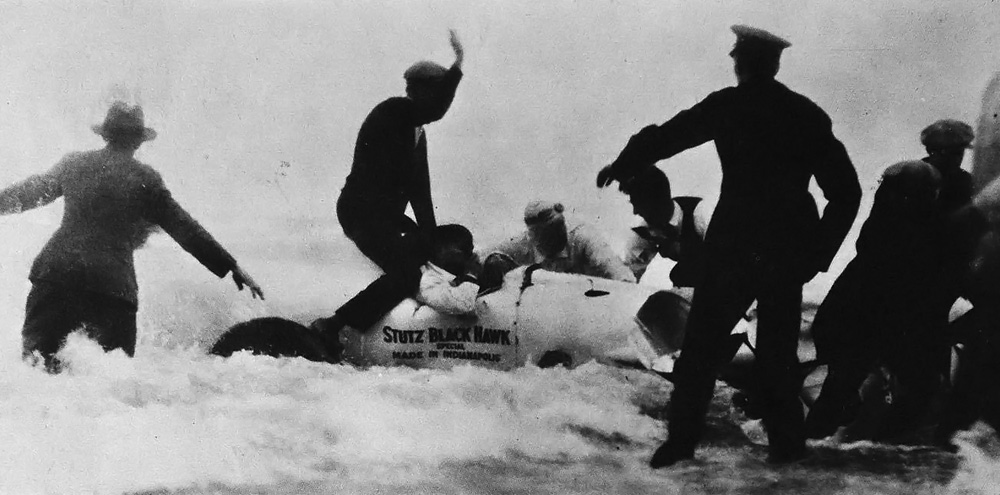
With the sanctioned event coming to a close, Lockhart made another run on 22 February in bad weather conditions. During the run at over 200 mph (322 km/h), Lockhart encountered a rain-squall that reduced his visibility to nothing. He lost control of the car, and the Black Hawk spun into the sea, rolling over several times. Lockhart was pinned in the car as the waves crashed over his head. Spectators rushed to his aid, shielding him from the incoming waves and holding his head above the water while others attached ropes to the car. More spectators joined in and began dragging the car to the beach, until a tow truck arrived to pull it the rest of the way in. Lockhart had to be freed from the wreck with the aid of crowbars and blowtorches. He suffered three severed tendons in his left wrist, some bad bruising, and was in shock.

The Black Hawk was transported back to Indianapolis where it was quickly rebuilt and repaired. Lockhart, his car, and his team arrived back at Daytona Beach on 20 April 1928, only two months after his accident. Again, the speed record runs were sanctioned by the AAA, and other racers were present. Also making runs was Ray Keech in the White Triplex, a vehicle powered by three Liberty V-12 aircraft engines.

Lockhart Stutz Black Hawk crash1

Spectators, press, and police rush to the aid of Frank Lockhart after his car has rolled into the surf. Lockhart could have drowned had it not been for O.D. Craig holding his head above water.

On 20 April 1928, Lockhart made a run and achieved 200.33 mph (322.40 km/h) on the return leg. The Black Hawk’s Miller engine was suffering carburation problems. Meanwhile, Keech made a series of runs, steadily improving in speed. On 22 April 1928, Keech got the Triplex up to an average of 207.55 mph (334.02 km/h), setting a new world record.

On 25 April 1928, Lockhart made a test run during which his rear right tire locked up under braking during the return. The carburation problems seemed to be resolved, and by 7:30 AM, Lockhart was making another run. The first leg was recorded at 203.50 mph (327.50 km/h), and everything went well. As the Black Hawk was prepared for the return run, Lockhart told his team that he was going to go for the record. Screaming down the beach at over 220 mph (355 km/h), about 700 ft (213 m) before the end of the course, the right rear tire blew, and the Black Hawk went out of control. The car skidded in the sand for about 400 feet (122 m), went sideways, and became airborne. The Black Hawk traveled another 503 ft (153 m), crashing down on the beach several times as it rolled. Lockhart was thrown 51 ft (15 m) from the vehicle. He was transported to a hospital where he was pronounced dead, Lockhart was only 25 years old.

Lockhart Stutz Black Hawk run

Lockhart flies the Black Hawk south down the beach at Daytona during a run.

Subsequent investigation revealed that the right rear tire had been damaged at some point during earlier runs. The tire had continued to deteriorate as the additional passes were made. The 16-cylinder engine was salvaged from the Black Hawk wreck. It was rebuilt and installed in the Sampson “16” Special, owned by Alden Sampson. Bob Swanson raced the car in the 1939 and 1940 Indy 500, finishing sixth in 1940. The car was also driven by Deacon Litz in 1941 and Sam Hanks in 1946. The Sampson “16” Special, with the 16-cylinder engine still installed, is currently on display at the Indianapolis Motor Speedway Hall of Fame Museum in Indianapolis, Indiana.

There are two Lockhart Stutz Black Hawk replicas. One replica is owned and displayed by Turner Woodward in his historic Stutz Building in Indianapolis, Indiana. The second is a running (but not with a 16-cylinder engine) replica that is being finished by Jeb Scolman of Jebs Metal and Speed in Long Beach, California.

The following is a YouTube video (sorry for the music) of the ill-fated speed run uploaded by SportingHistory. The south-bound (ocean on the left) run is shown from the air first, and then the north-bound return crash. The crash is very violent.

This article is part of an ongoing series detailing Absolute Land Speed Record Cars.

Sources:
Frank Lockhart: American Speed King by Morgan-Wu and O’ Keefe (2012)
The Miller Dynasty by Mark Dees (1981/1994)
http://gordonkirby.com/categories/columns/archive/lockhart_legend.html by Gordon Kirby
http://en.wikipedia.org/wiki/Frank_Lockhart
http://en.wikipedia.org/wiki/List_of_Indianapolis_500_lap_leaders
http://blog.hemmings.com/index.php/2011/09/28/replica-of-the-ill-fated-stutz-black-hawk-special-to-debut-at-long-beach-motorama/
http://www.autoweek.com/article/20061222/free/61206028

Inside the Cylinder of a Diesel Engine – by Harry Ricardo

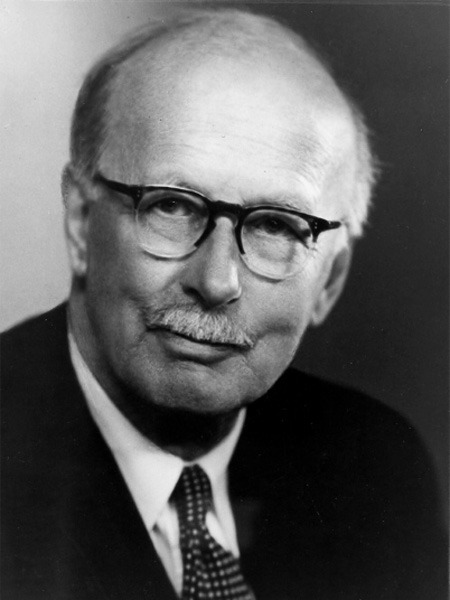
Sir Harry Ricardo as seen in 1955 at age 70.

Sir Harry Ricardo as seen in 1955 at age 70.

Sir Harry Ricardo (26 January 1885 – 18 May 1974) was one of the foremost engine designers and researchers of the internal combustion engine. During the First World War, Ricardo designed significantly improved engines for early British tanks. Between the wars, he researched the physics of internal combustion and the design of combustion chambers. This work led to the use of octane ratings, stratified charge, and intake swirl (vortex). Ricardo was instrumental in the development of the sleeve valve engine, particularly for aircraft use. His work and research contributed greatly to the high-power aircraft engines of World War II. After the war, he continued to develop the Diesel pre-combustion chamber (Comet), originally designed in the 1930s, which made high-speed diesel engines possible.

The following excerpt is from a lecture Harry Ricardo gave to the Royal Society of Arts on 23 November 1931.

I am going to take the rather unconventional course of asking you to accompany me, in imagination, inside the cylinder of a diesel engine. Let us imagine ourselves seated comfortably on the top of the piston, at or near the end of the compression stroke. We are in complete darkness, the atmosphere is a trifle oppressive, for the shade temperature is well over 500 Celsius – almost a dull red heat – and the density of the air is such that the contents of an average sitting-room would weigh about a ton; also it is very draughty, in fact, the draught is such that, in reality, we should be blown off our perch and hurled about like autumn leaves in a gale. Suddenly, above our heads, a valve opens and a rainstorm of fuel begins to descend. I have called it a rainstorm, but the velocity of droplets approaches much more nearly that of rifle bullets than of raindrops.

For a while nothing startling happens, the rain continues to fall, the darkness remains intense. Then suddenly, away to our right perhaps, a brilliant gleam of light appears, moving swiftly and purposefully; in an instant this is followed by a myriad others all around us, some large and some small, until on all sides of us the space is filled with a merry blaze of moving lights; from time to time the smaller lights wink and go out, while the larger ones develop fiery tails like comets; occasionally these strike the walls, but, being surrounded by an envelope of burning vapour, they merely bounce off like drops of water spilt on a red hot plate.

Right overhead all is darkness still, the rainstorm continues, and the heat is becoming intense; and now we shall notice that a change is taking place. Many of the smaller lights around us have gone out, but new ones are beginning to appear, more overhead, and to form themselves into definite streams shooting rapidly downwards or outwards from the direction of the injector nozzles.

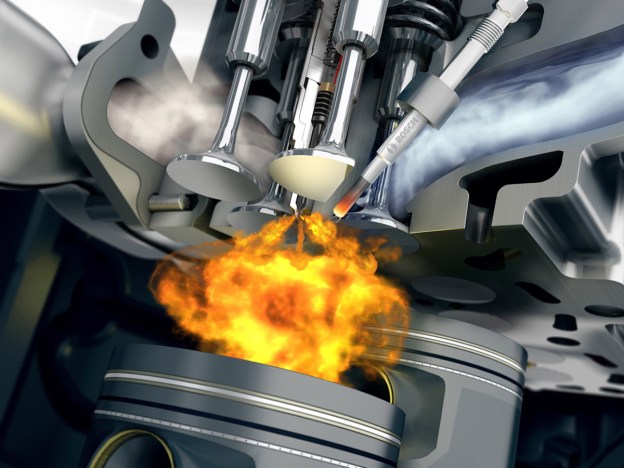
Fuel being burnt as it is injected into a diesel cylinder. (Bosch image)

Fuel igniting as it is injected into a diesel cylinder. (Bosch image)

Looking round again we see that the lights around are growing yellower; they no longer move in a definite direction, but appear to be drifting listlessly hither and thither; here and there they are crowding together in dense nebulae, and these are burning now with a sickly, smoky flame, half suffocated for want of oxygen. Now we are attracted by a dazzle, and looking up we see that what at first was cold rain falling through utter darkness, has given place to a cascade of fire as from a rocket. For a little while this continues, then ceases abruptly as the fuel valve closes.

Above and all around us are still some lingering fire balls, now trailing long tails of sparks and smoke and wandering aimlessly in search of the last dregs of oxygen which will consume them finally and set their souls at rest. If so, well and good; if not, some unromantic engineer outside will merely grumble that the exhaust is dirty and will set the fuel valve to close a trifle earlier.

So ends the scene, or rather my conception of the scene, and I will ask you to realise that what has taken me nearly five minutes to describe may all be enacted in one five hundredth of a second or even less.

– Harry Ricardo

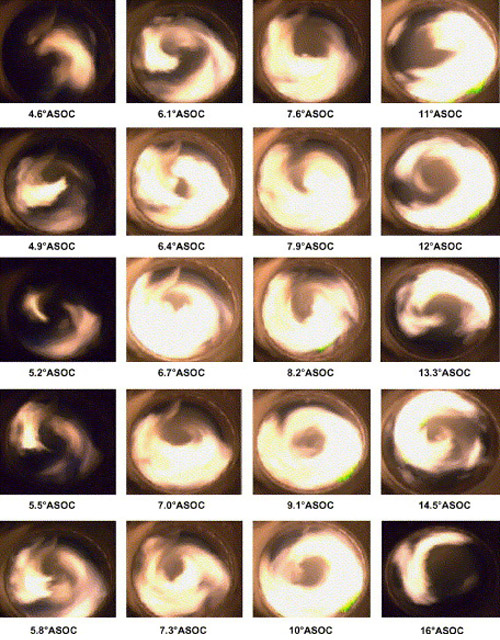
View of a diesel combustion chamber showing the combustion sequence (ASOC: After Start of Combustion).

View of a diesel combustion chamber showing the combustion sequence (ASOC: After Start of Combustion).

More on Sir Harry Ricardo:
Engines & Enterprise: The Life and Work of Sir Harry Ricardo by John Reynolds (1999)

Chrysler A57 Multibank Tank Engine

By William Pearce

When the United States entered World War II, there was a desperate need for a medium tank engine. Chrysler responded with a very unusual idea. Chrysler had its 251 cu in (4.1 L) straight six-cylinder, L-head engine available in large numbers. Under the direction of Executive Engineer Harry Woolson, the Engine Design department, headed by Mel Carpentier, designed a new powerplant that utilized the 251 cu in (4.1 L) engine. The basic idea was to combine five of these six-cylinder engines into a five-bank, 30-cylinder, single engine for medium tanks. This new engine, referred to as the Multibank, was given the designation A57.

Chrysler A57 engine as displayed at the Walter P. Chrysler Museum. Note the central water pump feeding the five engine banks, the individual distributors for each engine bank, and the row of carburetors at top: three on the left and two on the right.

The Multibank A57 engine had a large cast iron crankcase that formed the central structure of the powerplant. Five Chrysler 251 cu in (4.1 L) six-cylinder engines were bolted to this central crankcase. Two of the engines were bolted to the lower portion of the crankcase, one on each side, with their cylinders angled 7-1/2 degrees above horizontal. Two addition engines were bolted to the crankcase above the first two, with their cylinders 27 degrees above horizontal. The fifth engine was bolted vertically at the top of the crankcase. The five six-cylinder engines made up the banks of the A57.

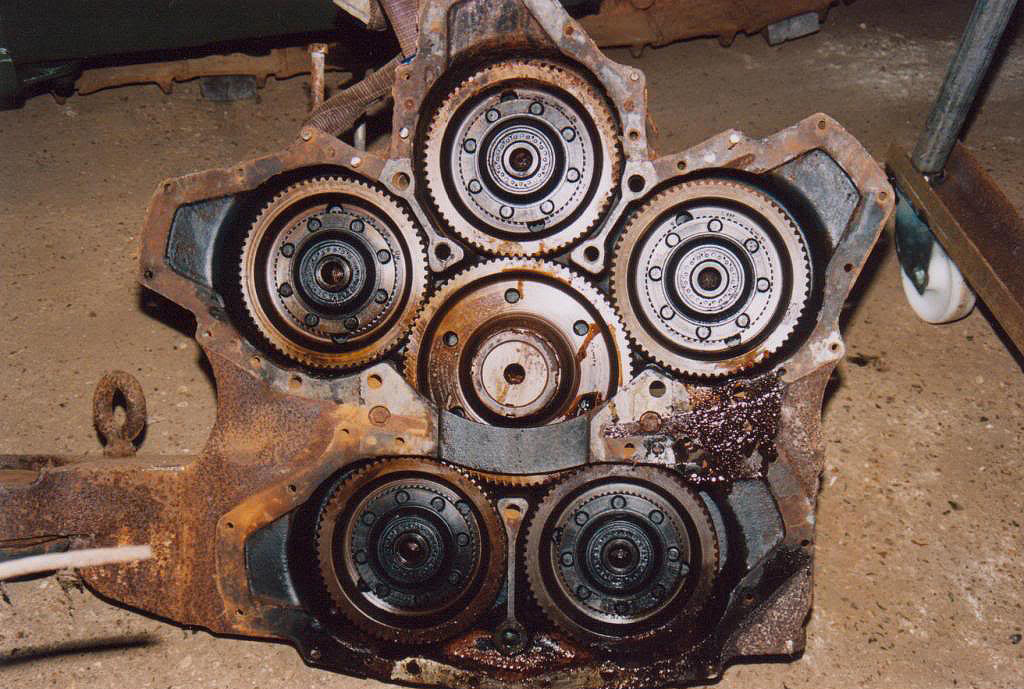
The A57 engine was mounted in the rear of the tank, and the crankshaft output flanges faced the front of the tank. The A57 retained the five crankshafts of the five six-cylinder engines.  A drive gear was coupled to the crankshaft of each engine bank. These five drive gears meshed with a single, central gear (all gears had herringbone teeth). The central gear drove the output shaft of the power plant. The output shaft went through the radiator and drove the cooling fan and clutch, which was attached to a drive shaft and then transmission.

A view of the gear case revealing the central drive gear that is driven by five outer gears, each coupled to their respective engine bank’s crankshaft. (Adrian Barrell image)

The A57 was originally equipped with five belt-driven water pumps. However, the belts would often break because of the alternating loads on the crankshaft pulleys. The design was changed to a single water pump with five outlets (one for each engine bank). This single water pump was driven by an accessory shaft from the central drive gear located on the opposite end of the central crankcase. Also at the rear of the tank, each engine bank had its own ignition coil and distributor that was gear-driven from the camshaft.

The first production engines had a single-barrel carburetor mounted directly on the intake manifold for each of the five engine sections. The different pipe lengths and contours leading from the air cleaner to the carburetors resulted in unequal fuel distribution. Metal vanes were added to direct airflow, and ultimately the five carburetors (each connected to its respective engine with a downpipe) were relocated in the same plane above the engine. This change simplified throttle linkages, the air cleaner arrangement, and maintenance.

The A57 Multibank had two oil pumps located in the central crankcase. One oil pump was a scavenge pump to transfer oil to a remote reservoir. The second pump was pressure pump that took oil from the reservoir and delivered high-pressure oil to all five engine sections.

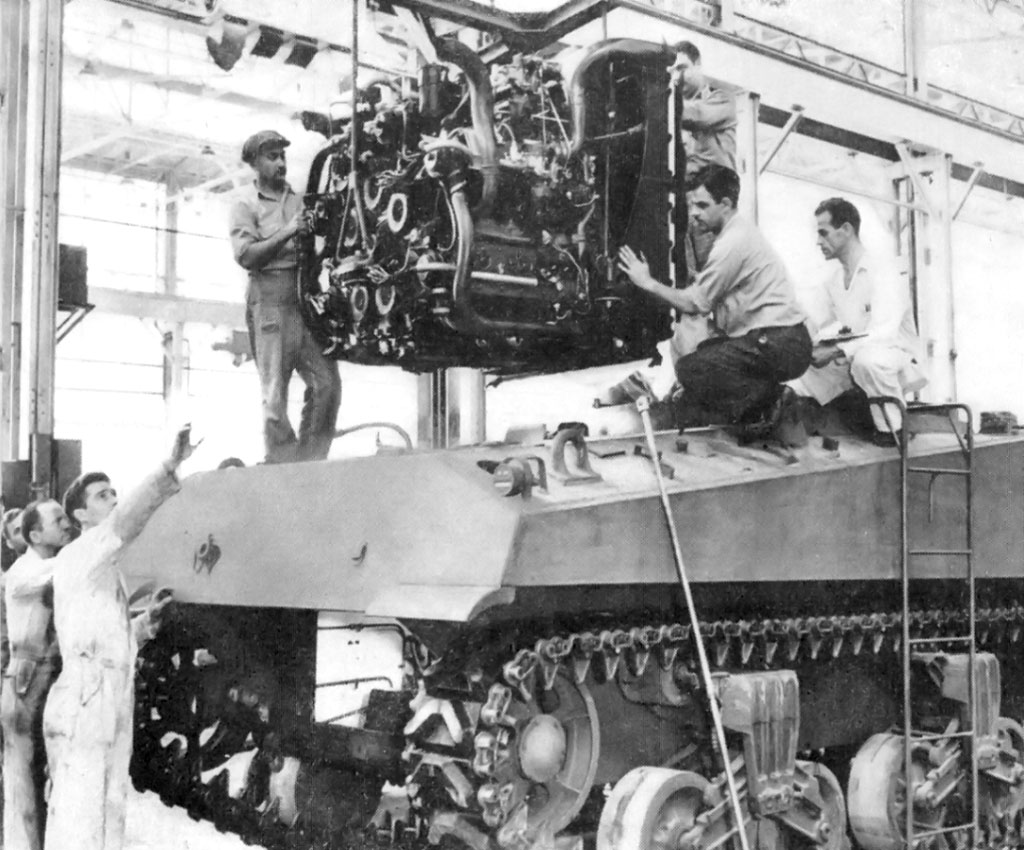
The 5,244 lb (2,379 kg) Chrysler A57 engine package being installed in a M4A4 Sherman tank. Note the engine’s size in comparison to the installers.

The A57 engine had a 3.4375 in bore and 4.50 in stroke, giving a total displacement of 1,253 cu in (20.5 L) from its 30 cylinders. The engine produced 445 hp (332 kW) and 1,060 lb ft (1,437 N m) of torque at 2,400 rpm. Given the arrangement of the engine sections, the Multibank was a relatively short but heavy engine, weighing 5,244 lb (2,379 kg) including radiator, cooling fan and clutch. Construction of the A57 utilized existing tooling from the 251 cu in (4.1 L) Chrysler six-cylinder engine, and the engines shared cylinder blocks, cylinder heads, pistons, connecting rods, and crankshafts.

On 3 June 1942, nine months after the initial engine discussion, the first of 109 M3A4 tanks were built with the A57 engine. However, the M3A4 tank was quickly replaced by the M4A4 Sherman tank, the first being produced on 30 June 1942. From April 1942 to September 1943, 9,965 Chrysler Multibank engines were built; 7,500 engines were installed in production tanks, and the remainder were built as spare engines. The A57 engine proved to be a very durable, reliable, and efficient power plant for medium tanks. Reportedly, the engine would still run with two of the five engine banks disabled from combat damage.

A number of Chrysler A57 Multibank engines survive, and some are still in working order in restored tanks.

Side view showing the relatively short length of the of the A57 engine at the Walter P. Chrysler Museum.

While similar engine concepts, no direct relation has been found between the Chrysler Multibank and the Perrier-Cadillac 41-75.

Sources:
Chrysler Engines 1922-1988 by Willem Weertman (2007)
Some Unusual Engines by L. J. K. Setright (1975)
http://autospeed.com/cms/title_The-Chrysler-A57-MultiBank-Engine/A_112613/article.html
http://en.wikipedia.org/wiki/Chrysler_A57_multibank
http://hmvf.co.uk/forumvb/showthread.php?10960-M4A4-restoration (amazing M4A4 restoration)
http://sbiii.com/chrymult.html

Mercedes-Benz T80 (Type 80) LSR Car

By William Pearce

German auto racer Hans Stuck wished to capture the world land speed record for himself and Germany. In the late 1930s, he worked to put together a team to achieve this goal. By 1937, Stuck had convinced Wilhelm Kissel, Chairman of Daimler-Benz AG, to have Mercedes-Benz develop and build the vehicle, which Dr. Ferdinand Porsche had agreed to design. Stuck also obtained project approval from Adolf Hitler, who saw the record as another propaganda tool to demonstrate Germany’s supposed technological superiority.

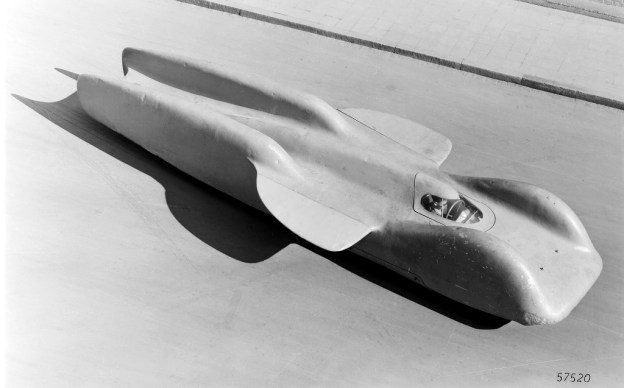
Mercedes-Benz T80. Hans Stuck’s project designed for over 373 mph (600 km/h) by Dr. Ferdinand Porsche. (Mercedes-Benz image)

The vehicle was officially known as the Mercedes-Benz T80 or Type 80. Dr. Porsche had first targeted a speed of 342 mph (550 km/h), utilizing a 2,000 hp (1,490 kW) engine. When the car was first planned in 1937, the speed record was held by Malcolm Campbell in the last of his Blue Bird cars at 301.473 mph (485.174 km/h) covering one km (.6 mi) and 301.129 mph (484.620 km/h) covering one mile (1.6 km). However, from 1937 through 1939, George Eyston in Thunderbolt and John Cobb in Railton had raised the record a total of five times, with Cobb achieving 369.74 mph (595.04 km/h) for the km (.6 mi) and 368.86 mph (593.62 km/h) for the mile (1.6 km) in August 1939. As these speed record challengers raised the record, the T80’s speed goal was raised as well. More power was made available from the engine, and when the T80 was nearly finished in 1939, the target speed for its record run was 373 mph (600 km/h) after 3.7 mi (6 km) of acceleration.

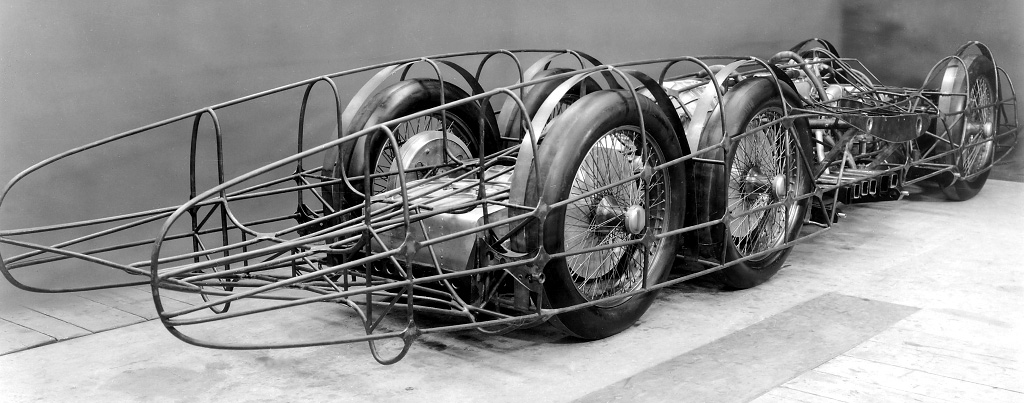
The T80 cost 600,000 Reichsmarks to complete; that is about $4 million in today’s USD. Aerodynamics specialist Josef Mikcl helped streamline the car’s body, which was built by aircraft manufacturer Heinkel Flugzeugwerke. The T80 incorporated a Porsche-designed enclosed cockpit, low sloping hood, and rounded fenders. The rear wheels were encased in elongated tail fins to help stabilize the vehicle at speed. Two small wings at the middle of the car provided downforce and ensured stability. The heavily streamlined twin-tailed body achieved a drag coefficient of 0.18, a very low figure even by today’s standards.

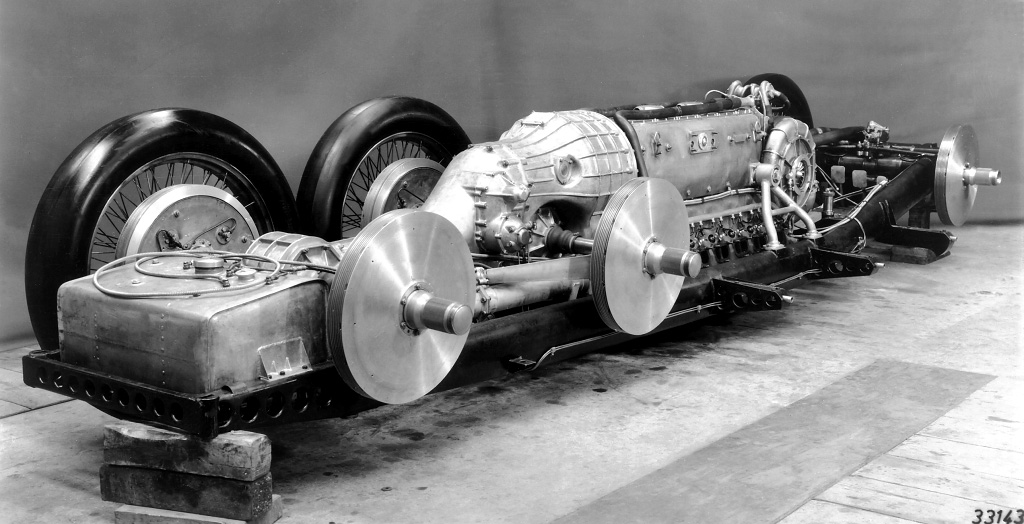
Chassis of the T80 with the DB 603 engine connected to the transmission. Note the drive arrangement to the four rear wheels and the fuel tank. (Mercedes-Benz image)

The car had three axles: the front provided steering, and the two rear axles were driven by a 2,717 cu in (44.5 L) Daimler-Benz DB 603 inverted V-12 aircraft engine. Ernst Udet, director of Germany’s Aircraft Procurement and Supply, provided the third DB 603 prototype engine for installation in the T80. The supercharged DB 603 engine with mechanical fuel injection was specially tuned to 3,000 hp (2,240 kW). The engine ran on a special mixture of methyl alcohol (63%), benzene (16%), ethanol (12%), acetone (4.4%), nitrobenzene (2.2%), avgas (2%), and ether (0.4%); it utilized MW (methanol-water) injection for charge cooling and anti-detonation.

Power from the engine was transmitted to the four drive wheels via a hydraulic torque converter to a single-speed final drive. To maintain traction, the T80 had a mechanical “anti-spin control” device. The front and rear wheels each had a sensor to mechanically detect wheel spin. If the rear wheels began to spin faster than the front, fuel to the engine was automatically reduced.

The framework of the T80’s body is shown here, illustrating how much longer the body was than the chassis. (Mercedes-Benz image)

The T80 was 26 ft 8 in (8.128 m) long and 4 ft 1 in (1.245 m) tall. Its body width was 5 ft 9 in (1.753 m) and 10 ft 6 in (3.20 m) wide including the wings. All six wheels were 7 in x 32 in and had a 4 ft 3 in (1.295 m) track. The vehicle weighed about 6,390 lb (2,900 kg).

The T80 vehicle had been unofficially nicknamed Schwarzer Vogel (Black Bird) by Hitler and was to be painted in German nationalistic colors complete with German Eagle and Swastika. Hans Stuck would have driven the T80 over a special stretch of the Dessau Autobahn (now part of the modern A9 Autobahn), which was 82 ft (25 m) wide and 6.2 mi (10 km) long with the median paved over. The record attempt was set for January 1940 and would have been the first absolute land speed record attempt in Germany.

The T80 as it looks now in the Mercedes-Benz Museum. (Mercedes-Benz image)

However, the outbreak of the war prevented the T80 run. In fact, the vehicle’s finishing touches were never completed, and it never moved under its own power. After the record attempt was cancelled, the T80 was garaged. In late February 1940, the DB 603 engine was removed, and the vehicle was stored in Karnten, Austria for the duration of the war. The Mercedes-Benz T80 was unknown outside of Germany until discovered by the Allies after World War II. Fortunately, the T80 survived the war relatively unscathed and was eventually moved into the Mercedes-Benz Museum in Stuttgart, where it is on permanent display in the Silver Arrows – Races & Records Legend room. (The T80’s body is on display. The chassis is in storage at a museum warehouse.)

On 16 September 1947, John Cobb achieved 394.19 mph (634.39 km/h) in the twin Napier Lion-powered Railton Mobil Special, surpassing the T80’s calculated Autobahn record run speed. However, after discovering the T80, the Allies had been quoted an astounding top speed of 465 mph (750 km/h) for the T80. Had the T80 been capable of this estimated top speed, the corresponding record would have been unequaled until 1964 when Craig Breedlove hit 468.72 mph (754.33 km/h) in the jet-powered Spirit of America. In addition, the T80 would still hold the record for the fastest piston-engined, wheel-driven vehicle.

Mercedes-Benz T80 leading the Silver Arrow display at the Mercedes-Benz Museum. (Mercedes-Benz image)

This article is part of an ongoing series detailing Absolute Land Speed Record Cars.

Sources:
The V12 Engine by Karl Ludvigsen (2005)
– “Rekord Krieg” by Charles Armstrong-Wilson. Racecar Engineering, Vol 22 No 1 (January 2012)
http://en.wikipedia.org/wiki/Mercedes-Benz_T80
http://www.autoevolution.com/news/mercedes-benz-t80-the-record-car-that-never-was-25555.html

Monaco-Trossi1935 Wiki

Monaco Trossi 1935 Grand Prix Racer

By William Pearce

One of the oddest Grand Prix race cars ever built was the 1935 Monaco Trossi. Built by Augusto Camillo Pietro Monaco and funded by race driver Count Carlo Felice Trossi, the 1935 Monaco Trossi was a front-wheel drive car powered by an air cooled, 16-cylinder, two-stroke radial engine.

Augusto Monaco had built a successful racing car / hill climber but had aspirations of building a Grand Prix car for the 750 kg (1,653 lb) Grand Prix racing formula. For the Grand Prix car, Monaco joined forces with an engineer/driver named Giulio Aymini. The team also received support from Senator Agnelli at FIAT, who offered FIAT’s Lingotto facilities, in Turin, to build and test the new two-stroke radial engine. However, once the engine was built, tests revealed so many problems that Agnelli and FIAT withdrew their support, leaving Monaco in search of new financial and manufacturing assistance.

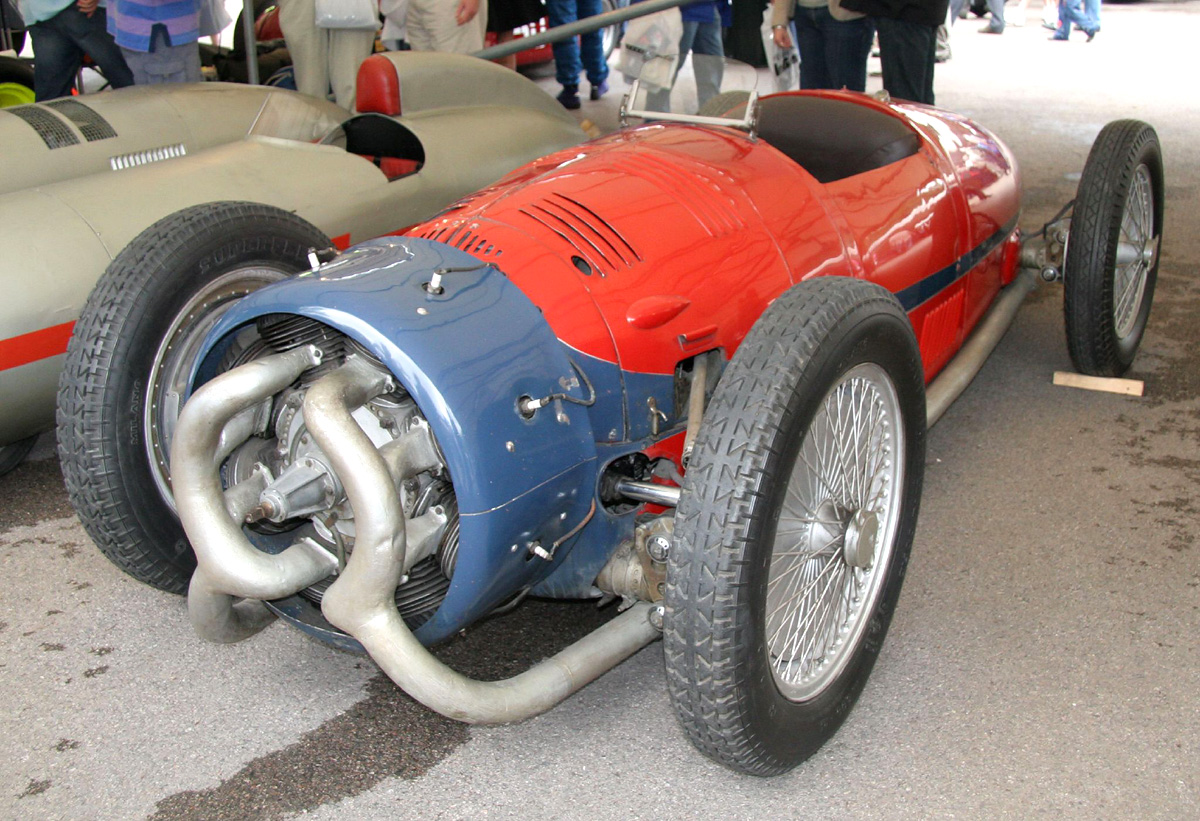
A vintage shot of the Monaco Trossi at Monza. With the cowling removed to aid cooling, a good view is provided of the engine and its paired cylinders.

Monaco convinced race driver Count Felice Trossi, who was a successful member of the Alfa Romeo team, to become a partner in the project providing financial and manufacturing support. The car was built in Trossi’s workshop, which was part of the Gaglianico castle outside Biella in northern Italy. A friend of Trossi, Count Revelli, helped design a streamlined body for the car. Many rumors and much speculation surrounded the racer, and it was finally revealed to the public at the Autodromo Nazional Monza in July 1935 for tests and qualifying sessions in preparation for the Italian Gran Prix.

The air cooled, 16-cylinder, two-stroke radial engine was mounted at the very front of the car. With a 65 mm (2.56 in) bore and 75 mm (2.96 in) stroke, the engine displaced 3,982 cc (243 cu in). The cylinders were arranged in two rows of eight with each front row cylinder and rear row cylinder paired together. While having two cylinders and two pistons, each cylinder pair had a common combustion chamber and spark plug. The eight two-cylinder pairs were positioned around the crankcase. Being a two-stroke engine, there were no intake or exhaust valves. The inlet ports were in the rear cylinders and exhaust ports were in the front cylinders. The crankshaft was a three-piece design and the crankcase was made of duralumin. For both cylinder rows, the connecting rods were of the normal radial engine type with one master rod connected to the crankshaft and the seven articulating rods connected to the master rod.

Rare view of the Monaco Trossi under its own power at Monza in 1935.

Behind the engine were two Zoller M 160 superchargers providing a pressure of 0.68 atm (10 psi), each supplied by a Zenith carburetor. Exhaust gases discharged into two four-pipe manifolds on the front of the engine. These manifolds led to two long exhaust pipes that extended under the car and exited behind the rear wheels. The engine produced 250 hp (186 kW) at 6,000 rpm.

Power from the engine was transferred to the four-speed transmission by a shaft that went through the transmission to the clutch, then back into the transmission. The independent suspension for each wheel was provided by double wishbones, horizontal coil springs, and cockpit adjustable oil dampers. The aircraft-type spaceframe chassis was made with 4 cm (1.57 in) diameter manganese-molybdenum steel tubes with larger cross tubes at the front and rear. The lightweight alloy body panels were screw-fastened to the chassis. The car featured large hydraulic drum brakes on each wheel, which was advanced for the time. Front tires were 5.25 x 31 and rear tires were 4.40 x 27. The vehicle weighed about 710 kg (1,565 lb).

Monaco-Trossi1935 Wiki

A clear view of the two four-pipe manifolds taking the exhaust to the rear of the car. Also note the spark plugs extending out of the engine cowl. (Image by Brain Snelson via Flickr/Wikimedia Commons)

Both Aymini and Trossi tested the car at Monza reaching speeds of 240 km/h (150 mph), and the car was on the entry list for the 1935 Italian Grand Prix. However, testing revealed that the car experienced severe overheating and a tendency for the engine to destroy the spark plugs. But the more serious issue was the extreme understeer caused by the 75% front / 25% rear weight distribution. With the problems uncorrectable without a serious redesign, the car proved too dangerous and it was never raced.

After Count Trossi’s death in 1949, the 1935 Monaco Trossi racer was donated by his widow, the Contessa Lisetta, to the Museo dell’Automobile in Turin where it is currently on display.

Monaco-Trossi_1935_Racer

This view clearly illustrates the Monaco Trossi’s front end complexity. (Image by Brain Snelson via Flickr/Wikimedia Commons)

Sources:
http://www.kolumbus.fi/leif.snellman/c8b.htm
http://www.omniauto.it/magazine/6016/monaco-trossi-laereo-senza-ali
http://jalopnik.com/383661/1935-monaco-trossi-is-16-cylinders-of-radial-engine-awesome