Monthly Archives: June 2016

Perrier-Cadillac 41-75 front

Perrier-Cadillac 41-75 Tank Engine

By William Pearce

As World War II started to gain momentum and become a global conflict, Australia realized that it was in a precarious position. In the war’s early years, Australia did not have an industry devoted to building war material, and the ability of other nations to supply war machines to Australia was in doubt. Australia realized that they would need to develop their own war equipment. In November 1940, Australia began developing its own tank, the Australian Cruiser Tank Mark I (AC1).

AC1 Clover leaf Cadillac

The “clover leaf” Cadillac drive system of the Australian Cruiser Tank Mark I. The rear engine (top of image) is not visible, but its long drive shaft can be seen passing between the other two engines. All three drive shafts connect to the transfer box (bottom of image).

The AC1 Sentinel was based on the United States M3 medium tank, but selecting a power plant for the AC1 proved to be a challenge. The M3 was powered by a 400 hp (298 kW) Wright R-975 radial engine, built under license by Continental Motors. But a continuous supply of R-975 engines, Guiberson diesel engines, or any powerful engines could not be assured to Australia. A solution was found in the unlikely form of a Cadillac V-8 engine originally used to power various coupes and sedans. The Australians referred to the engine as the Cadillac 75 because of its use in the Cadillac Series 75 sedan, but it was also used in the Series 70 and various Series 60 automobiles.

The Cadillac 75 engine had made its debut in 1936. It was a flat head (side valve) engine with the intake and exhaust valves located on the Vee side of the cylinder. The engine was a monobloc design with cylinder banks cast integral with the crankcase. The V-8 also incorporated hydraulic valve lifters for durability. The engine was designed to be built more economically than Cadillac’s V-12 and other V-8 engines. The Cadillac 75 engine had a 3.5 in (89 mm) bore, a 4.5 in (114 mm) stroke, and a displacement of 346 cu in (5.7 L). It produced 135 hp (101 kW) and weighed around 890 lb (404 kg).
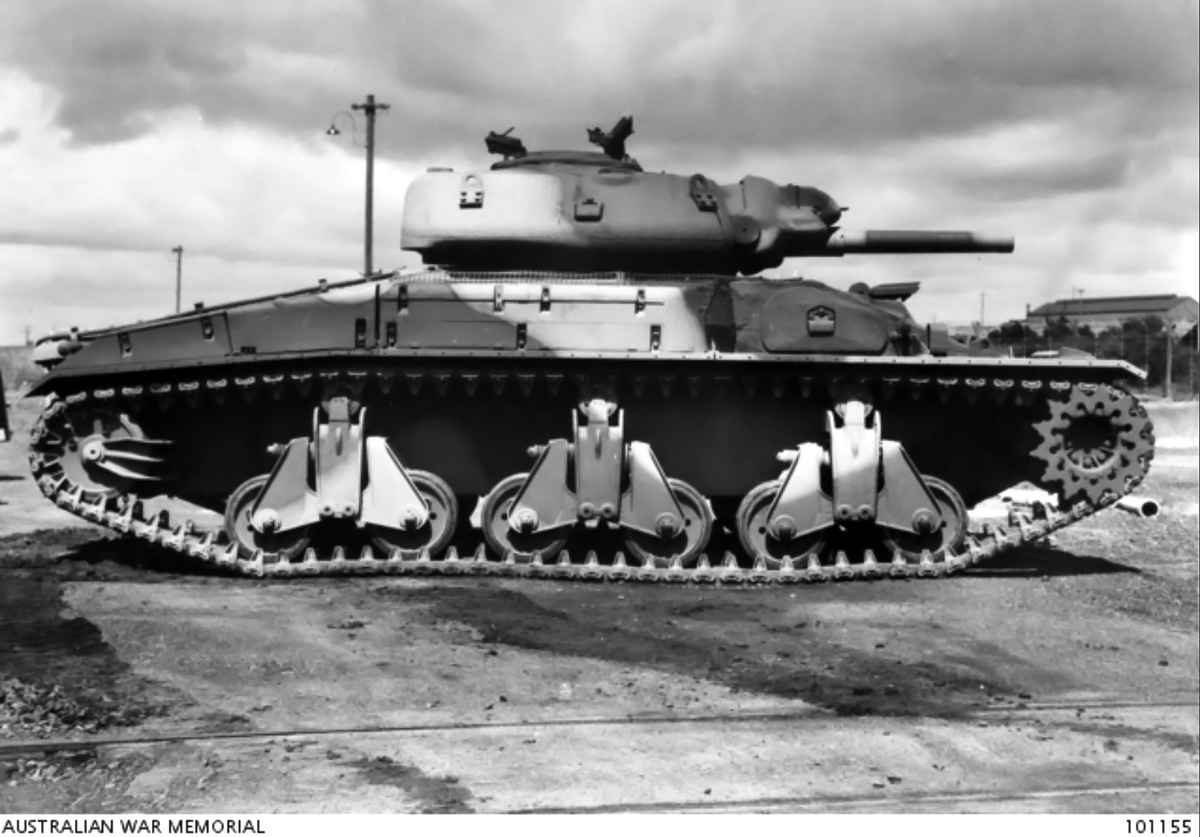
Australian Cruiser Tank Mark III

The Australian Cruiser Tank Mark III (AC3) powered by the Perrier-Cadillac 41-75 engine. Only one AC3 was fully assembled, and that tank is currently preserved at the Australian War Memorial in Campbell, Australia. (Australian War Memorial image)

The Cadillac 75 engine was readily available for import to Australia, but its 135 hp (101 kW) output was insufficient to power the 28 ton (25.4 metric ton) AC1 tank. As a result, AC1 designers, Colonel W. D. Watson and A. R. Code, decided to use three engines to power the tank. Watson was a British tank engineer on loan to Australia, and Code was the Director of Australia’s Armored Fighting Vehicle Production. The three-engine power package developed for the AC1 tank became known as a clover leaf arrangement and was built by General Motors’ Holden subsidiary in Melbourne.

In the clover leaf configuration, engine “3” was situated toward the rear of the tank, and engines “1” and “2” were located amidships, side-by-side. The engines were completely independent of one another, each having its own radiator and drive shaft. However, engine “3” also drove the cooling fan from six pulleys mounted on its driveshaft. The drive shafts for all three engines extended forward to a common transfer box near the middle of the tank. From the transfer box ran the final output shaft that connected to the tank’s gearbox. The AC1 tank could be run on two or even one of the Cadillac 75 engines.

Perrier-Cadillac 41-75 front

Front view of the Perrier-Cadillac 41-75 engine illustrates the odd cylinder bank arrangement. Note the single output shaft and how each exhaust manifold collects exhaust from three cylinder banks. A water pump and generator are driven from a belt at the front of each engine section.

The clover leaf Cadillac power package produced 330 hp (246 kW) at 3,050 rpm and was somewhat successful, powering 65 AC1 tanks. However, the rear engine did experience occasional cooling issues as a result of unequal coolant flow. The clover leaf’s three drive shafts, remote transfer box, and separate cooling systems added weight and complexity. As the Australian Cruiser Tank Mark III (AC3) was being designed in 1941, engineer Robert Perrier sought to simplify the clover leaf Cadillac power package. Perrier, a Frenchman, had been sent to Japan by the French government in 1940 and had subsequently made his way to Australia as Japan entered the war.

The AC3 Thunderbolt was an improved AC1 with better armor protection and firepower. To increase the performance of the three Cadillac 75 engines, Perrier mounted them radially to a common crankcase made from steel plates welded together. One engine was mounted on top of the crankcase, and the other two were mounted about 60 degrees to the left and right of the top engine. This configuration resulted in a rather odd looking engine, with its lower cylinder banks some 210 degrees apart. The engine was known as the Perrier-Cadillac 41-75; it was a lighter, more compact power package than the clover leaf configuration.

Perrier-Cadillac 41-75 crankcase

Rear view of the triangular, welded-steel crankcase of the Perrier-Cadillac engine. The power from all three engine sections was combined at the rear of the engine, and a single output shaft passed though the large, circular openings in the crankcase.

The Perrier-Cadillac engine had a single cooling system with one radiator, but each engine section had its own water pump. The remaining engine accessories were separate and operated independently of one another. At the rear of the Perrier-Cadillac engine, the crankshaft of each engine section was coupled to a common combining gear. The individual engine sections could be decoupled from the combining gear. A drive shaft extended from the combining gear at the rear of the engine, through the crankcase, and out the front of the engine.

The single output shaft of the Perrier-Cadillac engine allowed the transfer box used in the AC1 tank to be omitted, saving space and weight. The single output shaft also decreased mechanical losses, enabling the Perrier-Cadillac to produce more power than the clover leaf package with its three-into-one transfer drive arrangement. The 24-cylinder Perrier-Cadillac 41-75 displaced 1,039 cu in (17.0 L) and produced 397 hp (296 kW). The engine weighed around 3,000 lb (1,360 kg).

Perrier-Cadillac 41-75 rear

Rear view of the 397 hp (296 kW) Perrier-Cadillac engine. Behind the cover at the center of the engine is where the individual engine sections are connected to the single output shaft.

While the Perrier-Cadillac engine worked well, it did not go into production. A number of AC3 tanks were being built, but only one of these was fully assembled. The further improved Australian Cruiser Tank Mark IV (AC4) design followed, and it also used the Perrier-Cadillac engine. By 1943, the supply of war equipment to Australia had not been greatly impacted by the war, and equipment was imported faster than it could be domestically built. Australian resources were better utilized on projects other than tanks, and the Australian Cruiser tank programs were cancelled. However, the imported tanks did not completely match the Australian Cruiser tank design requirements, nor did they eclipse the Australian Cruiser tanks’ performance.

As a side note, the Perrier-Cadillac 41-75 was not the only engine intended to power AC4. A new engine was under development; it was comprised of four air-cooled, four-cylinder de Havilland Gypsy Major engines mounted in an H configuration on a common crankcase. Starting in 1941, Gypsy Major engines were produced under license at General Motors’ Holden plant. With its 4.65 in (118 mm) bore and 5.51 in (140 mm) stroke, the Quad-Gypsy engine would have displaced 1,495 cu in (24.5 L) and produced 510 hp (380 kW) at 2,500 rpm. The 16-cylinder engine weighed around 1,500 lb (680 kg). The Quad-Gypsy engine was domestically-built, simpler, more powerful, and much lighter than the Perrier-Cadillac engine.
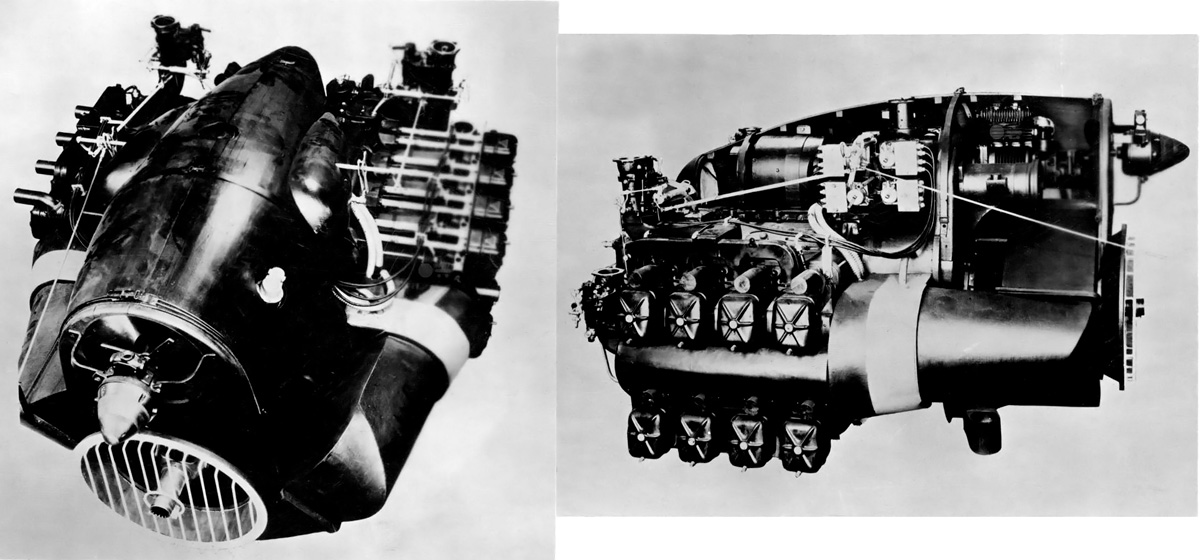
AC4 QuadGipsy engine

The 16-cylinder, QuadGipsy engine would provide around 510 hp (380 kW) for the Australian Cruiser Tank Mark IV. Lighter and more powerful that the Perrier-Cadillac, the engine would have been built in Australia by General Motors-Holden. Concealed in the shroud around the output shaft was a fan to force air through the cylinders’ cooling fins. Various accessories were mounted on top the engine.

While similar engine concepts, no direct relation has been found between the Perrier-Cadillac and the Chrysler A57 Multibank.

Sources:
Tanks Australian Cruiser Mark-1 Instruction Book (1943)
Australian Sentinel and Matildas (AFV Weapons 31) by Major James Bingham
The Role of Science and Industry (Australia in the war of 1939-1945) by D.P. Mellor (1958)
http://www.mheaust.com.au/Aust/Research/Sentinel/sentinelmk.htm
http://www.secretprojects.co.uk/forum/index.php/topic,8514.0/all.html
http://forum.worldoftanks.com/index.php?/topic/490738-inside-the-chieftains-hatch-ac-1-sentinel/

Martin-Baker MB3 runup

Martin-Baker MB3 Fighter

By William Pearce

By 1939, it was clear that the British Air Ministry would not order the Martin-Baker MB2 into production. James Martin (main designer) and Captain Valentine H. Baker had already been at work designing a new fighter aircraft—the MB3. Since the MB2 had proved to be a well-designed fighter, the British Air Ministry ordered three prototypes of the MB3 fighter on 16 June 1939. The new aircraft would be built under Specification F.18/39, issued to Martin-Baker in May 1939. The minimum requirements of Specification F.18/39 were a speed of 400 mph (644 km/h) at 15,000 ft (4,572 m), a ceiling of 35,000 ft (10,668 m), an endurance of 2.5 hours, and an armament of four 20 mm cannons. With the contract issued, Martin worked to finalize the MB3’s design.

Martin-Baker MB3 Denham guns

The nearly complete Martin-Baker MB3 in the summer of 1942 at Martin-Baker’s factory in Denham. The aircraft is not painted, and its six 20 mm cannons are installed. The cannons were removed before flight testing.

The timetable for completing the aircraft was rather optimistic for the relatively small Martin-Baker company. The original contract stated the first MB3 prototype was to be ready by 15 December 1939, with the two remaining aircraft completed by 15 February 1940. At this early stage, the aircraft was to be powered by a Rolls-Royce Griffon engine. By September 1939, it was apparent that the Griffon engine would not be available to Martin-Baker for some time. At the insistence of the Air Ministry, the Napier Sabre replaced the Griffon, and the entire aircraft was redesigned for the new engine. This resulted in a new contract that was somewhat delayed but ultimately signed on 11 August 1940. Britain was now fully involved in World War II, and Martin-Baker was inundated with other work of a higher priority. Therefore, completing the first MB3 took longer than anticipated. By the end of 1941, Martin-Baker was informed that there would be no production orders for the MB3, but the first prototype was so far along that it made sense to finish it.

Construction of the Martin-Baker MB3 followed the established company practice of using a tubular steel frame to make up the fuselage structure. The main wing spar was made of laminated steel, with the number of laminations decreasing near the wingtips. The rest of the wing structure formed a torsion box of extreme rigidity. The entire aircraft was covered with stressed aluminum skin, but many panels could be opened or removed for quick access to equipment and armament. The rudder was fabric-covered, but the rest of the control surfaces were skinned with aluminum.

Martin-Baker MB3 left

The MB3 during its brief flight testing career at RAF Wing. Note the retractable stirrup and fold-down door for cockpit entry.

The aircraft used pneumatically controlled split flaps and had spring loaded aileron gap seals to increase its roll rate and improve aerodynamics. The elevator also had gap seals. Fuel was carried in a fuselage tank in front of the cockpit. The aircraft’s fully retractable main landing gear had a wide track of 15 ft 5 in (4.7 m). The tailwheel retracted into an open well under the tail. The landing gear was lowered by gravity and raised by a pneumatic system, which was separate from the system that controlled the flaps.

Each wing housed three 20 mm cannons with 200 rpg, all installed outside of the aircraft’s main gear. The ammunition belts were installed parallel to the cannons; each bullet had to turn 90 degrees before being fed into the breach. This “flat-feed” ammunition system was patented by Martin. The cannon and ammunition arrangement made for a compact package that could be easily accessed and quickly serviced. With its six 20 mm cannons, the MB3 was one of the most heavily armed fighters of World War II.

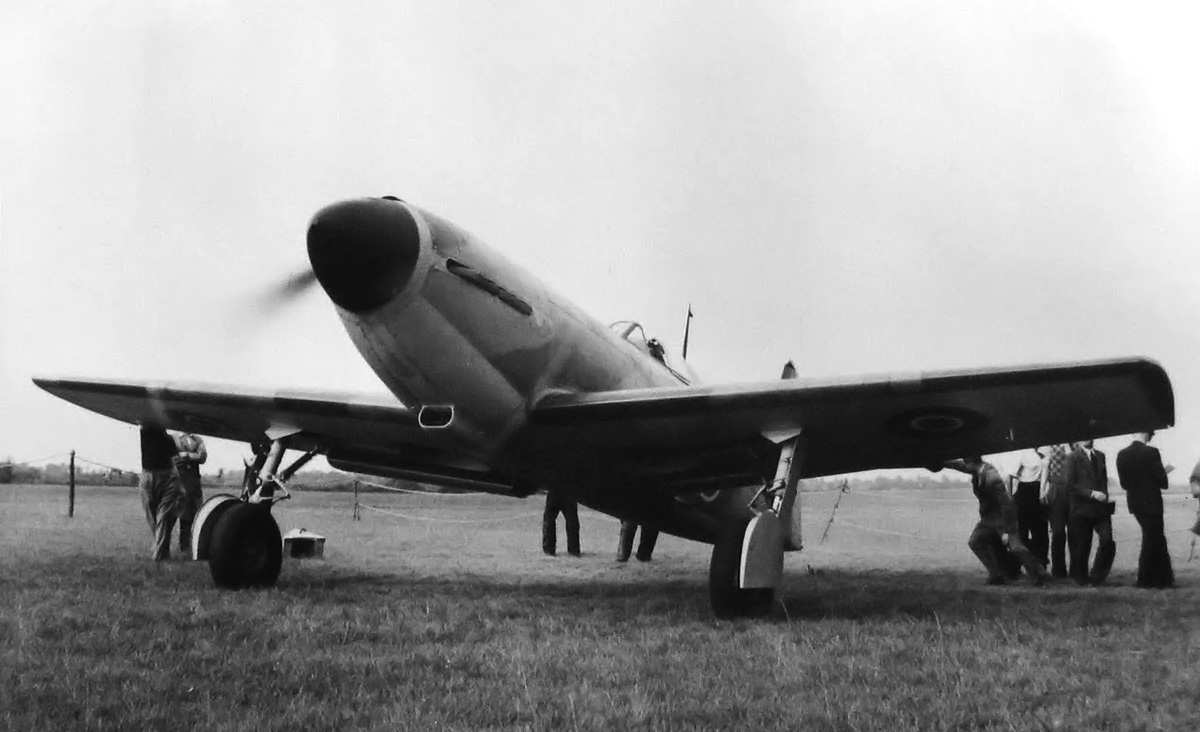
Martin-Baker MB3 runup

This image of the MB3 running up gives a good view of the aircraft’s wide-track landing gear and the close-fitting cowling that covered the Sabre engine. Also visible are the under-wing scoops for the radiator and oil cooler.

The Rolls-Royce Vulture X-24 engine was also considered to power the MB3. The V-12 Griffon was initially selected because it was a far less complex power plant than the Vulture or Sabre. However, because the Sabre was more readily available than the Griffon and was favored by the Air Ministry, it was ultimately selected to power the MB3. The 2,020 hp (1,506 kW) Sabre II engine had 24 cylinders arranged in a horizontal H configuration and used sleeve valves. The engine drove a three-blade de Havilland propeller that was 14 ft (4.27 m) in diameter. Engine cooling was provided by a radiator installed in the right wing and an oil cooler installed in the left wing. The radiator ran from the wing root to the main gear, and the oil cooler was about half the size of the radiator. The scoops for the radiator and oil cooler extended about 5 in (127 mm) under the wings and were positioned between the gear wells and the flaps.

The MB3 had a 35 ft (10.7 m) wingspan and was 35 ft 4 in (10.8 m) long. The aircraft had a gross weight of 11,497 lb (5,215 kg). The MB3 had a top speed of 418 mph (673 km/h) at 20,000 ft (6,096 m). However, Martin claimed that Captain Baker had achieved 430 mph (632 km/h) at the same altitude, albeit without the drag that the six cannons would produce. At sea level, the aircraft was capable of 372 mph (599 km/h), and maximum cruising speed was 370 mph (595 km/h) at 15,000 ft (4,572 m). The MB3’s landing speed was 88 mph (142 km/h). The aircraft had a service ceiling of 35,000 ft (10,668 m) and a range of approximately 420 miles (676 km).

Martin-Baker MB3 rear

This rear view of the MB3 illustrates the aircraft’s fine fit and finish. The aileron and elevator gap seals can just be seen.

The first MB3 was given the serial number R2492. The aircraft was expected in March 1942 but was not completed until early August. The aircraft was trucked to Royal Air Force Station Wing (RAF Wing) in Buckinghamshire for flight testing. Surrounded by small fields and many trees, the small airbase of RAF Wing was not an ideal location for flight testing. Martin had objected to using RAF Wing, but the Air Ministry insisted.

Captain Baker was at the controls when the MB3 flew for the first time on 31 August 1942. The six wing cannons had been installed when the aircraft was built at Denham (near London) but were removed before the aircraft flew and were never reinstalled. Ballast had been added to simulate the weight of the cannons and their ammunition. Flight testing revealed that the aircraft had excellent maneuverability and handling characteristics. However, difficulty was experienced with the Sabre engine, and engine overheating issues troubled the MB3.

Martin-Baker MB3 right rear

Many sources claimed that the MB3 was fitted with a bubble canopy after its first flight. This belief stems from a doctored image of the MB3 with a bubble canopy meant to illustrate what the production version of the aircraft would look like. A bubble canopy was never installed on the MB3.

On 12 September 1942, the aircraft made its 10th flight. Captain Baker had just taken off when the engine seized, a result of a sleeve drive crank failure. Low to the ground and without any options, Captain Baker put the MB3 down in one of the many small fields lined with hedgerows and other obstacles surrounding RAF Wing. The aircraft clipped a pile of straw and crashed through a hedgerow at high speed. The MB3 cartwheeled, broke apart, and caught fire. Captain Baker was killed instantly.

The death of Captain Baker was a bitter blow for the Martin-Baker company. Martin took it especially hard; he had lost his friend in an aircraft powered by an engine he did not want to use and at a test site that he thought was inadequate. It was not long before Martin and the Martin-Baker company began work to improve aircrew safety and developed a series of ejection seats, which the company still manufactures today.

Martin-Baker MB3 with Captain V H Baker

Captain Valentine H. Baker poses with the MB3 shortly before a test flight. The engine seized on the MB3’s 10th flight, and Captain Baker was killed during the subsequent crash landing.

With the first MB3 prototype destroyed, Martin’s attention turned to the partially completed second prototype (R2496). Construction of the third prototype (R2499, or possibly R2500) was probably never started. Martin had already designed the MB3A, which was the production version of the MB3. The MB3A had a bubble canopy (that was never fitted to the prototype), and its cockpit was moved slightly forward to improve the pilot’s view over the wing. The MB4 had also been designed; it used a Bristol Centaurs engine in the same basic MB3 airframe. However, since the Air Ministry was finally willing to provide Martin-Baker with a Griffon engine and with the MB3’s performance now on par with existing aircraft, Martin sought to redesign the entire aircraft as the improved MB5 fighter. The Air Ministry was agreeable, and serial R2496 was reallocated to the MB5 aircraft in late 1943. The MB5 flew in 1944 and was another outstanding aircraft. However, the MB5 never went into production, and it was the last aircraft built by Martin-Baker.

Sources:
– “Martin-Baker Fighters,” by Bill Gunston, Wings of Fame Volume 9 (1997)
British Experimental Combat Aircraft of World War II by Tony Buttler (2012)
RAF Fighters Part 2 by William Green and Gordon Swanborough (1979)
The British Fighter since 1912 by Francis K. Mason (1992)
Interceptor Fighters of the Royal Air Force 1935–45 by Michael J. F. Bowyer (1984)
https://picasaweb.google.com/109207897425941419378/MartinBakerAircraft