Monthly Archives: October 2016

kawasaki-ki-64-engine-run

Kawasaki Ki-64 Experimental Fighter

By William Pearce

In the late 1930s, designers at Arsenal de l’Aéronautique in France began working on a new fighter powered by two engines installed in tandem. One engine was positioned in front of the cockpit, and the other engine was behind the cockpit. Each engine drove half of a coaxial contra-rotating propeller. This design was eventually developed into the Arsenal VB 10. Takeo Doi was a Japanese designer at Kawasaki and was aware of Arsenal’s tandem-engine design.

kawasaki-ki-64-hangar

The Kawasaki Ki-64 fighter undergoing gear retraction tests in a hangar in Gifu. Note the exhaust stacks for the front engine and the dorsal air intake scoop for the rear engine.

Doi was also aware of the evaporative cooling system used on the German Heinkel He 100. Japan had sent a delegation to Germany in December 1938 that successfully negotiated the purchase of three He 100 and two He 119 aircraft. The He 100s were delivered to Japan in the summer of 1940.

In 1939, Doi began to contemplate a high-speed fighter for the Imperial Japanese Army Air Force that used tandem engines and evaporative cooling. At the time, the Japanese aircraft industry was more focused on conventional aircraft, and Kawasaki and Doi were busy with designing the Ki-60 and Ki-61 Hien (Swallow, or Allied code name “Tony”) fighters. In October 1940, Kawasaki and Doi received support for the tandem-engine fighter project, which was then designated Ki-64 (Allied code name “Rob”). The aircraft’s design was refined, and a single Ki-64 prototype was ordered on 23 January 1941.

The Kawasaki Ki-64 looked very much like a continuation of the Ki-61 design, and while some of its features were inspired by other aircraft, the Ki-64 was an entirely independent design. The single-seat aircraft had a taildragger configuration and was of all-metal construction. Although designed as a fighter, the Ki-64 was primarily a research aircraft intended to test its unusual engine installation and evaporative cooling system. Proposed armament included one 20 mm cannon installed in each wing and two 12.7 mm machine guns or 20 mm cannons installed in the upper fuselage in front of the cockpit. The armament was never fitted to the prototype.

kawasaki-ki-64-engine-run

The Ki-64 appears to be preparing for an early test flight. The front engine’s intake scoop can be seen just above the exhaust stacks. Note the exhaust stains from the front engine and that the lightning bolt has not yet been painted on the fuselage.

The Ki-64 was powered by a Kawasaki Ha-201 (joint designation [Ha-72]11) engine that was comprised of two Kawasaki Ha-40 inverted V-12 engines coupled to a coaxial contra-rotating propeller. The Ha-40 (joint designation [Ha-60]22) was a licensed-built Daimler-Benz 601A engine and had a 5.91 in (150 mm) bore, a 6.30 in (160 mm) stroke, and a displacement of 2,070 cu in (33.9 L). As installed in the Ki-64, the shaft for the rear engine extended under the pilot’s seat and through the Vee of the front engine to the propeller gearbox. The rear engine drove the front adjustable-pitch propeller of the contra-rotating unit. The front engine drove the rear fixed-pitch propeller. Each set of propellers had three blades that were 9 ft 10 in (3.0 m) in diameter. The Ha-201 displaced a total of 4,141 cu in (67.9 L) and produced 2,350 hp (1,752 kW) at 2,500 rpm for takeoff and 2,200 hp (1,641 kW) at 2,400 rpm at 12,795 ft (3,900 m). Each engine section could operate independently of the other.

The engine sections had separate evaporative cooling systems. Heated water from the engine at 45 psia (3.1 bar) was pumped to a steam separator, where the water pressure dropped to 25 psia (1.7 bar), and about 2% of the water flashed to steam. The steam was then ducted at 16 psia (1.1 bar) through panels in the wings, where it was cooled and condensed back into water. The water then flowed back into the engine. The evaporative cooling system eliminated the drag of a radiator, and this enabled the aircraft to achieve higher speeds. It was believed that battle damage would not be much of a problem for the cooling system. The low pressure of the steam combined with steam’s low density meant that the amount of coolant lost through a puncture would be minimal, and the separate engines and cooling systems helped minimize the risk of a forced landing if damage did render one system ineffective.

The evaporative cooling system for the front engine was housed in the left wing, and the rear engine’s system was housed in the right wing. Each system consisted of two steam separators, an 18.5-gallon (70 L) tank in the wing’s leading edge near the fuselage, four upper and four lower wing condenser panels, an upper and lower condenser section in the outer flap, and a water tank in the fuselage. Sources disagree regarding the size of each fuselage tank, but combined, the tanks held around 52.8 gallons (200 L). Suspended below the right wing was a scoop that held oil coolers for the engines.

kawasaki-ki-64-ground

Another image of the Ki-64 doing a ground run. Note the aircraft’s resemblance to a Ki-61 Hien. Exhaust for the rear engine was collected in a manifold that exited the fuselage just above where the trailing edge of the wing joined the fuselage. That exhaust exit can just barely be discerned in this image.

The Ki-64 had a 44 ft 3 in (13.50 m) wingspan and was 26 ft 2 in (11.03 m) long. The aircraft had a top speed of 435 mph (700 km/h) at 13,123 ft (4,000 m) and 429 mph (690 km/h) at 16,404 ft (5,000 m). The Ki-64 could climb to 16,404 ft (5,000 m) in 5.5 minutes and had a service ceiling of 39,370 ft (12,000 m). Since the wings housed the cooling system, little room was left for fuel tanks. Each wing had a 22-gallon (85 L) fuel tank, and an 82-gallon (310 L) tank was housed in the fuselage; this gave the Ki-64 a 621 mile (1,000 km) range. The aircraft weighed 8,929 lb (4,050 kg) empty and 11,244 lb (5,100 kg) loaded.

While the Ki-64 was being built, a Ki-61 was modified to test the evaporative cooling system. With its radiator removed and evaporative panels added to its wings, the modified Ki-61 first flew in October 1942. Around 35 flights were made before the end of 1943, and they served to develop and refine the cooling system. The aircraft proved the validity of the evaporative cooling system and achieved a speed 25–30 mph (40–48 km/h) in excess of a standard Ki-61. However, the evaporative cooling system did require much more maintenance than a conventional system.

The Ki-64 was completed at Kawasaki’s plant at Gifu Air Field in November 1943. The aircraft underwent ground tests that revealed a number of issues. By December, the issues were resolved enough for flight testing to commence. The aircraft made four successful flights, but the rear engine caught fire on the fifth flight. The pilot was able to make an emergency landing at Kakamigahara, but the rear engine and parts of the rear fuselage and cooling system had been damaged. The Ha-201 engine was sent to Kawasaki’s engine plant in Akashi for overhaul, and the Ki-64 airframe was sent back to Gifu for repairs.
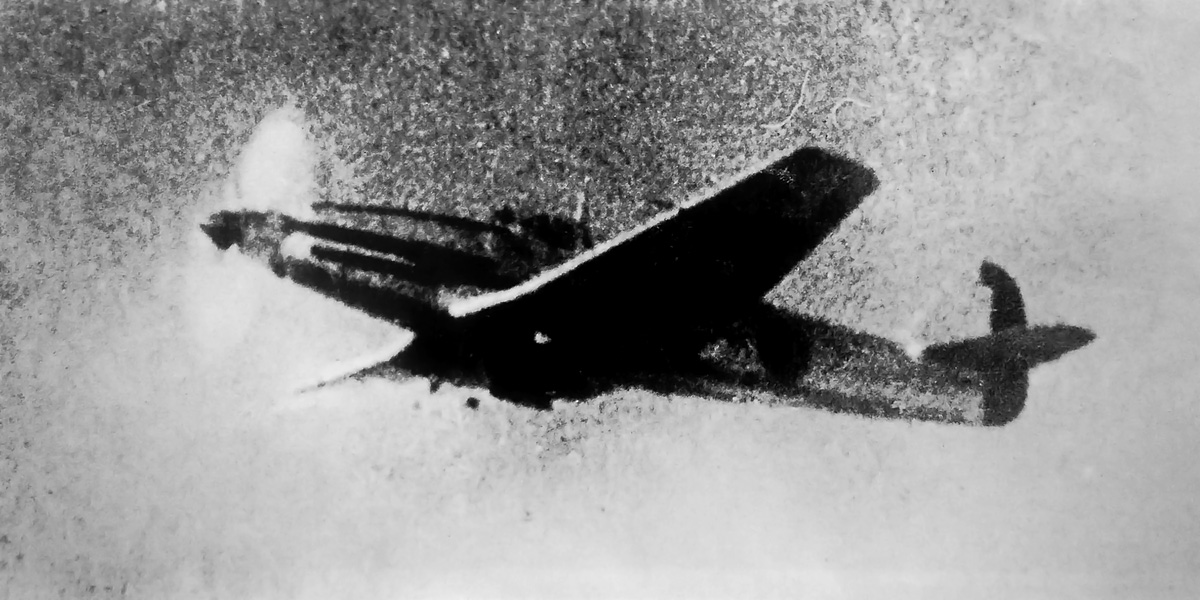
kawasaki-ki-64-in-flight

A poor image, but perhaps the only one, showing the Ki-64 in flight. The lightning bolt has been painted on the fuselage.

The short flying career of the Ki-64 had shown that its cooling system was insufficient. The system worked well for level flight, but it was inadequate for ground running, takeoff, and climb. When the system was overloaded, steam was not condensed back to water and was subsequently vented overboard via a 16 psi (1.1 bar) relief valve. The cooling system lost about 12 gallons (45 L) of water during a rapid climb from takeoff to 18,000 ft (5,500 m). Water freezing within the system, either while in flight or on the ground during cold temperatures, was another concern. Adding an alcohol mixture to the water coolant was a possible solution, but the Ki-64 never underwent any cold weather testing.

While undergoing repairs, the Ki-64 was to be modified and redesignated Ki-64 Kai. The existing propellers would be replaced with fully adjustable and feathering contra-rotating propellers, which would make it easier for one engine to be shut down in flight. The engines were to be replaced with more powerful Ha-140s (joint designation [Ha-60]41), each of which was capable of 1,500 hp (1,119kW). The coupled engine was designated Ha-321 (joint designation [Ha-72]21) and produced 2,800 hp (2,088 kW). With the changes, it was estimated that the Ki-64 Kai would have a top speed of 497 mph (800 km/h). However, the propeller and engines were delayed by more pressing war-time work, and the Ki-64 program was cancelled in mid-1944.

The Ki-64 airframe remained at Gifu where it was captured by American forces in 1945. Various parts of the cooling system were removed from the aircraft and shipped to Wright Field in Dayton, Ohio for further analysis and testing. The remainder of the Ki-64 was eventually scrapped.

kawasaki-ki-64-at-gifu

The K-64 as discovered by American forces at the end of World War II. The engines had been removed, and the aircraft was in a rather poor state. Note the canopy frame sitting on the wing.

Sources:
Japanese Army Fighters Part 1 by William Green and Gordon Swanborough (1977)
Japanese KI-64 Single Fighter with Two Engines in Tandem and Vapor-Phase Cooling, Air Technical Intelligence Review Report No. F-IR-100-RE by Petaja and Gilmore (31 July 1946)
Japanese Secret Projects by Edwin M. Dyer III (2009)
Japanese Aircraft of the Pacific War by René J. Francillon (1979/2000)
Encyclopedia of Japanese Aircraft 1900–1945 Vol. 4: Kawasaki by Tadashi Nozawa (1966)
The Xplanes of Imperial Japanese Army & Navy 1924–45 by Shigeru Nohara (1999)
Heinkel He 100 by Erwin Hood (2007)

tips-1917-18-cylinder-rotary-engine

Tips Aero Motor Rotary Aircraft Engines

By William Pearce

From a very early age, Maurice A. Tips and his younger brother Ernest Oscar were interested in aviation. By 1909, the Belgian siblings had built their first aircraft: a canard-design, pusher biplane. The first engine installed in the aircraft proved underpowered and was replaced with a Gnome rotary. The engine was geared to two shafts, each driving a two-blade pusher propeller. Although the aircraft made some flights, its handling was unsatisfactory, and the design was not developed further. The aircraft did possess unique concepts, a theme continued in Maurice’s subsequent designs.

tips-1908-biplane

Rear view of Maurice and Ernest Oscar Tips’ 1909 biplane pusher. The aircraft was unable to fly with its original Pipe V-8 engine, but the lighter Gnome rotary enabled the aircraft to takeoff. Note the central gearbox that provided power to the shafts that turned the propellers via right-angle drives.

After the 1909 aircraft, Maurice refocused his efforts on aircraft engines. By 1911, Maurice had designed the first in a series of “valveless” rotary engines. All of Tips’ engines used a rotary valve system for cylinder intake and exhaust. Unfortunately, documentation on these engines is nearly non-existent; their exact order of development and specifications are not known with certainty.

tips-1912-7-cylinder-rotary-engine

Drawings of the 25 hp (19 kW) Tips engine of 1912. Air was drawn through the rotating suction tubes (5) which enable the intake port (14) and exhaust port (13) to align with the cylinder. The suction tubes were geared (9 and 10) to the stationary crankshaft (4).

The first engine was a seven-cylinder rotary that produced 25 hp (19 kW). The engine had a 2.76 in (70 mm) bore, a 4.33 in (110 mm) stroke, and a displacement of 181 cu in (3.0 L). Hollow “suction tubes” took the air/fuel mixture from the engine’s crankcase and delivered it to the cylinders. Each suction tube was geared to the engine’s fixed crankshaft. The suction tubes would spin at half the speed of the crankcase as it rotated. The top of the suction tube had two passageways. Each passageway would align with a common port near the top of the cylinder once every two revolutions of the crankcase. One passageway aligned to allow the air/fuel mixture to flow from the suction tube and into the cylinder. The second passageway aligned to allow the exhaust gases to flow from the cylinder out into the atmosphere.

The 25 hp (19 kW) Tips “valveless” rotary engine was installed in a monoplane built by Henri Gérard. It appears the aircraft was completed around 1913. However, the performance results of the engine and aircraft have not been found. As history unfolded, this was the only Tips engine installed in an aircraft.

Maurice and EO Tips Gerard monoplane

Henri Gérard and his mechanic by Gérard’s Tips-powered monoplane. The engine was a 25 hp (19 kW) seven-cylinder “valveless” rotary. Note the spark plug protruding from the top of each cylinder. (Tips Family Archive via Vincent Jacobs)

Maurice continuously refined the design of “valveless” rotary engines. In late 1912, two larger versions of the seven-cylinder engine were planned. A 50 hp (37 kW) version had a 4.33 in (110 mm) bore, a 4.72 in (120 mm) stroke, and a displacement of 487 cu in (8.0 L). The largest engine produced 70 hp (52 kW) and had a 4.41 in (112 mm) bore, a 5.12 in (130 mm) stroke, and a displacement of 547 cu in (9.0 L). An advertisement stated that all three engines would be displayed at the Salon de l’Automobile held in Brussels, Belgium in January 1913. In addition, the 25 hp (19 kW) engine was used to power a Tips airboat that was displayed at the show.

Engine development continued throughout 1913 and 1914. The most obvious change was that the suction tube was moved to be parallel with the cylinder, rather than at an angle as seen in the earlier engines. The newer engine design had an updated drive for the suction tubes, and the air/fuel mixture no longer passed through the crankcase; rather, it was delivered through a hollow extension of the crankshaft to a space under the suction tubes. A nine-cylinder engine of this design was built, but it is not clear if the engine was built in Europe or the United States; it was most likely built in the US.

tips-1913-and-1914-rotary-engines

The 1913 (left) and 1914 (right) versions of the Tips rotary engine. The major changes were to the suction tube drive and rotary valve. The small tube (no. 14 on the 1913 engine and no. 40 on the 1914 engine) in the stationary crankshaft extension provided oil to the crankshaft and connecting rod.

When World War I broke out, Maurice and Ernest Tips fled Belgium. Ernest made his way to Britain, where he worked with Charles Richard Fairey and helped start the Fairey Aviation Company in 1915. Ernest would return to Belgium in 1931 to start the Fairey subsidiary, Avions Fairey. He also produced the Tipsy series of light aircraft.

Maurice Tips traveled to the US in October 1915 and continued to design aircraft engines. It is quite possible that the nine-cylinder engine was built once Tips had established himself in the US. The engine had a 4.92 in (125 mm) bore and a 5.91 in (150 mm) stroke. It displaced 1,011 cu in (16.6 L) and produced 110 hp (82 kW). The nine-cylinder engine was approximately 35 in (.89 m) in diameter and weighed 290 lb (132 kg). A smaller nine-cylinder engine was designed, but it is not clear if it was built. The smaller engine had a 4.92 in (125 mm) bore and a 5.51 in (140 mm) stroke. It displaced 944 cu in (15.5 L) and produced 100 hp (75 kW).

Tips 9-cylinder rear

Rear view of the 110 hp (82 kW) nine-cylinder Tips “valveless” rotary engine. Air was drawn in through the hollow extension to the crankshaft where it mixed with fuel. Ports in the crankshaft extension led to a distribution chamber at the back of the engine. The air/fuel mixture was drawn into the suction tube behind each cylinder and then into the combustion chamber. (Tips Family Archive via Vincent Jacobs)

For more power, Maurice had the idea of coupling two 110 hp (82 kW) nine-cylinder engines in tandem to make an 18-cyinder power unit. The two engine sections would be placed front-to-front and rotate in the same direction. The engines would be suspended some 20 in (508 mm) below the propeller shaft. A Renold Silent (inverted tooth) drive chain positioned between the two engines would deliver power to the propeller shaft. By varying the size of the drives, a propeller speed reduction could be achieved. Drawings show a 5 in (127 mm) drive gear and a 7.5 in (191 mm) gear on the propeller shaft, which would give a .667 speed reduction. The tandem 18-cylinder engine had an output of 220 hp (164 kW) and was 606 lb (275 kg). The power unit was 62 in (1.57 m) long and 40 in (1.02 m) in diameter, not including the propeller shaft. It is unlikely that a tandem engine was built.

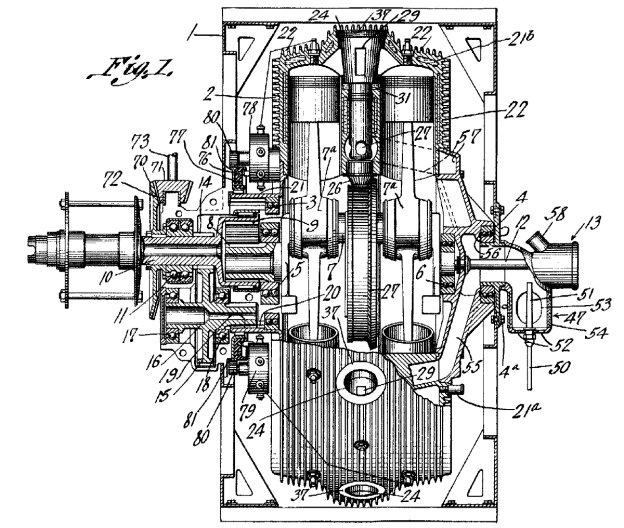
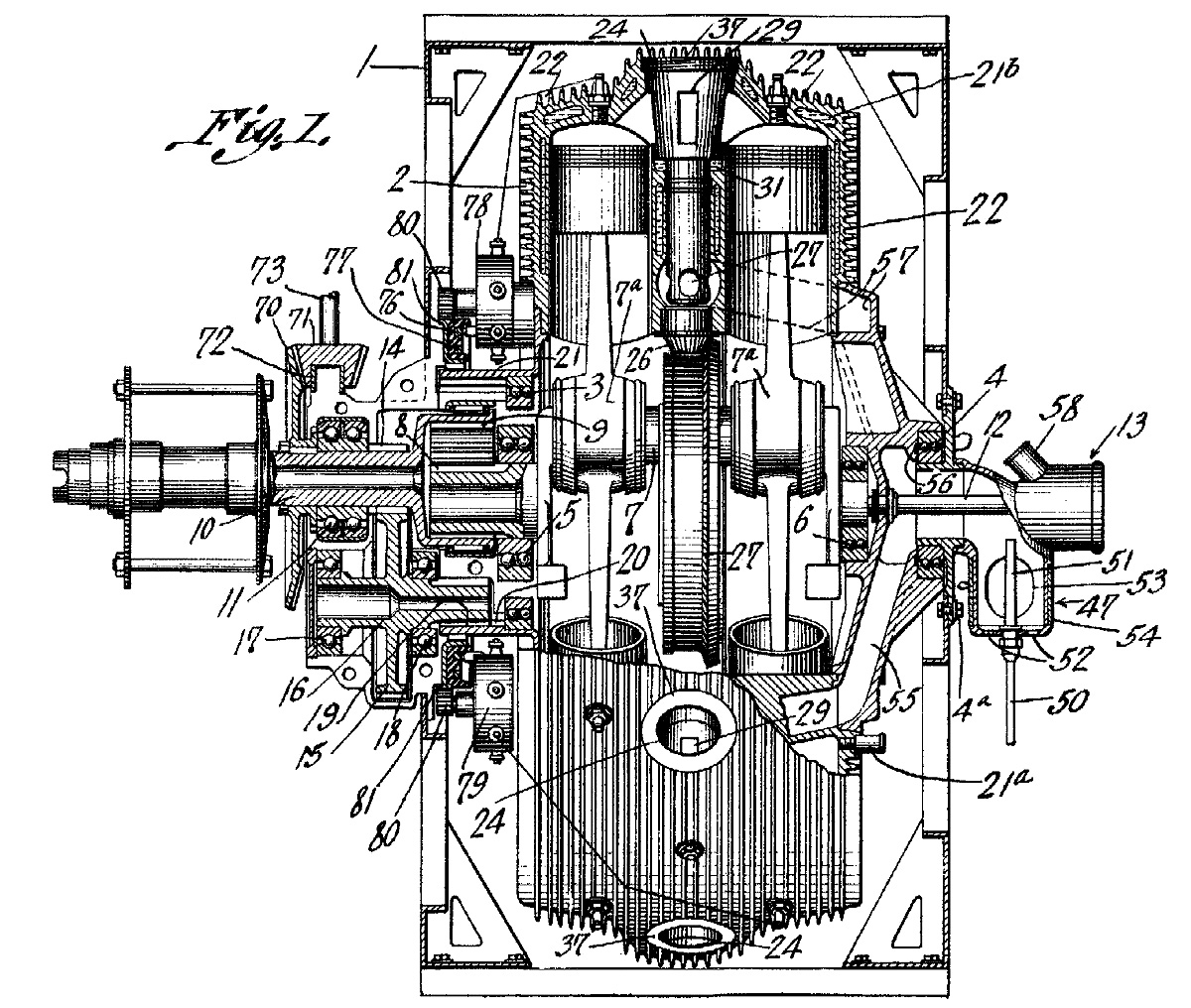
In 1917, The Tips Aero Motor Company was founded in Woonsocket, Rhode Island. That same year, Maurice applied for patents covering his new engine design, which incorporated many concepts from the earlier engines. Rather than a tandem engine, the new Tips engine was a single, 18-cylinder power unit. The rotary engine had two rows of nine cylinders and was housed in a stationary frame. The new engine employed both water and air cooling. The cylinders were arranged in pairs, with one in the front row of the engine and the other in the rear row. The crankshaft had only one throw, and the pistons for both cylinders in a pair were at top dead center on their compression strokes at the same time. The engine’s compression ratio was 5.25 to 1. Each cylinder had one spark plug at the center of its combustion chamber. The spark plugs were fired by two magnetos mounted to the front of the engine and driven from the propeller shaft.

Tips Tandem 18-cylinder engine

The Tips Tandem engine consisted of two nine-cylinder engines coupled together. An inverted tooth chain between the engines delivered power to the propeller shaft. (Tips Family Archive via Vincent Jacobs)

Most rotary engines had a fixed crankshaft and a crankcase that rotated. This arrangement created much stress on the crankshaft and crankcase and also imposed severe gyroscopic effects on the aircraft. The Tips engine employed several unique characteristics to resolve the drawbacks of traditional rotary engines. The crankshaft of the Tips engine rotated and was geared to the propeller shaft. The propeller shaft was geared to the crankcase, which allowed it to rotate in the opposite direction from the crankshaft and propeller. The end result was that when the crankshaft was turning at 1,800 rpm, the propeller would turn at 1,080 rpm, and the crankcase would rotate at 60 rpm in the opposite direction. Rotary engines in which the crankshaft and crankcase rotate in opposite directions and at different speeds are often called bi-directional or differential rotary engines.

The propeller shaft of the Tips 18-cylinder engine was geared to the crankshaft at a .600 reduction; the crankshaft gear had 18 teeth, and the propeller shaft’s internal gear had 30 teeth. For crankcase rotation, the 17 teeth on the propeller shaft gear engaged 51 teeth on one side of a countershaft to give a .333 gear reduction. The other side of the countershaft had 11 teeth that meshed with a 66-tooth internal gear attached to the crankcase and resulted in a further .167 reduction. Having the propeller and crankshaft rotating in opposite directions not only eliminated the gyroscopic effect inherent to conventional rotary engines, but it also neutralized the gyroscopic effect created by the propeller attached to a fixed engine.

tips-1917-18-cylinder-rotary-engine

The 18-cylinder Tips engine of 1917 was far more complex than the earlier engines. Note the paired cylinders separated by the rotary valve (24). The propeller shaft (10) was geared to the crankshaft (7) via reduction gears (8 and 9). The crankcase was geared to the propeller shaft via a countershaft (16).

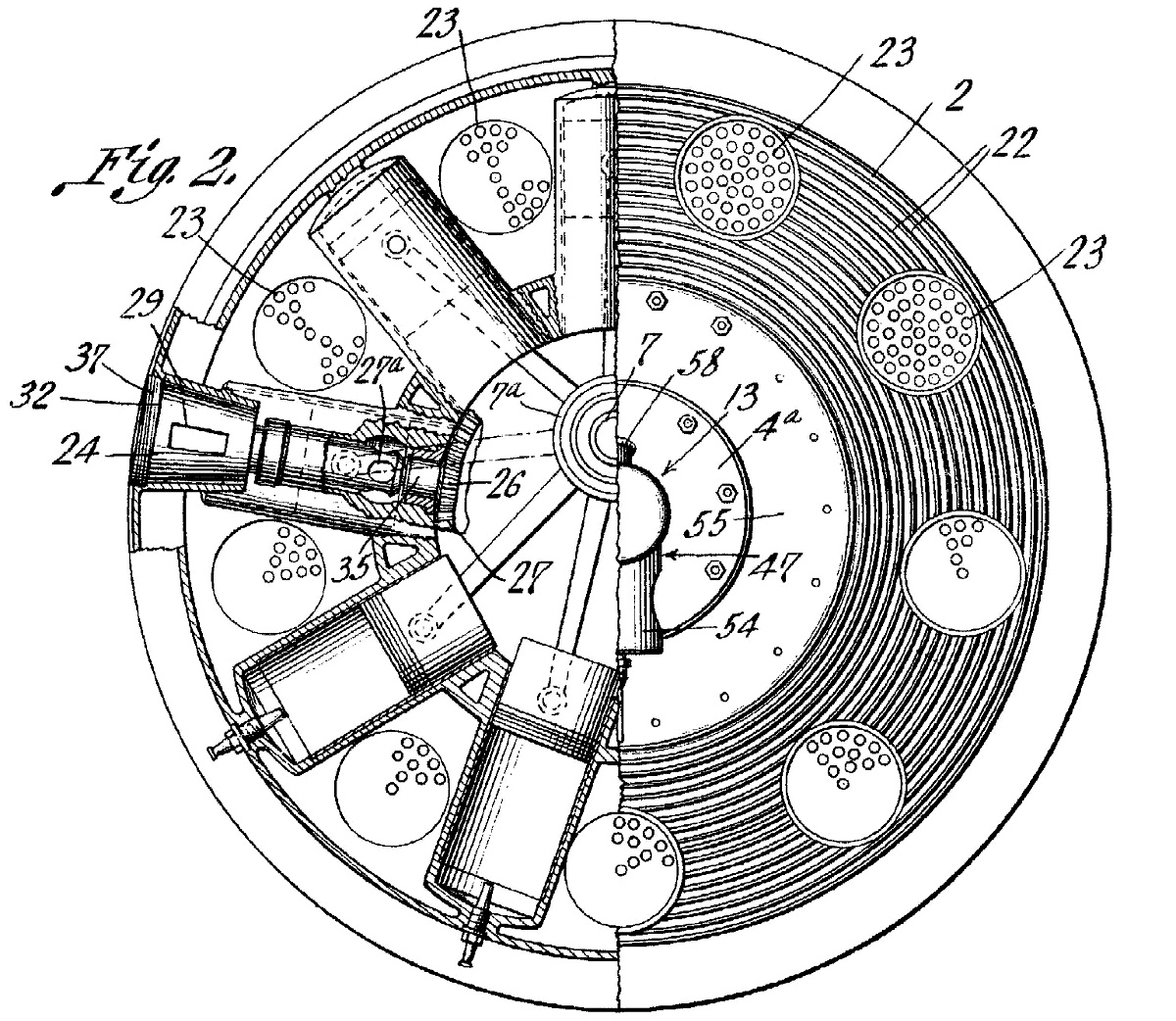
On the exterior of the cylinder castings were numerous cooling fins. In addition, internal passageways for water cooling were in the cylinder castings. Between each pair of cylinders were a series of air passageways to further augment cooling. The engine did not have a water pump; rather, thermosyphoning and the relatively slow rotation of the crankcase enabled the circulation of cooling water from the internal hot areas of the cylinders out toward the cooling fins on the exterior of the cylinders. The engine’s rotation also aided oil lubrication from the pressure-fed crankshaft to the rest of the engine. The oil pump and carburetor were located on the stationary frame at the rear of the engine.

A flange was positioned on the crankshaft, between the connecting rods of the cylinder pair. Mounted on the flange via ball bearings was an eccentric gear with 124 teeth on its outer edge. Attached (but not fixed) to the crankcase was a master valve gear that had 128 teeth on its inner edge. The gears meshing with an eccentric action resulted in the master valve gear turning four teeth per revolution of the crankshaft. On the outer edge of the master valve gear was a bevel gear with 128 teeth. These teeth engaged a 16-tooth pinion attached to a rotary valve positioned between each cylinder pair. The four teeth per revolution of the master valve gear acting on the 16-tooth rotary valve resulted in the rotary valve turning at a quarter engine speed. Each hollow rotary valve had two intake ports and two exhaust ports.

tips-1917-18-cylinder-valves-and-gear

On the left is the rotary valve shown with the intake ports aligned (Fig 3). The air/fuel mixture entered the valve through ports in its lower end (27a). On the right is the valve with the exhaust ports aligned (Fig 5). Fig 4 shows a cross section of the rotary valve with intake ports (28), exhaust ports (29), and passageways for the flow of cooling water (30). Fig 8 shows the valve gear drive. The crankshaft (7) turned an eccentric gear (44) that meshed (42 and 41) with a gear mounted to the crankcase. The result is that a bevel gear (27) engaged a gear screwed to the bottom of the rotary valve (26 on Fig 3) and turned the valve once for every four revolutions of the crankshaft.

Air was drawn in through a carburetor at the rear of the engine. The air/fuel mixture flowed through a manifold bolted to the cylinder casting and into a passageway that led to a chamber around the lower part of the rotary valve. Holes in the valve allowed the air to flow up through its hollow middle and into the cylinder when the intake ports aligned. As the valve rotated, the exhaust ports would align with the cylinder, allowing the gases to escape out the top of the valve head and into the atmosphere. Passageways in the lower part of the rotary valve head brought in cooling water from the cylinder’s water jacket. Water flowed up through the rotary valve and back into the cylinder’s water jacket. The rotary valve was lubricated by graphite pads and held in place by a spiral spring and retaining cap around its upper surface.

The 18-cylinder Tips engine had a 4.5 in (114 mm) bore and a 6.0 in (152 mm) stroke. The engine displaced 1,718 cu in (28.1 L) and produced 480 hp (358 kW) at 1,800 rpm. The Tips engine weighed 850 lb (386 kg). At speed, the engine consumed 22 gallons (83 L) of fuel and 3 gallons (11 L) of oil per hour. The oil consumption was particularly high, even for a rotary engine, but the Tips engine was larger and more powerful than other rotary engines.

tips-1917-18-cylinder-rear

Rear view of the 480 hp (358 kW) Tips engine shows the extensive fining (22) that covered the engine. The fining and air passages (23) combined to turn the whole engine into a radiator to cool the water that flowed through the engine via thermosyphoning and centrifugal force.

In 1919, the engine was mentioned in a few publications. In 1920, Leo G. Benoit, Technical Manager at Tips Aero Motors, passed away. Benoit was said to be in charge of the engine’s design and construction. No further information regarding the engine and no images of the engine have been found. This lack of information could mean that the 480 hp (358 kW) Tips engine was never built. However, given the detailed description of the engine and that it was worked on from 1917 to at least 1920, the possibility certainly exists that the engine was built and tested.

Sometime before World War II, Maurice Tips returned to Belgium. He continued to design engines and applied for a patent on a rotary piston engine in 1938. This engine was not designed for aircraft use and bore no similarities to his early aircraft engines.

Tips 18-cylinder engine crankcase

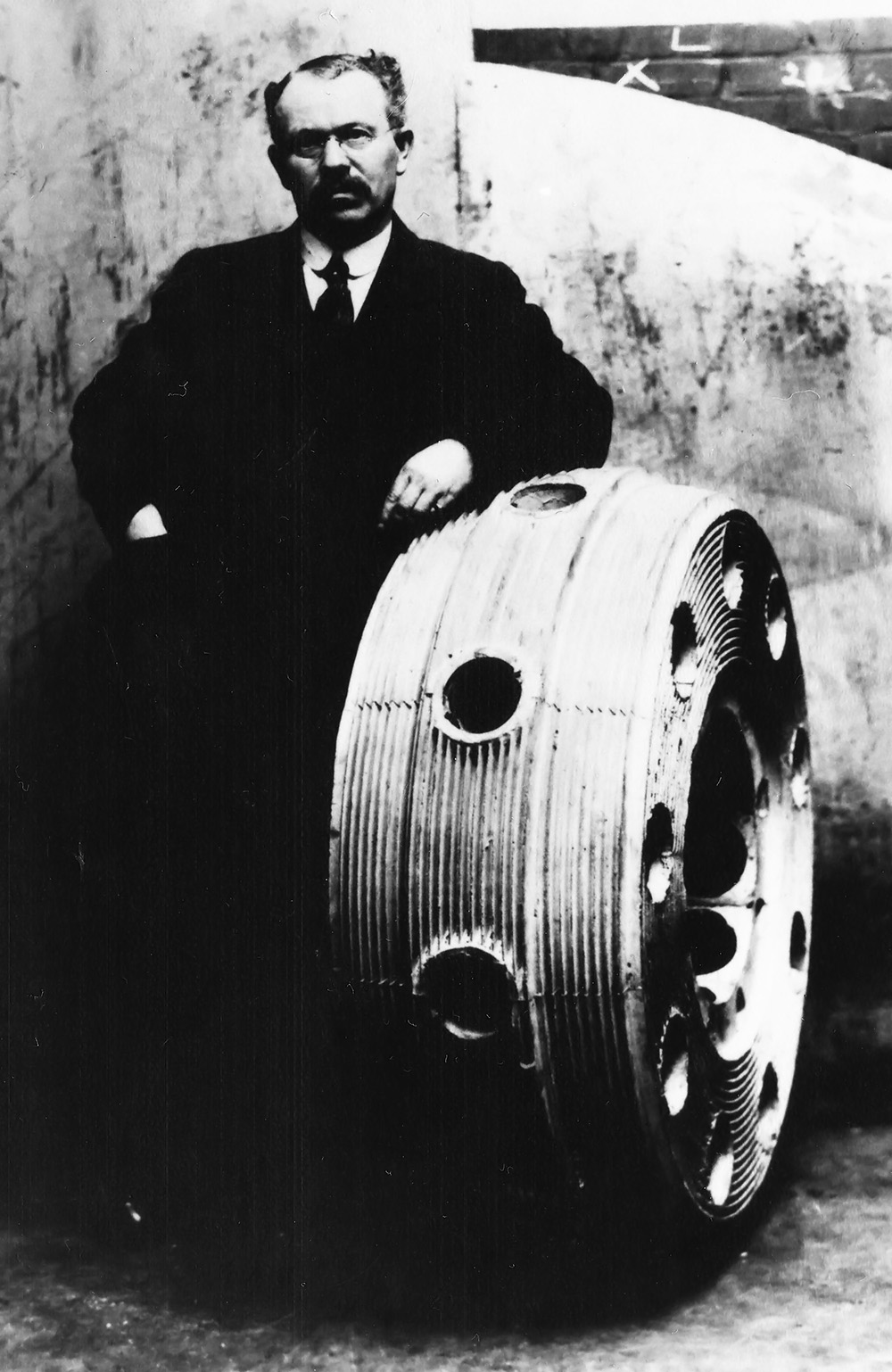
Maurice Tips stands next to the unfinished crankcase casting for the 18-cylinder differential rotary engine. The holes in the crankcase’s outer diameter were for the rotary valves. The holes in the crankcase’s face were for water radiators, and the holes inside of the crankcase were for the cylinders. It is not known if a complete engine was built. (Tips Family Archive via Vincent Jacobs)

Sources:
Les Avions Tipsy by Vincent Jacobs (2011)
– “Valveless Rotary Combustion Engine” US Patent 1,051,290 by Maurice Tips (granted 21 January 1913)
– “Improvements in Rotary Combustion Engines” GB Patent 191307778 by Maurice Tips (application 15 April 1913)
– “Improvements in or relating to Rotary Combustion Engines” GB Patent 191506821 by Maurice Tips (application 8 May 1914)
– “Rotary Valve” US Patent 1,286,149 by Maurice A. Tips (granted 26 November 1918)
– “Internal Combustion Engine” US Patent 1,306,035 by Maurice A. Tips (granted 10 June 1919)
– “Valve-Operating Mechanism” US Patent 1,306,036 by Maurice A. Tips (granted 10 June 1919)
– “Internal Combustion Engine” US Patent 2,203,449 by Maurice Tips (granted 4 June 1940)
– “The Tips 480 H.P. Aero Motor” Aerial Age Weekly (17 March 1919)
Airplane Engine Encyclopedia by Glenn Angle (1921)
http://www.vieillestiges.be/fr/rememberbook/contents/42