Monthly Archives: November 2016

mercedes-benz-w154-record-car

Mercedes-Benz W154 Record Car

By William Pearce

For the 1938 European Grand Prix season, the Association Internationale des Automobile Clubs Reconnus (AIACR) issued a rule change that limited the displacement of supercharged engines to 3.0 L (183 cu in) and normally aspirated engines to 4.5 L (275 cu in). Rather than modifying its existing W125 racer with its supercharged 345.6 cu in (5.66 L) straight-eight engine, Mercedes-Benz built an entirely new car for the 1938 season. Designated W154, the car was designed by Rudolf Uhlenhaut, Max Sailer, and Max Wagner.

The 1938 Mercedes-Benz W154 Grand Prix racer. Each of the hand-built cars was unique, and they underwent modifications throughout the 1938 race season. For 1939, the nose of the car was extended and a new grille was installed.

The 1938 Mercedes-Benz W154 Grand Prix racer. Each of the hand-built cars was unique, and they underwent modifications throughout the 1938 race season. For 1939, the nose of the car was extended, and a new grille was installed.

The Mercedes-Benz W154 was an open-wheel, front-engine Grand Prix race car. The W154’s chassis was essentially the same as that used on its predecessor, the W125. The W154 had a 107.4 in (2,728 mm) wheelbase, a 58.0 in (1,473 mm) track for the front wheels, and a 55.6 in (1,412 mm) track for rear wheels. The car’s frame was made of tubular steel and was covered with aluminum body panels contoured to improve aerodynamics.

Powering the W154 was a V-12 engine known as the M154. The M154 engine was designed by Albert Heess and was inspired by the 570 hp (425 kW), 340 cu in (5.58 L) DAB V-12 engine that was intended for the W125 during the 1936 Grand Prix season. The DAB engine made the W125 too heavy for the Grand Prix class, and the engine was replaced by the lighter M125 straight-eight. On 28 January 1938, a tuned DAB engine developing some 736 hp (549 kW) was installed in a special, streamlined W125 chassis. The car and engine combination was known as the Rekordwagen (record car). Driven by Mercedes-Benz driver Rudolf Caracciola, the W125 Rekordwagen set a new Class B (5.001–8.000 L / 305–488 cu in) speed record of 268.863 mph (432.692 km/h) over 1 km (.6 mi) and 268.657 mph (432.361 km/h) over 1 mile (1.6 km).

mercedes-benz-w125-rekordwagen

The W125 Rekordwagen and the DAB V-12 engine were used to set Class B records in 1938. In 1939, a M154 engine was installed, and the car set Class D records in the flying kilometer and mile.

The two cylinder banks of the M154 V-12 engine were set at 60 degrees. Each bank was comprised of two three-cylinder blocks made of steel. The engine used side-by-side connecting rods and a one-piece crankshaft. Mounted to the front of the M154 engine were two Roots-type superchargers. Air entered a carburetor attached to the superchargers at the very front of the engine. The air/fuel mixture was then compressed by the superchargers operating in parallel and flowed through an intake manifold positioned in the Vee of the engine. The superchargers were driven at 1.5 times engine speed and delivered around 20 psi (1.38 bar) of boost.

Each cylinder had two intake and two exhaust valves that were driven by dual overhead camshafts. The M154 engine had a bore of 2.64 in (67 mm), a stroke of 2.76 in (70 mm), and a displacement of 180.7 cu in (2.96 L). The engine’s compression varied from 5.95 to 1 and 6.60 to 1 depending on the desired reliability. The different compression ratios resulted in the engine’s output varying from 433 hp to 474 hp (323 kW to 353 kW) at 8,000 rpm. It was also noted that the superchargers used an additional 160 hp (119 kW) at 8,000 rpm.

mercedes-benz-w154-record-car

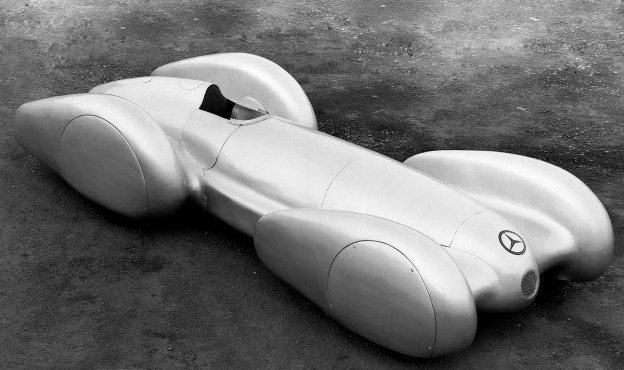
This view of the streamlined M154 record-breaker shows the extensive fairings that covered the car’s wheels, suspension, and cockpit sides.

The V-12 engine was angled in the W154’s frame so that the car’s drive shaft extended back along the left side of the driver and to the rear differential. This configuration allowed the driver to be seated next to the driveline and some 4 in (102 mm) lower in the car, which lowered the racer’s center of gravity and improved its aerodynamics and handling. To compensate for the smaller and less-powerful engine compared to the W125, the W154’s gearbox had closer ratio gears with a fifth gear added to maintain top speed. The M154 weighed around 2,161 lb (980 kg) and had a top speed of over 193 mph (310 km/h).

The W154 did very well during the 1938 Grand Prix season, sweeping the top three spots, with two other cars tied for fifth. The car gave Mercedes-Benz driver Rudolf Caracciola his third European Championship title. Some engine and aerodynamic modifications to the W154 were planned for the 1939 season, but before the season got underway, Mercedes-Benz decided to use the W154 to make attempts on the Class D (2.001–3.000 L / 122–183 cu in) standing start speed record.

mercedes-benz-w154-record-front

This low view of the M154’s front illustrates how the fairings wrapped around to the underside of the car. Note the extra space in the front wheel fairings to allow a limited amount of steering. The intake in the nose of the car led directly to the carburetor.

Chassis number 11 of the 15 W154s built was modified by enclosing the wheels and suspension in aerodynamic fairings. The sides of the cockpit were also enclosed by panels; the one on the right side was easily removed for entry into the cockpit. Further streamlining improvements were made to the rest of the body, and unneeded equipment was removed to make the car as light as possible. Overall, 68 lb (31 kg) were shed, reducing the car’s weight to 2,092 lb (949 kg). Since the record runs were brief, the radiator was removed, and an ice tank was installed above the rear axle. Hot coolant from the engine flowed into the tank and melted the ice, and the now-chilled coolant flowed back to the engine. With the radiator removed, an inlet in the nose of the car fed air directly to the engine’s carburetor. The streamlined W154 record car’s engine developed 468 hp (349 kW) at 7,800 rpm.

On 8 February 1939, Caracciola climbed into the streamlined W154 car as it sat on a special section of the Autobahn south of Dessau, Germany. Called the Dessauer Rennstrecke (Dessau Racetrack), this 6.2 mi (10 km) stretch of the Autobahn was specially made for record attempts and was 82 ft (25 m) wide with the median paved over. From a stop, Caracciola and the W154 rocketed down the Autobahn, covering 1 km (.6 mi) in 20.56 seconds and 1 mile (1.6 km) in 28.32 seconds—both times were new Class D records. Unfortunately, the top speed achieved was not recorded, but the times averaged to 108.800 mph (175.097 km/h) over 1 km (.6 mi) and 127.119 mph (204.578 km/h) over 1 mile (1.6 km).

The next day, Caracciola drove the W125 Recordwagen streamliner with a M154 engine installed. The car fell into Class D with the smaller engine and was used to set new records for the flying km and mile. Caracciola traveled 1 km (.6 mi) in 9.04 seconds at 247.449 mph (398.230 km/h) and 1 mile (1.6 km) in 14.50 seconds at 248.276 mph (399.561 km/h).

mercedes-benz-w154-record-start

Rudolf Caracciola sits in the W154 at the start of a record attempt. Swastikas (Hakenkreuz) appeared on the W125 and W154 record cars. Because of its very negative connotations and the fact that the symbol is illegal in present-day Germany, the swastika markings have been removed from most images.

Not entirely satisfied with the standing start record in the special W154 car, Caracciola set another record on 14 February when he covered 1 km (.6 mi) in 20.29 seconds, averaging 110.248 mph (177.427 km/h). This was the last speed record set in Germany before World War II. The Mercedes-Benz T80 was to make an attempt on the world speed record in 1940, but the war derailed those plans.

The W154’s engine was modified for the 1939 Grand Prix season. The new engine was known as the M163 and used two-stage supercharging. Two superchargers were still at the front of the engine, but now they operated in series, with one feeding the other. The superchargers rotated at 1.25 times crankshaft speed. The first supercharger (stage) provided 12 psi (.83 bar) of boost, which was increased to 19 psi (1.31 bar) after the second supercharger (stage). While similar boost was achieved with the earlier supercharger set up, the two-stage system only consumed 84 hp (63 kW) at 7,500 rpm, about half of the earlier system. This allowed the M163 engine to produce 480 hp (358 kW) at 7,500 rpm. While that was only 6 hp (5 kW) more than the M154 engine, the 500 rpm decrease made the M163 engine much more reliable than its predecessor. Because of the M163 engine, the 1939 cars are often referred to as W163s, but they were still W154s. World War II prevented an official winner of the 1939 Grand Prix season to be declared. However, all the races had been run, and Mercedes-Benz cars occupied the top four spots.

W154 chassis number 11, the one used for the record run, was returned to Grand Prix racer configuration. In 1951, the car was raced by Juan Manuel Fangio in two Grand Prix races in Argentina. The car was preserved and is owned by Mercedes-Benz.

mercedes-benz-w154-record-run

A small amount of tire smoke and dust can be seen near the crowd as the M154 sets off to set standing start records in the 1 km (.6 mi) and 1 mile (1.6 km) distances. The runs were made on a special section of the Autobahn south of Dessau. Note how the overpass does not have any center supports and that the median is paved over. These features gave record challengers more space to operate.

Sources:
The Mercedes-Benz Racing Cars by Karl Ludvigsen (1971)
Classic Racing Engines by Karl Ludvigsen (2001)
http://www.kolumbus.fi/leif.snellman/reco.htm
http://www.ultimatecarpage.com/spec/361/Mercedes-Benz-W154.html
https://en.wikipedia.org/wiki/Mercedes-Benz_W154
http://www.ultimatecarpage.com/car/361/Mercedes-Benz-W154.html
https://en.wikipedia.org/wiki/Mercedes-Benz_W125_Rekordwagen
http://www.ultimatecarpage.com/spec/965/Mercedes-Benz-W125.html
https://en.wikipedia.org/wiki/Mercedes-Benz_W125
pander-s4-engine-run

Pander S.4 Postjager Trimotor Mailplane

By William Pearce

In the early 1930s, Dutch pilot Dirk Asjes was disappointed with the slow development of Dutch airmail flights and Fokker aircraft. Asjes sketched out an aircraft design and asked the aircraft manufacturer Pander to build a special mailplane to compete with KLM (Koninklijke Luchtvaart Maatschappij or Royal Dutch Airlines) mail and passenger service. Officially, Pander was called the Nederlandse Fabriek van Vliegtuigen H. Pander & Zonen (H. Pander & Son Dutch Aircraft Company). Pander was a furniture company that had expanded to aircraft construction in 1924 when its owner, Harmen Pander, purchased the bankrupt VIH (Vliegtuig Industrie Holland or Holland Aircraft Industry).

pander-s4-engine-run

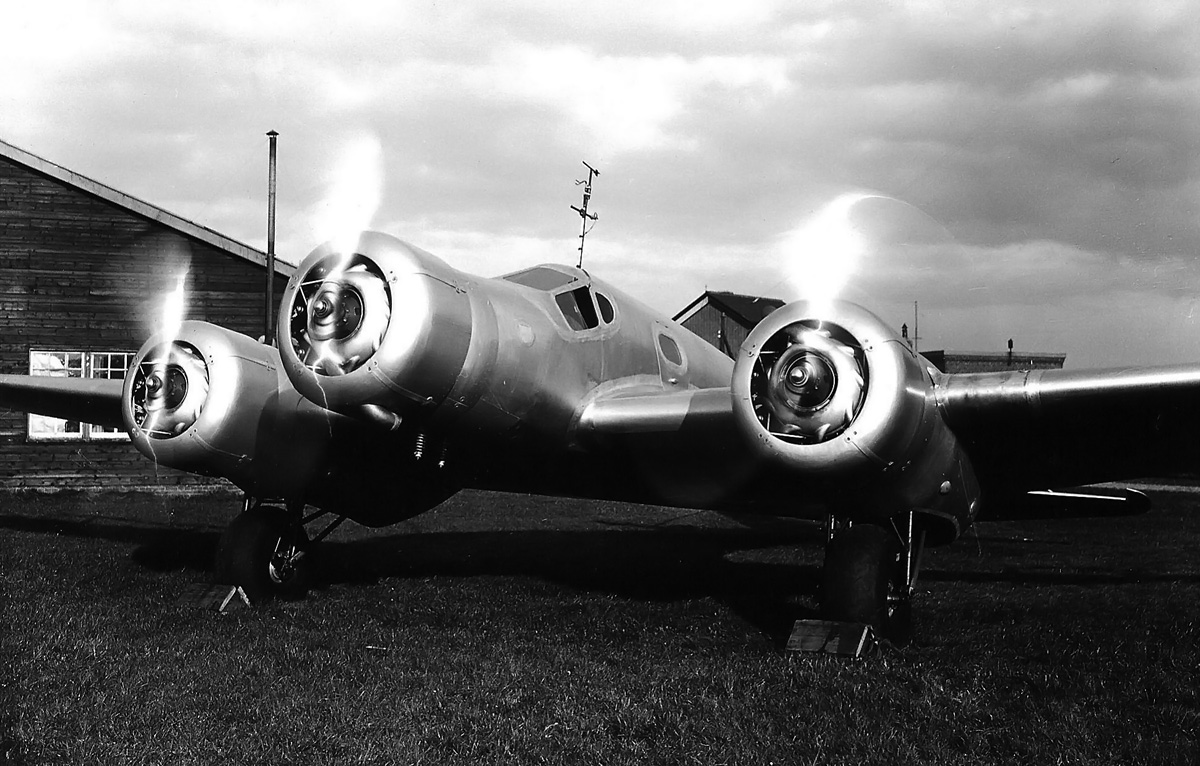
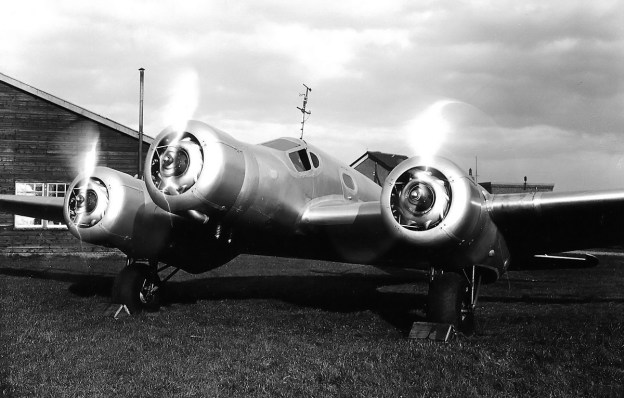
The Pander S.4 Postjager displays its clean lines. The trimotor aircraft was purpose-built as a mail carrier to fly from Amsterdam to Batavia.

Airmail service to the Dutch East Indies involved using the relatively slow Fokker F.XVIII, which had a top speed of 149 mph (240 km/h). To improve service, KLM ordered the Fokker F.XX Zilvermeeuw, which had a top speed of 190 mph (305 km/h). While the F.XX was being built, Pander took up the challenge to build a faster aircraft solely to transport mail. Pander’s new design was the S.4 Postjager, and financial support came from a few Dutch shipping companies who hoped to break KLM’s monopoly on air transport to the East Indies.

The Pander S.4 Postjager was designed by Theodorus (Theo) Slot, who was originally with VIH. The aircraft was a low-wing trimotor with retractable main gear. The S.4 was made almost entirely of wood. The aircraft was powered by three 420 hp (313 kW) Wright Whirlwind R-975 engines. The aircraft’s interior was divided into three compartments: cockpit, radio room, and mail cargo hold.

pander-s4-takeoff

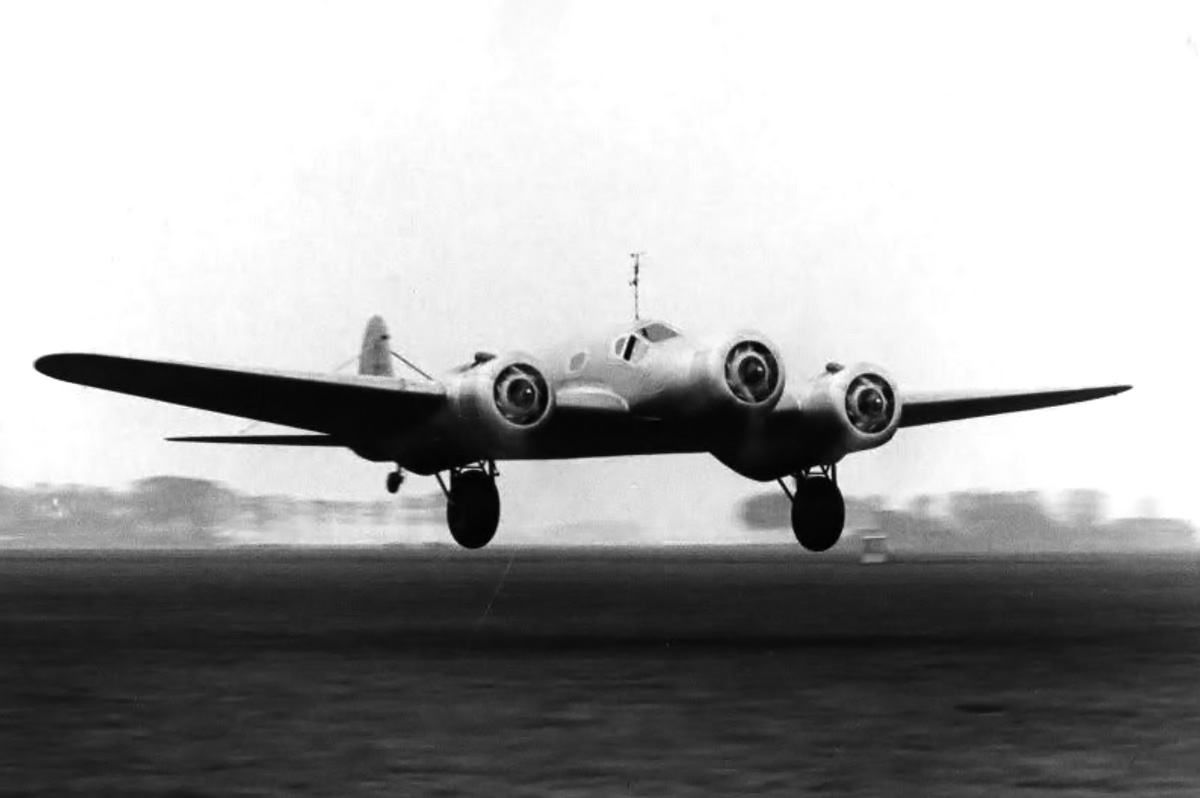
On paper, the S.4 appeared to be an impressive, purpose-built aircraft that could improve airmail service for the Netherlands. In practice, the aircraft never had an opportunity to fully demonstrate its capabilities without outside difficulties hindering its performance.

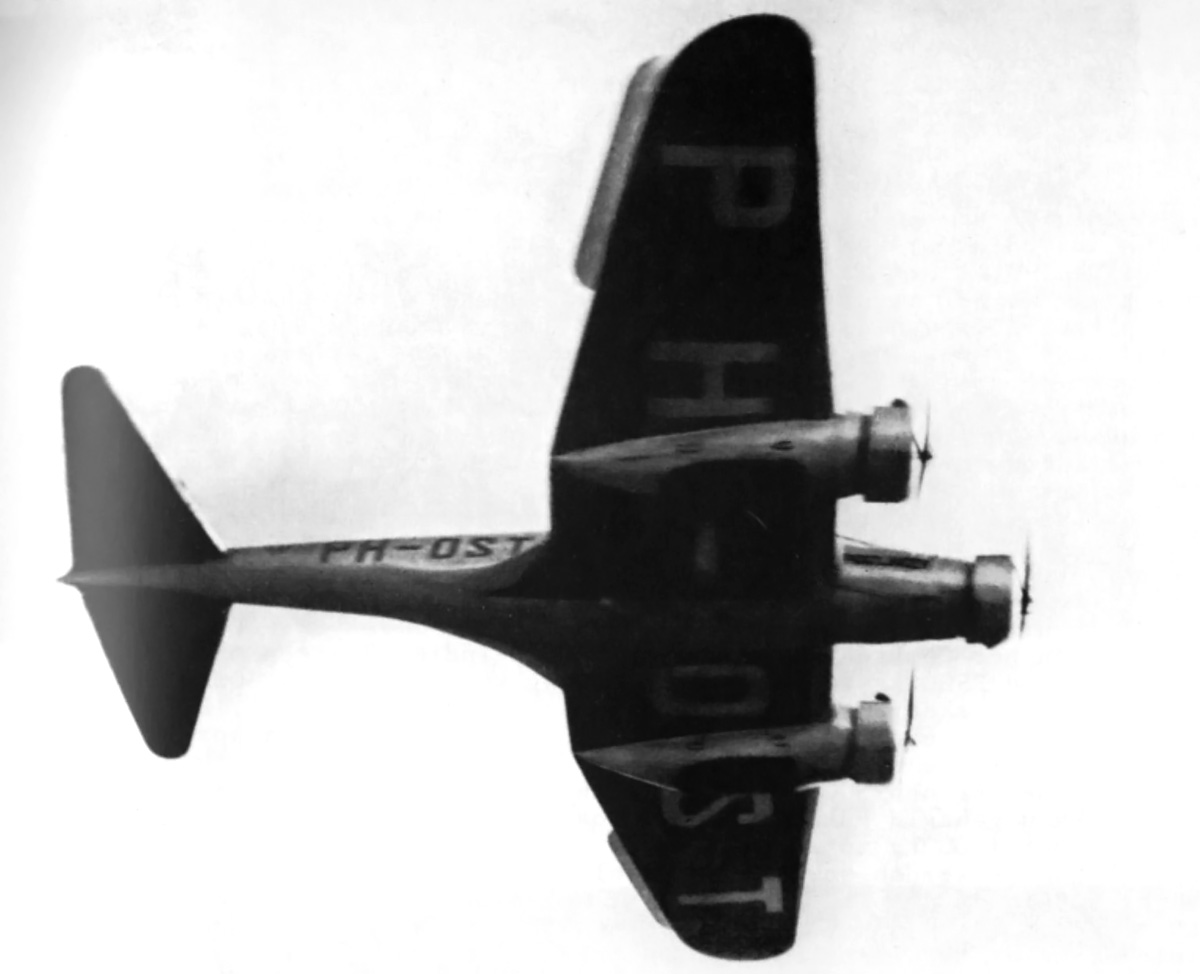
The S.4 used external ailerons that mounted above the wings’ trailing edge. Sometimes called “park bench” ailerons because of their appearance, they are often mistaken for Flettner tabs. A Flettner tab is a supplementary control surface that attaches to and assists the primary control surface. By contrast, a “park bench” aileron is the primary control surface, and there is no other control surface integral with the wing. External ailerons operated in the undisturbed airflow apart from the wing and were more responsive during minor control inputs or during slow flight. In addition, external ailerons allowed the use of full-span flaps to give the aircraft a low landing speed. However, external ailerons had a tendency to flutter at higher speeds, potentially causing catastrophic damage to the aircraft (but flutter was not well understood in the 1930s). On the S.4, the flaps extended from the engine nacelles to near the wingtips.

The S.4 had a wingspan of 54 ft 6 in (16.6 m) and was 41 ft (12.5 m) long. The aircraft had a maximum speed of 224 mph (360 km/h), a cruising speed of 186 mph (300 km/h), and a landing speed of 60 mph (97 km/h). The S.4 was designed to carry 1,102 lb (500 kg) of mail. It had an empty weight of around 6,669 lb (3,025 kg) and a loaded weight of around 12,125 lb (5,200 kg). Six fuel tanks, three in each wing, carried a total of 555 gallons (2,100 L). The aircraft had a range of 1,510 miles (2,430 km) and a ceiling of 17,717 ft (5,400 m).

pander-s4-underside

This underside view of the S.4 shows its PH-OST registration. Also visible are the external ailerons attached to the wings’ upper surfaces. The aircraft’s slot flaps (not visible) extended from the engine nacelle to near the wingtip.

Cleverly registered as PH-OST, the completed S.4 mailplane made its public debut on 23 September 1933. The Fokker F.XX also made its debut at the event, which was attended by Prince Henry of the Netherlands. The S.4 flew the following month, when Gerrit Geijsendorffer and Funker van Straaten made the maiden flight on 6 October 1933. Flight testing went well, and on 9 December 1933, the S.4 departed on an 8,700-mile (14,000-km) flight from Amsterdam to Batavia (now Jakarta, Indonesia). Flown by Geijsendorffer, Asjes, and van Straaten, this flight was a special run to demonstrate the aircraft’s speed and range and also to deliver 596 lb (270 kg) of Christmas mail (made up of some 51,000 letters and postcards) to the Dutch colony. At the time, the Fokker F.XX was being prepared for the same flight.

The S.4 had made a scheduled stopover in Rome, Italy and was proceeding to Athens, Greece when the right engine lost oil pressure. The aircraft made an emergency landing in Grottaglie, Italy, and inspection revealed that the right engine needed to be replaced. With no engines available anywhere in Europe, one was shipped from the United States and set to arrive on 22 December. This setback put the Christmas mail service in jeopardy. To make sure the mail was delivered, arrangements were made for the F.XX to pick up the S.4’s mail and continue to Batavia. But, the F.XX had its own engine issues before it even took off. This left the Fokker F.XVIII, the aircraft the S.4 and F.XX were meant to replace, as the only alternative. A F.XVIII picked up the mail and continued to Batavia with enough time for Christmas delivery. The failed Christmas flight was a huge embarrassment for both the S.4 and F.XX programs.

pander-s4-ground-side

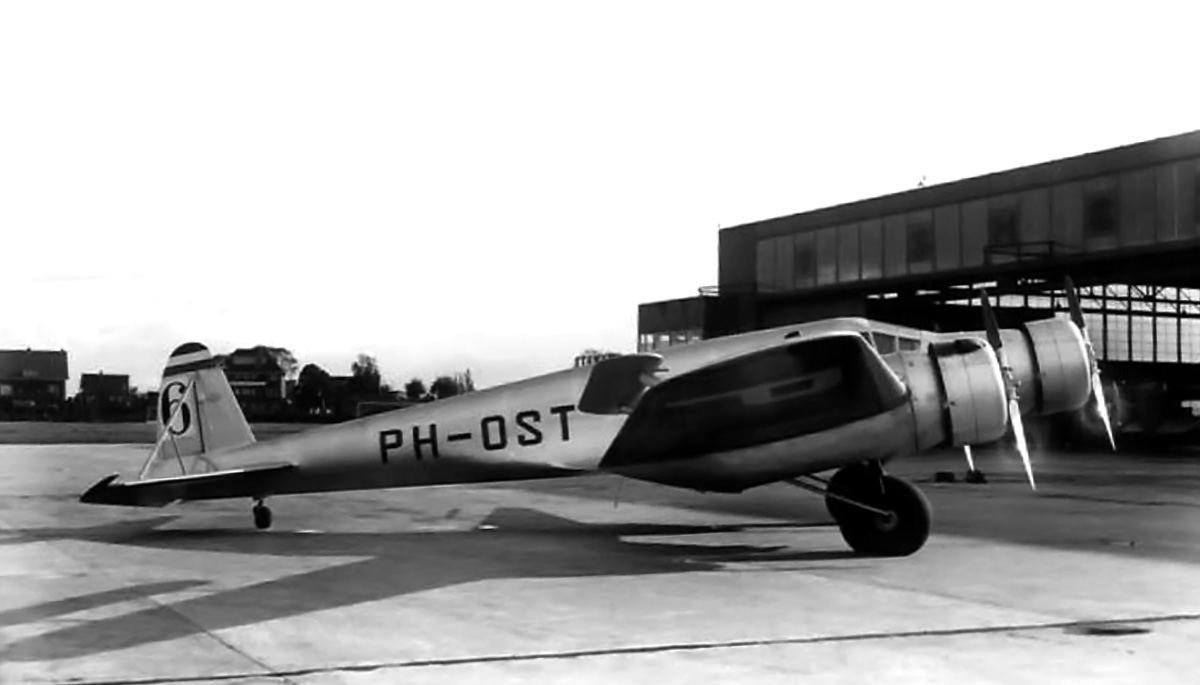
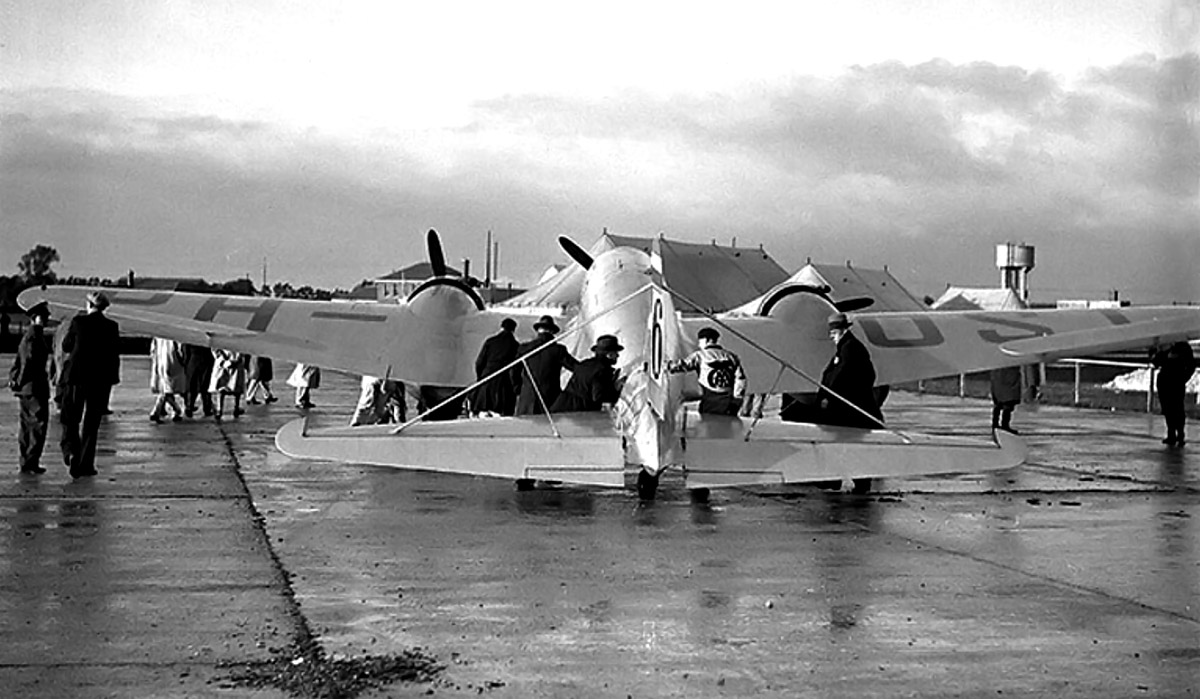
This side view of the S.4, now named Panderjager, shows the aircraft as it appeared in the MacRobertson Race. Note the “park bench” aileron extending above the wing.

The repaired S.4 set out for Batavia on 27 December and arrived on 31 December. It made the return flight, leaving Batavia on 5 January 1934 and arriving in Amsterdam on 11 January. Although the S.4 averaged 181 mph (291 km/h) on the flight from Batavia, the aircraft’s mail flight failed to impress, and the S,4 was not put into service. Pander decided to prepare the aircraft for the MacRobertson Trophy Air Race flown from London to Melbourne, Australia.

The MacRobertson Race started on 20 October 1934 and covered some 11,300 miles (18,200 km). For the race, the S.4 was flown by Geijsendorffer, Asjes, and Pieter Pronk and carried race number 6. The aircraft had been renamed Panderjager, but some referred to it as the Pechjager (“pech” meaning “bad luck” and “breakdown”). After leaving Mildenhall airfield in England, the S.4 arrived in Bagdad, Iraq in third place at the end of the first day of the race. The next day, the aircraft proceeded to Allahabad, India, still in third place. Upon touchdown in Allahabad, the left gear collapsed, resulting in bent left and front propellers and a damaged left cowling and main gear.

pander-s4-rear

This rear view of the S.4 shows the external brace on the horizontal stabilizer and the elevators’ trim tabs. The image also provides a good view of the “park bench” ailerons.

Allahabad did not have the facilities to repair the S.4. Geijsendorffer took the propellers and traveled by train to the KLM depot in Calcutta (now Kolkata), India to make the needed repairs. This delay took the S.4 out of competition, but the decision was made to finish the race. Repairs were completed, and the S.4 was ready to fly on the evening of 26 October 1934. A service vehicle towing a light was positioned across the field from the S.4 to illuminate its path. The S.4’s crew found the light distracting and asked for it to be shut off, as the aircraft could provide its own lighting.

Once the service vehicle’s light was shut off, the S.4 prepared for takeoff. Unfortunately, the crew of the service vehicle misunderstood the instructions. They thought they were to proceed to the S.4 and illuminate the aircraft from behind. As they made their way toward the S.4 in darkness, the aircraft began its takeoff run. At about 99 mph (160 km/h), the S.4’s right wing struck the service vehicle. Fuel spilled from the ruptured wing and quickly ignited as the S.4 skidded 427 ft (130 m) to a stop. Pronk was uninjured, and Geijsendorffer and Asjes escaped with minor burns, but the S.4 was completely destroyed by the fire. The two operators of the service vehicle were severely injured.

Pander planned to convert the S.4 to a scout or bomber after the race and sell it to the military. With the loss of the S.4, there was no aircraft to sell, and Pander was not able to recover its expenses. The company went out of business a short time later.

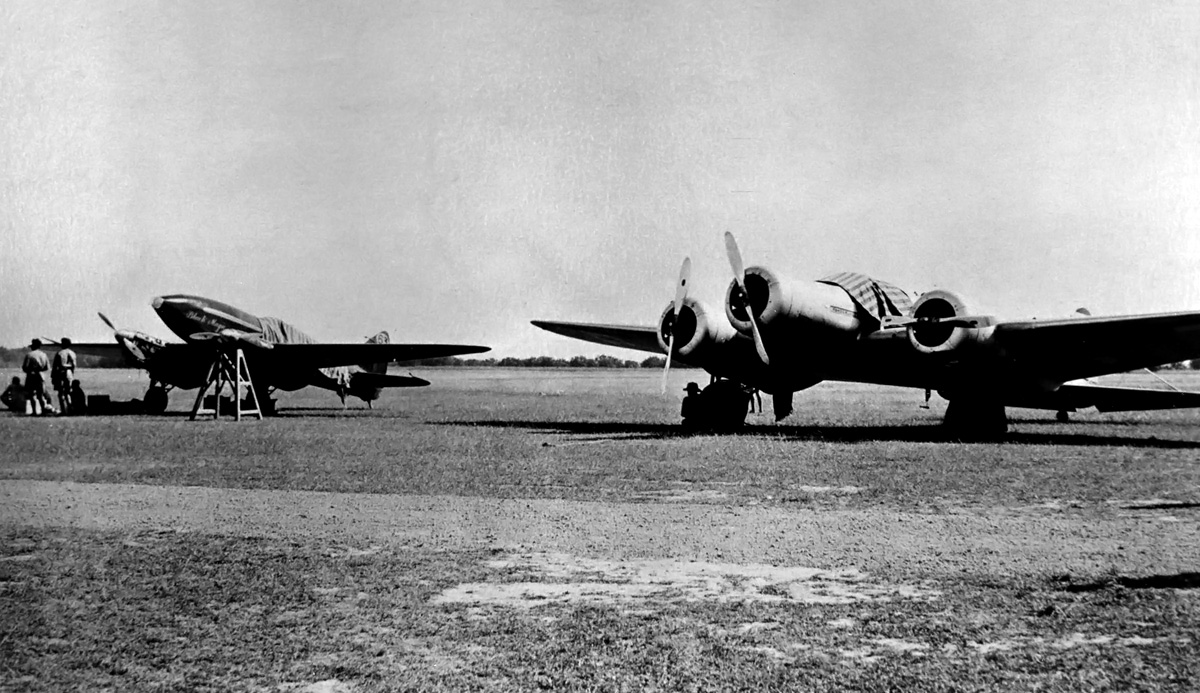
The S.4 sits at Allahabad, India with bent propellers on its front and left engines. The de Havilland DH 88 Comet “Black Magic” suffered engine trouble, and work to repair its engine was underway as it sat next to the S.4. The S.4 never left Allahabad.

The S.4 sits at Allahabad, India with bent propellers on its front and left engines. The de Havilland DH 88 Comet “Black Magic” suffered engine trouble, and work to repair its engine was underway as it sat next to the S.4. The S.4 never left Allahabad.

Sources:
Nederlandse Vliegtuigen Deel 2 by Theo Wesselink (2014)
Jane’s All the World’s Aircraft 1934 by G. G. Grey (1934)
Blue Wings Orange Skies by Ryan K. Noppen (2016)
– “High-Speed Mail Machine” Flight (7 September 1933)
– “The Aerial Phost” Flight (5 October 1933)
– “Opening of Amsterdam Aero Club’s New Clubhouse” Flight (28 September 1933)
– “The Pander Postjager Pauses” Flight (14 December 1933)
http://www.aviacrash.nl/paginas/panderjager.htm
https://de.wikipedia.org/wiki/Pander_S4
https://en.wikipedia.org/wiki/Pander_%26_Son