Monthly Archives: November 2019

Alexeyev A-90 Orlyonok top

Alexeyev SM-6 and A-90 Orlyonok Ekranoplans

By William Pearce

Rostislav Alexeyev (sometimes spelled Alekeyev) of the Central Hydrofoil Design Bureau (CHDB or Tsentral’noye konstruktorskoye byuro na podvodnykh kryl’yakh / TsKB po SPK) had been working out of the Krasnoye Sormovo Shipyard in Gorky (now Nizhny Novgorod), Russia since the 1940s. In the 1950s, Alexeyev began experimental work with ekranoplans (meaning “screen planes”), also known as wing-in-ground effect (WIG) or ground-effect-vehicle (GEV). His work led to the construction of the massive, experimental KM (Korabl Maket or ship prototype) ekranoplan in the mid-1960s.
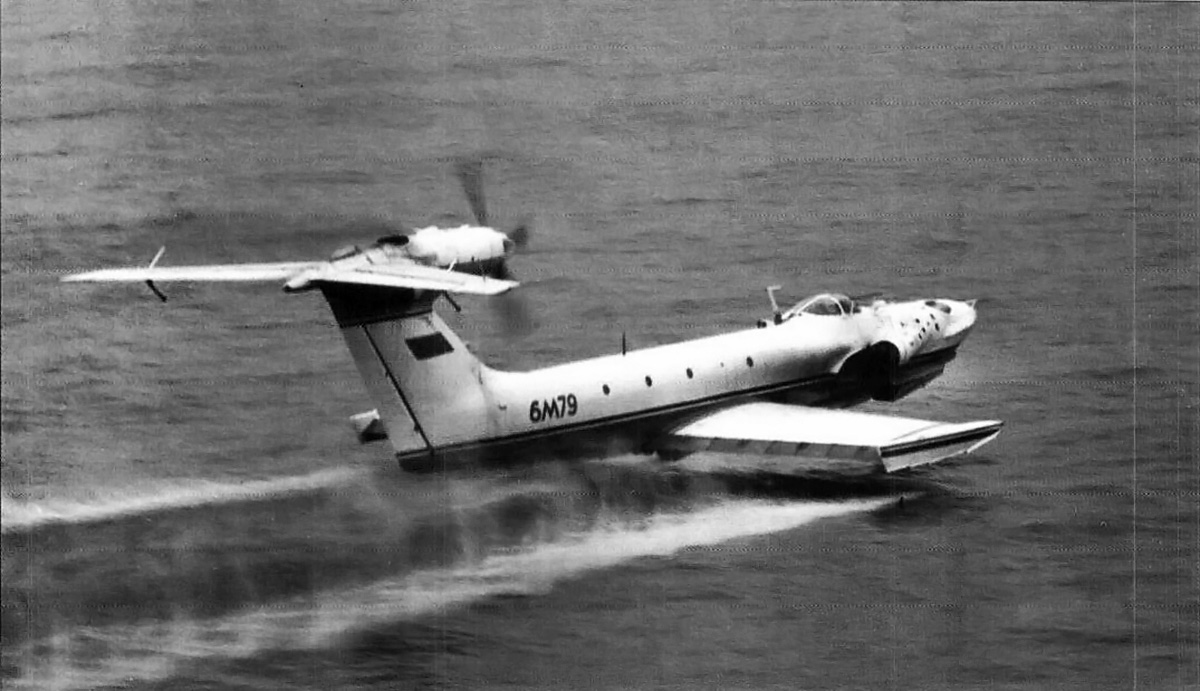
Alexeyev SM-6 rear

The SM-6 was a 50-percent scale proof-of-concept vehicle for the A-90 Orlyonok ekranoplan. First flown in 1971, testing of the SM-6 continued until the mid-1980s.

As work on the KM was underway, the Soviet Navy expressed interest in a troop transport ekranoplan, and Alexeyev had started design studies of such a craft as early as 1964. In 1966, the decision was made to construct a 50-percent scale test model of the troop transport. The test ekranoplan was designated SM-6 (samokhodnaya model’-6 or self-propelled model-6).

The SM-6 had a flying boat-style stepped hull that was made of steel and aluminum. The two-place, side-by-side cockpit was near the front of the machine and covered with a large canopy. Two hydro-skis were placed under the hull: one under the nose (bow) and one under the wings. The hydraulically-actuated skis helped lift the craft out of the water as it picked up speed.
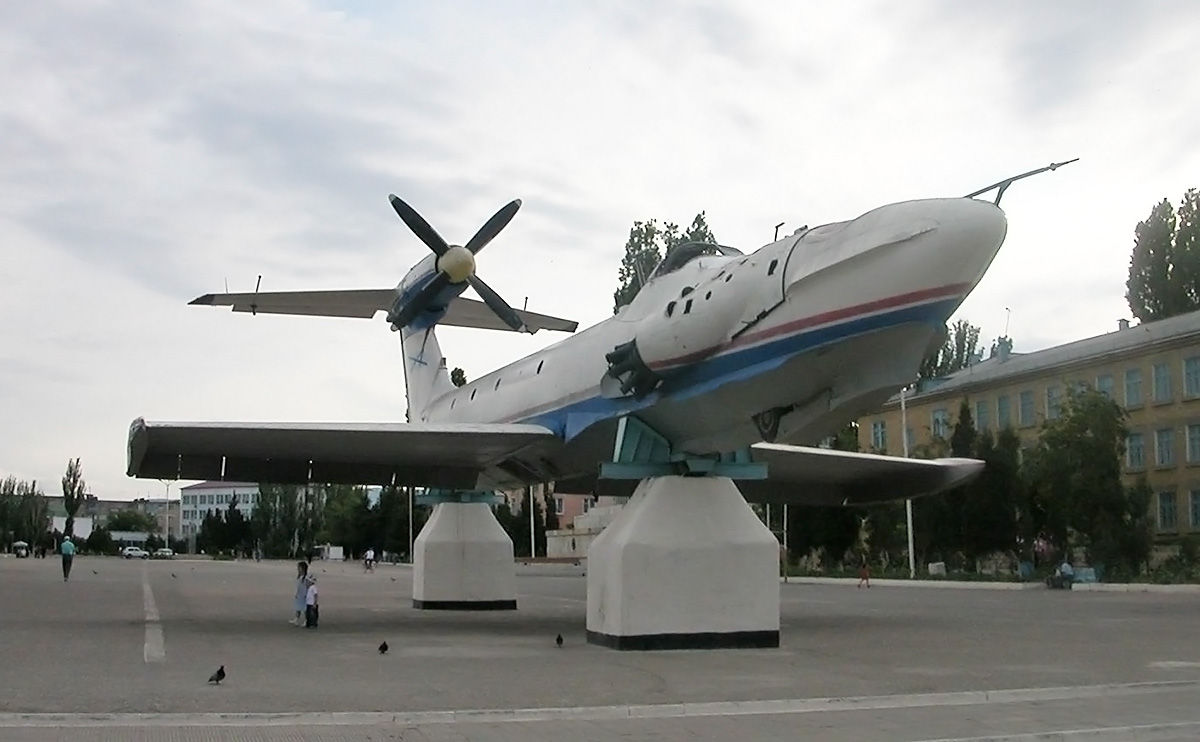
Alexeyev SM-6 square

An undated image of the SM-6 on display at Lenin Square in Kaspiysk, Russia. The ekranoplan has since been removed, and its fate is unknown. However, another undated image shows the its derelict fuselage (hull) in a sorry state.

Mounted in the SM-6’s nose were two Milkulin RD-9B jet engines, each of which produced 4,630 lbf (20.6 kN) of thrust. The inlets for the engines were in the upper surface of the nose, and the nozzles protruded out the sides of the SM-6, just behind and below the cockpit. For takeoff, the jet nozzle of each engine was rotated down to increase air pressure under the craft’s wings (power augmented ram thrust). In cruise flight, the nozzles were pointed back for forward thrust.

The low-mounted wing had a short span and a wide cord, and had an aspect ratio of 2.8. Five flaps were attached along each wing’s trailing edge. The outer flaps most likely acted as flaperons, a combination flap and aileron, but definitive proof has not been found. The tip of each wing extended down to form a float. A large vertical stabilizer extended from the rear of the craft. A rudder was positioned on the trailing edge of the vertical stabilizer. When the SM-6 was on the water’s surface, the bottom part of the rudder was submerged and helped steer the craft. Mounted atop the tail was a 3,750 shp (2,796 kW) Ivchenko AI-20K turboprop engine driving a four-blade propeller that was approximately 12 ft (3.65 m) in diameter. Behind the engine and atop the tail was the large horizontal stabilizer with swept leading and trailing edges. Large elevators were incorporated into the trailing edges of the horizontal stabilizer.

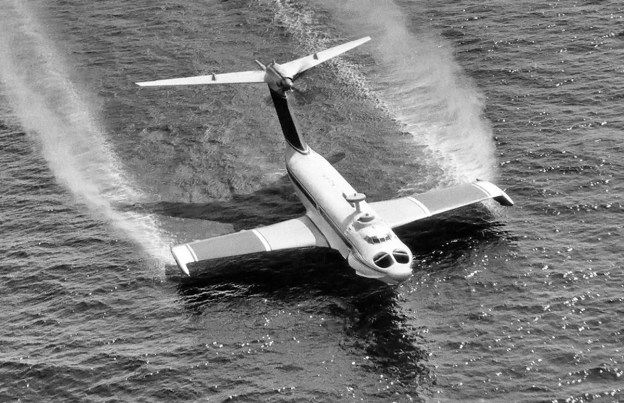
Alexeyev A-90 Orlyonok top

The A-90 Orlyonok cruising above the Caspian Sea. The jet intakes positioned atop the bow helped reduce the amount of water ingested into the engines and kept the craft rather streamlined.

The SM-6 had a wingspan of 48 ft 7 in (14.8 m), a length of 101 ft 8 in (31.0 m), and a height of 25 ft 9 in (7.85 m). The craft had a cruise speed of 186 mph (300 km/h) and a maximum speed of 217 mph (350 km/h). Its operating height was from 2 to 5 ft (.5 to 1.5 m), and the SM-6 had a maximum weight of 58,422 lb (26,500 kg). The craft had a range of 435 miles (700 km) and could operate in seas with 3.3 ft (1.0 m) waves.

Construction of the SM-6 started in October 1966 at the Krasnoye Sormovo Shipyard. Insufficient funding caused some delays, and the SM-6 was not finished until 30 December 1970. At that time, the Volga Shipyard was established as an experimental production facility of the CHDB and operated out of the same plant in which the SM-6 was built. The CHDB was also renamed the Alekseyev Central Hydrofoil Design Bureau.

Alexeyev A-90 Orlyonok cargo

The entire front of the Orlyonok swung open to allow access to the cargo hold. A 22,708 lb (10,300 kg) BTR-60PB armored personnel carrier is seen loaded on the Orlyonok. Note the engine’s exhaust nozzle and the machine gun turret.

In July 1971, the SM-6 was transported about 53 miles (85 km) up the Volga River to Chkalovsk, Russia. Initial tests of the craft were conducted in August 1971 on the Gorky Reservoir. In early 1972, the SM-6 was successfully tested on ice and snow. In 1973, modifications were made that included mounting wheels to the hydro-skis. The wheels were used as beaching gear, allowing the SM-6 to power itself out of the water and onto land, or vice versa. Having proven itself as a fully functioning ekranoplan, the SM-6 was transferred to the Kaspiysk base on the Caspian Sea in late 1974. The SM-6 continued to undergo modifications and testing until the mid-1980s. At different points in its career, the SM-6 was marked as 6M79 and 6M80. After it was withdrawn from service, the SM-6 was displayed for a number of years at a public square (Lenin Square?) in Kaspiysk. The elements took a toll on the ekranoplan, and it was eventually removed from the square. The derelict remains of the SM-6 sat near the shore of the Caspian Sea for a time, and mostly likely, the machine was later scrapped.

Following the successful tests of the SM-6 in 1971, plans moved forward for constructing a full-scale, troop transport ekranoplan. The full-size ekranoplan was known as the A-90 Orlyonok (Eaglet) or Project 904. Although twice its size, the Orlyonok had mostly the same configuration as the SM-6.
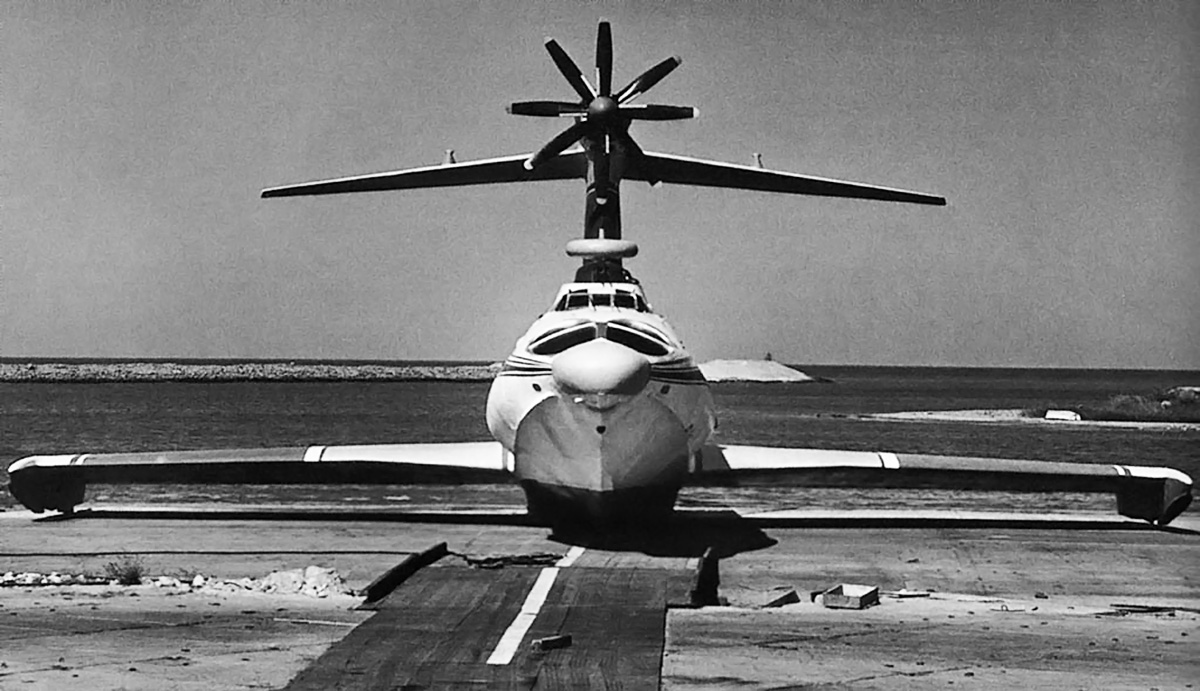
Alexeyev A-90 Orlyonok front

The Orlyonok’s beaching gear allowed the craft to propel itself out of the water and onto a hard surface. The turning arc of the nose wheel has not been found, but with the main wheels under the wing, the Orlyonok may have been able to turn rather sharply on land.

Mounted in the Orlyonok’s nose (bow) were two Kuznetsov NK-8-4K jet engines that provided 23,149 lbf (103.0 kN) of thrust each. Just behind the craft’s cockpit was a turret with two 12.7-mm (.50-Cal) machine guns. The entire nose of the Orlyonok, including its cockpit, swung open to the right a maximum of 92 degrees. A set of folding ramps allowed for direct entry into the machine’s cargo hold, which was 68 ft 11 in (21.0 m) long, 9 ft 10 in (3.0 m) wide, and 10 ft 6 in (3.2 m) tall. The hold could carry 250 troops or 44,092 lb (20,000 kg) of equipment, including armored vehicles.

The beaching gear mounted to the hydro-skis consisted of a steerable, two-wheel nose unit and a ten-wheel main unit under the hull. The low-mounted wing had a short span and a wide cord, with an aspect ratio of 3.0. The trailing edge of the wing had flaperons at its tips with flaps spanning the rest of the distance. The tip of each wing extended down to form a float. A large vertical stabilizer extended from the rear of the craft. Mounted atop the tail was a 15,000 ehp (11,186 kW) Kuznetsov NK-12MK turboprop engine driving an eight-blade, contra-rotating propeller that was approximately 19 ft 8 in (6.0 m) in diameter. The Orlyonok was equipped with a full-range of navigational and combat electronics.
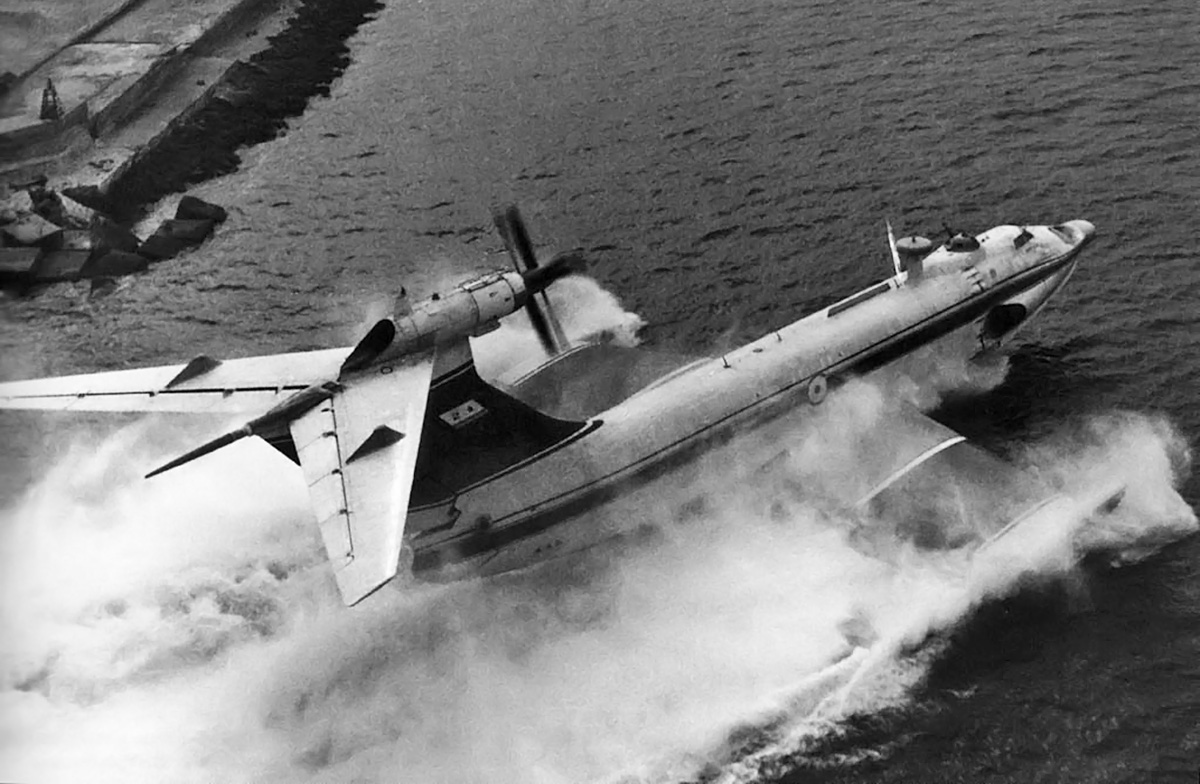
Alexeyev A-90 Orlyonok slow

At low speed, a fair amount of spray enveloped the Orlyonok. The circular markings on the sides of the craft designated over-wing access doors, which were actually rectangular.

The Orlyonok had a wingspan of 103 ft 4 in (31.5 m), a length of 190 ft 7 in (58.1 m), and a height of 52 ft 2 in (15.9 m). The craft had a cruise speed of 224 mph (360 km/h) and a maximum speed of 249 mph (400 km/h). Operating height was from 2 to 16 ft (.5 to 5.0 m). The Orlyonok had an empty weight of 220,462 lb (100,000 kg) and a maximum weight of 308,647 lb (140,000 kg). The craft had a range of 932 miles (1,500 km) and could operate in seas with 6.6 ft (2.0 m) waves.

The Orlyonok prototype was built at the Volga Shipyard and made its first flight in 1972, taking off from the Volga River. The craft was later disguised as a Tupolev Tu-134 airliner fuselage and transported by barge to the Kaspiysk base on the Caspian Sea for further testing. In 1975, the prototype was accidently beached on a rocky sandbar. The craft was able to power itself back into the water, but the hull was damaged and its structural integrity was compromised. The damage went undetected until the rear fuselage and tail broke off during a landing on rough seas. Alexeyev was onboard and took control of the crippled ekranoplan. Using full-power of the bow jet engines, Alexeyev as able to keep the open back of the hull above water and return to base. The authorities attributed the accident to a design deficiency and blamed Alexeyev, who was removed as the chief designer and reassigned to experimental work.
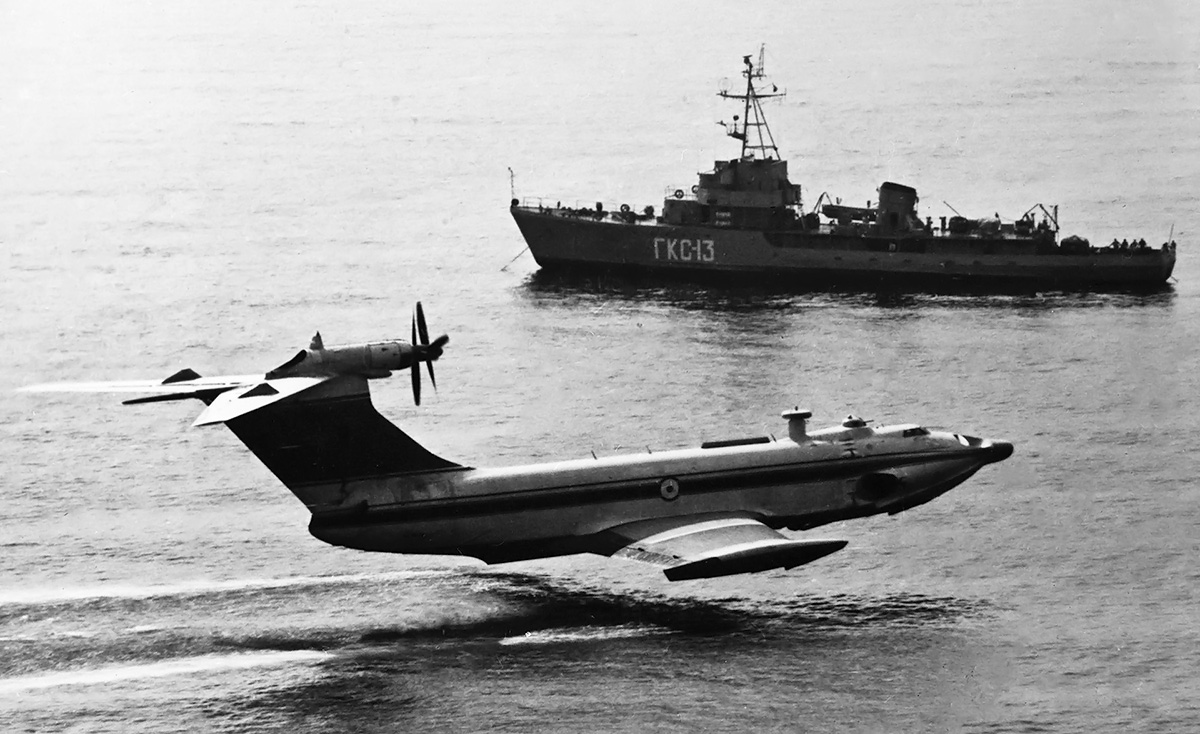
Alexeyev A-90 Orlyonok GKS-13

The Orlyonok prototype flies past a Soviet Navy ship on the Caspian Sea. Unlike the SM-6, the Orlyonok’s rudder did not extend into the water when the craft was on the sea.

The Russian Navy had been sufficiently impressed by the Orlyonok to order three production machines and a static test article. The damaged prototype was returned to the Volga Shipyard and completely rebuilt as the first production Orlyonok, S-21 (610), which was completed in 1978 and delivered to the Navy on 3 November 1979. The second Orlyonok, S-25 (630), was completed in 1979 and delivered on 27 October 1981. The final Orlyonok, S-26 (650), was completed in 1980 and delivered on 30 December 1981. Plans to produce an additional eight units were ultimately abandoned.

The three Orlyonoks were tested and operated for several years on the Caspian Sea. The captain and crew of S-21 took it upon themselves to test the machine to its limits. Away from witnesses and in the middle of the Caspian Sea, S-21 was flown out of ground effect and up to 328 ft (100 m) for an extended time. At that height, the ekranoplan was sluggish, unstable, and a challenge to fly, but positive control was maintained.
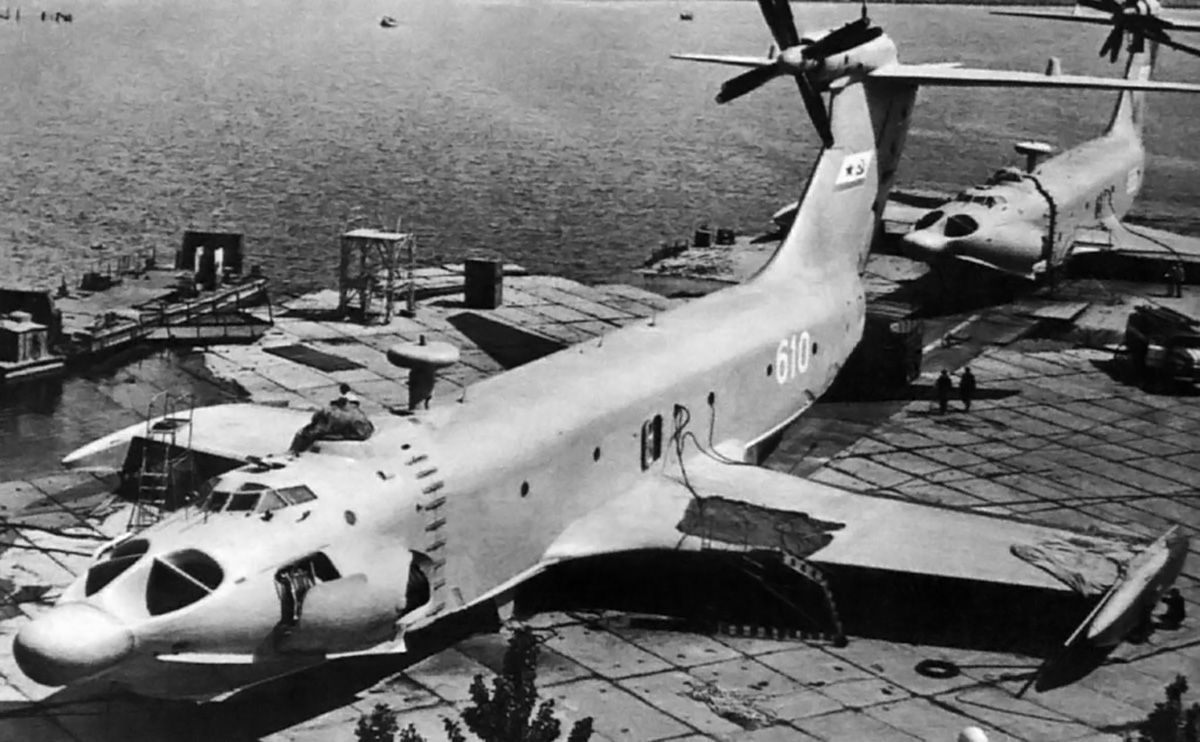
Alexeyev A-90 Orlyonoks

Two production Orlyonoks at Kaspiysk on the Caspian Sea. Note the open over-wing doors and the open engine access panel of the first machine.

By 1989, the three Orlyonoks had performed a total of 438 flights and 118 beachings. On 12 September 1992, S-21 was lost when a control malfunction coupled with pilot error caused it to rise to 130 ft (40 m) and stall. One member of the ten-man crew was killed, and S-21 was eventually sunk by the Navy—the cost of salvaging the craft was too high. Reportedly, the last Orlyonok flight was made by S-26 in late 1993, after which, the Orlyonoks fell into a state of disuse followed by disrepair.

In 1998, the Navy wrote off the two remaining Orlyonoks. Around 2000, S-25 was scrapped, but S-26 was somehow preserved. In 2006, S-26 was given to the Museum and Memorial Complex of the History of the Navy of Russia (Muzeyno-Memorial’nyy Kompleks Istorii Vmf Rossii) located on the Volga River in Moscow. The S-26 was demilitarized in 2007 and restored and installed at the museum in 2008. The Orlyonok design inspired other military and commercial ekranoplan design, but none were built.
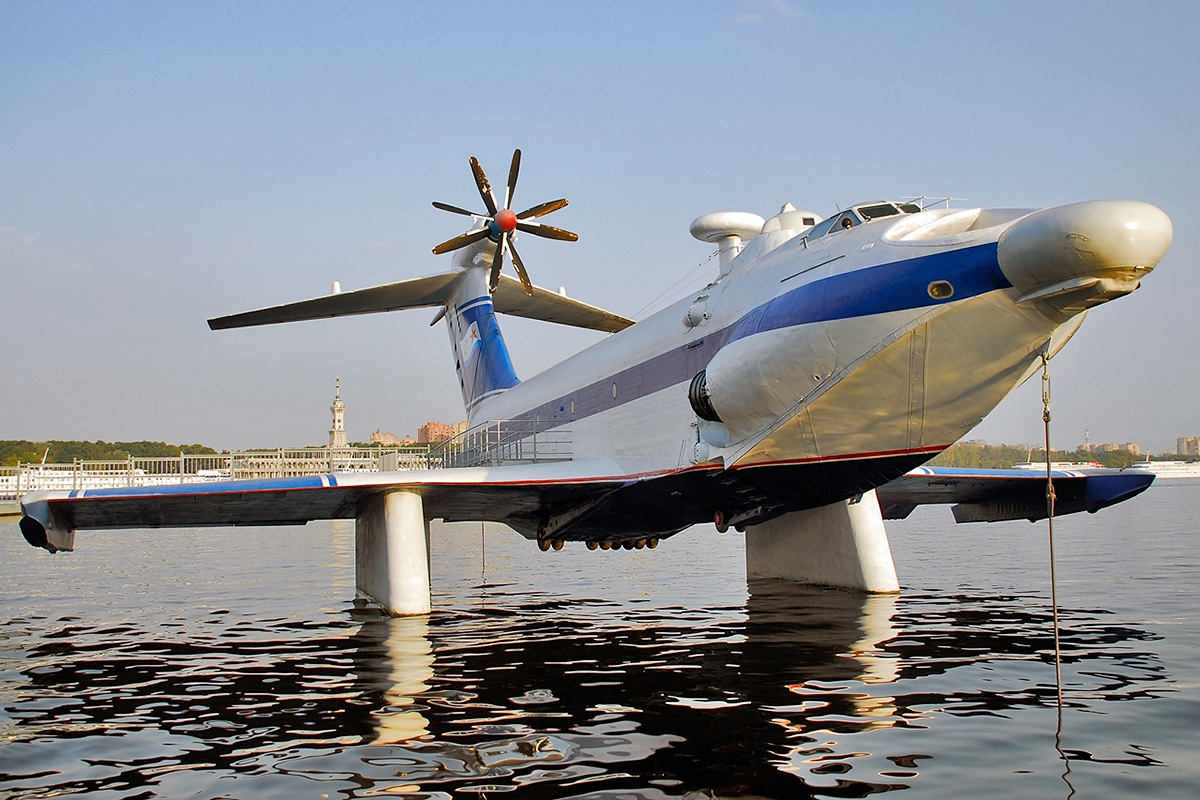
Alexeyev A-90 Orlyonok 2008

Orlyonok S-26 shortly after it was put on display at the Naval museum in Moscow. The wheels of the beaching gear are visible, although it appears the main set is missing two wheels. Sadly, the condition of the impressive ekranoplan has deteriorated over the years. (Alex Beltyukov image via Wikimedia Commons)

Sources:
Soviet and Russian Ekranoplans by Sergy Komissarov and Yefim Gordon (2010)
WIG Craft and Ekranoplan by Liang Lu, Alan Bliault, and Johnny Doo (2010)
https://aviationhumor.net/the-last-flight-of-the-soviet-beach-assault-ekranoplan-a-90-orlyonok/#
http://www.volga-shipyard.com/index.php?section=history&lang=eng
Alexeyev KM rear

Alexeyev KM Ekranoplan (Caspian Sea Monster)

By William Pearce

Rostislav Alexeyev (sometimes spelled Alekeyev) was born in Novozybkov, Russia on 18 December 1916. On 1 October 1941, he graduated from the Gorky Industrial Institute (now Gorky Polytechnic Institute) as a shipbuilding engineer. Alexeyev was sent to work at the Krasnoye Sormovo Shipyard in Gorky (now Nizhny Novgorod), Russia. In 1942, Alexeyev was tasked to develop hydrofoils for the Soviet Navy, work that was still in progress at the end of World War II. However, there was sufficient governmental interest for Alexeyev to continue his hydrofoil studies after the war. This work led to the development of the Raketa, Meteor, Kometa, Sputnik, Burevestnik, and Voskhod passenger-carrying hydrofoils spanning from the late 1940s to the late 1970s.

Alexeyev SM-2

The SM-2 was the first ekranoplan that possessed the same basic configuration later used on the KM. The nozzle of the bow (booster) engine is visible on the side of the SM-2. The intake for the rear (cruise) engine is below the vertical stabilizer. Note the three open cockpits.

Alexeyev appreciated the speed of the hydrofoil but realized that much greater speeds could be achieved if the vessel traveled just above the water’s surface. Wings with a short span and a wide cord could be attached to a vessel to lift its hull completely out of the water as it traveled at high speed, allowing it to ride on a cushion of air. Such a craft would take advantage of the ground (screen) effect as air is compressed between the craft and the ground. In Russian, this type of vessel is called an ekranoplan, meaning “screen plane.” They are also known as wing-in-ground effect (WIG) or a ground-effect-vehicle (GEV), since the craft’s wing must stay near the surface and in ground effect. Because ground effect vehicles fly without contacting the surface, they are technically classified as aircraft. However, ground effect vehicles need a flat surface over which to operate and are typically limited to large bodies of water, even though they can traverse very flat expanses of land. Because they operate from water, ground effect vehicles are normally governed by maritime rules.

In the late 1950s, Alexeyev and his team began work on several scale, piloted, test machines to better understand the ekranoplan concept. The first was designated SM-1 (samokhodnaya model’-1 or self-propelled model-1) and made its first flight on 22 July 1961. The SM-1 was powered by a single jet engine and had two sets (mid and rear) of lifting wings. Lessons learned from the SM-1 were incorporated into the SM-2, which was completed in March 1962. The SM-2 had a single main wing and a large horizontal stabilizer. The craft also incorporated a booster jet engine in its nose (bow) to blow air under the main wing to increase lift (power augmented ram thrust). The SM-2 was demonstrated to Premier of the Soviet Union Nikita Khrushchev, who then lent support for further ekranoplan development to Alexeyev and his team.

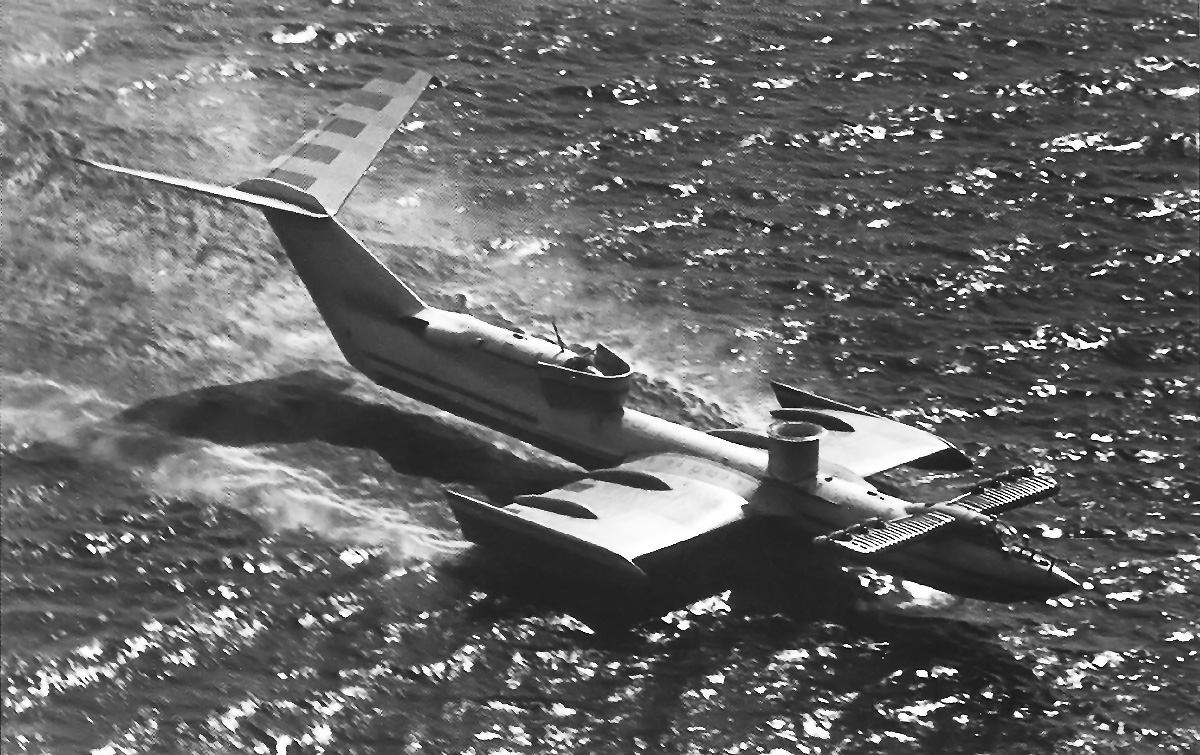
Alexeyev SM-5

The SM-5 was a 25-percent scale version of the KM. The craft followed the same basic configuration as the SM-2 but was more refined. The structure ahead of the dorsal intake was to deflect sea spray.

Ekranoplan design experimentation was expanded further with the SM-3. The craft had very wide-cord wings and was completed late in 1962. That same year, Alexeyev began working at the Central Hydrofoil Design Bureau (CHDB or Tsentral’noye konstruktorskoye byuro na podvodnykh kryl’yakh / TsKB po SPK). In 1963, the next test machine, the SM-4, demonstrated that a good understanding of ekranoplan design had been achieved. Also in 1963, the Soviet Navy placed an order for a large, experimental ekranoplan transport known as the KM (Korabl Maket or ship prototype).

While the CHDB began design work on the KM, the SM-5 was built in late 1963. The SM-5 was a 25-percent scale model of the KM and was powered by two Mikulin KR7-300 jet engines. The craft had a wingspan of 31 ft 2 in (9.5 m), a length of 59 ft 1 in (18.0 m), and a height of 18 ft 1 in (5.5 m). The SM-5 had a takeoff speed of 87 mph (140 km/h), a cruise speed of 124 mph (200 km/h), and a maximum speed of 143 mph (230 km/h). Its operating height was from 3 to 10 ft (1 to 3 m), and the craft had a maximum weight of 16,094 lb (7,300 kg). The SM-5 could operate in seas with 3.9 ft (1.2 m) waves. Initial tests of the SM-5 were so successful that the decision was made to construct the KM without building a larger scale test machine. Sadly, the SM-5 was destroyed, and its two pilots were killed in a crash on 24 August 1964. During a test, a strong wind was encountered that caused the craft to gain altitude. Rather than reduce power, the pilot added power. The SM-5 rose out of ground effect and stalled.

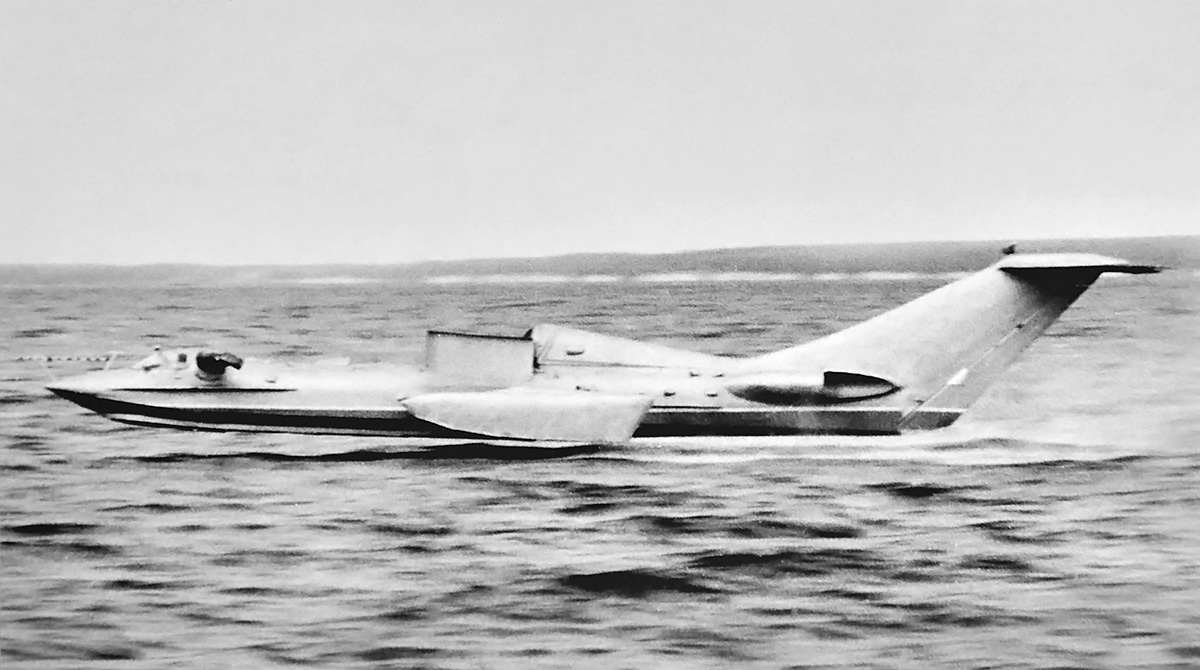
Alexeyev KM at speed

The KM (Korabl Maket) at speed on the Caspian Sea. Note the “04” tail number and the spray deflectors covering the cruise engine intakes on the vertical stabilizer.

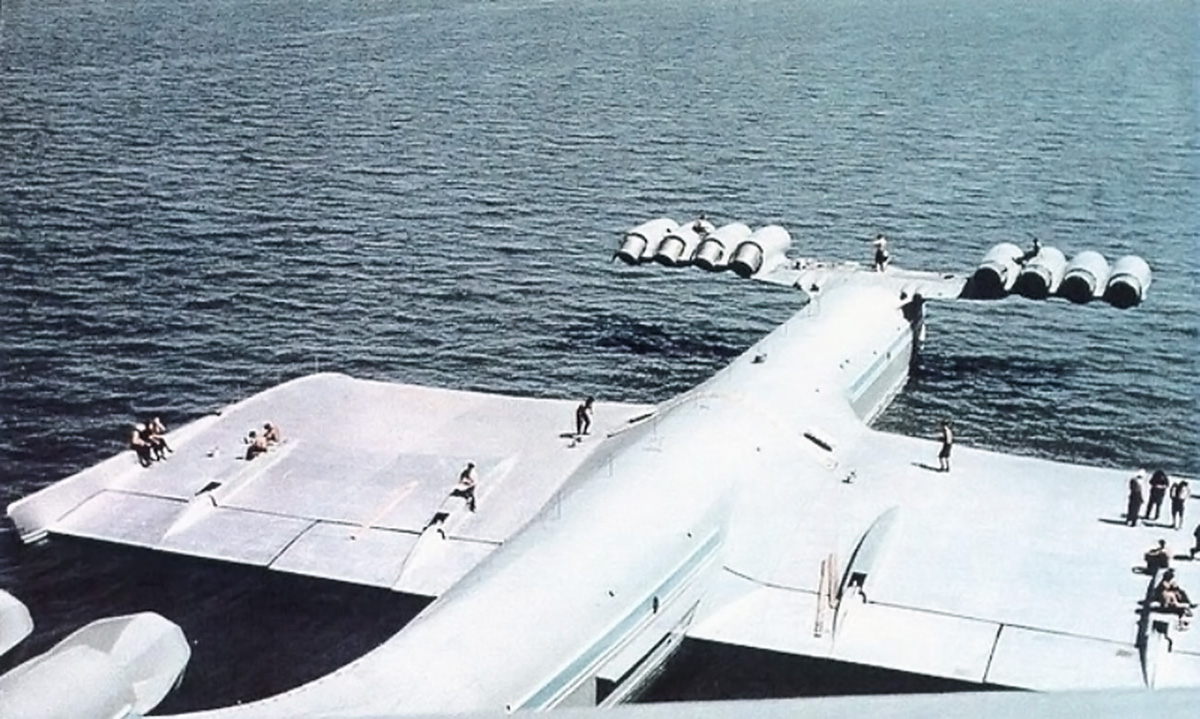
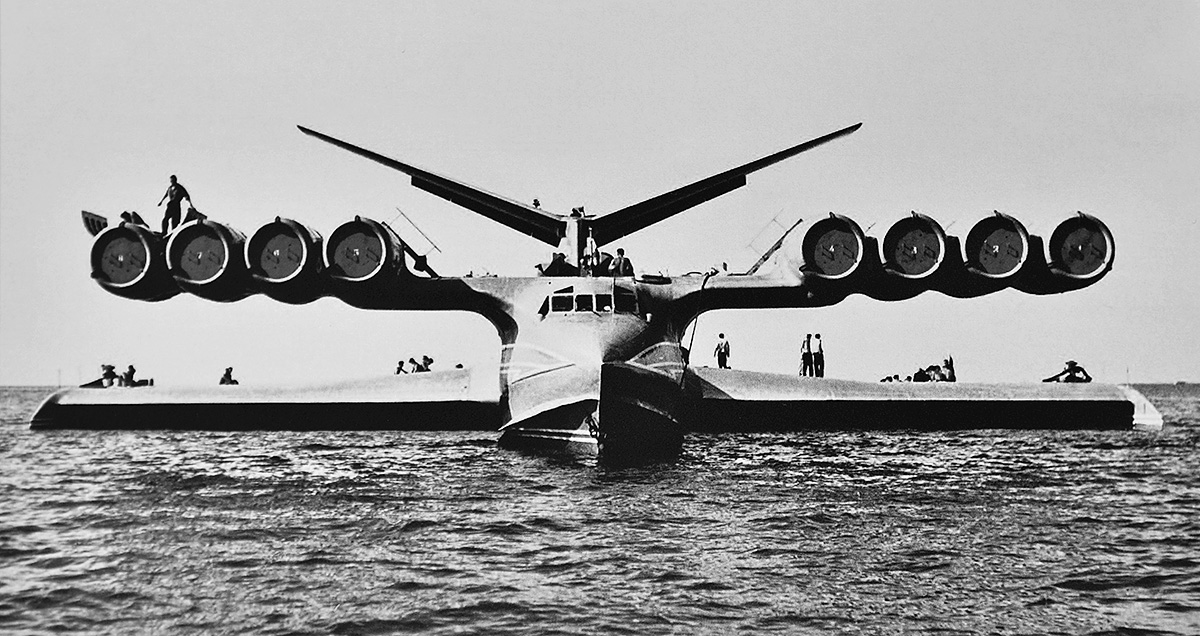
The KM’s all-metal fuselage closely resembled that of a flying boat with a stepped hull. Mounted just behind the cockpit were eight Dobrynin VD-7 turbojets, with four engines mounted in parallel on each side of the KM. Each VD-7 was capable of 28,660 lbf (127.5 kN) of thrust. The jet nozzle of each engine rotated down during takeoff to increase the air pressure under the craft’s wings. These engines were known as boost engines.

The shoulder-mounted, short span wings had a wide cord and an aspect ratio of 2.0. Two large flaps made up the trailing edge of each wing. The tip of each wing was capped by a flat plate that extended down to form a float. Two additional VD-7 turbojets were mounted near the top of the KM’s large vertical stabilizer. These engines were known as cruise engines and were used purely for forward thrust. A heat-resistant panel covered the section of the rudder just behind the cruise engines. At low speeds, the rudder extended into the water and helped steer the KM. Atop the vertical stabilizer was the horizontal stabilizer, which had about 20 degrees of dihedral. A large elevator was mounted to the trailing edge of the horizontal stabilizer.

Alexeyev KM top

The servicemen atop the KM help illustrate the craft’s immense size. Note the access hatches in the wings. This view also shows the ekranoplan’s large control surfaces. The nozzles of the left engines are in the down (boost/takeoff) position while the nozzles on the right are in the straight (cruise flight) position.

The KM had a wingspan of 123 ft 4 in (37.6 m), a length of 319 ft 7 in (97.4 m), and a height of 72 ft 2 in (22.0 m). The craft had a cruise speed of 267 mph (430 km/h) and a maximum speed of 311 mph (500 km/h). Operating height was from 13 to 46 ft (4 to 14 m), and the KM had an empty weight of 529,109 lb (240,000 kg) and a maximum weight of 1,199,313 lb (544,000 kg). The craft had a range of 932 miles (1,500 km) and could operate in seas with 11.5 ft (3.5 m) waves. The KM had a crew of three and could carry 900 troops, but the craft was intended purely for experimental purposes.

The KM was built at the Krasnoye Sormovo Shipyard in Gorky. Alexeyev was the craft’s chief designer and V. Efimov was the lead engineer. The KM was launched on the Volga River on 22 June 1966 and was subsequently floated down the river to the Naval base at Kaspiysk, Russia on the Caspian Sea. To keep the KM hidden during the move, its wings were detached, it was covered, and it was moved only at night. After arriving at the Kaspiysk base, the KM was reassembled, and sea-going trials started on 18 October 1966. V. Loginov was listed as the pilot, but Alexeyev was actually at the controls. At 124 mph (200 km/h), the KM rose to plane on the water’s surface but did not take to the air. Planning tests were continued until 25 October 1966. The early tests revealed that the KM’s hull was not sufficiently rigid and that engine damage was occurring due to water ingestion. Stiffeners were added to the hull, and plans were made to modify the engines.

Alexeyev KM front

While at rest, the KM’s water-tight wings added to the craft’s stability on the water’s surface. Note the far-left engine’s open access panels. Covers are installed in all of the engine intakes.

The first true flight of the KM occurred on 14 August 1967 with Alexeyev at the controls. The flight lasted 50 minutes, and a speed of 280 mph (450 km/h) was reached. Further testing revealed good handling characteristics, and sharp turns were made with the inside wing float touching the water. At one point, the KM was mistakenly flown over a low-lying island for about 1.2 miles (2 km), proving the machine could operate over land, provided it was very flat.

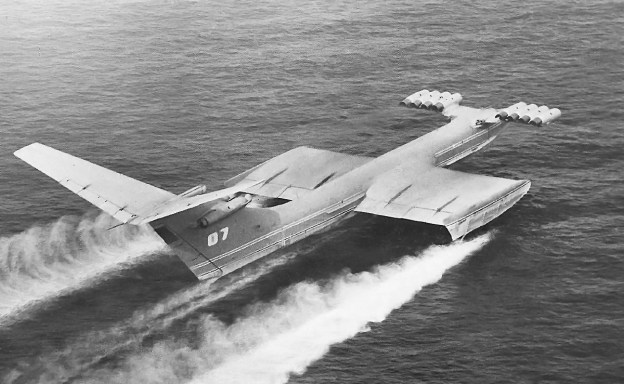
The KM was discovered in satellite imagery by United States intelligence agencies in August 1967. Rather baffled by the craft’s type and intended purpose, the Central Intelligence Agency (CIA) began to refer to the enormous machine as the “Kaspian Monster,” in reference to the KM designation. The “Kaspian Monster” name slowly changed to “Caspian Sea Monster,” which is how the craft is generally known today. The sole KM was painted with at least five different numbers (01, 02, 04, 07, and 08) during its existence. Some sources state the numbers corresponded to different developmental phases, while others contend that the numbers were an attempt to obscure the actual number of machines built.

Alexeyev KM rear

The KM, now with an “07” tail number, cruises above the water. Note the heat resistant panel on the rudder, just behind the exhaust of the cruise jet engines.

While the KM was being built, a second 25-percent scale model was constructed. The model was designated SM-8, and its layout incorporated changes made to the KM’s design that occurred after the SM-5 was built. Like the SM-5, the SM-8 was powered by two Mikulin KR7-300 jet engines. The craft had a wingspan of 31 ft 2 in (9.5 m), a length of 60 ft 8 in (18.5 m), and a height of 18 ft 1 in (5.5 m). The SM-8 had a cruise speed of 137 mph (220 km/h). Operating height was from 3 to 10 ft (1 to 3 m), and the craft had a maximum weight of 16,094 lb (8,100 kg). The SM-8 could operate in seas with 3.9 ft (1.2 m) waves. The craft was first flown in 1968 and tested over a grassy bank in June 1969. The SM-8 also served to train pilots for the KM.

Alexeyev SM-8

The SM-8 was a second 25-percent scale model of the KM and constructed after the loss of SM-5. Its configuration more closely matched that of the KM. The stack above the wings surrounded the intake for the front (booster) engine and deflected sea spray. The front engine was installed so that its exhaust traveled forward to the eight outlets (four on each side) behind the cockpit.

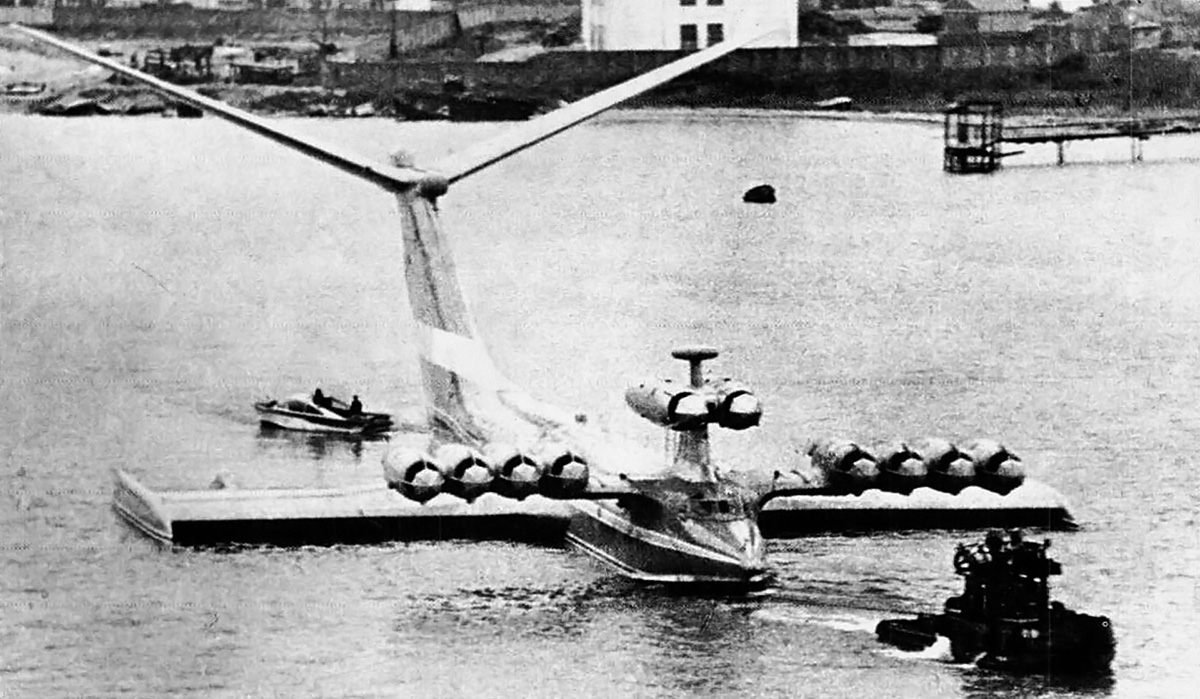
By the late 1960s, the KM had proven that the ekranoplan was a viable means to quickly transport personnel or equipment over large expanses of water. Alexeyev’s focus had moved to another ekranoplan project, the A-90 Orlyonok. By 1979, the KM had been modified by relocating the cruise engines from the vertical stabilizer to a pylon mounted above the cockpit. All engines were fitted with covers to deflect water and prevent the inadvertent ingestion of the occasional unfortunate seabird.

In December 1980, the KM was lost after an accident occurred during takeoff. Excessive elevator was applied and resulted in a relatively high angle of attack. Rather than applying power and correcting the pitch angle, the angle was held and power was reduced. A stall occurred with the KM rolling to the left and impacting the water. The crew escaped unharmed, but the KM was left to slowly sink to the bottom of the Caspian Sea. Reportedly, the craft floated for a week before finally sinking. Either the Soviets were done with the KM, or its immense size prevented reasonable efforts to salvage the machine. From the time it first flew, the KM was the heaviest aircraft in the world until the Antonov An-225 Mriya made its first flight on 21 December 1988. The KM is still the longest aircraft to fly. Experience gained from the KM was applied to the Lun-class S-31 / MD-160.

Alexeyev KM 1979

The KM as seen in 1979 with the cruise engines relocated from the vertical stabilizer to a pylon above the cockpit. A radome is mounted above the engines. All of the engines have been fitted with spray deflectors.

Sources:
Soviet and Russian Ekranoplans by Sergy Komissarov and Yefim Gordon (2010)
WIG Craft and Ekranoplan by Liang Lu, Alan Bliault, and Johnny Doo (2010)
https://en.wikipedia.org/wiki/Rostislav_Alexeyev
https://en.wikipedia.org/wiki/Caspian_Sea_Monster
https://rtd.rt.com/stories/caspian-monster-ekranoplan-vessel/
https://www.theregister.co.uk/2006/09/22/caspian_sea_monster/