Category Archives: Automotive

Perrier-Cadillac 41-75 front

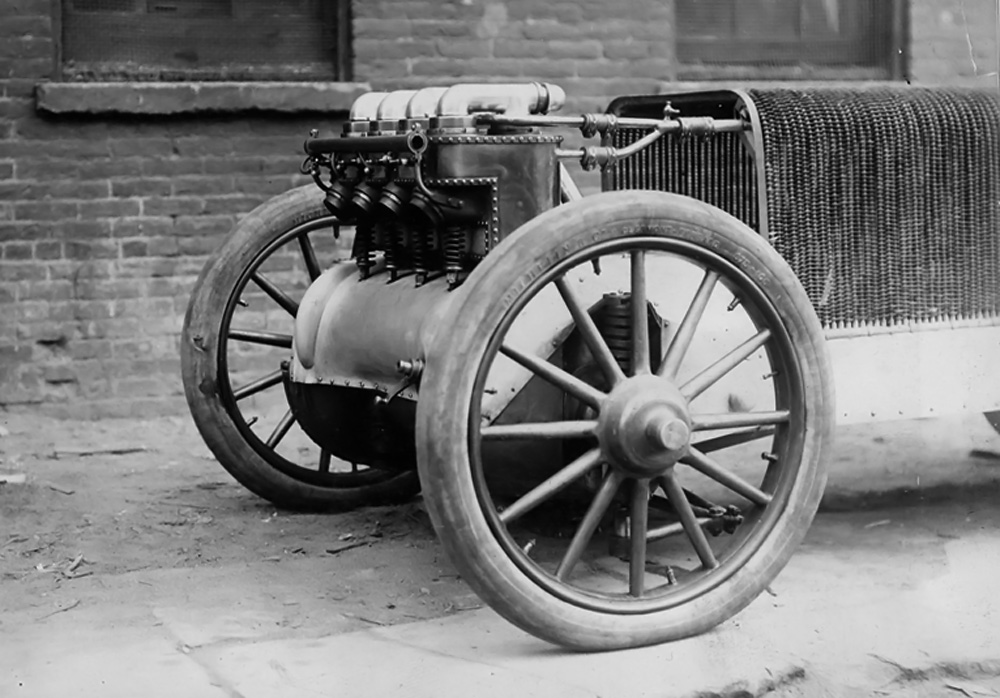
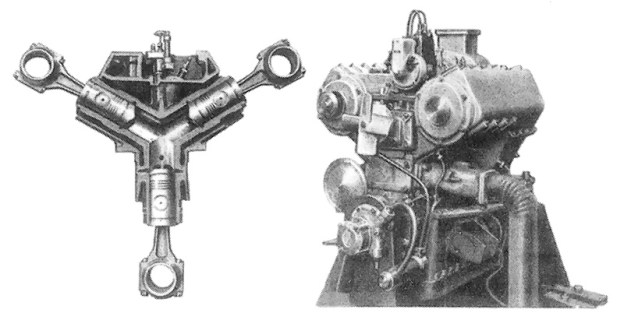
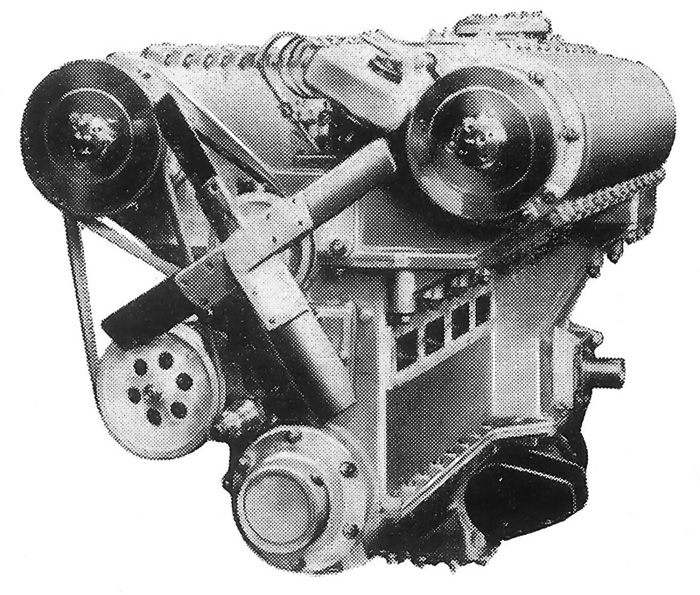
Perrier-Cadillac 41-75 Tank Engine

By William Pearce

As World War II started to gain momentum and become a global conflict, Australia realized that it was in a precarious position. In the war’s early years, Australia did not have an industry devoted to building war material, and the ability of other nations to supply war machines to Australia was in doubt. Australia realized that they would need to develop their own war equipment. In November 1940, Australia began developing its own tank, the Australian Cruiser Tank Mark I (AC1).

AC1 Clover leaf Cadillac

The “clover leaf” Cadillac drive system of the Australian Cruiser Tank Mark I. The rear engine (top of image) is not visible, but its long drive shaft can be seen passing between the other two engines. All three drive shafts connect to the transfer box (bottom of image).

The AC1 Sentinel was based on the United States M3 medium tank, but selecting a power plant for the AC1 proved to be a challenge. The M3 was powered by a 400 hp (298 kW) Wright R-975 radial engine, built under license by Continental Motors. But a continuous supply of R-975 engines, Guiberson diesel engines, or any powerful engines could not be assured to Australia. A solution was found in the unlikely form of a Cadillac V-8 engine originally used to power various coupes and sedans. The Australians referred to the engine as the Cadillac 75 because of its use in the Cadillac Series 75 sedan, but it was also used in the Series 70 and various Series 60 automobiles.

The Cadillac 75 engine had made its debut in 1936. It was a flat head (side valve) engine with the intake and exhaust valves located on the Vee side of the cylinder. The engine was a monobloc design with cylinder banks cast integral with the crankcase. The V-8 also incorporated hydraulic valve lifters for durability. The engine was designed to be built more economically than Cadillac’s V-12 and other V-8 engines. The Cadillac 75 engine had a 3.5 in (89 mm) bore, a 4.5 in (114 mm) stroke, and a displacement of 346 cu in (5.7 L). It produced 135 hp (101 kW) and weighed around 890 lb (404 kg).
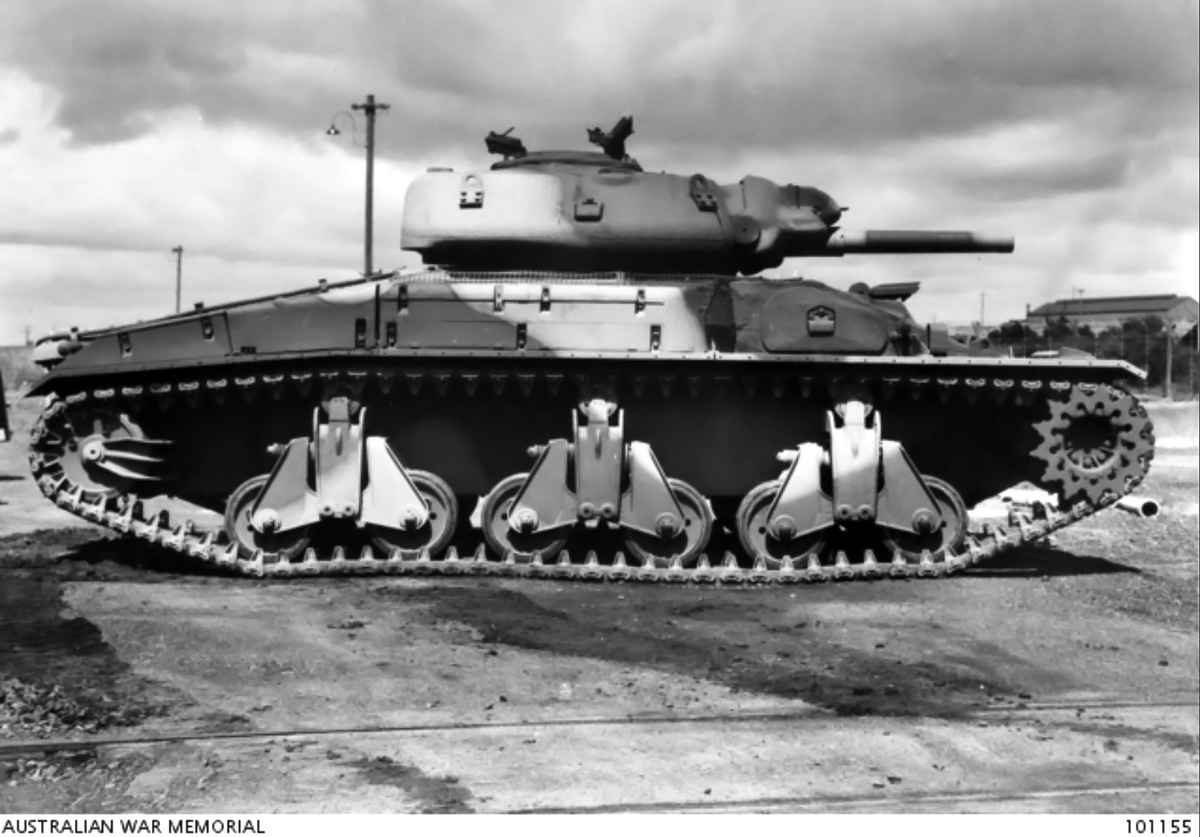
Australian Cruiser Tank Mark III

The Australian Cruiser Tank Mark III (AC3) powered by the Perrier-Cadillac 41-75 engine. Only one AC3 was fully assembled, and that tank is currently preserved at the Australian War Memorial in Campbell, Australia. (Australian War Memorial image)

The Cadillac 75 engine was readily available for import to Australia, but its 135 hp (101 kW) output was insufficient to power the 28 ton (25.4 metric ton) AC1 tank. As a result, AC1 designers, Colonel W. D. Watson and A. R. Code, decided to use three engines to power the tank. Watson was a British tank engineer on loan to Australia, and Code was the Director of Australia’s Armored Fighting Vehicle Production. The three-engine power package developed for the AC1 tank became known as a clover leaf arrangement and was built by General Motors’ Holden subsidiary in Melbourne.

In the clover leaf configuration, engine “3” was situated toward the rear of the tank, and engines “1” and “2” were located amidships, side-by-side. The engines were completely independent of one another, each having its own radiator and drive shaft. However, engine “3” also drove the cooling fan from six pulleys mounted on its driveshaft. The drive shafts for all three engines extended forward to a common transfer box near the middle of the tank. From the transfer box ran the final output shaft that connected to the tank’s gearbox. The AC1 tank could be run on two or even one of the Cadillac 75 engines.

Perrier-Cadillac 41-75 front

Front view of the Perrier-Cadillac 41-75 engine illustrates the odd cylinder bank arrangement. Note the single output shaft and how each exhaust manifold collects exhaust from three cylinder banks. A water pump and generator are driven from a belt at the front of each engine section.

The clover leaf Cadillac power package produced 330 hp (246 kW) at 3,050 rpm and was somewhat successful, powering 65 AC1 tanks. However, the rear engine did experience occasional cooling issues as a result of unequal coolant flow. The clover leaf’s three drive shafts, remote transfer box, and separate cooling systems added weight and complexity. As the Australian Cruiser Tank Mark III (AC3) was being designed in 1941, engineer Robert Perrier sought to simplify the clover leaf Cadillac power package. Perrier, a Frenchman, had been sent to Japan by the French government in 1940 and had subsequently made his way to Australia as Japan entered the war.

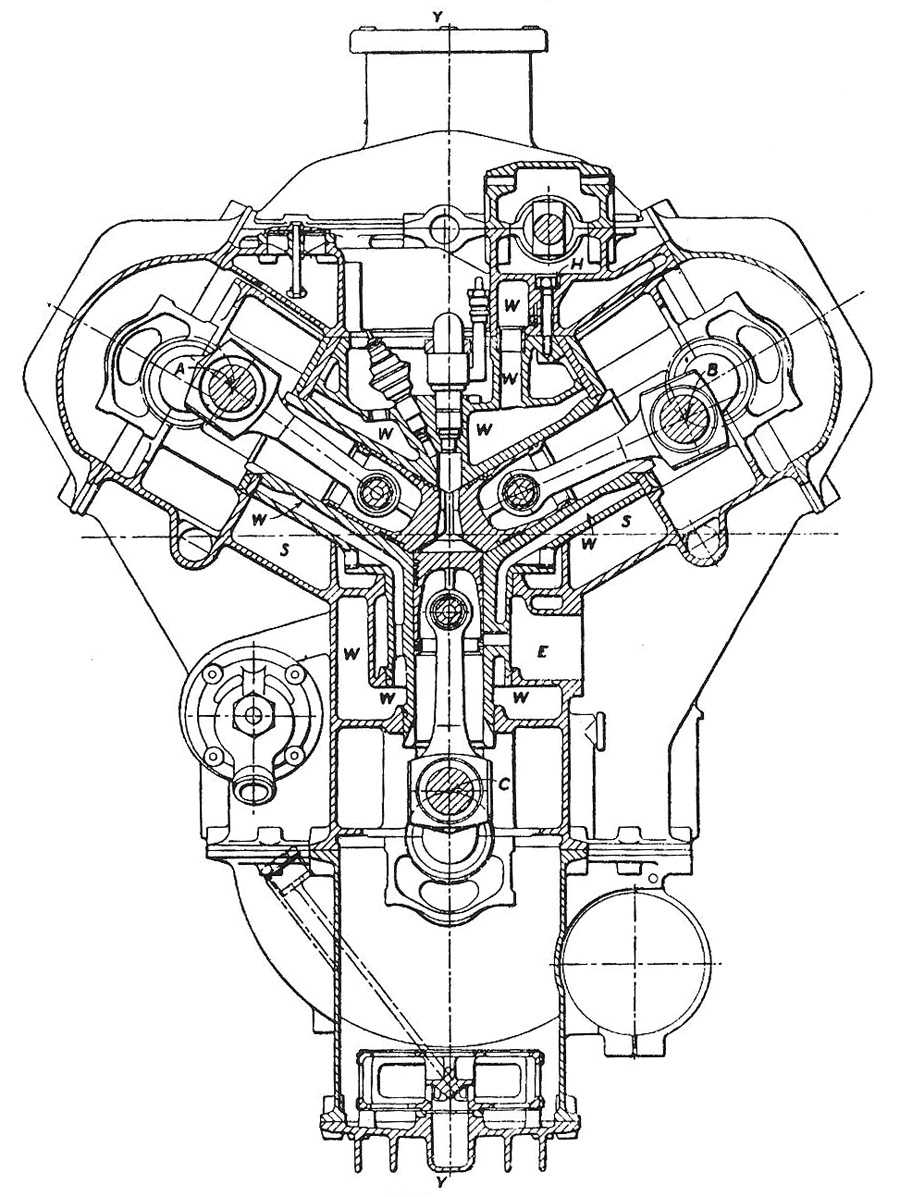
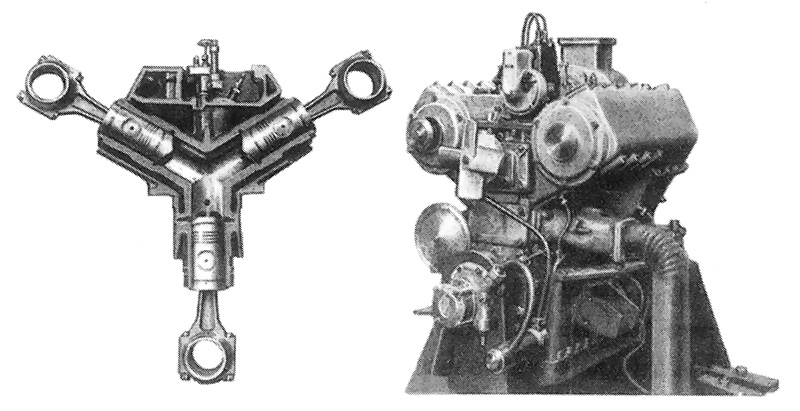
The AC3 Thunderbolt was an improved AC1 with better armor protection and firepower. To increase the performance of the three Cadillac 75 engines, Perrier mounted them radially to a common crankcase made from steel plates welded together. One engine was mounted on top of the crankcase, and the other two were mounted about 60 degrees to the left and right of the top engine. This configuration resulted in a rather odd looking engine, with its lower cylinder banks some 210 degrees apart. The engine was known as the Perrier-Cadillac 41-75; it was a lighter, more compact power package than the clover leaf configuration.

Perrier-Cadillac 41-75 crankcase

Rear view of the triangular, welded-steel crankcase of the Perrier-Cadillac engine. The power from all three engine sections was combined at the rear of the engine, and a single output shaft passed though the large, circular openings in the crankcase.

The Perrier-Cadillac engine had a single cooling system with one radiator, but each engine section had its own water pump. The remaining engine accessories were separate and operated independently of one another. At the rear of the Perrier-Cadillac engine, the crankshaft of each engine section was coupled to a common combining gear. The individual engine sections could be decoupled from the combining gear. A drive shaft extended from the combining gear at the rear of the engine, through the crankcase, and out the front of the engine.

The single output shaft of the Perrier-Cadillac engine allowed the transfer box used in the AC1 tank to be omitted, saving space and weight. The single output shaft also decreased mechanical losses, enabling the Perrier-Cadillac to produce more power than the clover leaf package with its three-into-one transfer drive arrangement. The 24-cylinder Perrier-Cadillac 41-75 displaced 1,039 cu in (17.0 L) and produced 397 hp (296 kW). The engine weighed around 3,000 lb (1,360 kg).

Perrier-Cadillac 41-75 rear

Rear view of the 397 hp (296 kW) Perrier-Cadillac engine. Behind the cover at the center of the engine is where the individual engine sections are connected to the single output shaft.

While the Perrier-Cadillac engine worked well, it did not go into production. A number of AC3 tanks were being built, but only one of these was fully assembled. The further improved Australian Cruiser Tank Mark IV (AC4) design followed, and it also used the Perrier-Cadillac engine. By 1943, the supply of war equipment to Australia had not been greatly impacted by the war, and equipment was imported faster than it could be domestically built. Australian resources were better utilized on projects other than tanks, and the Australian Cruiser tank programs were cancelled. However, the imported tanks did not completely match the Australian Cruiser tank design requirements, nor did they eclipse the Australian Cruiser tanks’ performance.

As a side note, the Perrier-Cadillac 41-75 was not the only engine intended to power AC4. A new engine was under development; it was comprised of four air-cooled, four-cylinder de Havilland Gypsy Major engines mounted in an H configuration on a common crankcase. Starting in 1941, Gypsy Major engines were produced under license at General Motors’ Holden plant. With its 4.65 in (118 mm) bore and 5.51 in (140 mm) stroke, the Quad-Gypsy engine would have displaced 1,495 cu in (24.5 L) and produced 510 hp (380 kW) at 2,500 rpm. The 16-cylinder engine weighed around 1,500 lb (680 kg). The Quad-Gypsy engine was domestically-built, simpler, more powerful, and much lighter than the Perrier-Cadillac engine.
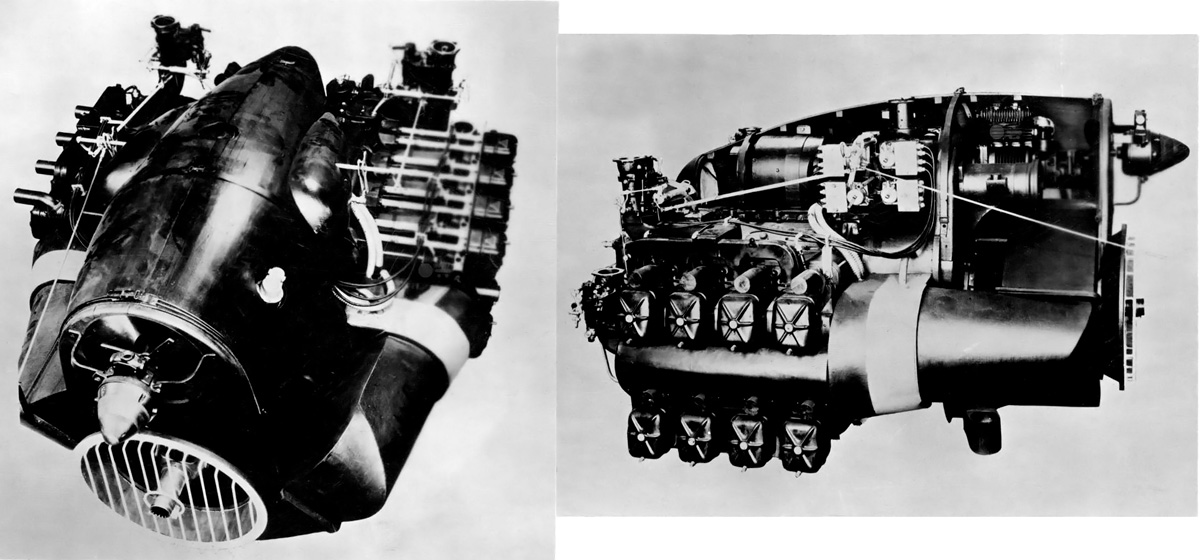
AC4 QuadGipsy engine

The 16-cylinder, QuadGipsy engine would provide around 510 hp (380 kW) for the Australian Cruiser Tank Mark IV. Lighter and more powerful that the Perrier-Cadillac, the engine would have been built in Australia by General Motors-Holden. Concealed in the shroud around the output shaft was a fan to force air through the cylinders’ cooling fins. Various accessories were mounted on top the engine.

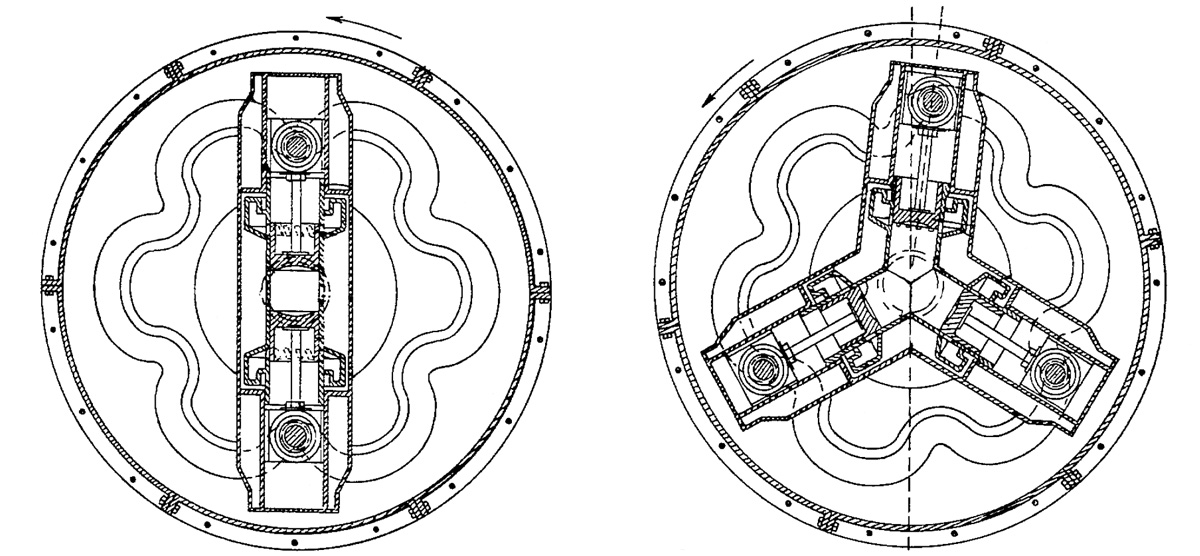
While similar engine concepts, no direct relation has been found between the Perrier-Cadillac and the Chrysler A57 Multibank.

Sources:
Tanks Australian Cruiser Mark-1 Instruction Book (1943)
Australian Sentinel and Matildas (AFV Weapons 31) by Major James Bingham
The Role of Science and Industry (Australia in the war of 1939-1945) by D.P. Mellor (1958)
http://www.mheaust.com.au/Aust/Research/Sentinel/sentinelmk.htm
http://www.secretprojects.co.uk/forum/index.php/topic,8514.0/all.html
http://forum.worldoftanks.com/index.php?/topic/490738-inside-the-chieftains-hatch-ac-1-sentinel/

Duesenberg Milton LSR Beverly Hills Murphy

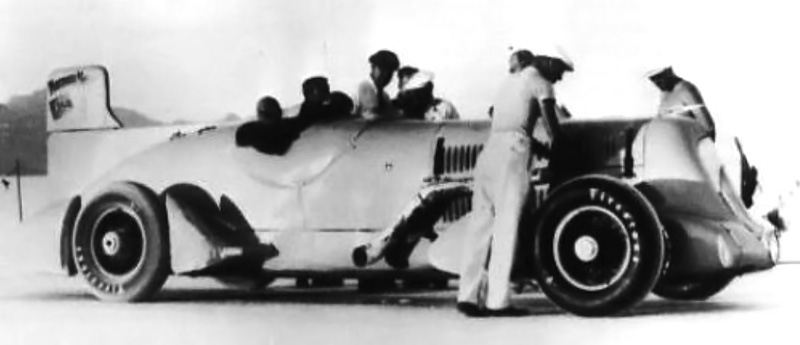
Duesenberg-Milton Land Speed Record Car

By William Pearce

After winning the Elgin National Road Race, held in Elgin, Illinois on 23 August 1919, Duesenberg race car driver Tommy Milton began to focus on one of his top goals: establishing a new land speed record at Daytona Beach, Florida. The current record was held by Milton’s rival Ralph De Palma at 149.875 mph (241.001 km/h). Milton had been contemplating a land speed record (LSR) car for a long time. In December 1916, he and Fred Duesenberg entered into an agreement* to build a car to Milton’s specifications provided Milton would partially fund the vehicle. With his share of the Eglin winnings, Milton was one step closer to building the LSR car.

Duesenberg Milton LSR Indy

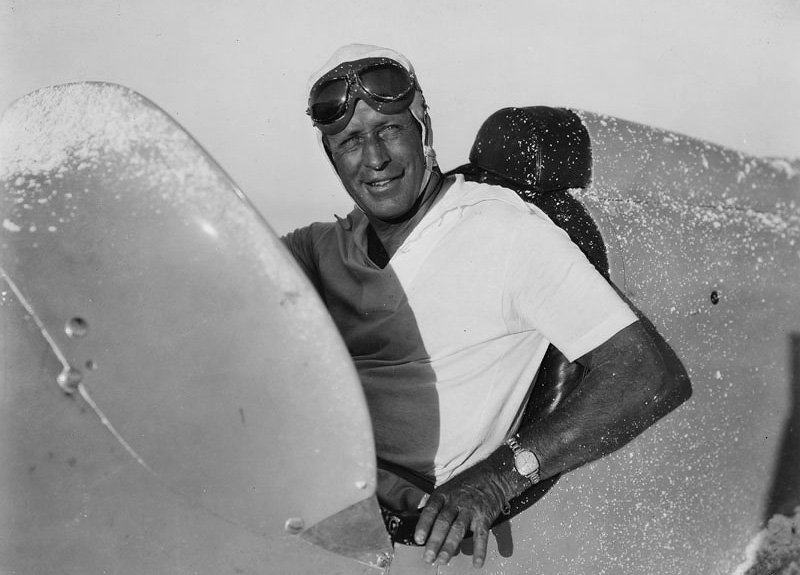
Tommy Milton sits in the Duesenberg-Milton LSR car at the Indianapolis Motor Speedway (most likely in May 1920). The burnt paint on the engine cowl was a result of a fire during its speed runs in April 1920. (RacingOne image via Getty Images)

Milton was born in St. Paul, Minnesota on 14 November 1893. From birth, he was blind in his right eye, but he never let that slow him down. At the age of 19, in 1913, Milton was given his family’s old car, and he quickly set to work to make it a faster. He began entering the car in local races and stood out with obvious potential. Milton’s natural abilities were noticed by race promoter Alex Sloan, who offered Milton a job. Sloan ended up firing Milton in 1915 for winning staged races he was supposed to lose. Milton did not mind; he had already made arrangements to race for Duesenberg during the 1916 season.

Even without any victories, Milton did well enough through the 1916 season to finish in seventh place in the AAA national points standings. A world at war interrupted the 1917 and 1918 seasons, but Milton was back behind the wheel of a Duesenberg for 1919. After the Elgin, Milton headed to Uniontown, Pennsylvania for the next race.

It was at Uniontown on 1 September 1919 where Milton met disaster while hunting for his fourth win in a row. In first place and with only 10 laps to go, fuel from a ruptured line ignited, causing an intense fire. The car ablaze, Milton expertly spun the car 180 degrees, putting the flames away from himself and his riding mechanic, Dwight Kessler. Driving backward, Milton headed toward the inner guard rail and help. Milton was able to extricate himself from the car but required hospitalization for his badly burned right leg. Kessler, also burned, escaped with less severe injuries.

Duesenberg Milton LSR build

The Duesenberg-Milton LSR car under construction at The Duesenberg factory in Elizabeth, New Jersey in late 1919 or early 1920. (Eddie Miller image via King of the Boards: The Life and Times of Jimmy Murphy)

While in the hospital, a semi-conscious Milton interrupted the doctors who were discussing the need to amputate his burned leg. Before he fell back into unconsciousness, Milton made it very clear that he wanted to keep his leg. The doctors were able to avoid amputation, but Milton needed months of hospitalization to recover. Jimmy Murphy often visited Milton in the hospital. Murphy was also a driver for Duesenberg, and the two had become good friends. Murphy had been Milton’s riding mechanic for the Elgin race, and Milton, who was the Duesenberg team captain, continued to encourage the novice Murphy.

As Milton lay in his hospital bed, he had a lot of time to think of his land speed record ambitions. As World War I was drawing to a close, Fred and Augie Duesenberg designed a new straight, eight-cylinder engine for when racing resumed. This new engine was a departure from previous Duesenberg designs; gone were the long rocker arms and horizontal valves of their previous engines. In their place was a single overhead camshaft that actuated two exhaust valves and one intake valve positioned at the top of each cylinder. The engine’s camshaft was driven from the crankshaft via a vertical shaft at the front of the engine.

The crankcase and cylinders were a single casting to which the cylinder head was attached. All castings were iron. Two intake manifolds were positioned on the left side of the engine, and each manifold fed the air/fuel mixture to four cylinders from a single Miller updraft carburetor. On the right side of the engine, the exhaust gases were collected in a common manifold. The engine had a 3.0 in (76 mm) bore and 5.25 in (133 mm) stroke. It displaced 297 cu in (4.86 L) to conform to the 300 cu in (4.91 L) limit imposed on race engines at the time. The engine produced around 92 hp (69 kW) at 3,800 rpm.

Duesenberg Milton LSR Daytona Chassis

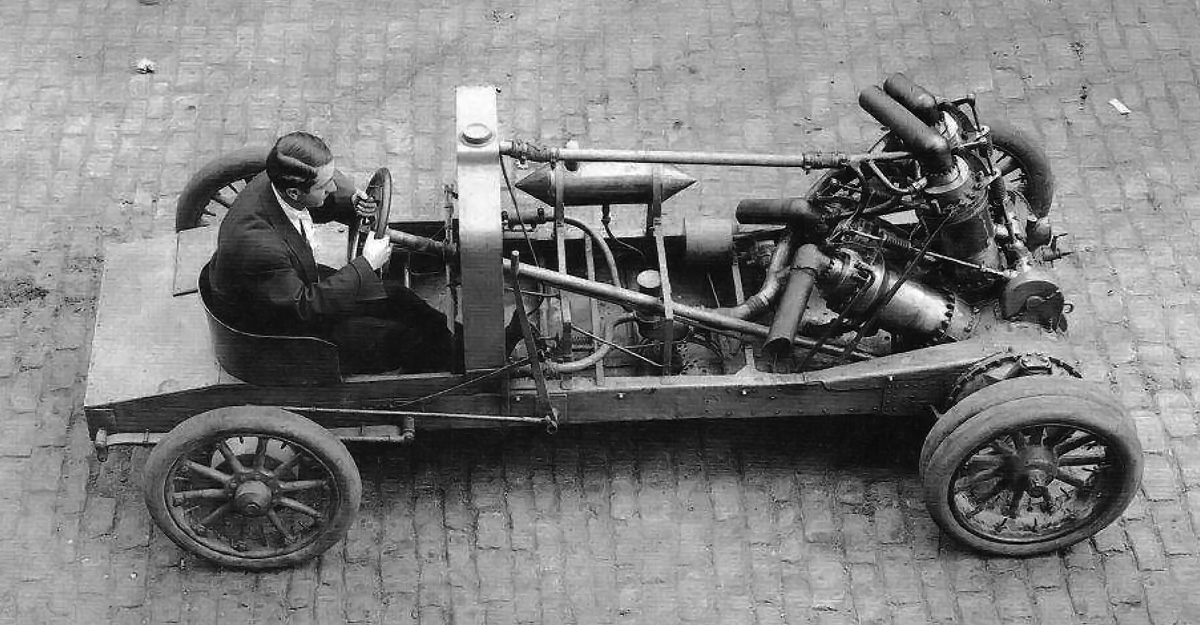
Picture taken in Daytona Beach, Florida showing the bodiless Duesenberg-Milton LSR car. Each eight-cylinder engine drove its own drive shaft which led back to the rear axle. Note the hollow steering column and the position of the exhaust manifold for the left engine.

Unfortunately for Duesenberg, this new “300 cu in” engine was soon made obsolete by a rule change that stipulated a 183 cu in (3.0 L) displacement limit for the 1920 Indianapolis race. With no other application for the 300 cu in engines, Milton envisioned using them for his LSR car. Over his two months of hospitalization, Milton solidified the LSR car design to include two completely separate 300 cu in engines positioned side by side at the front of the racer. Via a cone clutch, each engine directly drove a drive shaft. At the end of each drive shaft was a pinion that engaged a ring gear on the special, solid, live axle.

The chassis for the Duesenberg LSR car was encased by a sheet-metal body, including an undertray. The front of the car was slanted and had a large opening for the radiator. A long tail tapered back beyond the rear wheels to form the rear of the car. The exhaust pipe from the left engine passed through the cockpit on its way to the outside of the car.

In November 1919, Milton was out of the hospital and, although still recovering, was back behind the wheel of a race car; he continued to win races and break records. Milton also worked on the LSR car whenever he could at Duesenberg’s shop in Elizabeth, New Jersey.

Duesenberg Milton LSR Daytona Engines

Another view of the twin-engine set up in the Duesenberg-Milton LSR car. Just below the steering column is a reversing gear that was quickly added to the racer at Daytona to comply with Automobile Association of America rules.

The first race of the 1920 season was the inaugural race at the Los Angles Speedway in Beverly Hills, California. Since this race would be the last for the 300 cu in engines, the LSR car was shipped with the other racers to Beverly Hills. Once the races were over, the 300 cu in engines could be installed in the LSR car and tested at the track.

The race was held on 28 February 1920, and it was Murphy’s first victory. Milton had dropped out with engine trouble. Another race was run a month later on 28 March. Milton and Murphy both won separate sprint races. As planned, the 300 cu in engines were removed from Milton and Murphy’s cars and installed in the LSR car. The LSR car, sometimes referred to as the “Double Duesy,” was tested around the track, where Milton reportedly covered the one mile (1.6 km) circuit in 37 seconds—a speed of over 97 mph (156 km/h).

The Duesenberg LSR car still needed many finishing touches. Murphy, Harry Hartz, and the LSR car were sent to Daytona Beach, Florida to be prepped for a record attempt in April. Milton went to Havana, Cuba to participate in an “all-star” race in which he hoped to earn some much needed winnings, as the LSR car had drained his finances. Before he left, Milton gave explicit instructions that the LSR car was not to make any high-speed runs without him behind the wheel.

Duesenberg Milton LSR Beverly Hills Murphy

The completed Duesenberg-Milton LSR car at the Los Angles Speedway in Beverly Hills, CA. Jimmy Murphy sits behind the wheel ready to take the car out on the track. The picture was taken before the car was sent to Daytona Beach in April 1920.

When Milton arrived in Florida from Cuba on 18 April 1920, he read in a newspaper that Murphy had driven the Duesenberg LSR car to 153 mph (246 km/h), unofficially surpassing De Palma’s speed of 149.875 mph (241.201 km/h). Milton’s outrage with Murphy’s speed run was obvious to everyone once he arrived at Daytona Beach. Fred Duesenberg attempted to take the blame for putting Murphy in the LSR car, but Milton was beyond being reasoned with, and Murphy left the beach. This event marked the end of Milton and Murphy’s close friendship, and Milton would also be done with Duesenberg when he got the chance. The issue was not that Murphy tested the car, but that a record speed had been run. The recording of a record speed was not Murphy or Duesenberg’s fault; an intrepid reporter with a stopwatch was most likely the catalyst for all the turmoil.

Milton was determined to go faster in the LSR car for the official runs. Milton and Fred Duesenberg believed the car was capable of 180 mph (290 km/h). However, Milton ran into trouble with mechanical issues, bad sand, bad weather, and the wrong gear ratio. Despite his best efforts, Milton was not able to better Murphy’s speed. On the beach, Milton and Hartz worked on the car to clear it of sand that had gotten everywhere during previous runs.

Duesenberg Milton LSR Daytona Engines

The Duesenberg-Milton LSR car under power on Daytona Beach. Many sources indicate Milton was driving the car at the time, but it was very likely Murphy behind the wheel.

With the Duesenberg LSR car back together and with favorable conditions, Milton made progressively faster runs down Daytona Beach. On 25 April 1920, Milton set seven new speed records, for everything from 0.5 to 5.0 miles (0.8 to 8.0 km). Milton covered a mile at 153.846 mph (247.593 km/h), but he felt the LSR car could go even faster. On 27 April 1920, Milton rocketed atop the sand when suddenly the car caught fire. Perhaps the extreme heat generated by the twin engines (especially the exhaust of the left engine) ignited fuel and oil that had pooled on the undertray. Heat and fumes traveled through the hollow steering column situated between the two engines and blew into Milton’s face. With the burns of his Uniontown fire still healing, Milton knew his situation was not a good one. He pressed on to finish the run but thought about driving the car into the ocean to extinguish the flames. Fortunately, that was not necessary. Milton and onlookers were able to put out the fire out using sand once he came to a stop at the end of the course. Milton’s speed on that run was recorded at 156.046 mph (251.131 km/h).

Milton suffered burns and impaired vision and again needed time to recover. The Duesenberg LSR car was in need of repair, and the period of good weather was over. It was time to leave the beach. Because Milton’s record run was only one way, it would not be an officially recognized international record. However, the 156.046 mph (251.132 km/h) speed would stand as a United States record, and the speed would not be surpassed internationally until 1926.

Duesenberg Milton LSR Daytona Beach

The Duesenberg-Milton LSR car with Milton in the cockpit. This picture was taken at Daytona Beach, most likely after Milton’s speed run. The paint on the engine cowling has been burned off, but the car appears to be in otherwise good condition, similar to how it looks in the picture from Indianapolis. Note the fabric wheel covers that Milton added to improve the vehicle’s aerodynamics and increase its speed.

Milton left the Duesenberg team at the end of the 1920 season. Murphy was killed in a race on 15 September 1924. Despite whatever friction may have existed between the two men, Milton always respected and thought highly of Murphy. Milton helped get Murphy’s affairs in order after his death, even signing Murphy’s death certificate. The LSR car was retained by Duesenberg and later repainted and displayed in their Indianapolis factory showroom. However, it is not clear what happened to the car after the 1926 merger with the Cord Company.

*Milton and Duesenberg’s agreement specified the use of a V-12 aircraft engine. The intended engine could very well have been the 1,568 cu in (25.7 L) V-12 Duesenberg aircraft engine of 350 hp (261 kW) first run that same year (1916).

Note: Many sources present conflicting information regarding the history of the Duesenberg LSR car, the record runs, and the perceived conflict between Milton and Murphy. This article is an attempt to present the story without magnifying or ignoring its primary details.

Duesenberg Milton LSR 1924

The Duesenberg-Milton LSR car at the Duesenberg Indianapolis plant in 1921. Note that the LSR car has been repainted and branded the “Duesenberg World Record Car.” In the foreground are some of the cars Duesenberg sent to France to participate in the Grand Prix at Le Mans, which Murphy won (Murphy’s number 12 racer is not pictured).

This article is part of an ongoing series detailing Absolute Land Speed Record Cars.

Sources:
King of the Boards: The Life and Times of Jimmy Murphy by Gary Doyle (2002)
The Golden Age of the American Racing Car by Griffith Borgeson (1966/1998)
– “The Incomparable Milton” by Al Bloemker Automobile Quarterly Vol. 8 No. 2 (Fall 1969)
Land Speed Record by Cyril Posthumus and David Tremayne (1971/1985)
– “Papa Time Gets Trimmed Again Down on Daytona Beach” Touring Topics (May 1920)
Duesenberg Aircraft Engines by William Pearce (2012)
https://en.wikipedia.org/wiki/Tommy_Milton
https://en.wikipedia.org/wiki/Beverly_Hills_Speedway

Christie 1909 V-4 racer

Christie V-4 Engine 1909 Racer

By William Pearce

In late 1908, John Walter Christie set to work designing and building his last front-wheel drive race car. While the 1909 racer illustrated the continuing evolution of Christie’s front-wheel drive race cars, it also incorporated many features that were a departure from the previous racers (inline racers, 1906 V-4, and 1907 V-4).

Christie 1909 V-4 racer Firestone

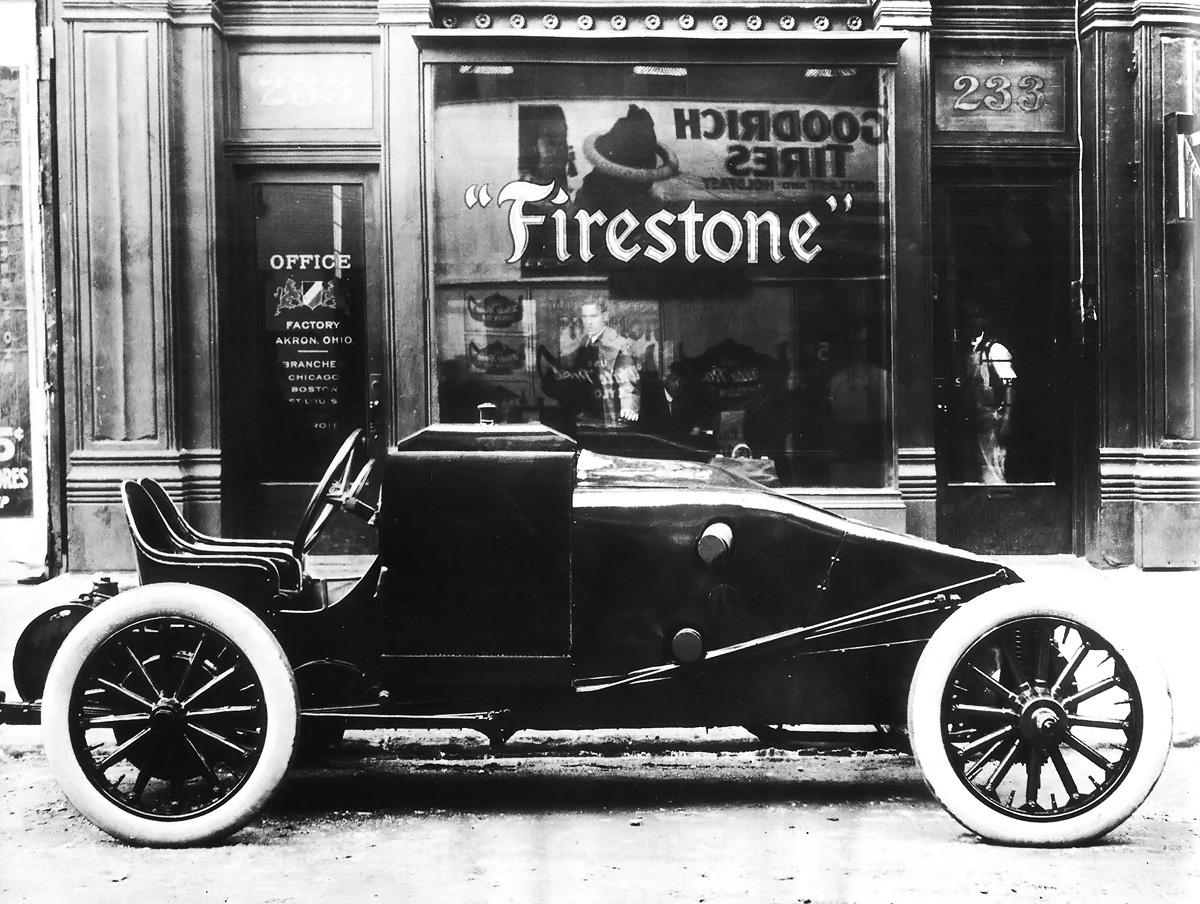
J. Walter Christie’s newly completed 1909 front-wheel drive racer in front of the Firestone office at 233 West 58th Street in New York. Note the cylindrical fuel tank at the rear of the vehicle.

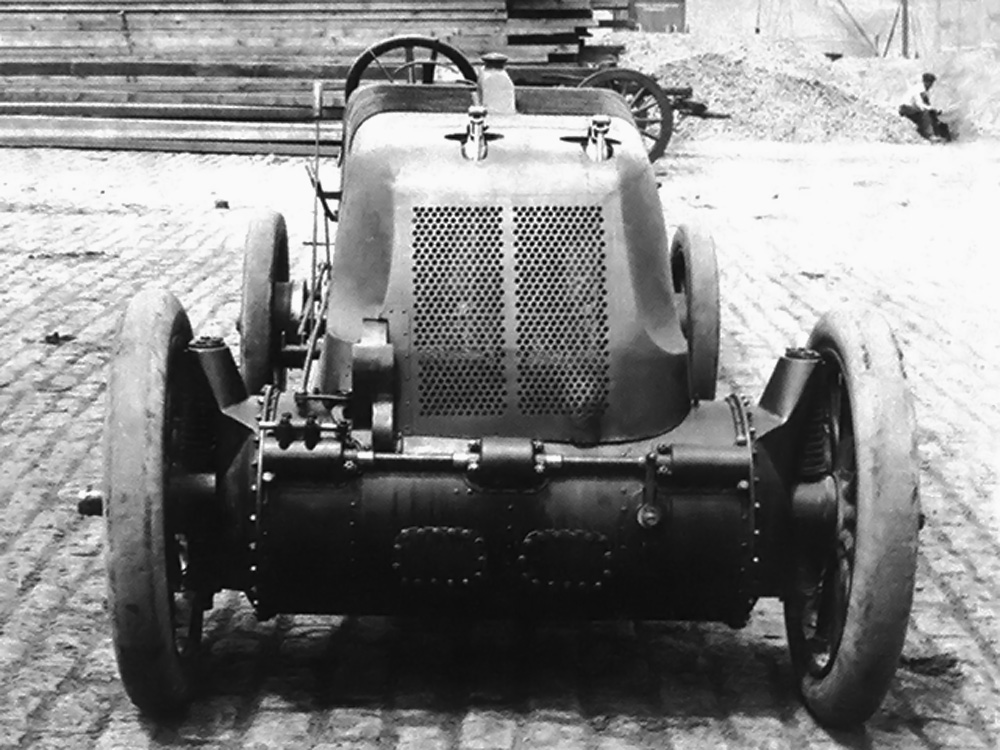
Like the previous racers, the 1909 car had its four-cylinder engine mounted transversely between the front drive wheels. The engine’s crankcase housed the transmission and formed the vehicle’s front axle. The cylindrical crankcase was 15.125 in (384 mm) in diameter and made of bronze. Behind the engine was a radiator shaped like an inverted “U” that extended from one side of the vehicle’s frame to the other. Above the vehicle’s rear axle were seats for the driver and passenger (or riding mechanic). The fuel tank was at the extreme rear of the car. The 1909 V-4 racer had a wheelbase around 102 in (2.59 m) and a track around 54 in (1.37 m).

Although the racer was powered by a V-4 like Christie’s previous two racers, the 1909 engine was an entirely new design. Extending from the crankcase toward the rear of the vehicle was a large block to which the individual cylinders were mounted. The sides of this block were integral with the vehicle’s frame. The cylinders of the 1909 V-4 engine were angled so far back that the rear row was just eight degrees from being completely horizontal. The front row of cylinders was angled 20 degrees from the rear row. The cylinders were slanted back to improve the vehicle’s weight distribution and aerodynamics.

Christie 1909 V-4 racer details

The photo on the left illustrates the 1909 Christie racer’s cross shaft (with notched drive gears at its ends) and accessory shaft. The long shaft leading back from the accessory shaft drove the camshaft. The photo on the right shows the overhead camshaft and its drive, the rocker arms, the valves, and the intake manifold. Note the large block between the crankcase and cylinders.

The forged steel crankshaft was 3.5 in (89 mm) in diameter and 19 in (483 mm) long. It had two throws and was supported by two main bearings. Attached to each crankshaft throw was one 30.5 in (775 mm) long (center-to-center) master connecting rod. The master rods served the rear row (lower) cylinders. Attached 7.0 in (178 mm) above each master rod’s big end was a 23.5 in (597 mm) long (center-to-center) articulated connecting rod. The articulated connecting rods served the front row (upper) cylinders. The incredibly long connecting rods allowed the mass of the engine to be placed toward the rear of the car in an effort to further equalize the vehicle’s weight distribution.

The engine’s cylinders had a 7.5 in (191 mm) bore and 7.0 in (178 mm) stroke, which gave the engine total displacement of 1,237 cu in (20.3 L). The engine’s output has been given as various numbers from 100 to 300 hp (75 to 224 kW), but 200 hp (149 kW) is probably close to the correct number. Each cylinder had one intake and one exhaust valve—both were 3.0 in (76 mm) in diameter and mechanically operated. The intake valves were placed on the inner side of the cylinders so that a common intake manifold could feed each row of cylinders. The upper and lower intake manifolds joined at the center of the engine, and the Christie-designed carburetor was bolted to the lower manifold.

Christie 1909 V-4 racer drive

Sectional drawing of the 1909 Christie V-4 racer’s crankcase with normal, high-speed drive engaged. The short drive shaft with universal joints on its ends can be seen coupled to the engine’s crankshaft. The front cross shaft is shown with its notched gear straddling the gear of the inner universal joint.

The exhaust valves were on the outer side of the cylinders and positioned so that the exhaust gases for each cylinder vented through a small stack. The valves were actuated by separate rocker arms driven by a single overhead camshaft situated between the two cylinder rows. The camshaft was driven via beveled gears by a long shaft on the left side (from the driver’s perspective) of the engine. The long shaft was driven from the left side of an auxiliary shaft positioned above the engine’s crankcase and in front of the cylinders.

A single spark plug was installed in each cylinder and just under the intake valve. In order to achieve proper timing with the odd cylinder angles, the spark plugs for each row of cylinders were fired by separate magnetos. The magnetos were driven from the extended end of the same long shaft that drove the camshaft.

For normal, high-speed front-wheel drive operation, each end of the crankshaft was coupled via disk clutches to a short drive shaft with universal joints at each end. The short drive shaft was constructed of solid steel and was 2.25 in (57 mm) in diameter. The spindles for the drive wheels were on the outer ends of these shafts. In this configuration, the drive wheels turned once for each revolution of the engine.

Christie 1909 V-4 racer

The 1909 Christie V-4 racer undergoing final checks before a run. Walter Christie is checking the water level in the radiator’s header tank. Note the thick radiator and the exhaust stacks protruding from the engine cowling.

Machined between the throws at the center of the crankshaft were 1.0 in (25 mm) wide spur teeth that drove the auxiliary shaft positioned above and slightly to the rear of the crankcase. Positioned in front of and driven by the right side of the auxiliary shaft was a cross shaft. This cross shaft could slide to decouple the drive wheels from the crankshaft and engage a reverse gear. In addition, the cross shaft could engage a low-speed gear via an intermediate gear.

Each end of the cross shaft had a notched gear that could mesh with teeth on the inner side of the short drive shaft. For normal, high-speed operation, the notch would align with the teeth on the short drive shaft, allowing for direct drive. For low-speed operation, the cross shaft would slide left, and one side of the notched gear would engage the teeth on the short drive shaft. For reverse, the cross shaft would slide right, mesh with the intermediate gear, and the other side of the notched gear would engage the teeth on the short drive shaft. Shifting levers operated various forks that slid the cross shaft and engaged or disengaged the clutches.

Christie 1909 V-4 Ormond Roberts

Walter Christie driving the 1909 V-4 racer on Dayton-Ormond Beach in Florida with George Robertson holding on. For the beach runs, special cowlings were installed, the passenger seat was removed, and the radiator’s header tank was altered.

The radiator was formed from 80 copper tubes in 10 sections. Five sections were positioned on each side of the vehicle, and the eight copper tubes of each section formed a half arch. The copper tubes were flattened to a width of 2.625 in (67 mm) and extended from one side of the vehicle’s frame to a header tank positioned at the upper center of the radiator. The complete radiator was 29.25 in (743 mm) high, 35 in (889 mm) wide, and 32.5 in (826 mm) long.

Three different tires sizes were intended to be used on the 1909 racer: 30 in (762 mm) tires for circle tracks, 32 in (813 mm) tires for road use, and 34 in (864 mm) tires for high speed operations. Christie estimated his racer was capable of 130 mph (209 km/h), which equates to an engine speed of 1,285 rpm with the 34 in (864 mm) tires. Christie proposed that an engine with a smaller bore of either 5.5 in (140 mm) or 6.0 in (152 mm) could be used in a touring car version of the racer. These bores would give engine displacements of 665 cu in (10.9 L) and 792 cu in (13.0 L) respectively. However, it is doubtful that engines of these sizes were ever made.

Christie 1909 V-4 racer Oldfield

Barney Oldfield in the 1909 Christie racer at one of the many race exhibitions he staged. By this time, the racer had a new radiator and a square fuel tank. The dangerous aspects of the racer were embellished by Oldfield and subsequent owners; the car was even called the “Killer Christie.” It is safe to assume that no car in the 1910s was safe at over 100 mph (160 km/h).

Christie’s new V-4 racer made its public debut on 8 July 1909 at the Blue Bonnets track in Montreal, Canada, but Christie did not find the success he had hoped for. Experiencing some engine trouble, he was able to run a 59.6 second mile (60.4 mph / 97.2 km/h) on the circle track. In the next race, Christie’s car caught fire, taking him out of the event. In early August, the car ran at Grosse Pointe, Michigan where Christie ran a 54.6 second mile (65.9 mph / 106.1 km/h)—a new record for that circle track. Christie’s speed was limited by the track’s insufficient banking, which resulted in him coasting through the turns.

For the remainder of 1909, Christie raced at several tracks but was always plagued by trouble. On the Indianapolis Motor Speedway in mid-December, Christie ran a half mile in 17.53 seconds (102.7 mph / 165.2 km/h). He was slowed again by the turns, completing a mile in 42.58 seconds (84.5 mph / 136.0 km/h). Christie’s former partner (and nephew) Lewis Strang ran a few seconds faster in his 200 hp (149 kW) FIAT.

Christie 1909 V-4 Oldfield Beachey

Oldfield on the Ascot track in Los Angeles, California leading Lincoln Beachey in his Curtiss Pusher in 1913.

George Robertson was hired to drive Christie’s V-4 racer at Ormond-Daytona Beach, Florida in March 1910. The car was fitted with special, aerodynamic front and rear cowlings, and the passenger seat was removed. While the racer did a respectable 32.36 second mile (111.2 mph / 179.0 km/h), it could not approach the 27.33 second mile (131.723 mph / 211.988 km/h) Barney Oldfield had previously run in the 200 hp (149 kW) Blitzen Benz. Robertson went out to make another attempt despite the Christie racer constantly overheating. In the middle of what he felt would be a record-setting run, the engine seized. Once the engine stopped, the drive wheels froze and slid along the sand. This destroyed the tires and damaged the wheels. After much work to repair the vehicle, overheating issues and carburetor problems continued to plague the racer.

Christie had grown tired of all the issues with his racer. He announced that he was done racing and exited the automobile business altogether. The V-4 racer sat until 1912 when Oldfield bought it for $750. A new radiator was installed by either Christie or Oldfield, and the original body was put back on.

Oldfield campaigned the car for four years, putting on show after show. For some of his exhibitions, Oldfield raced against aviation pioneer Lincoln Beachey in his Curtiss Pusher airplane. Oldfield did achieve some success, setting a number of records with the Christie racer. On 20 June 1915, Oldfield set a new American record when he lapped the 2 mile (3.2 km) Speedway Park track in Chicago, Illinois in 64.6 seconds (111.5 mph / 179.4 km/h). On 28 May 1916, Oldfield became the first person to exceed 100 mph (161 km/h) on the 2.5 mile (4.0 km) Indianapolis Motor Speedway track when he completed a lap in 87.7 seconds at 102.623 mph (165.156 km/h). He then upped his 2 mile (3.2 km) American record in Chicago on 5 June 1916 when he completed a lap in 63.75 seconds (112.9 mph / 181.8 km/h).

Christie 1909 V-4 racer Oldfield IMS

Oldfield and his crew by the Indianapolis Motor Speedway for their record-setting run in 1916. Leather straps are now used to secure the racer’s cowling, and what appear to be grease cups protrude from the cowl.

Damaged during the run in Chicago, Oldfield sold the car mid-June 1916. The Christie was then used in Ernest Moross’ traveling auto race shows. During World War I, the Christie racer and the rest of the show toured Canada. At some point during this time, the racer was fitted with a new cowl and body. In March 1918, the car was sold to racer Louis Disbrow and continued to be used in various shows. Some of the shows included driver Jerry Wonderlich racing against aviatrix Ruth Law in her Curtiss Pusher aircraft. Outdated and unwieldy, the last of Christie’s front-wheel drive racers was scrapped in Chicago, Illinois around April 1919. All of the bronze parts proved to be the racer’s last payout: $450.

After parting with his racer in 1910, Christie had a short stint in aviation. He then built a series of front-wheel drive fire trucks. These trucks replaced the horses of existing horse-drawn units. This business venture proved quite lucrative. Christie then moved into designing tanks, which occupied his remaining days. Unfortunately, the money faded as the years went by, and Christie died nearly broke on 11 January 1944.

Christie 1909 V-4 Law Old Motor

The Christie 1909 racer with its new cowl and body circa 1918. Ruth Law’s Curtiss Pusher is in the background, and her mechanic Bob Westover sits behind the wheel. Note the 300 hp claim and that the racer is still prominently labeled as a “Christie.” (Lee Stohr image via TheOldMotor.com)

Sources:
– “The Front-Wheel-Drives of John Walter Christie, Inventor” by Stan Grayson Automobile Quarterly Volume 14, Number 3 (1976)
– “Christie’s New 100-Horsepower Racer” The Automobile (5 August 1909)
– “Montreal Sees Two-Man Meet” The Motor World (15 July 1909)
– “Christie the Bright Star at Grosse Pointe” The Automobile (5 August 1909)
– “Furious Driving at Fort Erie” The Motor World (12 August 1909)
– “Under the Spell of Speed” The Motor World (26 August 1909)
– “Basle Finishes Miles Ahead” The Motor World (2 September 1909)
– “Oldfield Smashes Florida Beach Records” Automobile Topics (26 March 1910)
– “Rain Cuts Short Florida Record Breaking” Automobile Topics (2 April 1910)
– “Delay Only Increases Race Interest” Motor World (23 June 1915)
– “Oldfield Breaks Record” Motor Age (8 June 1916)
– “Barney’s Christie Junked” Motor Age (24 April 1919)
Barney Oldfield by William F. Nolan (1961/2002)
http://www.stohrdesign.com/christie-automobiles-1903-1909-a-blog (various pages)
http://theoldmotor.com/?p=114991
http://theoldmotor.com/?p=130800
http://theoldmotor.com/?p=2798

Christie 1907 V-4 Oldfield

Christie V-4 Engine 1907 Racer

By William Pearce

Shortly after John Walter Christie wrecked his V-4-powered racer practicing for the 1906 running of the Vanderbilt Cup, he went to work on his next front-wheel drive race car. He took what he learned from his first V-4 racer and from all his inline racers and applied this knowledge while building the new car. Christie planned to take his new racer to Europe as the first American vehicle to compete in the French Grand Prix. At the same time, Christie wanted to expand his Christie Direct Action Motor Car Company and start producing various automobiles of his design.

Christie 1907 V-4 build

J. Walter Christie’s 1907 V-4 racer under construction at his shop in New York. The drive shaft for the water pump can be seen behind and to the right of the front wheel and extending toward the bottom of the radiator. This shaft was driven from the bevel gear visible in front of the first row of cylinders.

While the 1907 V-4 racer closely resembled the 1906 V-4 racer, it was an entirely new design. The car’s configuration followed that of the previous Christie racers in which the engine was mounted transversely between the two front wheels. The engine’s crankcase formed the car’s front axle and housed its transmission. The car had two forward gears: a normal gear for high-speed operation and a low gear. There was also a reverse gear. Behind the engine was a large radiator in which individual copper tubes were shaped in an inverted “U” and extended from one side of the frame to the other. A header tank was at the upper center of the tubes. The driver and passenger (typically a riding mechanic) sat over the rear axle with the fuel tank behind them.

The engine’s circular crankcase was made of nickel steel and formed an integral part of the chassis. The individual steel cylinders were mounted in two staggered rows on the crankcase. The first row of cylinders leaned back about 10 degrees from vertical, and the second row was angled about 45 degrees from the first row. Each cylinder was surrounded by a copper water jacket. Cooling water exited the top of each cylinder and flowed through a common manifold to the radiator’s header tank. After flowing through the radiator, the cooled water was pulled through a circulation pump and then flowed into the lower part of the cylinder water jacket. The water pump was driven from the camshaft via a long shaft with beveled gears.

Christie 1907 V-4 engine

Detail view of the V-4 engine and how its crankcase was an integral part of the car’s frame. The cross shaft on the front of the crankcase drove low and reverse gears. Note the camshaft housing in front of the cylinders and the exhaust valve train. The camel hair lining can just be seen on the outer diameter of the flywheel housed in the crankcase. The clutch would be installed between the flywheel and the crankcase.

Each cylinder had one large, mechanically operated exhaust valve. Via a rocker arm and pushrod, all exhaust valves were actuated by a single camshaft mounted on the outside of the crankcase and in front of the first row of cylinders. From the driver’s position, the right side of the camshaft was geared to the crankshaft, and its left side was geared to the water pump drive shaft. Surrounding the exhaust valve were eight atmospheric (automatic) intake valves mounted in a manganese bronze inlet chamber. The incoming air/fuel charge flowed from the Breeze carburetor, which was positioned behind the engine, into a manifold that branched into separate intake pipes for each cylinder. This configuration gave each cylinder a different induction pipe length and led to unequal air/fuel distribution.

Many sources list the bore and stroke as 7-9/32 in (185 mm) and the total displacement as 1,214 cu in (19.9 L). However, the engine actually had a 7.25 in (184 mm) bore and stroke that gave a total displacement of 1,197 cu in (19.6 L). The 185 mm (7-9/32 in) figure probably originated from the European press rounding up the true 7.25 in (184 mm) number. Regardless, the car’s displacement was the largest of any Grand Prix racer before or since. The V-4 engine reportedly produced around 130 hp (97 kW), but it was probably closer to 100 hp (75 kW).

Christie 1907 V-4 front cowl

Christie’s V-4 racer with its full engine cowling. It seems the cowling’s grill was quickly cut away to increase airflow through the radiator. Each cylinder had short exhaust stacks, and the front cylinders expelled their exhaust through the top of the cowl.

The stagger of the cylinders allowed the use of a two-throw crankshaft. Two hollow steel connecting rods were attached to each throw. The crankshaft was supported by three main bearings. The steel pistons had concave heads and five rings; three rings were above the wrist pin, and two bronze rings were below. The underside of the piston had cooling fins to help dissipate heat. For each cylinder, a single spark plug was mounted on its Vee side near the pushrod guide. The spark plugs were fired by a battery-powered Heinz coil and communicator (distributor). The engine used splash lubrication and also a Petersen pressure feed oiler.

On each end of the crankshaft was a manganese bronze flywheel. The outer diameter of the flywheel was lined with woven camel hair to provide a friction surface. Covering the flywheel was a chrome steel cone clutch. Shafts and universal joints connected the drive wheels to the clutches and allowed for steering and independent coil spring suspension. Normal gear would lock the flywheel, clutch, and shaft together so that there was no reduction between the engine and drive wheels; for every revolution of the engine, the drive wheels turned one revolution. Normal engine speed was 1,000 to 1,200 rpm. With its 34 in (864 mm) by 4.5 in (114 mm) front tires, the car was capable of 120 mph (193 km/h) at 1,200 rpm. Of course, different size tires could be used to alter the vehicle’s acceleration and top speed. The rear tires were 34 in (864 mm) by 4 in (102 mm).

Christie 1907 V-4 French Grand Prix

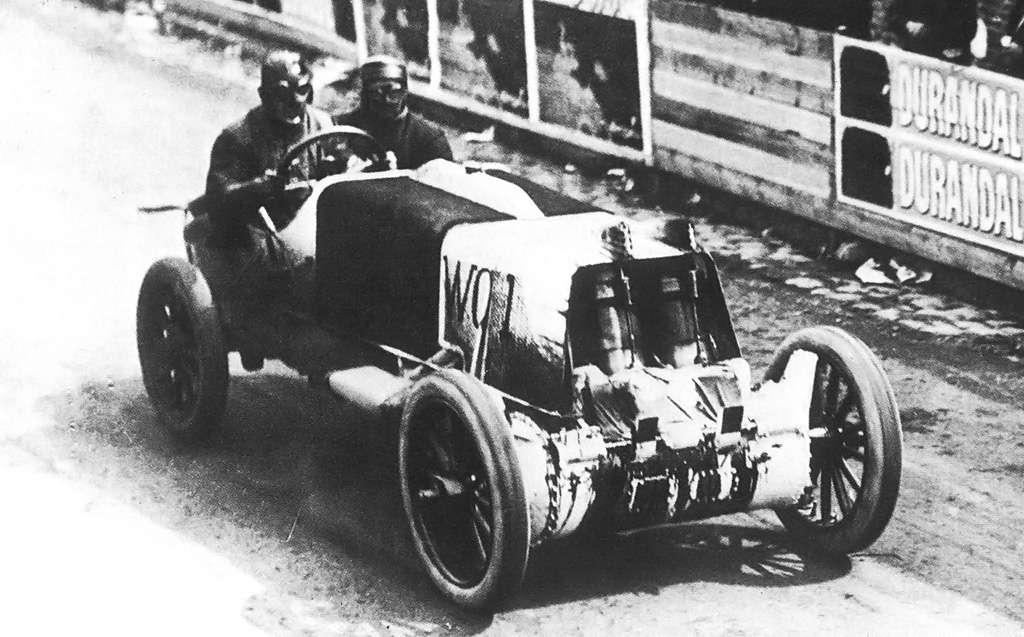
Christie and Lewis Strang running in the French Grand Prix in 1907. The car was painted white for the race, the engine cowl had been cut back, exhaust valve covers had been added to the top of the cowl, engine exhaust was now piped out of the cowl and into a muffler (of sorts) seen just behind the front wheel, and crankcase breathers had been added to the front of the car. Note the oil leaking from the camshaft and cross shaft housings.

Low and reverse gears were enabled by a cross shaft on the front of the crankcase. As the cross shaft slid laterally, gears on the shaft meshed with teeth cut into the outside of the clutch drums; at the same time, the clutch disengaged from the flywheel, allowing the speed of the drive wheels to be dictated by the speed of the cross shaft. The cross shaft was geared to the crankshaft at a reduced speed.

The car was only fitted with rear brakes, but two sets were employed. One set of rear brakes acted upon the inner surface of the brake drum while the other set acted upon the drum’s outer surface. The inner and outer brakes were controlled by individual foot pedals; however, the pedals were situated so that both could be pressed simultaneously by one foot.

The rear axle was a hollow steel tube and attached to the frame by semi-elliptic leaf springs. The 25 gal (95 L) fuel tank was easily removed so that it could be inspected by the Grand Prix committee. The car used a pressed steel, channel-section frame. It had a 110 in (2.79 m) wheelbase and a 53 in (1.35 m) track (some sources say a 100 in / 2.54 m wheelbase and a 56 in / 1.42 m track). The car weighed around 1,780 lb (807 kg).

Christie 1907 V-4 GP racer

This photo was most likely taken soon after the racer returned from Europe (possibly at Morris Park, New York). The cross shaft, mufflers, and crank case breathers have been removed, but the rest of the car is still in its Grand Prix configuration—apparently still wearing white paint from the Grand Prix. Christie is in the driver’s seat. Note the oil still leaking from the front of the crankcase.

Completed in late April, the Christie racer was tested out on the streets of Long Island, New York at 4 AM. Lewis Strang, who was Christie’s ridding mechanic and nephew, accompanied Christie on this first run. Reportedly, the car broke down after about 20 mi (32 km), but the issues were not severe. The car was repaired and underwent further testing and refinement in May. The racer originally had a cowling that covered the entire engine. Due to cooling issues, the front of this cowling was removed to increase airflow through the radiator. This cowling was continually modified throughout the racer’s life.

In June, Christie, Strang, and the V-4 racer left for France. Thirty-eight cars were entered in the French Grand Prix to be run on 2 July 1907. The race consisted of 10 laps on a 77 km (47.8 mi) course laid out near Dieppe in Northern France. Christie’s racer was the lightest and one of the most powerful racers. It was allocated the race designation WC1 (for Walter Christie 1) and the 12th starting position. The Christie Direct Action Motor Car Company had arranged for several locals to assist with the racer. However, upon arriving in France, Christie and Strang discovered that the helpers were nowhere to be found. Christie and Strang spent their time repainting the car in the white and red colors required for United States racers. They then needed to register the racer in France. With all the administrative work completed, Christie and Strang did not have much time to practice and only made one test lap around the course. This session revealed a sticking exhaust valve, but there was no time for repairs.

Christie 1907 V-4 Oldfield

Barney Oldfield in the 1907 Christie V-4 racer. It is not known when or where this photo was taken, but a new engine cowling has been installed and the cross shaft has been reinstalled.

Christie and Strang started the race at 6:12 AM and had a tire failure less than two miles later; it was not a good start. Repairs were quickly made, but the car was struggling. Christie picked up the pace and ran a lap in 48 min and 49 sec (58.8 mph / 94.6 km/h). However, this was several minutes slower than the leader. Adding to the trouble of the sticking exhaust valve were a jammed clutch and an overheated main bearing. Christie and Strang retired the V-4 racer on the fifth lap.

Upon return to the United States, Christie was ridiculed for his poor showing at the Grand Prix. He responded that he had spent his own money on his effort, and, unlike other American auto manufactures, he “at least did something.” Christie went on to challenge his critics to a race “for any distance and for any amount of money, and at any time, on any road or track anywhere.” No one stepped up to accept his challenge.

Christie and Strang ran the racer at various tracks to prove its capabilities and those of the Christie Direct Action Motor Car Company. In August, Christie ran a 52.2 second mile (69.0 mph / 111.0 km/h) on the dirt track at Morris Park, New York. He then ran a 52 second lap (69.2 mph / 111.4 km/h) in Boston, Massachusetts followed by the same time at St. Paul, Minnesota. On 9 September, Christie and Strang were running at speed on the Brunots Track near Pittsburg, Pennsylvania when they struck a wrecked racer from a previous crash on the track. Christie lost control of the car, and both men were thrown from their racer. Strang was uninjured, but Christie was hospitalized with a broken wrist, a sprained back, a lacerated head, and abdominal injuries.

Christie 1907 V-4 Blakely Ormond

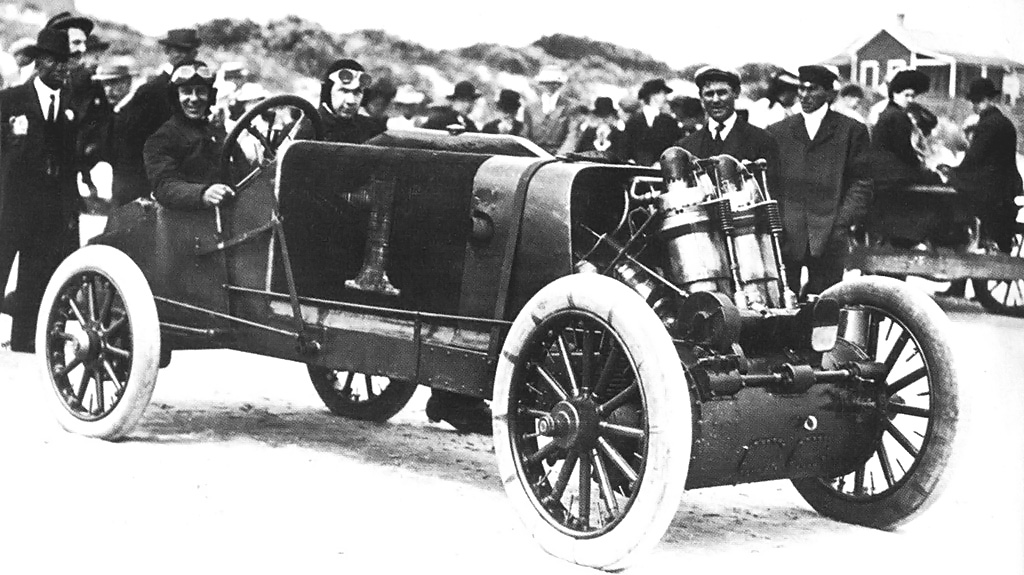
Ned Blakely sits behind the wheel of the Christie racer at Ormond Beach, Florida in March 1908. Although Christie made a 109 mph (175 km/h) test run, the car did not finishing any official race.

The V-4 racer was repaired, and Christie and Strang took the car to Birmingham, Alabama. Christie was still recovering from his injuries and did not drive much. The next stop was New Orleans, Louisiana, but the meet was delayed. Christie made arrangements to send the car back to New York and returned there himself. However, the car never arrived. Subsequently, Christie discovered that Strang had taken the car back to Birmingham, Alabama were he set a record on 16 October, lapping the mile track in 51.6 seconds (69.8 mph / 112.3 km/h). Strang also ran the V-4 racer at a few other events.

This unauthorized use of his car deeply upset Christie, and it was the end of his association with Strang. Some of Strang’s behavior can be attributed to the negative influence of his and Christie’s manager, William Pickens. To make matters worse, before Christie knew the car was missing, he had sold it to William Gould Brokaw. The arrangement allowed Christie to continue to drive the 1907 V-4 racer so long as he kept it in good repair. When Christie finally tracked down the missing racer and had it returned to his shop in New York, the engine had a cracked cylinder and other damage.

Christie 1907 V-4 late

An undated photo illustrating the many changes made to the 1907 V-4 racer. The cross shaft on the front of the crankcase and the engine cowling have been completely removed. A more conventional radiator has been installed along with new exhaust stacks. A much smaller fuel tank (just in front of the radiator) has replaced the original tank. Note the twin front tires on the right drive wheel. Race promoter Ernest Moross is behind the wheel.

Repairs (which included a new crankcase) were made, and Ned Blakely was tasked with racing the car at Ormond Beach, Florida in March 1908. Unfortunately, in a 100 mi (161 km) race on the first day of the event, a valve broke and took the car out of the race. Repairs were completed, but during a 256 mile (412 km) race on the third day, a spark plug broke off and damaged a cylinder, ending the racer’s participation at the event. Sometime during this event, Christie covered a mile in 33 seconds (109.1 mph / 175.5 km/h) on a test run, but it was not officially timed.

The car was again repaired. In early June, Morton J. Seymour was behind the wheel of the racer practicing for an event on Long Island, New York when he crashed and most likely overturned the car. The radiator was destroyed, but Christie managed to repair the car enough to run without cooling water for an attempt on the 1 km (.62 mi) record. Seymour covered the km in 26.6 seconds (84.1 mph / 135.3 km/h)—not fast enough for a new record.

Christie 1907 V-4 late track

Another view of the modified 1907 racer. The car still has the twin right drive wheels. Christie is in the driver’s seat. Note how the steering column passes through the radiator.

The racer was repaired yet again and further modified. A new (more conventional) radiator was installed. A small fuel tank was installed in front of the radiator, and the large, rear tank was removed. The low and reverse gears and the engine cowling were completely removed. Seymour and Christie went on to drive the car at a few events. After this, Christie and his good friend Barney Oldfield toured the country and made many appearances at various tracks.

At some point, after the new radiator, the V-4 racer had twin front right wheels installed to help the front-wheel drive vehicle on the circle tracks. It is not clear how often the car ran in this configuration. In December 1908, the racer was running at Tanforan Park near San Francisco, California, but a cracked cylinder took it and its driver Hughie Hughes out of competition. In January 1909, Hughes crashed the car at a race in Phoenix, Arizona, and that was the last known event for Christie’s 1907 V-4 racer; the car’s final disposition is not known. By this time, the Christie Direct Action Motor Car Company had fallen into receivership. Undaunted, Christie had established the Walter Christie Automobile Company in September 1908 and went to work on another V-4 racer.

Note: Some sources state that Blakely ran a 35 second mile in the 1907 V-4 racer at “a beach near Atlantic City” prior to March 1908. However, I was unable to find specifics to this event and feel it may have been confused with the 35.2 second run Christie made at Ventnor Beach, which is near Atlantic City, in 1905.

Christie 1907 V-4 DePalma Clark

A photo from the 1908 Minnesota State Fair with Christie, DePalma, and Clark. The fair was held in St. Paul from 31 August to 5 September. Note that the Christie racer has only one front right drive wheel.

Sources:
– “The Front-Wheel-Drives of John Walter Christie, Inventor” by Stan Grayson Automobile Quarterly Volume 14, Number 3 (1976)
– “America’s Candidate for the Grand Prix” by W. F. Bradley The Automobile (11 April 1907)
– “Grand Prix Failures 6. The 1907 Grand Prix Christie” The Bulletin of the Vintage Sports-Car Club No. 281 (Autumn 2013)
– “Christie Racer for the Grand Prix” The Automobile (21 February 1907)
– “The Grand Prix” The Automobile (11 April 1907)
– “Christie Racer is Being Tried Out” The Automobile (2 May 1907)
– “Florida’s Meet Supplied More Records than Races” by John C. Wetmore The Automobile (12 March 1908)
– “Christie’s New 100-Horsepower Racer” The Automobile (5 August 1909)
http://www.stohrdesign.com/christie-automobiles-1903-1909-a-blog (various pages)
http://blog.hemmings.com/index.php/2010/05/31/how-strang-met-his-death/
http://www.findagrave.com/cgi-bin/fg.cgi?page=gr&GRid=112329874
http://hclib.tumblr.com/post/9466387511/auto-racing-at-the-minnesota-state-fair-1908

Christie 1906 V-4 Strang Vanderbilt

Christie V-4 Engine 1906 Racer

By William Pearce

In the early 1900s, John Walter Christie built a series of front-wheel drive automobiles; each had its inline, four-cylinder engine mounted transversely between the front wheels. The engine’s crankcase also served as the vehicle’s axle. With only so much room between the wheels, the bore of the engine’s cylinders was limited, and Christie found that other cars were producing more power and outperforming his. In late 1905, Christie devised a way to increase the capacity and power of his engines by using a V-4 configuration.

Christie 1906 V-4 wheel Ormond Beach

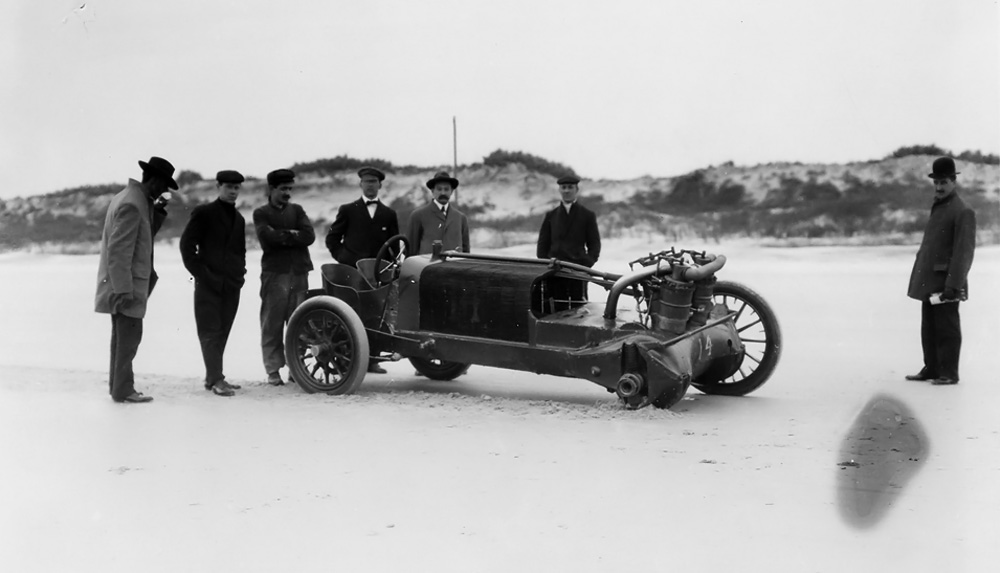
J. Walter Christie’s 1906 racer after hitting debris on Ormond Beach, Florida in January 1906. Note the exhaust manifolds on the front of the engine, the original cylinder water jackets, and the lack of a radiator header tank. The induction pipe can be seen behind the engine.

After the Vanderbilt Cup race in October 1905, Christie took his 1905 racer, with the 828 cu in (13.6 L), 70 hp (52 kW) inline engine, and modified it with a new V-4 engine. Essentially, the axle of the 1905 racer was reworked to accommodate four individual cylinders. The car maintained its normal (high-speed) gear and low forward and reverse gears. The drive wheels were coupled to the crankshaft, and wheel slip was limited in the normal gear. For low gear and reverse gear, a five to one reduction was employed, and the drive wheels were allowed to slip relative to one another. The individual cylinders were arranged in two rows and were staggered to keep the engine compact. The cylinders were mounted to the top of the axle, and the angle between the rows was around 22.5 degrees.

The carburetor was placed low and behind the engine. The air/fuel mixture traveled from the carburetor and through a large pipe to the top center of the engine. Attached to the end of the pipe was an intake manifold with four outlets to provide the incoming air charge to each cylinder. The air/fuel mixture flowed into each cylinder though a single intake port that led to a chamber ringed around the outer cylinder head. In this ring were eight 1.5 in (38 mm) atmospheric (automatic) intake valves. A single spark plug was positioned below the inlet valve chamber ring.

Christie 1906 V-4 push Ventnor Beach

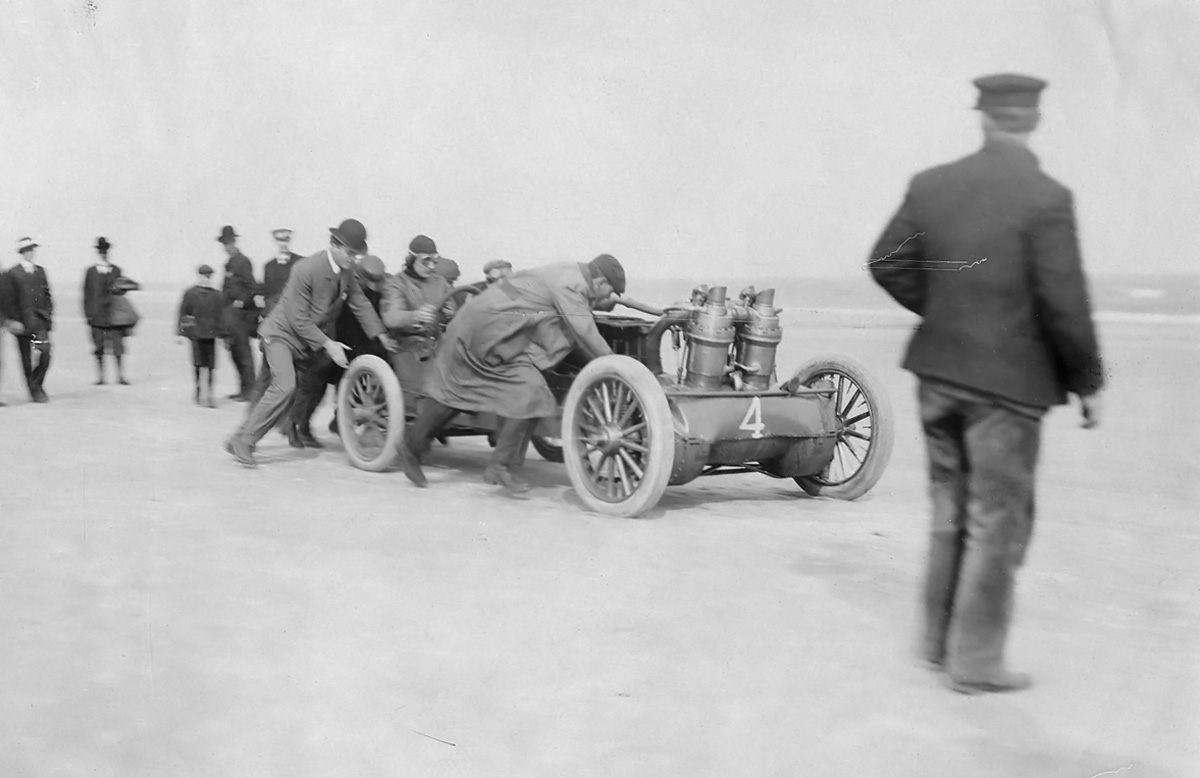
Christie behind the wheel of his racer at Ventnor Beach, New Jersey in April 1906 . The car had been modified with short exhaust stacks, redesigned cylinder water jackets, and a header tank above the radiator. It was here that Christie set a four-cylinder automobile speed record by covering a mile in 35.2 seconds (102.3 mph / 164.6 km/h).

At the center of the induction ring but separate from it was a single 3.125 in (79 mm) mechanically operated exhaust valve. The exhaust valve was controlled by a rocker arm actuated by a pushrod. The pushrods were driven from a camshaft situated behind the second row of cylinders. Originally, the exhaust valve was enclosed in a housing that had an exhaust port on its side. Each cylinder had its own exhaust manifold attached to the port; this configuration was replaced by a short exhaust stack that extended from the top of the cylinder.

The steel cylinders were originally surrounded by electrolytic (oxygen-free) formed copper water jackets. However, these jackets were prone to leaking and were replaced by jackets made of sheet metal. Water from the radiator entered the water jacket of each cylinder near its bottom. The water flowed out the top of each cylinder and into a common manifold that delivered it back to the radiator/header tank. The radiator was the same originally used with the inline engine in which copper tubes 5/16 in (8 mm) in diameter and 64 in (1.63 m) long were bent into an inverted “U” shape, extending from one side of the vehicle to the other. A header tank was later added above the middle of the radiator. Later still, the header tank was integrated into the middle of the radiator.

Christie 1906 V-4 push Empire

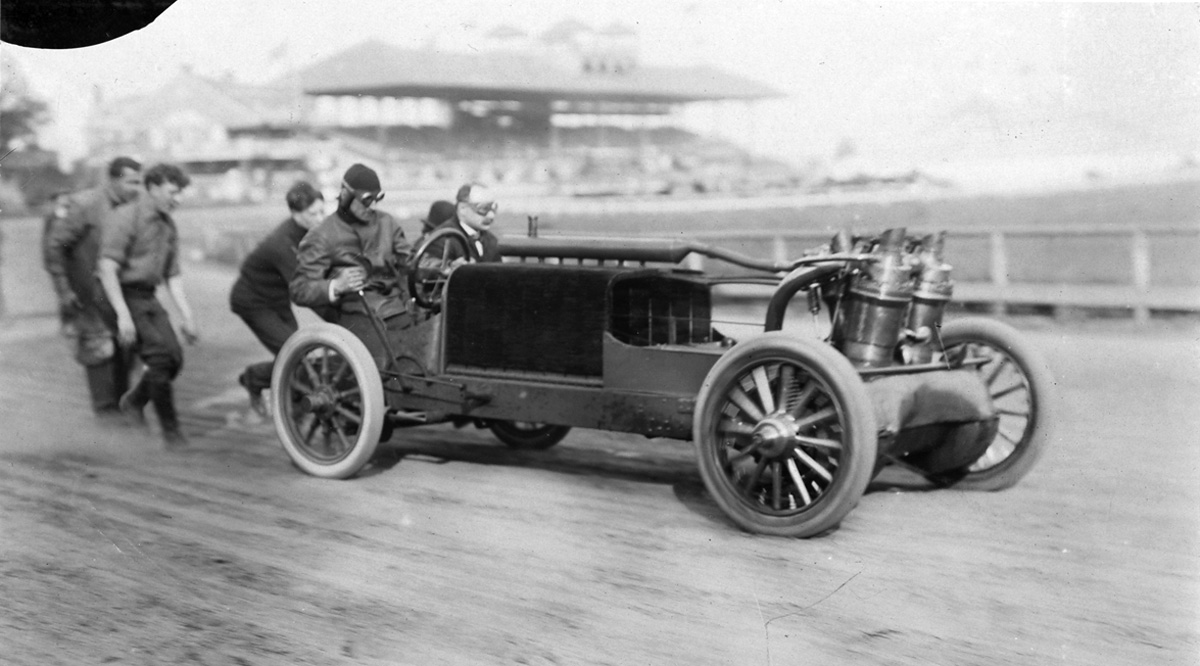
Lewis Strang push starting Christie in the 1906 V-4 racer at the Empire City Race Track in May 1906. On this track, Christie tied the then-current mile-track record of Barney Oldfield at 53 seconds (67.9 mph / 109.3 km/h). The racer is shown with an eight section radiator.

Sources disagree on the engine’s size, the engine’s power, and the car’s weight. Some sources list the engine as having a 7.375 in (187 mm) bore and stroke and a total displacement of 1,260 cu in (20.7 L). Other sources give a 7.5 in (191 mm) bore, a 7.0 in (178 mm) stroke, and 1,237 cu in (20.3 L) total displacement. The engine’s output varies by source between 100 to 135 hp (75 to 97 kW), but 100 hp (75 kW) is probably close to the correct figure. The car’s reported weight varies between 1,800 and 2,150 lb (816 to 975 kg). The crankshaft was 2.75 in (70 mm) in diameter and made of chrome steal. It was most likely a two-throw crankshaft supported by three main bearings. This would mean two connecting rods were attached side-by-side to one crankpin. The engine is said to have weighed 470 lb (213 kg).

Christie’s V-4 racer made its debut at Ormond Beach (north of Daytona Beach), Florida in January 1906. The car was numbered 14 for this event and experienced several issues. The right front wheel broke off after the racer struck some debris on the beach during a practice run. The car was repaired, but the copper water jackets leaked, and the car had engine cooling issues. Christie had to stop and refill the radiator with four miles left in the 30 mile race. Christie went on to finish the race in 37 minutes and 24.6 seconds, averaging 48.1 mph (77.4 km/h).

The car’s next appearance was in April at Ventnor Beach, near Atlantic City, New Jersey. The racer was now numbered 4 and was modified with new cylinder water jackets, open exhaust stacks, and the header tank above the radiator. Christie covered a mile in 35.2 seconds at 102.3 mph (164.6 km/h), making the racer the fastest four-cylinder automobile in the world. In May, Christie lapped the mile track at Empire City (Yonkers, New York) in 53 seconds (67.9 mph / 109.3 km/h). This speed tied the mile-track record held by Barney Oldfield.

Christie 1906 V-4 Strang Vanderbilt

Christie (at the wheel) and Strang ready for the Vanderbilt Cup race. Note the new header tank and the ten section radiator. Also visible are the springs on the pushrods that held the exhaust valves closed.

By September 1906, Christie had readied his V-4 racer for the Vanderbilt Cup. The car now had the integrated header tank installed, and the radiator had ten sections rather than the eight sections used earlier. George Robertson was to drive the car for the Vanderbilt Cup, but he crashed it during a qualifying run on September 15. The damage was not too severe, and Christie made the repairs that night. However, Christie did not notice that the steering arm had been cracked in the accident.

On the morning of 16 September, Christie and his riding mechanic (and nephew) Lewis Strang took the car out for a test run. As the car quickly gained speed, the steering arm failed and Christie lost control of the racer. The car smashed into a telegraph pole and was too damaged to be repaired. Fortunately, Christie and Strang were not injured. The pair went on to race in the 1906 Vanderbilt Cup in a converted touring car that the Christie Direct Action Motor Car Company had built. After the race, Christie went to work on his next racer; he had already set his sights on putting his front-wheel drive cars on the international stage.

Christie 1906 V-4 crash Vanderbilt

The destroyed Christie 1906 V-4 racer after the steering arm broke on 16 September. Note how the steering wheel was broken in the accident. Fortunately, Christie and Strang were not injured.

Sources:
– “The Front-Wheel-Drives of John Walter Christie, Inventor” by Stan Grayson Automobile Quarterly Volume 14, Number 3 (1976)
– “The Reconstructed Christie racer and Its Record at the Automobile Carnival” Scientific American (9 June 1906)
– “Record-Holding Racers at the Ormond Automobile Meet” Scientific American (10 February 1906)
– “Now for the Selection of the American Cup Team” The Motor Way (20 September 1906)
– “Christie’s New 100-Horsepower Racer” The Automobile (5 August 1909)
http://www.stohrdesign.com/christie-automobiles-1903-1909-a-blog (various pages)
http://www.vanderbiltcupraces.com (various pages)

Christie 1905 racer and Robertson

Christie Inline Engine Race Cars

By William Pearce

John Walter Christie was born in New Milford, New Jersey on 6 May 1865. From 1881 to 1900 (age 16 to 25), he worked in and was a consultant for various engineering firms. During this time, he designed a new style of gun turret for Navy ships. This design proved lucrative, and in 1900, Christie opened his own machine shop, Walter Christie Machinery, in New York City, New York. He opened the Christie Iron Works the very next year in 1901. As the dawn of the automotive age shone on the United States, the successful Christie was able to own an automobile, but the engineer in him could not help but see ways to improve its design.

Christie 1903 Auto side

J. Walter Christie in his 1903 front-wheel drive auto, the first built in the United States. Just visible behind the rear wheel is the radiator. Christie took this car to Ormond Beach, Florida in January 1904.

By late 1903, Christie had built his own automobile, and it was unlike any other. He designed not only the car but also its engine and transmission. Christie felt that an automobile drive system should pull the vehicle (like a train or carriage), not push it (like a boat). As a result, Christie focused on a front-wheel drive system in which the engine was situated transversely between the front wheels. He believed this arrangement would create a light, simple, high-speed auto. Christie’s first vehicle design closely followed a patent that he took out in 1904. Christie’s front-wheel drive car was the first of its kind built in the United States.

The front axle of Christie’s auto was also the engine’s crankcase and housed its transmission. The cylinder block was mounted atop the axle housing. The auto had a low gear and a reverse gear; both provided a five to one reduction and enabled the drive wheels to slip relative to one another. For normal (high-speed) operation, the drive wheels were coupled to the crankshaft and wheel slip was limited. Each drive wheel had a clutch to facilitate the gear change. In addition, each drive wheel had two universal joints, and shafts that allowed for steering and independent coil spring suspension. The rear axle used leaf spring suspension.

Christie 1904 patent drive

A drawing from Christie’s 1904 patent illustrating the front-wheel drive system’s drive shafts, universal joints, and coil spring suspension. Note the offset X-beams of the connecting rods.

The 1903 car originally accommodated a driver and passenger (or mechanic, which for Christie was often his nephew Lewis Strang), but it was later fitted with a second row of seats for three passengers. The car only had rear brakes, and they were operated by a hand lever or a foot pedal. The auto weighted about 1,400 lb (635 kg). The engine for the 1903 car is believed to have had a 5.0 in (127 mm) bore and a 6.0 in (152 mm) stroke. It displaced 471 cu in (7.7 L) and produced around 30 hp (22 kW). The connecting rods were of the X-beam type. The X-beam was offset relative to the crankpin to allow for a shorter crankshaft and to provide clearance for the crankshaft’s three main bearings. A handle for crank-starting the engine protruded from the front of the axle, but the car was typically push started.

The engine had an intake over exhaust (F-head) valve arrangement. A set of four intake valves with a small combustion chamber space beneath them was positioned adjacent to the cylinder. The intake valves were atmospheric (or automatic): they were held closed by a weak spring and pulled open by the vacuum created during the piston’s downward stroke. A single, large exhaust valve was situated under the intake valves. The exhaust valves were mechanically operated. They were actuated by pushrods driven by a camshaft geared to the engine’s crankshaft. Each cylinder had a single spark plug positioned in the combustion chamber space between the exhaust valve and intake valves. The spark plugs were fired by a communicator (distributor) driven from an auxiliary shaft.

Christie 1903 Auto front

The 606 cu in (9.9 L), 30 hp (22 kW) engine of the 1903 Christie car. The spark plugs are in the center of the combustion chamber space adjacent to the cylinders. A set of four intake valves are above each spark plug, with a single exhaust valve below. Note the exhaust manifold. The hand crank on the front of the car was used to start the engine.

For induction, the air/fuel mixture flowed from a remote carburetor and through a long intake pipe to the engine. The intake manifold sat atop the engine and was split into four runners. Each runner connected to one group of four intake valves

The engine’s cylinders were covered by water jackets formed from sheet copper and screwed to the cylinder block. A remote water pump drew cooling water from the radiator and sent it to the engine. After flowing through the engine, the cooling water was taken from the top of the engine and sent to the radiator. The radiator was positioned under the rear of the car for better weight distribution. The water pump was driven from the same shaft that drove the ignition system’s communicator.

Christie 1904 racer

Christie’s 1904 racer with its unusual radiator and eight-intake-valves-per-cylinder engine. Christie sits in the driver’s seat.

Christie took the 1903 car to Ormond Beach, Florida (just north of Daytona Beach) in January 1904. In his car, Christie averaged 63.1 mph (101.5 km/h) in a 10 mile (16 km) race and completed a 25 mile (40 km) endurance race. However, the engine did experience some issues from lack of lubrication. Christie continued to campaign this car at a few events, but he also built a larger car more dedicated to racing in 1904.

Christie’s 1904 racer used an engine of similar configuration to the 1903 engine. However, each cylinder had two sets of intake valves, for a total of eight per cylinder. The new set of four intake valves was positioned directly above the piston. Each of the four intake runners that sat atop the engine had two outlets, one for each set of four valves. The engine’s bore and stroke were 6.25 in (159 mm) and 6.75 in (171 mm) respectively. The engine had a total displacement of 828 cu in (13.6 L) and produced 70 hp (52 kW). Its crankshaft and pistons were made of carbon steel, and its crankcase and flywheels were made of a manganese bronze alloy. The spark plugs were fired from a battery powered coil ignition.

Christie 1904 racer engine

A close up of the engine in the 1904 Christie racer. Note the springs for the mechanical exhaust valves, the lack of an exhaust manifold, and the outlet for the sheet copper water jacket.

In the 1904 car, the driver and passenger were moved to the extreme rear of the vehicle for better weight distribution. In addition, the fuel tank was situated under the seat. A new radiator was installed in the middle of the auto. It consisted of around 60 long, copper tubes shaped in an inverted “U” extending from one side of the car to the other. The radiator was positioned so that air passed over it rather than through it; this configuration limited its effectiveness. No information regarding where or if the 1904 car was raced has been found. Some believe that it was a modification of the 1903 car, but it was not; the engine, axle, and frame were all different.

Christie continued to develop his concept of the front-wheel drive racer and built another car toward the end of 1904. The car, sometimes referred to as the Blue Flyer, made its debut at Ormond Beach in January 1905. It was very similar to the 1904 racer but had a new frame and axle. The car was powered by the same 70 hp, 36-valve (four being exhaust), four-cylinder engine used in the 1904 car. However, its orientation had been changed so that the exhaust valves were toward the rear of the vehicle.

Christie 1905 racer engine

The engine of the 1905 Christie racer was the same used in the 1904 racer; it was repositioned so that the exhaust valves faced toward the rear of the vehicle. The protuberance on the front of the engine was the water jacket outlet used on the 1904 car. The two sets of four valves for one cylinder are visible in the right image.

A new radiator was developed consisting of 12 sections (although photos seem to indicate only eight sections). Each of the sections was made up of eight copper tubes that were 5/16 in (8 mm) in diameter and 64 in (1.63 m) long. Attached to each section were 340 aluminum fins that were 5 in (127 mm) long and 1 in (25 mm) wide. Reportedly, this gave the radiator a surface area of some 20,000 sq in (12.9 sq m), but as with the earlier radiator, air flowed over its surface. Cooling water was taken from the water jacket between the cylinders and delivered to an expansion tank in front of the radiator. The water then flowed through the radiator and into the bottom of the water jacket on both sides of the engine. The 1905 racer had a 96 in (2.44 m) wheel base, a 57.5 in (1.46 m) track, and weighed 1,800 lb (816 kg).

For each revolution of its 40 in (1 m) wheels, the car travel 10 feet (3 m) forward. Given the car’s direct drive, 90 mph (145 km/h) would be achieved at 792 rpm. Christie raced the car on Ormond Beach in January 1905 and covered a mile in 42.2 seconds (85.3 mph / 137.3 km/h). Christie went on to win a 50 mile (80 km) race and received the Lozier Trophy. However, his was the only car to finish the race. Regardless, people were impressed by Christie and his automobiles. Based on the interest in his vehicles, Christie formed the Christie Direct Action Motor Car Company in March 1905 to manufacture passenger and race cars.

Christie 1905 twin engine racer

This image shows Christie’s 1905 racer modified with a second engine. The rear engine appears to be identical to the engine used in the 1903 car. The radiator appears to have eight sections.

In search of more power, Christie installed a second engine in the 1905 car. The car was lengthened, and the second engine was installed behind the driver and passenger. The second engine produced around 30 hp and powered the rear wheels. The engine appears to be the same four intake and one exhaust valve engine used in the 1903 car (and used in the 1906 car described below). The two engines provided a total of around 100 hp (75 kW). The twin-engined car made its debut on 4 July at Morris Park, New York. The car proved to be a handful but went on to run at Cape May, New Jersey in July, where it covered a mile in 37.0 seconds (97.3 mph / 156.6 km/h). In August, Christie ran a km in 25 seconds (89.5 mph / 144.0 km/h). In September, that flying km time was lowered to 23.25 seconds (96.2 mph / 154.8 km/h), for which Christie won the Cape May Trophy. Later in September, the rear engine was removed from the racer after it failed while Christie was attempting a new mile record. (It appears two additional radiator sections were added at this time, bringing the total to 10.)

Christie then set his sights on the Vanderbilt Cup race scheduled for 14 October in Long Island, New York. George Robertson was selected to drive the car in the race, but he was not familiar with the peculiarities of the car and its front-wheel drive. Robertson had trouble during qualifications on 23 September and ultimately crashed the car. The needed repairs took too long, and Christie’s car was out. However, the Cup Commission made a bizarre decision that is still not understood. Three qualified cars were removed from the race, and three cars that did not qualify were reinstated; Christie’s racer was one of the three reinstated cars.

Christie 1905 racer and Robertson

Christie and George Robertson sit in the 1905 racer ready for a Vanderbilt Cup practice run . The rear engine has been removed, and the radiator now has 10 sections. Robertson crashed the car a short time later.

Christie worked feverishly, almost up to the start of the race, to completely repair his racer, which had suffered some engine damage. Christie drove his car in the race due to Robertson’s inexperience with the unique racer. At the start, Christie’s 1905 racer ran poorly and completed the first lap at only 29.2 mph (47.0 km/h). The engine then smoothed out, and the second lap passed at 56.0 mph (90.1 km/h). On the fourth lap, Italian driver, and race leader, Vincenso Lancia left the pits right as Christie was speeding by. Christie tried unsuccessfully to avoid a collision. Both drivers and their mechanics escaped with only minor injuries. Christie’s car was damaged beyond repair, and the time needed to repair Lancia’s car effectively took him out of contention.

Christie rebuilt the 1905 racer with a new V-4 engine. The car made its debut in January 1906. Unfortunately, it crashed on 16 September during qualification for the 1906 running of the Vanderbilt Cup. Christie quickly took stock of his resources to find a new car for the races held on 6 October.

Christie 1906 touring car

The Christie Direct Action Motor Car Company’s 1906 touring car. This car was stripped of its body and modified to race in the 1906 Vanderbilt Cup. Note the stripe painted on the axle.

The Christie Direct Action Motor Car Company had just completed a seven-passenger touring car. With no other car available, it was the only option for the race. Christie quickly returned to his New York shop and removed the touring car’s blue painted body and black leather seats. A new body was fabricated with the seats over the rear axle. The steering was redone and the steering shaft extended. Other efforts were made to lighten the 2,300 lb (1,043 kg) touring car.

The touring car’s radiator was removed and a new one installed. The new radiator was similar to those used in the previous Christie cars but had a header tank at its center. The engine of the touring car was very similar to the original Christie F-head engine from 1903 and to the engine used in the rear of the 1905 car—all had four atmospheric intake valves and one mechanical exhaust valve. It is possible that these three engines were actually the same engine. However, the bore and stroke of the touring car’s engine was increased from the 1903 engine by .375 in (10 mm) and 1.0 in (25 mm) respectively. The touring car’s engine had a 5.375 in (137 mm) bore and a 7.0 in (178 mm) stroke. The engine produced 50 hp (37 kW) at 1,200 rpm from its 635 cu in (10.4 L). The car had a 102 in (2.59 m) wheel base and a 56 in (1.42 m) track. In race trim, the touring car’s weight was dropped to 1,895 lb (860 kg) race-ready.

Christie 1906 Vanderbilt start

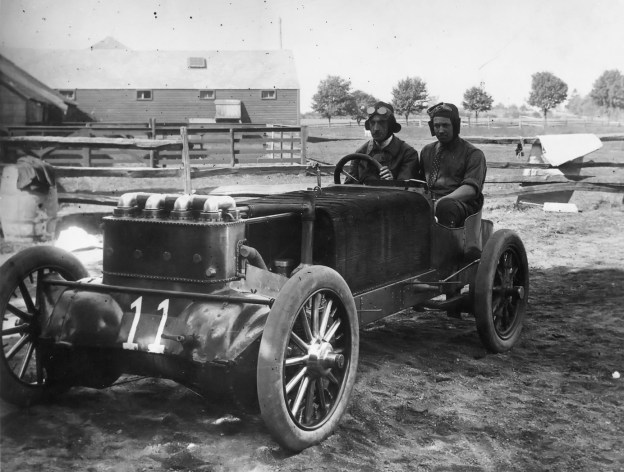
Christie and his nephew Lewis Strang sit in the race-ready touring car stripped for the 1906 Vanderbilt Cup race. This image was taken at the start of an elimination trial. The stripe on the axle noted in the previous image is just visible.

At less than half the power of most of the other cars in the Vanderbilt Cup, Christie did not stand much of a chance. After running for a while in seventh place, Christie had slipped back to 13th place out of the 18 competitors, averaging 44.7 mph (71.9 km/h) when the race was called. Even so, Christie had shown that his front-wheel drive cars were as reliable and competitive as those of other manufacturers that used a conventional powertrain. After the race, Christie refocused on his V-4 racers.

Christie’s 1906 touring-car-turned-racer was eventually sold to William Gould Brokaw. The car reappeared in March 1908 at Ormond Beach, Florida and was driven by R. G. Kelsey. The racer failed to finish a 125 mile (201 km) race but placed second and averaged 62.4 mph (100.4 km/h) in a 256 mile (412 km) race held two days later. Also, Kelsey covered a mile in 42.8 seconds (84.1 mph / 135.3 km/h). The further activities and ultimate disposition of the racer is unknown.

Christie 1906 Vanderbilt

Christie and Strang taking a turn during the 1906 Vanderbilt Cup race. Although the bore had been increased, the engine could very well be the same as the original 1903 engine.

Sources:
– “The Front-Wheel-Drives of John Walter Christie, Inventor” by Stan Grayson Automobile Quarterly Volume 14, Number 3 (1976)
– “Motor-Vehicle” US patent 761,657 by Walter Christie (granted 7 June 1904) 2.7 MB pdf
– “A New American Automobile” Scientific American (28 January 1905)
– “The First Christie Front Drive Touring Car” The Automobile (13 September 1906)
– “Now for the Selection of the American Cup Team” The Motor Way (20 September 1906)
– “Christie’s New 100-Horsepower Racer” The Automobile (5 August 1909)
– “Florida’s Meet Supplied More Records than Races” by John C. Wetmore The Automobile (12 March 1908)
http://www.stohrdesign.com/christie-automobiles-1903-1909-a-blog (various pages)
http://www.vanderbiltcupraces.com (various pages)

Alkett VsKfz 617 NK-101 Kubinka front

Alkett VsKfz 617 / NK-101 Minenräumer

By William Pearce

Safely clearing land mines has been a challenge vexing militaries since shortly after the devices’ first widespread use in World War I. Methods to clear land mines have included heavy rollers or flailing chains positioned in front of vehicles and designed to detonate the mines without it damaging the vehicle. In the midst of World War II, the German firms Alkett, Krupp, and Daimler-Benz designed a new vehicle to detonate land mines and clear a path for men and machines to follow.

Alkett VsKfz 617 NK-101 Kubinka front

The strange looking Alkett VsKfz 617 (NK-101), preserved at the Kubinka Tank Museum. Note the small slit in the armor for the driver’s view. The small structure in front of the driver’s window was a position indicator for the rear wheel.  (Kubinka Tank Museum image)

Built in the Alkett factory near Berlin, the VsKfz 617 Minenräumer was heavily armored and designed to detonate mines by simply rolling over them. (VsKfz is short for Versuchs Kraftfahrzeug, meaning “test vehicle.”) The three-wheeled vehicle’s wide track was designed to clear a mine-free path for other vehicles to safely travel. The sole prototype carried the Alkett chassis number of 9537 and was registered as NK-101. Unfortunately, much solid information on this vehicle has been lost to history.

The Alkett VsKfz 617 had two large main power wheels at its front. A smaller, caster-style rear wheel was used for turning. Via power take offs and clutches, turning the steering wheel engaged worm shafts on both sides of the hull. The worm shafts operated in opposite directions—one side drew in a chain while the other slackened a separate chain. The chains extended through the VsKfz 617’s hull and were connected to each side of the rear wheel, rotating it as the driver turned the steering wheel. There is no indication that any differential steering was available.

Alkett VsKfz 617 NK-101 side

The rear wheel of the VsKfz 617 digging into the ground can be seen in this image. Note the large shoes of the main wheel.

Each wheel was made up of 10 links and 10 thick, heavy, solid shoes. The pin that connected two links also attached a shoe. Three of the shoes would come together on the ground for each wheel. The total of nine shoes gave the VsKfz 617 ample ground contact. The thick shoes were also resistant to damage from mine blasts. Damaged individual shoes and links could be easily replaced.

The VsKfz 617’s transmission was positioned in middle of the vehicle. A shaft led from each side of the transmission and engaged the gearing for the main wheels. A Maybach HL-120 V-12 engine was situated transversely behind the transmission. This gasoline engine produced 300 hp (224 kW) from its 4.13 in (105 mm) bore and 4.53 (115 mm) stroke cylinders. Its total displacement was 729 cu in (11.9 L). Two radiators were positioned behind the engine. Cooling air was brought in from ducts on the upper middle of the VsKfz 617 and expelled through vents on its upper rear. A 190 gallon (720 L) fuel tank was positioned above the rear wheel.

Alkett VsKfz 617 NK-101 front

This poor quality image of the VsKfz 617 still conveys the vehicle’s rather imposing appearance. Only one machine gun is in the turret, which is how it was found by Russian forces.

The VsKfz 617’s hull had about 39 in (1 m) of ground clearance that helped protect the crew from mine detonations. Furthermore, the bottom of the vehicle’s hull consisted of 1.58 in (40 mm) thick armor plating, with an additional 0.79 in (20 mm) of armor sheeting inside—creating a double hull. The rest of the vehicle’s hull thickness varied from 0.39 to 1.58 in (10 to 40 mm).

For defensive armament, the VsKfz 617 prototype had a Panzer I turret with two 7.92 mm MG 34 machine guns. However, the production version would have a Panzer II turret with a single 20 mm KwK 30 L/55 cannon and one MG 34 machine gun. The driver occupied the left side of the vehicle and saw out via a small slit in the upper armor. A rear wheel position indicator was just in front of the driver’s view. The vehicle’s commander was on the right, operating the turret. The VsKfz 617 was 20.6 ft (6.28 m) long, 10.6 ft (3.22 m) wide, and 9.5 ft (2.90 m) tall. It weighed 55 tons (50 tonne).

Alkett VsKfz 617 NK-101

This view of the VsKfz 617 displays its unique side profile.

Testing of the VsKfz 617 started as soon as it was completed in 1942. It was quickly found that the VsKfz 617’s method for steering was unsatisfactory and that the vehicle was slow and hard to handle. To make matters worse, its immense weight caused the vehicle to easily get bogged down. The VsKfz 617 and plans for its manufacture were abandoned after the tests.

The sole VsKfz 617 was captured by the Russians in late World War II, possibly in April 1945. The vehicle was inspected and tested in Kubinka near Moscow in early 1947. The Russians came to the same conclusions as the Germans regarding the VsKfz 617’s use, also finding that its slow speed and lack of maneuverability would make it an easy target for artillery. The VsKfz 617 was preserved and is currently on display in the Kubinka Tank Museum.

Alkett VsKfz 617 NK-101 Kubinka rear

The Alkett VsKfz 617 (NK-101) Minenräumer on display in the German pavilion of the Kubinka Tank Museum. Note the steering chain passing through the hull. The scoops on the top of the vehicle are the cooling air exits from the radiators. (Kubinka Tank Museum image)

Sources:
http://ww2history.ru/3909-nemeckijj-minnyjj-tral-minenraumer.-nemeckie.html
http://www.rumaniamilitary.ro/enciclopedia-armelor-roboti-terestrii-in-ww-ii-2
http://www.taringa.net/posts/apuntes-y-monografias/14137217/Vehiculos-extranos-2gm-Kfz-617-MINENR-UMER.html
http://strangevehicles.greyfalcon.us/Alkett.htm
http://www.tankmuseumkubinka.com/?cat=3

Jenkins Mormon Meteor III restored

Jenkins Mormon Meteor III

By William Pearce

Ab (David Abbott) Jenkins was a devout Mormon who did not drink or smoke. He was interested in pushing endurance records beyond what his Mormon Meteor II racer could achieve. The Duesenberg J chassis of the Mormon Meteor II simply could not handle its heavy, 750 hp (559 kW) Curtiss Conqueror V-12 aircraft engine. In 1937, Jenkins commissioned Augie Duesenberg to design a new car able to accommodate the 1,570 cu in (25.7 L) Curtiss Conqueror or an Allison V-1710 engine. The new endurance racer was known as the Mormon Meteor III.

jenkins mormon meteor iii indy in

The newly completed Mormon Meteor III at the Indianapolis Motor Speedway in 1938. Note the original exhaust manifold that was later replaced by individual stacks.

The Mormon Meteor III was built in Augie Duesenberg’s shop in Indianapolis, Indiana. Jenkins wanted the car to be able to accommodate both of his Curtiss Conqueror engines, one powering each axle. However, the initial build would be with just one engine powering the rear axle. The Mormon Meteor III was a large vehicle and designed specifically for endurance record runs. The chassis was offset 6 in (152 mm) to the left on the running gear to aid in the constant turn encountered on the 10 and 12 mi (16 and 19 km) circular record courses.

The Mormon Meteor III was an evolution of the Mormon Meteor II. The car was nearly 21 ft (6.4 m) long and had a streamlined, narrow body with an enclosed cockpit. A tall fin was incorporated behind the cockpit, and two fuel tanks were positioned above the rear axle. Power was delivered from the Conqueror engine to the rear wheels via a three-speed transmission. At speed, the 112 gal (424 L) of fuel the Mormon Meteor III carried would be nearly exhausted in around two hours after traveling 400 miles (644 km). Four headlights to provide ample illumination of the track during the night hours were faired into the sloped radiators. The Mormon Meteor III had independent front suspension and specially made Firestone tires mounted on 22 in (.56 m) wheels. The car weighed 4,800 lb (2,177 kg). Marvin Jenkins, Ab’s son, assisted with the build.

Jenkins Mormon Meteor III loading

The Mormon Meteor III being rolled out of Augie Duesenberg’s shop to be taken to the Speedway for testing. The canopy has not been installed, and the truck it is being loaded onto is still painted “Mormon Meteor II.” (V. J. Horvath image via www.AutoGiftGarage.com)

The Mormon Meteor III was finished in 1938 and tested at the Indianapolis Motor Speedway. The car was painted orange and blue: the colors of the Firestone Tire & Rubber Company, its primary sponsor. The racer made its debut at the Bonneville Salt Flats in July 1939. The conditions at Bonneville were not the best, but Jenkins and the Mormon Meteor III set a 1,000 km (638 mi) record, averaging 171.30 mph (275.68 km/h). Jenkins intended to run the car longer but a fire changed his plans. The fire started when fuel leaked out of an overfilled tank and came in contact with an overheating universal joint. Marvin had to pry the canopy open in order to free Ab. Jenkins had suffered minor burns and was taken to the hospital. A few weeks later Jenkins was back and, with relief driver Rex Mays, set a 12 hour record covering some 2,040 mi (3,283 km) at 169.99 mph (273.57 km/h). Racing was halted due to a cracked exhaust manifold that allowed fumes to enter the cockpit.

The Mormon Meteor III was back on the Bonneville Salt Flats in August 1940. Marvin Jenkins was too young to race the car, but he was able to extensively test the Mormon Meteor III to make sure all was in order. Marvin drove the car for over 2,000 mi (3,200 km) in the course of his testing.

Jenkins Mormon Meteor III top

The Mormon Meteor III’s narrow body and its 6 in (152 mm) left offset are visible in this image.

At 57 years old, Jenkins climbed back in the Mormon Meteor III to again challenge endurance records. With relief driver Cliff Bergere, Jenkins and the Mormon Meteor III set some 21 speed records for just about everything up to 24 hours and 10,000 km (6,214 mi). For the first hour, Jenkins averaged 190.680 mph (306.87 km/h). At six hours, 1,034 mi (1,664 km) had been covered at 172.380 mph (277.419 km/h). After twelve hours, the Mormon Meteor III had covered 2,042 mi (3,286 km) at 170.210 mph (273.927 km/h). After 24 hours, 3,868 miles (6,225 km) had been traveled at 161.180 mph (259.394 km/h). At 5,000 mi (8,047 km), the Mormon Meteor III had averaged 149.420 mph (240.468 km/h). By the 10,000 km (6,214 mi) mark, the speed had dropped to 148.970 mph (239.744 km/h).

The Mormon Meteor III did not race in 1941. Jenkins had been elected mayor of Salt Lake City, Utah and was preoccupied with his duties there. World War II then began and put an end to all racing activities. In 1943, Jenkins sold the Mormon Meteor III to the State of Utah for $1.00 on the conditions that he could borrow it for future record runs and that it would be properly cared for. The Mormon Meteor III was put on display in the Capitol building in Salt Lake City.

In 1946, after the war, Marvin bought a war-surplus Lockheed P-38 Lightning for $1,250. The intention was to use the two 1,300 hp (969 kW) Allison V-1710 engines from the P-38 in the Mormon Meteor III and make an attempt at the absolute land speed record. However, Briton John Cobb set a new speed record in 1947. In his twin Napier Lion-powered Railton Mobil Special, Cobb raised the record to 394.196 mph (634.397 km/h). Ab Jenkins felt the Mormon Meteor III would not be able to best that mark even with the two Allisons.

jenkins mormon meteor iii bonneville ut

Ab Jenkins and the Mormon Meteor III on the Bonneville Salt Flats. Note the individual exhaust stacks for the Curtiss Conqueror engine.

In 1949, Jenkins thoughts returned to racing the Mormon Meteor III. It was taken out of the Capitol and prepped for another run at Bonneville. However, the weather that year did not permit suitable conditions to race, and the Mormon Meteor III was returned to the Capitol. In 1950, the car was again taken out and readied for the Bonneville Salt Flats.

In September 1950, Jenkins set off in the Mormon Meteor III. The 67-year-old Jenkins climbed out of the Mormon Meteor III after setting 30 records during the run. His top recorded speed was 199.190 mph (320.565 km/h), and he covered 195.95 mi (315.35 km) in an hour. Jenkins was at it again in 1951, breaking 22 records. For these runs, the Mormon Meteor III was painted light beige and red for its main sponsor, D-X Oil. Jenkins was trying to set a new one hour record averaging over 200 mph (322 km/h) when the clutch locked up. The Mormon Meteor III went out of control and hit a course marker that punctured the car’s radiator, putting an end to the 1951 Bonneville attempt.

Jenkins Mormon Meteor III D-X

Ab Jenkins in the Mormon Meteor III in 1951. The car is painted in the colors of D-X Oil, and the top two headlights have been removed for better streamlining.

The Mormon Meteor III was returned to the Utah Capitol, where it sat on display for all to see. Jenkins continued to race, and his last records were in 1956 for a 24 hour run in a Pontiac sedan. Pontiac would later name the new car Bonneville in honor of the Salt Flats and all that they inspire. Later in 1956, Ab Jenkins passed away. Over his lifetime, Jenkins had set more records than anyone else and had traveled two million miles (3.2 million km) without getting into an accident or even getting a ticket.

The Mormon Meteor III stood proud in the Utah Capitol, but as the years passed, the memory of the car, its records, and the incredible men who made it all possible began to fade. In 1971, the Mormon Meteor III was taken from the Capitol to be used in a parade. Once the parade was over, no one claimed the car and it was left out in the elements. Marvin Jenkins was living in Texas at the time. He received a call from a friend who found the car in a deteriorating state. Marvin immediately flew to Utah.

Jenkins Mormon Meteor III NBC

A detailed view of the Conqueror engine in the restored Mormon Meteor III. (NBC/Jay Leno’s Garage image)

The Mormon Meteor III had been vandalized, and its magnesium components were corroding from exposure to the elements. The car was moved back to the Capitol, and the next 25 years passed with the Jenkins family working with the state government to restore the car. However, some in the Capitol just did not care. In 1996, with the State of Utah having broken the terms of the agreement, Marvin Jenkins took possession of the Mormon Meteor III.

Jenkins Mormon Meteor III restored

The restored Mormon Meteor III back on the Bonneville Salt Flats.

Restoration of the Mormon Meteor III continued for several years and the car was returned to working order, but it would not return to the Capitol. The restored Mormon Meteor III, repainted orange and blue, was run on the Bonneville Salt Flats for the filming of Boys of Bonneville, a documentary about Ab and Marvin Jenkins. Marvin Jenkins passed away in 2008, a few weeks before the car returned to the salt. The Mormon Meteor III is currently owned and displayed by the Price Museum of Speed in Salt Lake City, Utah. Ab Jenkins and the Mormon Meteor III still hold about a dozen speed records.

Jenkins Ab Marv Mormon Meteor III

Ab and Marv Jenkins and the hard-run Mormon Meteor III at Bonneville circa 1939.

Sources:
Ab & Marvin Jenkins by Gordon Eliot White (2006)
– “They Always Called Him Augie” by George Moore, Automobile Quarterly, Vol. 30, No. 4 (1992)
http://www.barracudamagazine.com/ab-jenkins.htm
http://www.deseretnews.com/article/779737/Mormon-Meteor-III-restored.html?pg=all

Jenkins Duesenberg Special

Jenkins Duesenberg Special / Mormon Meteor II

By William Pearce

Ab (David Abbot) Jenkins was a devout Mormon who did not drink or smoke. He made a name for himself by setting numerous long distance and endurance automotive records. He was one of the first people, perhaps the first, to run on the Bonneville Salt Flats when he took his motorcycle there in 1910. In the 1920s, he set many promotional records for Studebaker, even beating a train from New York to San Francisco in 1926. In the early 1930s, he acted on his belief that the Bonneville Salt Flats would be an ideal venue for automotive speed records.

Jenkins Duesenberg Special debut

The newly completed Duesenberg Special in June 1935. From left to right: Augie Duesenberg, Ab Jenkins, Harvey Firestone, and John Thomas.

In the early-1930s, Jenkins organized a number of speed runs at Bonneville and set many records, including a flying 1 mi run at 65.45 mph (105.33 km/h) on an Allis-Chalmers tractor and a 24 hour run in a modified Pierce-Arrow at 127.229 mph (204.755 km/h), covering 3,053 mi (4,913 km). The endurance runs were on a 10 mi (16 km) circular course. These events made the Bonneville Salt Flats the premier destination for international contestants looking to set speed and endurance records.

In 1934, Jenkins was looking to better his 24 hour record. With the support of Errett L. Cord, whose company controlled Duesenberg Inc, a special Duesenberg car was built for Jenkins to set endurance records at Bonneville. Augie Duesenberg was involved with the design of this car. The endurance racer was originally known as the Duesenberg Special.

Jenkins Duesenberg Special

Ab Jenkins and the Duesenberg Special in their natural habitat: the Bonneville Salt Flats

The Duesenberg Special was built on a standard 142.5 in (3.62 m) Duesenberg J chassis and was intended to be driven on the street with minimal changes. For higher speeds, the gear ratio of the rear axle was dropped to 3.0 to 1. The car used a standard Duesenberg eight-cylinder, inline engine with a 3.75 in (95 mm) bore, 4.75 in (121 mm) stroke, and displacing 420 cu in (6.9 L). The engine was supercharged and had dual overhead camshafts. The standard engine produced 320 hp (239 kW); however, the Duesenberg Special’s engine had special grind camshafts, larger carburetors, a larger impeller for the supercharger, and updated intake manifolds that increased the engine’s output to 400 hp (298 kW) at 5,000 rpm. An identical spare engine was also built for the Duesenberg Special.

The body of the Duesenberg Special was designed by Herbert Newport and was streamlined to minimize the car’s frontal area. Newport’s design included a single headlight positioned below the sloped radiator. The two seats were staggered slightly to keep the car’s body narrow. The front suspension was lowered, and large Firestone tires were fitted onto 18 in (.46 m) wire wheels. Behind each wheel was a fairing designed to reduce air turbulence. Detachable fenders were used for normal road travel. The Duesenberg Special was 18.5 ft (5.64 m) long, had a 56.1 in (1.42 m) track, and weighed 4,800 lb (2,177 kg).

Jenkins Duesenberg Special pit

The Duesenberg Special makes a pit stop after a grueling run on the salt flats. Note the straight-pipe exhaust extending from the eight-cylinder Duesenberg engine to the back of the car.

Once completed, the Duesenberg Special was tested on the Indianapolis Motor Speedway and then shipped to Salt Lake City, Utah. Meanwhile, on the Bonneville Salt Flats in July 1935, Briton John Cobb had bested Jenkins’ 24 hour record in his aero-engined Napier-Railton racer. Cobb set the new mark in the 450 hp (336 kW) Napier Lion-powered machine at 134.850 mph (217.020 km/h)—over 7.5 mph (12 km/h) faster than Jenkins.

Jenkins and the Duesenberg Special were soon on the Bonneville Salt Flats. Jenkins quickly took the one hour record at 143.42 mph (230.81 km/h), but shortly after, an engine bearing burned out. A couple of weeks later, both engines were back from Indianapolis with new bearings, and Jenkins was back on the salt flats. Jenkins and his relief driver Tony Gulotta had run the Duesenberg Special for 1,960 mi (3,154 km) and averaged over 138 mph (222 km/h) when the engine failed. The spare engine was installed, and over 29 and 30 August 1935, Jenkins retook the 24-hour record by covering 3,354 mi (5,398 km) at an average of 135.580 mph (218.195 km/h)—less than one mph (1.6 km/h) faster than Cobb.

Jenkins Mormon Meteor pit

Ab Jenkins in the Conqueror-powered Mormon Meteor II. Note the rudimentary fin to increase the car’s directional stability at high speeds; it was one of many tried.

The new record was short lived. In September 1935, Capitan George Eyston, another Briton, upped the 24 hour record to 140.52 mph (226.15 km/h). Eyston used a 500 hp (373 kW) Rolls-Royce Kestrel V-12 aircraft engine in his streamlined Speed of the Wind racer to best Jenkins’ record by 5 mph (8 km/h).

Per an existing agreement, Jenkins purchased the Duesenberg Special for $4,500 (and $300 in expenses). A name change was in order, and the Salt Lake City Desert News held a contest to rename the car. The winning name was the Mormon Meteor. Jenkins knew that he would need more power to win back the record.

Like Cobb and Eyston, many land speed racers had switched to aircraft engines, and Jenkins saw the 400 hp (298 kW) eight-cylinder engine as the Duesenberg Special‘s weak point. Jenkins acquired two 1,570 cu in (25.7 L), 750 hp (559 kW), V-12 Curtiss Conqueror aircraft engines. One would be used in the Mormon Meteor and the other held as a spare.

Jenkins Mormon Meteor

The Mormon Meteor II in its final Curtiss Conqueror-powered form. Note the improved fin and additional lights.

Augie Duesenberg drew up the plans to shoehorn the Conqueror engine into the Mormon Meteor. A new bell housing, flywheel, clutch, and other parts for the conversion were made by the Lycoming Machine Company. Augie, aided by Marvin Jenkins, Ab Jenkins’ young son, oversaw the installation of a Conqueror engine in the Mormon Meteor at the Auburn auto plant in Auburn, Indiana in early 1936. Other modification included a tail fin to increase the vehicle’s directional stability at high speeds. The decision was made to rename the car Mormon Meteor II as a result of all the changes.

By this time, Eyston had returned to Bonneville and set new records. In the Speed of the Wind, Eyston upped the 24 hour record to 149.096 mph (239.947 km/h) and set a 48 hour record at 136.349 mph (219.432 km/h). Jenkins in the Mormon Meteor II beat Eyston’s 12 hour speed, averaging 152.84 mph (245.97 km/h), but was forced to quit shortly after with a failed drive shaft. While the Mormon Meteor II was down for repairs, Cobb took to the salt and beat Eyston’s 24 hour speed—averaging 150.163 mph (241.664 km/h).

Jenkins, with Babe Stapp as his relief driver, broke yet another set of records on 22 and 23 September 1936. The Mormon Meteor II averaged 153.823 mph (247.554 km/h) for 24 hours and 148.641 mph (239.215 km/h) for 48 hours—covering 3,692 mi (5,942 km) and 7,135 mi (11,483 km), respectively. On 21 and 22 September 1937, Jenkins, and relief driver Lou Meyer, increased the 24 hour record to 157.270 mph (253.102 km/h), covering 3,774 mi (6,074 km) in the Mormon Meteor II.

Ab Jenkins Mormon Meteor

Ab Jenkins in the cockpit of the Mormon Meteor II after running on the Bonneville Salt Flats.

As good as the Mormon Meteor II was, the Duesenberg chassis was not built for the heavy 750 hp (559 kW) engine. In 1937, Jenkins commissioned Augie Duesenberg to design a new car able to accommodate the Curtiss Conqueror. The new endurance racer was known as the Mormon Meteor III. The Mormon Meteor II had its Conqueror engine removed; the Duesenberg straight eight was reinstalled, and the car was made usable for normal road travel. Jenkins had the car painted burgundy and rechristened it the Mormon Meteor.

Ab and Marvin Jenkins used the Mormon Meteor for personal transportation as well as in parades in Salt Lake City, of which Ab Jenkins had been elected mayor. After putting another 20,000 mi (32,000 km) on the Mormon Meteor, Jenkins sold the car in 1943. The Mormon Meteor passed through a few owners until it was purchased at auction in 2004 by Harry Yeaggy for $4.45 million. Yeaggy had the car carefully restored to its original 1935 condition, earning it Best of Show at the Pebble Beach Concours d’Elegance in August 2007. That honor was followed by Best of Show wins at the Amelia Island Concours d’Elegance in March 2011, the Elegance at Hershey in June 2014, and the Arizona Concours d’Elegance in January 2016. The Duesenberg Special / Mormon Meteor is considered one of the most important Duesenberg automobiles in existence.

Duesenberg-SJ--Mormon-Meteor--Special

The beautifully restored Duesenberg SJ Mormon Meteor Special (returned to its 1935 configuration) at Pebble Beach, CA. (Wouter Melissen image via ultimatecarpage.com)

Sources:
Ab & Marvin Jenkins by Gordon Eliot White (2006)
– “They Always Called Him Augie” by George Moore, Automobile Quarterly, Vol. 30, No. 4 (1992)
http://www.hemmings.com/hcc/stories/2007/12/01/hmn_feature1.html
http://www.supercars.net/cars/2480.html
http://en.wikipedia.org/wiki/Speed_of_the_Wind
http://www.sportscardigest.com/amelia-island-concours-delegance-2011-best-of-show-winners/
http://www.sportscardigest.com/elegance-hershey-2014-report-photos/
http://blog.hemmings.com/index.php/2016/01/27/mormon-meteor-duesenberg-takes-best-of-show-at-arizona-concours-delegance/?refer=news

Michel 3-cylinder

Michel Opposed-Piston Diesel Engines

By William Pearce

Hermann Michel* of Voorde, Germany was a foreman at the Krupp Germania shipyard in Kiel, Germany. Through his work, he experienced the common problems of two-stroke submarine engines. Seeking to avoid the disadvantages of conventional engines, Michel designed a unique, new engine. He believed his engine would be particularly well suited for marine use. His design was for an opposed-piston, two-stroke, diesel engine. Beyond the use of opposed pistons, the Michel engine was unique in that it was a crankless cam engine. With minor changes in the basic engine design, the cylinder group could either be stationary or rotate like a rotary engine.  Michel filed a patent application for his engine configuration in Germany on 20 July 1920 and in the United States on 23 August 1921.

Michel Cam engines

Drawings from Hermann Michel’s original patent show two- and three-cylinder cam engines. In the drawings, the cylinder group was stationary and the cam ring rotated. The upper cylinder in the three-cylinder engine drawing had the exhaust ports. Note that it was angled slightly different than the other cylinders to facilitate scavenging.

Michel’s engine design was for either two pistons in a common cylinder or three pistons in three cylinders. Regardless of the number of pistons used, the cylinder group possessed a common combustion chamber in which the pistons moved toward each other on the compression stroke. The movement of opposite pistons covered or uncovered intake and exhaust ports that were in the cylinder walls. This configuration eliminated the use of valves and a head gasket. The intake and exhaust port locations allowed scavenging air to flow through the cylinder and completely evacuate any exhaust gases when the ports were open.

The engine did not have a crankshaft. The pistons’ movement was controlled by a comparatively large cam ring that surrounded the cylinder group. The rod for each piston had rollers in an annular cam track that formed an undulating path. This path determined the pistons’ movement in the cylinder and facilitated the compression stroke. When configured with stationary cylinders, the cam ring rotated around the cylinder group. For a rotary configuration, the cylinder group rotated inside the stationary cam ring.

Unlike a crankshaft that is directly tied to the cycle of the engine, the cam ring could be made with several compression and power cycles for each revolution. For example, if the cam ring had six cycles, the cylinder group would go through six compression and six power strokes for each revolution of the cam ring. Likewise on a rotary configuration, the cylinder group would go through six compression and six power strokes each revolution.

Michel cam rings

This Michel patent drawing from 1923 illustrates the axillary cam (21) and axillary piston rod rollers (20) on a two-cylinder opposed-piston engine. The main roller (7) rode on the main cam track (15).

Michel took out at least five other patents relating to and further detailing his engine design. A patent filed on 27 October 1923 detailed the use of an auxiliary cam ring. In this design, the cam track was widened and the piston rod’s main roller rode on the track’s main outer edge during normal engine operation. The power stroke forced the main roller against the main track, and the main track was forced against the main roller during the compression stroke. As a result, the main roller was always in contact with the main cam track during normal operation.

Coaxial with the main rollers were smaller auxiliary rollers. During engine start or if a piston began to seize, the auxiliary roller would come into contact with the inner, auxiliary edge of the cam ring track. During the power stroke, if the cylinder lacked compression or there was too much friction between the piston and cylinder, the main roller would lose contact with the main cam track and the inner cam track would come into contact with the auxiliary roller. This action would result in a rattling nose emanating from the engine, alerting the (astute) operator that something was amiss.

A two-piston cam engine of Michel’s design was built in 1921 at the Krupp shipyard. For this engine, the cylinder group was stationary and the cam ring rotated. The engine had a bore and stroke of 5.9 in (150 mm), and the total displacement was 324 cu in (5.3 L). Reportedly, the engine produced 62.5 hp (46.6 kW) at 110 rpm. A larger two-piston engine followed with a 6.9 in (175 mm) bore and stroke; its total displacement was 514 cu in (8.4 L). This engine produced 120 hp (89.5 kW) at 110 rpm. Because of the six piston cycles per each revolution, it was noted that the Michel engine running at 110 rpm was equivalent to a standard engine operating at 660 rpm.

Michel 2-cylinder rotary B

Section drawings of the Michel 2-cylinder engine that was built in 1921. Like the patent drawings, the cylinder group was stationary and the cam ring rotated. Attached to the front of the cam ring housing was a drive shaft mounted in bearings.

After encouraging results with his two-piston engine, Michel went on to build a three-cylinder engine. For this engine, the cylinder group rotated within the stationary cam ring. The two intake cylinders were spaced 120 degrees apart, but the exhaust cylinder was at slightly different angle to allow that cylinder’s piston to lead the others. This arrangement uncovered the exhaust port first and improved cylinder scavenging. The three-cylinder engine had a 6.5 in (165 mm) bore and a 6.3 in (160 mm) stroke. The engine’s total displacement was around 626 cu in (10.3 L), and it produced 250 hp (186 kW), which seems high. Michel’s basic design allowed the addition of multiple cylinder groups (or stars) to create engines of increased power.

Michel continued his development of the three-cylinder opposed-piston engine design and reverted back to the use of a crankshaft, albeit three of them. The three cast iron cylinders were arranged in a Y configuration, and all the cylinders were spaced 120 degrees apart. Air was fed into the upper two cylinders via ports in the cylinder walls. The exhaust ports were in the wall of the lower cylinder, and exhaust gases were expelled through the side of the lower cylinder bank. The lower piston had a 24 degree lead time over the upper pistons to ensure good cylinder scavenging. The exhaust ports alone were uncovered for 32.6 degrees of crankshaft rotation. For the next 76.3 degrees, both the exhaust and intake ports were uncovered, followed by another 15.8 degrees where only the intake ports were unobstructed.

Michel section

Section view of the Michel three-crank opposed-piston engine. The crankshafts are marked A, B, and C. Clearly seen are the liquid-cooling (W), scavenging air (S), and exhaust (E) passageways. Note the unique piston head shape that creates a combustion chamber.

The three-cylinder engine had a 15 to 1 compression ratio. The engine’s three pistons converged on a common combustion chamber where a fuel injector was positioned vertically between the upper two cylinders. The piston heads were specially designed to create a combustion space when the pistons came together. Fuel injection started 19 degrees before the exhaust piston reached top dead center and continued for 21 degrees. The engine’s configuration resulted in very efficient combustion due to the high degree of turbulence and thorough mixing of air and fuel.

All three crankshafts rotated in the same direction. There was an additional, projecting crank at the end of each crankshaft. Attached to this crank was a triangular casting that connected the crankshafts together at the rear of the engine. This triangular member drove the generator and the water, oil, and Bosch fuel injection pumps. The fuel injection pump was positioned in the upper V of the engine.

Michel 3-cylinder section

Front and rear section view of the Michel three-cylinder opposed-piston engine. Note on the rear view, the triangular member connecting the three crankshafts and the rectangular scavenging air pump at its center.

A scavenging air pump was situated at the rear of the engine. This air pump was a rectangular frame formed integral with the triangular member that joined the crankshafts. The air pump took advantage of the frame’s rotary motion. The rectangular frame was sealed except for strategically placed passageways. A slide valve formed a partition within the frame and was fixed so that it could only move up and down. As the engine ran, the space within the frame on either side of the slide valve partition alternately expanded and contracted, creating a pumping action. Air was fed from the slide valve at 21-25 psi (1.4-1.7 bar) to the cylinders via internal passageways. Power from the engine was taken from the lower crankshaft.

In the early 1930s, Michel relocated to Hamburg, Germany and built a few of his redesigned, three-cylinder, opposed-piston engines. Like the cam engine, the cylinder group was somewhat modular, and additional groups could be added to the design. The engine with the smallest cylinder size had a 1.9 in (47 mm) bore and a 3.1 in stroke (80 mm). This engine had four three-cylinder groups and a total displacement of around 102 cu in (1.7 L) from its 12 cylinders. It produced 60 hp (45 kW) at 2,000 rpm and weighed 616 lb (279 kg).

Michel 3-cylinder

A Michel 3-cylinder group and its engine. This engine has one cylinder group. Note its short length and the single exhaust port of the lower cylinder..

A larger three-cylinder engine was built with a 2.6 in (67 mm) bore and a 4.7 in stroke (116 mm). Each three-cylinder group would displace around 75 cu in (1.2 L) and had an output of around 45 hp. A one cylinder group and a four cylinder group were made. The four cylinder group engine had a displacement of 299 cu in (4.9 L). This engine produced 180 hp (134 kW) at 2,000 rpm and weighed 1,188 lb (539 kg).

Although the engine’s size was not stated, a Michel engine was extensively run in a truck testbed and reportedly gave good results. However, the engine never entered production. The Michel line of engines was supposed to be made under license in the United Kingdom by Tekon Development Ltd and called the Stellar. However, it does not appear that any engines were made.

*Please note, the Hermann Michel discussed in this article is not the Nazi war criminal with the same name.

Michel 12-cylinder opposed piston engine

A Michel engine with four groups of three opposed-piston cylinders. This engine had a total of 12 cylinders. Note the four square exhaust ports on the lower cylinder bank.

Sources:
– “Two-Stroke-Cycle Internal-Combustion Engine” US patent 1,603,969 by Hermann Michel (granted 19 October 1926)
– “Engine, and Particularly Internal Combustion Engine” US patent 1,568,684 by Hermann Michel (granted 5 January 1926)
– “Comments on Crankless Engine Types” NACA Technical Memorandum No. 462, May 1928 (Translated from “Motorwagen” 20 November 1927) 12.8 MB
High Speed Diesel Engines by Arthur W. Judge (1941)
The Modern Diesel fourth edition no date Illiffe & Sons Ltd
New Motoring Encyclopedia (complete work 1937)
Ungewöhnliche Motoren by Stefan Zima and Reinhold Ficht (2010)