Monthly Archives: April 2013

Clerget 16 H Diesel Aircraft Engine

By William Pearce

In 1936, the French Air Ministry issued a specification for a flying boat able to carrying at least 40 passengers and 1,100 lb (500 kg) of cargo 3,725 miles (6,000 km) against a 37 mph (60 km/h) headwind. This large passenger aircraft was to be used on transatlantic service for both the northern and southern routes. In 1938, three projects were selected for prototype construction: the Potez-CAMS 161, the Lioré et Olivier H-49 (which became the SNCASE SE.200), and the Latécoère 631.

Clerget 16 H front

The 2,000 hp Clerget 16 H with four Rateau turbosuperchargers atop the engine. In between the cylinder banks is the camshaft housing.

The new transatlantic airliner would be a large aircraft, necessitating powerful engines. Pierre Clerget felt an entirely new engine was needed to power this aircraft. Clerget, an aircraft engine pioneer who had already designed and built a few diesel aircraft engines in his long career, decided to capitalize on the inherent safety and efficiency of a diesel engine. Diesel fuel offered an increase in fuel efficiency and was far less prone to accidental ignition, eliminating much of the fire risk common in early aviation.

Clerget spent much of 1937 designing the engine, and what emerged was a powerful V-16 diesel engine known as the Clerget 16 H. Because of its 16 H designation, the engine is often assumed to be of an H configuration. However, the “H” most likely represented “Huile,” a French word for oil, as diesel fuel is a type of fuel oil. The four-stroke 16 H engine was first displayed at the Paris Salon de l’Aviation (Air Show) in late 1938. The 16 H had a bore of 7.09 in (180 mm) and stroke of 7.87 in (200 mm). The engine’s total displacement was 4,969 cu in (81.43 L). The 16 cylinders were arranged at a 45 degree angle in two banks of eight cylinders. The compression ratio was 14 to 1. The direct drive engine had individual aluminum cylinders with a steel barrel for the aluminum piston. The exposed four valves per cylinder were actuated by roller rocker arms and short pushrods from the camshaft, that was situated in the Vee of the engine. The camshaft was driven from the crankshaft via a vertical drive shaft at the rear of the engine.
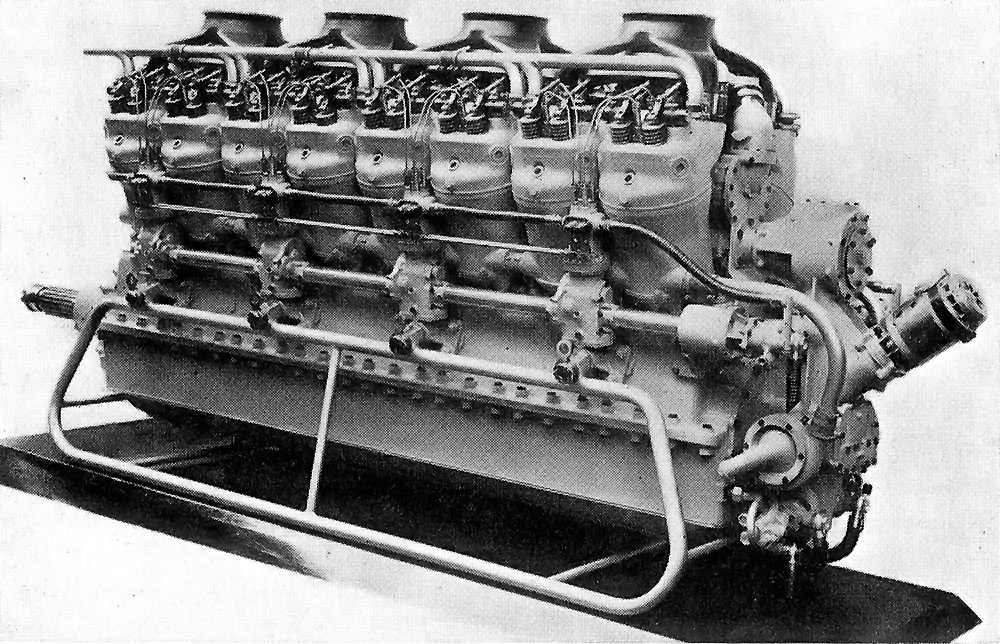
Clerget 16 H rear

The diesel Clerget 16 H showing the fuel injection pumps along the side of the engine and various accessories at the rear of the engine.

Fuel injection for each cylinder was provided by two Clerget injection pumps and two Clerget hydraulically-operated injectors. Groups of four pump units (to supply two cylinders) were arranged on the outside of the engine, with a total of four such groups on each side. The pumps along each side of the engine were driven by a camshaft running at half-engine speed. One complete set of pumps could be shut off for operating the engine at low speeds. Fuel was injected into the cylinder at a maximum of 8,500 psi (586 bar).

The 16 H used a two-piece aluminum crankcase. The single-piece crankshaft had eight throws and was supported by nine main bearings. Connecting rods were of the master and articulated rod type. Pressure lubrication was provided by a dry-sump system, and each bank of cylinders had its own water-cooling circulation system. Starting was achieved by an air-starter unit attached to the rear of the engine. The engine was 31.5 in (.8 m) wide, 49.2 in (1.25 m) tall, and 112.6 in (2.86 M) long. The 16 H weighed 3,750 lb (1,700 kg).

Four Rateau turbosuperchargers sat atop the Clerget 16 H engine. Each turbocharger served four cylinders (two on each side of the engine). The turbine spun by exhaust gases from the cylinders was at the top of the turbocharger, and the compressor that supplied air to the cylinders was at the bottom of the turbocharger. The turbochargers allowed the 16 H engine to maintain power up to 16,400 ft (5,000 m).
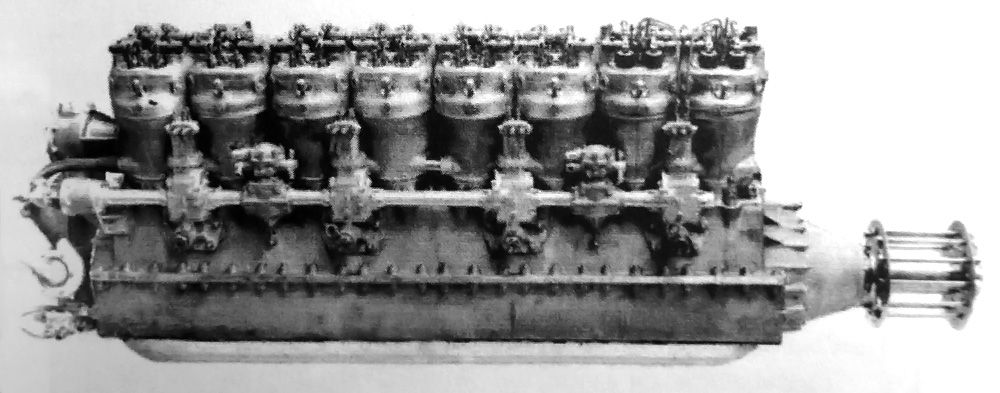
Clerget 16 H side

An early image of the Clerget 16 H without turbochargers.

First run on 17 May 1939, the 16 H could produce 1,500 hp (1,119 kW) without the turbochargers. With the turbochargers, the engine produced 2,000 hp (1,491 kW) at 2,200 rpm for takeoff and 1,600 hp (1,193 kW) at 1,800 rpm for continuous cruise. At cruise power, fuel consumption was 0.375 lb/hp/hr (228 g/kW/hr), and oil consumption was 0.020 lb/hp/hr (12 g/kW/hr).

With the German invasion of France on 10 May 1940, engine development and the transatlantic passenger seaplane were put on hold. The sole Clerget 16 H engine was destroyed during a bombing raid on Paris in 1940. There were some rumors that the engine was moved to Germany before the bombing, but nothing ever came of this. In October 1940, there was interest in building another 16 H, but no further development was undertaken. Pierre Clerget continued to work on other aircraft engine designs but was found dead in the Canal du Midi in Moissac, France on 22 June 1943—a sad end for a remarkable man. The cause of his death has never been explained.

The Germans restarted the transatlantic passenger seaplane program in March 1941, and an example of each prototype had been completed and flown by the end of 1942. These aircraft were subsequently destroyed in Allied bombing raids. After World War II, ten examples of the Latécoère 631 were built, each powered by six 1,600 hp (1,193 kW) Wright R-2600 engines. The aircraft entered service in 1947 but would not last long. After four of the Latécoère 631s had crashed in separate incidents, the remaining aircraft were banned from flying in 1955.
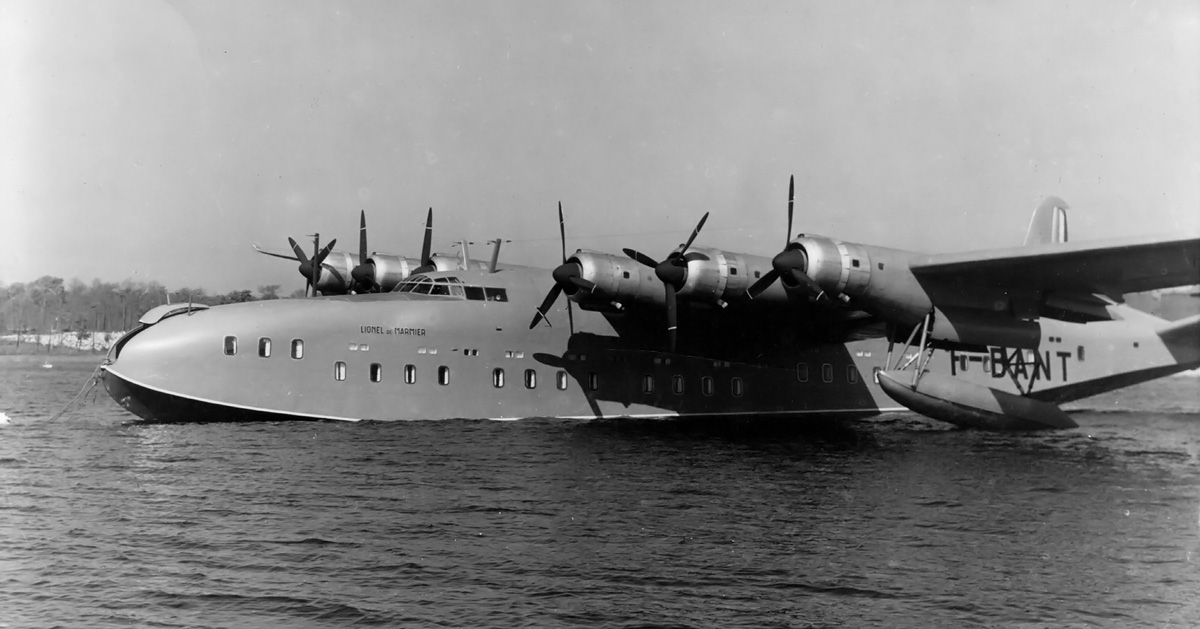
Latecoere 631 Lionel de Marmier

The inspiration for the Clerget 16 H: the transatlantic flying boat airliner. This Latécoère 631, named Lionel de Marmier after the French ace who served in WWI and WWII, disappeared over the South Atlantic with all 52 on board on 1 August 1948.

Sources:
Diesel Aviation Engines by Paul H. Wilkinson (1942)
Aircraft Engines of the World 1941 by Paul H. Wilkinson (1941)
Pierre Clerget: Un motoriste de génie by Gérard Hartmann (2004)
Flying Boats & Seaplanes by Stephane Nicolaou (1998)
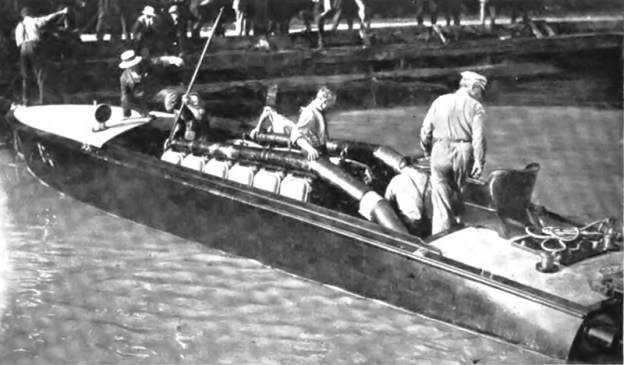
Duesenberg 12-Cylinder Marine Engine and the Disturber IV

By William Pearce

In 1910, the relatively unknown Fred and Augie Duesenberg began designing what would become their walking beam engine. This style of engine had a unique valve arrangement in which horizontal valves, perpendicular to the cylinder axis, opened into a small space above the cylinders. The valves were actuated by very long and large rocker arms, referred to as “walking beams.” By 1913, Duesenberg engines had attracted some attention and were noticed by Commodore James A. Pugh.

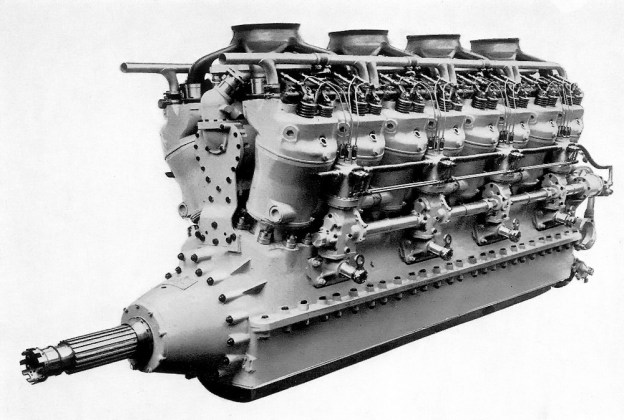
Duesenberg Inline-12 Marine engine

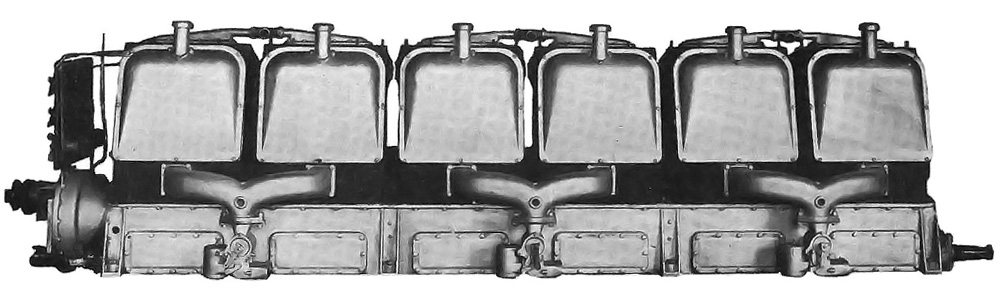
The Duesenberg straight-12 marine engine of over 750 hp. Large aluminum covers protected the walking beam rockers of each cylinder pair.

Pugh was interested in building a boat to win the Harmsworth Trophy (British International Trophy for Motorboats) in 1914 and bring the trophy back to the United States. The Harmsworth Trophy was held each year by the country that won it the previous year. The British had won the trophy in 1913 (and 1912), and the 1914 race was to be held on Osborne Bay, England. Pugh was building a 40-foot (12.2 m) hydroplane named Disturber IV and needed powerful engines to ensure victory. Pugh brought the Duesenbergs into the project, and the Duesenbergs began designing a truly unique engine to power Pugh’s new boat.

Duesenberg Straight-12 aluminum crankcase

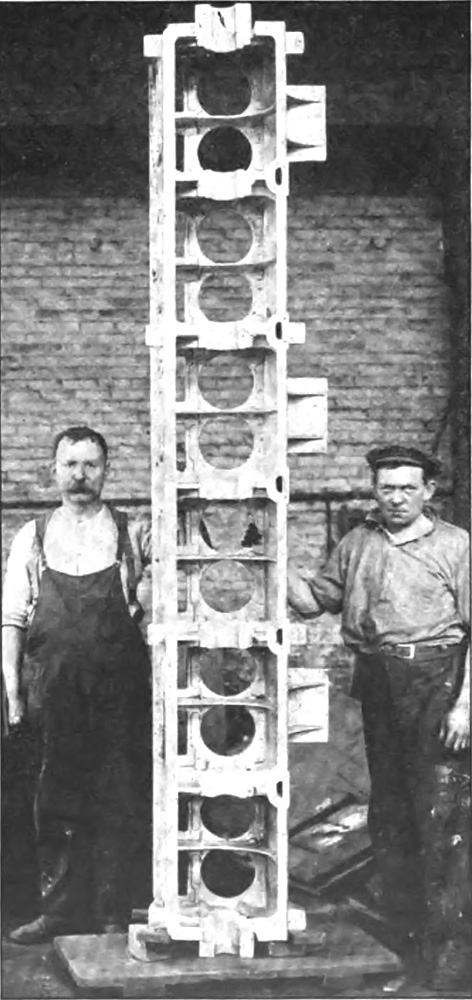
The one-piece aluminum crankcase for the Duesenberg straight-12 engine.

The Disturber IV was to be powered by two separate straight 12-cylinder engines. Each engine was over 10-feet (3 m) long and was comprised of six two-cylinder blocks mounted on a one-piece crankcase. Each two-cylinder block was water-cooled with the intake valves in the middle of the block and the exhaust vales on the outside. The intake and exhaust valves were operated by long walking beam rockers. A single updraft carburetor provided the fuel/air mixture to a split manifold that fed four cylinders. Each cylinder had two spark plugs. Lubrication was provided by a pressurized oil system, a now-universal concept that was just being introduced at the time. The single-piece crankshaft was supported by seven main bearings.

The use of aluminum was rare for the time, yet the Duesenbergs used it extensively in the engine’s design. The crankcase was one of the largest aluminum forgings made at the time and weighed 365 lb (166 kg) before the final machine work. Magnalite aluminum pistons were used, and the walking beam rocker arm covers were aluminum.

The inline 12-cylinder engine had a bore of 6.75 in (171 mm) and a stroke of 7.5 in (191 mm). Total displacement was 3,221 cu in (52.8 L). The engine developed 750 hp (559 kW) at 1,500 rpm and 800 hp (597 kW) at 1,600 rpm. While it is possible that more power could have been obtained at a higher rpm, the often quoted 900 hp (671 kW) seems a little optimistic. The engine weighed 2,700 lb (1,225 kg). With both engines installed in Disturber IV and running at full speed, total fuel burn was reported at 132 gallons (500 L) per hour.

These mighty 12-cylinder engines were built at the Duesenberg Motor Company factory in St. Paul, Minnesota. The engines were finished and installed in Disturber IV in mid-1914. The installation of the engines was mirrored so that the intake of the left engine was on the left side and the intake of the right engine was on the right side. This effectively allowed the engines to run in opposite directions. Thus, each engine’s single propeller rotated in opposite directions. The propellers were 24 in (610 mm) in diameter with a 40 in (1 m) pitch. Through a step-up gearbox with a ratio of 1.25 to 1, each propeller turned at 2,000 rpm while the engine speed was 1,600 rpm.

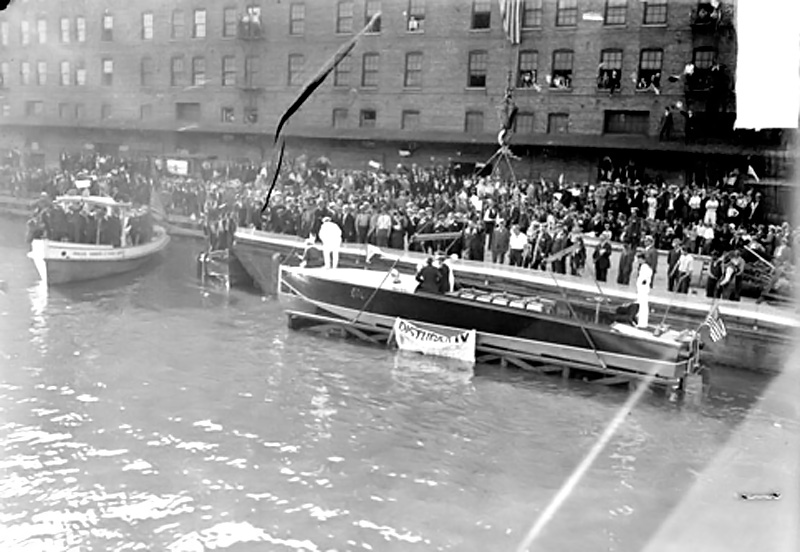
The Disturber IV being launched on he Chicago River 2 July 1914. (Image DN-0063061, Chicago Daily News negatives collection, Chicago History Museum)

The Disturber IV being launched on the Chicago River on 2 July 1914. (Image DN-0063061, Chicago Daily News negatives collection, Chicago History Museum)

On 2 July 1914, the Disturber IV was officially launched on the Chicago River. It underwent trials for a short time, achieving speeds in excess of 50 mph (80 km/h), before it was shipped to New York on 12 July 1914. In New York, it was loaded on the S.S Minnetonka and shipped to Cowes, England for the Harmsworth Trophy race to be held on 15-18 August 1914. Augie Duesenberg accompanied the boat to ensure the engines would be trouble free. While the Disturber IV was in transit, Archduke Franz Ferdinand of Austria was assassinated, World War I began, and the Harmsworth Trophy was cancelled. The Disturber IV arrived in England only to be immediately shipped back to the United States without ever touching the water.

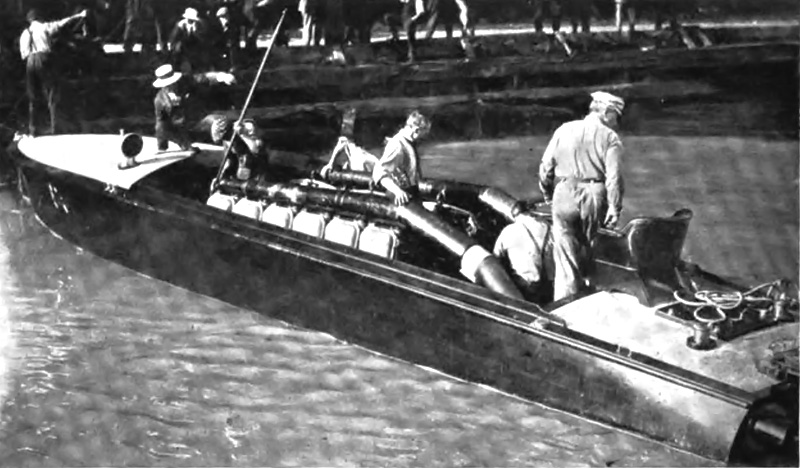
It had been a rushed pace from the inception of the 12-cylinder engines to the voyage back to the United States. Now with spare time on his hands, Augie began to think of ways to improve the 12-cylinder engines. After arriving back in the United States, the engines were shipped back to the Duesenberg factory in St. Paul where they were disassembled and modified. The exact extent of the modifications are not known, but it was during this rebuild that the large, water-jacketed exhaust manifold was replaced by individual, vertical exhaust stacks.

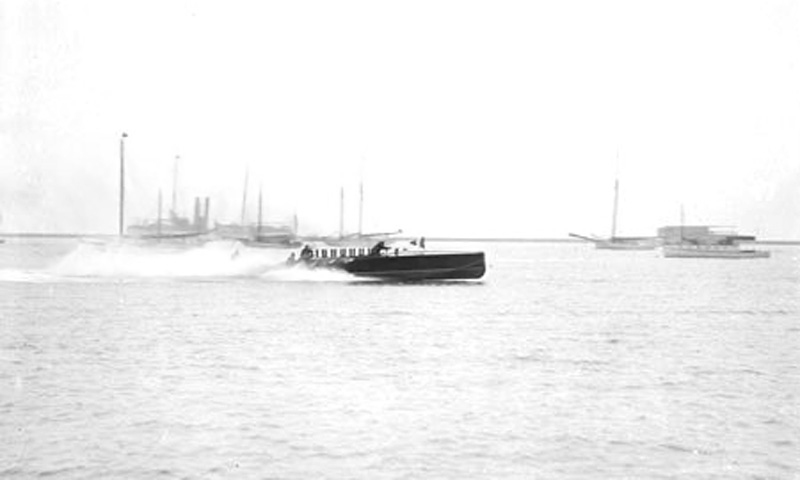
Disturber IV July 1914

Disturber IV in July 1914 with the large, water-jacketed exhaust manifold atop each engine and leading out the boat’s stern.

By October 1914, the 12-cylinder engines were back in Disturber IV, and the boat was turned loose on Lake Michigan. Pugh, accompanied by mechanics Charles Swanson and Henry Suttkas, won a special race off the coast of Chicago, Illinois on 20 October 1914. Two 14.83 mi (23.87 km) laps were run for a total distance of 29.66 mi (47.74 km). Disturber IV completed the first lap at a record speed of 56.6 mph (91.1 km/h). The second lap was completed at 47.0 mph (75.6 km/h), and the boat averaged 51.4 mph (82.7 km/h) over the total course. Disturber IV finished 17 minutes ahead of the second place boat.

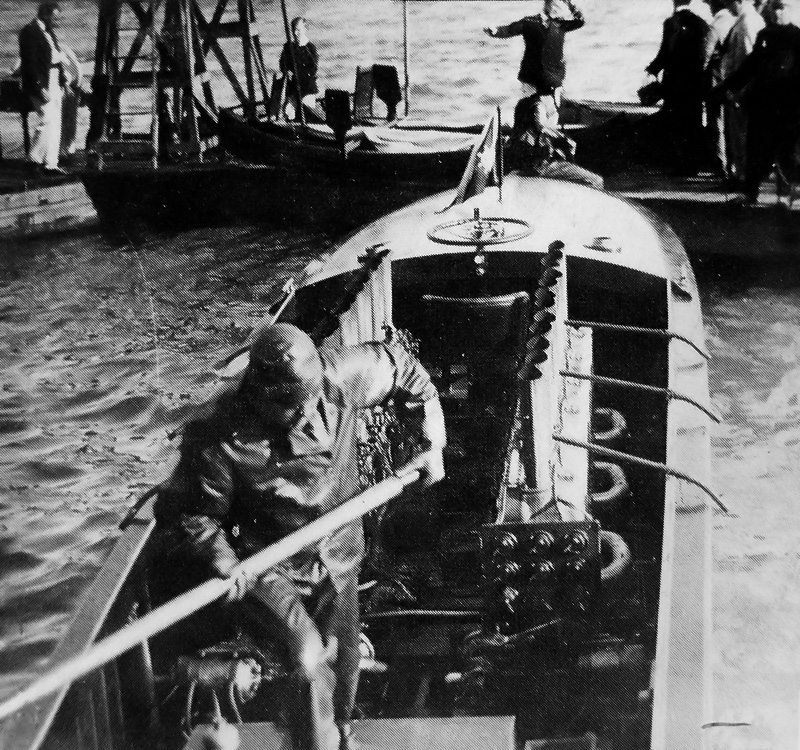
Disturber IV Duesenberg

By October 1914, the Duesenberg engines in the Disturber IV had been modified with individual exhaust stacks. The pipes leading overboard were the cooling water outlet for each cylinder pair. Note the intake manifolds on the right engine.

In 1915, the American Speed Boat Championship was held over three days in early September on Lake Michigan. Each day a two lap race was made over a 15.25 mi (24.54 km) course for a total distance of 30.5 mi (49.09 km). The winner of the first day’s race would receive the Wrigley Trophy. During the first race, Disturber IV was in the lead after completing the first lap at 55.4 mph (89.2 km/h). The second lap was completed at 44.7 mph (71.9 km/h), and the boat averaged 49.5 mph (79.7 km/h) over the entire distance. Disturber IV won the Wrigley Trophy—and finished nearly 10 minutes ahead of the second place boat, Miss Detroit. During the second day’s race, Disturber IV turned the first lap at 55.3 mph (89.0 km/h) and the second at 55.2 mph (88.8 km/h), averaging 55.2 mph (88.8 km/h) over the 30.5 mi (49.09 km/h) total distance. Disturber IV was undefeated the third day and won the American Speed Boat National Championship.

A few days later on 12 September 1915, with the Duesenberg engines running at a smooth 1,600 rpm, Pugh and the Disturber IV became the first to break the mile-a-minute mark on water. Pugh made six timed speed runs on Lake Michigan near Chicago. His fastest run was 61.2 mph (98.5 km/h), but is often reported as 62 mph (99.8 km/h), and another run was at 60.4 mph (97.2 km/h). Disturber IV’s six run average was at 59.2 mph (95.3 km/h).

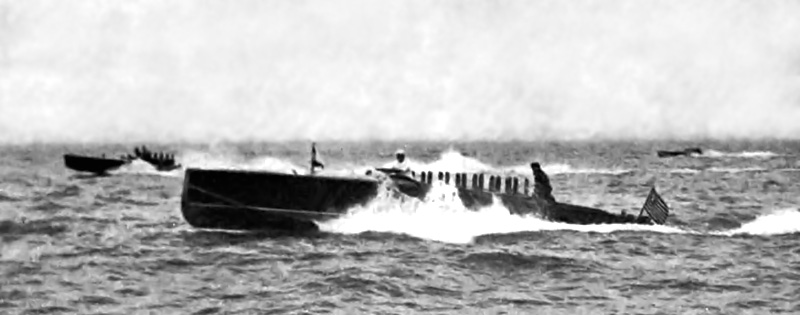
Disturber IV 1915 Race

Disturber IV in the 1915 American Speed Boat Championship on Lake Michigan. In the background are Peter Pan and Miss Detroit.

Late in 1915, Pugh put Disturber IV in storage and stated he would not race again until the next international meet. Pugh had built the Disturber IV solely to win the Harmsworth Trophy, and he found dominating other boats on Lake Michigan was not very fulfilling. With World War I raging, all international meets had been cancelled until the end of hostilities. What Pugh did not know was that the war would continue for another three years, and the next Harmsworth Trophy race would not be held until 1920. When peace did return, the world was a different place. The war had advanced engine technology, and the powerful Disturber IV was no longer on the cutting edge. The ultimate fate of the Disturber IV and its straight-12 Duesenberg engines is not known.

Disturber IV’s Duesenberg engines attracted so much interest that the Loew-Victor Company retained Fred Duesenberg as a designer. Fred went on to design six- and eight-cylinder engines based on the 12-cylinder engine’s design. In early 1917, Duesenberg Motor Company and the Loew-Victor Engine Company combined to form the Duesenberg Motors Corporation. Although it was not a direct path to the Duesenberg automobile, the engines for the Disturber IV helped open the door to the Duesenberg’s future endeavors.

Sources:
– “Walking Beam on Water” by Joseph Freeman, Automobile Quarterly, Vol. 30, No. 4 (1992)
– “A Large Aluminum Crank Case,” The Foundry, July 1914
– “Disturber Makes Record at Chicago” Power Boating, December 1914
– “Early Days of Aluminum Pistons” by Joseph Leopold, The Automobile, 7 October 1915
– “Chicago Races,” The Rudder, October 1915
– “Disturber IV Sets Mile-a-Minute Mark” by Jack Proctor, Sporting Life, 25 September 1915
Duesenberg Aircraft Engines: A Technical Description by William Pearce (2012)