Monthly Archives: July 2013

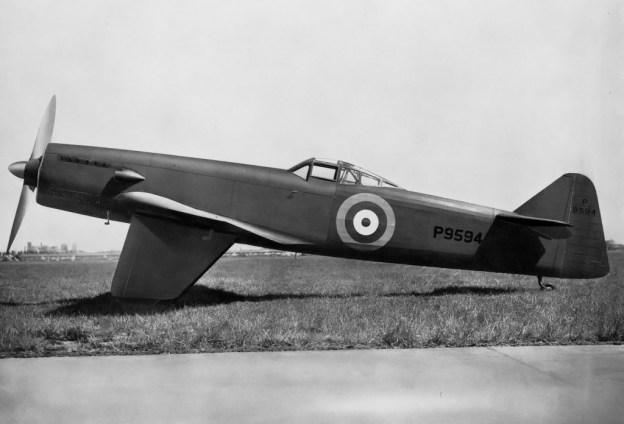
Martin-Baker MB2 final tail

Martin-Baker MB2 Fighter

By William Pearce

In 1934, James Martin and Captain Valentine Baker formed the Martin-Baker Aircraft Company in Denham, United Kingdom. Designed by Martin, their first aircraft was the MB1—a low-wing touring aircraft with a two-place enclosed cockpit. First flown by Capt. Baker in April 1935, the MB1’s airframe was comprised of a steel tube structure, and the wings could be folded back for transport or storage. However, with the political situation in Europe deteriorating, and with Britain in search of new fighter aircraft, Martin-Baker turned its attention to designing a new fighter: the MB2.

Martin-Baker MB2 final tail

The Martin-Baker MB2 eight-gun fighter with its final tail configuration.

The MB2 started as a private venture around 1935 and closely followed Air Ministry Specification F.5/34 issued in 1934 for an eight-gun, 275 mph fighter aircraft. The MB2 was to be an easily produced and low cost fighter. Construction on the MB2 began in March 1936 and utilized the same steel tube construction techniques employed on the MB1. The wings and forward fuselage were covered by duralumin, and the rear fuselage and control surfaces were fabric covered. For simplicity and lightness, the MB2 had fixed undercarriage housed in streamlined fairings; the left fairing also incorporated an engine oil cooler. A pneumatic crash pylon would extend above the canopy to protect the pilot in the event of a nose-over during takeoff or landing.

Martin-Baker MB2 pylon

The MB2 with the crash pylon extended above the cockpit canopy. Note that the canopy provided a 360 degree view.

From the start, Martin had wanted a Rolls-Royce Merlin engine for the MB2, but none were available to the Martin-Baker Company. Napier was willing to loan Martin-Baker a Dagger IIIM engine, and the MB2 was designed around that engine. The Napier Dagger was an air-cooled, 24-cylinder, vertical H engine. With a 3.8125 in (96.8 mm) bore and a 3.75 in (95.25 mm) stroke, the Dagger displaced 1,027 cu in (16.8 L). The moderately supercharged Dagger IIIM produced around 805 hp (600 kW) at 4,000 rpm for takeoff and drove a 10.5 ft (3.2 m), fixed-pitch, two-blade, wooden propeller.

Martin-Baker MB2 marked as M-B-1

An early photo of the Martin-Baker MB2 when marked as M-B-1, with Capt. Baker at the controls. Note the exhaust manifold and how it differs from the other images.

The MB2 was designed with ease of maintenance in mind. All major components were easily accessible. The Dagger engine could be changed out faster than any other engine on any fighter then in service. Two men could remove the MB2’s armament, eight Browning .303 (7.7 mm) machine guns, in under five minutes (compared to 60 minutes for the Hurricane and 70 minutes for the Spitfire). Two men could reload the MB2, 300 rounds per gun, in 15 minutes (compared to 16 minutes for the Hurricane and 60 minutes for the Spitfire). The wings just outside of the gear could be removed in minutes to allow the aircraft to be easily transported or stored. The MB2 had a span of 34 ft (10.4 m), a length of 34 ft 9 in (10.6 m), and weighed 5,537 lb (2,512 kg). At 9,250 ft (2,820 m), the aircraft had a top speed of 305 mph (491 km/h), although some sources say 320 mph (515 km/h). The MB2’s ceiling was 29,000 ft (8,840 m).

Baker made the first flight in the MB2 on 3 August 1938. As first flown, the MB2 did not have any vertical tail. It was thought that the large main gear fairings and flat-sided fuselage would provide directional stability. The rear of the MB2’s fuselage tapered back to a vertical wedge that incorporated the aircraft’s rudder. Directional stability proved insufficient, and a small vertical tail stub was provided above the horizontal stabilizer. A conventional tail was later added to the MB2 after flight trials at Martlesham Heath in late 1938 indicated further improvement in directional stability were needed.
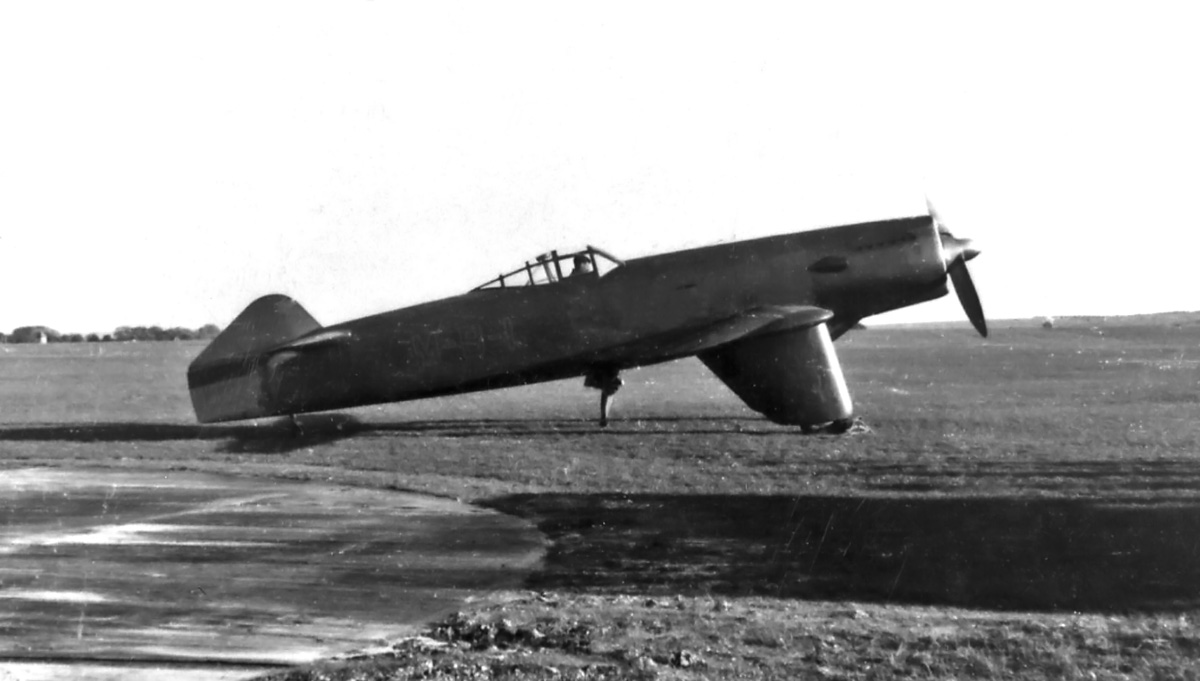
Martin-Baker MB2 with short tail

The MB2 with the revised small stub tail to provided better directional control over the original design having no tail. However, this tail configuration was still insufficient.

Early on, the MB2 carried “M-B-1” on the side of its fuselage for reasons that have not been made clear. While at Martlesham Heath, the MB2 was loved by ground crews for its ease of maintenance and serviceability. However, pilots found it lacking directional control, with insufficient rudder authority and heavy aileron control. Because of the control difficulties, it would not have made a good gun platform.

After the tail was modified to address the directional instability, the aircraft was re-evaluated at Martlesham Heath in late 1939. The new rudder was found to be satisfactory and effective, but the other flight controls still needed improvement. Designs were also made to fit the MB2 with fully retractable gear and change out the machine guns for cannons. But these changes were not pursued.
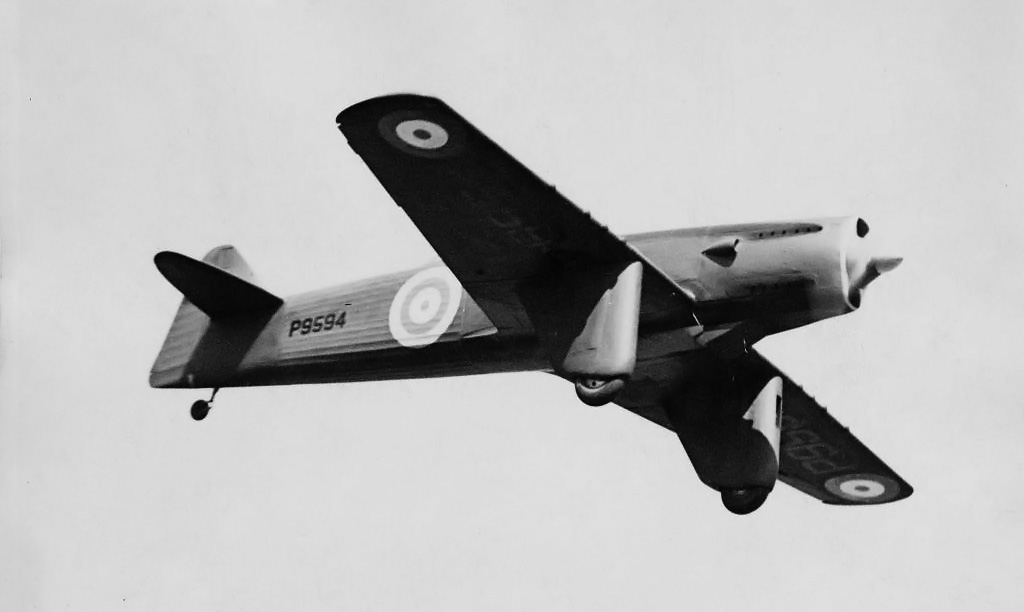
Martin-Baker MB2 flight

The Martin-Baker MB2 in flight with the final tail configuration. Note the opening for the oil cooler on the left main gear fairing and the exhaust ports on the cowling.

The Air Ministry purchased the MB2 in July 1939, but it was clear that there would be no further modifications or any chance of a production contract. While the MB2’s shortcomings could have been addressed, it would not have changed the fact that the aircraft was developed for a fighter specification over five years old. However, Martin-Baker was tasked to take what they had learned from the MB2 and develop a new Napier Sabre-powered fighter, which would become the MB3. The sole MB2 was scrapped in 1944. Designed and built by a small company with fewer than 40 employees, the MB2 exemplified simple and inexpensive construction techniques employed on an aircraft that was designed for ease of serviceability and whose performance could match fighter aircraft then in service.
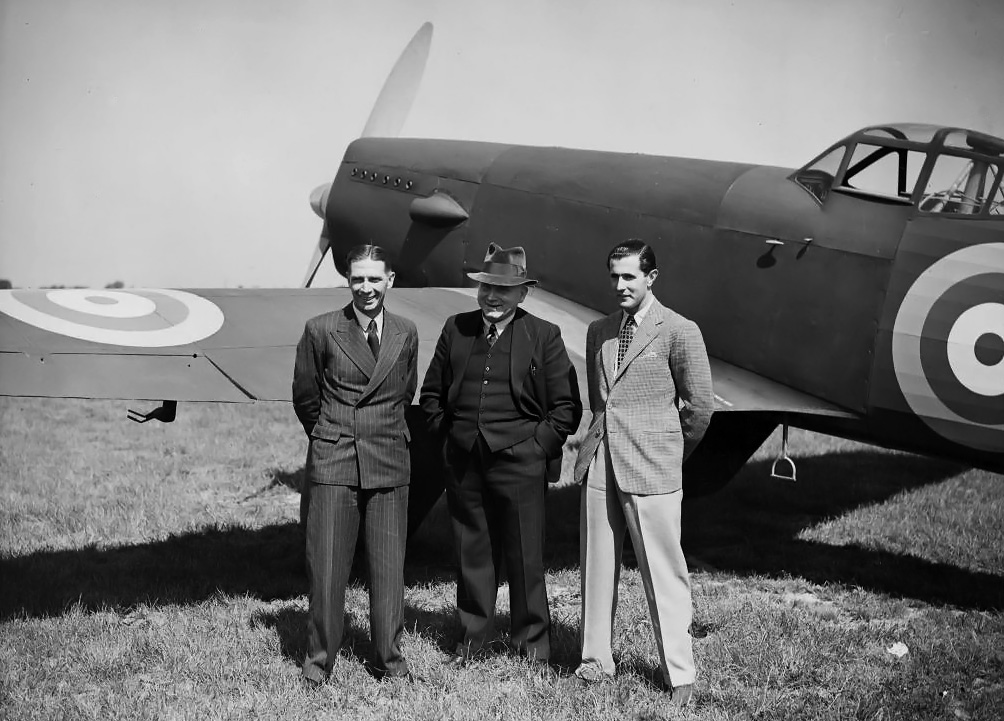
Martin-Baker MB2

From left to right, Captain Valentine Baker, James Martin, and Francis Francis, who provided funding for the Martin-Baker Aircraft Company, stand next to the MB2.

Sources:
– “Martin-Baker Fighters,” by Bill Gunston, Wings of Fame Volume 9 (1997)
The British Fighter Since 1912 by Francis K. Mason (1992)
Interceptor Fighters for the Royal Air Force by Michael J.F. Bowyer (1984)
British Piston Aero-Engines and Their Aircraft by Alec Lumsden (1994/2003)
http://www.martin-baker.com/about/mb1-mb5
Hispano-Suiza 18Sbr

Hispano-Suiza 18R and 18Sb Aircraft Engines

By William Pearce

In the spring of 1928, after not participating in the Schneider Trophy contest for several years, the French Ministère de l’Air* (Air Ministry) set its sights on the competition for 1929. Aircraft for the race were ordered from Bernard and Nieuport-Delage. To be competitive, a new engine of around 1,200 hp was needed. The Ministère de l’Air put out orders for such an engine to Gnome-Rhône, Hispano-Suiza, and Lorraine. Only Hispano-Suiza was up to the challenge and responded with a new engine, known as the 18R.

Hispano-Suiza 18Sbr Musée de l'Air et de l'Espace

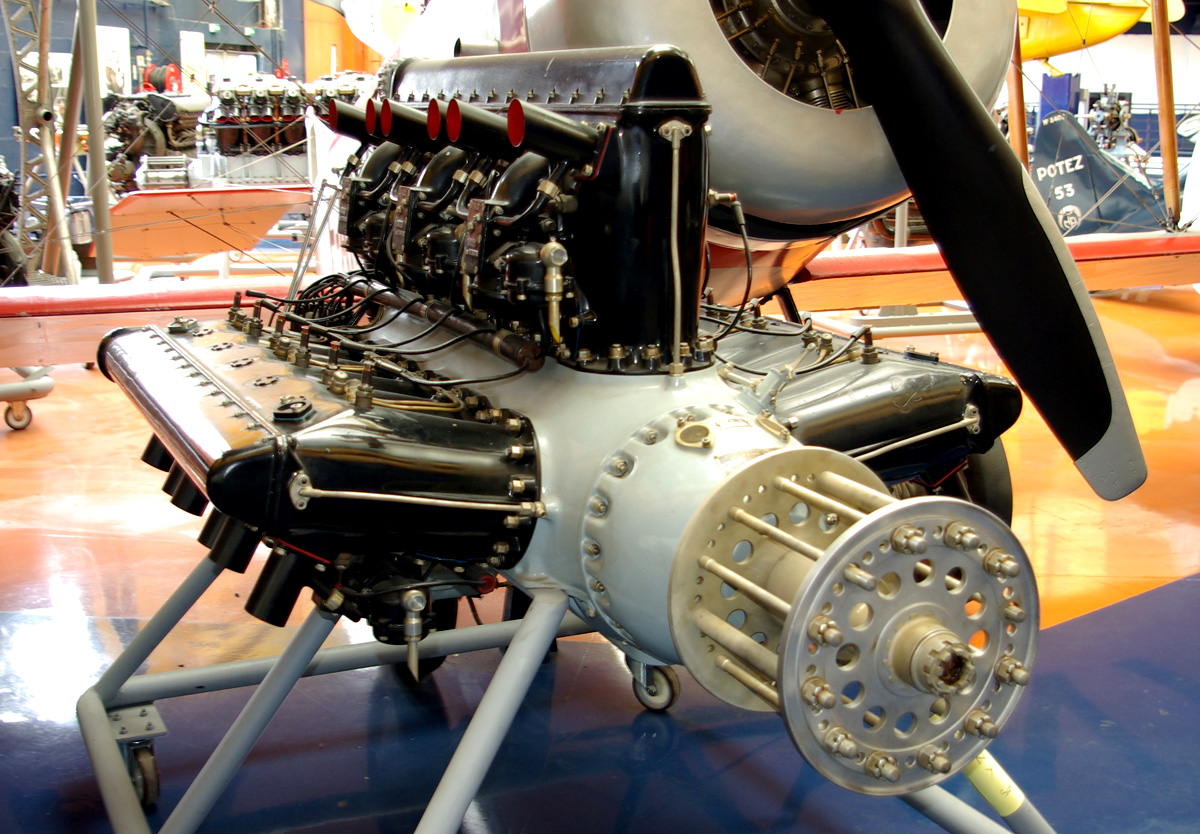
Hispano-Suiza 18Sbr W-18 engine on display in the Musée de l’Air et de l’Espace in Le Bourget, France. The 18Sb was essentially a detuned 18R. Note the carburetors on the sides of the cylinder banks and that each carburetor feeds two cylinders. (Duch.seb image via Wikimedia Commons)

The 18-cylinder, liquid-cooled Hispano-Suiza 18R had three very wide cylinder banks that formed a “W” (or broad-arrow) engine. The monobloc, six-cylinder banks were spaced at 80 degrees and derived directly from the Hispano-Suiza 12Nb V-12 engine of 750 hp (560 kW). The cylinders retained the 5.91 in (150 mm) bore and 6.69 in (170 mm) stroke of the 12Nb, but the compression ratio was increased from 6.2:1 to 10:1. The 18R’s total displacement was 3,300 cu in (54.1 L). The two valves per cylinder were actuated by a single overhead camshaft driven at the rear of the 18R. Each cylinder had two spark plugs positioned perpendicular to the cylinder but on opposite sides from one another. The spark plugs were fired by magnetos at the rear of the engine.

The engine’s connecting rods were of the master/articulated type, with the master rod for the vertical cylinder bank and articulated rods for the side cylinder banks. To keep the engine light, the crankcase and other components were made of Elektron, a magnesium alloy developed in Germany during World War I. The 18R was available with or without a Farmen (bevel planetary) propeller gear reduction, which weighed 132 lb (60 kg). The engine’s overall weight was 1,190 lb (540 kg) without gear reduction and 1,323 (600 kg) with gear reduction. The engine was 64.7 in (1.64 m) long without gear reduction and 78.5 in (1.99 m) long with gear reduction. The 18R had a width of 52.4 in (1.33 m) and a height of 46.1 in (1.17 m).

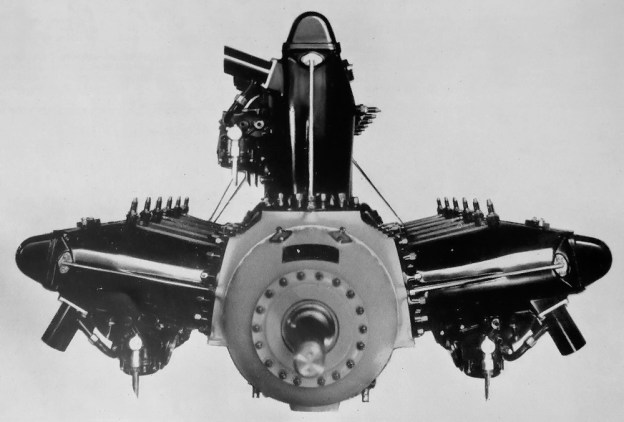
Hispano-Suiza 18Sbr

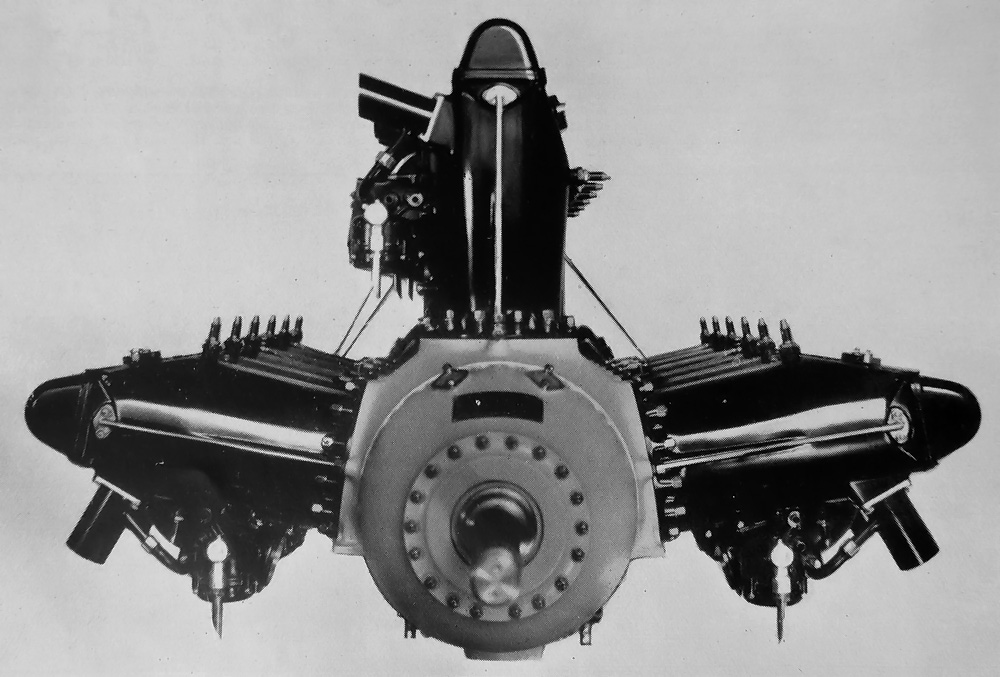
Front view of a Hispano-Suiza 18Sbr. The tube on the front of each cylinder bank supplied oil to the overhead camshaft.

The 18R had a planned output of 1,680 hp (1,253 kW) at 2,400 rpm. However, developmental issues delayed the engine, and neither it nor the aircraft it was to power were ready for the 1929 Schneider contest. The first 18R engine, a geared drive version, was delivered to Nieuport in October 1929, a month after the contest.

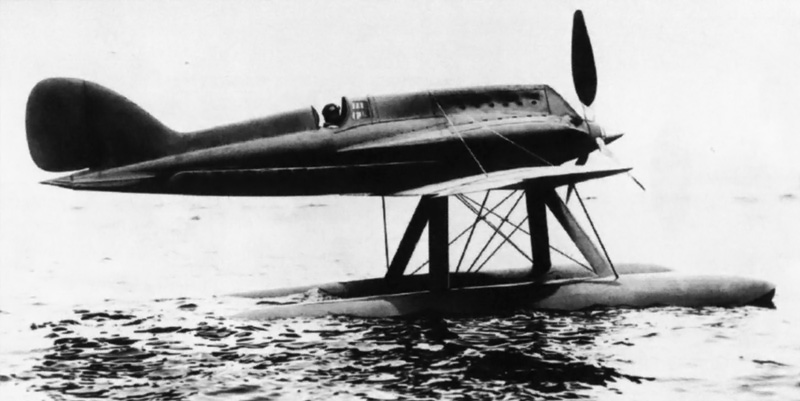
The Schneider contest racer from Nieuport-Delage was known as the NiD-450, and two were ordered. It was a low wing, wire-braced seaplane of conventional layout. When installed in the NiD-450, the 18R was limited to 1,200 hp (895 kW) at 2,000 rpm. For the NiD-450, the engine’s nine carburetors were placed between the cylinder banks. This limited the interference between the fairings for the side cylinder banks and the wing. Although the engine was installed and test-run in the NiD-450 in 1929, the aircraft did not undergo tests until February 1930. The first flight was made by Sadi Lecointe at the end of April. The NiD-450 was damaged in June when the engine cowling came free while in flight and struck the aircraft. Once repaired, the aircraft was damaged again in July when it crashed while taking off.

A further development of the NiD-450 built for possible use in the 1931 Schneider contest was the NiD-650. In fact, the second NiD-450 was finished as the first NiD-650, and the first NiD-450 was rebuilt and modified, becoming the second NiD-650. Still powered by the Hispano-Suiza 18R, the first NiD-650 was delivered on 11 February 1931. Lecointe made the first flight on 12 March, but the aircraft’s handling was not good. Modifications and test flights continued, but the aircraft crashed on 22 July. The pilot, Ferdinand Lesne, was not harmed. The second NiD-650 was flown on 31 August by Lecointe. The aircraft performance was less than what was needed for the Schneider contest, and there was not enough time for any improvement.

Nieuport-Delage NiD-650

Both Nieuport-Delage NiD-450s became NiD-650s, an example of which is seen here. Note how the side cylinder bank was housed in its own fairing, completely separate of the low-mounted wing. For the NiD-450/650, all nine of the 18R’s carburetors were installed between the cylinder banks.

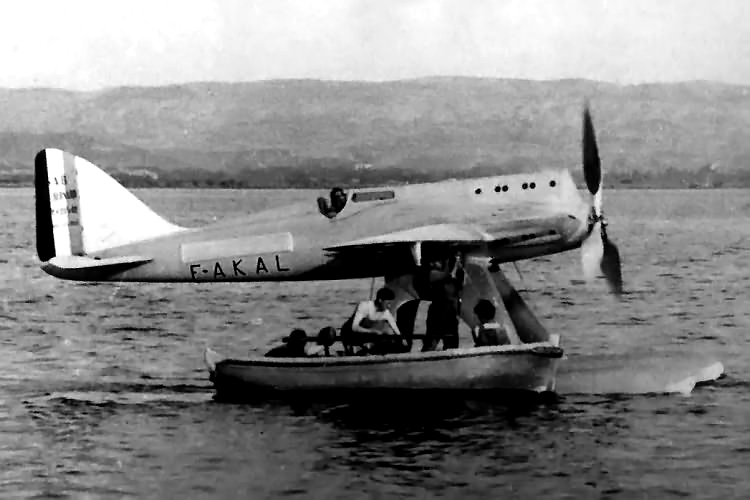
The Schneider contest racer from Bernard was known as the HV120. Two were built, and the HV120 had a layout similar to the NiD-450. The HV120 used a direct drive 18R engine and was ready for tests in early 1930, long after the 1929 contest. For the HV120, the carburetors for the engine’s lower cylinder banks were placed under the banks. This allowed the side cylinder banks to be faired into the wings. Antoine Paillard undertook the aircraft’s testing and made the first flight on 25 March 1930. The highest recorded speed for the HV120 was 317 mph (510 km/h), far below the competition. Modifications were made for the HV120’s possible use in the 1931 contest, but by this time, the aircraft was mainly used for flight training while newer racers were prepared. Unfortunately, the first HV120 was destroyed when it crashed on 30 August 1931, killing its pilot, Georges Bougault, who was the leader of the French Schneider team. The second HV120 was ready for flight, but little effort was made to prepare it for the Schneider contest.

The Hispano-Suiza 18R had absolutely no success with the Schneider Trophy contest. The engine was delayed, but there were many issues with the racing aircraft as well. In an attempt to recoup its loss and make something out of the 18R, Hispano-Suiza detuned the engine for commercial use. Known as the 18Sb, the engine had its compression returned to 6.2, was limited to 2,000 rpm, and had an aluminum crankcase. With the changes, the engine had a respectable max output of 1,125 hp (840 kW) and a normal output of 1,000 hp (745 kW). With gear reduction the engine was known as the 18Sbr and weighed 1,300 lb (590 kg). Without rear reduction the engine was known as the 18Sb and weighed 1,138 lb (516 kg). Other dimensions were the same as the 18R, except the 18Sb’s height was slightly reduced to 45.3 in (1.15 m).

Bernard HV140

Bernard HV140 had the side banks of the Hispano-Suiza 18R faired into the wings. It is because of this that the carburetors for the lower cylinder banks were mounted under the banks.

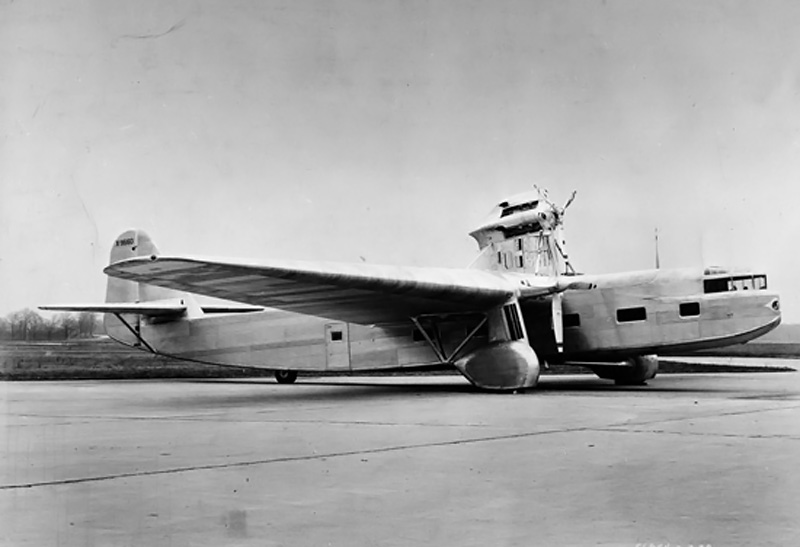
Although many projects were proposed to use the 18Sb, few were actually built. One aircraft that probably should have remained a project was the Ford 14-AT (some say 14-A), the last of the Ford trimotors. Developed in relative secrecy, the blunt nosed Ford 14-A was an all metal monoplane built in 1932 by the Stout Metal Airplane Division of the Ford Motor Company. The aircraft had a wingspan of 110 ft (33.5 m), length of 80 ft (24.4 m), and was built to carry 40 passengers. Two 715 hp (533 kW) Hispano-Suiza 12Nc V-12 engines were buried in the wings, and a single 18Sbr W-18 was mounted on a pylon atop the aircraft.

The 14-AT tried numerous times to take flight, none of which brought success. Originally designed for Pratt & Whitney air-cooled radial engines (Henry Ford made the engine change), the heavy 14-AT would not leave the ground and was damaged in an attempt to pry it free from earth. Reportedly, Edsel Ford ordered the 14-AT quietly scrapped in 1933, without ever making a public appearance.

One Hispano-Suiza 18Sbr engine is preserved at the Musée de l’Air et de l’Espace (Air & Space Museum) in Le Bourget, France.

Ford 14-AT

The very large and unsuccessful Ford 14-AT. Note the four-blade propellers on the wings and the three-blade propeller for the high-mounted 18Sbr.

*Technically, France’s 1929 Schneider efforts were started by the Ministère de la Marine (Ministry of the Navy). The Ministère de l’Air was not established until October 1928 and subsequently took over the Schneider efforts and other aviation projects.

Sources:
Schneider Trophy Seaplanes and Flying Boats by Ralph Pegram (2012)
Hispano Suiza in Aeronautics by Manuel Lage (2004)
Aerosphere 1939 by Glenn Angle (1940)
Jane’s All the World’s Aircraft 1931 – 1933 by C.G. Grey
Beyond the Model T: The Other Ventures of Henry Ford by Ford Bryan (1997)