Monthly Archives: February 2017

daimler-benz-db602-zeppelin-museum

Daimler-Benz DB 602 (LOF-6) V-16 Diesel Airship Engine

By William Pearce

Around 1930, Daimler-Benz* developed the F-2 engine, initially intended for aviation use. The F-2 was a 60 degree, supercharged, V-12 engine with individual cylinders and overhead camshafts. The engine had a 6.50 in (165 mm) bore and an 8.27 in (210 mm) stroke. The F-2’s total displacement was 3,288 cu in (53.88 L), and it had a compression ratio of 6.0 to 1. The engine produced 800 hp (597 kW) at 1,500 rpm and 1,000 hp (746 kW) at 1,700 rpm. The engine was available with either direct drive or a .51 gear reduction, and weighed around 1,725 lb (782 kg). It is unlikely that the Daimler-Benz F-2 powered any aircraft, but it was used in a few speed boats.
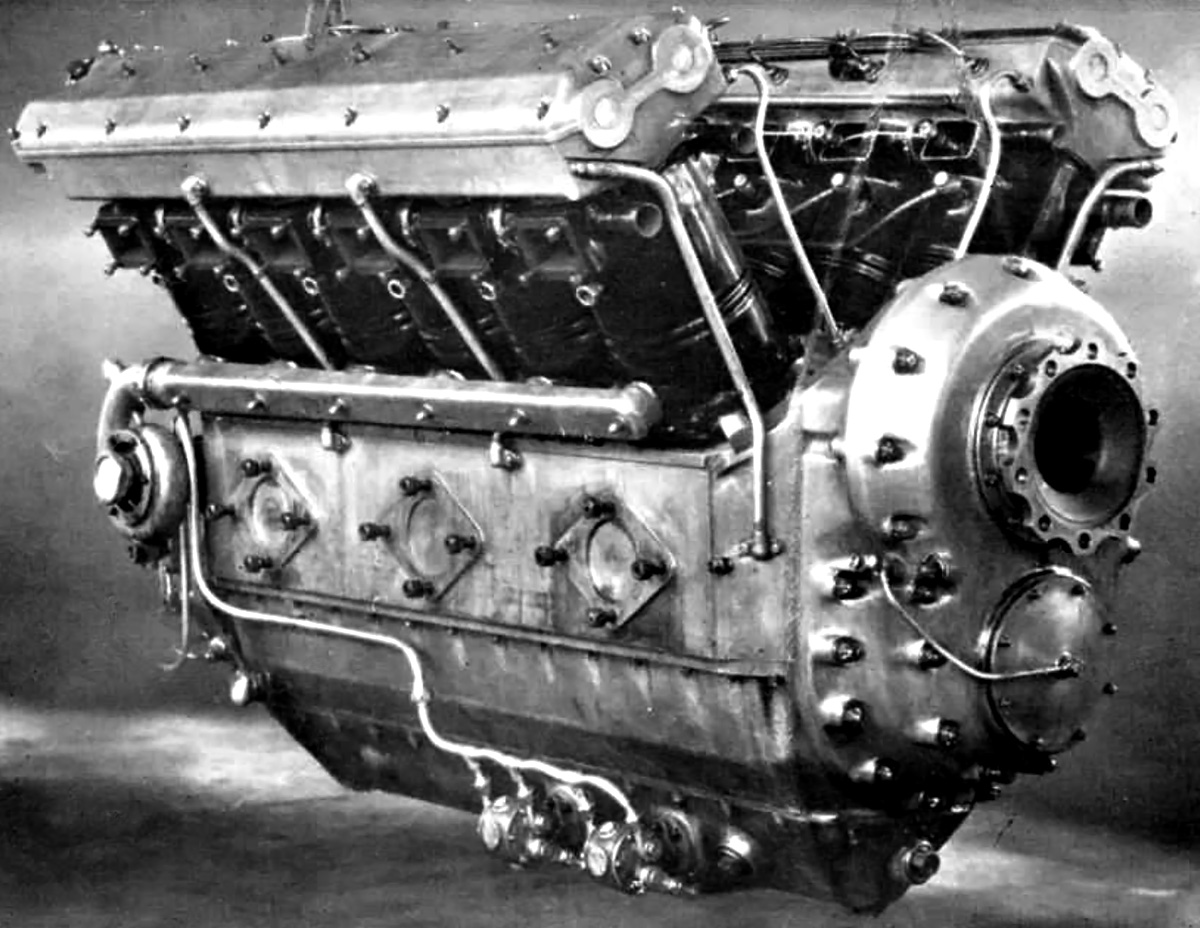
The Daimler-Benz OF-2 diesel engine was very similar to the spark ignition F-2. Note the dual overhead camshafts in the Elektron housing above the individual cylinders. This was one of the OF-2’s features that was not incorporated into the LOF-6.

The Daimler-Benz OF-2 diesel engine was very similar to the spark ignition F-2. Note the dual overhead camshafts in the Elektron housing above the individual cylinders. This was one of the OF-2’s features that was not incorporated into the LOF-6.

In the early 1930s, Daimler-Benz used the F-2 to develop a diesel engine for airships. This diesel engine was designated OF-2 (O standing for Ölmotor, or oil engine), and it maintained the same basic V-12 configuration as the F-2. The individual cylinders were mounted on an Elektron (magnesium alloy) crankcase. Each cylinder had four valves that were actuated by dual overhead camshafts. The OF-2 had the same bore, stroke, and displacement as the F-2, but the OF-2’s compression ratio was increased to 15 to 1.

Fuel was injected into the cylinders at 1,330 psi (91.7 bar) via two, six-plunger injection pumps built by Bosch. The fuel was injected into a pre-combustion chamber located between the four valves in the cylinder head. This design had been used in automotive diesels built by Mercedes-Benz. Sources disagree on the gear reduction ratio, and it is possible that more than one ratio was offered. Listed ratios include .83, .67, and .58.

The Daimler-Benz OF-2 engine had a normal output of 700 hp (522 kW) at 1,675 rpm, a maximum output of 750 hp (559 kW) at 1,720 rpm, and it was capable of 800 hp (597 kW) at 1,790 rpm for very short periods of time. Fuel consumption at normal power was .392 lb/hp/hr (238 g/kW/hr). The engine was 74.0 in (1.88 m) long, 38.6 in (.98 m) wide, and 42.5 in (1.08 m) tall. The OF-2 weighed 2,061 lb (935 kg).
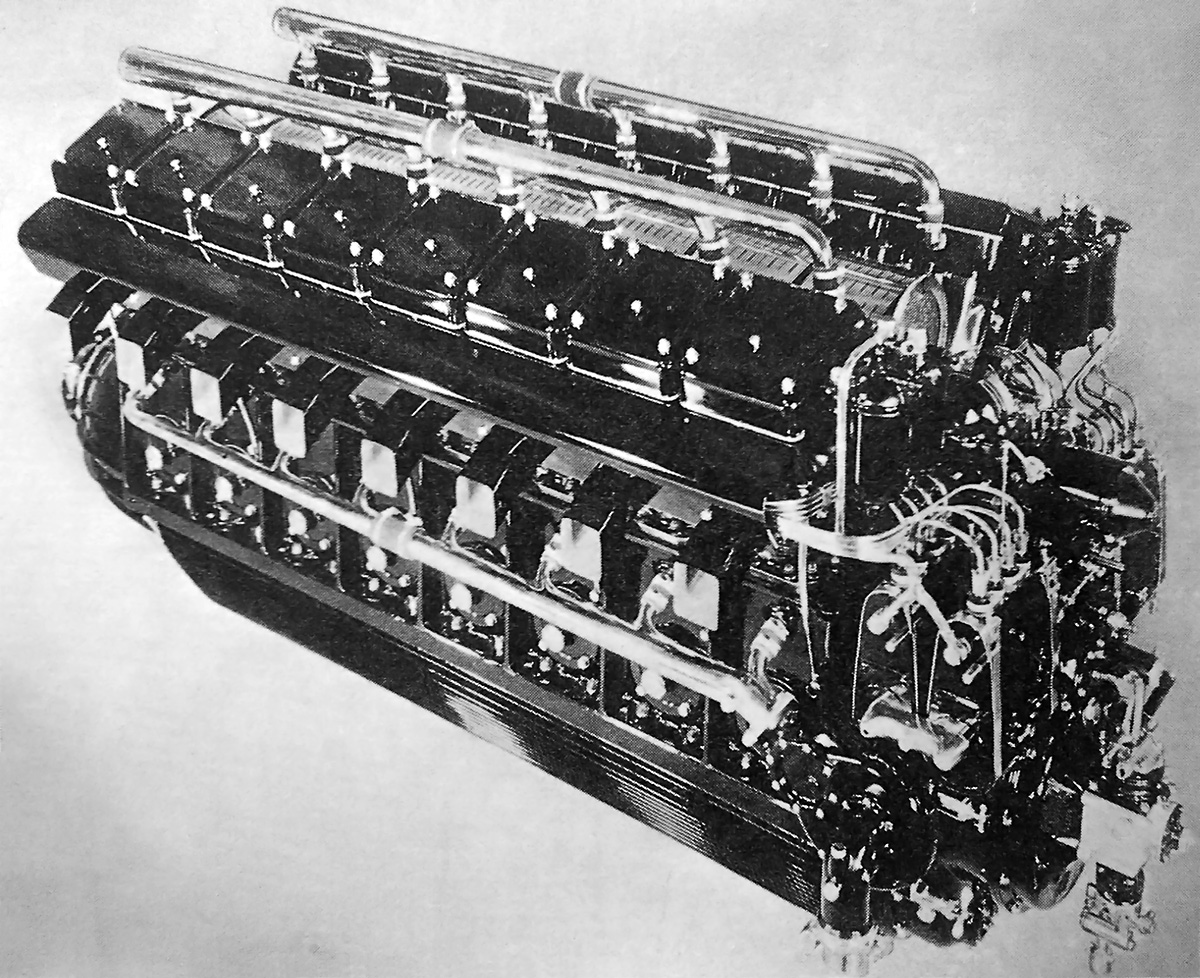
daimler-benz-lof-6-db602-diesel-rear

This view of a display-quality DB 602 engine shows the four Bosch fuel injection pumps at the rear of the engine. The individual valve covers for each cylinder can also be seen.

The OF-2 passed its type test in 1932. At the time, Germany was developing its latest line of airships, the LZ 129 Hindenburg and LZ 130 Graf Zeppelin II. These airships were larger than any previously built, and four OF-2 engines would not be able to provide sufficient power for either airship. As a result, Daimler-Benz began developing a new engine to power the airships in 1933. Daimler-Benz designated the new diesel engine LOF-6, but it was soon given the RLM (Reichsluftfahrtministerium or Germany Air Ministry) designation DB 602.

Designed by Arthur Berger, the Daimler-Benz DB 602 was built upon lessons learned from the OF-2, but it was a completely new engine. The simplest way to build a more powerful engine based on the OF-2 design was by adding two additional cylinders to each cylinder bank, which made the DB 602 a V-16 engine. The two banks of eight cylinders were positioned at 50 degrees. The 50 degree angle was selected over the 45 degree angle typically used for a V-16 engine. This gave the DB 602 an uneven firing order which helped avoid periodic vibrations.

The individual steel cylinders were mounted to the aluminum alloy crankcase. About a third of the cylinder was above the crankcase, and the remaining two-thirds protruded into the crankcase. This arrangement helped eliminate lateral movement of the cylinders and decreased vibrations. The crankcase was made of two pieces and split horizontally through the crankshaft plane. The lower part of the crankcase was finned to increase its rigidity and help cool the engine oil.

Daimler-Benz LOF-6 DB602 V-16 diesel engine

Originally called the LOF-6, the Daimler-Benz DB 602 was a large 16-cylinder diesel engine built to power the largest German airships. Note the three-pointed star emblems on the front valve covers. Propeller gear reduction was achieved through bevel planetary gears.

A single camshaft was located in the Vee of the engine. The camshaft had two sets of intake and exhaust lobes per cylinder. One set was for normal operation, and the other set was for running the engine in reverse. The fore and aft movement of the camshaft to engage and disengage reverse operation was pneumatically controlled. Separate pushrods for the intake and exhaust valves rode on the camshaft and acted on duplex rocker arms that actuated the valves. Each cylinder had two intake and two exhaust valves. Four Bosch fuel injection pumps were located at the rear of the engine and were geared to the camshaft. Each injection pump provided fuel at 1,600 psi (110.3 bar) to four cylinders. Fuel was injected into the center of the pre-combustion chamber, which was situated between the four valves. For slow idle (as low as 300 rpm), fuel was cut from one cylinder bank.

The DB 602 engine was not supercharged and had a .50 propeller gear reduction that used bevel planetary gears. The engine used fork-and-blade connecting rods that rode on roller bearings fitted to the crankshaft. The camshaft also used roller bearings, but the crankshaft was supported by plain bearings. Two water pumps were driven by a cross shaft at the rear of the engine. Each pump provided cooling water to one cylinder bank. The engine’s compression ratio was 16.0 to 1, and it was started with compressed air.

The DB 602 had a 6.89 in (175 mm) bore and a 9.06 in (230 mm) stroke, both larger than those of the OF-2. The engine displaced 5,401 cu in (88.51 L). Its maximum continuous output was 900 hp (671 kW) at 1,480 rpm, and it could produce 1,320 hp (984 kW) at 1,650 rpm for 5 minutes. The DB 602 was 105.9 in (2.69 m) long, 40.0 in (1.02 m) wide, and 53.0 in (1.35 m) tall. The engine weighed 4,409 lb (2,000 kg). Fuel consumption at cruising power was 0.37 lb/hp/hr (225 g/kW/hr).
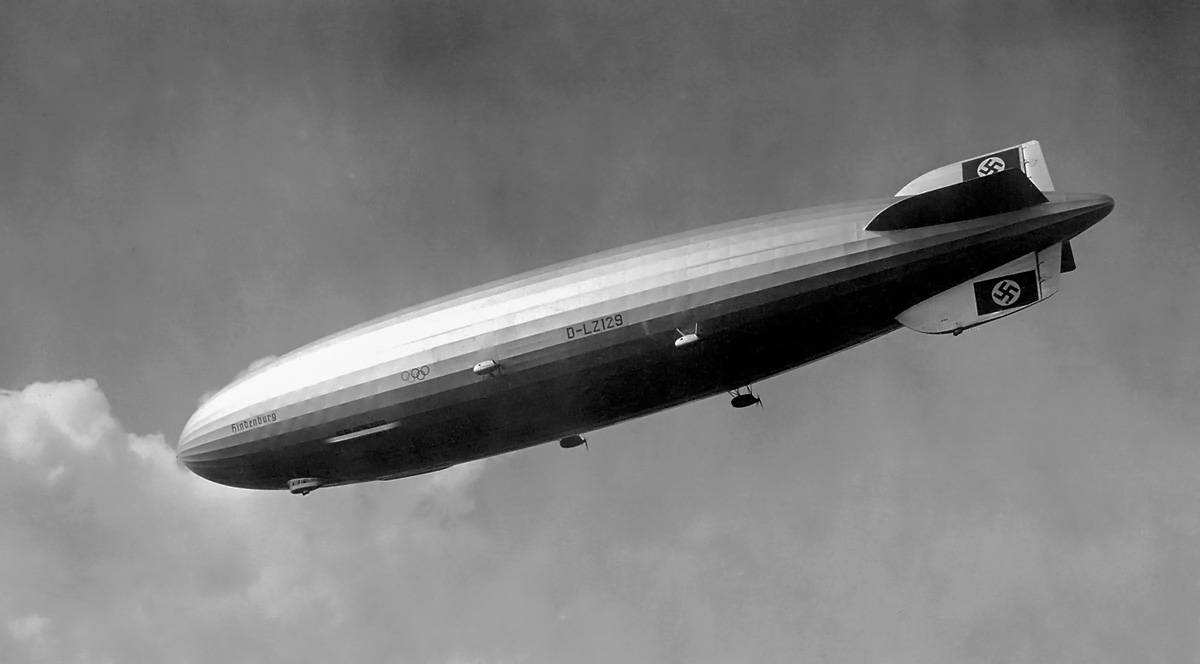
lz-129-hindenburg

The ill-fated LZ 129 Hindenburg on a flight in 1936. The airship used four DB 602 engines housed in separate cars in a pusher configuration. Note the Olympic rings painted on the airship to celebrate the summer games that were held in Berlin.

Development of the DB 602 progressed well, and it completed two non-stop 150-hour endurance test runs. The runs proved the engine could operate for long periods at 900 hp (671 kW). Four engines were installed in both the LZ 129 Hindenburg and the LZ 130 Graf Zeppelin II. Each engine powered a two-stage compressor. Each compressor filled a 3,051 cu in (50 L) air tank to 850 psi (59 bar) that was used to start the engine and to manipulate the camshaft for engine reversing.

Plans for a water vapor recovery system that used the engines’ exhaust were never implemented, because the airships used hydrogen instead of the more expensive helium. The recovery system would have condensed vapor into water, and the collected water would have been used as ballast to help maintain the airship’s weight and enable the retention of helium. Without the system in place, expensive helium would have been vented to compensate for the airship steadily getting lighter as diesel fuel was consumed. With the United States unwilling to provide helium because of Germany’s aggression, the airships used inexpensive and volatile hydrogen, as it was readily available. The Hindenburg was launched on 4 March 1936, and the Graf Zeppelin II was launched on 14 September 1938.

Engines for the Hindenburg were mounted in a pusher configuration. In April 1936, the Hindenburg’s DB 602 engines experienced some mechanical issues on its first commercial passenger flight, which was to Rio de Janeiro, Brazil. The engines were rebuilt following the airship’s return to Germany, and no further issues were encountered. The Hindenburg tragically and famously burst into flames on 6 May 1937 while landing at Lakehurst, New Jersey.

daimler-benz-db602-musee-de-l-air-et-de-l-espace

Front view of the DB 602 engine in the Musée de l’Air et de l’Espace, in Le Bourget, France. Above the engine are the cooling water outlet pipes. In the Vee of the engine is the induction manifold, and the pushrod tubes for the front cylinders can be seen. Note the finning on the bottom half of the crankcase. (Stephen Shakland image via flickr.com)

The Graf Zeppelin II was still being built when the Hindenburg disaster occurred. Design changes were made to the Graf Zeppelin II that included mounting the DB 602 engines in a tractor configuration. The inability of Germany to obtain helium, the start of World War II, and the end of the airship era meant the Graf Zeppelin II would not be used for commercial travel. The airship was broken up in April 1940.

The DB 602 engine proved to be an outstanding and reliable power plant. However, its capabilities will forever be overshadowed by the Hindenburg disaster. Two DB 602 engines still exist and are on display; one is in the Zeppelin Museum in Friedrichshafen, Germany, and the other is in the Musée de l’Air et de l’Espace, in Le Bourget, France. Although the DB 602 was not used on a wide scale, it did serve as the basis for the Mercedes-Benz 500 series marine engines that powered a variety of fast attack boats (Schnellboot) during World War II.

*Daimler-Benz was formed in 1926 with the merger of Daimler Motoren Gesellschaft and Benz & Cie. Prior to their merger, both companies produced aircraft engines under the respective names Mercedes and Benz. After the merger, the Daimler-Benz name was used mostly for aircraft engines, and the Mercedes-Benz name was used mostly for automobiles. However, both names were occasionally applied to aircraft engines in the 1930s.

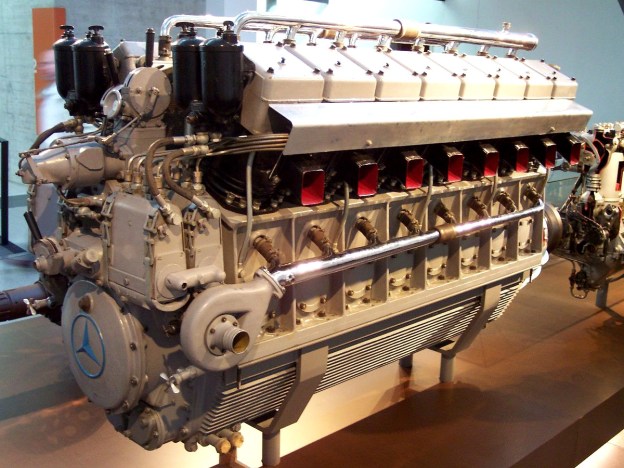
daimler-benz-db602-zeppelin-museum

Rear view of the DB 602 engine on display in the Zeppelin Museum in Friedrichshafen, Germany. A water pump on each side of the engine provided cooling water to a bank of cylinders. (Stahlkocher image via Wikimedia Commons)

Sources:
Aircraft Diesels by Paul H Wilkinson (1940)
Aerosphere 1939 by Glenn D. Angle (1940)
Diesel Engines by B. J. von Bongart (1938)
High Speed Diesel Engines by Arthur W. Judge (1941)
Diesel Aviation Engines by Paul H Wilkinson (1942)
– “The Hindenburg’s New Diesels” Flight (26 March 1936)
– “The L.Z.129’s Power Units” Flight (2 January 1936)
https://en.wikipedia.org/wiki/LZ_129_Hindenburg
https://en.wikipedia.org/wiki/LZ_130_Graf_Zeppelin_II

vought-xf5u-front

Vought XF5U Flying Flapjack

By William Pearce

Following the successful wind tunnel tests of the Vought V-173 low-aspect ratio, flying wing aircraft in late 1941, the US Navy asked Vought to propose a fighter built along similar lines. Charles H. Zimmerman had been working on such a design as early as 1940. He and his team at Vought quickly finalized their fighter design for the Navy as VS-315. On 17 September 1942, before the V-173 had flown, the Navy issued a letter of intent for two VS-315 fighters, designated XF5U-1. One aircraft was a static test airframe, and the other aircraft was a flight test article.

zimmerman-1940-patent

Charles Zimmerman’s fighter aircraft from a patent application submitted in 1940. Although the drawing shows fixed horizontal stabilizers (45/50) and skewed ailerons (34/36), the patent also covered the configuration used on the Vought XF5U. Note the prone position of the pilot, and the guns around the cockpit.

The Vought XF5U was comprised of a rigid aluminum airframe covered with Metalite. Metalite was light and strong and formed by a layer of balsa wood bonded between two thin layers of aluminum. The XF5U had the same basic configuration as the V-173 but was much heavier and more complex.

The XF5U’s entire disk-shaped fuselage provided lift. The aircraft had a short wingspan, and large counter-rotating propellers were placed at the wingtips. At the rear of the aircraft were two vertical tails, and between them were two stabilizing flaps. When the aircraft was near the ground, air loads acted on spring-loaded struts to automatically deflect the stabilizing flaps up and allow air to escape from under the aircraft. The stabilizing flaps enhanced aircraft control during landing. On the sides of the XF5U were hydraulically-boosted, all-moving ailavators (combination ailerons and elevators). The ailavators had a straight leading edge, rather than the swept leading edge used on the V-173’s ailavators. Two large balance weights projected forward of each ailavator’s leading edge.

vought-xf5u-mockup

The XF5U mockup was finished in June 1943. Note the gun ports by the cockpit. The mockup had three-blade propellers and single main gear doors, items that differed from what was ultimately used on the prototype. The acrylic panel under the nose was most likely to improve ground visibility, like the glazing on the V-173. However, test pilots reported that the glazing was not useful.

Zimmerman originally proposed a prone position for the pilot, but a conventional seating position was chosen. The pilot was situated just in front of the leading edge and enclosed in a bubble canopy. Some sources state that an ejection seat was to be used, but no mention of one has been found in Vought documents, and an ejection seat does not appear to have been installed in the XF5U-1 prototype. The cockpit was accessed via a series of recessed steps that led up the back of the aircraft. The acrylic nose of the XF5U housed the gun camera and had provisions for landing and approach lights.

The aircraft’s landing gear was fully retractable, including the double-wheeled tailwheel. The main gear had a track of 15 ft 11.5 in (4.9 m). A small hump in the outer gear doors covered the outboard double main gear wheel. The long gear gave the aircraft an 18.7 degree ground angle. A catapult bridle could be attached to the aircraft’s main gear to facilitate catapult-assisted launches from aircraft carriers. For carrier landings, an arresting hook deployed from the XF5U’s upper surface and hung over the rear of the aircraft. Armament for the XF5U consisted of six .50-cal machine guns—three guns stacked on each side of the cockpit—with 400 rpg. The lower four guns were interchangeable with 20 mm cannons, but the proposed rpg for the cannons has not been found. Two hardpoints under the aircraft could each accommodate a 1,000 lb (454 kg) bomb. No armament was installed on the prototype.

vought-xf5u-x-2

The two XF5Us under construction. The left airframe was used for static testing, and the right airframe was the test flight aircraft. The engine cooling fans and oil tanks can be seen on the right airframe.

Originally, the XF5U was to be powered by two 14-cylinder, 1,600 hp (1,193 kW) Pratt & Whitney (P&W) R-2000-2 engines. It appears P&W stopped development of the -2 engine, and the 1,350 hp (1,007 kW) R-2000-7 was substituted sometime in 1945. The engines were buried in the aircraft’s fuselage, and engine-driven cooling fans brought in air through intakes in the aircraft’s leading edge. Cooling air exit flaps were located on the engine nacelles on both the upper and lower fuselage. An exit flap for intercooler air was located farther back on the top side of each nacelle.

Engine power was delivered to the propellers via a complex set of shafts and right angle gear drives. A two-speed gear reduction provided a .403 speed reduction for takeoff and a .177 reduction for cruising and high-speed flight. With the engines operating at 2,700 rpm (1,350 hp / 1,077 kW) at maximum takeoff power, the propellers turned at 1,088 rpm. At maximum cruise with the engines at 2,350 rpm (735 hp / 548 kW), the propellers turned at 416 rpm.

vought-xf5u-powerplant

The complex power drive of the XF5U was the aircraft’s downfall. The system was unlikely to work flawlessly, and the Navy chose to use its post-war budget on jet aircraft rather than testing the XF5U. The inset drawing is from Zimmerman’s patent outlining the propeller drive.

A power cross shaft was mounted between the gearboxes on the front of the engines. In the event of an engine failure, the dead engine would be automatically declutched, and the cross shaft would distribute power from the functioning engine to both propellers. The two engines were declutched from the propeller drive at startup. The clutches were hydraulically engaged, and a loss of fluid pressure caused the clutch to disengage. The engines were controlled by a single throttle lever and could not be operated independently (except at startup).

By November 1943, the ongoing flight tests of the V-173 indicated that special articulating (or flapping) propellers would be needed on the XF5U. Propeller articulation was incorporated into the hub by positioning one two-blade pair of propellers in front of the second two-blade pair. The extra room provided the space needed for the 10 degrees of articulation and the linkages for propeller control. As one blade of a pair articulated forward, the opposite blade of the pair moved aft. To relieve the load and minimize vibrations, the propeller hub mechanism caused the blade pitch to decrease as the blade articulated forward and to increase as the blade moved aft. The XF5U’s wide-cord propellers were 16 ft (4.9 m) in diameter, made from Pregwood (plastic-impregnated wood), and built by Vought. The propellers were finished with a black cuff, a woodgrain blade, and a yellow tip. The pitch of the propellers was controlled by a single lever and could not be independently controlled; the set pitch of all blades changed simultaneously. If both engines failed, the propellers would feather automatically. Construction of the special propellers was delayed, and propellers from a F4U-4 Corsair were temporarily fitted to enable ground testing to begin.

Vought XF5U with F4U-4 propellers

The completed XF5U ready for primary engine runs with F4U-4 propellers. The aircraft was completed over a year before the articulating propellers were finished. Had the propellers been ready sooner, it is likely the XF5U would have been transported to Edwards Air Force Base for testing in late 1945.

The XF5U had a wingspan of 23 ft 4 in (7.1 m) but was 32 ft 6 in (9.9 m) wide from ailavator to ailavator and 36 ft 5 in (8.1 m) from propeller tip to propeller tip. Each ailavator had a span of about 8 ft 4 in (2.5 m). The aircraft was 28 ft 7.5 in (8.7 m) long and 14 ft 9 in (4.5 m) tall. The XF5U could take off in 710 ft (216 m) with no headwind and in 300 ft (91 m) with a 35 mph (56 km/h) headwind. The aircraft had a top speed of 425 mph (684 km/h) and a slow flight speed of 40 mph (64 km/h). Initial rate of climb was 3,000 fpm (15.2 m/s) at 175 mph (282 km/h), and the XF5U had a ceiling of 32,000 ft (9,754 m). A single tank located in the middle of the aircraft carried 261 gallons (988 L) of fuel. The internal fuel gave the XF5U a range of 597 miles (961 km), but with two 150-gallon (568-L) drop tanks added to the aircraft’s hardpoints, range increased to 1,152 miles (1,854 km). The XF5U had an empty weight of 14,550 lb (6,600), a normal weight of 16,802 lb (7,621 kg), and a maximum weight of 18,917 lb (8,581 kg).

vought-xf5u-front

The XF5U with its special, wide-cord, articulating propellers installed. Note the winged Vought logo on the propellers. The purpose of the bottles under the fuselage is not clear. The aircraft used compressed air for emergency extension of the landing gear and tail hook. Perhaps that system was being tested. Note that the inner main gear doors have been removed.

A wooden mockup of the XF5U was inspected by the Navy in June 1943. At this time, the mockup had narrow, three-blade propellers that were very similar to those used on the V-173. The XF5U’s complex systems and unconventional layout delayed its construction, which was further stagnated by higher priority work during World War II. The aircraft was rolled out on 20 August 1945 with the F4U-4 propellers installed. Some ground runs were undertaken, but more serious tests had to wait until Vought finished the special articulating propellers in late 1946.

The aircraft started taxi tests on 3 February 1947, but concerns over the XF5U’s propeller drive quickly surfaced. Vought’s chief test pilot Boone T. Guyton made at least one small hop into the air, but no serious test flights were attempted. The test pilots and Vought felt that the only suitable place for test flying the radical aircraft with its unproven gearboxes and propellers was at Edwards Air Force Base in California. Given the XF5U’s construction, the aircraft could not be disassembled, and it was too large to be transported over roads. The only option was to ship the XF5U to California via the Panama Canal. Faced with the expensive transportation request, no urgent need for the XF5U, questions about propeller drive reliability, and the emergence of jet aircraft, the Navy cancelled all further XF5U project activity on 17 March 1947.

vought-xf5u-side

This side view of the XF5U shows how the propeller blades were staggered. Note the balance weights on the ailavator, the hump on the gear door, and the slightly open engine cooling air exit flap on the upper fuselage. Strangely, the tail markings appear to have been removed from the photo.

With the original 1,600 hp (1,193 kW) P&W R-2000-2 engines, the XF5U had a forecasted top speed of 460 mph (740 km/h) and a slow speed of 20 mph (32 km/h). The aircraft had a 3,590 fpm (18.2 m/s) initial rate of climb and a service ceiling of 34,500 ft (10,516 m). With a fuel load listed at 300 gallons (1,136 L), the aircraft would have a 710-mile (1,143-km) range. To increase the XF5U’s performance and try to keep the program alive, Vought proposed a turbine-powered model to the Navy, designated VS-341 (or V-341). While it is not entirely clear which engine was selected, the engine depicted in a technical drawing closely resembles the 2,200 hp (1,641 kW) General Electric T31 (TG-100) turboprop. The estimated performance of the VS-341 was a top speed of 550 mph (885 km/h) and a slow speed of 0 mph (0 km/h)—figures that would allow the VS-341 to achieve Zimmerman’s dream of a high-speed, vertical takeoff and landing (VTOL) aircraft.

vought-xf5u-rear

Rear view of the XF5U shows padding taped to the aircraft to protect its Metalite surface. The engine cooling air exit flaps are open. The intercooler doors have been removed, which aided engine cooling during ground runs. Note the tail markings on the aircraft.

The XF5U intended for flight testing (BuNo 33958) was smashed by a wrecking ball shortly after the program was cancelled. The XF5U’s rigid airframe withstood the initial blows, but there was no saving the aircraft; its remains were sold for scrap. At the time, the second XF5U (BuNo 33959) had already been destroyed during static tests.

Zimmerman’s aircraft were given several nicknames during their development: Zimmer’s-Skimmer, Flying Flapjack, and Flying Pancake. It is unfortunate that a radical aircraft so close to flight testing was not actually flown. Zimmerman continued to work on VTOL aircraft for the rest of his career.

xf5u-jet-engine-v-341

To bring the XF5U into the jet age, Vought designed the turbine-powered VS-341. The aircraft had the same basic layout as the XF5U. Note the power cross shaft extending from the gearbox toward the other engine.

Sources:
Chance Vought V-173 and XF5U-1 Flying Pancakes by Art Schoeni and Steve Ginter (1992)
Aeroplanes Vought 1917–1977 by Gerard P. Morgan (1978)
XF5U-1 Preliminary Pilot’s Handbook by Chance Vought Aircraft (30 September 1946)
XF5U-1 Illustrated Assembly Breakdown by Chance Vought Aircraft (1 January 1945)
Langley Full-Scale Tunnel Investigation of a 1/3-scale Model of the Chance Vought XF5U-1 Airplane by Roy H. Lange, Bennie W. Cocke Jr., and Anthony J. Proterra (1946)
– “Airplane of Low Aspect Ratio” US patent 2,431,293 by Charles H. Zimmerman (applied 18 December 1940)
– “Single or Multiengined Drive for Plural Airscrews” US patent 2,462,824 by Charles H. Zimmerman (applied 3 November 1944)
– “The Flying Flapjack” by Gilbert Paust Mechanix Illustrated (May 1947)
http://www.vought.org/special/html/sxf5u.html
http://www.vought.org/products/html/xf5u-1spec.html