Monthly Archives: August 2017

Sikorsky S-67 Blackhawk airbrakes

Sikorsky S-67 Blackhawk Attack Helicopter

By William Pearce

In the late 1960s, Sikorsky Aircraft had many helicopter models in production, but they had lost contracts to develop new helicopters. In 1966, the United States Army’s Advanced Aerial Fire Support System (AAFSS) contract was awarded to Lockheed, but their AH-56 Cheyenne attack helicopter ran into serious design issues. On 20 November 1969, Sikorsky initiated development of a new helicopter to be used primarily as a gunship, but it could also be used in other roles. This helicopter was designated S-67 Blackhawk, and its design and construction was self-funded by Sikorsky.

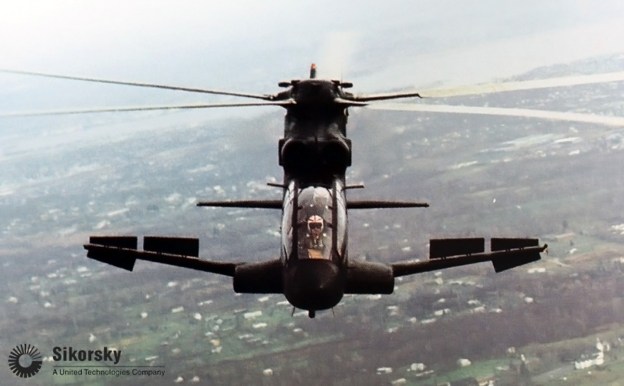
Sikorsky S-67 Blackhawk airbrakes

The Sikorsky S-67 Blackhawk was a very versatile helicopter that exhibited great performance, but it also had various shortcomings that the US Army could not overlook. The helicopter’s narrow fuselage and air brakes are illustrated in this image.

The Sikorsky S-67 Blackhawk was designed as a high-speed attack helicopter with a small wing to generate lift. The pilot and copilot/gunner sat in tandem in the helicopter’s cockpit, with the copilot in the front seat and the pilot in the rear seat. The pilot accessed the cockpit from the left side of the helicopter and the copilot from the right. The narrow, streamlined fuselage was only 3 ft 10 in (1.2 m) wide, which decreased the helicopter’s drag and increased its survivability by presenting a smaller target to enemy gunners. Behind the cockpit was a compartment that could be used for additional equipment or to transport personnel.
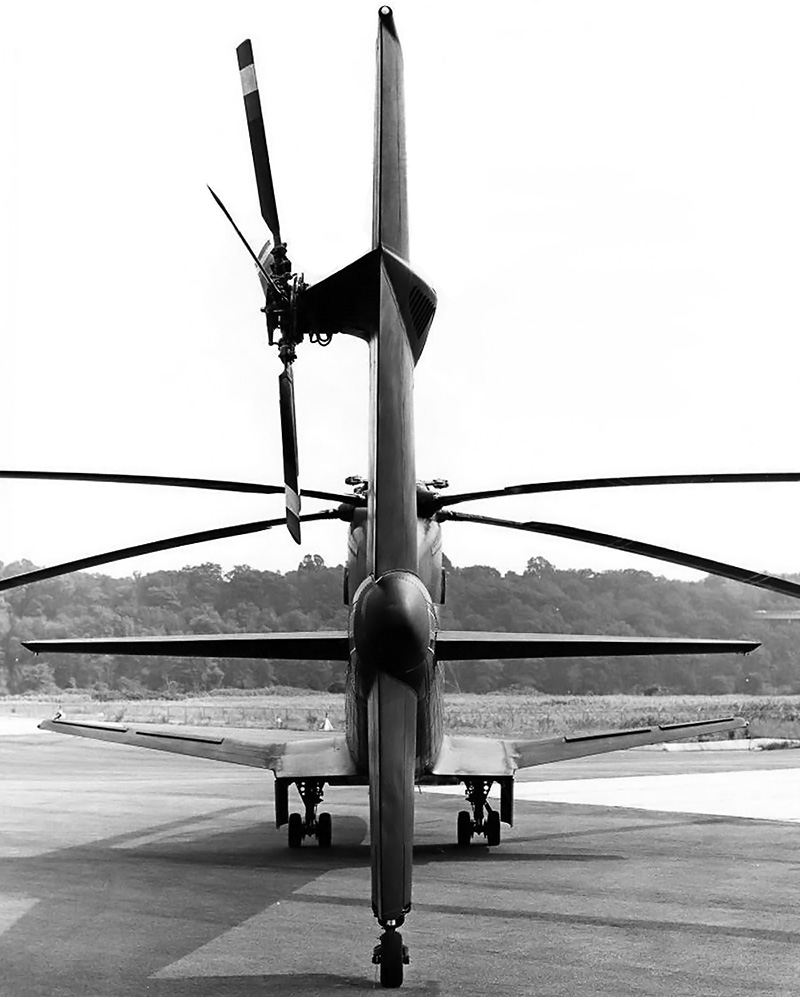
Sikorsky S-67 Blackhawk tail

This image shows the S-67’s original tail that did not have any rudders. Note the tail’s camber. Air brakes can be seen on the upper wing surfaces. The main gear had a 7 ft (2.1 m) track.

To cut expense and development time, the S-67 was designed to use the dynamic drive power system from a Sikorsky S-61/SH-3 Sea King. This included two 1,500 hp (1,119 kW) General Electric T58-GE-5 turboshaft engines and their drive, rotor, hydraulic, and electrical systems. The S-67’s five-blade rotors had 22 in (559 mm) of their tips swept back 20 degrees to delay compressibility effects, lower vibration, and reduce noise. The net effect was that the blades allowed the helicopter to achieve higher speeds. The main rotors also had a hub fairing, and their collective pitch control was modified to increase sensitivity and range.

The S-67’s main gear retracted into sponsons mounted on the fuselage sides. The helicopter’s thin wings extended from the sponsons. Each wing featured two hardpoints for weapons, auxiliary fuel tanks, or equipment. Each wing also had three air brakes: two that deployed along its upper surface and one that deployed along the lower surface. With the air brakes deployed, the helicopter slowed twice as fast as without the air brakes. In addition, the air brakes could be deployed during combat to offer unrivaled maneuverability. The S-67 was the first helicopter with air brakes.

A five-blade, 10 ft 7 in (3.2 m) diameter tail rotor was mounted to the left side of the S-67’s vertical fin. A lower fin with a non-retractable tailwheel extended below the helicopter’s tail. The large upper and lower fins were cambered to counteract the torque of the main rotor at speeds above 46 mph (74 km/h). This enabled controlled flight without the tail rotor as long as the S-67’s forward speed was in excess of 46 mph (74 km/h). If the tail rotor was lost, the helicopter could be flown back to base and landed like a conventional aircraft. The S-67 used an all-moving horizontal stabilizer that increased the helicopter’s maneuverability and decreased rotor stress.

Sikorsky S-67 Blackhawk landing

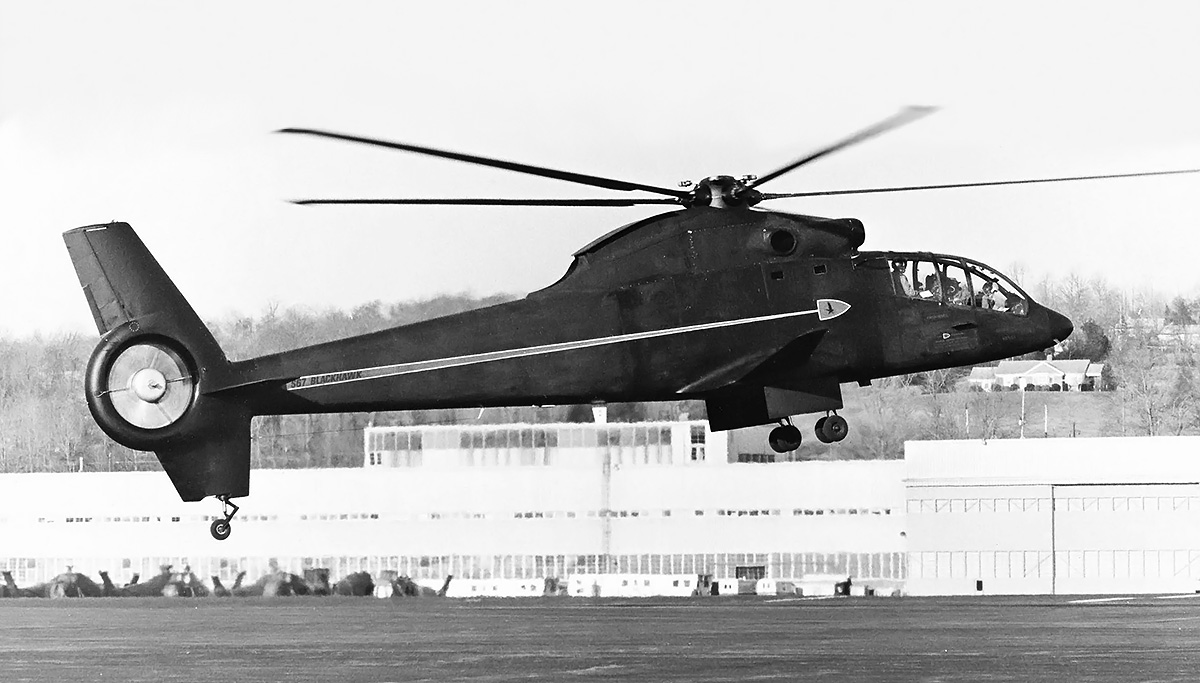
Note the angle of the all-moving horizontal stabilizer as the S-67 comes in for a landing. The landing gear was found to be insufficient for operating from unimproved locations. The helicopter’s double main wheels sunk into soft ground, and the gear doors only had 9.75 in (248 mm) of clearance.

With a 7,000 lb (3,175 kg) payload, the S-67 could accommodate a variety of armaments. A removable Emerson Electric Company TAT-140 turret mounted under the cockpit could carry a 7.62 mm minigun (M134), a 20 mm three-barrel rotary cannon (M197), a 30 mm single-barrel cannon (XM140), a 30 mm three-barrel rotary cannon (XM188), or a 40 mm grenade launcher (M129). The four underwing hardpoints could carry two drop tanks, up to 16 TOW missiles, or up to eight rocket pods. Each 2.75 in (70 mm) rocket pod contained 19 rockets, for a total of 152 rockets.
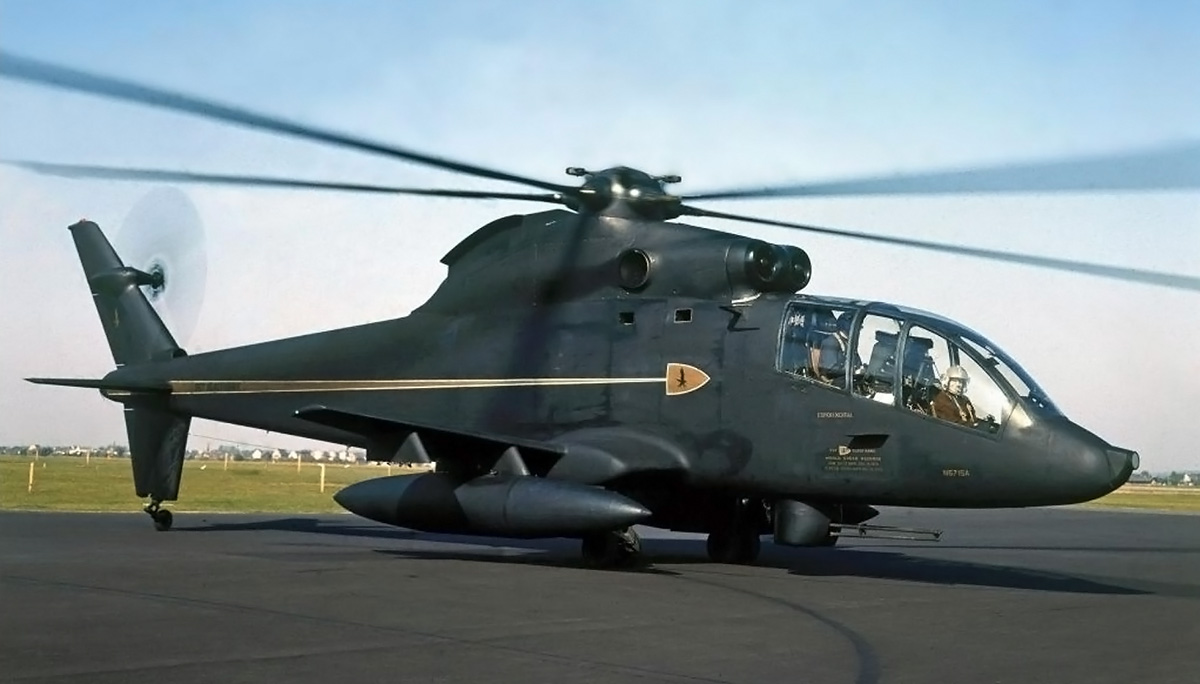
Sikorsky S-67 Blackhawk side

The S-67’s rudders can be seen in this image. One is on the upper fin below the tail rotor, and the other is on the lower fin. Pylons have been installed on the wings’ hardpoints, with drop tanks mounted to the inner stations. The turret is installed with a M197 three-barrel 20 mm cannon.

The S-67 had a wingspan of 27 ft 4 in (8.3 m) and a rotor diameter of 62 ft (18.9 m). The fuselage was 64 ft 2 in (19.6 m) long, and the helicopter’s total length including the rotor was 74 ft 1 in (22.6 m). The S-67’s mast height was 15 ft (4.6 m), and the top of the tail rotor was 16 ft 4 in (5.0 m). The helicopter’s top speed was 213 mph (343 km/h); maximum cruise speed was 201 mph (324 km/h), and normal cruise speed was 167 mph (269 km/h). The S-67 could climb at 2,000 fpm (10.2 m/s) and had a service ceiling of 20,000 ft (6,096 m). The helicopter could hover in ground effect up to 9,700 ft (2,957 m) and could hover without ground effect up to 6,500 ft (1,981 m). Maximum range on internal fuel was 325 miles (523 km), but its normal combat range was 220 miles (354 km). With external fuel tanks, range was extended to over 600 miles (966 km). The S-67 had an empty weight of 12,525 lb (5,681 kg), a normal weight of 18,500 lb (8,391 kg), and a maximum takeoff weight of 22,050 lb (10,002 kg).
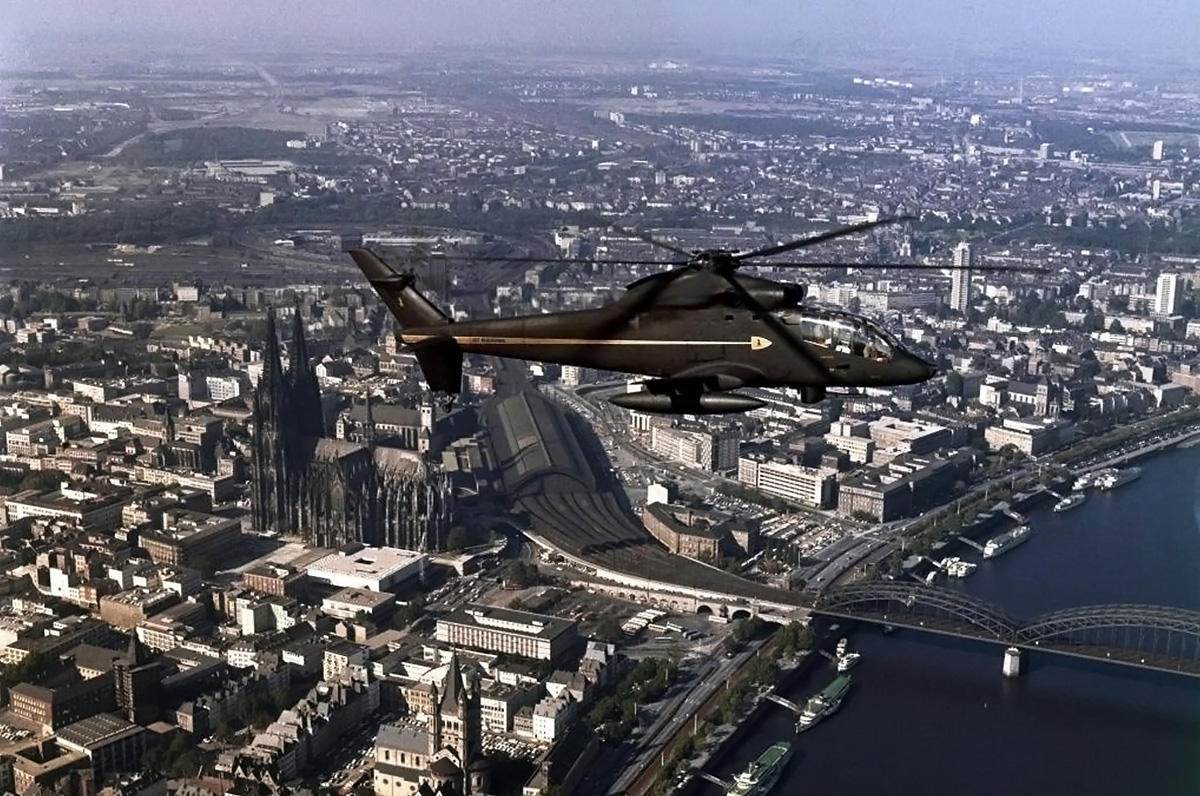
Sikorsky S-67 Colonge Germany 1972

The S-67 seen in the same configuration as the previous image. The helicopter is over Cologne, Germany on its European and Middle Eastern tour in 1972.

Construction on the S-67 started on 15 February 1970 and proceeded rapidly. The helicopter made its first flight on 20 August 1970. Flight testing proved the S-67 to be very responsive, maneuverable, smooth, and quiet. The helicopter was able to perform rolls, loops, and split-S turns—although, only rolls to the right were made. On 14 December 1970, Sikorsky test pilots Kurt Cannon and Byron Graham in the S-67 established a new absolute speed record by averaging 216.841 mph (348.971 km/h) over a 3 km (1.86 mile) course. They then set a new record on 19 December 1970 by averaging 220.888 mph (355.485 km/h) on a 15–25 km (9.3–15.5 mile) course.

In 1971, the S-67 covered 3,500 miles (5,633 km) touring 12 US military bases. In addition to Sikorsky demonstration flights, the helicopter was flown on 147 demo flights with military personnel. The S-67 completed 155 rolls and 140 split-S turns during these flights.
Sikorsky-S-67-Blackhawk-fan-in-tail

A fan-in-fin anti-torque system was tested in the S-67. Note the rudders above and below the fan. No issues were encountered with the fan-in-fin, but the helicopter was converted back to a conventional tail rotor.

Between 25 May and 13 June 1972, the S-67 was flown 26 hours for a series of flight evaluations by the US Army. The helicopter was competing against the Bell 309/AH-1 KingCobra to replace the AH-56 Cheyenne, which had been cancelled. For the AAFSS role, the S-67 was designated AH-3, and Sikorsky’s proposal included adding an additional hardpoint to each wing, bringing the total number to six. This would enable the S-67 to carry up to 24 TOW missiles. While the S-67 was praised for its performance and most of its flight characteristics, the evaluation recorded a number of shortcomings. The Army did not award either Sikorsky or Bell a contract and decided to initiate a new Armed Attack Helicopter program, which eventually was won by the Hughes AH-64 Apache.

The S-67 underwent a number of modifications in late 1972. Rudders were added to the ventral and dorsal fins to increase yaw control. The compartment behind the cockpit was altered to enable the transport of six troops. Hardpoints were added to the wingtips for each to carry a Sidewinder missile. A hoist was added under the helicopter that allowed the S-67 to transport a 7,000 lb (3,175 kg) external load.
Sikorsky S-67 Blackhawk cockpit

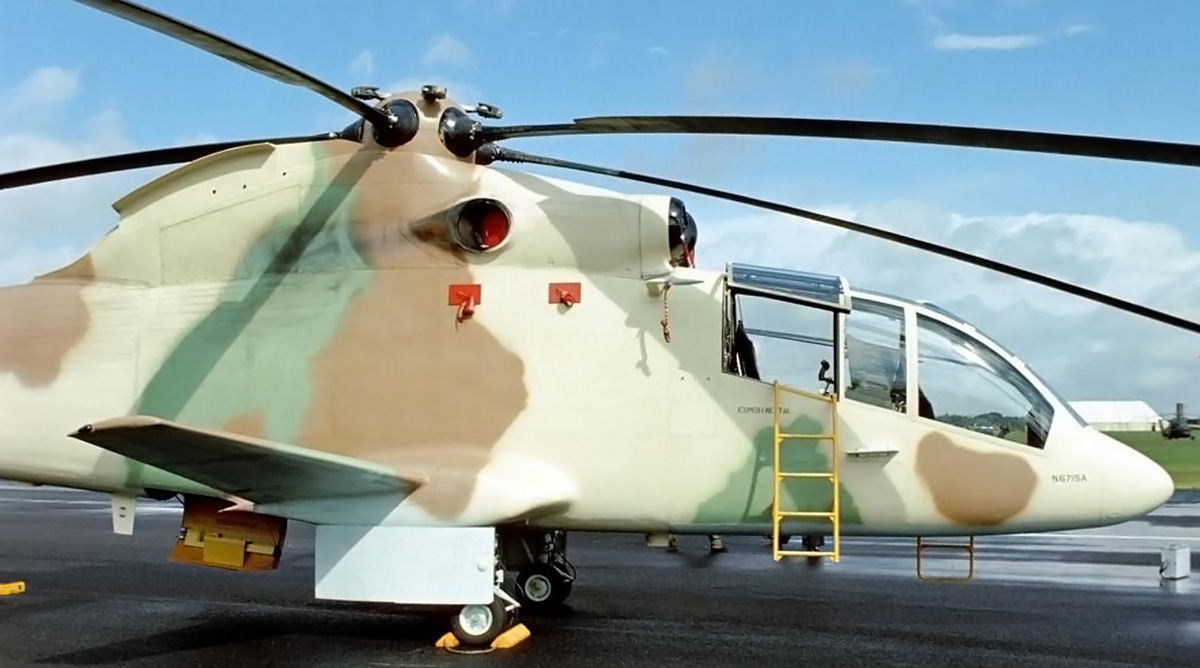
After the fan-in-tail rotor tests, a small door was added on the left side of the fuselage to access the compartment behind the cockpit. Initially, access was gained (with some difficulty) via the door under the fuselage (seen above). The S-67 was then painted a light desert camouflage, and this was the helicopter’s final configuration.

With no interest from the US Armed Forces, Sikorsky offered the S-67 for export. In late 1972, the S-67 was taken on a two-month tour of Europe and the Middle East. More than 7,500 miles (12,070 km) were covered, and the helicopter was flown for 136 hours. Despite interest from Israel, no orders were placed. Sikorsky then modified the S-67 to test a fan-in-fin tail rotor installation. A 4 ft 8 in (2.6 m), seven-blade rotor was installed in the modified tail. The helicopter underwent flight tests, including a dive at 230 mph (370 km/h). After the tests in 1974, the S-67’s tail was converted back to its previous configuration (with rudders), and a door to access the rear compartment was installed in the helicopter’s left side. The S-67 was then painted a light desert camouflage. The data from the fan-in-fin test was used for the Sikorsky H-76 fantail demonstrator, which tested the tail configuration later used in the Boeing-Sikorsky RAH-66 Comanche.
Sikorsky S-67 Blackhawk inverted

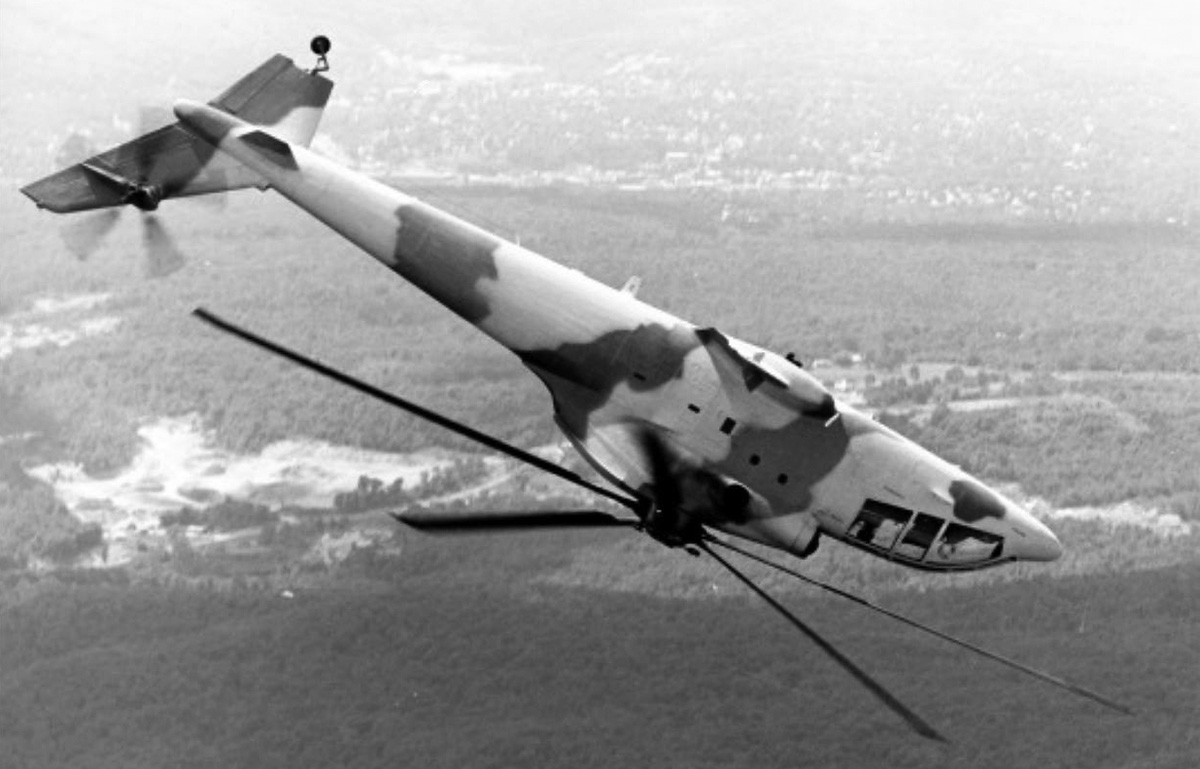
The S-67 made hundreds of rolls in its lifetime, but they were always to the right. The square in the fuselage above the wing is the window in the new rear compartment access door. What appear to be two rectangular windows can be seen father aft. Note the helicopter’s rudders and deployed air brakes.

On 26 August 1974, the S-67 arrived in the United Kingdom to start another European tour. On 1 September 1974, the S-67 was destroyed after failing to recover from a second roll during a practice session for the upcoming Farnborough Air Show. The copilot, Stu Craig, was killed in the crash, and the pilot, Kurt Cannon, died from his injuries nine days later. The accident was caused by the second roll being initiated in a less than ideal configuration combined with low altitude. However, the accident investigators believed that the crash was survivable had the helicopter been fitted with five-point harnesses rather than four-point harnesses. The S-67 had accumulated 598.7 hours at the time of the crash.

With the prototype destroyed and no interest from the US military, Sikorsky decided to end the S-67 Blackhawk program. Its swept-tip rotor blades were developed into those used on the Sikorsky S-70/UH-60 Black Hawk (the name similarity is a coincidence) and other helicopters. The S-67’s speed record stood for eight years until it was broken on 21 September 1978 by the Soviet Mil A-10 (modified Mi-24B) at 228.9 mph (368.4 km/h).
Sikorsky S-67 Blackhawk crash

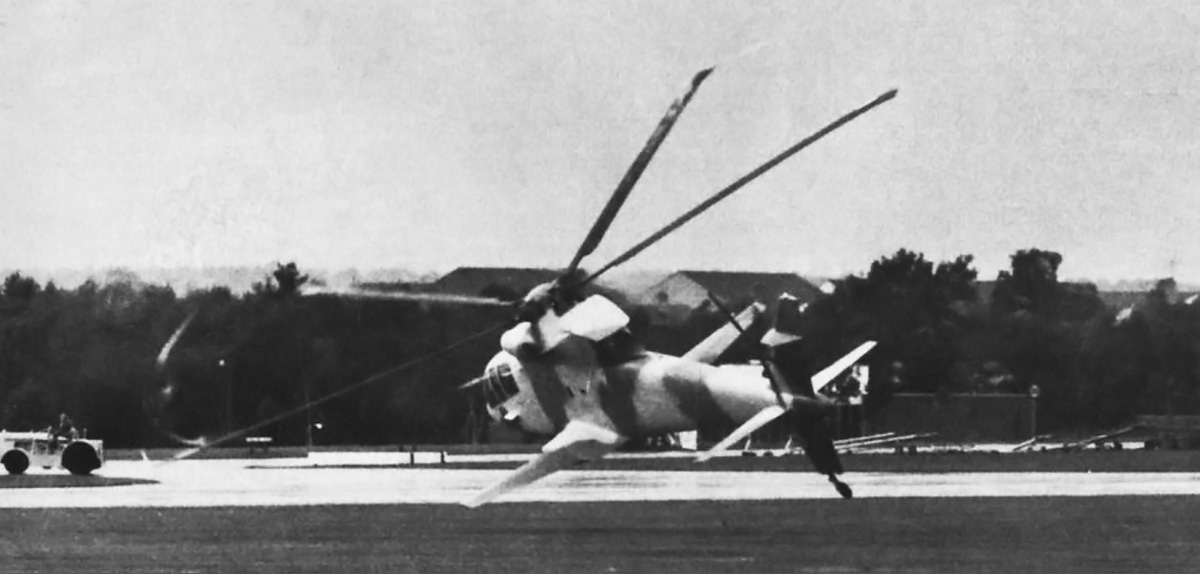
The S-67 tries to recover from a roll a split second before it impacts the ground. The helicopter’s low altitude left no room to recover from the roll, which was rushed and initiated in a flawed manner. The crash would ultimately kill the pilot and copilot and end the S-67 program.

Sources:
http://www.sikorskyarchives.com/S-67%20BLACKHAWK.php
https://en.wikipedia.org/wiki/Sikorsky_S-67_Blackhawk
http://www.aviastar.org/helicopters_eng/sik_s-67.php
http://1000aircraftphotos.com/Contributions/Visschedijk/6269.htm
– “Blackhawk’s Last Flight” Aeroplane Monthly (June 1976)
Attack Helicopter Evaluation, Blackhawk S-67 Helicopter by George M. Yamakawa, et al (July 1972)
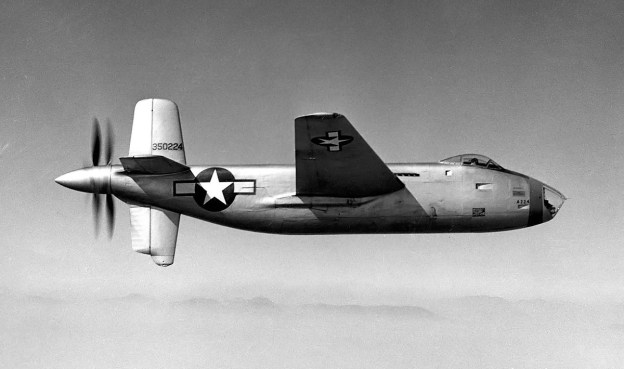
Douglas XB-42 no1 in flight

Douglas XB-42 Mixmaster Attack Bomber

By William Pearce

In the early 1940s, Edward F. Burton began to investigate ways to simplify bomber aircraft. Burton was the Chief of Engineering at the Douglas Aircraft Company (Douglas), and he had noted that each subsequent generation of bomber aircraft was substantially larger, more complex, and more expensive than the preceding generation. Burton and his team started with a clean sheet of paper and designed what would become the XB-42.

Douglas XB-42 no1 in flight

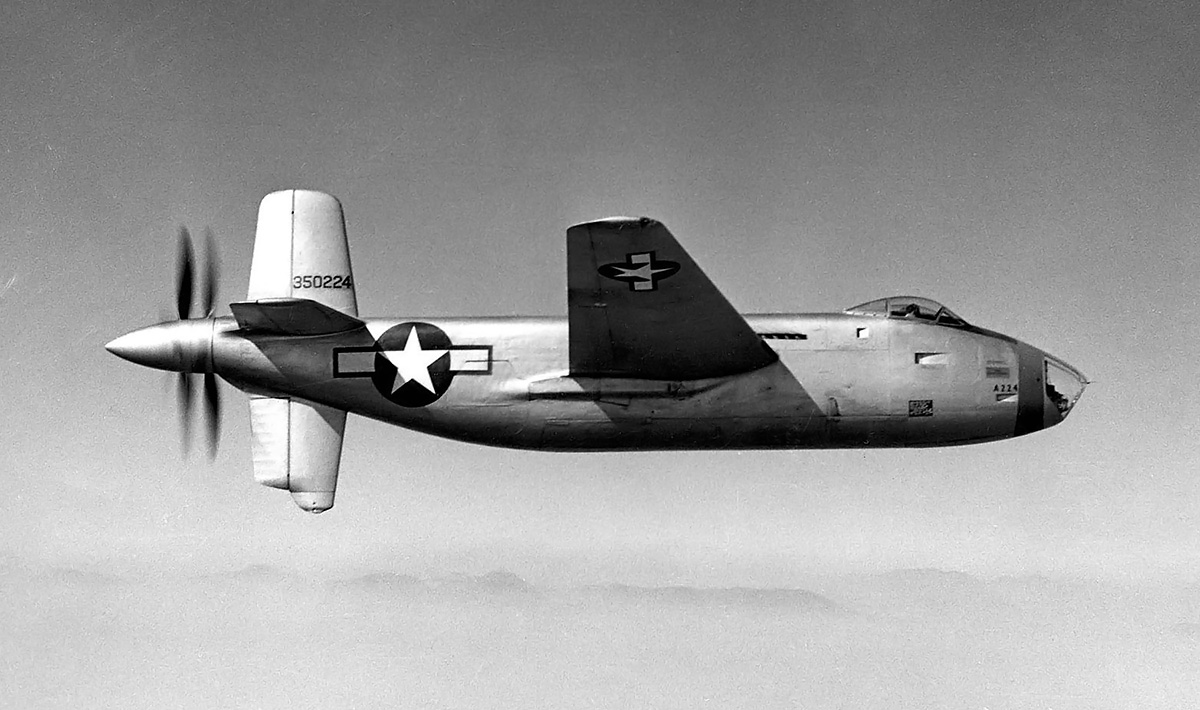
The Douglas XB-42 Mixmaster had a unique design that provided very good performance. However, it was too late for World War II and too slow compared to jet aircraft. The first prototype (43-50224) is seen with its short tail on an early test flight.

Acting on their own, with no official United States Army Air Force (AAF) requirement, Burton and his team worked to design a two-engine tactical bomber with a top speed of over 400 mph (644 km/h) and that was capable of carrying 2,000 lb (907 kg) of bombs to a target 2,500 miles (4,023 km) away. The aircraft’s high speed would eliminate the need for extensive defensive armament, which would minimize the bomber’s crew and save weight. Burton’s team placed the wings, tail, and propellers in their optimal positions; the designers then filled in the rest of the aircraft with the needed equipment. What emerged from the drafting table was the Douglas Model 459: a mid-wing aircraft operated by a crew of three. At the rear of the aircraft were a set of coaxial contra-rotating pusher propellers driven by engines buried in the fuselage. In May 1943, Douglas proposed the aircraft to the AAF, and they were sufficiently impressed to order two prototypes and a static test airframe on 25 June 1943.

The AAF originally gave the aircraft the Attack designation XA-42. Douglas had presented the aircraft in a variety of roles that suited the Attack aircraft profile. However, the aircraft was reclassified as a bomber and redesignated XB-42 on 25 November 1943. Unofficially, the XB-42 was given the name Mixmaster, on account of its eight contra-rotating propeller blades loosely resembling a popular kitchen mixer.

The Douglas XB-42 Mixmaster was a unique aircraft. It was an all-metal aircraft with a tricycle landing gear arrangement, which was novel at the time. A plexiglass nose covered the bombardier’s position. Atop the fuselage were two separate bubble canopies for the pilot and copilot. At the rear of the aircraft was a cruciform tail; its ventral fin contained an oleo-pneumatic bumper to protect the propellers from potential ground strikes during takeoff and landing.

Douglas XB-42 no1 nose

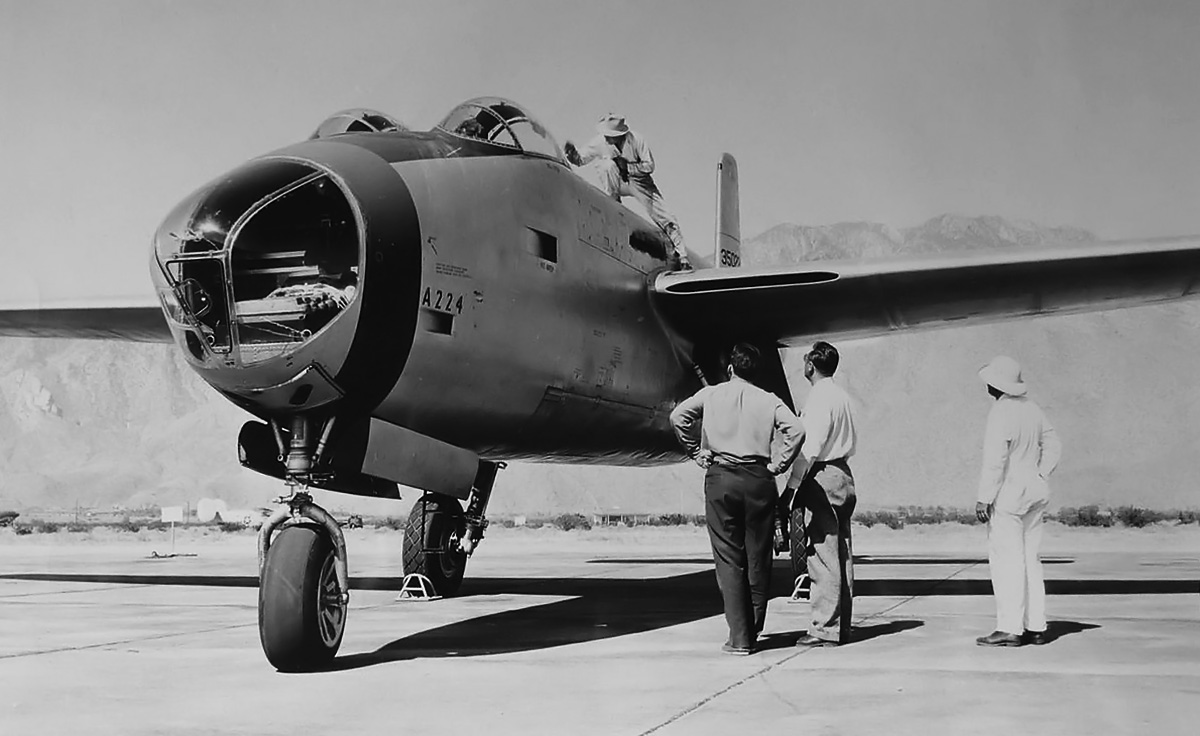
Nose view of the first prototype shows the twin bubble canopies to advantage. Both XB-42 aircraft were originally built with the canopies, but they were disliked. The second aircraft was later modified with a more conventional canopy.

The aircraft’s long wing used a laminar flow airfoil and was fitted with double-slotted flaps. An inlet in the wing’s leading edge led to the engine oil cooler and radiator, both fitted with electric fans for ground operation. After air flowed through the coolers, it was expelled out the top of the wing. The main landing gear retracted back into the sides of the fuselage, below and behind the wings. The complex retraction required the gear legs and wheels to rotate 180 degrees. Fuel tanks in each wing carried 330 gallons (1,249 L) of fuel. Four additional 275 gallon (1,041 L) fuel tanks could be installed in the bomb bay to extend the aircraft’s range. In addition, a 300 gallon (1,136 L) drop tank could be installed under each wing.

Housed in the fuselage behind the cockpit were two Allison V-1710 engines. Each engine was installed with its vertical axis tilted 20 degrees out from center, and the engines were angled toward the tail. Ducts flush with the aircraft’s skin and positioned below the cockpit on both sides of the aircraft brought induction air to the engines. A row of exhaust stacks was located above the leading edge of each wing, and two rows of exhaust stacks were positioned along the aircraft’s spine. The engines of the first XB-42 prototype produced 1,325 hp (988 kW) at takeoff and 1,820 hp (1,357 kW) at war emergency power. The second prototype had engines that produced 1,675 hp (1,249 kW) for takeoff and 1,900 hp (1,417 kW) for war emergency power.

Douglas XB-42 no2 gear retract

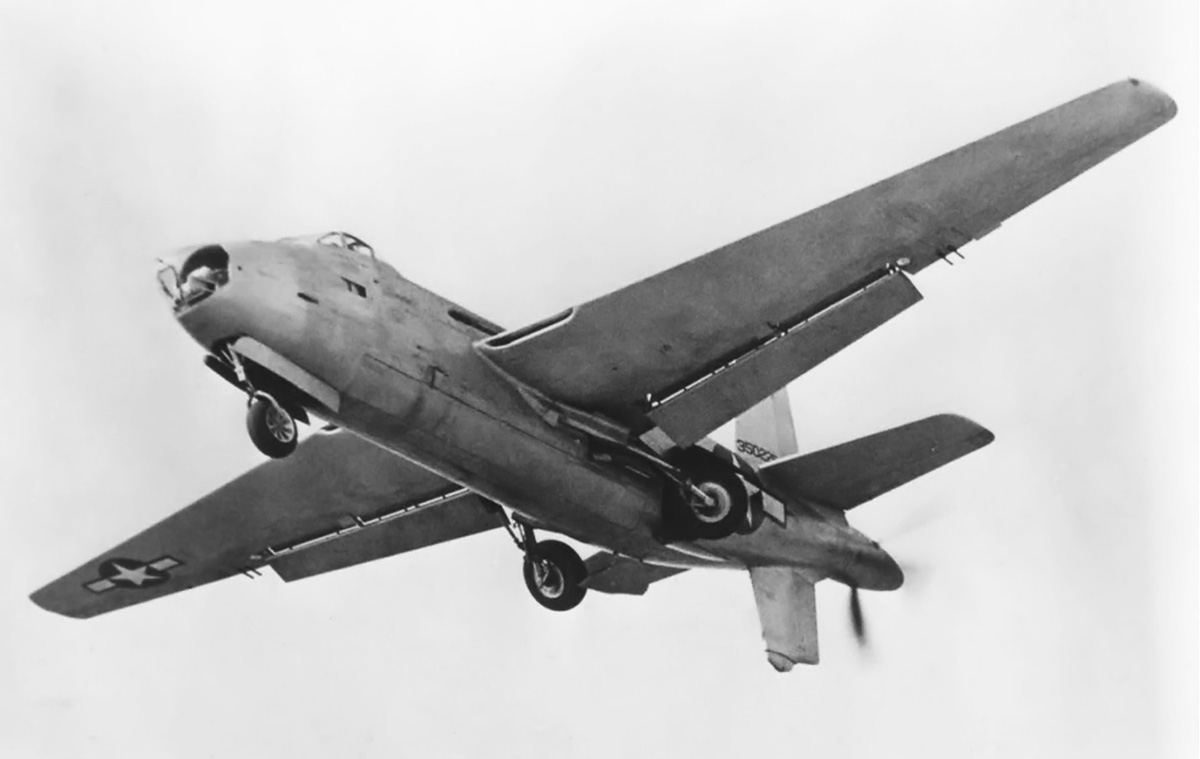
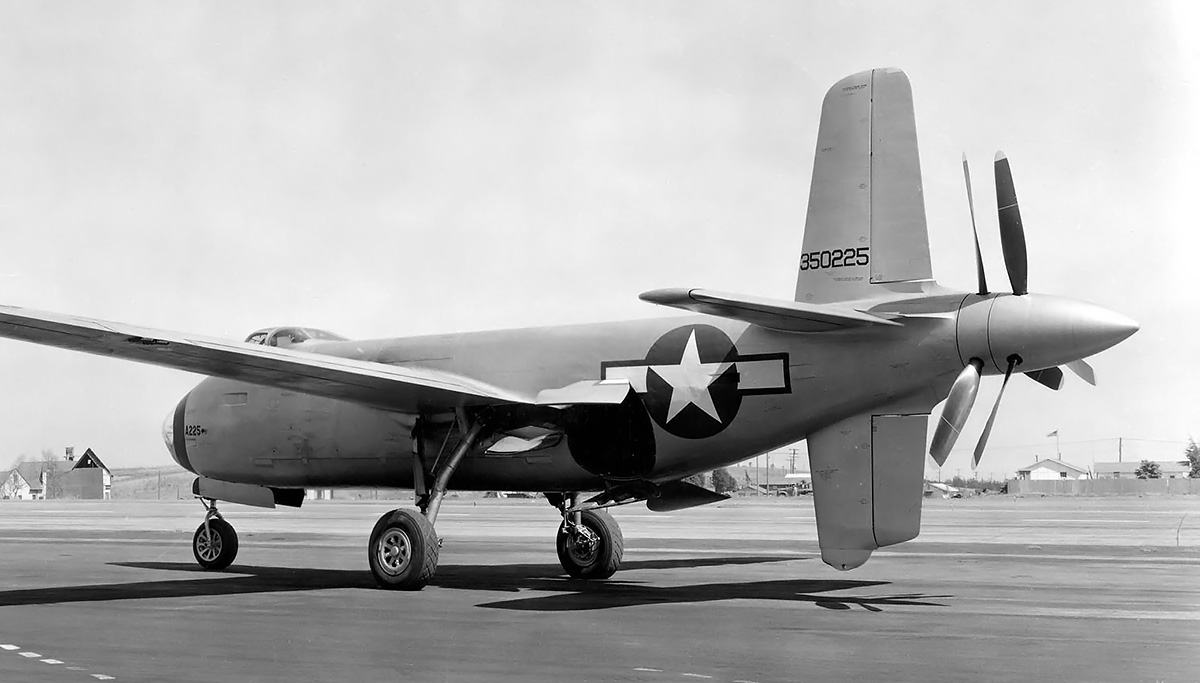
An unusual view of the second prototype (43-50225) that displays the aircraft’s slotted flaps and uncommon main gear retraction that required the legs and wheels to rotate 180 degrees into the fuselage sides. Also visible are the wing guns and revised leading edge inlets, both features exclusive to the second prototype.

Extending from each engine was an extension shaft made up of six sections. The shaft sections were like those used in the Bell P-39 Airacobra (which used two sections). The shafts extended around 29 ft (8.8 m) and connected the engines to a remote, contra-rotating gear reduction box from an Allison V-3420-B engine. The gearbox had been slightly modified for the XB-42 and used a .361 gear ratio that was unique to the aircraft. Each engine turned a three-blade Curtiss Electric propeller. The left engine drove the forward propeller, which was 13 ft 2 in (4.01 m) in diameter. The right engine drove the rear propeller, which was 13 ft (3.96 m) in diameter. The engines and propellers were operated independently—if needed, one engine could be shut down and its propeller feathered while in flight.

To eliminate the danger the propellers presented to the crew during a bail out, a cord of explosives (cordite) was threaded through holes carefully drilled around the gearbox mount. Before bailing out, the crew could detonate the explosives, which would separate the gearbox and propellers from the aircraft.

Douglas XB-42 Allison engine test

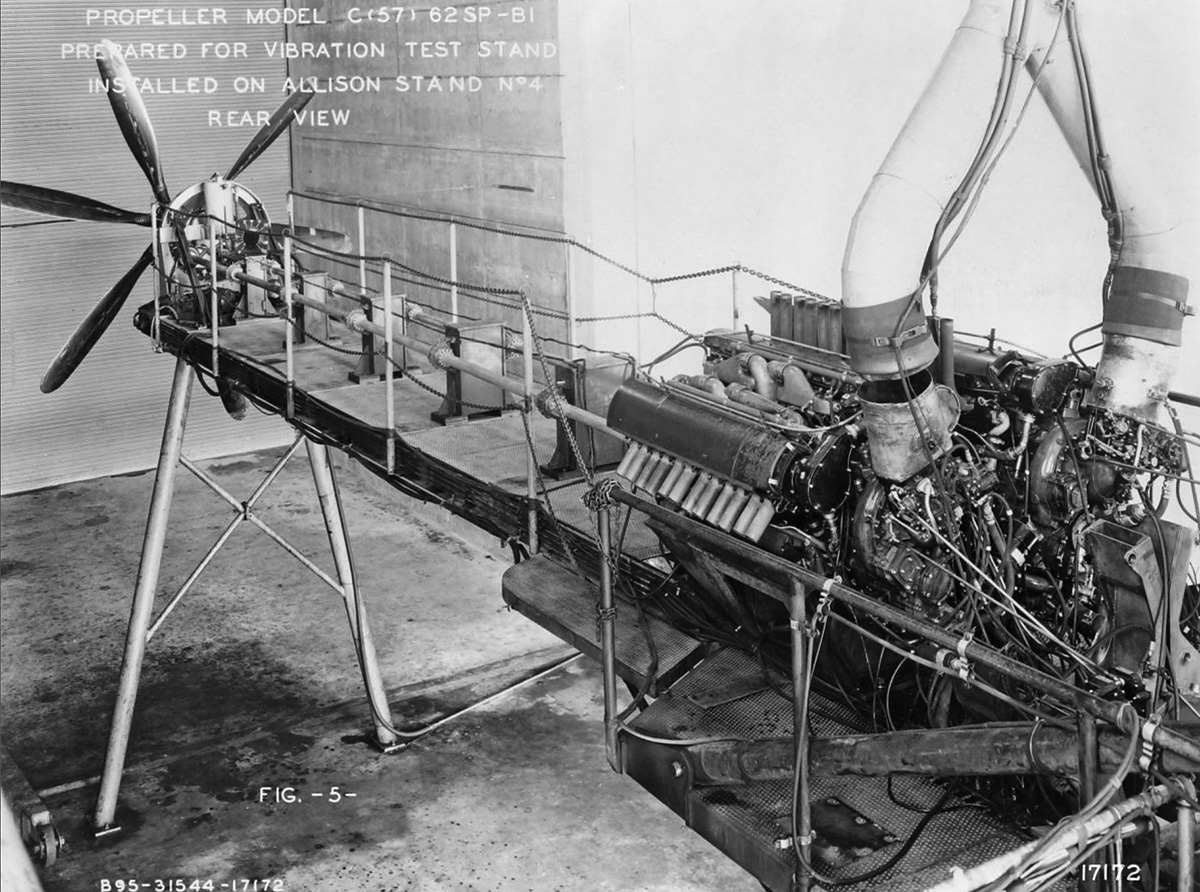
Two Allison V-1710 engines connected to the V-3420 remote gear reduction for the contra-rotating propellers as used on the XB-42. The power system accumulated over 600 hours on the test stand and never caused serious issues during the XB-42 program.

The XB-42’s bomb bay was covered by two-piece, snap-action doors. The bay accommodated 8,000 lb (3,629 kg) of bombs, or a single 10,000 lb (4,536 kg) bomb could be carried if the doors were kept open six inches. The bay was long enough to carry two 13 ft 9 in (4.2 m) Mk 13 torpedoes. Two fixed .50-cal machine guns with 500 rpg were installed in the aircraft’s nose. Housed in the trailing edge of each wing, between the aileron and flap, were a pair of rearward-firing .50-cal machine guns, each with 350 rpg. The guns were concealed behind snap-action doors. Once exposed, the guns could be angled through a range of 30 degrees up, 15 degrees down, and 25 degrees to the left or right. Their minimum convergence was 75 ft behind the aircraft. The rear-firing guns were operated by the copilot, who rotated his seat 180 degrees to use the gun’s sighting system.

Douglas designers envisioned that the B-42 aircraft could be fitted with a solid nose containing different weapons for different roles. This is the same concept that was applied to the Douglas A-20 Havoc and A-26 Invader. Three of the possible B-42 nose configurations were as follows: eight .50-cal machine guns; two 37 mm cannons and two .50-cal machine guns; or a 75 mm cannon and two .50-cal machine guns. Douglas also thought the aircraft’s speed and range would make it very useful in a reconnaissance role. None of these plans made it off the drawing board.

The XB-42 had a 70 ft 6 in (21.49 m) wingspan and was 53 ft 8 in (16.4 m) long. Originally, the aircraft was 18 ft 10 in (5.7m) tall, but the tail and rudder were extended to cure some instability. The extension increased the XB-42’s height to 20 ft 7 in (6.3 m). A brochure published by Douglas in April 1944 predicted the B-42 would be able to carry 2,000 lb (907 kg) of bombs over 5,333 miles (8,583 km) and have a top speed of 470 mph (756 km/h). These numbers proved very optimistic. Perhaps the speed was a misprint, because some sources indicate the anticipated top speed was 440 mph (708 km/h). Regardless, the aircraft only achieved 410 mph (660 km/h) at 23,440 ft (7,145 m), and its cruising speed was 312 mph (502 km/h). The XB-42 had an empty weight of 20,888 lb (9,475 kg) and a maximum weight of 35,702 lb (16,194 kg). The aircraft’s service ceiling was 29,400 ft (8,961 m). Its combat range was 1,800 miles (2,897 km), but additional fuel tanks in the bomb bay could extend the XB-42’s range to a maximum of 5,400 miles (8,690 km).

Douglas XB-42 no2 rear

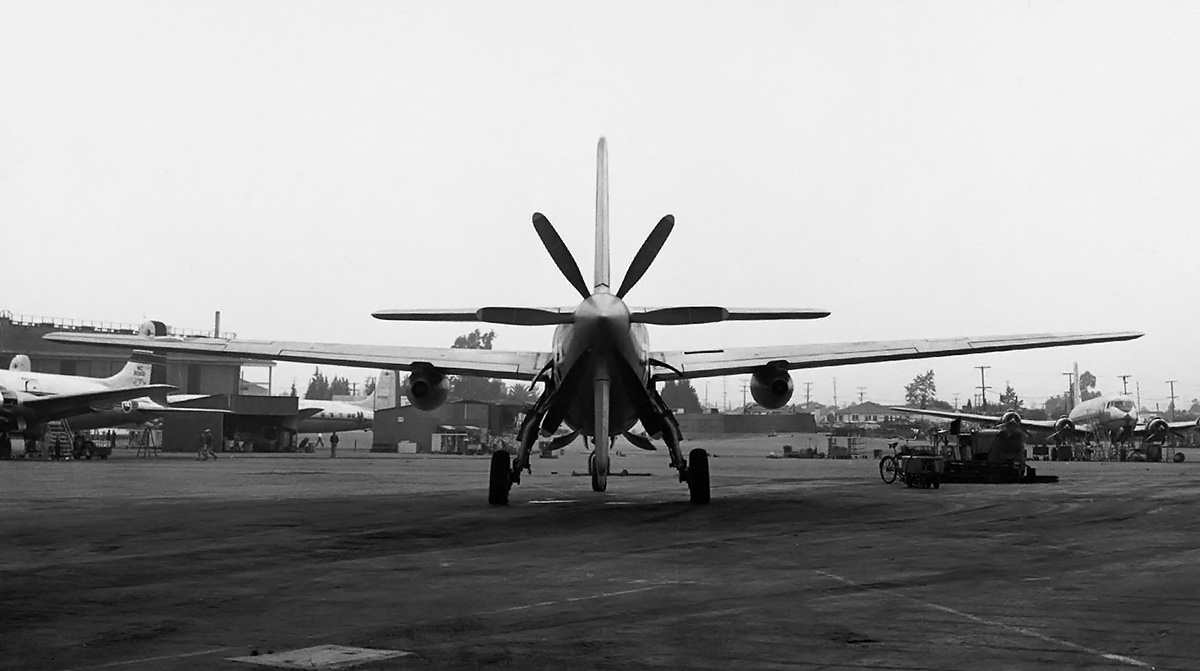
Rear view of the second prototype shows the ventral tail and rudder. Note the oleo-pneumatic bumper on the tail and its minimal ground clearance. The wing guns and new canopy are just barely visible.

Construction of the XB-42 proceeded rapidly. The AAF inspected and approved an aircraft mockup in September 1943, and the first prototype (43-50224) was completed in May 1944—one year after the aircraft was proposed and 10 months after the contract was awarded. The XB-42 flew for the first time on 6 May 1944, flown by Bob Brush and taking off from the Palm Springs Army Airfield in California. The second prototype (43-50225) flew for the first time on 1 August 1944, taking off from Santa Monica Airport in California.

Both XB-42s were originally fitted with separate bubble canopies. This cockpit layout was not very popular with the pilots. Although they could communicate via intercom, the pilots often found themselves leaning forward to speak with one another face to face under the canopies. The second aircraft was modified with a more conventional single canopy that encompassed both pilot and copilot. While the bubble canopies reduced drag, the single canopy was preferred. Another issue facing the aircraft was that cracks formed in the plexiglass nose. After the plexiglass was replaced several times, the nose was eventually covered with plywood.

Both prototypes were heavier than expected, which reduced performance. Some work went into lightening the second aircraft, like the use of hollow propeller blades. However, issues with vibrations occurred when disturbed air encountered the propellers, and this phenomenon was exacerbated by the hollow blades. No issues were encountered when the aircraft was clean, but when the bomb bay doors were open or when the gear or flaps were deployed, the vibration issue occurred. Some pilots lived with the vibrations and dismissed the issue, but other pilots found it very disconcerting. An improved propeller was designed that featured reversible blades to decrease landing roll and to slow the aircraft in flight. However, it was cancelled in March 1945 and was never built.

Douglas XB-42 no2 with canopy

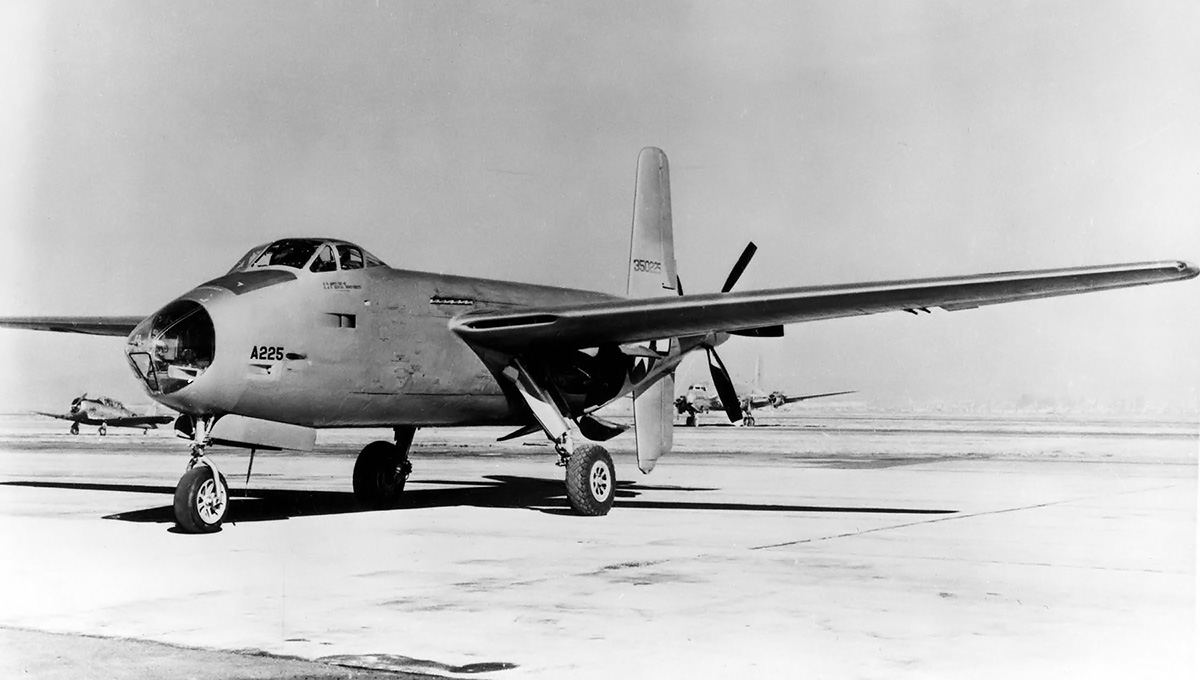
Front view of the second prototype illustrates the aircraft’s revised canopy. The canopy on production aircraft would have been similar but more refined. Again, note the tail clearance and wing guns.

Some cooling issues were encountered, and modifications to the air intakes were made to improve airflow. The main gear was also modified a few times to improve its retraction and performance. Overall, the aircraft flew well, but the controls were not well harmonized. In addition, the XB-42 aircraft would encounter a slow dutch roll oscillation if not counteracted by the pilot. As previously mentioned, the tail of the aircraft was enlarged to resolve the issue, but it was never entirely solved. The XB-42 required a very long takeoff run of some 6,415 ft (1,955 m). Because there was only about 9 in (.23 m) of clearance between the ventral tail and the ground, the aircraft needed to build up a substantial amount of speed before it was carefully rotated for liftoff.

The second XB-42 prototype was the only aircraft to have revised wing inlets and to be fitted with its machine gun armament, although the guns were never tested. The second aircraft was flown around 70 hours before it was turned over to the AAF. On 8 December 1945, Lieutenant Colonel Henry E. Warden and Captain Glen W. Edwards flew the second XB-42 from Long Beach, California to Bolling Field in Washington, D.C. The record-setting, point-to-point flight covered 2,295 miles (3,693 km) in a time of 5:17:34—an average of 433.6 mph (697.8 km/h). The XB-42 had benefited from a favorable tailwind, and the aircraft’s average true airspeed was around 375 mph (604 km/h).

Douglas XB-42 wing guns

The guns in the left wing are seen aimed 30 degrees up and 25 degrees inboard. Only the second aircraft was fitted with the guns, and they were never tested. Note the snap-action doors that covered the guns. When open, the doors increased the XB-42’s directional stability, resulting in additional rudder force to give the desired yaw.

On 16 December 1945, the second XB-42 was lost during a test flight near Bolling Field. The aircraft was in a landing configuration when there was an issue with extending the landing gear. While the crew was troubleshooting the problem, the left engine began to overheat and then died. The right engine was taken to full power and began to overheat. The decision was made to bail out, and two of the crew safely jumped free before the pilot remembered to jettison the propellers. The propellers and their gearbox were successfully severed from the XB-42, and the pilot bailed out. All three crew members survived the ordeal without any injuries, but the aircraft was completely destroyed.

An exact cause of the crash was never determined, but it was speculated that the coolant doors were inadvertently left in their nearly-closed landing configuration while the crew investigated the gear issue. This resulted in the engines overheating. At the same time, a fuel tank switch was made a bit late and probably led to fuel starvation of the left engine. The second XB-42 had accumulated a little over 118 hours of flight time when it crashed.

The first XB-42 prototype had made 42 flights and accumulated over 34 flight hours by 30 September 1944. A year later, that number rose to around 150 flights, with the aircraft accumulating around 125 flight hours. Before the XB-42 had even flown, Douglas contemplated adding jet engines to the aircraft. An official proposal for the modification was submitted on 23 February 1945. The proposal was approved on 8 March 1946, and modifications to the aircraft began on 26 June 1946. At the time, the first XB-42 had made 168 flights and had flown around 144.5 hours. The two Westinghouse 19XB-2A (J30) jet engines were finally delivered in October 1946 and were installed on the aircraft.

Douglas XB-42A rear

Rear view of the XB-42A illustrates the notches in the new flaps to avoid the jet exhaust. The rest of the aircraft remained relatively unchanged from the XB-42 configuration. The cooling air exit can be seen on the right wing. Note the various Douglas aircraft in the background.

With the jet engines added to the first prototype, the aircraft was redesignated as the Douglas XB-42A. The 1,600 lbf (7.12 kN) thrust jet engines were mounted under the aircraft’s wings. New flaps were installed that were notched behind the jet engines. The notches allowed the flaps to avoid the jet exhaust when they were deployed. The fuel tanks in the wings were modified because of the jet engine mounts. Total wing tankage was decreased by 154 gallons (583 L), but two additional 74 gallon (280 L) tanks were installed in the fuselage. The jets themselves burned the same fuel as the piston engines. The aircraft’s instrumentation was also modified to accommodate the jet engines.

The XB-42A is listed as having a 70 ft 7 in (21.51 m) wingspan and a length of 53 ft 10 in (16.4 m). In reality, the wingspan was probably the same as the XB-42, and the length was slightly longer due to a different spinner. The aircraft’s height was 20 ft 7 in (6.3 m). The XB-42A had a predicted maximum speed of 488 mph (785 km/h) but only achieved 473 mph (761 km/h) at 14,000 ft (4,267 m); cruising speed was 442 mph (711 km/h). The XB-42A had an empty weight of 24,775 lb (11,238 kg) and a maximum weight of 44,900 lb (20,366 kg). The aircraft’s service ceiling was 34,500 ft (10,516 m). The XB-42A had a normal range of around 1,200 miles (1,931 km), but a maximum range of 4,750 miles (7,644 km) could be achieved with additional fuel tanks in the bomb bay.

Douglas XB-42A

The XB-42A makes a low pass over Muroc Air Base during an early test flight. Note the exhaust stains above the wing and the oil stains below the wing. The aircraft was outclassed by other jet aircraft, including its XB-43 cousin.

The first flight of the XB-42A (still 43-50224) occurred on 27 May 1947 at Muroc (now Edwards) Air Base in California. The aircraft required a lot of maintenance and did not prove remarkable in any category to justify further development. Despite the increased performance, the XB-42A was perched on the awkward dividing line between piston-powered aircraft of the past and jet-powered aircraft of the future. There is no better indicator of this than the fact that Douglas had already moved forward with an all-jet XB-42 aircraft, designated XB-43. The Douglas XB-43 Jetmaster had its jet engines buried in the fuselage, near were the Allison engines were installed on the XB-42. The first XB-43 was built using the XB-42 static test airframe. The jet-powered XB-43 made its first flight on 17 May 1946—little more than a year before the jet/piston-powered XB-42A first flew. The XB-42A made only 23 flights, accounting for a little under 18.5 hours of flight time.

With technological progress outpacing the XB-42A, the aircraft was donated to the Air Force Museum on 30 June 1949. It was later moved to the National Air and Space Museum’s Paul Gerber Facility in Silver Hill, Maryland, where it was stored for a number of years. In 2010, the XB-42A was transferred to the National Museum of the United States Air Force in Dayton, Ohio. The aircraft, along with second XB-43 prototype, will eventually be restored for static display.

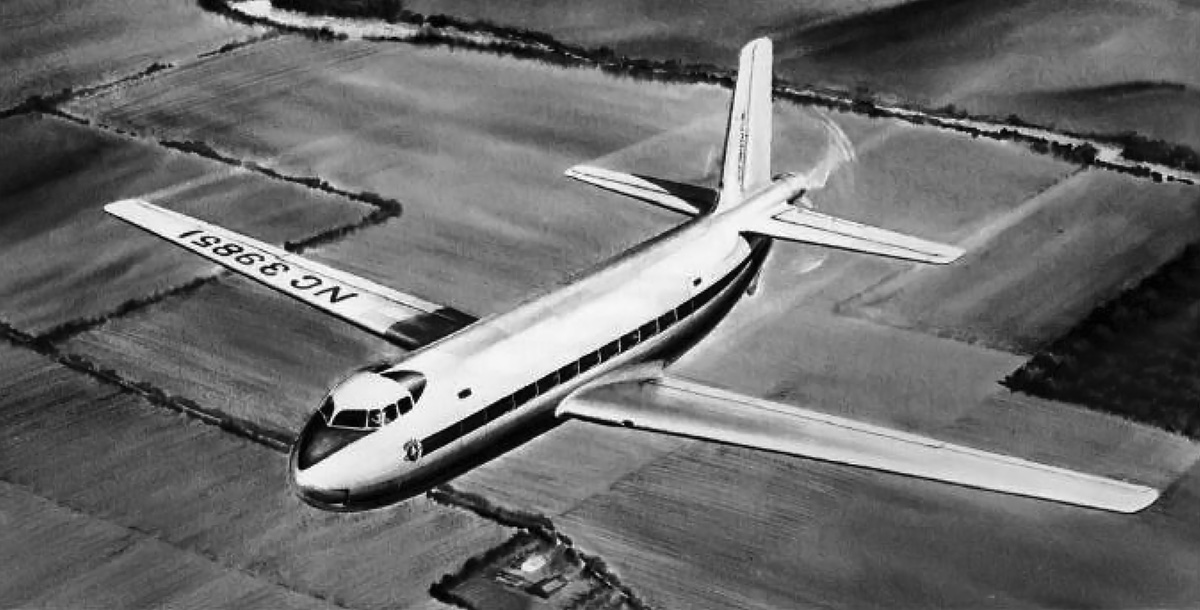
Douglas persisted with the pusher configuration and designed a number of other military and commercial aircraft. The most developed design was that of the Model 1004, which was actually designated DC-8. Known as the Skybus, the aircraft was similar to an XB-42, but with an extended fuselage for airline service. The aircraft could seat a maximum of 48 passengers, and the extension shafts from the Allison engines traveled under the passenger compartment. First proposed in October 1945, the Skybus was never built, and the DC-8 designation was reapplied to Douglas’s first jet airliner.

Douglas DC-8 Skybus

Although visually similar to the XB-42, the Douglas DC-8 Skybus was an entirely new design. The aircraft’s excellent performance and great single-engine handling was not enough to justify its expense over more conventional designs.

Sources:
American Bomber Development in World War 2 by Bill Norton (2012)
Vee’s for Victory! The Story of the Allison V-1710 Aircraft Engine 1929-1948 by Daniel D. Whitney (1998)
McDonnell Douglas Aircraft since 1920: Volume I by René J Francillon (1979/1988)
The Allison Engine Catalog 1915–2007 by John M. Leonard (2008)
– “The First, The Last, and the Only” by Walt Boyne, Airpower Vol. 3 No. 5 (September 1973)
– “The Douglas DC-8 Skybus” by R. E. Williams, Douglas Service Vol. 41 (second quarter 1984)
http://www.enginehistory.org/Propellers/Curtiss/XB-42Prop.shtml