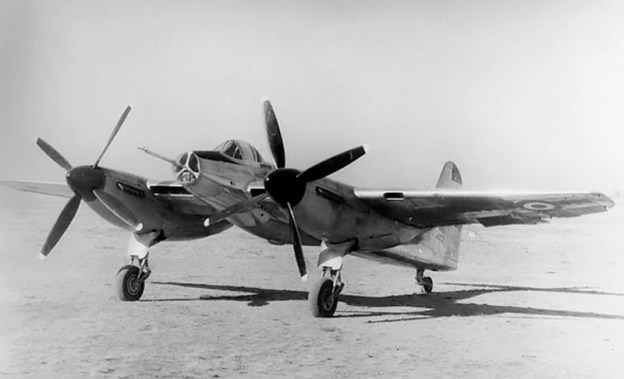
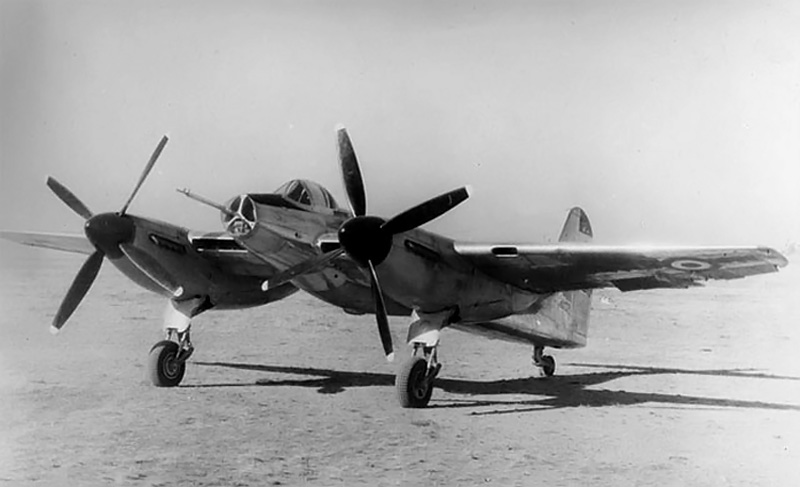
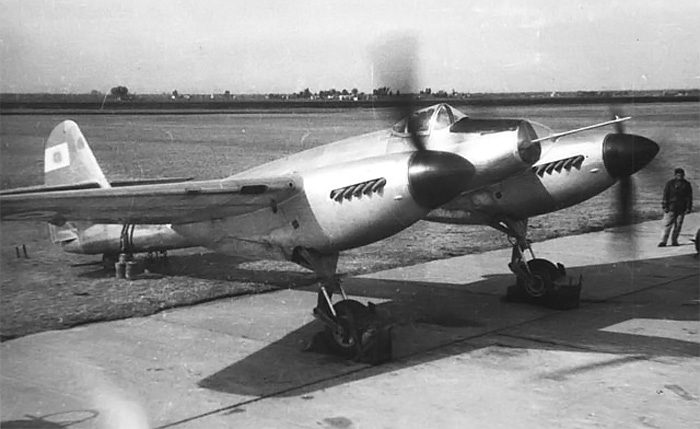
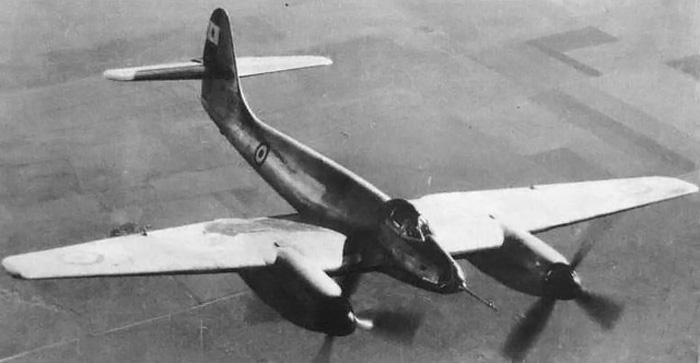
Category Archives: Aircraft

Bolkhovitinov S-2M-103 Sparka

By William Pearce

With the intention of creating a high speed light bomber, Viktor Bolkhovitinov designed what is commonly referred to as the Bolkhovitinov S or Sparka. During flight trials the Soviet Air Force (VVS) referred to the aircraft as S-2M-103, for skorostnoy (high speed) with two M-103 engines; however, a number of other designations have been applied over the years. The common “Sparka” designation means twin—because the aircraft had two engines mounted in tandem. Other designations are BBS-1 for blizhniy bombardirovshchik skorostnoy (short range bomber, high-speed), BB for blizhniy bombardovshchik (short range bomber), and LB-S for lyohkiy bombardirovshchik-sparka (light bomber-paired).
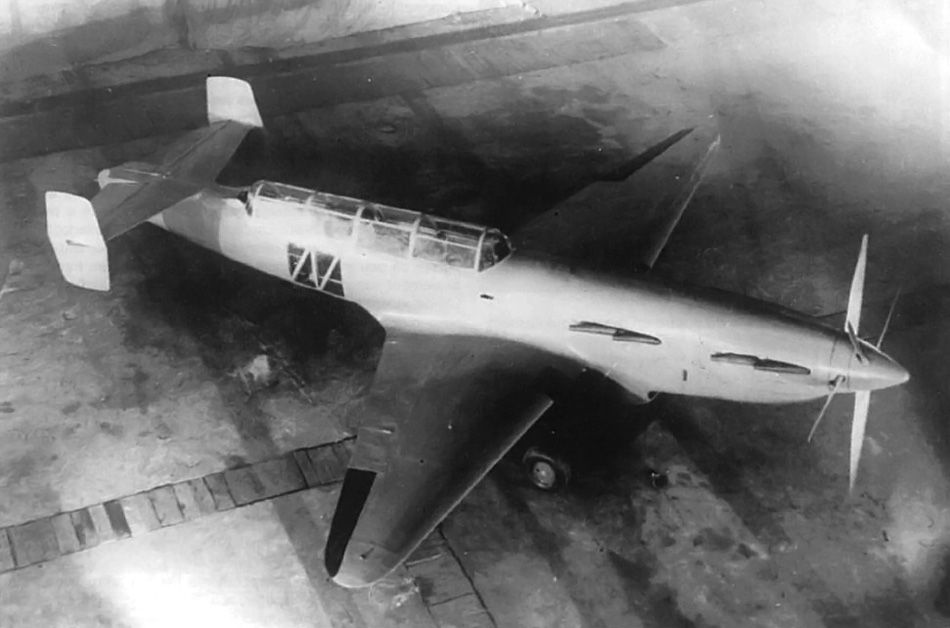
A good view of the twin engine Bolkhovitinov Sparka. Note the plexiglass glazing for the bombardier's downward view.

A good view of the twin-engine Bolkhovitinov Sparka. Note the plexiglass glazing for the bombardier’s downward view.

The Sparka was a low-wing aircraft of all-aluminum construction with stressed skin. The aircraft had a twin fin tail to increase the rear gunner’s field of fire. The undercarriage was fully retractable; the main gear retracted toward the rear, and the wheels rotated 90 degrees to lie flat within the wings. The pilot and navigator/bombardier/gunner sat in tandem under a long canopy. Between the pilot and second crew member was a small bomb bay for 882 lb (400 kg) of bombs. A plexiglass section on the bottom of the aircraft just aft of the bomb bay provided the bombardier a view of the ground. The aircraft was 43 ft 4 in (13.2 m) long and had a relatively short wingspan of 37 ft 4 in (11.38 m). The Sparka weighed 12,460 lb (5,652 kg).

The Sparka was powered by two Klimov M-103A engines positioned in tandem in the aircraft’s nose. This coupled engine package was designated M-103SP. Each engine drove half of the aircraft’s six-blade, coaxial contra-rotating propeller unit. This engine and propeller arrangement was similar to the FIAT AS.6 installed in the Italian MC.72 and the Hispano-Suiza 12Y installed in the French Arsenal VB 10. With this engine arrangement, the front engine drove the rear propeller, and the rear engine drove the front propeller via a drive shaft that ran through the Vee of the front engine.
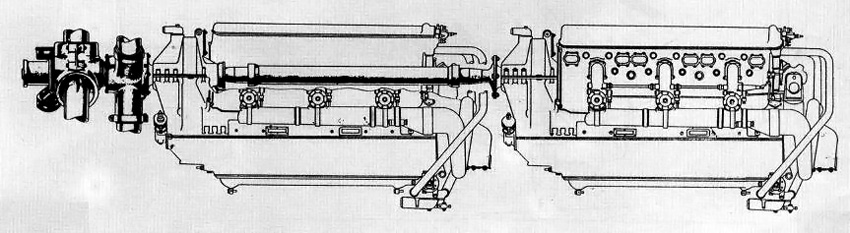
Schematic of the paired Kimlov M-103 engines installed in the Bolkhovitinov Sparka with the rear engine's drive shaft through the Vee of the front engine.

Schematic of the paired Klimov M-103 engines installed in the Bolkhovitinov Sparka with the rear engine’s drive shaft passing through the Vee of the front engine.

The Klimov M-103 engine was derived from the M-100, which was a licensed copy of the Hispano-Suiza 12Ybrs. The M-103SP had a 5.83 in (148 mm) bore and a 6.69 in (170 mm) stroke. Total displacement was 2,142 cu in (35.09 L). The engine produced 960 hp (716 kW). A radiator was installed in a large duct just below the rear engine, and it cooled both of the Sparka’s engines.

Bolkhovitinov started design work on the Sparka in 1937, and prototype construction began in July 1938. The aircraft made its first flight in January 1940 (some say late 1939) with B. N. Kudrin at the controls. VVS testing took place from March through July 1940. The Sparka showed good speed, reaching 354 mph (570 km/h). However, the takeoff run was excessive, landing speeds were high, and visibility over the nose was impaired. In addition, some trouble was encountered with the rear engine’s propeller drive shaft breaking due to excessive vibrations. Even so, the aircraft received a positive assessment, noting that the installation of the tandem engines eliminated a considerable amount of drag over two separate nacelles.
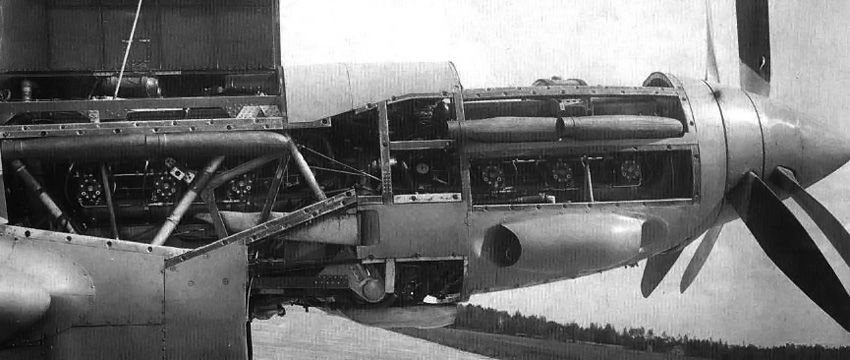
Engine bay view of the two Kimlov M-103 engines.

Engine bay view of the two Klimov M-103 engines.

A new wing was designed with a NACA-230 airfoil section to improve takeoff and landing performance. The aircraft was tested with this new wing from September to December 1940, and it did improve the aircraft’s takeoff and landing characteristics.

The Sparka was reconfigured for a single 1,050 hp (783 kW) Klimov M-105P (some say 103P) engine, which was installed in the forward engine bay. The M-105P was a development of the M-103P and could be fitted with a cannon in the engine’s Vee to fire through the propeller hub. The M-105P retained the bore and stroke of the earlier M-103P (and M-103SP) engine. The aircraft was tested on skis in early 1942 but was underpowered with the single M-105P, attaining a top speed of only 249 mph (400 km/h).
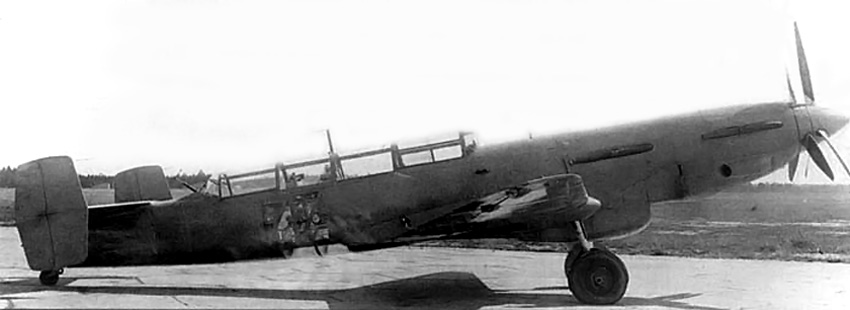
In this side view, the glazing on the bottom of the Sparka can clearly be seen.

In this side view, the glazing on the bottom of the Sparka can clearly be seen.

Some say the single engine version was really a separate aircraft (known as S-1) that flew in January 1940 to test the airframe configuration. This seems unlikely because of the time frame involved. The twin-engine Sparka (S-2) would have been nearly complete by the time the single engine airframe test ship first took to the air, making major changes impossible and minor changes difficult. If the airframe test ship had issues, there would not have been enough time for any changes to be made before the official trials took place in March 1940. Not to mention that adding the power and weight of another engine would change the aircraft’s flight dynamics considerably.
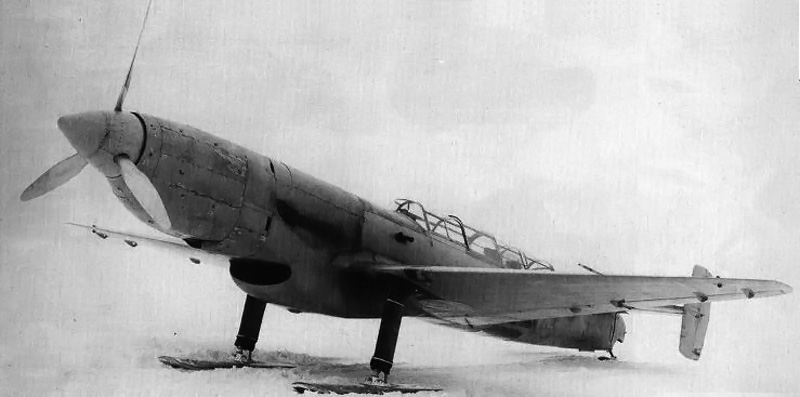
Bolkhovitinov S skis

The single-engined Bolkhovitinov S on skis.

Regardless, development on the Sparka was abandoned in mid-1941, partially a result of the German invasion. However, further studies were made on the feasibility of the tandem engine arrangement powering a fighter, but these studies did not lead to the production of any aircraft. In addition, the factory where the Sparka was built was needed to produce the Petlyakov Pe-2 attack bomber.

Rear view of the Sparka showing the defensive machine gun installation.

Rear view of the Sparka showing the defensive machine gun installation.

Sources:
Soviet X-Planes by Gordon and Gunston (2000)
Soviet Air Power in World War 2 by Yefim Gordon (2008)
Soviet Combat Aircraft of the Second World War, Vol. 2 by Gordon and Khazanov (1999)
Aircraft of the Soviet Union by Bill Gunston (1983)
Russian Piston Aero Engines by Vladimir Kotelnikov (2005)
http://www.secretprojects.co.uk/forum/index.php/topic,4532.msg152239.html#msg152239
http://en.wikipedia.org/wiki/Bolkhovitinov_S
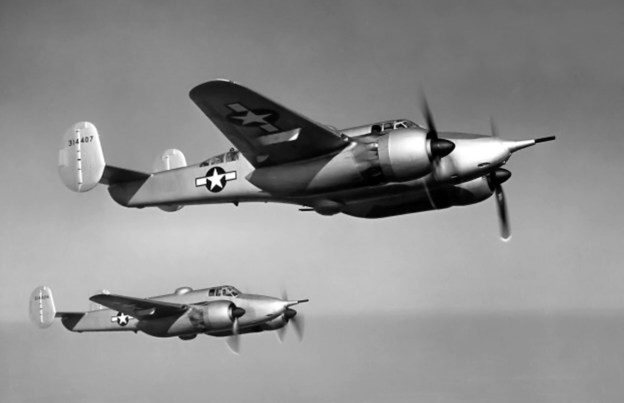
Beech XA-38 Grizzly air 2

Beech Aircraft Company XA-38 Grizzly

By William Pearce

In March 1942, the Beech Aircraft Company began design work on a two-seat heavy fighter to destroy enemy bombers. Since the Curtiss XP-71 had already been delegated this task, the Beech developed the design into an attack aircraft to replace the Douglas A-20 Havoc. Beech gave this aircraft the in-house designation Model 28 and submitted its proposal to the US Army Air Force on 23 September 1942. On 2 December 1942, the AAF ordered two prototypes and designated the aircraft XA-38; this was Beech’s first combat aircraft. Beech originally called the aircraft Destroyer, but the AAF changed the name to Grizzly. The XA-38 was similar in appearance to the Beech 18, but it was an all-new aircraft. The project was led by Bill Cassidy, and the aircraft was to be strong, maneuverable, and well-armed. Its mission was to destroy fortified gun emplacements, armored vehicles, tanks, submarines, and coastal surface vessels.

Beech XA-38 Grizzly air

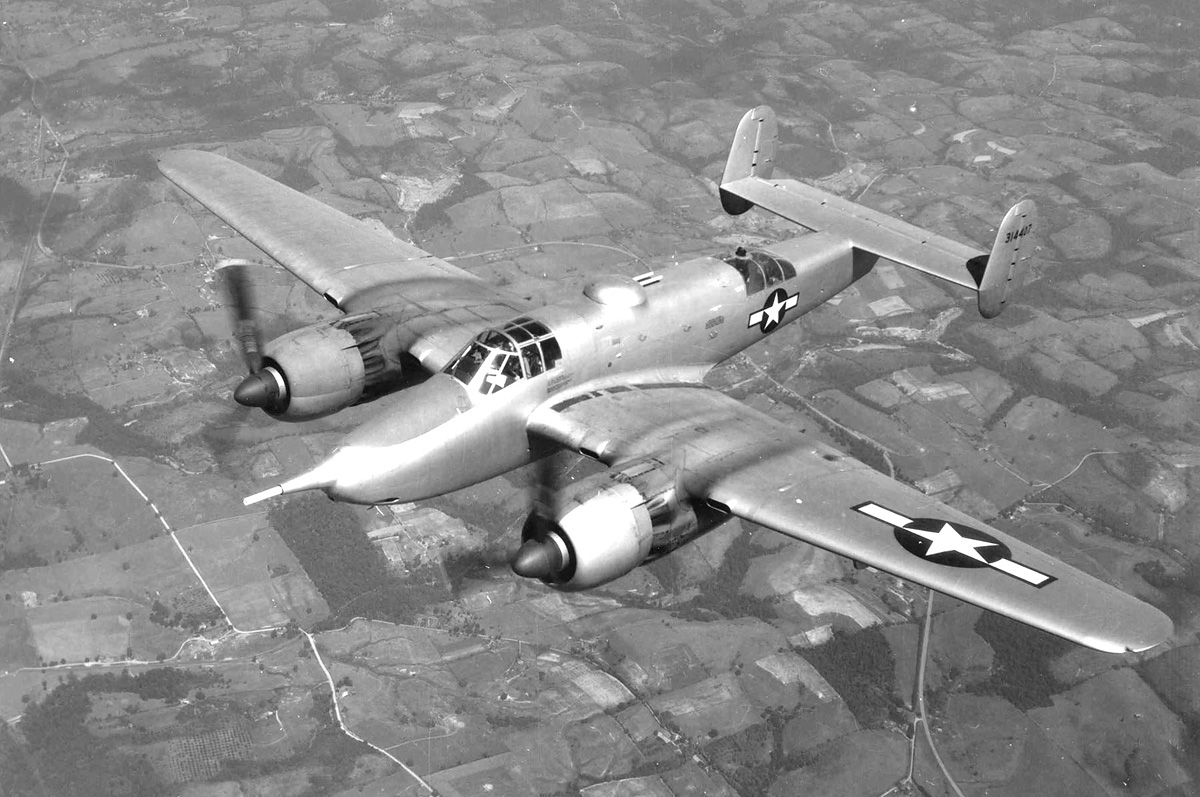
The second Beech XA-38 Grizzly (serial no 43-11407), with all guns installed.

The XA-38 was a two-place, mid-wing aircraft with a slim fuselage and twin tails. The gunner sat in the rear of the fuselage and operated remote upper and lower turrets, each fitted with two Browning .50 cal guns. The ventral turret could be locked in the forward position and fired by the pilot in strafing attacks. In the nose of the aircraft were another two Browning .50 cal guns and a T15E1 (M10) 75 mm cannon. The nose swung open to service the guns and was even removable so that different armament could be used. The .50 cal guns each had 500 rounds, and the 75 mm cannon had 20 rounds. Each wing supported two hard points that could carry a combined total of 2,650 lb (1,200 kg) of ordinance or 600 gal (2,270 L) of fuel.
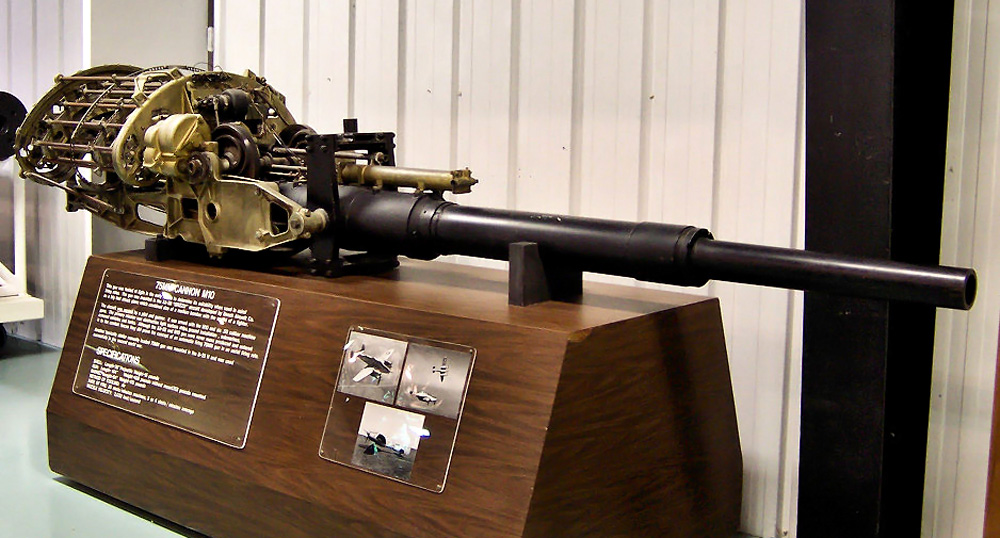
The T15E1 75 mm cannon had an 84 in (2.13 m) barrel that extended about 2 ft (.61 m) beyond the aircraft’s nose. The cannon was self-loading, 144 in (3.66 m) long, and originally weighed 1,800 lb (816 kg). However, through further development, the weight was reduced to 1,138 lb (516 kg). It fired a 26 in (.66 m) shell with a 15 lb (6.8 kg) projectile. The cannon consisted of a 75 mm gun (T9E2), 75 mm feed mechanism (T13), and the 75 mm gun mount (T15E1).

Beech XA-38 Grizzly above

Excellent view of the second XA-38, showing the slim fuselage. The aircraft was on a test flight over Kansas.

The Grizzly’s aluminum skin was entirely flush riveted, and the fully retractable gear, including tailwheel, was engineered for operations out of unimproved airstrips. The aircraft was powered by two Wright R-3350-43 engines producing 2,300 hp (1,715 kW) each. Each engine turned a 14.2 ft (4.32 m), three-blade Hamilton Standard propeller. The XA-38 could carry 640 gal (2,423 L) of fuel in its wings and an additional 185 gal (700 L) in the fuselage behind the pilot. The aircraft had a wingspan of 67.3 ft (20.5 m) and was 51.8 ft (15.8 m) long. It weighed 22,480 lb (10,197 kg) empty and had a maximum takeoff weight of 35,265 lb (15,995 kg). The XA-38’s climb rate was 2,170 fpm (661 m/m), and it had a service ceiling of 27,800 ft (8,475 m). Maximum speed at 3,100 ft (945 m) was 376 mph (605 km/h), and cruise speed at 16,000 ft (4,877 m) was 344 mph (554 km/h). The 45-degree flaps allowed the aircraft to land at 97 mph and operate out of a 2,500 ft (762 m) runway.

Beech XA-38 Grizzly air 2

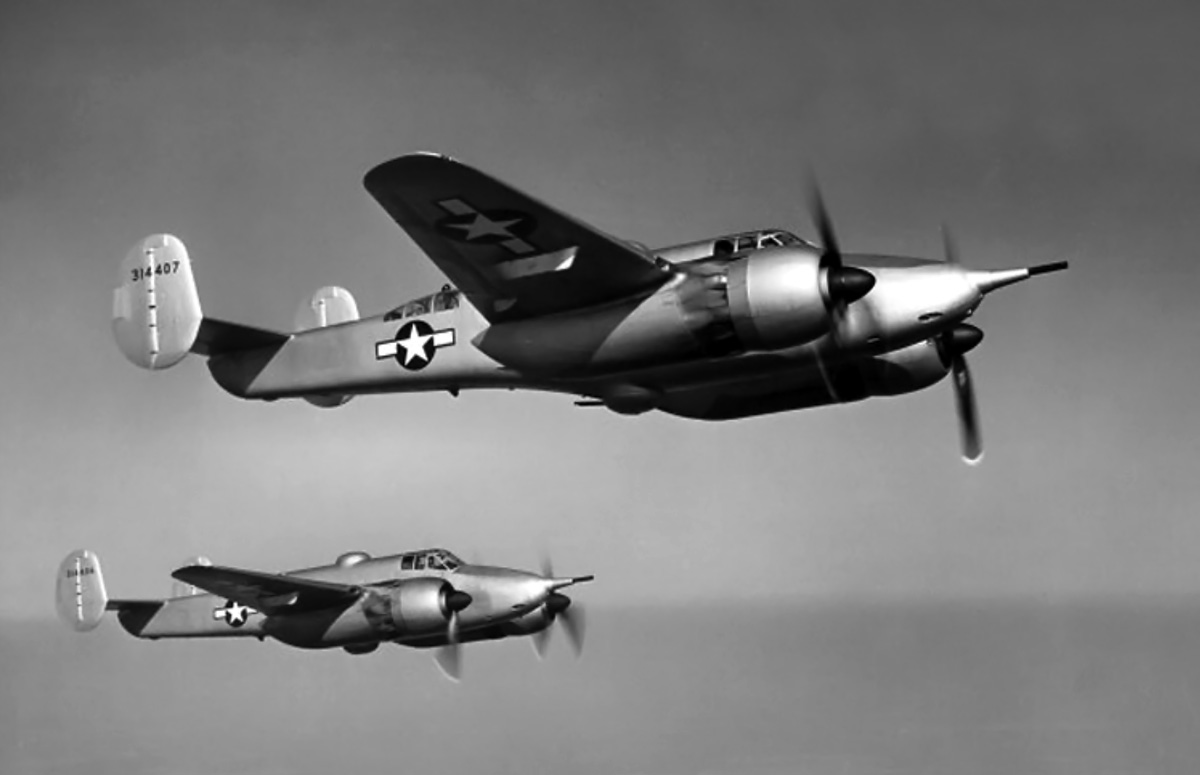
Both XA-38 aircraft in flight. The dummy turrets can be see on the first XA-38 to fly (furthest from camera).

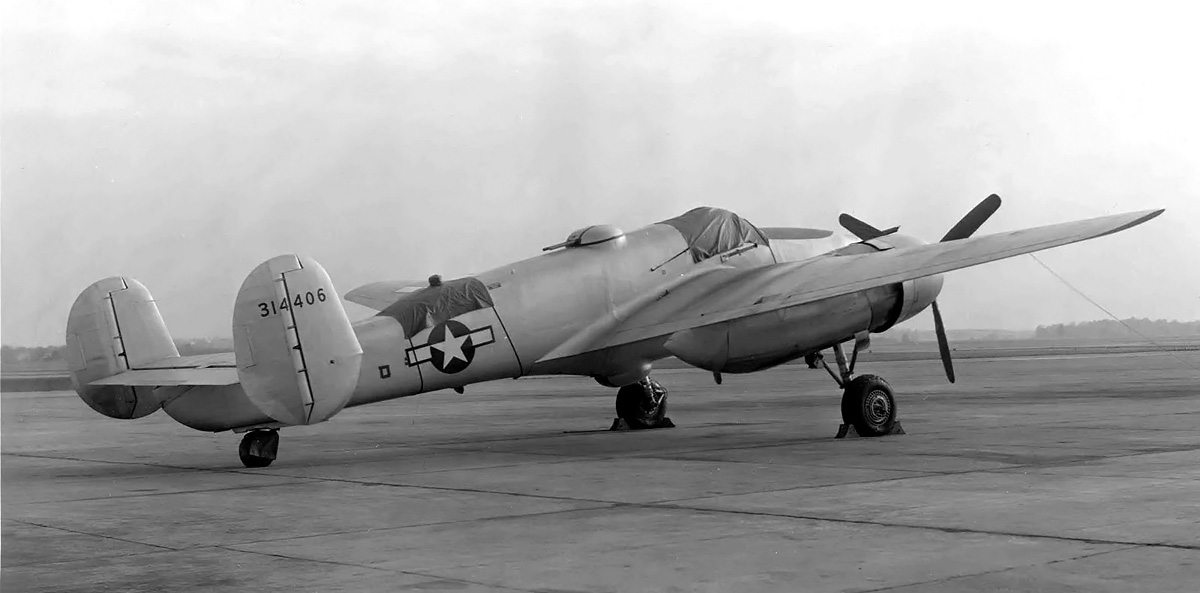
The aircraft program was met with long delays due to the unavailability of the R-3350 engines, remote turrets, and the 75 mm cannon. The Boeing B-29 had engine priority; the Douglas A-26 had the turrets; and the cannon was still being developed. The first XA-38 (serial no 43-14406) took to the air on 7 May 1944 with Vern Carstens at the controls. The turrets were still not available, so dummy turrets were substituted. In July 1944, the aircraft was flown to Tulsa, Oklahoma, where the 75 mm cannon was fitted and ground fired. Later in July, the Grizzly fired the cannon in-flight over Great Bend, Kansas.

Flight tests continued and minor issues were worked out. The aircraft performed very well, and during one early, low-level test flight, the XA-38 was able to pull away from the P-51B chase plane. Capt. Jack Williams evaluated the aircraft for the AAF and made 38 flights in the XA-38 between 13-24 October 1944. The aircraft was reported to be very maneuverable for an aircraft of its size and easy to fly through most aerobatic maneuvers. The aircraft was transferred to Dayton, Ohio for further evaluation on 7 July 1945. At some point, at least a mockup of the upper turret was added to the aircraft.

Beech XA-38 Grizzly 06

What must be a late image of the first Beech XA-38 Grizzly (serial no 43-14406) with what appears to be a mockup of the upper turret installed.

The second aircraft (serial no 43-11407) took to the air on 22 September 1945; Carstens was again at the controls. This aircraft had the correct turrets installed, and all weapons were operational. After initial flight tests, the XA-38 was transferred to Eglin Field, Florida for armament trials. Here, it amassed an additional 38 hours of flight tests, but there was little interest since the war was over.

The Grizzly’s main problem was that its engines were needed elsewhere. B-29 production left no spare R-3350s available for any type of A-38 production until mid-1945. By that time, the war was winding down, and there was no foreseeable need for the A-38. One of the XA-38s reportedly went to Davis-Monthan AFB, Arizona, but its ultimate fate is not recorded. The other aircraft was believed to be scrapped. The only remnant of the XA-38 Grizzly is the T15E1 cannon on display at the United States Air Force Armament Museum in Eglin AFB, Florida.

The T15E1 (M10) 75 mm cannon from the XA-38 as displayed in the United States Air Force Armament Museum. (Tom Fey image)

The T15E1 (M10) 75 mm cannon from the XA-38 as displayed in the United States Air Force Armament Museum. (Tom Fey image)

Sources:
Beech Aircraft and their Predecessors by A.J. Pelleteir (1995)
U.S. Experimental & Prototype Aircraft Projects by Bill Noton (2008)
American Attack Aircraft Since 1926 by E.R. Johnson (2008)
U.S. Aerial Armament in World War II, Vol. 1 by William Wolf (2009)
American Combat Planes of the 20th Century by Ray Wagner (2004)
– 75MM Cannon M10 display in the United States Air Force Armament Museum in Eglin AFB, Florida

FMA IAe 30 Ñancú

By William Pearce

Following World War II, Argentina experienced an influx of former German and Italian engineers. One such engineer was Cesare Pallavicino, formally with the Italian aircraft firm Caproni. Pallavicino was brought into the Instituto Aerotécnico (IAe) to design a twin-engine escort fighter. This project would become the IAe 30 Ñancú.

The sleek Argentine FMA IAe30 Namcu with what appears to be a damaged aileron.

The sleek Argentine FMA IAe 30 Ñancú with what appears to be a damaged aileron.

Initially, Pallavicino submitted two jet-powered designs and one piston-powered design. The piston-powered design was chosen for development as the IAe 30. In addition to Argentine engineers, Pallavicino was also able to bring on a number of former Caproni engineers to work on the project. Three IAe 30s were ordered and construction of the first prototype began in July 1947.

Powered by two 1649 cu in (27.0 L) Rolls-Royce Merlin 134/135 engines that produced 2,035 hp (1,517 kW) each, the Ñancú resembled the de Havilland Hornet, but it was an original, all-metal design. The propellers were four-blade de Havilland units, 12 ft (3.66 m) in diameter. The aircraft had a wingspan of 49 ft 3 in (15 m) and a length of 37 ft 10 in (11.52 m). The aircraft’s empty weight was 12,313 lb (5,585 kg), and it had a gross weight of 19,301 lb (8,755 kg). The IAe 30’s top speed was 460 mph (740 km/h) and cruise speed was 311 mph (500 km/h). Range was 1,678 mi (2,700 km).

The IAe 30 during a ground run of its Merlin engines.

The IAe 30 during a ground run of its Merlin engines. Note the streamlined engine nacelles.

The proposed armament consisted of four 20 mm Hispano-Suiza cannons mounted in the aircraft’s lower fuselage, under the wings. In addition, a 550 lb (250 kg) bomb could be carried under the fuselage, and five 3.25 in (83 mm) rockets could be fitted under each wing. However, the prototype was never armed.

The IAe 30 team was under a lot of pressure to quickly complete the aircraft. A few corners were cut during design and testing but the aircraft, mostly complete, was ready for ground tests on 8 June 1948 (some say 9 June). Despite wind tunnel tests not being completed, the IAe 30 took to the air for the first time with Captain Edmundo Osvaldo Weiss at the controls on 18 July 1948 (some say 17 July). Initial flight tests revealed that the aircraft performed well and possessed good handling characteristics.

On a cross country flight from Córdoba to Buenos Aires on 8 August 1948, the Ñancú averaged 404 mph (650 km/h) at only 60% power. While flying level at 18,370 ft (5,600 m) during the flight, the aircraft reached 485 mph (780 km/h) with the aid of a strong tail wind. Based on the initial performance of the aircraft, an order for 210 IAe 30s was placed.

The Ñancú in flight displaying is resemblance to a de Havilland Hornet.

The Ñancú in flight, displaying is resemblance to the de Havilland Hornet.

During  continued testing the aircraft achieved 560 mph (900 km/h) in a dive. Only minor changes of the aircraft were required, but it took a long time for the changes to be implemented. Part of the delay was poor communication between the test pilots and the design staff. One pilot who flew the Ñancú and reported very favorable results was Professor Matthies, better known as Kurt Tank. Tank was a German aircraft designer who had worked for Focke-Wulf during World War II, designing the Fw 190 fighter, among others. After the war, he immigrated to Argentina and assumed the pseudonym Pedro Matthies.

In early 1949, the prototype was badly damaged when test pilot Carlos Fermín Bergaglio misjudged a landing. Although the aircraft could have been repaired, there was no interest in doing so. The prototype had achieved its design goals and showed great potential. However, the jet age had arrived, and the Fuerza Aérea Argentina (Argentine Air Force) was focused on jet aircraft for their future fighters. Argentina had purchased 100 Gloster Meteor jet fighters, which were delivered by September 1948. Citing “financial reasons,” the order for the IAe was cancelled in late April 1949. The Fabrica Militar de Aviones (FMA), the state-run overseer of the IAe, made the decision to abandon the project. The damaged prototype and the two unfinished prototypes were scrapped, ending the story of one of the last piston-engine fighters to be developed.

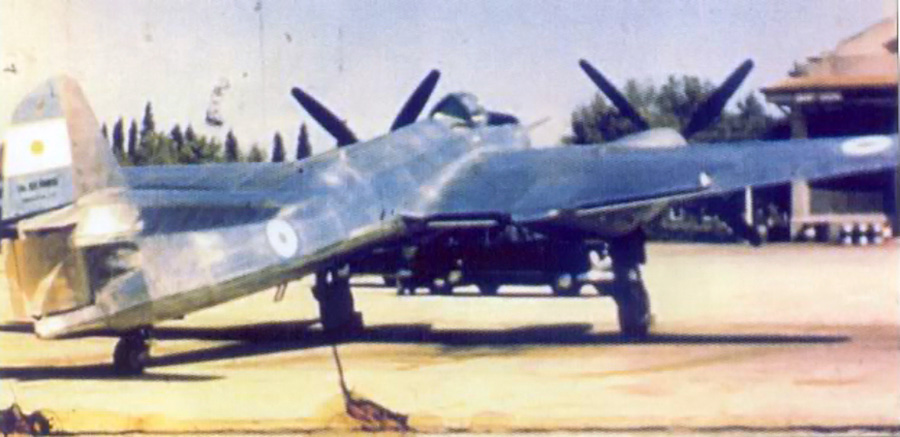
A rare color image of the IAe 30.

A rare color image of the IAe 30. Note the split rudder.

Sources:
– “IAe Ñancú: Argentinian Eaglet,” Wing of Fame Volume 5 by Jim Winchester (1996)
The Complete Book of Fighters by Green and Swanborough (1994)
Jane’s All the World’s Aircraft 1949-1951 by Leonard Bridgham (1949)
http://en.wikipedia.org/wiki/IAe_30_%C3%91anc%C3%BA

Yokosuka (Kugisho) R2Y1 Keiun

By William Pearce

Late in 1938, the Heinkel He 119 experimental high-speed reconnaissance aircraft was shown to a Japanese Naval delegation visiting Germany. The Japanese liked the speed and range of the He 119, and overall, were impressed by the aircraft. Based on the positive initial interest, the Japanese sent a group of technicians from the Yokosuka Naval Air Technical Arsenal (Yokosuka, also known as Kaigun Koku Gijutsusho or Kugisho) to Germany for a closer examination of the He 119. Eventually, Commander Hideo Tsukada was able to purchase two He 119 prototypes and a license to manufacture the aircraft in Japan.

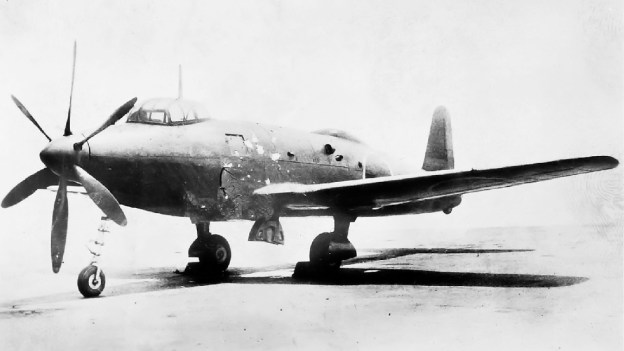
The standard image of the Yokosuka R2Y1 Keiun. Speculation suggests the first scoop on the side of the aircraft provided cooling air for the engine's internal exhaust baffling, the second, larger scoop provided induction air for the normally aspirated Aichi [Ha-70] engine installed in the prototype, and the final two ports were for the engine's exhaust.

The standard image of the Yokosuka R2Y1 Keiun. Speculation suggests the first scoop on the side of the aircraft provided cooling air for the engine’s internal exhaust baffling, the second, larger scoop provided induction air for the normally aspirated Aichi [Ha-70] engine installed in the prototype, and the final two ports were for the engine’s exhaust.

The two He 119 prototypes were delivered via ship to Japan in 1941 (some say 1940). The aircraft were reassembled at Kasumigaura Air Field, and flight tests occurred at Yokosuka Naval Base. During an early test flight, one of the He 119s was badly damaged in a landing accident, and it is believed the other He 119 suffered a similar fate. Plans to produce the He 119 never moved forward, but the Japanese were still interested in a high-speed reconnaissance aircraft and felt the general configuration of the He 119 held promise.

Inspired by the Heinkel He 119, Yokosuka began to design an aircraft of a similar layout, known as the Y-40, in 1943. Headed by Commander Shiro Otsuki, the aircraft project was a pressurized, two-seat, unarmed, high-speed, reconnaissance aircraft of all-metal construction that featured tricycle retractable gear. The design was approved, and the Y-40 officially became known as the R2Y1 Keiun (Beautiful Cloud). The construction of two prototypes was ordered.

A good view of the R2Y1 where a radiator inlet can be seen under the wing and in front of the main gear. The ventral scoop was an intake for the turbocharger and intercooler but these were not installed on the prototype.

A good view of the R2Y1 where a radiator inlet can be seen under the wing and in front of the main gear. The ventral scoop was an intake for the turbocharger and intercooler but these were not installed on the prototype.

The R2Y1 had a 45.93 ft (14 m) wingspan and was 42.81 ft (13.05 m) long. The aircraft stood 13.91 ft (4.24 m) high, weighed 13,260 lb (6,015 kg) empty, and had a maximum weight of 20,725 lb (9,400 kg). The Keiun had an estimated top speed of 447 mph (720 km/h) at 32,810 ft (10,000 m) and a cruise speed of 288 mph (463 km/h) at 13,125 ft (4,000 m). Maximum range was an estimated at 2,240 mi (3,610 km). The pilot sat under a raised bubble-style canopy that was toward the extreme front of the aircraft. The radio operator/navigator occupied an area in the fuselage just behind and a little below the pilot.

The Keiun was powered by two 60-degree, inverted V-12 Aichi Atsuta 30 series engines, licensed-built versions of the Daimler-Benz DB 601. The engines were coupled together by a common gear reduction in a similar fashion as the DB 606. The resulting 24-cylinder power unit was known as the Aichi [Ha-70]. With a 5.91 in (150 mm) bore and 6.30 in (160 mm) stroke, the engine displaced 4,141 cu in (67.8 L) and was installed behind the cockpit and above the wings. The Aichi [Ha-70] engine was to be turbocharged and rated at 3,400 hp (2,535 kW) for takeoff and 3,000 hp (2,237 kW) at 26,247 ft (8,000 m). Without the turbocharger, the engine was rated at 3,100 hp (2,312 kW) for takeoff and 3,060 hp (2,282 kW) at 9,843 ft (3,000 m). The engine drove a 12.47 ft (3.8 m), six-blade propeller via a 12.8 ft (3.9 m) long extension shaft that ran under the cockpit. Engine cooling was achieved by radiators under the fuselage and inlets for oil coolers in the wing roots. A ventral air scoop was located behind the engine to provide induction air for the turbocharger and air for the intercooler.

The R2Y1 Keiun undergoing taxi tests in May 1945.

The R2Y1 Keiun undergoing taxi tests in May 1945.

By the fall of 1944, the direction of the war had changed, and Japan no longer needed a high-speed reconnaissance aircraft. The R2Y1 Keiun was all but cancelled when the design team suggested the aircraft could easily be made into a fast attack bomber. In addition, the Aichi [Ha-70] power plant would be discarded, and one 2,910 lb (1,320 kg) thrust Mitsubishi Ne 330 jet engine would be installed under each wing. A fuel tank would be installed in the space made available by the removal of the piston engine. This jet-powered attack bomber had an estimated top speed of 495 mph (797 km/h). The project was approved, and the new aircraft was designated R2Y2.

The decision was made to finish the nearly completed R2Y1 airframe and use it as a flight demonstrator to assess the flying characteristics of the aircraft. With pressurization, the turbocharger, and the intercooler omitted, the R2Y1 prototype was completed in April 1945 and transferred to Kisarazu Air Field for tests. Ground tests revealed that the aircraft suffered from nose-wheel shimmy and engine overheating.

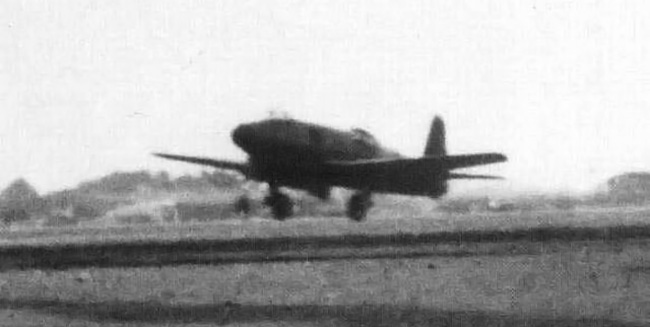
Yokosuka R2Y1 Keiun taking off from Kisarazu Air Field for its first an only flight.

Yokosuka R2Y1 Keiun taking off from Kisarazu Air Field for its first an only flight.

Adjustments were made to overcome the issues, and the Keiun took to the air on 29 May 1945 (date varies by source and is often cited as 8 May 1945), piloted by Lt. Commander Kitajima. The flight proved to be very short because the engine quickly overheated, and a fire broke out in the engine bay. Lt. Commander Kitajima quickly returned to the field, and the R2Y1 suffered surprisingly little damage. On 31 May during a ground run to test revised cooling, the engine was mistakenly run at high power for too long and overheated. The engine was removed from the aircraft to repair the damage. The R2Y1 sat awaiting repair for some time before it was destroyed by Japanese Naval personnel to prevent its capture by American forces (some say it was destroyed in an Allied bombing raid). Because of the end of the War, the second R2Y1 prototype was never completed nor was the design work for the R2Y2.

The unfinished second R2Y1 prototype as seen at the end of WWII. Note the wing root and ventral intakes. The hole in the center of the bulkhead in the nose was for the propeller's drive shaft.

The unfinished second R2Y1 prototype as seen at the end of WWII. Note the wing root and ventral intakes. The hole in the center of the bulkhead in the nose was for the propeller’s drive shaft.

Sources:
– “Yokosuka R2Y1 Keiun: Japan’s mid-engined twin” Wings of Fame, Volume 12 (1998)
Japanese Secret Projects by Edwin Dyer (2009)
Japanese Aircraft of the Pacific War by Rene Francillon (1970/2000)
Japanese Aero-Engines 1910–1945 by Mike Goodwin and Peter Starkings (2017)
General View of Japanese Military Aircraft in the Pacific War by Airview (1956)
Japanese Aircraft Performance & Characteristics TAIC Manual by Edward Maloney (2000)
http://www.secretprojects.co.uk/forum/index.php/topic,15633.0/all.html

Heinkel He 119 V4 front

Heinkel He 119

By William Pearce

In the 1930s, brothers Siegfried and Walter Günter were pushing the limits of aerodynamics as they designed aircraft for Heinkel Flugzeugwerke in Germany. Perhaps the ultimate expression of their aerodynamic beliefs was the Heinkel He 119. The Günter brothers and Ernest Heinkel envisioned the He 119 as an unarmed, high-speed reconnaissance aircraft or light bomber.

Heinkel He119 V1 side

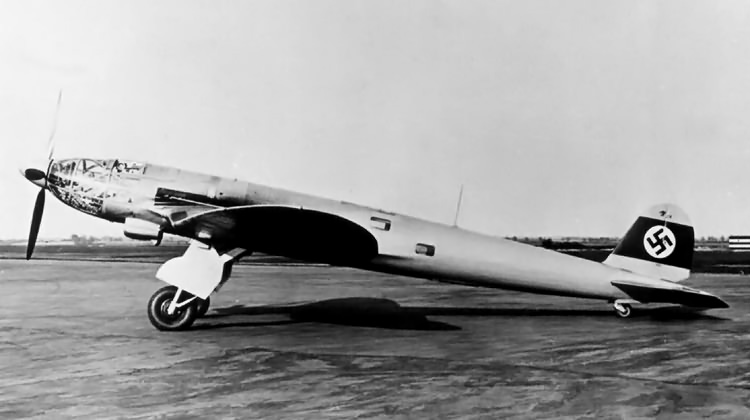
Heinkel He 119 V1 prototype with the hastily installed radiator to augment the evaporate cooling system.

Work on the He 119 began in the summer of 1936 as a private venture funded by Heinkel Flugzeugwerke. The aircraft appeared to have a fairly standard layout as an all metal, low-wing monoplane with retractable gear. However, the very streamlined fuselage hid the He 119’s unorthodox power arrangement. To achieve the low-drag necessary for high-speed operations, the engine was buried in the fuselage, just behind the cockpit and above the wings. An enclosed drive shaft extended forward from the engine, through the cockpit, between the pilot and co-pilot, and to the front of the aircraft where it drove a 14 ft 1 in (4.30 m), metal, variable-pitch, four-blade propeller.

No engine produced the power needed for the He 119, so two Daimler-Benz DB 601 engines were placed side-by-side and coupled together through a common gear reduction. The DB 601 was a liquid-cooled, 12-cylinder, 60 degree, inverted Vee engine with a 5.91 in (150 mm) bore and 6.30 in (160 mm) stroke. When coupled, the 24-cylinder engine was known as the DB 606; it displaced 4,141 cu in (67.8 L) and produced 2,350 hp (1,752 kW). The inner banks of the DB 606 were pointed nearly straight down and exhausted under the aircraft. The side banks’ exhaust was expelled just above the He 119’s wings.

Daimler-Benz DB 606

The Daimler-Benz DB 606 engine was comprised of two DB 601 engines joined to a common gear reduction.

The DB 606 engine in the He 119 was to be cooled exclusively by surface evaporative cooling, where steam from the heated coolant was pumped under the skin of the wing’s center section. Here, the steam would cool and condense back into liquid. The liquid was then pumped back to the engine. However, during testing the system proved to be inadequate, and a radiator was added below the fuselage, just before the wings. The first prototype had a fixed radiator that was rather hastily installed. The subsequent prototypes included an improved radiator that was extended during low-speed operations but was semi-retracted into the fuselage as the aircraft’s speed increased.

The He 119’s cockpit formed the nose of the aircraft. The cockpit was entirely flush with the 48 ft 7 in (14.8 m) fuselage and was extensively glazed with heavily framed windows. The pilot and co-pilot accessed the cockpit by separate sliding roof panels. In the aft fuselage were provisions for a radio operator and a ventral bay for cameras. Another bay for either large cameras or a maximum of 1,200 lb (1,000 kg) of bombs was located in fuselage, just aft of the wing spar.

Heinkel He 119 nose radiator

A good view of the He 119’s glazed cockpit is provided in this image. Most sources state this aircraft is V4, but it possesses the exhaust ports of V1. Note the extended radiator.

The He 119 had a wingspan of 52 ft 6 in (16 m). To provide for proper ground clearance, conventional main landing gear would have been too long to fit in the inverted-gull, semi-elliptical wing. A telescoping strut was devised that would collapse as the gear retracted. This allowed the gear to fit within the wing and also extend to provide the needed ground clearance.

Heinkel kept the He 119 a secret during construction, and the first prototype (V1) flew in June 1937 with Gerhard Nitschke at the controls. Even with the bulk of the added radiator, the aircraft achieved 351 mph (565 km/h), which was faster than fighter aircraft of the day. This speed validated Heinkel and the Günter brothers’ position that the fast bomber did not need to be armed. However, when the aircraft was revealed to German officials, they insisted the aircraft be armed with upper and lower guns operated by separate gunners. German officials did allow the continued experimentation of the aircraft; at this point, the aircraft was officially designated He 119. The addition of the guns lowered the aircraft’s speed, and it appears that only the upper gun was included in other prototypes, housed under a sliding panel.

Heinkel He 119 V2 with windows in the rear fuselage for the radio operator.

Heinkel He 119 V2 with windows in the rear fuselage for the radio operator. Reportedly, this is the last He 119 built with the semi-elliptical wing.

It is at this point that sources disagree on the He 119’s history. One theory is that the second prototype (V2) first flew in September 1937, followed by the fourth prototype (V4) in October 1937. The He 119 V4 set a speed record on 22 November 1937 and was destroyed in a follow-up attempt on 16 December. A total of eight aircraft were built; the seventh (V7) and eighth (V8) were purchased by and subsequently shipped to Japan.

The other theory, supported by German Heinkel expert Dr. Volker Koos, is that the V1 was prepared (which included the installation of a new radiator as used on the subsequent prototypes) for the record flight. The V1 flew the record flight and crashed during the follow-up attempt. The first flight of V2 was in 1938, and V4 first flew in May 1940. Most likely, only four aircraft were built, and V2 and V4 were shipped to Japan.

Side view of the He 119 V3. The updated wing used on the V3 and all further He 119 aircraft can be seen as well as tail modifications to increase the seaplanes stability.

Side view of the He 119 V3. The updated wing used on the V3 and all further He 119 aircraft can be seen as well as tail modifications to increase the seaplane’s stability.

All sources agree that the He 119 carrying the registration D-AUTE made the record flights. The third prototype (V3) was first flown after V4 because V3 was built as a seaplane. All prototypes from V3 on were built with a new wing that had a straight leading edge and a slightly reduced span of 52 ft 2 in (15.9 m).

After careful examination of various photos, it appears that the He 119 registered at D-AUTE had the semi-elliptical wing as used on the first two prototypes. It also appears that the exhaust ports above the wing on V1 were unique and at an angle, with each port slightly higher (relative to the fuselage) than the port preceding it. All other He 119s had exhaust ports in a straight line relative to the fuselage. D-AUTE appears to have the ports as seen on V1. Based on the information available, it seems more likely that V1 did indeed make the record flights. Sadly, given the secrecy under which the He 119 was built, the propaganda subterfuge surrounding the record flights, and the destruction of German documents during World War II, the exact aircraft identities as well as the number built may never be definitively known.

Heinkel He 119 V3 b

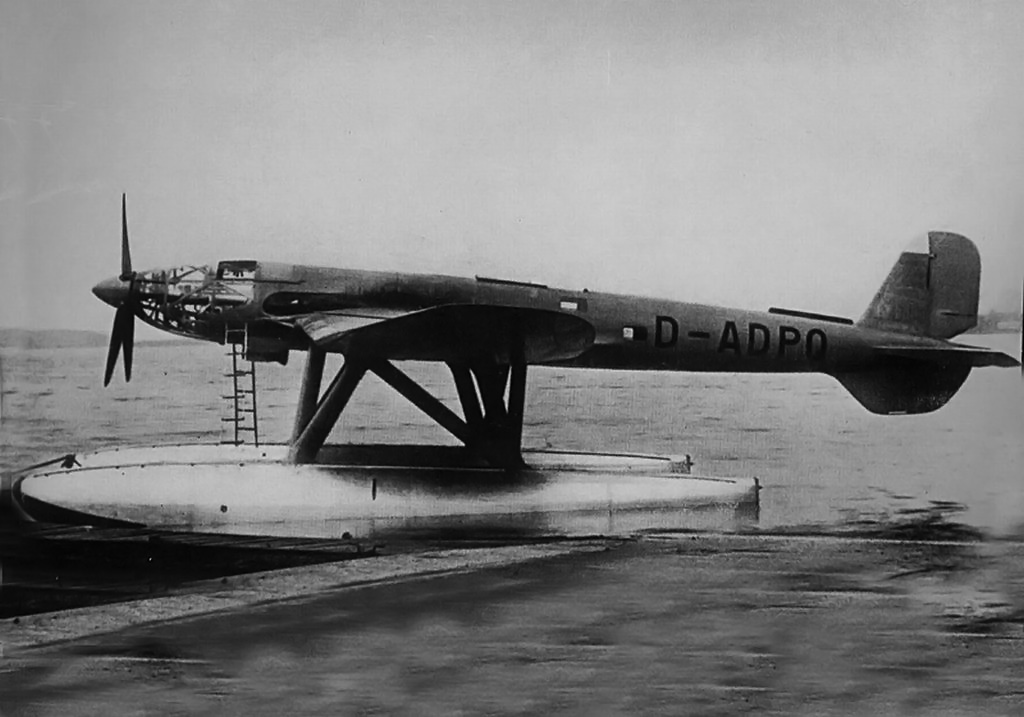
The Heinkel He 119 V3 seaplane taxiing under its own power. This aircraft was to be used on an attempt to set a new 1000 km (621 mi) seaplane record, but such plans were cancelled after the other He 119’s crash.

Regardless of the specific airframe, on 22 November 1937, the He 119 set a world record for flying a payload of 1,000 kg (2,205 lb) over a distance of 1,000 km (621 mi). For propaganda purposes, the He 119 was labeled He 111U and also He 606. Due to weather, the He 119 was forced to fly lower than anticipated which reduced its airspeed. Even though the He 119 set the record at 313.785 mph (504.988 km/h), the speed was seen as a disappointment that did not represent the He 119’s true capabilities. Indeed, the record was broken about two weeks later by an Italian Breda Ba 88.

A follow-up flight to reclaim the record occurred on 16 December 1937.  With over half the distance flown and the He 119 averaging just under 370 mph (595 km/h), the DB 606 engine quit. The pilots, Nitschke and Hans Dieterle, attempted an emergency landing at Travemünde but hit a drainage ditch. The He 119 was destroyed; Nitschke and Dieterle were injured, but they survived. The engine failure was a result of a faulty fuel transfer switch. After the crash, Heinkel was ordered not to attempt any further record flights with the He 119.

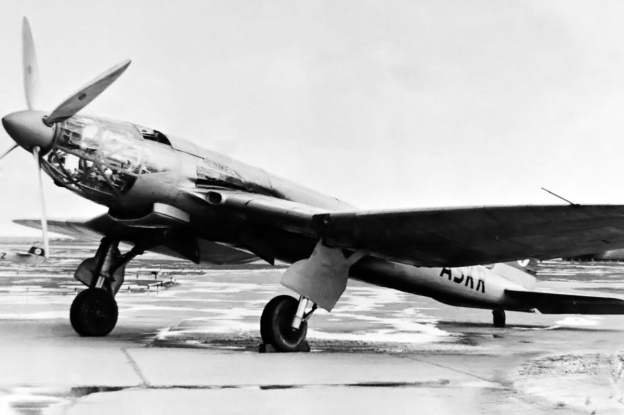
Heinkel He 119 V4 front

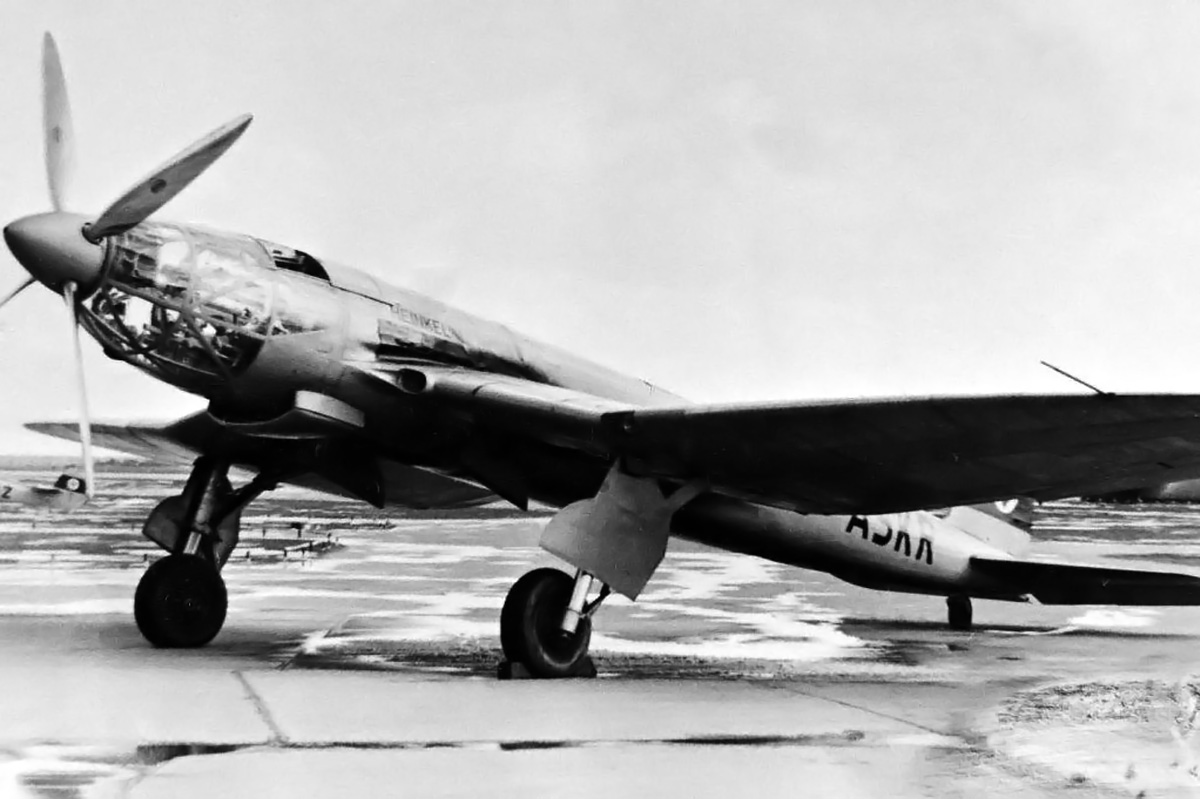
Many sources identify this aircraft (D-ASKR) as the He 119 V2. Interestingly, the wing root intake for the supercharger and lower lip of the radiator do not match those found on other images of V2. The features do match those found on V3.

Other He 119 prototypes took over the test flights. He 119s with the new wing demonstrated a top speed of around 370 mph (595 km/h) and a range of 1,865 mi (3,000 km). Despite the floats, the He 119 V3 seaplane had a top speed of 354 mph (570 km/h) and a range of 1,510 mi (2,430 km). The V3 aircraft also had a ventral fin added to counteract the destabilizing effects of the floats. Unfortunately, the German authorities did not have any interest in producing the He 119 in any form because of its unorthodox features. Reportedly, some of the remaining aircraft served as test-beds for the DB 606 and DB 610 engines. The remaining He 119s in Germany were scrapped during World War II.

Late in 1938, the He 119 was shown to a Japanese Naval delegation that expressed much interest in the aircraft. In 1940 the Japanese purchased a manufacturing license for the He 119 along with two of the prototype aircraft. These aircraft were delivered via ship to Japan in 1941 (some say 1940). The aircraft were reassembled at Kasumigaura Air Field, and flight tests occurred at Yokosuka Naval Base. During an early test flight, one of the He 119s was badly damaged in a landing accident, and it is believed the other He 119 suffered a similar fate. While it was not put into production, the He 119 did provide the Japanese with inspiration for the Yokosuka (Kugisho) R2Y1 Keiun high-speed reconnaissance aircraft.

Heinkel He 119 V2 with the Japanese Naval delegation.

The Heinkel He 119 with the Japanese Naval delegation. The sliding roof panel for the pilot’s cockpit access can clearly be seen. Note the differences with the wing root intake and lower lip of the radiator compared to the D-ASKR aircraft.

Sources:
– “An Industry of Prototypes – Heinkel He 119”, Wings of Fame, Volume 12 by David Donald (1998)
Warplanes of the Third Reich by William Green (1970/1972)
http://www.whatifmodelers.com/index.php/topic,21627.0/
http://forum.12oclockhigh.net/showthread.php?t=14198

Fokker F.XX Zilvermeeuw Transport

By William Pearce

In the never-ending quest for speed, KLM (Royal Dutch Airlines) asked the Fokker Aircraft Corporation to design an aircraft for its East Indies route that could fly some 35 mph (56 km/h) faster than the Fokker F.XVIII then in service. Fokker’s response was a trimotor design that could accommodate 12 passengers and three crew members. The new aircraft, the Fokker F.XX Zilvermeeuw (Herring Gull), was the last wooden aircraft and last trimotor built by Fokker. However, it was the first Fokker-built aircraft with retractable landing gear.

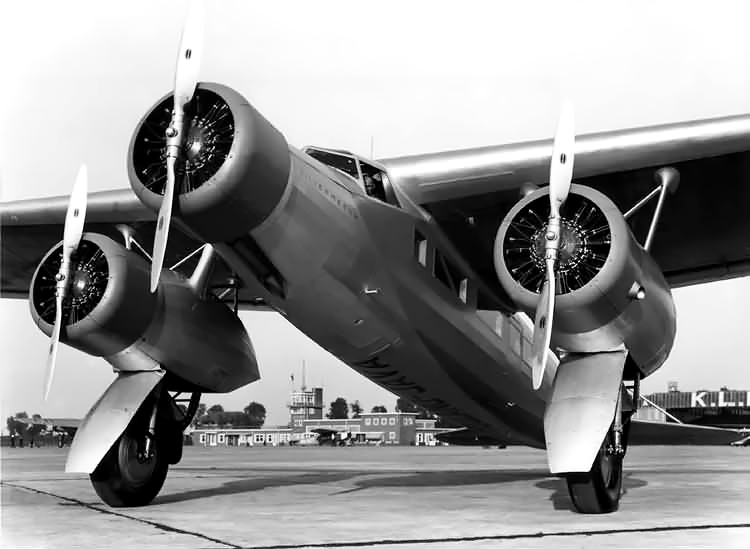
The Fokker F.XX: the pinnacle of the Fokker trimotors.

The Fokker F.XX was revealed on 20 December 1932. The aircraft was built under the direction of Marius Beeling and featured a fabric covered fuselage of steel tube construction. The fuselage used an elliptical cross section, another design-first for Fokker, who had used rectangular fuselages on their earlier aircraft. The F.XX’s high-wing had a wooden structure and was plywood covered. The plywood skin was omitted from the lower wing section running through the cabin so that more headroom was available for the passengers.

The aircraft was originally powered by three 650 hp (485 kW), nine-cylinder, air-cooled Wright Cyclone R-1820-F engines, all housed in NACA cowlings. One engine was in the nose of the aircraft, and the others were each in a nacelle suspended under each wing by struts. Later, KLM replaced the engines with more powerful 690 hp (515 kW) Wright Cyclone R-1820-F.2 engines. Metal, two-blade, ground-adjustable propellers were initially used. However, when the uprated engines were installed, metal Hamilton Standard propellers that were adjustable in-flight were used.

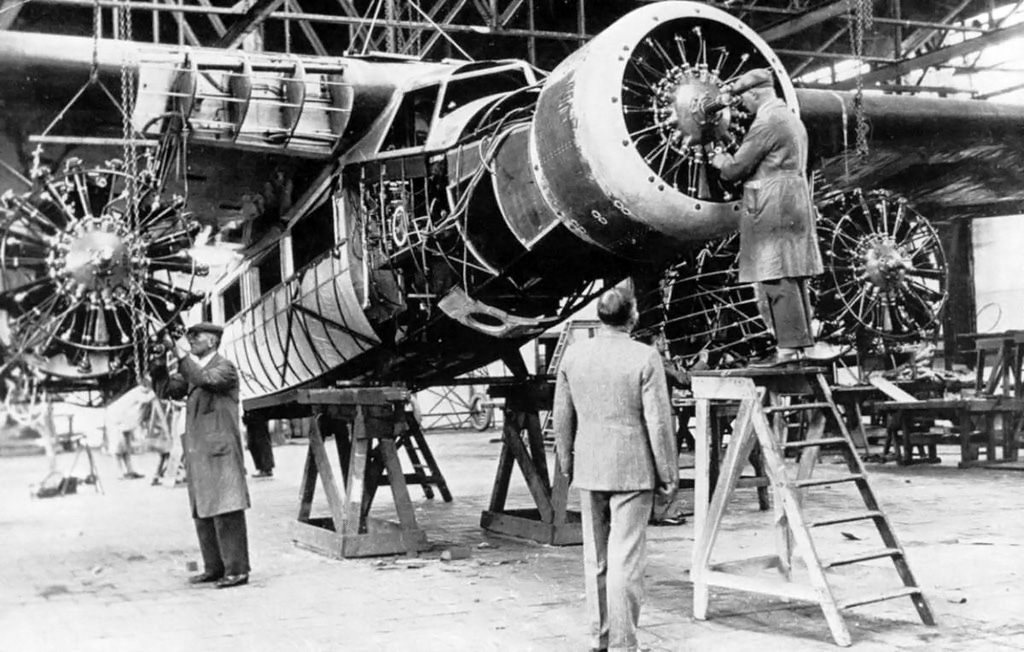
The Fokker F.XX under constructions in 1933.

The Fokker F.XX was 54.8 ft (16.7 m) long and had a span of 84.3 ft (25.7 m). The aircraft weighed 11,795 lb (5,350 kg) empty and 19,510 lb (8,850 kg) loaded. Range with full fuel was 1,056 mi (1,700 km), and range with full payload was 400 mi (645 km). The aircraft’s service ceiling was 21,650 ft (6,600 m). Maximum speed of the F.XX was 190 mph (305 km/h), and cruise speed was 155 mph (250 km/h).

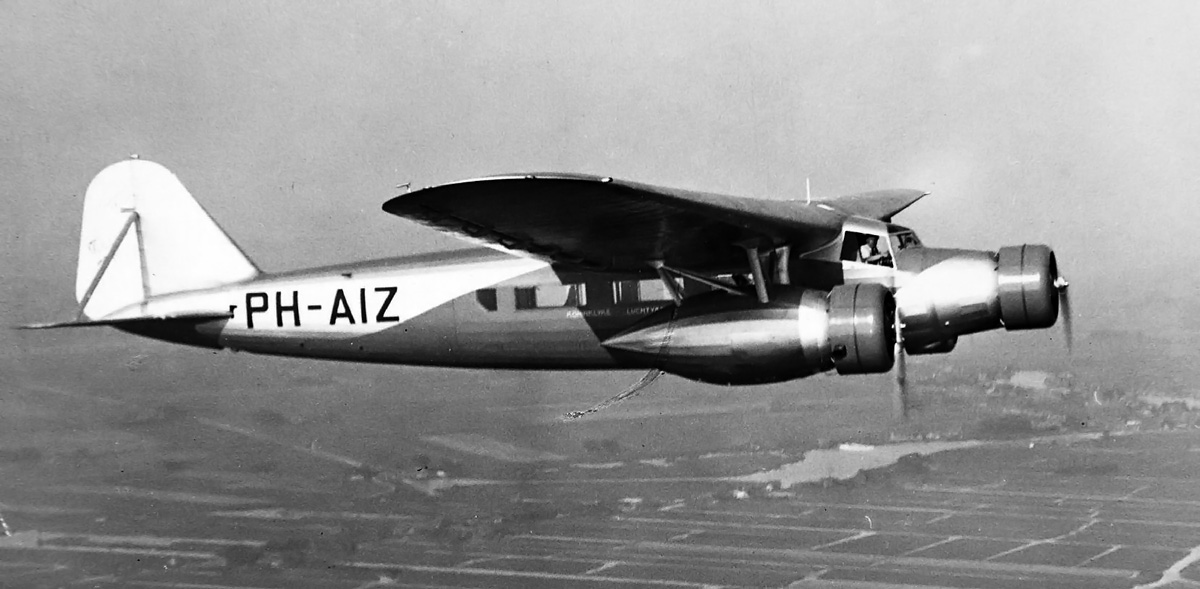
The F.XX carried the Dutch registration PH-AIZ and made its first flight on 3 June 1933, piloted by Emil Meineche. For this first flight, the engine cowlings were omitted and the undercarriage was not retracted. During a test on 29 June 1933, it was found that heavy aileron vibration occurred as speed was increased. This phenomenon was solved by adding 70 lb (32 kg) of balance weights to the ailerons. Flight testing resumed on 11 August 1933.

The F.XX probably undergoing early flight tests with the large gear doors still installed and short engine nacelles.

It was also discovered that when the landing gear was deployed, the large door in front of each main wheel caused turbulence that resulted in severe vibrations of the tail section. The doors were reduced in size, but the problem persisted. Eventually, the doors were removed altogether. During the flight test program, the engine nacelles were lengthened to reduce drag. The flight test program, the airworthiness trials, and the acceptance flights were completed over the course of four months, encompassing 62 flights that totaled 37 hours in the air.

On 18 December 1933, the Fokker F.XX made its KLM debut on a special Christmas mail flight to the East Indies. The objective was to fly as fast as possible to the Dutch colonies in competition with another aircraft, the Pander S.4 Postjager, to inaugurate a special mail service.

Inflight image of the Fokker F.XX showing its graceful lines.

The Pander Postjager had departed earlier but was stranded in Italy because of an engine failure, leaving the Fokker F.XX poised to win the competition. However, engine trouble was experienced during a warm-up, and the F.XX was grounded. Work to repair the F.XX would take too much time, and KLM quickly prepared a Fokker F.XVIII for the Christmas flight. It was a disastrous public failure for the new F.XX, one from which it never fully recovered.

Although the F.XX was a more advanced design than earlier Fokker aircraft, the eminent arrival of twin-engine, low-wing, metal aircraft (like the Douglas DC-2) rendered it obsolete. In addition, the negativity surrounding the failed Christmas flight meant that there would no production contract for the Fokker F.XX. Quietly and shrewdly, Fokker Aircraft Corporation obtained manufacturing rights for the DC-2.

The F.XX with the gear doors removed and lengthened engine nacelles.

However, the F.XX’s reputation was boosted when KLM began using the aircraft on a fast London-Amsterdam-Berlin service starting 1 March 1934. On the Amsterdam-Berlin leg of the flight, the aircraft achieved an impressive average speed of 157 mph (253 km/h). Also in 1934, the F.XX flew 1,535 hours; this was nearly double KLM’s 850 flight hour average with the F.XVIII.

The F.XX was in service with KLM for only a few years. In September 1936, the aircraft was sold to Alain Pilain of France and registered as F-APEZ. Mr. Pilain represented the fictitious airline Air Tropique, which was a cover for another organization: the Société Française de Transports Aériens (SFTA). SFTA was a purchasing agent for the Spanish Republicans disguised as a French air transport service.

The Fokker F.XX in service with the Spanish Republicans and with a camouflage paint scheme as seen at Le Bourget, France in 1937.

SFTA flew the aircraft to Spain in October 1936, where it carried the governmental registration EC-45-E and was used in the Spanish Civil War. The F.XX was painted in a camouflaged scheme and used to transport various cargoes (including gold bullion and jewelry) between Spain and France.

It was not a very popular aircraft, especially after one of its Wright engines was replaced with a Walter-built Mercury engine from a Letov S-231 fighter, and at least one other engine was replaced with a Shvetsov M-25 engine from Polikarpov I-16 fighter. The engine changes resulted in a vicious yaw on takeoff. The F.XX served with the Republicans until early February 1938 when, piloted by Eduardo Soriano, it was destroyed in a crash near Barcelona at Prat de Llobregat Airport.

The following is a video of the Fokker F.XX Zilvermeeuw filmed in 1933 and uploaded by BeeldenGeluid.

Sources:
– “The Fokker F.XX,” Flight (5 October 1933)
– “Fokker’s Trimotors Go To War,” Air Enthusiast, No. 13 August–November 1980 by Gerald Howson
Jane’s All the World’s Aircraft 1934 by C.G. Grey (1934)
Aircraft of the Spanish Civil War 1936-1939 by Gerald Howson (1990)
Fokker: Aircraft Builders to the World by Thijs Postma (1979/1980)
http://www.dutch-aviation.nl/index5/Civil/index5-2%20F20.html

Kawasaki Ki-78 (KEN III)

By William Pearce

In the 1930s, Japanese aviation began to make strides toward closing the technological gap with the Western World. In 1938, the Aeronautical Research Institute of the University of Tokyo, led by Shoroku Wada, began a high-speed aircraft research program. Gathering data on high-speed flight was the primary objective, but it was felt that an attempt on the 3 km absolute world speed record was an obtainable goal.

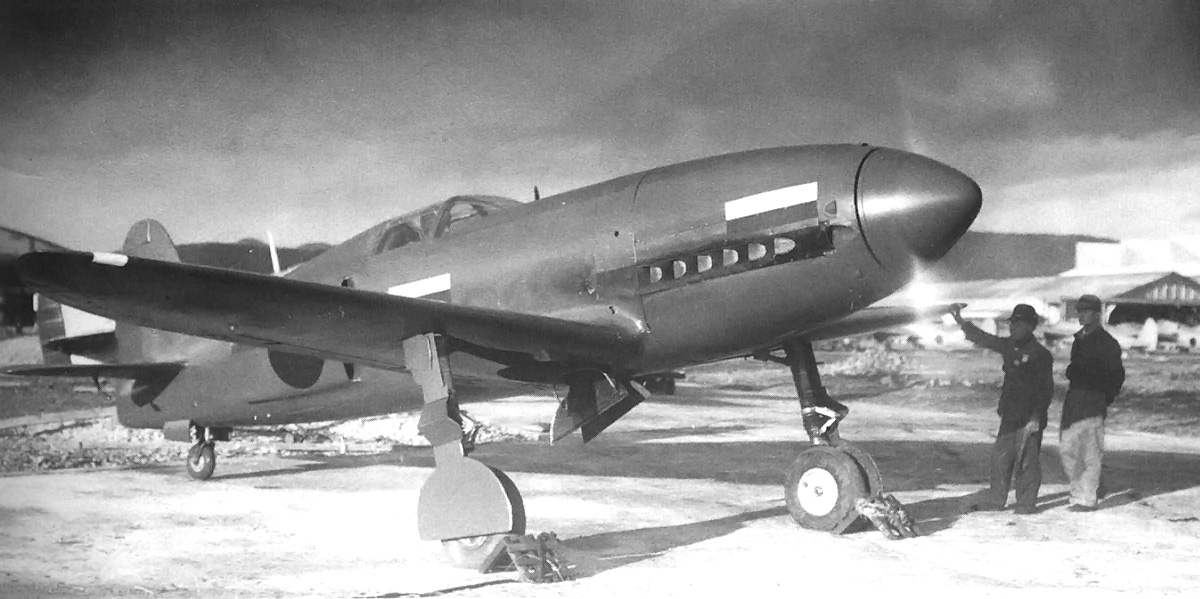
The nearly complete and unpainted high-speed research aircraft, the Kawasaki Ki-78. Note the radiator housing on the fuselage side.

The aircraft project was known as KEN III (for Kensan III or Research III) and incorporated numerous advanced features new to Japanese aircraft. Approval was given for the aircraft’s development and a full-scale wooden mockup was finished in May 1941. Because of the outbreak of World War II, the project was taken over by the Imperial Japanese Army and designated Ki-78. A production contract for two prototypes was awarded to Kawasaki, under the direction of Isamu Imashi. Construction of the first prototype began in September 1941 at Kawasaki’s plant at Gifu Air Field.

The Ki-78 was an all-metal, low wing monoplane of conventional layout. The small streamlined fuselage was made as narrow as possible and was 26 ft 7 in (8.1 m) long. The wings possessed a laminar flow airfoil with a span of 26 ft 3 in (8 m) and an area of 118.4 sq ft (11 sq m). To reduce landing speed and improve low-speed handling, the wings incorporated drooping ailerons along with a combination of Fowler and split flaps, which was a first for a Japanese aircraft. When the Fowler flaps were deployed, the split flaps opened simultaneously to a similar extent. When the flaps were fully deployed, the ailerons automatically drooped down 10 degrees.

Factory fresh and unpainted view of the Ki-78. The aircraft is missing its outer gear doors and there is no horn-balance on the elevator.

Power for the Ki-78 was provided by an imported Daimler-Benz DB 601A inverted V-12 engine driving a three-blade metal propeller. The engine was not a Kawasaki Ha-40, a licensed copy of the DB 601. The DB 601 had a 5.91 in (150 mm) bore and 6.30 in stroke (160 mm), giving a total displacement of 2,070 cu in (33.9 L). It produced 1,175 hp (876 kW) at 2,500 rpm. The engine was modified by Kawasaki with the addition of a water-methanol injection system (another Japanese first) to boot the power output to 1,550 hp (1,156 kW) for short periods. The Ki-78 carried 66 gal (250 L) of fuel and 16 gal (60 L) of water-methanol.

The freshly-painted Ki-78 running-up its DB 601A engine. Note the hinge in the outer gear door to account for extension of the gear strut.

The freshly-painted Ki-78 running-up its DB 601A engine. Note the hinge in the outer gear door to account for extension of the gear strut.

Engine cooling was provided by two radiators: one mounted on each side of the rear fuselage. The radiators had a wide air inlet protruding slightly out from the fuselage. Airflow through each radiator was controlled by an actuated exit door. In addition, within the fuselage a small 60 hp (45 kW) turbine drove a fan to further assist cooling. The aircraft stood 10 ft 7/8 in (3.07 m) tall and weighed 4,255 lb (1,930 kg) empty.

The Ki-78 first flew on 26 December 1942 and was found to be extremely difficult to fly at low speeds and had poor stall characteristics. The aircraft was heavier than the design estimates, which increased the wing loading. Even with the special flaps and drooping ailerons, takeoff and landing speeds were both high at 127 mph (205 km/h) and 106 mph (170 km/h) respectively. In addition, elevator flutter was experienced at the relatively low speed of 395 mph (635 km/h) but was subsequently cured by fitting a horn-balance to the elevator.

Rear view of the Kawasaki Ki-78 as found by American troops after the war. Note the flat tailwheel and missing cockpit glass, flight instruments, and starboard tire. This view also displays the radiator exit door and elevator horn-balance.

High-speed flight tests were started in April 1943, and during the Ki-78’s 31st flight on 27 December, the aircraft achieved its maximum speed of 434.7 mph (699.6 km/h) at 11,572 ft (3,527 m). This was considerably less than the program’s speed goal of 528 mph (850 km/h). A study showed that extensive airframe modifications were needed to improve the Ki-78 flight performance. Consequently, the project was officially terminated after the aircraft’s 32nd flight on 11 January 1944. Only one prototype was built.

The unique Ki-78 survived the war but was crushed by American forces at Gifu Air Field in 1945.

The sole Ki-78 being crushed by American forces at Gifu Air Field, after the war, in 1945.

Sources:
World Speed Record Aircraft by Ferdinand Kasmann (1990)
Japanese Aircraft of the Pacific War by Rene Francillon (1970/2000)
General View of Japanese Military Aircraft in the Pacific War by Airview (1956)
http://forum.axishistory.com/viewtopic.php?t=32870
http://www.letletlet-warplanes.com/2008/06/04/the-kawasaki-ki-78-ken-iii-research-plane/

Bugatti 110P Racer top

Bugatti Model 100P Racer

By William Pearce

Ettore Bugatti was born in Milan, Italy on 15 September 1881. In 1909, he founded his own automobile company in Molsheim, in the Alsace region. The Alsace region was controlled by the German Empire until 1919, when control returned to France. The Bugatti race cars were incredibly successful in the 1920s and 1930s, collectively wining over 2,000 races. During that time period, Bugatti enjoyed seeing the small machines that bore his name defeat the larger and more powerful machines of his major rivals: the German vehicles from Mercedes-Benz and Auto Union.

Bugatti 110P Racer top

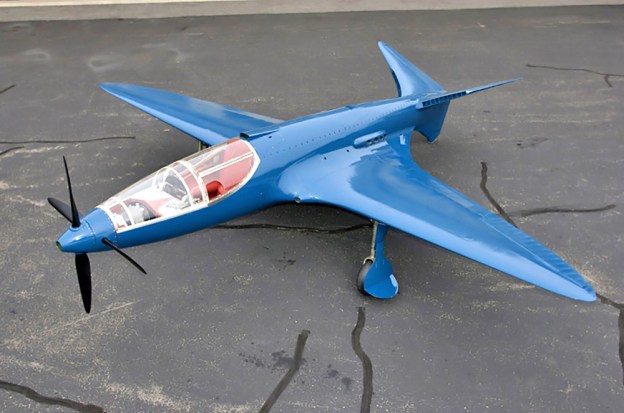
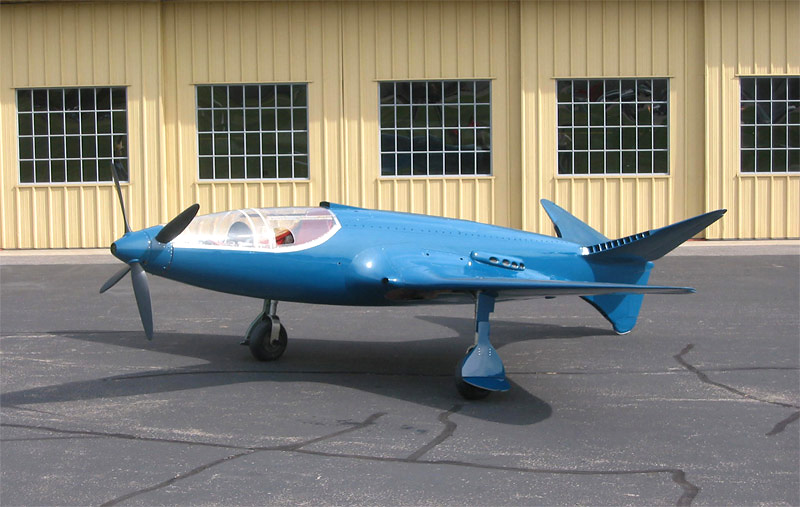
The elegant lines of the Bugatti 100P are well displayed in this image. (Hugh Conway Jr. image)

In 1936, Bugatti began to consider the possibility of building an aircraft around two straight eight-cylinder Bugatti T50B (Type 50B) engines, very similar to the engines that powered the Bugatti Grand Prix race cars. This aircraft would be used to make attempts on several speed records, most importantly, the 3 km world landplane speed record, then held by Howard Hughes in the Hughes H-1 Racer at 352.389 mph (567.115 km/h). Bugatti turned to Louis de Monge, a Belgian engineer, to help design the aircraft, known as the Bugatti Model 100P.

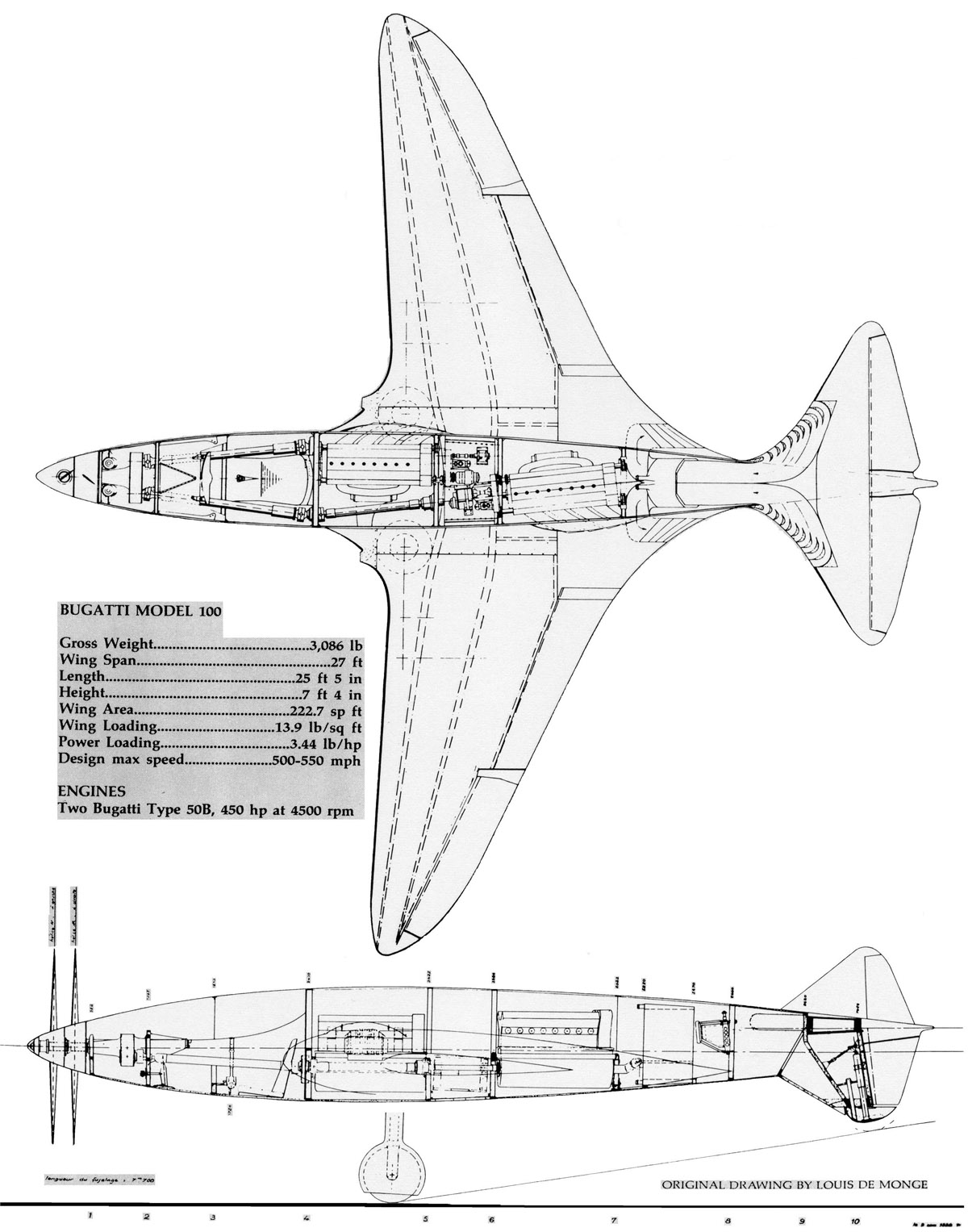
Bugatti 100P general arrangement drawing based off the original drawings by Louis de Monge. Note the arrangement of the power and cooling systems.

Before construction of the Bugatti 100P began, Germany demonstrated what if felt was its aerial superiority by setting a new 3 km world landplane speed record at 379.63 mph (610.95 km/h) in a Messerschmitt Bf 109 (V13) on 11 November 1937. Bugatti disliked Nazi-Germany and was very interested in beating their record. Bugatti and de Monge continued to develop the 100P for an attempt to capture the 3 km record from Germany.

The Bugatti 100P was one of the most beautiful aircraft ever built. With the exception of engine exhaust ports, the 25 ft 5 in (7.75 m) fuselage was completely smooth. The aircraft employed wood monocouque “sandwich” construction in which layers of balsa wood were glued and carved to achieve the desired aerodynamic shape. Hardwood rails and supports were set into the balsa wood to take concentrated loads at stress points, like engine mounts and the canopy. The airframe was then covered with tulipwood strips, which were then sanded and filled. Finally, the aircraft was covered with linen and doped. The Bugatti 100P stood 7 ft 4 in (2.23 m) tall and weighed 3,086 lb (1,400 kg).

The 100P had a 27 ft (8.235 m), one-piece wing that was slightly forward-swept. The wing had a single box spar that ran through the fuselage. The wing was constructed in the same fashion as the fuselage and housed the fully retractable and enclosed main gear. The wing featured a multi-purpose, self-adjusting flap system (U.S. patent 2,279,615). Both the upper and lower flap surfaces automatically moved up or down to suit the speed of the aircraft and the power setting (manifold pressure) of the engines. At high manifold pressure and very low airspeed, the flaps set themselves to a takeoff position. At low airspeed and low power, the flaps dropped into landing position, and the landing gear was automatically lowered. In a dive, the flaps pivoted apart to form air brakes.

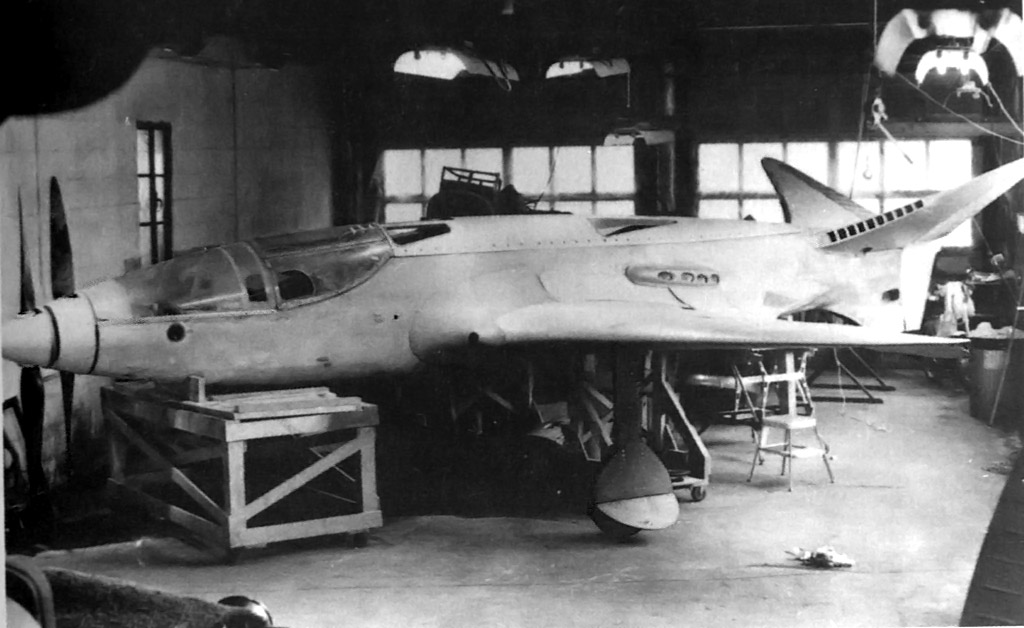
Image of the nearly complete Bugatti 100P still under construction in Paris. The cooling-air inlet in the butterfly tail can be easily seen.

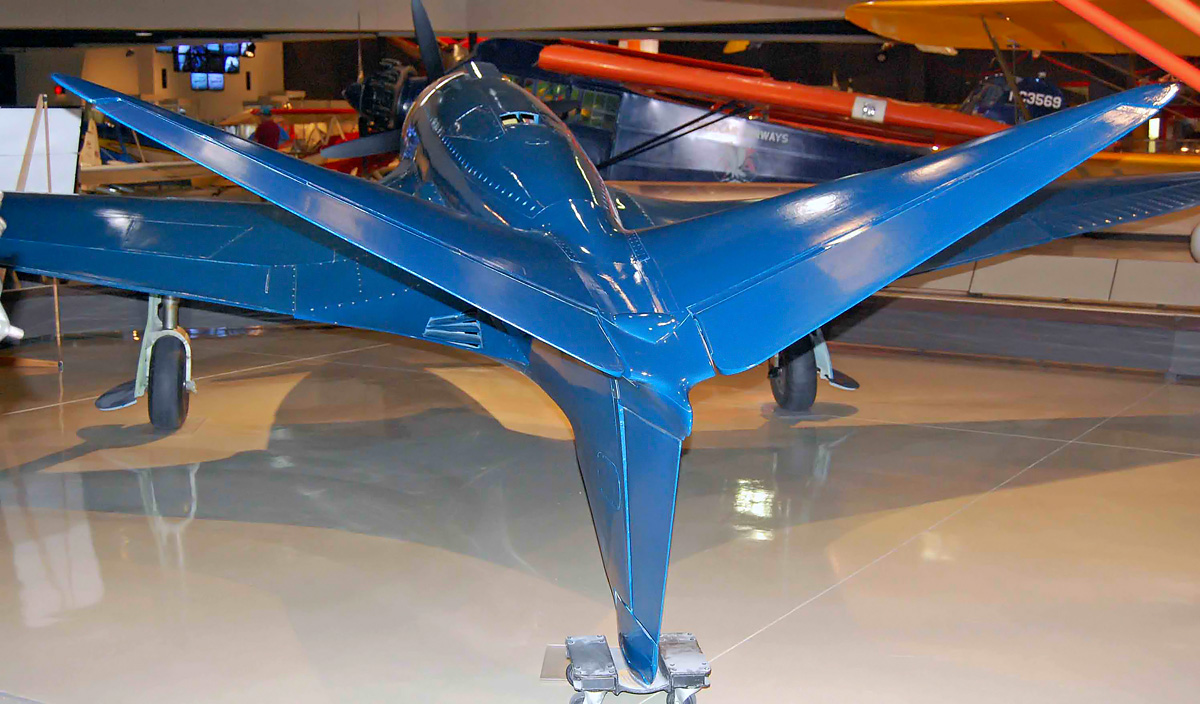
The Bugatti tail surfaces consisted of two butterfly units and a ventral fin at 120-degree angles (French patent 852,599). They were constructed with the same wood “sandwich” method used on the fuselage and wing. The tip of the ventral fin incorporated a retractable tail skid.  For cooling, air was scooped into ducts in the leading edges of the butterfly tail and ventral fin. The air was turned 180 degrees, flowed into a plenum chamber in the aft fuselage, and passed through a two section radiator (one section for each engine) located behind the rear engine. The now-heated air again turned 180 degrees and exited out the fuselage sides into a low pressure area behind the trailing edge of the wings. The high pressure at the intake and low pressure at the outlet created natural air circulation that required no fans or blowers (U.S. patent 2,268,183).

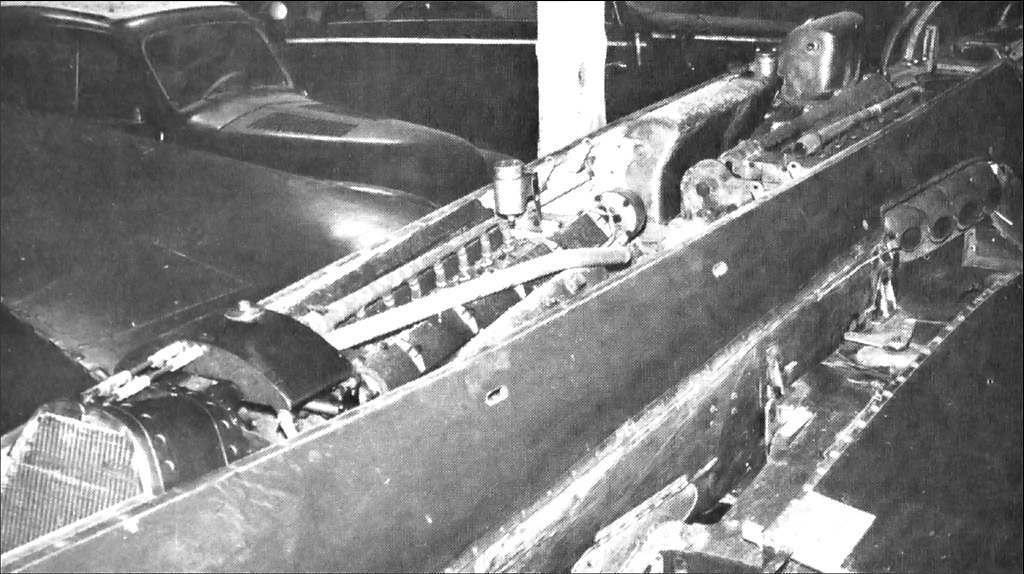
The two Bugatti T50B straight eight-cylinder engines were specially made for the 100P aircraft. The engine crankcases were made of magnesium to reduce weight, and each engine used a lightweight Roots-type supercharger feeding two downdraft carburetors. The T50B had a bore of 3.31 in (84 mm) and a stroke of 4.21 in (107 mm), giving a total displacement of 289 cu in (4.74 L). Twin-overhead camshafts actuated the two intake and two exhaust valves for each cylinder. The standard T50B race car engine produced 480 hp (358 kW) at 5,000 rpm. An output of 450 hp (336 kW) at 4,500 rpm is usually given for the 100P’s engines; however, de Monge stated the engines planned for the 100P were to produce 550 hp (410 kW) each. The engines were situated in tandem, behind the pilot. The front engine was canted to the right and drove a drive shaft that passed by the pilot’s right side. The rear engine was canted to the left and drove a drive shaft that passed by the pilot’s left side. The two shafts joined into a common reduction gearbox just beyond the pilot’s feet. The gearbox allowed each engine to drive a metal, two-blade, ground-adjustable Ratier propeller. Together, the two propeller sets made a coaxial contra-rotating unit. From the gearbox, the rear propeller shaft (driven by the front engine) was hollow, and the front shaft (driven by the rear engine) rotated inside it (U.S. patent 2,244,763).

Image of the two T50B engines in the Bugatti 100P while at the Ermeronville estate. Note the radiator at left , how the engines are canted within the fuselage, and how the exhaust ports on the front engine protrude through the fuselage.

Once the new design was finalized in 1938, construction of the 100P was begun at a high quality furniture factory in Paris. While construction proceeded, it was obvious that war would break out soon. France did not have any fighters that could match the performance of their German counterparts. The French Air Ministry felt the 100P could be developed into a light pursuit or reconnaissance fighter and awarded a contract to Bugatti in 1939. This fighter was to be equipped with at least one gun mounted in each wing, an oxygen system, and self-sealing fuel tanks. Most aspects of the fighter are unknown, but it is possible that it was larger than the 100P and incorporated 525 hp (391 kW) T50B engines installed side-by-side in the fuselage driving six-blade coaxial contra-rotating propellers with a 37-mm cannon firing through the propeller hub. Because of France’s surrender, the aircraft never progressed beyond the initial design phase.

The Bugatti 100P, finally in all its glory after being completely restored by the Experimental Aircraft Association. Note the fairing for the rear engine ‘s exhaust ports above the wing. (Hugh Conway Jr. image)

Bugatti’s contract included a bonus of 1 million francs if the 100P racer captured the world speed record which the Germans had raised to 463.919 mph (746.606 km/h) with a Heinkel He 100 (V8) on 30 March 1939 and raised again to 469.221 mph (755.138 km/h) with a Messerschmitt Me 209 (V1) on 26 April 1939. Bugatti and de Monge felt the 100P was capable of around 500 mph (800 km/h). In addition, a smaller version of the racer, known as the 110P, was planned; it featured a 5 ft (1.525 m) reduced wingspan of 22 ft (6.7 m). The 110P was to have the same engines as the 100P, but the top speed was estimated at 550 mph (885 km/h). However, other sources indicate these figures were very optimistic, and the expected performance was more around 400 mph (640 km/h) for the 100P and 475 mph (768 km/h) for the 110P.

The 100P was nearly complete when Germany invaded France. As the Germans closed in on Paris in June 1940, the Bugatti 100P and miscellaneous parts, presumably for the 110P, were removed from the furniture factory and loaded on a truck. The 100P was taken out into the country and hidden in a barn on Bugatti’s Ermeronville Castle estate 30 mi (50 km) northeast of Paris.

Bugatti 100P on display at the EAA AirVenture Museum in Oshkosh, Wisconsin. The cooling air exit slots on the left side of the aircraft can be seen on the wing trailing edge fillet. Also note the tail skid on the ventral fin.

Ettore Bugatti died on 21 August 1947 with the 100P still stashed away in Ermeronville. The aircraft was purchased by M. Serge Pozzoli in 1960 but remained in Ermeronville until 1970 when it was sold to Ray Jones, an expert Bugatti automobile restorer from the United States. Both Pozzoli and Jones offered the 100P to French museums but were turned down. Jones acquired the 100P with the intent to complete the aircraft; however, that goal could not be completed due to missing parts. Jones had the two Bugatti T50B engines removed from the airframe before everything was shipped to the United States. Dr. Peter Williamson purchased the airframe and moved it to Vintage Auto Restorations in Ridgefield, Connecticut in February 1971 to begin a lengthy restoration. Les and Don Lefferts worked on the project from 1975 to 1979. Louis de Monge was now living in the United States and assisted with some aspects of the restoration work before he passed away in 1977. In 1979, the unfinished 100P was donated to the Air Force Museum Foundation with the hope of having the restoration completed and the aircraft loaned to a museum for display. However, the aircraft sat until 1996 when it was donated to the Experimental Aircraft Association (EAA) in Oshkosh, Wisconsin and finally underwent a full restoration. The restored, but engineless, Bugatti 100P is currently on display at the EAA AirVenture Museum.

The original engines out of the Model 100P were reportedly not the final version of the engines intended for the actual speed record run. Both engines still exist and are installed in Bugatti automobiles. The front engine is installed in Ray Jones’ 1937 Type 59/50B R Grand Prix racer, and the rear engine is installed in Charles Dean’s 1935 Type 59/50B Grand Prix racer. Since January 2009, Scotty Wilson has led an international team, including Louis de Monge’s grand-nephew, Ladislas de Monge, to build a flying replica of the Bugatti 100P in Tulsa, Oklahoma. Piloted by Wilson, the Bugatti 100P replica flew for the first time on 19 August 2015. Tragically, Scotty Wilson was killed when the replica crashed during a test flight on 6 August 2016.

Bugatti 100P on display at the EAA AirVenture Museum in Oshkosh, Wisconsin. Simply one of the most beautiful aircraft ever built.

Sources:
The Bugatti 100P Record Plane by Jaap Horst (2013)
World Speed Record Aircraft by Ferdinand Kasmann (1990)
Airplane Racing by Don Berliner (2009)
The Classic Twin-Cam Engine by Griffith Borgeson (1979/2002)
http://www.bugattiaircraft.com/kalempa.htm by Alex Kalempa
http://www.airventuremuseum.org/collection/aircraft/2Bugatti Model 100 Racer.asp
http://www.airventuremuseum.org/collection/aircraft/2Bugatti Model 100 Racer Facts.asp
http://morlock68.pagesperso-orange.fr/bugatti.htm
http://bugatti100p.com/
http://en.wikipedia.org/wiki/Bugatti
http://kfor.com/2016/08/06/historic-replica-airplane-the-bugatti-100p-crashes-near-burns-flat-pilot-and-designer-scotty-wilson-dies/

Bellanca 28-92 Trimotor

By William Pearce

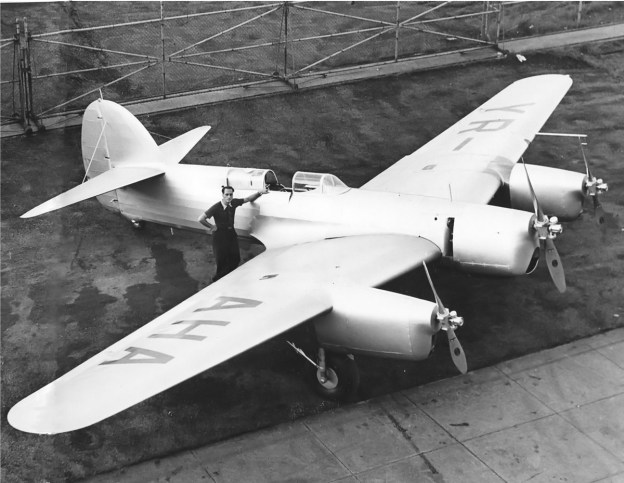
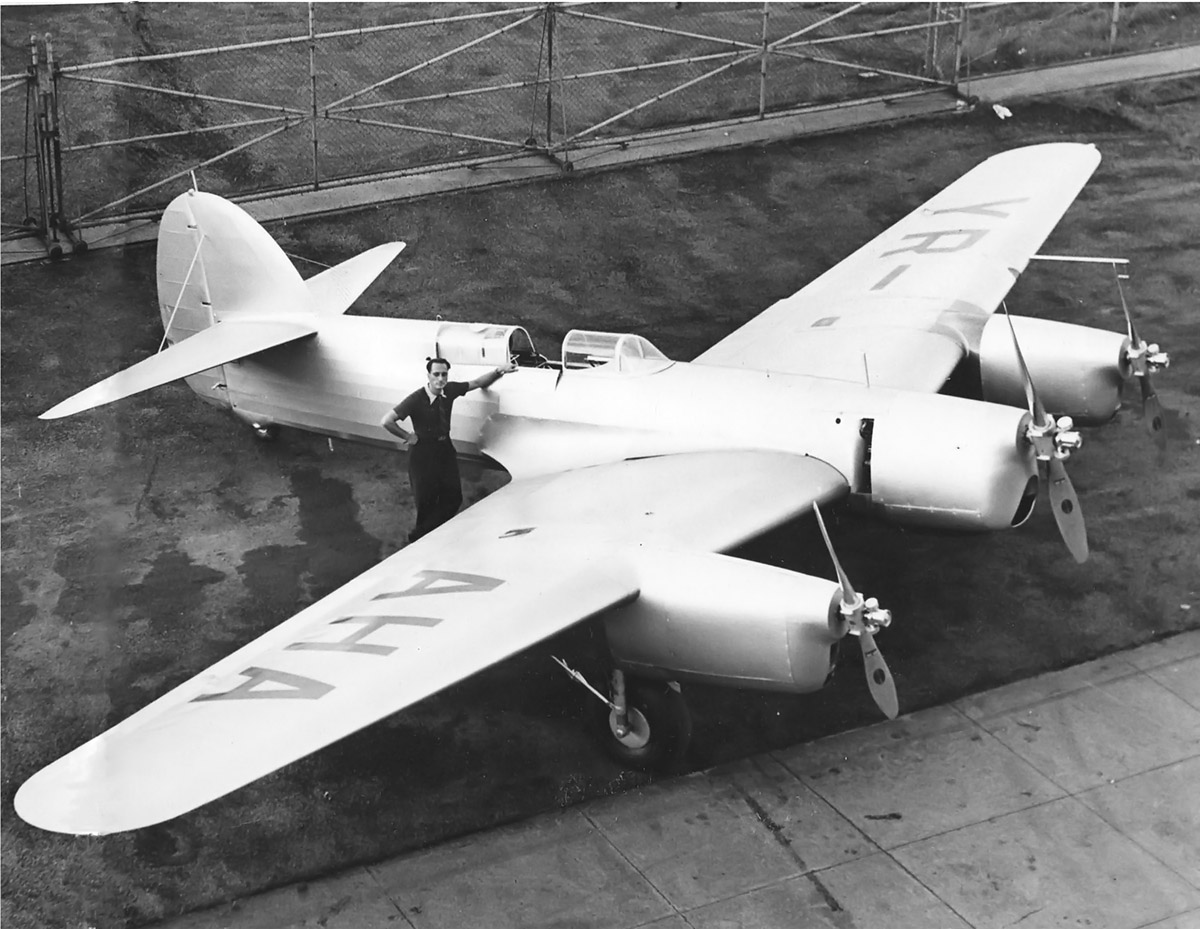
The Bellanca 28-92 (construction no. 903) was developed by Giuseppe Bellanca in 1937 for Capt. Alexandru Papana. Papana was a Romanian Air Force pilot who planned to use the Bellanca on a long-distance good-will flight from New York to Bucharest. He named the aircraft Alba Iulia 1918 to commemorate the assembly of ethnic Romanian delegates who unified what is modern-day Romania at Alba Iulia, Transylvania in 1918. The aircraft carried the Romanian registration YR-AHA.

Alex Papana poses with the Bellanca 28-92. The Romanian registration can be seen on the wings but the name, “Alba Iulia 1918,” has yet to be applied. Note the propellers do not have spinners.

The Bellanca 28-92 was a low-wing, single-seat, trimotor design. The fuselage was of tubular steel construction and covered by aluminum back to the cockpit. Aft of the cockpit, the fuselage was covered with fabric. The wings and tail were plywood-covered, and the control surfaces were covered by fabric. The main undercarriage partially retracted into the rear of the wing engine nacelles, but the tailwheel did not retract.

Installed in each wing of the aircraft was a 250 hp (186 kW) Menasco C6S4 engine. The C6S4 Super Buccaneer was a direct drive, air-cooled, inverted, straight-six aircraft engine. The C6S4 was supercharged and displaced 544 cu in (8.9 L). Each C6S4 engine drove a 6 ft 6 in (1.98 m) diameter, two-blade, adjustable-pitch propeller.

The complete 28-92 with spinners and “Alba Iulia 1918” painted on the side. “YR” is painted on the tail, and the registration “YR-AHA” is repeated on the upper fuselage behind the cockpit..

A 420 hp (313 kW) Ranger SGV-770 engine was in the nose of the 28-92. The SGV-770 was an air-cooled, inverted, V-12 engine. The engine was supercharged, displaced 773 cu in (12.7 L), and had gear reduction for the 8 ft 3 in (2.51 m) diameter, two-blade, adjustable-pitch propeller.

All of the trimotor’s engines were hand cranked to start. The 28-92 had a fuel capacity of around 715 gallons (2,707 L). The aircraft had a span of 46 ft 4 in (14.1 m), a length of 28 ft 4 in (8.6 m), and weighed 4,700 lb (2,132 kg) empty. The 28-92 had a top speed of 285 mph (459 km/h) and a 3,000 mile (4,828 km) range at 250 mph (402 km/h) or a 4,160 mile (6,695 km) range at 200 mph (322 km/h). Landing speed was 75 mph (121 km/h).

Front view of the 28-92 trimotor illustrating the limited visibility from the cockpit while the aircraft was on the ground.

Papana was inexperienced with superchargers and inadvertently overboosted the engines during his first test flight in the trimotor. The incident led to a disagreement with Bellanca, and Papana cancelled his order for the aircraft. Since the 28-92 was complete and neither Papana nor the Romanian government paid for the aircraft, it remained at the Bellanca factory.

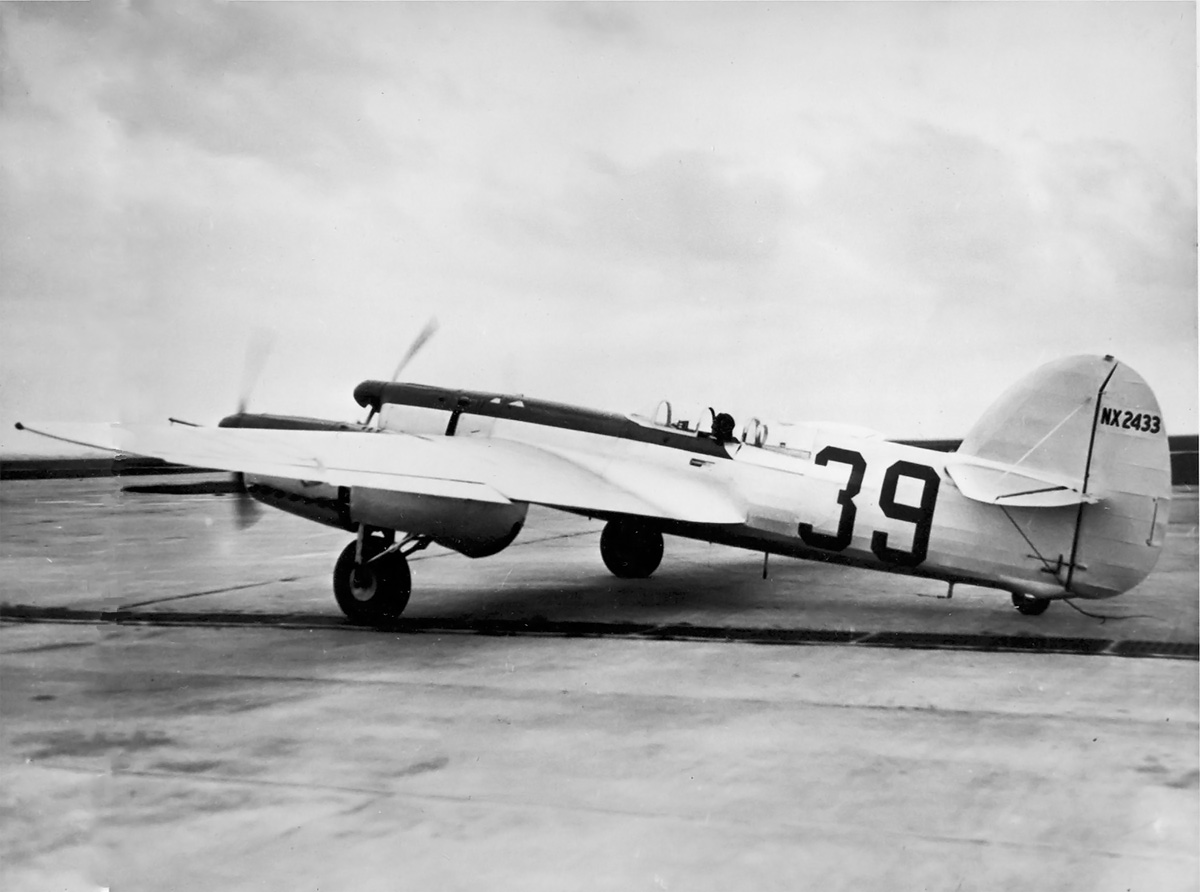
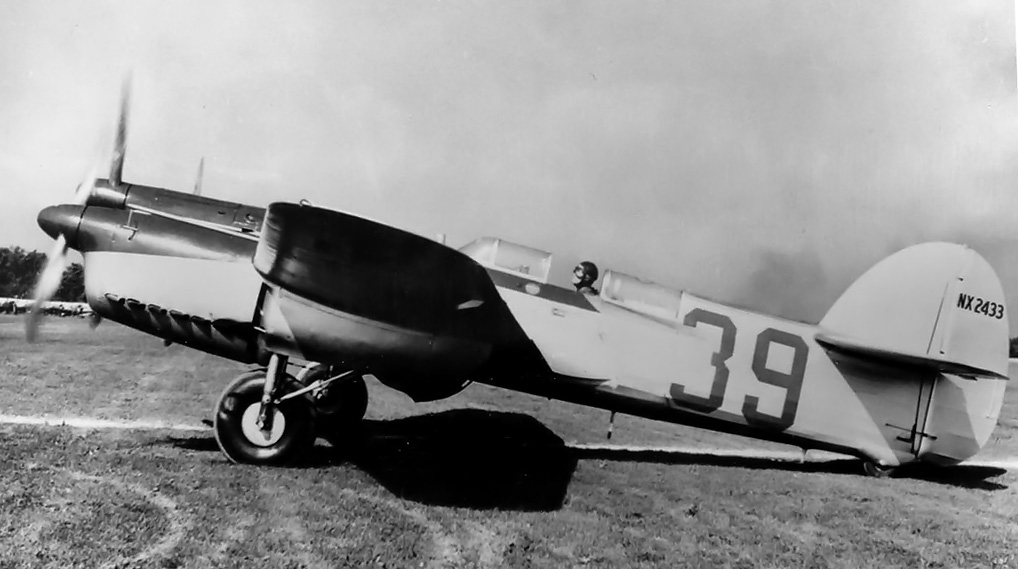
In 1938, Bellanca registered the aircraft in the United States as NX2433 and entered it in the Bendix Trophy cross-country race. Frank Cordova was the pilot for the race, and the trimotor flew as race number 99. Unfortunately, because of engine trouble, the aircraft did not finish the cross-country race. The Ranger engine in the nose quit, but Cordova continued to fly on the two Menasco engines for another 1,000 miles (1,609 km), landing in Bloomington, Illinois. A new rule for the 1938 races stated that no aircraft entered in the Bendix race could compete in the Thompson Trophy race, so the trimotor was returned to the Bellanca factory.

Bellanca 28-92 trimotor with Art Bussy at the controls for the 1939 Bendix race. The aircraft looked the same for the 1938 race except the race number was 99.

The 28-92 was again entered for the 1939 Bendix Trophy race, this time piloted by Art Bussy. Competing as race number 39, the aircraft finished second in the Los Angeles to Cleveland race with an average of 244.486 mph (393.462 km/h). Continuing on to New York, Bussy and the trimotor again finished second, averaging 231.951 mph (373.290 km/h) for the total distance from Los Angeles to New York.

Because of the start of World War II, all air races and record flights were put on hold. The Bellanca 28-92 trimotor was of little use during this time. The aircraft was eventually purchased by the Ecuadorian Air Force and served in South America from 1941 to 1945. Reportedly, the 28-92 was abandoned at a small airfield in Ecuador; a sad end for a unique aircraft.

Rear 3/4 view of the Bellanca 28-92 showing the aircraft’s clean lines.

*Sources disagree on what number the aircraft used for which year. Images reportedly from 1939 show number 39 on the fuselage, but it is possible that they are in error and race number 99 could have been used in 1939 and race number 39 used in 1938.

Sources:
Aircraft of Air Racing’s Golden Age by Robert and Ross Hirsh (2005)
The Air Racer by Charles Mendenhall (1994)
Aerosphere 1939 by Glenn Angle (1940)
Bellanca Specials 1925 – 1940 by Theo Wesselink (2015)
Jane’s all the World’s Aircraft 1938 by Grey and Bridgman (1938)

Arsenal VB 10-02 under construction

Arsenal VB 10 Heavy Interceptor Fighter

By William Pearce

In January 1937, the Ministère de l’Air (French Air Ministry) gave Arsenal de l’Aéronautique a contract to develop a twin-engine heavy interceptor fighter built from wood and powered by two 690 hp (515 kW) Hispano-Suiza 12X engines. The engines were to be mounted in tandem inside the fuselage driving coaxial propellers in the nose. Through the course of several changes, the aircraft’s design was developed into the all-aluminum VB 10 fighter. The VB 10 was designed in 1938 by Michel Vernisse and Robert Badie; the initials of their last names formed the ‘VB’ of the aircraft’s designation.

Arsenal VB 10-01 rear

The Arsenal VB 10-01 prototype powered by two 860 hp (641 kW) Hispano-Suiza 12Y-31 V-12 engines. Note the obstructed rear view from the flush canopy.

The VB 10 was a low-wing monoplane in a standard taildragger configuration with retractable undercarriage and a single-seat. It was a large aircraft with a span of 50 ft 10 in (15.49 m), length of 42 ft 7 in (12.98 m), height of 17 ft 3/4 in (5.2 m), and an empty weight of 15,190 lb (6,890 kg).

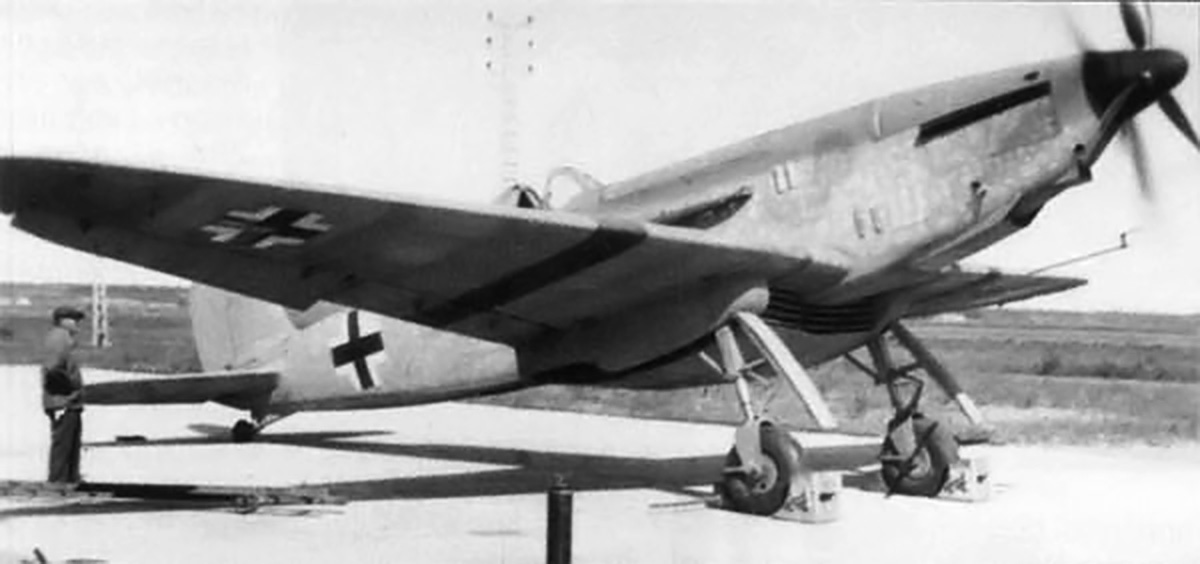
While the aircraft was of a standard configuration, the engine arrangement was not. One engine occupied the standard position in the nose of the aircraft and a second engine was included behind the cockpit. Each engine drove a set of propeller blades that, together, made up a coaxial contra-rotating unit in the nose. The front engine drove the rear propeller, and the rear engine drove the front propeller. The drive shaft from the rear engine ran through the Vee of the front engine and to the front propeller. A Vernisse or homocinetic coupling was used in which flexibly-mounted ball joints join sections of the rear engine’s propeller shaft to accommodate deflection and vibration of the shaft.

Latecoere 299A runup

The Latécoère 299A that served as an engine testbed for the Arsenal VB 10. The 229A was powered by two 860 hp (641 kW) Hispano-Suiza 12Y V-12 engines, same as the VB 10-01 prototype. Note the front propeller is not turning and the German markings.

Before the prototype was built, a contract for 40 aircraft was placed in May 1940. However, construction was suspended with the capitulation of France in June 1940. In April 1942, the Vichy government was able to persuade the RLM (Reichsluftfahrtministerium or German Ministry of Air) to allow construction to resume on the twin-engine propulsion system. To thoroughly evaluate the unusual engine arrangement, a Latécoère 299 was made into a flying testbed and renamed 299A. Completed in July 1943, the Latécoère 299A was destroyed in an Allied bombing raid on 30 April 1944.

With the tide of the war changing, the French restarted construction of the first prototype, VB 10-01, in July 1944. The unarmed prototype was powered by two 860 hp (641 kW) Hispano-Suiza 12Y-31 12-cylinder, liquid-cooled engines and had a flush, sliding canopy with an obstructed rear view. This aircraft was first flown on 7 July 1945 by Modeste Vonner. During initial flight tests, the VB 10-01 achieved a sea-level speed of 304 mph (490 km/h). An order for 200 aircraft was placed on 22 December 1945.

Arsenal VB 10-02 under construction

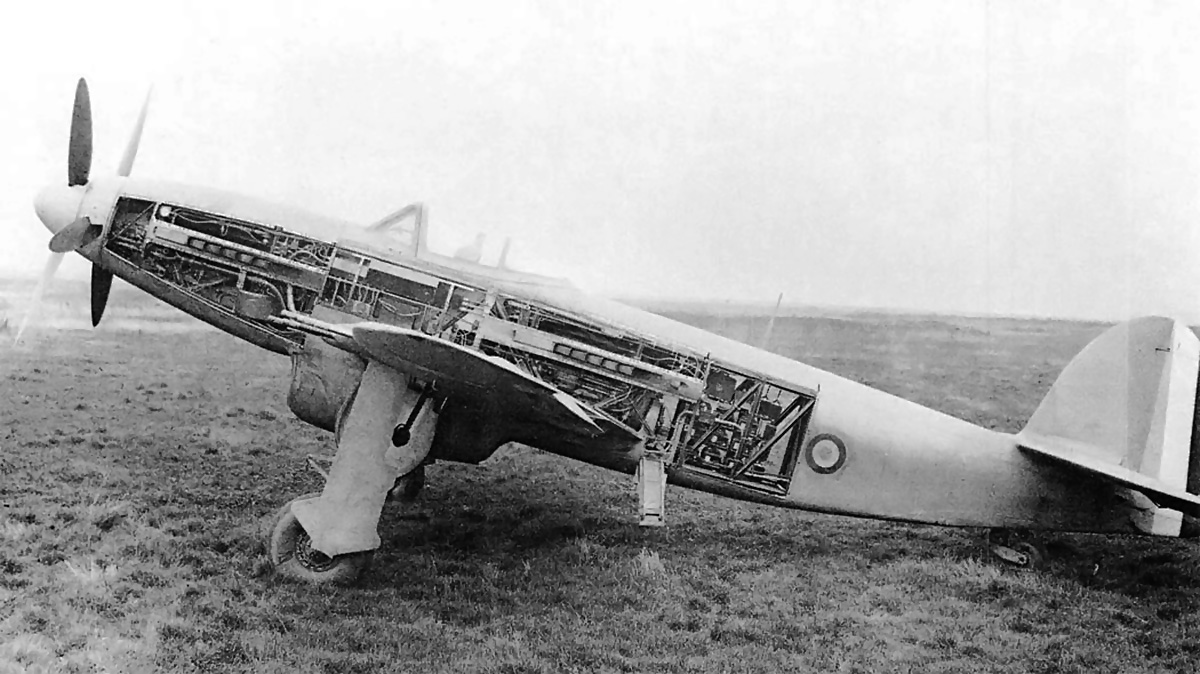
The second prototype VB 10-02 under construction. Note the two 20 mm cannons and three .50-cal machine guns in each wing.

The second prototype, VB 10-02, had a bubble canopy for improved visibility and was powered by two 1,150 hp (858 kW) Hispano-Suiza 12Z engines. The aircraft was also armed with four 20 mm Hispano-Suiza cannons (with 600 rounds total) and six .50-cal Browning machine guns (with 2,400 rounds total), all mounted in the wings. The VB 10-02 first flew on 21 September 1946. Mechanical issues and engine overheating plagued both prototypes; these challenges, combined with the availability of cheap surplus allied aircraft and the jet age on the horizon, led to a revised order of just 50 aircraft.

Arsenal VB 10-02 side open

Another image of the Arsenal VB 10-02 with the side panels removed. Note the bubble canopy.

The first production VB 10 made its maiden flight on 3 November 1947. The aircraft was powered by two Hispano-Suiza 12Z-15/16 engines that were rated at 1,300 hp (969 kW) max and 1,150 hp (858 kW) continuous. It was armored with only four 20mm cannons but had provisions to carry one 1,100 lb (500 kg) bomb under each wing. Additional fuel took the place of the removed machine guns. The production aircraft went on to achieve a max speed of 323 mph (517 km/h) at sea-level and 435 mph (700 km/h) at 24,600 ft (7,500 m).

For the VB 10, the beginning of the end occurred on 10 January 1948 when the second prototype, VB 10-02, caught fire while over southern Paris. An uncommanded propeller pitch change over-reved the rear engine, destroying it and starting the fire. The pilot, Pierre Decroo, was forced to bail out. He survived but suffered burns. On 15 September 1948, the third (some say first) production machine crashed in much the same fashion, killing the pilot, Henri Koechlin. Six days later on 21 September 1948, the Arsenal VB 10 contract was cancelled. At the time of cancellation, four production VB 10 aircraft (including the one that crashed) had flown, six additional airframes had been completed, and a number of airframes were under construction. All remaining VB 10s (including the first prototype) were scrapped.

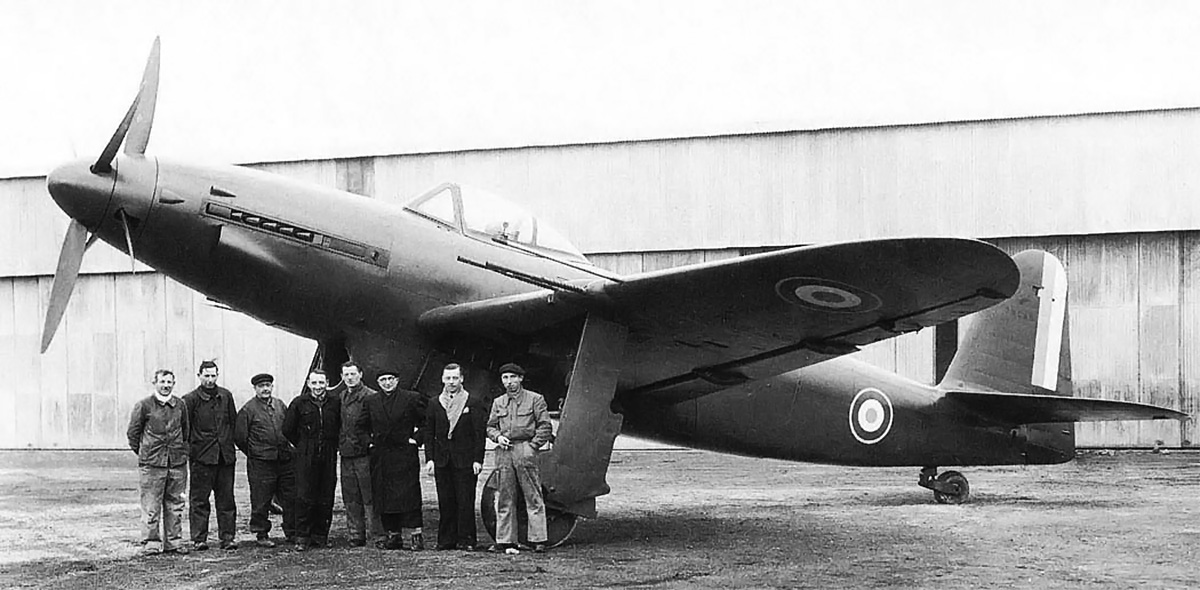
Arsenal VB 10 C-1 production

The size of the VB 10 is illustrated here by the crowd in front of the first production VB 10. The aircraft was powered by two Hispano-Suiza 12Z-15/16 engines. Note the 20 mm cannons and no machine guns.

Sources:
The Complete Book of Fighters by Green and Swanborough (1994)
Hispano Suiza in Aeronautics by Manuel Lage (2004)
Jane’s All the World’s Aircraft 1948 by Leonard Bridgman (1948)
– “Behind the Lines: French Development” Flight (3 February 1944)
http://fr.wikipedia.org/wiki/Arsenal_VB-10
http://en.wikipedia.org/wiki/Arsenal_VB_10
L’ Arsenal de l’Aéronautique by Gérard Hartmann (pdf in French)