Category Archives: World War II

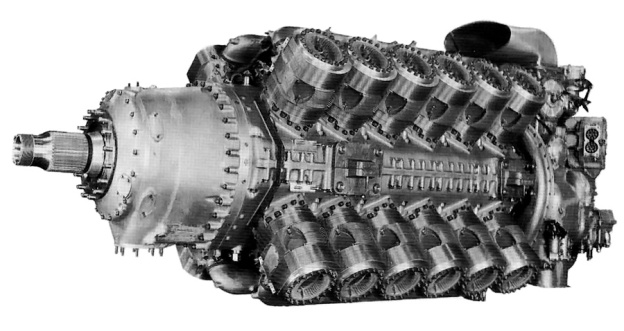
FKFS Gruppen-Flugmotor A mockup copy

FKFS Gruppen-Flugmotor A, C, and D

By William Pearce

In 1930, German engineer Wunibald Kamm founded the FKFS (Forschungsinstitut für Kraftfahrwesen und Fahrzeugmotoren Stuttgart or Research Institute of Automotive Engineering and Vehicle Engines Stuttgart). The FKFS was an organization that tried and tested new, inventive ideas in the field of automotive technology. However, it was not long before Kamm’s thoughts and some of the FKFS’s resources were directed toward aircraft engines.
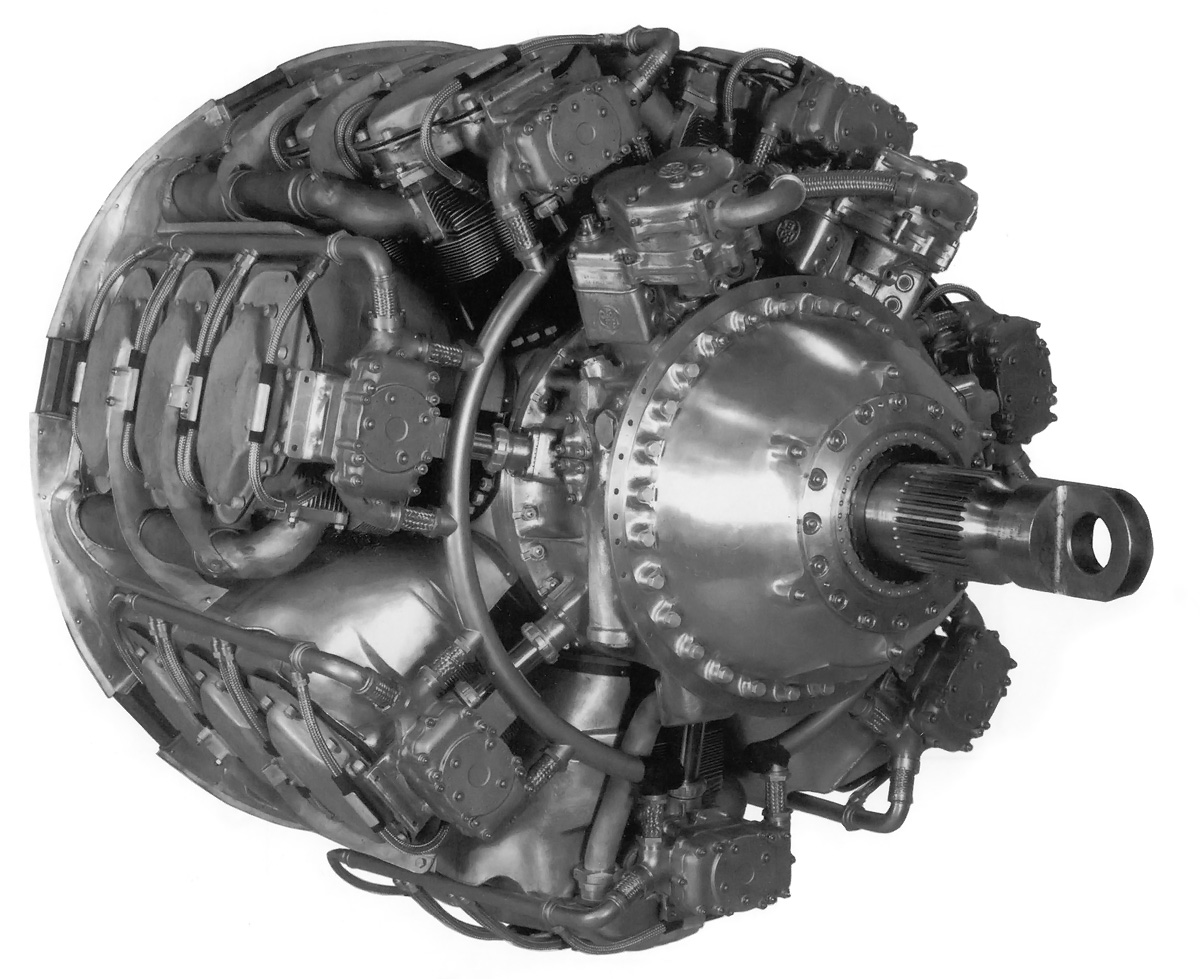
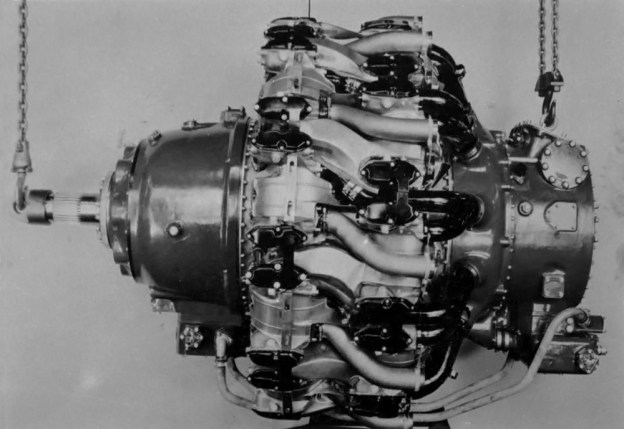
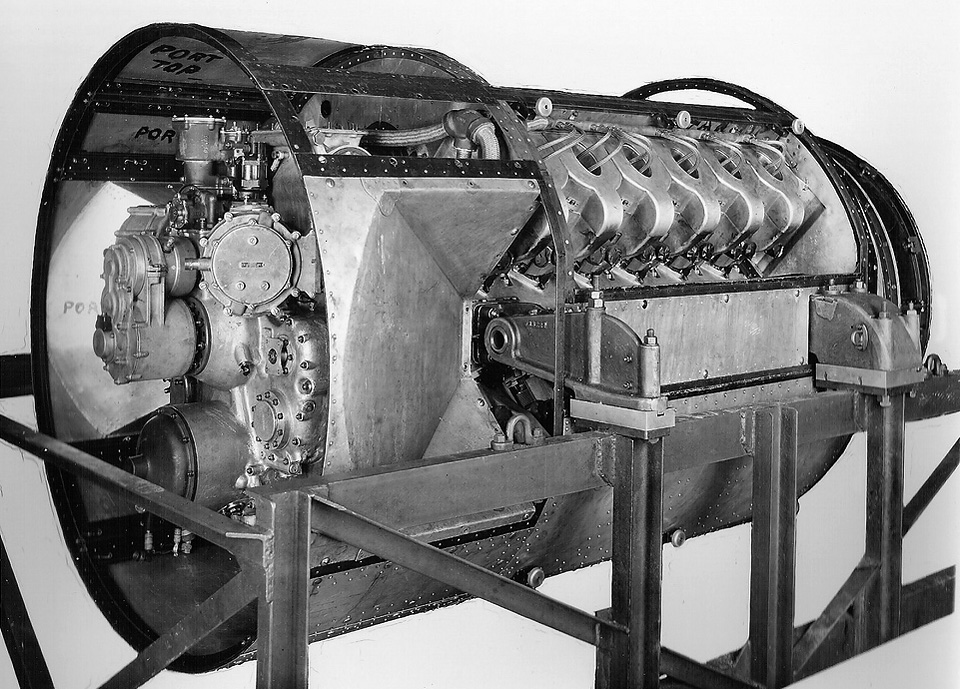
FKFS Gruppen-Flugmotor A mockup copy

Crankcase mockup of the FKFS Gruppen-Flugmotor A with Hirth HM 512 cylinders. Visible on the side of the engine is a mockup of the axial supercharger. (Kevin Kemmerer image)

In mid-1938, Kamm was able to persuade Willy Krautter of Hirth Motoren to join the FKFS as head of the FKFS’s Special Engine Group. Krautter’s first project at FKFS was building FKFS’s first aircraft engine. The result was a flat, air-cooled, two-stroke, four-cylinder engine that displaced 31 cu in (.51 L) and produced 25 hp (18 kW). The engine was used in the Hirth Hi-20 MoSe motor glider. Next, Krautter designed an improved and updated version of the four-cylinder engine, but priorities had shifted with the outbreak of World War II. Inspired by an open request from the RLM (Reichsluftfahrtministerium or German Ministry of Aviation), the FKFS focused on designing much larger engines.

The RLM was interested in large, powerful engines for bombers being designed to reach targets in North America. Both Kamm and Krautter believed that air-cooled engines were overall superior for aircraft use, and they designed a 32-cylinder engine intended for the RLM. This radial engine had eight cylinder banks evenly spaced at 45 degree intervals around the crankcase. Each cylinder bank consisted of four inline, air-cooled cylinders and a single overhead camshaft. The cylinder proposed for the engine was designed by Krautter and was undergoing tests at the FKFS.
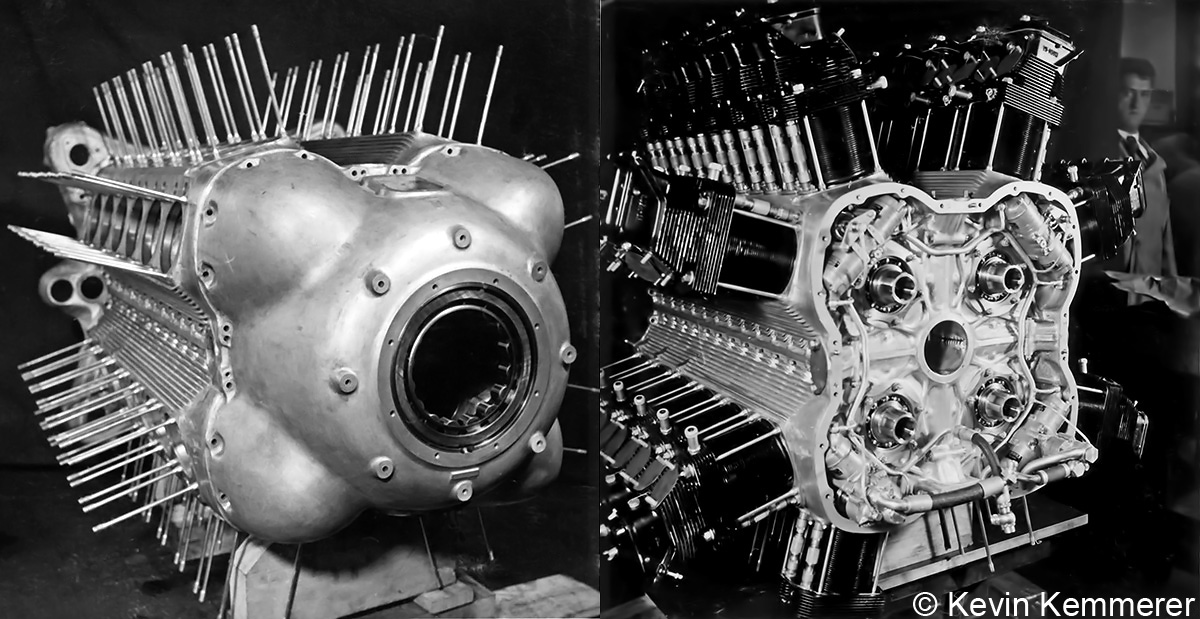
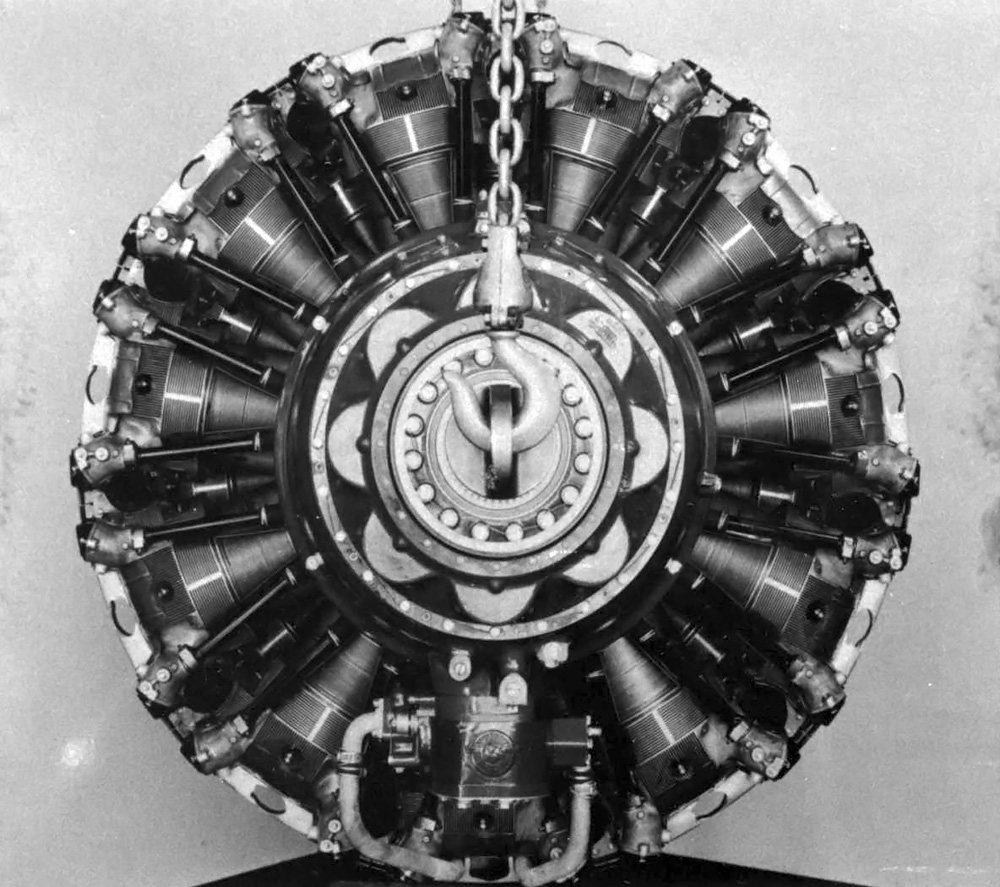
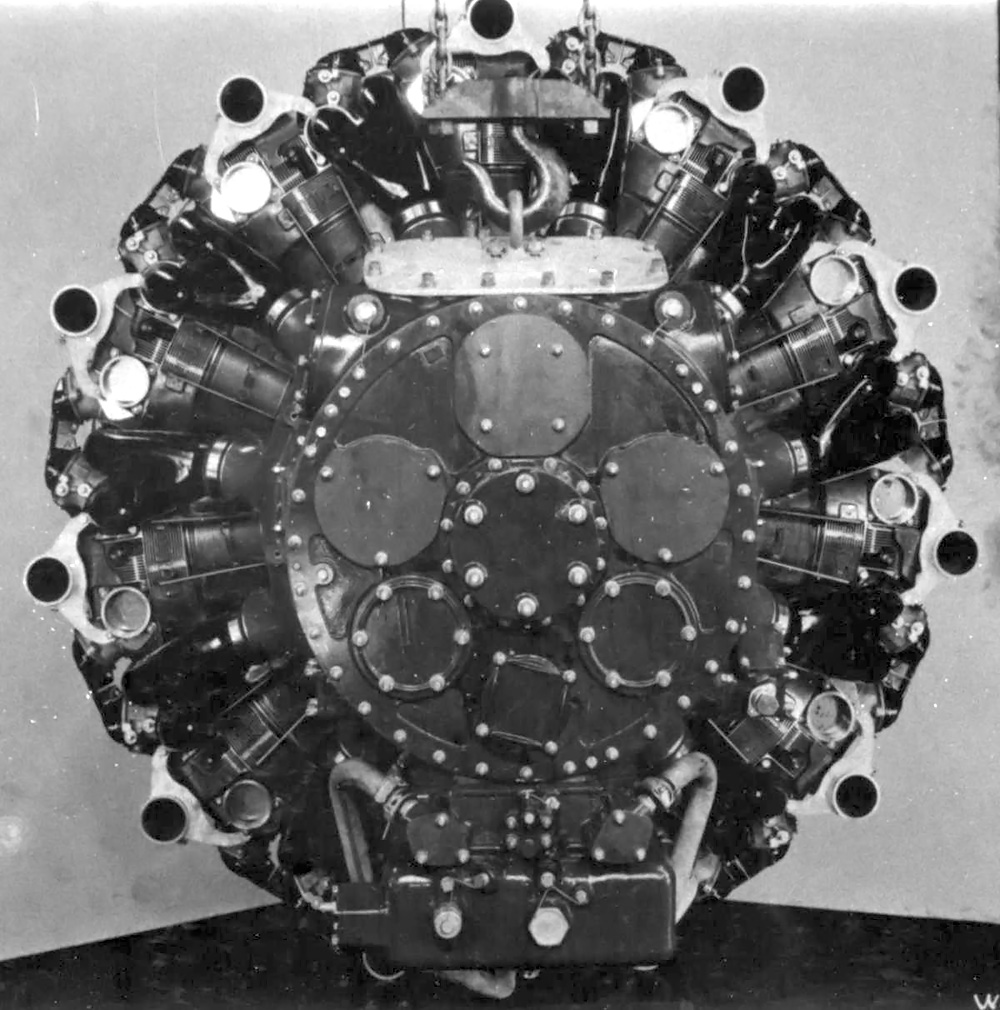
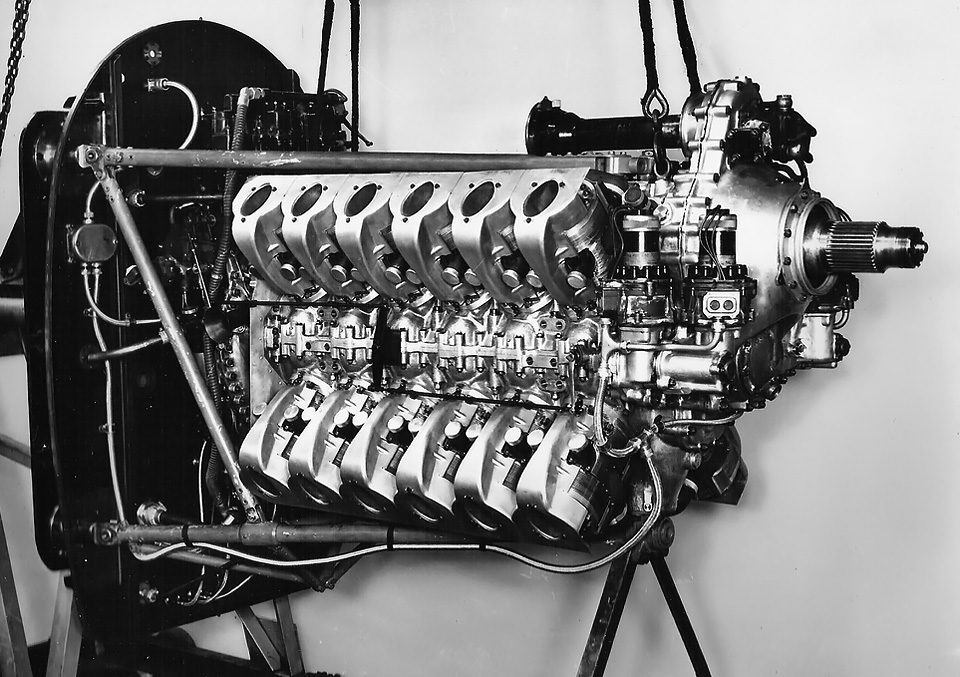
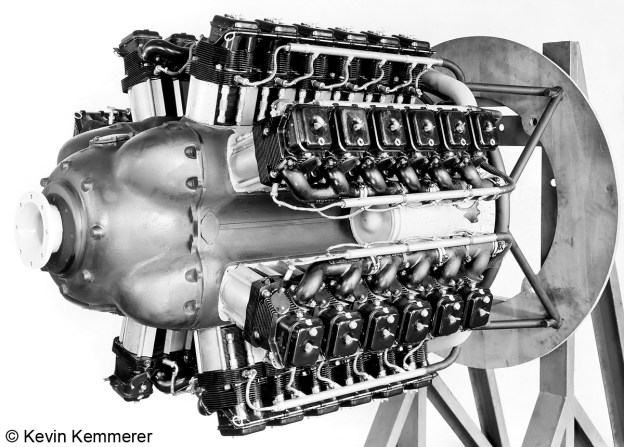
FKFS Gruppen-Flugmotor A crankcase copy

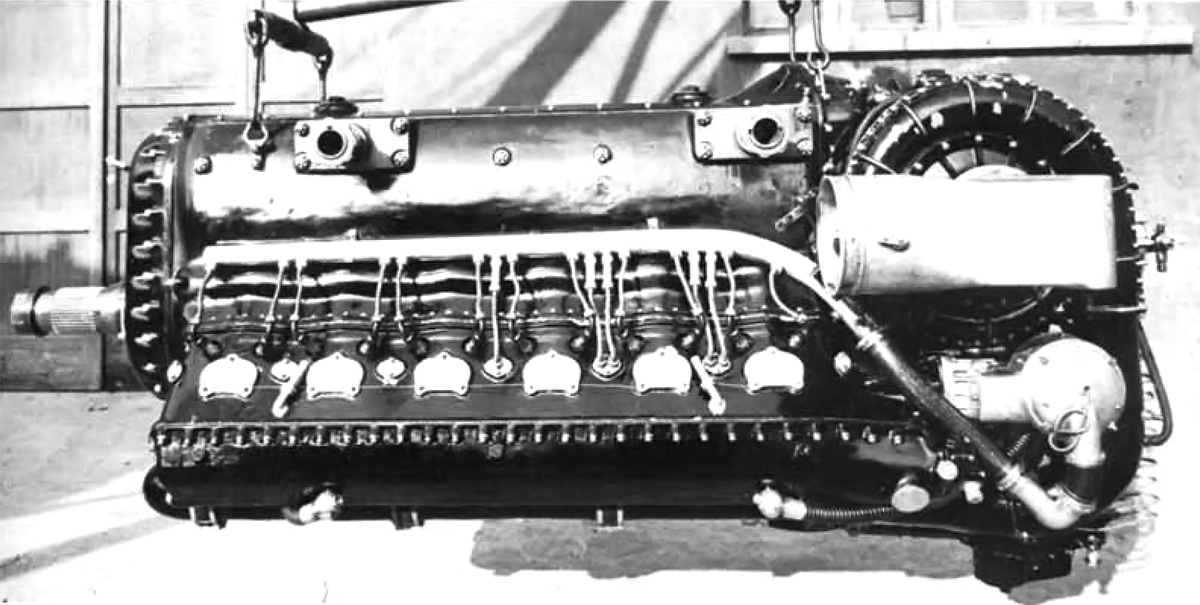
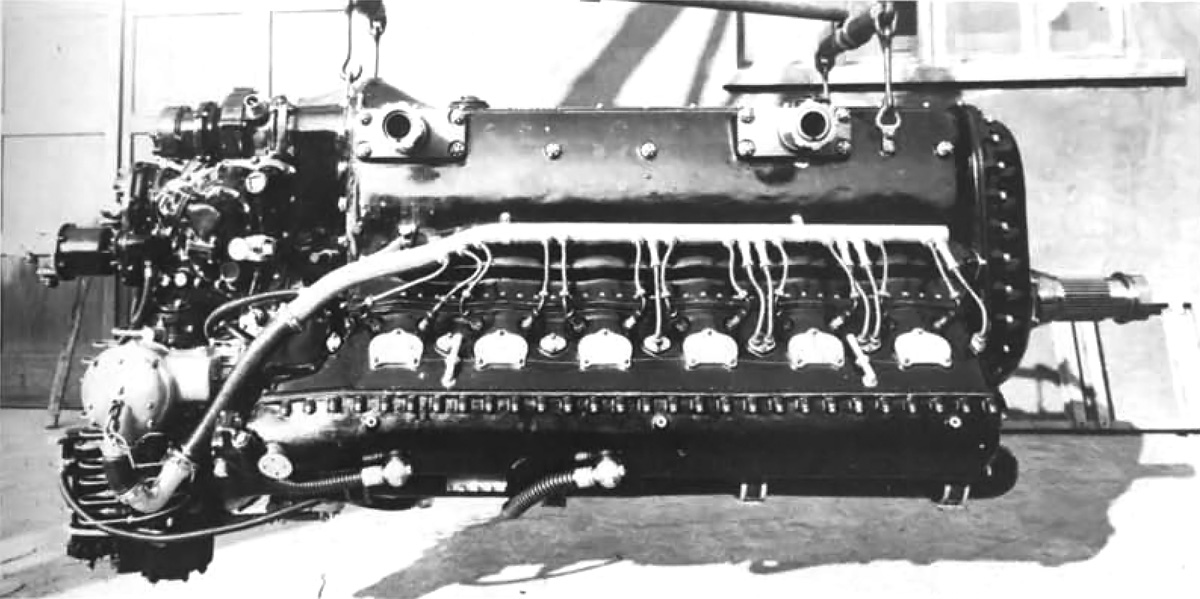
Two views of the Gruppen-Flugmotor A’s crankcase. In the left image, note the rear accessory drive housing with provisions to power the axial supercharger. Also note the large roller bearing in the nose case. In the right image, note the crankshaft and camshaft position for each engine section. Crankcase finning is also visible in both images. (Kevin Kemmerer images)

Building a new aircraft engine from scratch is a massive undertaking, so Krautter suggested grouping together existing, proven engines to quickly create a larger, more powerful unit. Kamm supported Krautter’s idea of a Gruppen-Flugmotor (Group Aircraft Engine), and the detailed design of such a power unit commenced in 1939. The first engine was known as the Gruppen-Flugmotor A (or just Motor A), and it utilized almost all of the components from four Hirth HM 512 engines (excluding their crankcases) to create a new 48-cylinder engine. Undoubtedly, Krautter’s experience at Hirth Motoren influenced his decision to use HM 512 parts.

The Hirth HM 512 was an inverted, air-cooled, V-12 engine. Its individual cylinders were arranged in two rows spaced at 60 degrees and attached under an elektron (magnesium alloy) crankcase. Four long studs held each cylinder to the crankcase, and the cylinders were staggered to allow the use of side-by-side connecting rods. Each cylinder was made of cast iron and had an aluminum cylinder head. In the Vee of the engine, one intake and one exhaust valve per cylinder were actuated by individual pushrods driven by a single camshaft. Each cylinder had two spark plugs—one on each side of the cylinder. The intake and exhaust manifolds were mounted to the outer sides of the cylinder banks. The HM 512 had a 4.13 in (105 mm) bore, a 4.53 in (115 mm) stroke, and a displacement of 729 cu in (11.9 L). The engine produced 450 hp (336 kW) at 3,100 rpm.
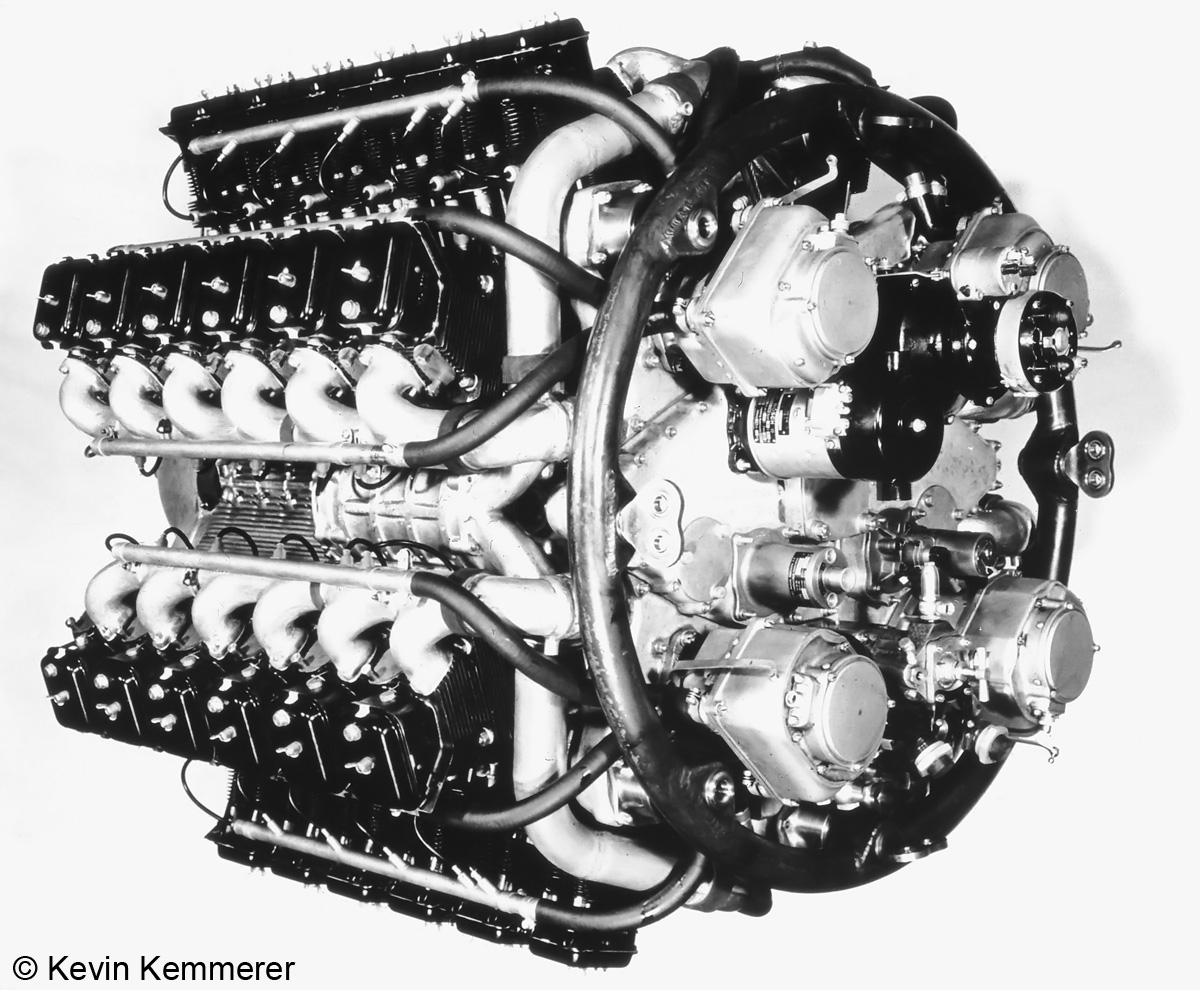
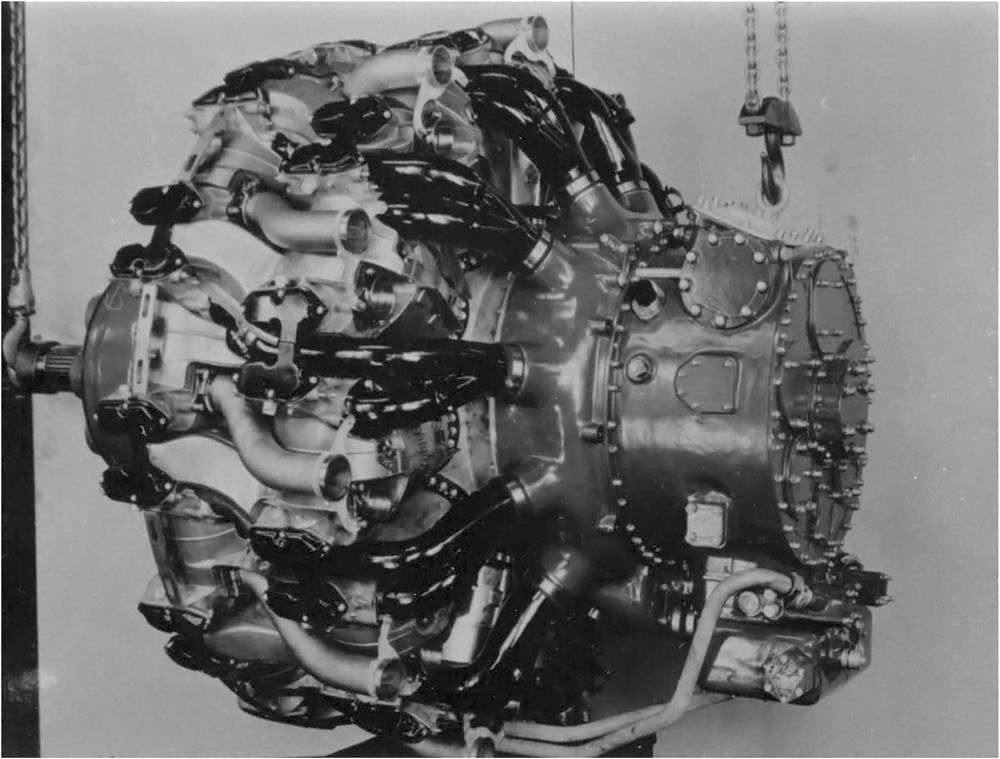
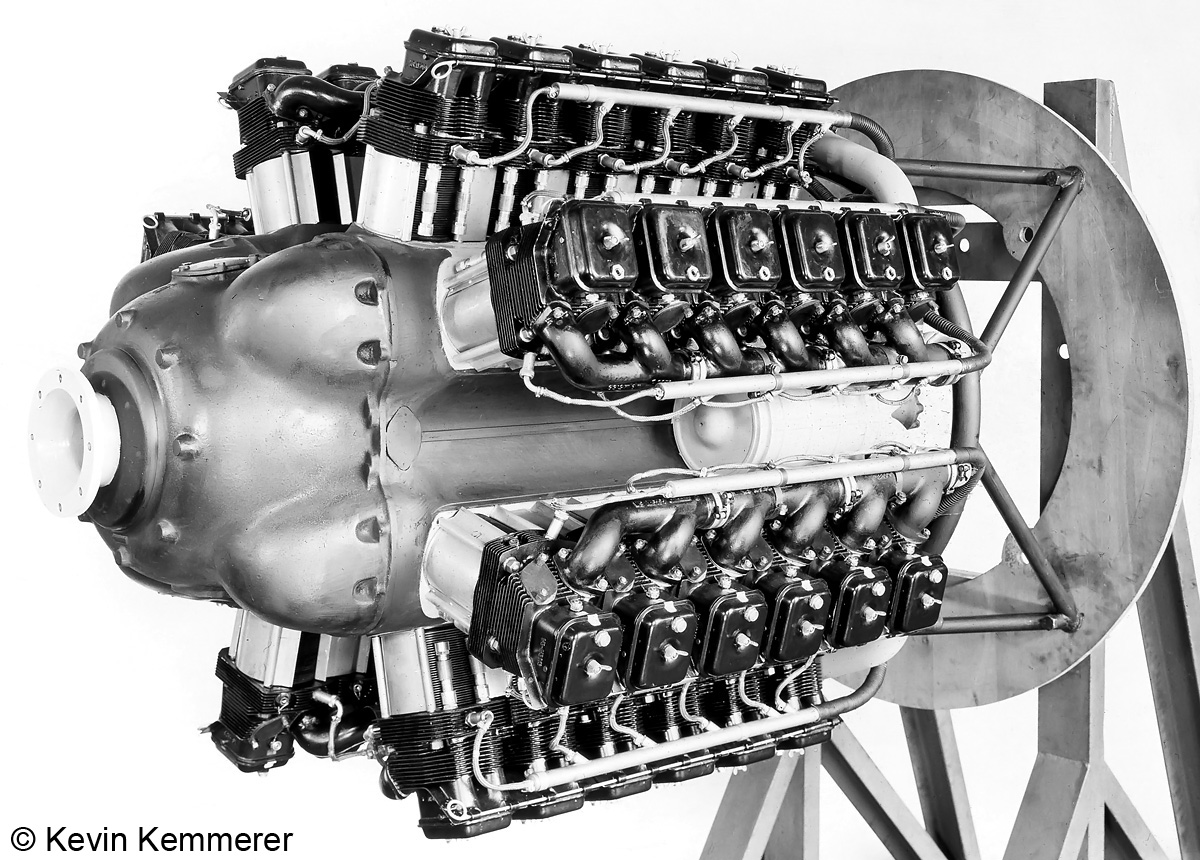
FKFS Gruppen-Flugmotor A complete copy

The complete 48-cylinder Gruppen-Flugmotor A. Note the intake manifolds leading from the axial supercharger to the two adjacent V-12 engine sections. The four Bosch magnetos are visible at the rear of the engine. (Kevin Kemmerer image)

For the Gruppen-Flugmotor A, an HM 512 crankshaft occupied each corner of the engine’s large, square-shaped, aluminum crankcase, and a camshaft was located at the apex of each corner. The cylinder banks for each engine section were on adjacent sides of the Gruppen-Flugmotor A’s crankcase. The two-piece aluminum crankcase was split horizontally and incorporated cooling fins on its exterior.

At the front of the Gruppen-Flugmotor A’s crankcase was a central combining gear that took power from each of the four crankshafts and transmitted it to a single propeller shaft. The crankshaft of each engine section could be decoupled from the combining gear if the engine section were damaged or to conserve fuel and increase an aircraft’s range. It was believed that the Gruppen-Flugmotor A’s economy could be increased up to 56% by decoupling two of the engine sections while cruising during a long-range flight.
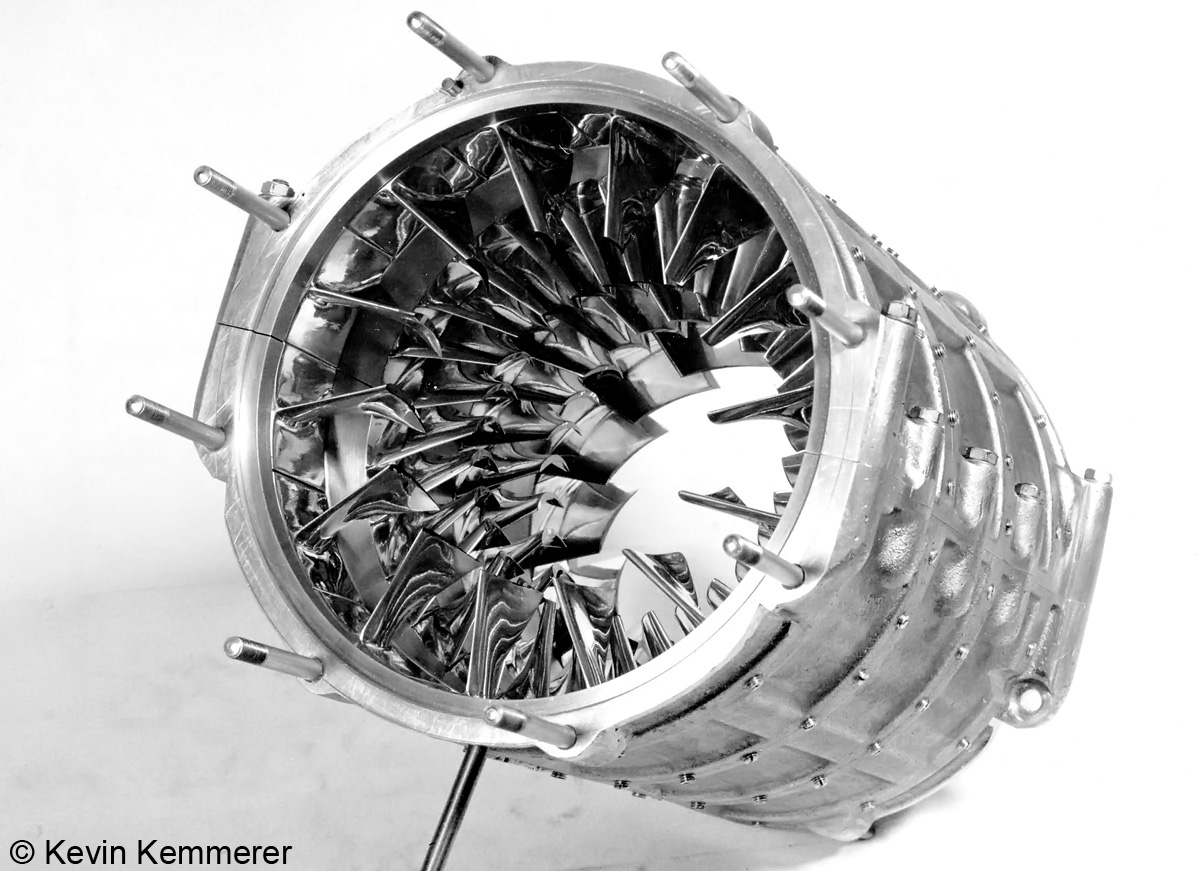
FKFS Gruppen-Flugmotor A axial supercharger housing copy

The housing for an axial supercharger used on the Gruppen-Flugmotor A. Visible are the four stator rows. Each blade was inserted into a dovetail groove and held in place by a screw, visible on the outside of the housing. (Kevin Kemmerer image)

Another unusual feature of the Gruppen-Flugmotor A was its use of two axial superchargers that provided 11.6 psi (0.8 bar) of boost. The left and right sides of the engine each had one supercharger located between the cylinder banks. The axial superchargers had four stages (although photos appear to show three compressor stages and four stator rows) and were driven from the accessory section at the rear of the engine. Fuel was injected ahead of the superchargers and subsequently mixed with air. The air/fuel mixture was then fed to the cylinders via long induction manifolds. The engine’s four Bosch dual magnetos and other accessories were mounted to the rear of the engine.

The Gruppen-Flugmotor A had 48 cylinders with a 4.13 in (105 mm) bore and a 4.53 in (115 mm) stroke. The engine’s total displacement was 2,917 cu in (47.8 L). Unfortunately, most of the engine’s specifications have been lost, but it was around 6.07 ft (1.85 m) long and 4.27 ft (1.30 m) in diameter. The engine produced 1,970 hp (1,470 kW) at 3,200 rpm with manifold fuel injection. A switch to direct fuel injection was made by changing to Hirth HM 512 D cylinders that had an unused port in the cylinder head. With direct fuel injection, the Gruppen-Flugmotor A’s output was increased by 200 hp (150 kW) to 2,170 hp (1,620 kW). The engine was tested during 1941 and 1942, but test information has not been found. Photos indicate some trouble was encountered with the axial superchargers failing in dramatic ways. After the war, Krautter stated that the engine was capable of 2,400 hp (1,790 kW).
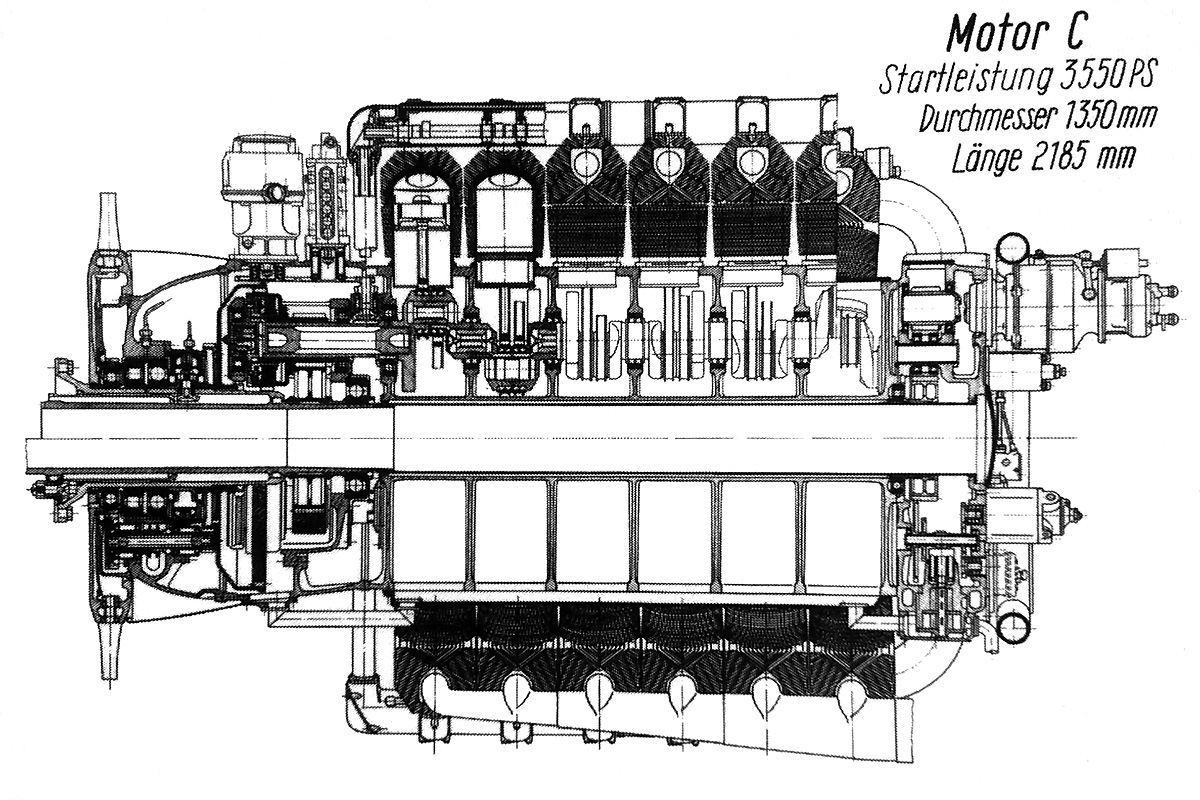
FKFS Gruppen-Flugmotor C

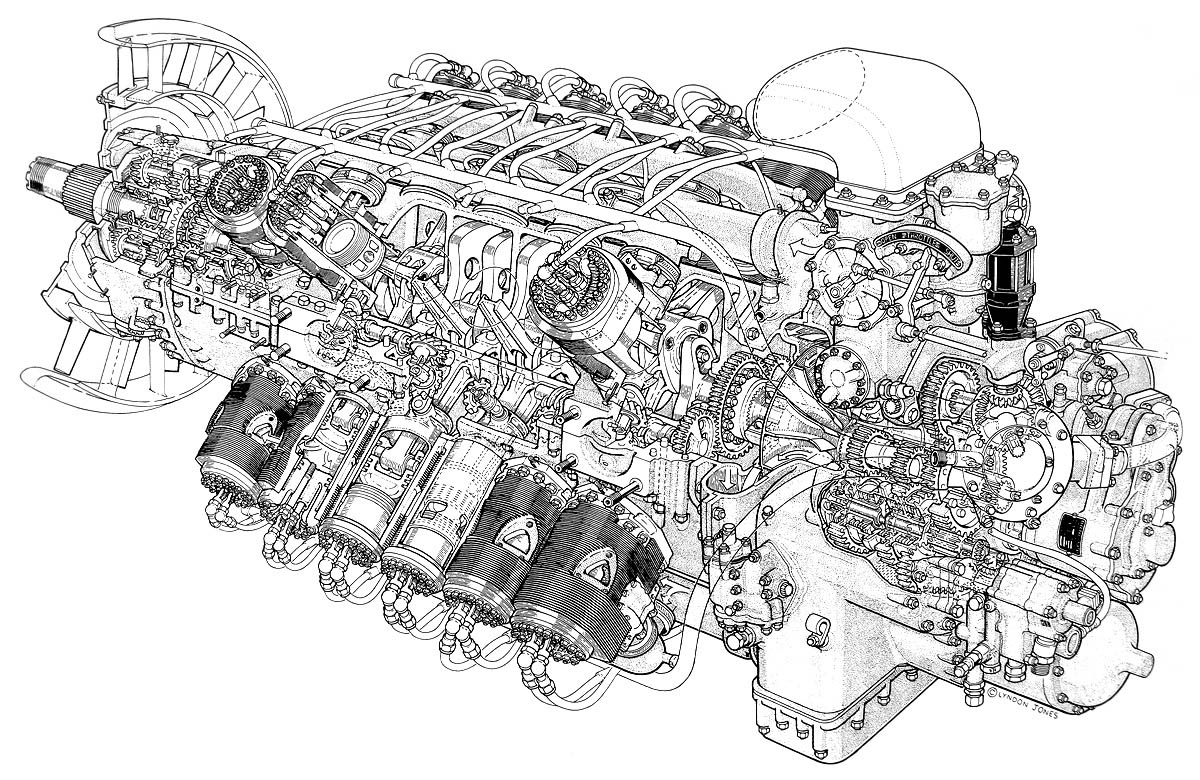
This drawing of the Gruppen-Flugmotor C illustrates how the engine design was a link between the Gruppen-Flugmotor A and D engines. Note the cooling fan and side-by-side connecting rods. (“Wunibald I. E. Kamm – Wegbereiter der modernen Kraftfahrtechnik” image)

As the Gruppen-Flugmotor A was proving the concept of a grouped-engine power unit, Kamm, Krautter, and the FKFS had already designed a larger, more powerful engine in 1941. Called the Gruppen-Flugmotor C (or Motor C), the 48-cylinder engine had the same basic layout as the earlier engine but used new components. An engine-driven cooling fan was employed to help minimize cooling drag, as both Kamm and Krautter felt the Gruppen-Flugmotor A’s cooling drag was excessive. The engine also had contra-rotating propeller shafts and two five-stage axial superchargers that provided 11.6 psi (0.8 bar) of boost.
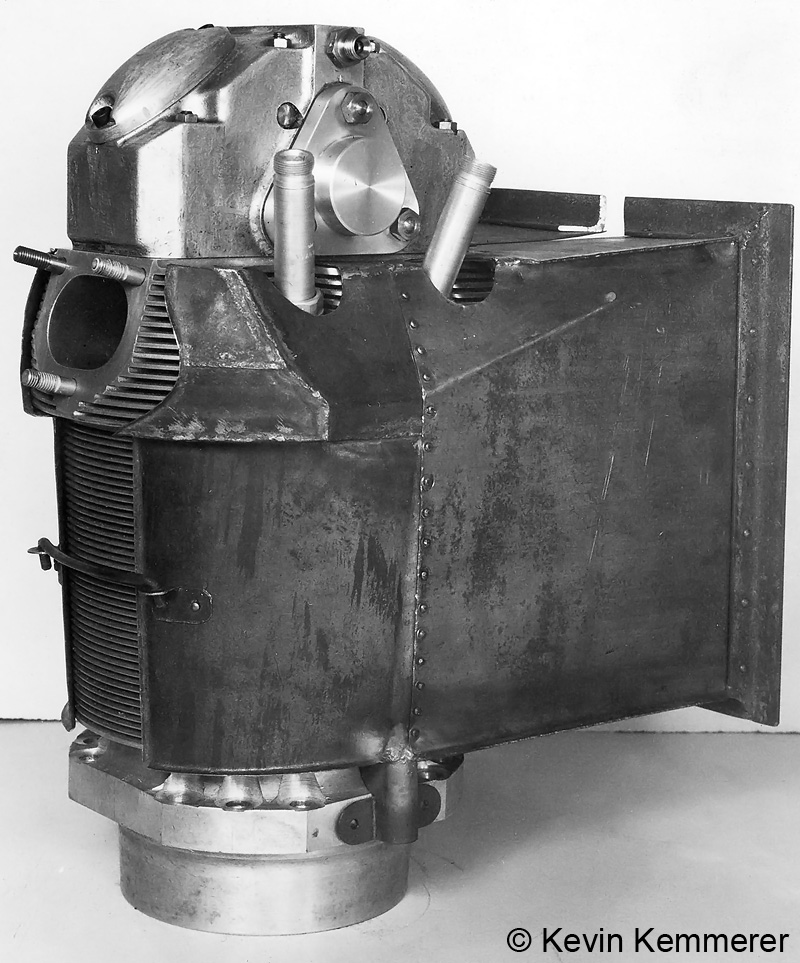
FKFS Gruppen-Flugmotor D Cylinder copy

The 122 cu in (2.0 L) cylinder used on the Gruppen-Flugmotor D. The triangular cover conceals the camshaft drive for the valves. The baffle around the cylinder helped direct air to maximize cooling efficiency. (Kevin Kemmerer image)

The individual cylinders of the Gruppen-Flugmotor C were of Krautter’s maturing design, each having a capacity of 67 cu in (1.1 L). The cylinder had a hemispherical combustion chamber with two spark plugs and a port for direct fuel injection. The cylinder barrel and head were cast from aluminum as one piece, and the cylinder bore was chrome plated. A flange at the base of the cylinder attached it to the crankcase. Atop the cylinder was a housing for the intake and exhaust valves. The two valves were actuated via roller rockers by a single overhead camshaft, which served all the cylinders of one bank. Each camshaft was driven by a vertical shaft at the front of the engine.

The Gruppen-Flugmotor C had a 4.33 in (110 mm) bore, a 4.53 in (115 mm) stroke, and a total displacement of 3,201 cu in (52.5 L). The engine was 7.17 ft (2.185 m) long and 4.43 ft (1.35 m) in diameter. The Gruppen-Flugmotor C was forecasted to produce 3,500 hp (2,610 kW) at 4,000 rpm with the original 67 cu in (1.1 L) cylinders, but studies of larger 92 cu in (1.5 L) and 122 cu in (2.0 L) cylinders indicated outputs of 4,290 hp (3,200 kW) and 5,920 hp (4,415 kW), respectively. While some components of the Gruppen-Flugmotor C were built for testing, a complete engine was never built.

Seeing the potential of the Gruppen-Flugmotor C with 122 cu in (2.0 L) cylinders inspired Kamm and Krautter to create the Gruppen-Flugmotor D. Designed in 1943, the engine was very similar to the Gruppen-Flugmotor C, with 48 cylinders, a cooling fan, and contra-rotating propellers, but it used fork-and-blade connecting rods. The 122 cu in (2.0 L) cylinder was basically an enlargement of the 67 cu in (1.1 L) cylinder design. The Gruppen-Flugmotor D had four (one on each side of the engine) five-stage axial superchargers that provided 13.8 psi (0.95 bar) of boost.
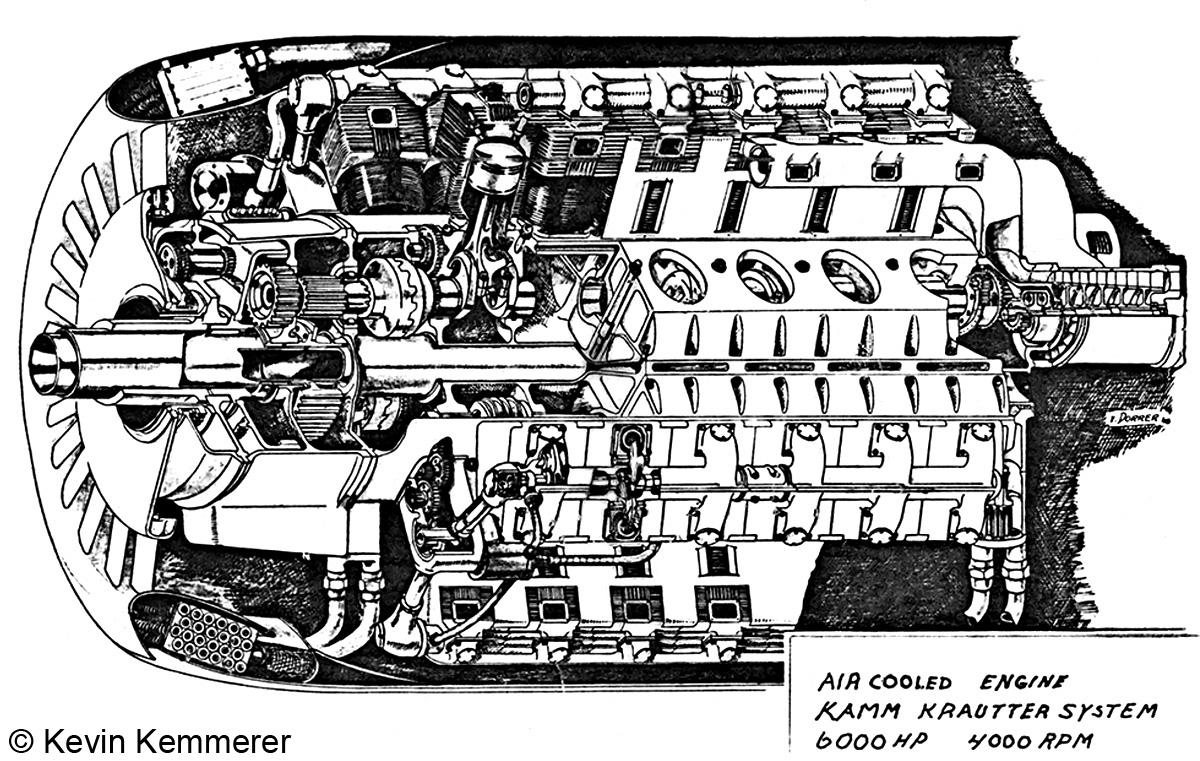
FKFS Gruppen-Flugmotor D copy

Drawing of the 48-cylinder Gruppen-Flugmotor D. Note the cooling fan, contra-rotating propeller drive, and fork-and-blade connecting rods. One five-stage axial supercharger can be seen on the right side of the drawing. The engine was estimated to produce 5,920 hp (6,000 ps / 4,415 kW). (Kevin Kemmerer image)

The Gruppen-Flugmotor D had a 5.31 in (135 mm) bore and a 5.51 in (140 mm) stroke. The engine’s total displacement was 5,870 cu in (96.2 L), and it was forecasted to produce 5,920 hp (4,415 kW) at 4,000 rpm. Reportedly, a complete engine was ready for tests in April 1944, but the state of the war and the progress of jet engines rendered the Gruppen-Flugmotor D and its further development irrelevant. At the time, Germany was in need of interceptor fighters, not long-range bombers.

At war’s end, Kamm and Krautter were brought to the United States under Operation Paperclip, a program to extradite the best German scientists, engineers, and technicians and apply their skills and knowledge to further industries in the United States. The two men worked at Wright Field in Dayton, Ohio until they were released from their service. In the 1950s, Krautter founded his own engineering firm, the Wilkra Company, where he designed everything from engines for boats and motorcycles to lawn tractors and ski bikes.
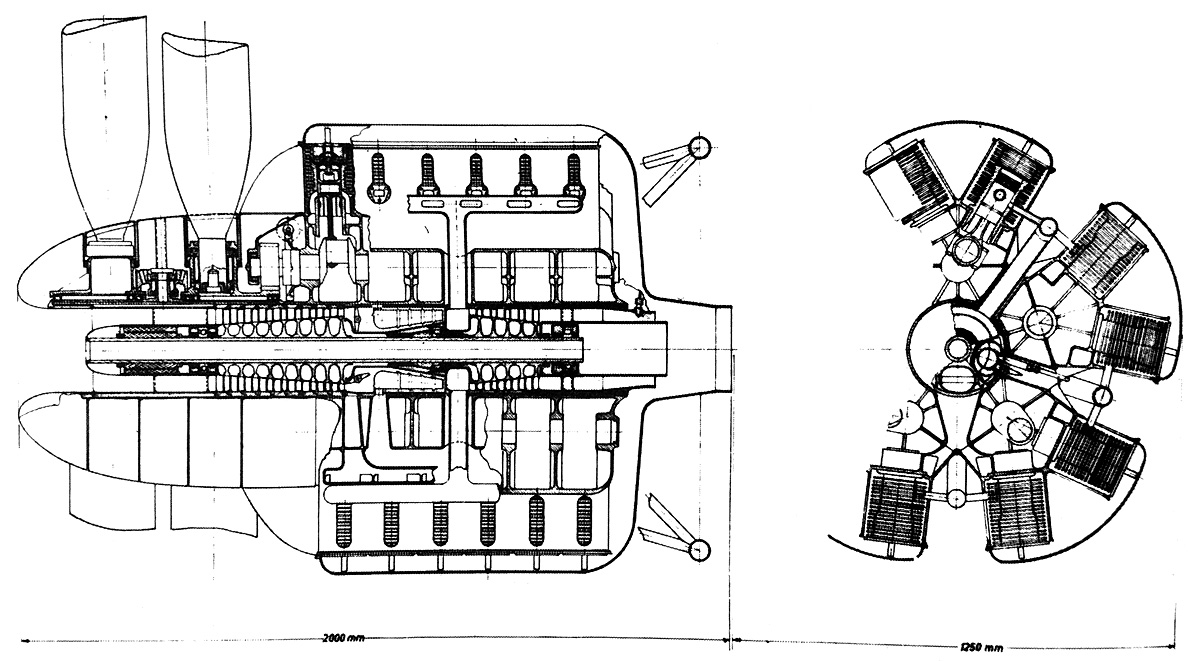
Kamm 60-cylinder compound-diesel

The Kamm-designed 60-cylinder compound-diesel engine incorporating five V-12 engine sections around a central turbine. The engine’s concept was roughly similar to that of the Napier Nomad. (“Wunibald I. E. Kamm – Wegbereiter der modernen Kraftfahrtechnik” image)

For a time, Kamm worked with Krautter at Wilkra but returned to Germany in 1955. Kamm revisited the Gruppen-Flugmotor concept when he designed a 60-cylinder compound diesel-turbine engine. This engine consisted of five V-12 engine sections mounted around a central turbine. The V-12 engine sections were based on an extremely-high-output diesel engine Kamm had helped design while at the Stevens Institute of Technology in Hoboken, New Jersey in the early 1950s. The V-12s were air-cooled, two-stroke, loop-scavenged engines with side-by-side connecting rods. The turbine had a nine-stage axial compressor section, a combustion section, and a five-stage exhaust turbine section. High-pressure air from the compressor section would provide the incoming charge for the diesel engine. The diesel’s exhaust would be expelled into the exhaust section of the turbine. The turbine’s combustion section could run independently of the piston engine sections to increase the compound engine’s overall output. The engine’s bore and stroke were around 2.75 in (70 mm) and 4.5 in (114 mm), respectively, giving a total displacement of approximately 1,604 cu in (26.3 L). The 60-cylinder compound engine was designed to produce 2,950 hp (2,200 kW) without additional power from the turbine’s combustion section and 4,025 hp (3,000 kW) with the additional power. The engine would have had a low specific fuel consumption of .296 lb/hp/h (180 g/kW/h) and was forecasted to be 6.56 ft (2.00 m) long and 4.10 ft (1.25 m) in diameter. The 60-cylinder engine was never built.

Note: Kamm and Krautter’s Gruppen-Flugmotoren were not the first time that multiple engine sections were combined to create a large, powerful engine. In the 1920s, the French firm Bréguet created the Bréguet-Bugatti 32-cylinder Quadimoteurs in a similar but less complex fashion.
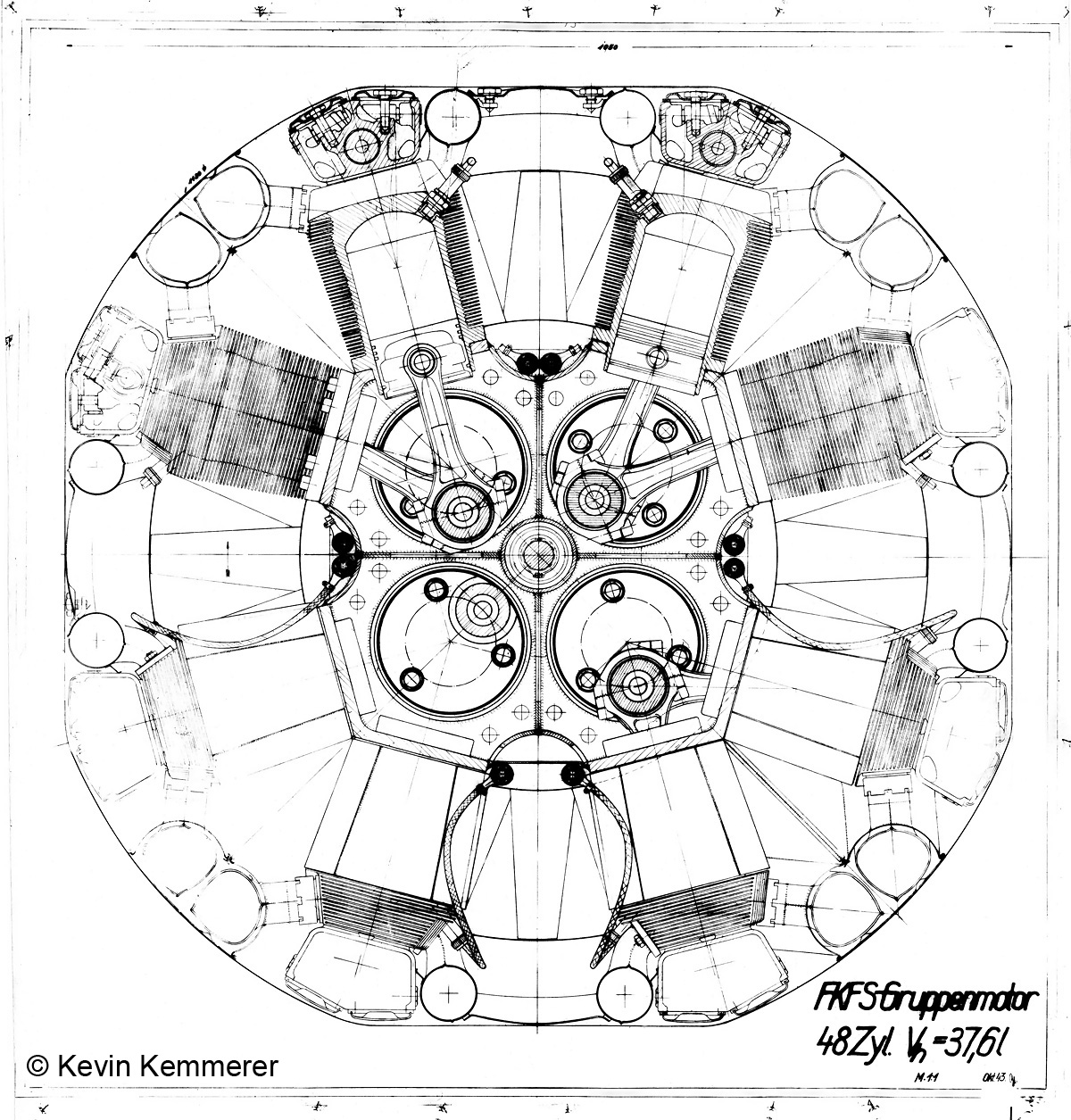
FKFS Gruppenmotor 48-Zyl copy

This drawing dated October 1943 depicts a 48-cylinder engine and lists its displacement as 37.6 L (2,294 cu in). The engine’s bore and stroke appear to be the same but are not listed on the drawing. A 100 mm (3.94 in) bore and stroke would give a displacement of 37.70 L (2,300 cu in). It is not clear how this engine fits into the overall history of the Gruppen-Flugmotoren, but its design is similar to the C and D engines. (Kevin Kemmerer image)

Sources:
– Correspondence with Kevin Kemmerer, grandson of Willy Krautter
Wunibald I. E. Kamm – Wegbereiter der modernen Kraftfahrtechnik by Jurgen Potthoff and Ingobert C. Schmid (2012)
– “Why Multicylinder Motorcycle Engines?” by W. Krautter, Design of Racing and High Performance Engines edited by Joseph Harralson (1995)
Aircraft Engines of the World 1944 by Paul H. Wilkinson (1944)
Engine-Transmission Power Plants for Tactical Vehicles by Emil M. Szten et. al. (1967)

Hispano-Suiza 24Z left

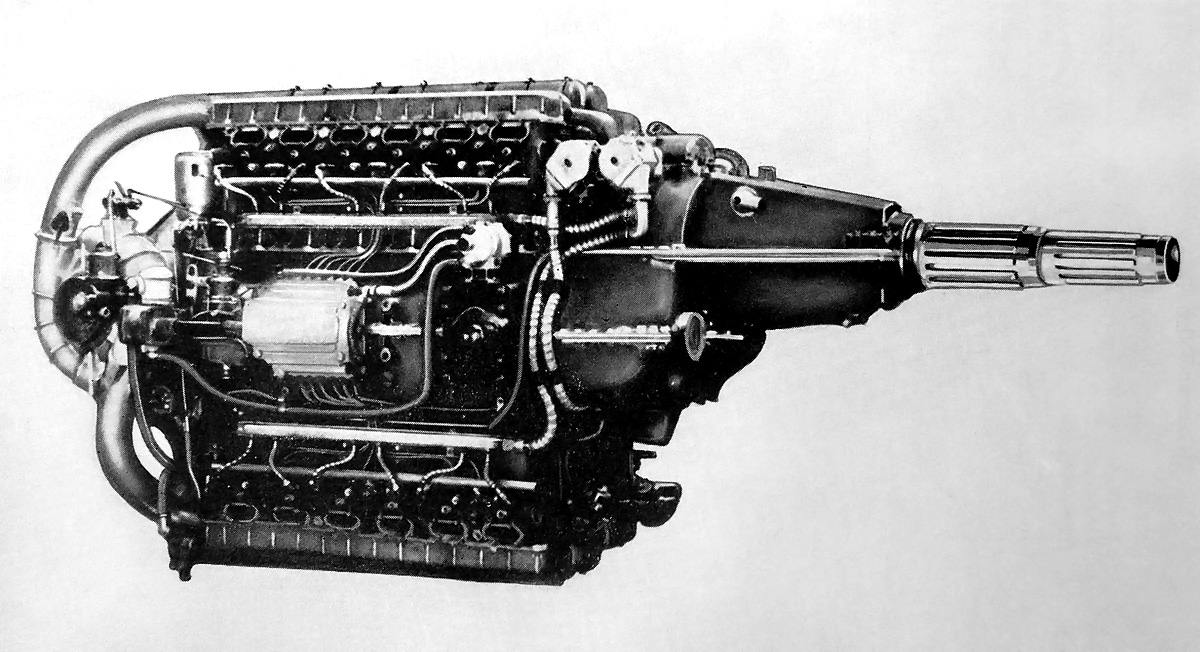
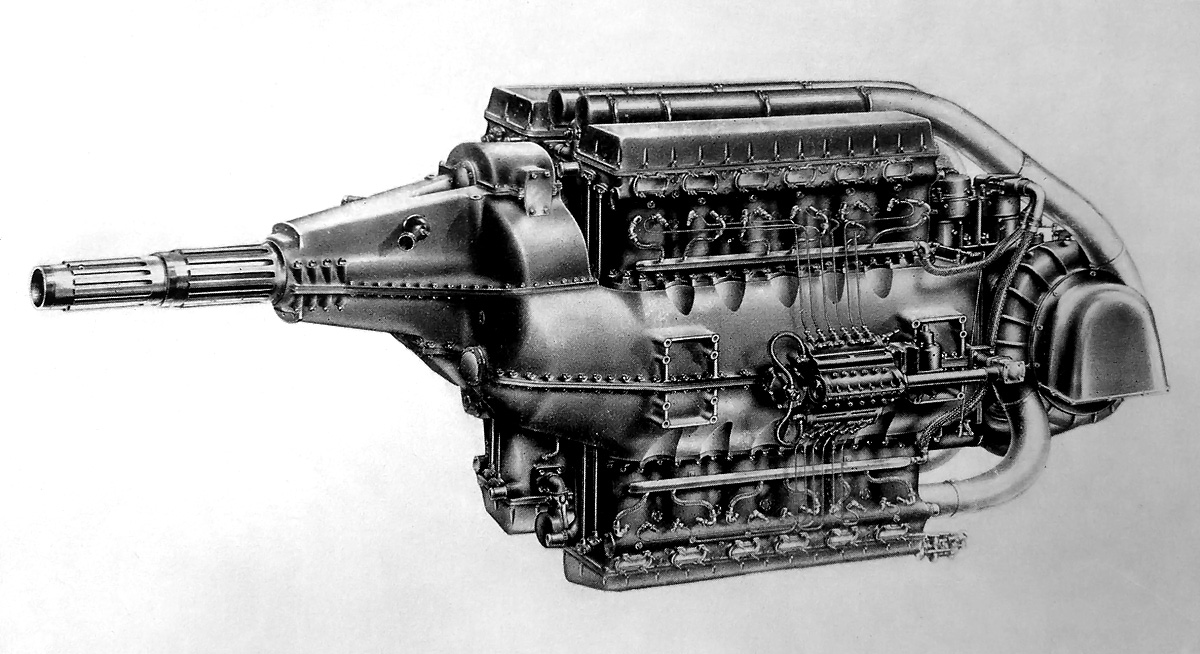
Hispano-Suiza 24Z (Type 95) Aircraft Engine

By William Pearce

Starting around 1938, Hispano-Suiza began to halt development of its other aircraft engines to focus on its latest V-12, the 12Z (Type 89). The 12Z drew heavily from the Hispano-Suiza 12Y but had many improvements, including two-speed supercharging and four-valves per cylinder actuated by dual-overhead camshafts. France was in desperate need of high-powered aircraft engines to keep its air force comparable to those of other European nations during the build-up to World War II. The 12Z was developing 1,400 hp (1,044 kW) at 2,600 rpm when France surrendered in June 1940.

Hispano-Suiza 24Z right

The Hispano-Suiza 24Z incorporated the improved features of the 12Z engine but was very similar to the 24Y. Note the high position of the propeller shafts to accommodate a cannon mounted between the upper cylinder banks and firing through the propeller hub. The magnetos for the right side of the engine can be seen mounted to the propeller gear reduction housing.

One of the engine programs that was suspended because of the 12Z was the Hispano-Suiza 24Y: a 2,200 hp (1,641 kW), 24-cylinder H engine utilizing many 12Y components. Not long into the 12Z program, engineers started to wonder what level of performance could be achieved by a 24-cylinder engine using 12Z components. In 1943 and under German occupation, development began on the Hispano-Suiza 24Z (Type 95) engine.

The 24Z had the same vertical H-24 configuration as the earlier 24Y with two cylinder banks situated above crankcase and another two cylinder banks below. The two-piece crankcase was made from aluminum and split horizontally. A crankshaft served each upper and lower cylinder bank pair. Each one-piece crankshaft had six-throws, was counterbalanced, and was supported by seven main bearings. The pistons were connected to the crankshafts via fork-and-blade connecting rods. The crankshafts, connecting rods, and pistons were the same as those used in the 12Z engine.

Each of the 24Z’s four cylinder banks was made up of a six-cylinder block with an integral crossflow cylinder head. The two intake valves and two exhaust valves for each cylinder were controlled by separate overhead camshafts. The camshafts were driven from a vertical shaft at the rear of each cylinder bank. The cylinder banks and their valve train were from the 12Z engine.

Hispano-Suiza 24Z left

Each left and right half of the 3,600 hp (2,685 kW) 24Z engine could operate independently of the other half. Note the intake manifolds routing air from the supercharger to the cylinder banks and the drive shaft for the fuel injection pump extending from the rear of the engine.

Two superchargers were mounted at the rear of the engine with their impellers parallel to the engine’s crankshafts. Originally, single-speed supercharges were used, but these were later replaced with two-speed units. At low speed, the supercharger’s impeller spun at 6.72 times crankshaft speed. At high speed, the impeller spun at 9.52 times crankshaft speed. Supercharger speed change and boost control were automatic. Separate intake manifolds led from each supercharger to the inner side of the upper and lower cylinder banks. Mounted on each side of the crankcase was a fuel pump that injected fuel directly into each cylinder. Each fuel pump was driven via a shaft from the rear of the engine. The two spark plugs per cylinder were positioned below the intake valves. The spark plugs for each upper and lower cylinder bank pair were fired by two magnetos mounted to the propeller gear reduction case.

The front of each crankshaft engaged a separate propeller shaft at a .44 to 1 gear reduction. The two propeller shafts made up a contra-rotating unit. The 24Z was not built with a single-rotation propeller shaft. The engine had provisions for a cannon to be mounted between the upper cylinder banks and fire through the hollow propeller shaft. Each upper and lower cylinder bank pair on the 24Z constituted a 12-cylinder engine section, and each engine section could operate independently of the other.

Sud-Est 580 HS 24Z

The Sud-Est SE 580 under construction with the 24Z engine installed. Note the supercharger intake on both sides of the cowling. Also note the upper and lower row of exhaust stacks. The scoop behind the cockpit was for the radiators.

The Hispano-Suiza 24Z had a 5.91 in (150 mm) bore and a 6.69 in (170 mm) stroke. The engine’s total displacement was 4,400 cu in (72.10 L). The 24Z produced 3,600 hp (2,685 kW) at 2,800 rpm for takeoff. This power was achieved at an over-boosted condition of 7.7 psi (.53 bar); normal boost was 7.0 psi (.49 bar). Max power with low-speed supercharging was 3,200 hp (2,386 kW) at 2,800 rpm at 8,202 ft (2,500 m). Max power with high-speed supercharging was 2,640 hp (1,969 kW) at 2,800 rpm at 26,247 ft (8,000 m). The engine’s normal rating was 3,000 hp (2,237 kW) at 2,600 rpm at 8,202 ft (2,500 m) with low-speed supercharging and 24,606 ft (7,500 m) with high-speed supercharging. The 24Z’s cruising power was 1,500 hp (1,119 kW) at 2,100 rpm at 9,843 ft (3,000 m) with low-speed supercharging and 18,373 ft (5,600 m) with high-speed supercharging. The engine had a specific fuel consumption of .48 lb/hp/hr (292 g/kW/hr). The 24Z was 10.72 ft (3.27 m) long, 4.27 ft (1.30 m) wide, 4.54 ft (1.39 m) tall, and weighed 3,197 lb (1,450 kg).

World War II hindered the 24Z’s construction. The engine was first run in 1946, and it was exhibited at the Salon de l’Aéronautique (Air Show) in Paris in November 1946. Bench tests of the 24Z revealed some serious issues, the extent of which have not been found. In September 1947, the engine’s compression was lowered to 6.75 to 1 from its original value of 7.0 to 1. Perhaps this change was an attempt to cure issues with detonation. Later, the gear reduction failed while a 24Z was under test, destroying the engine.

The 24Z’s prime application was the Sud-Est* SE 580/582 fighter that was designed during the war. However, issues with the 24Z resulted in the substitution of an Arsenal 24H engine for the SE 580. The SE 580 itself was later scrapped before the aircraft was completed. Many other projects, mostly flying boats and transports, were proposed with 24Zs as their power plant. None of these projects made it off the drawing board.

Hispano-Suiza 48Z Late 133

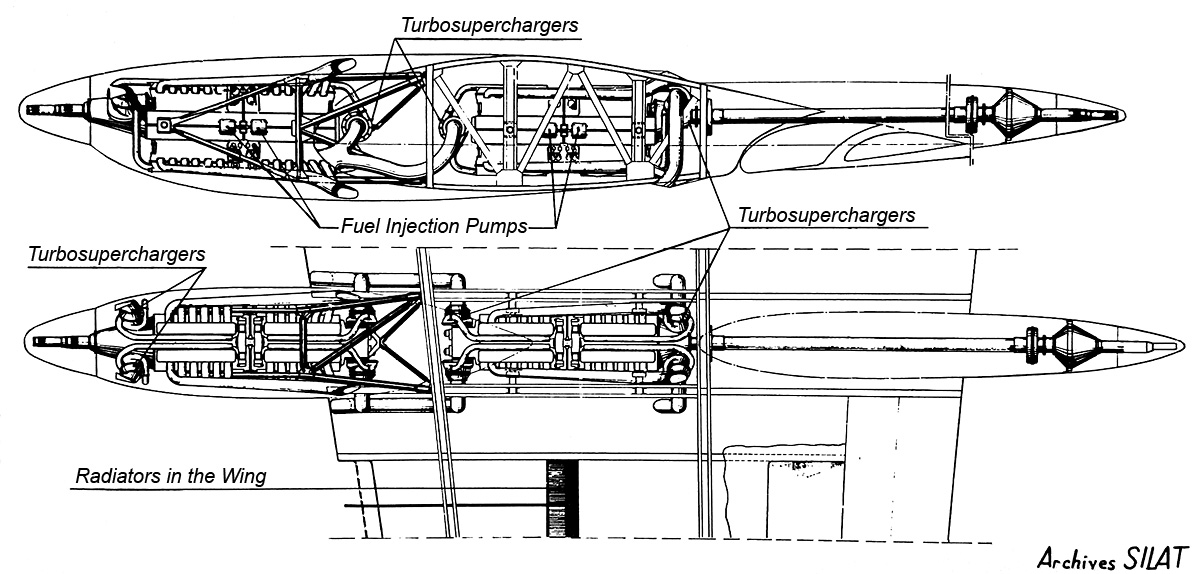
Drawing of two Hispano-Suiza 48Z engines installed in the wing of a Latécorère 133 flying boat. (image relabeled, but originally from “Latécorère: Les avions et hydravions” by Jean Cuny)

A further Hispano-Suiza proposal consisted of coupling two 24Z engines together to create the 48Z (Type 96) engine. In this configuration, the propeller shaft of the rear 24Z engine section passed between the upper cylinder banks of the front 24Z engine section and extend though the propeller shaft of the front engine. The rear 24Z powered the front propeller of a coaxial contra-rotating unit, while the front 24Z powered the rear propeller. The 48Z would have used four turbosuperchargers—two mounted near the front of the engine and two mounted at the rear. The 48-cylinder 48Z engine displaced 8,800 cu in (144.20 L), had a takeoff rating of 7,200 hp (5,369 kW) at 2,800 rpm, and produced 5,200 hp (3,878 kW) at 13,123 ft (4,000 m). Like many large engine projects at the dawn of the jet age, the 48Z existed only on paper.

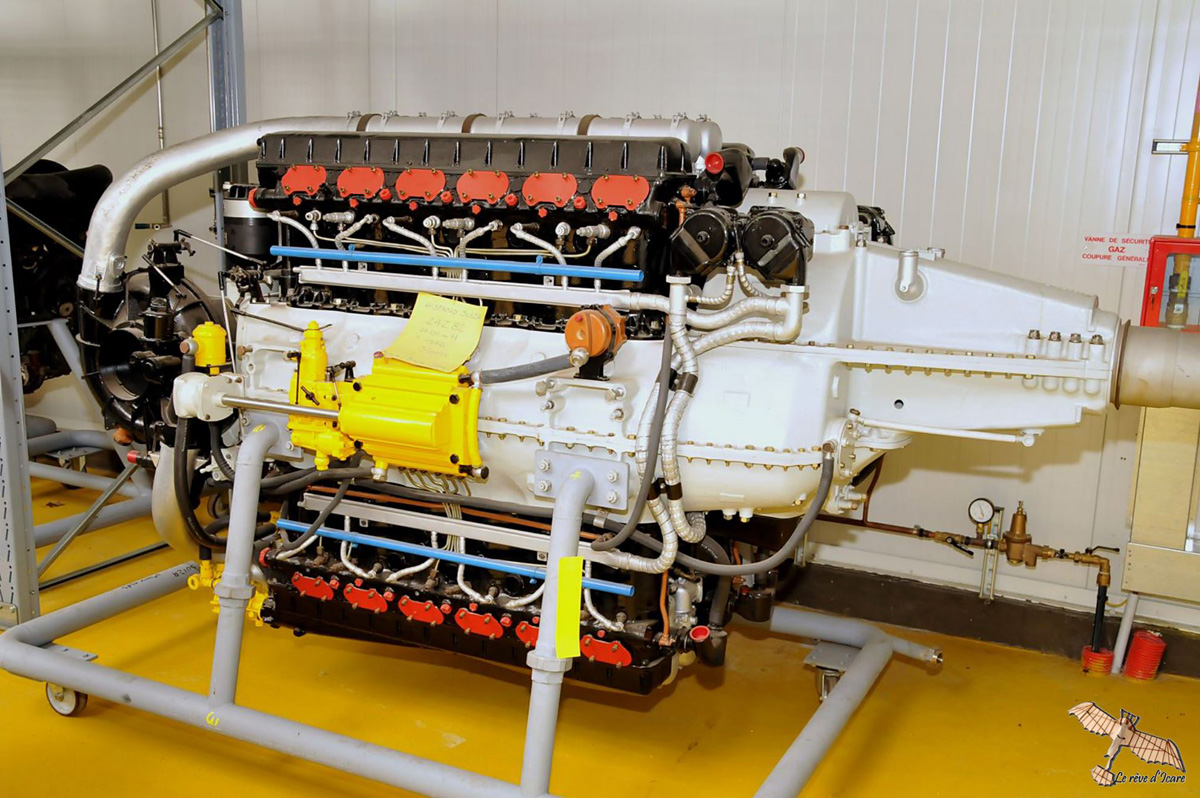
With the 24Z’s developmental issues and no tangible prospects for installation in an aircraft, the engine program was stopped in 1948. At least two 24Z engines were built, but probably not many more. One engine survives and is preserved in the Musée de l’Air et de l’Espace in le Bourget (near Paris), France.

Hispano-Suiza 24Z

The Hispano-Suiza 24Z preserved in the Musée de l’Air et de l’Espace in le Bourget, France. Most likely, this is the engine that was displayed at the 1946 Salon de l’Aéronautique and was installed in the SE 580. (image via Le Rêve d’Icare)

*The SE 580/582’s development began at what was Dewoitine, which had been nationalized into SNCAM (Société nationale des constructions aéronautiques du Midi or National Society of Aircraft Constructors South). SNCAM was absorbed into SNCASE (Société nationale des constructions aéronautiques du Sud-Est or National Society of Aircraft Constructors Southeast), which is often shortened to just Sud-Est.

Sources:
Hispano Suiza in Aeronautics by Manuel Lage (2004)
Jane’s All the World’s Aircraft 1947 by Leonard Bridgman (1947)
Aircraft Engines of the World 1947 by Paul H. Wilkinson (1947)
Latécorère: Les avions et hydravions by Jean Cuny (1992)
– “Engines at the Paris Show” Flight (21 November 1946)

Armstrong Siddeley Deerhound III

Armstrong Siddeley ‘Dog’ Aircraft Engines

By William Pearce

The British firm Armstrong Siddeley Motors (ASM) was formed in 1919 when Armstrong Whitworth (founded in 1847) purchased Siddeley-Deasy (founded in 1912). Prior to the merger, both Armstrong and Siddeley were active in the automotive and aeronautical fields. Siddeley first began manufacturing aircraft engines in 1915 under a contract to build the Royal Aircraft Factory’s RAF 1A engine. In 1916, Siddeley had built its first aircraft engine—the Puma—which was developed from the B.H.P. (Beardmore-Halford-Pullinger) six-cylinder engine. The Puma was the first in a long line of engines that were produced by ASM into the 1940s and named after cats (felines)—the last being the Cougar of 1945.

Armstrong Siddeley Hyena AW16

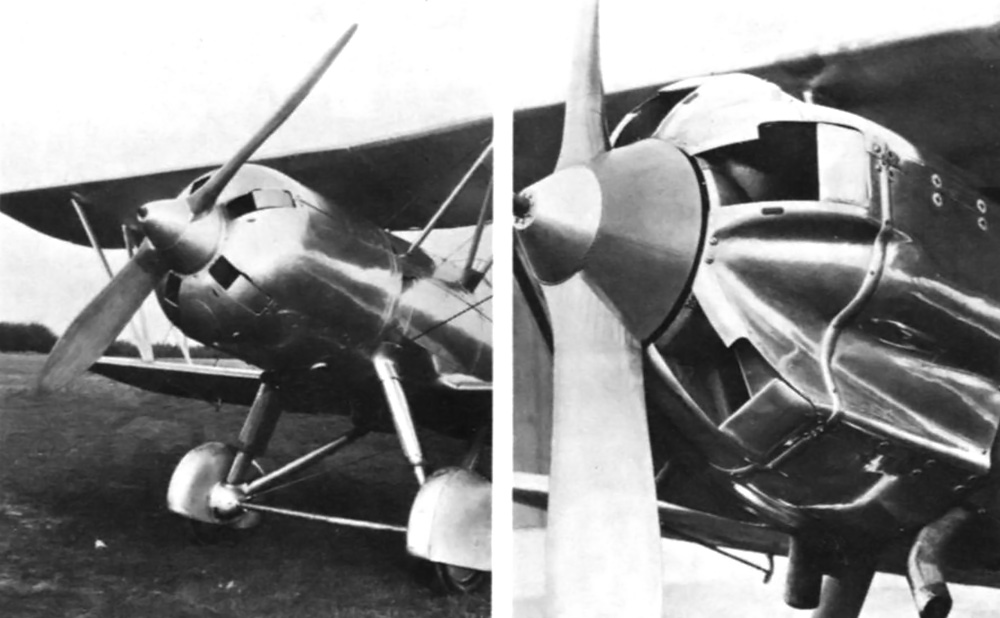
Two versions of the cowling used to cover the 15-cylinder Armstrong Siddeley Hyena installed in an Armstrong Whitworth A.W.XVI (A.W.16). The cowling on the right is illustrative of the Hyena’s inline radial cylinder arrangement.

In 1932, ASM worked to develop a new line of air-cooled, radial engines. These engines would be a design departure from their existing cat-engines, so they decided to name the engines after dogs (canines). Unfortunately, none of these engines were successful, and information about them is frustratingly hard to find and occasionally contradictory. To add to the confusion, some of the engine names were used more than once, and the engines possess many of the same characteristics.

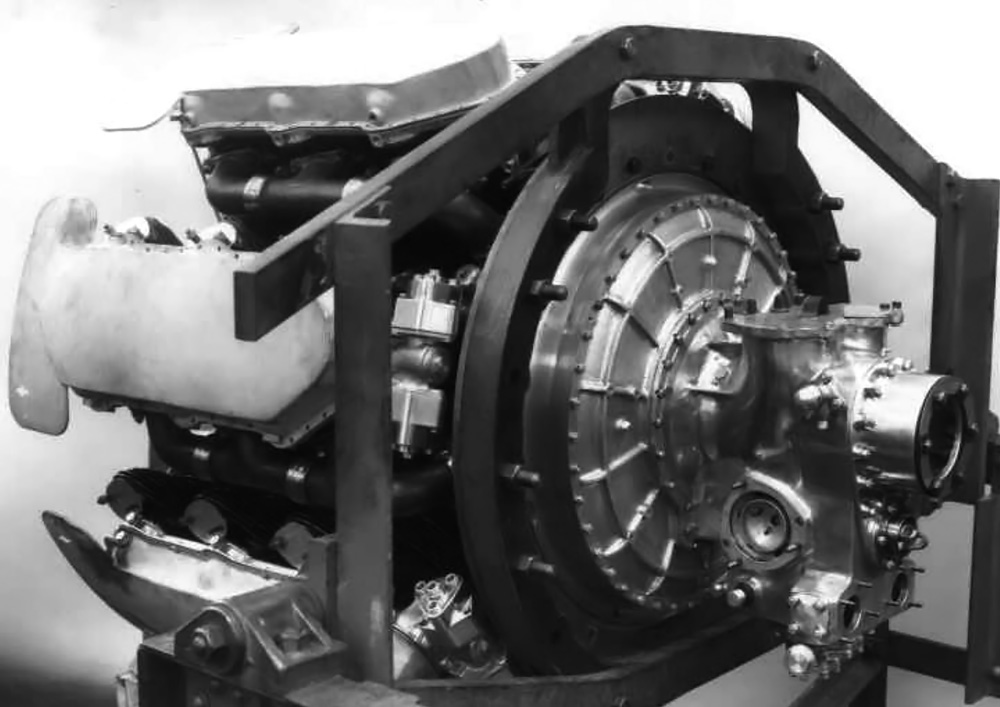
The first engine of the new dog-series was the Mastiff (this name was used again later). This engine was built in 1932 and was a large radial engine with two rows of seven cylinders. The specifications of the 14-cylinder engine are currently not known. In reviewing a photo (that is unfortunately not publishable) of the Mastiff, the engine closely resembles a larger version of the 1,996 cu in (32.7 L) ASM Tiger in appearance and construction. The Mastiff was supercharged and had a one-piece crankcase and gear reduction. A cam ring at the front of the engine acted on pushrods that actuated each cylinder’s two valves. One Mastiff was built for Italy, but it is not known if the engine was ever tested.

Armstrong Siddeley Deerhound I side

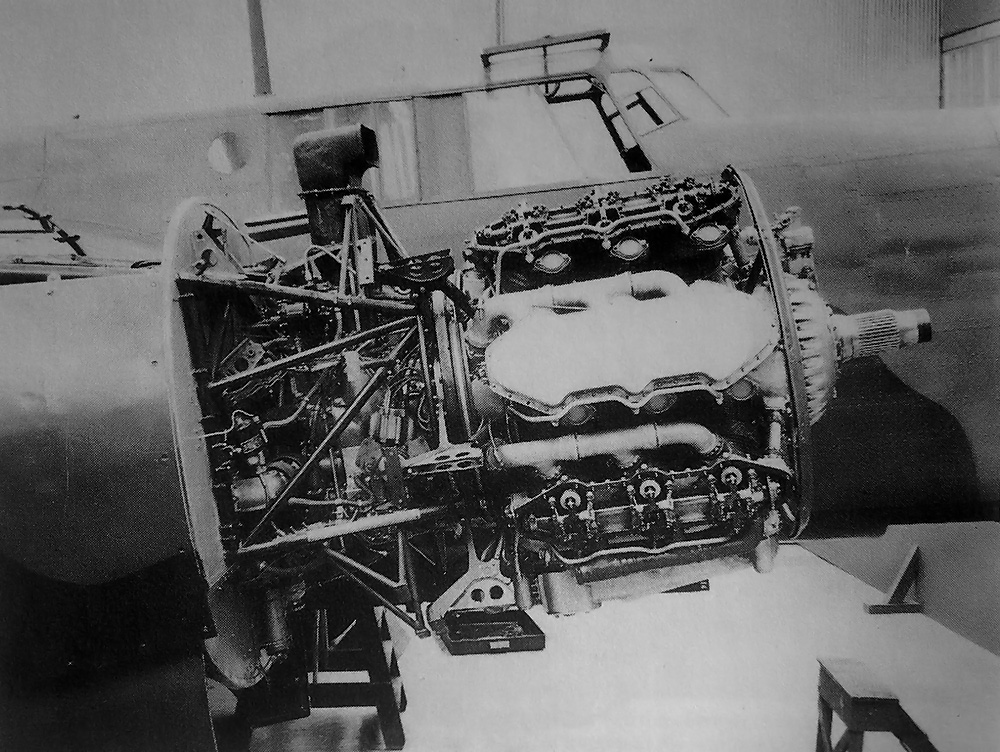
This photo gives a good view of the 21-cylinder Armstrong Siddeley Deerhound I’s configuration. Note the engine’s inline radial layout and the vertical shaft in front of each cylinder bank to drive the overhead camshaft.

The second dog-engine was the Hyena. The Hyena’s 15 air-cooled cylinders were arranged in three rows of five. Even more unusual than the three-row arrangement was the fact that the cylinder rows were inline rather than staggered. Between each of the engine’s five cylinder banks was a camshaft that acted upon short pushrods to actuate the two valves per cylinder. The camshafts were geared to the crankshaft.

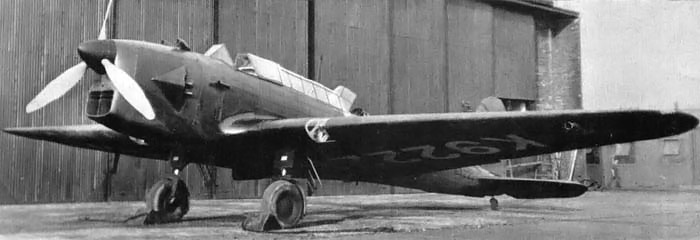
The Hyena had a 5.39 in (137 mm) bore and a 4.92 (125 mm) stroke. The engine’s total displacement was 1,687 cu in (27.64 L), and it produced 620 hp (462 kW) at 2,250 rpm. The Hyena was first run in 1933 and was installed in an Armstrong Whitworth A.W.XVI (A.W.16) biplane fighter later that year. The Hyena-powered A.W.XVI (registered as G-ABKF) first flew on 25 October 1933. The basic engine proved itself to be mechanically sound but rather heavy for its power. Issues were encountered with cooling the rear cylinders. This led to a number of different engine cowlings being tried, but the overheating issues persisted. Eventually, further development of the Hyena was abandoned, and only one or two engines were built. The Hyena was proposed to power the A.W.21 and A.W.28 fighters, but these projects did not proceed past the design stage.

Armstrong Siddeley Deerhound I rear

This rear view of the Deerhound I shows the supercharger housing with intake manifolds leading to each bank of cylinders.

Lessons learned from the Hyena were applied to the next dog-engine: the Deerhound. Led by Lt. Col. F. L. R. Fell, the design of the Deerhound was underway by late 1935, and it retained the inline radial cylinder configuration of the Hyena. However, the Deerhound had two addition cylinders for each row, making three rows of seven cylinders. Each cylinder bank of the Deerhound used a single overhead camshaft to actuate each cylinder’s two valves. The camshafts were driven from the crankshaft by a vertical shaft at the front of the engine. The Deerhound had a single-stage, two-speed supercharger and a propeller reduction gear of .432.

The 21-cylinder Deerhound had a 5.31 in (135 mm) bore and a 5.00 in (127 mm) stroke. The engine displaced 2,330 cu in (38.18 L) and had a forecasted output of 1,500 hp (1,119 kW). The Deerhound was seen as insurance against the potential failure of the Bristol Hercules engine then under development. The designers of the Deerhound would have preferred to create a liquid-cooled engine in the 1,500 hp (1,119 kW) class, but ASM management (John Siddeley) insisted on air-cooling. One of the engine’s designers, W. H. “Pat” Lindsey, stated the engine was “old-fashioned” and did not possess many then-modern refinements.

Armstrong Siddeley Deerhound construction

This photo shows five Deerhound engines in various stages of assembly. Most likely, all of the engines are Deerhound Is, but it is possible one is a Deerhound II. From left to right, the engines appear to be numbered D1, D5, D3, D4, and D2. The engine marked D5 is definitely a Deerhound I.

The Deerhound was first run in 1936, and it was not long before cooling and other problems were encountered. Most likely, five engines were built, and the last achieved 1,370 hp before it failed. In 1937, the ASM board tasked Fell to redesign the engine to cure its ills. The redesign resulted in the Deerhound II, which will be described later. The Deerhound was proposed for the Armstrong Whitworth A.W.42 heavy bomber.

Another engine from 1935 was the Terrier. The Terrier was a two-row radial engine in which each row had seven cylinders. Again, specifics of the engine’s configuration are not available, but most likely the Terrier was effectively a two-row, 14-cylinder Deerhound. Retaining the Deerhound’s 5.31 in (135 mm) bore and a 5.00 in (127 mm) stroke, the engine would have a displacement of 1,553 cu in (24.45 L). The Terrier had a 6.6 to 1 compression ratio.

Armstrong Siddeley Deerhound II side

An Armstrong Siddeley Deerhound II partially assembled. The front of the engine, gear case, and valve covers have all be redesigned from that used on the Deerhound I. Note the overhead camshaft and valve arrangement visible on the upper cylinder bank.

Like the Deerhound, the Terrier had a single-stage, two-speed supercharger. The engine produced a maximum of 550 hp (410 kW) at 2,700 rpm for takeoff, 510 hp (380 kW) at 2,100 rpm at 6,500 ft (1,981 m), and 476 hp (355 kW) at 3,100 rpm at 14,700 ft (4,481 m). Normal outputs were 470 hp (350 kW) at 2,700 rpm at 5,000 ft (1,524 m), and 450 hp (336 kW) at 2,700 rpm at 12,000 ft (3,658 m). The Terrier was proposed for a number of projects including the Armstrong Whitworth F.9/35 turret fighter proposal, the Blackburn M.15/35 torpedo bomber proposal, and the Avro 672 and 675 multi-role aircraft designs. None of those projects were built, and work on the Deerhound prevented the Terrier from being constructed.

Also in 1935, the Whippet was designed. Specifics of the Whippet are not available, but the 250 hp (186 kW) engine may have had two rows of seven cylinders with a bore and stroke of around 4.02 in (102 mm). That cylinder size would give the engine a total displacement of around 712 cu in (11.67 L). The Whippet did not proceed beyond the design phase.

The next engine design was initiated around 1936 and was for the Wolfhound (this name was used again later). The inline radial Wolfhound was an outgrowth of the Deerhound and had four rows of seven cylinders. Specifics of the engine are not available. However, 28 cylinders with the Deerhound’s 5.31 in (135 mm) bore and 5.00 in (127 mm) stroke would displace 3,106 cu in (50.90 L) and produce around 1,800 hp (1,342 kW). The Wolfhound did not make it off the drawing board.

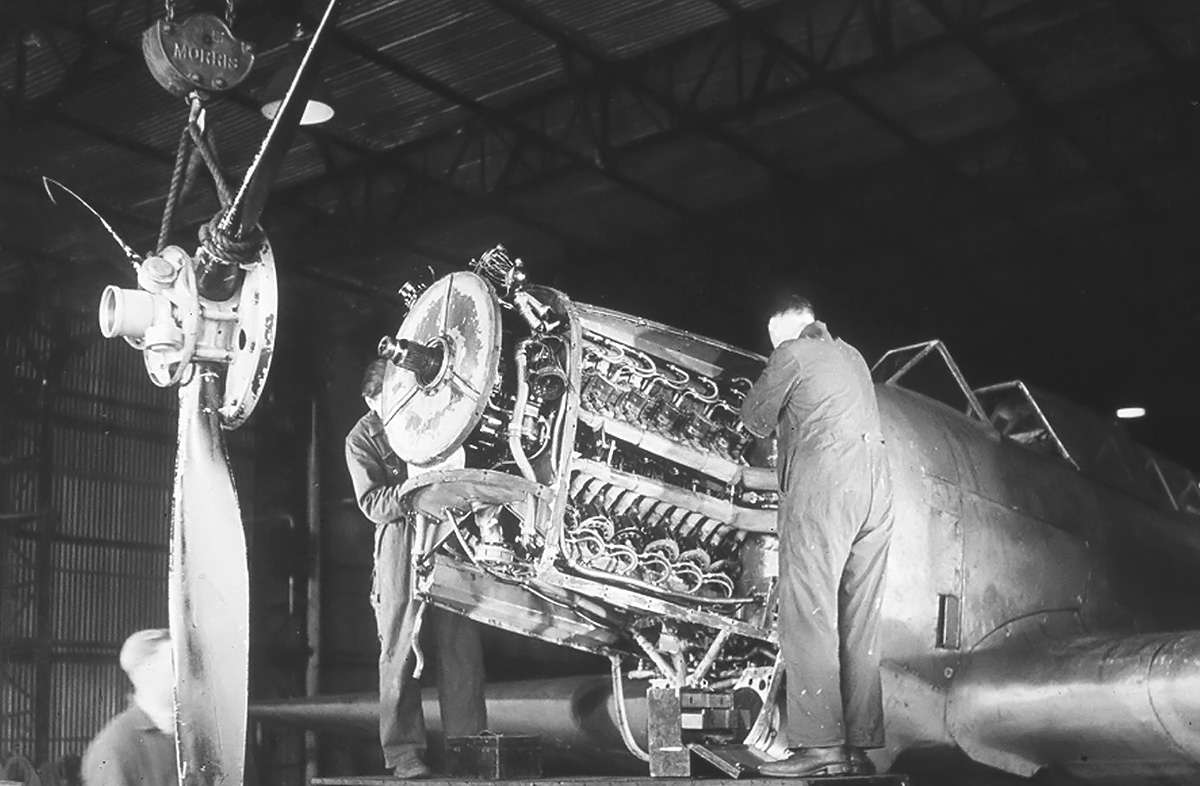
Deerhound II engine Whitley

A Deerhound II engine installed in an Armstrong Whitworth A.W.38 Whitley bomber. Note the relatively small diameter of the engine compared to that of the firewall. The 44 in (1.12 m) diameter Deerhound replaced the 51 in (1.29m) diameter Armstrong Siddeley Tiger that was originally installed in the Whitley II.

In 1937, the Deerhound was redesigned and became the Deerhound II. The engine’s configuration changed little. However, refinements were made, and the cylinder bore was increased from 5.31 in (135 mm) to 5.51 in (140 mm). The stroke was unchanged, but the larger bore increased the engine’s displacement by 175 cu in (2.88 L), bringing the total displacement to 2,505 cu in (41.06 L). The engine’s forecasted output was still 1,500 hp (1,119 kW). The Deerhound II had a 6.75 to 1 compression ratio and was 44 in (1.12 m) in diameter. Extensive baffles were installed around the cylinders to help direct air flow and cool the rear cylinders.

The Deerhound II was first run in 1938, but more issues were encountered, including a broken crankshaft during a type test in October 1938. Fell and his team were under immense pressure from the ASM board to fix the engine’s issues. Two Deerhound II engines were installed in an Armstrong Whitworth A.W.38 Whitley bomber (serial no. K7243) for flight tests, and the aircraft first flew in January 1940. Fell’s contract with ASM was not renewed when it expired on 9 February 1939. Lindsey temporarily took over Deerhound development until Stewart S. Tresilian was brought on staff in mid-1939.

Deerhound engine cowling Whitley

Any aerodynamic advantages achieved by the close-fitting cowling covering the Deerhound engine installed on the Whitley must have been undermined by the bulbous cooling-air intake under and the large induction scoop above the engine. This Whitley was eventually lost, but through no fault of the engines.

Although the date is not recorded, the engine did achieved and output of 1,500 hp (1,119 kW) at 2,975 rpm with 5 psi (.34 bar) of boost. On the Whitley bomber, the engines were housed in special nacelles. Cooling air was taken in under the spinner and directed from the rear of the engine forward through the cylinders. However, engine cooling issues persisted, and the designers believed increasing the cooling fin area of the cylinders would resolve the problem.

Flight testing continued until 6 March 1940 when the Deerhound II-powered Whitley bomber was lost on takeoff, killing all three people on board. The crash was attributed to an improperly set trim tab and had nothing to do with the engines. With the testbed destroyed, ASM decided to curtain development of the Deerhound II and focus on an improved version that would cure the overheating issues. The new engine, the Deerhound III, will be described later. Five Deerhound II engines were built.

Armstrong Siddeley 36-cyl Mastiff

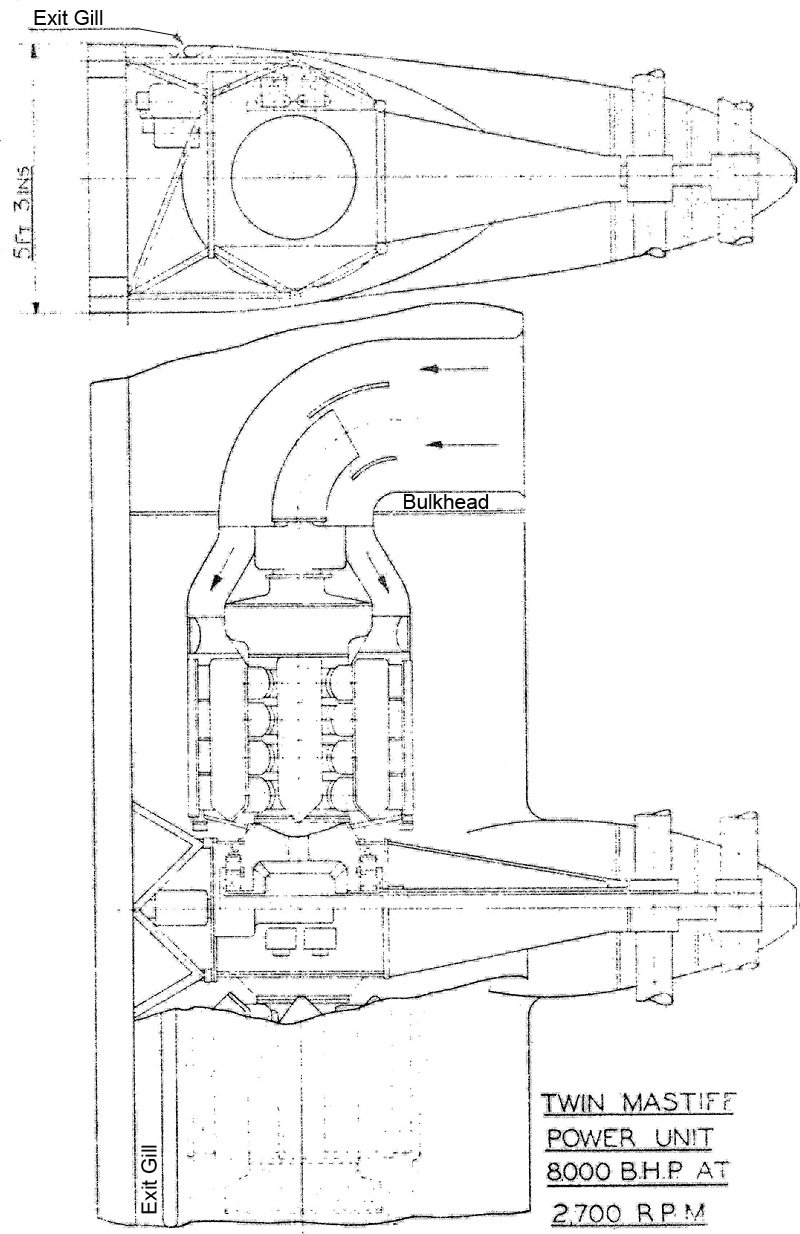
This drawing illustrates a coupled arrangement for two 36-cylinder Armstrong Siddeley Mastiff engines. The engine’s nine banks of four cylinders can be deduced from the drawing. A similar arrangement was purposed with two Deerhound engines.

In 1937, the Boarhound was designed. This engine possessed the larger 5.51 in (140 mm) bore of the Deerhound II and had a longer 6.30 in (160 mm) stroke. The real design change was the engine’s layout—the Boarhound had three inline rows of nine cylinders. With its 27 cylinders, the Boarhound displaced 4,058 cu in (66.50 L). Its initial and rather conservative estimated output was 2,300 hp (1,715 kW) at 2,700 rpm. The Boarhound had a diameter of 51 in (1.30 m). With all resources focused on the Deerhound, the Boarhound was never built.

Around 1938, the Mastiff name was resurrected and given to a further development of the Boarhound. The new Mastiff had four inline rows of nine cylinders. While the cylinder’s bore was still 5.51 in (140 mm), the stroke was lengthened to 6.69 in (170 mm). The 36 cylinders of the Mastiff engine displaced an impressive 5,749 cu in (94.21 L), and output was estimated at 4,000 hp (2,983 kW). Like the Boarhound, the Mastiff was not developed.

In 1940, Tresilian went to work on the Deerhound III to create an engine free from the issues experienced with the original Deerhound and the Deerhound II. The Deerhound III possessed the same bore, stroke, displacement, and 44 in (1.12 m) diameter as the Deerhound II. However, the engine was essentially redesigned, and its output was increased to 1,800 hp (1,342 kW). The engine was first run in late 1940. High-power tests revealed detonation issues with the first row of cylinders, but some sources state the engine did achieve 1,800 hp (1,342 kW) on the dyno. An updated design, the Deerhound IV, was proposed but never built. Only one Deerhound III was built.

Armstrong Siddeley Deerhound III

This picture shows the sole Armstrong Siddeley Deerhound III engine. Again, revisions to the front of the engine, gear reduction, and valve covers can easily be seen. Reportedly, this engine survived into the 1970s.

In mid-1941, the Wolfhound name was reused for a new Tresilian-designed engine. The new Wolfhound had four inline rows of six cylinders in a flattened X configuration. The 24-cylinder engine had a 5.91 in (150 mm) bore and a 5.51 in (140 mm) stroke. Total displacement was 3,623 cu in (59.38 L), and the engine was to produce 2,600–2,800 hp (1,939–2,088 kW) at 2,800 rpm. The engine had a two-stage supercharger and was designed to power contra-rotating propellers.

In October 1940, a bombing raid severely damaged the Armstrong Siddeley Aero Development shop and destroyed several Deerhound engines. Another raid on 8 April 1941 further damaged the shop and set engine development back even more. ASM dog-engine development continued at a slow pace until October 1941, when the British Ministry of Aircraft Production (MAP) cancelled further work. The ASM dog-engines would not be ready in time to be of any use in the war, and the MAP wanted the company to focus on turbine engines (ASM named theirs after snakes). The sole Deerhound III engine was thought to have survived into the 1970s, but there are no known ASM dog-engines currently preserved.

Armstrong Siddeley Deerhound IV

Drawing of the Armstrong Siddeley Deerhound IV engine that was never built. Even if this design from 1941 proved successful, it would not have been developed in time to see much use during World War II.

Sources:
Armstrong Siddeley — the Parkside Story 1896–1939 by Ray Cook (1988)
Parkside: Armstrong Siddeley to Rolls-Royce 1939–1994 by Roy Lawton (2008)**
Sectioned Drawings of Piston Aero Engines by Lyndon Jones (1995)**
Armstrong Whitworth Aircraft since 1913 by Oliver Tapper (1973)
British Secret Projects: Fighters & Bombers 1935–1950 by Tony Buttler (2004)
British Piston Aero-Engines and Their Aircraft by Alec Lumsden (1994/2003)
http://www.designchambers.com/wolfhound/index.htm#Articles (and pages therein)
http://www.secretprojects.co.uk/forum/index.php?topic=5580.0

**Rolls-Royce Heritage Trust books that are currently in print and available from the Rolls-Royce Heritage Trust site.

Junkers-Jumo-224-side

Junkers Jumo 224 Aircraft Engine

By William Pearce

Under Junkers engineer Manfred Gerlach, development of the Junkers Motorenbau (Jumo) 224 two-stroke, opposed-piston, diesel aircraft engine began when the development of the Jumo 223 stopped in mid-1942. The Jumo 223 had encountered vibration issues as a result of its construction, and its maximum output of 2,500 hp (1,860 kW) fell short of what was then desired. More power was needed for the large, long-range aircraft on the drawing board.

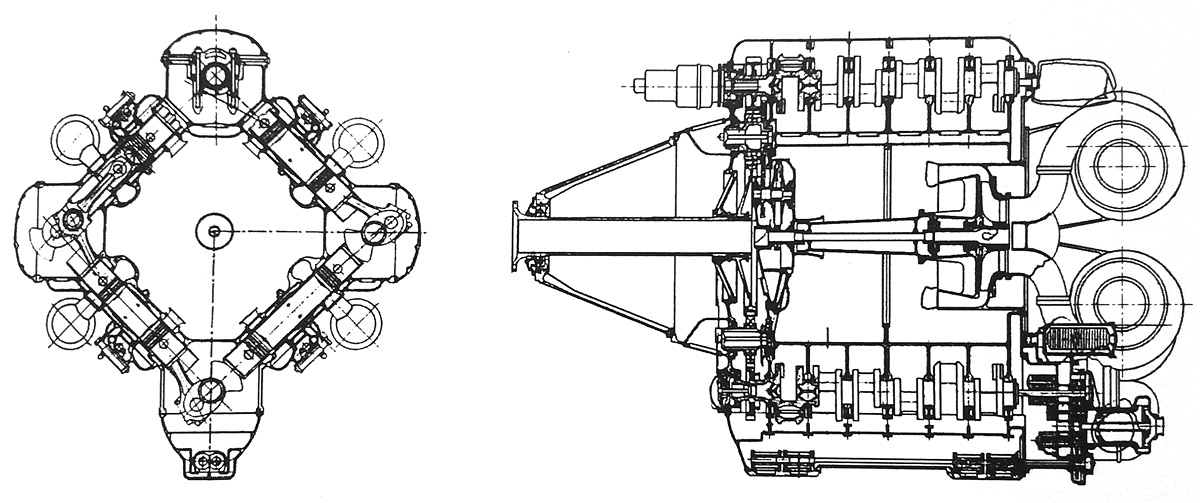
Junkers Jumo 224

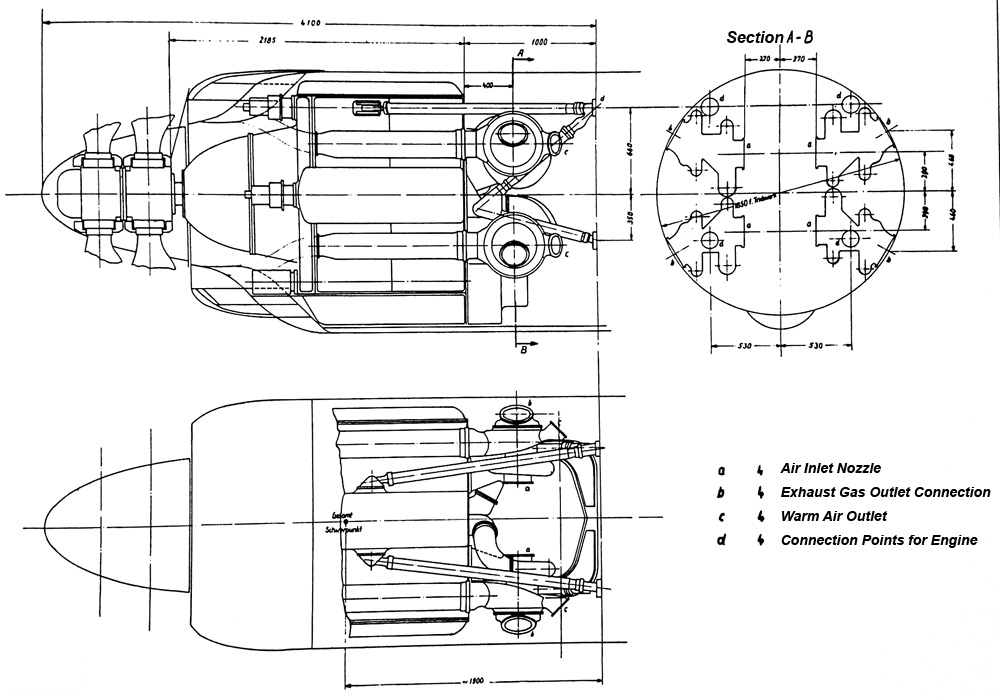
Front and side sectional views of the Junkers Jumo 224 engine. Note in the side view how the turbochargers feed the supercharger/blower mounted in the “square” of the engine. The front of the crankshafts engage gears for the propellers, supercharger, and fuel injection camshafts.

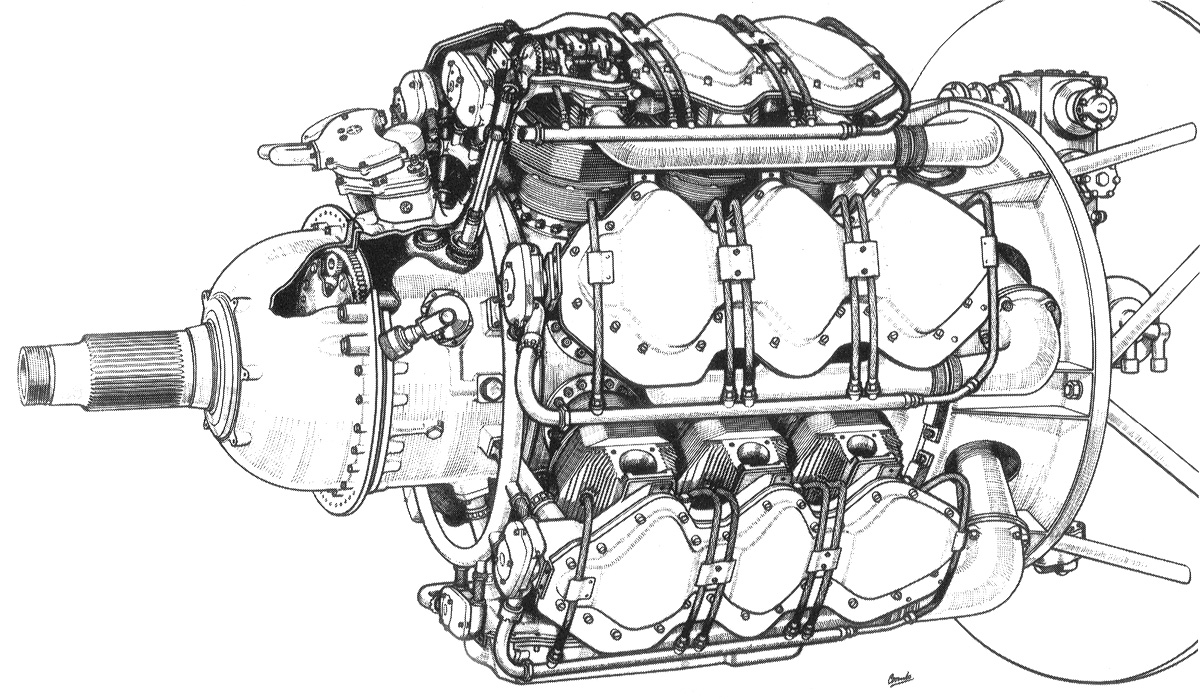
The Jumo 224 retained the same basic configuration as the Jumo 223, with four six-cylinder banks positioned 90 degrees to each other so that they formed a rhombus—a square balanced on one corner (◇). The pistons for two adjacent cylinder banks were attached to a crankshaft located at each corner of the rhombus. The complete engine had four crankshafts, 24 cylinders, and 48 pistons.

Like the Jumo 223, the Jumo 224 engine was constructed from two large and complex castings—one for the front of the engine and one for the rear. Each casting had four banks of three-cylinders. To enable the use of contra-rotating propellers, two gears were connected to the front of each crankshaft. The first gear was the bigger of the two and engaged a large central gear at the front and center of the engine. The outer propeller shaft was connected to the front of the central gear. Through an idler gear, the small gears on all the crankshafts drove a smaller central gear that was connected to the inner propeller shaft. However, the engine could be configured for use with a single propeller rotating in either direction. The central gears provided an engine speed reduction of .35.

Junkers Jumo 223 with prop

Although never completed, the  Jumo 224 would have closely resembled a larger version of the Jumo 223 shown above.

The upper and lower crankshafts also drove separate camshafts for the left and right rows of fuel injection pumps. These camshafts as well as the injection pumps were located near the upper and lower crankshafts. Through a series of step-up gears, the left and right crankshafts powered a drive shaft for the engine’s supercharger/blower, which was located in the rear “square” of the engine.

Exhaust gases from each cylinder bank were collected by a manifold that led to a turbocharger at the rear of the engine. Each of the four cylinder banks had its own turbocharger. After passing through the turbocharger, the air flowed into the supercharger where it was further pressurized, and then into the cylinders via a series of holes around the cylinder’s circumference. As the pistons moved toward each other, the intake holes were covered and the air was compressed. Diesel fuel was injected and ignited by the heat of compression. The expanding gases forced the pistons away from each other, uncovering the intake holes (for scavenging) and then the exhaust ports, which were located near the left and right crankshafts.

At its core, the Jumo 224 was four Jumo 207C inline, six-cylinder, opposed-piston engines combined in a compact package. Using the proven Jumo 207C as a starting point cut down the development time of the Jumo 224 engine. The Jumo 224 used the same bore and stroke as the Jumo 207C. While the Jumo 224 was being designed, a Jumo 207C was tested to its limits to better understand exactly what output could be expected from the Jumo 224. Tests conducted in late 1944 found that with a 200 rpm overspeed (3,200 rpm), intercooling, modified fuel injectors, and 80% methanol-water injection, the Jumo 207C was capable of a 10 minute output at 2,210 hp (1,645 kW)—twice its standard rating of 1,100 hp (820 kW).

Junkers Jumo 207C

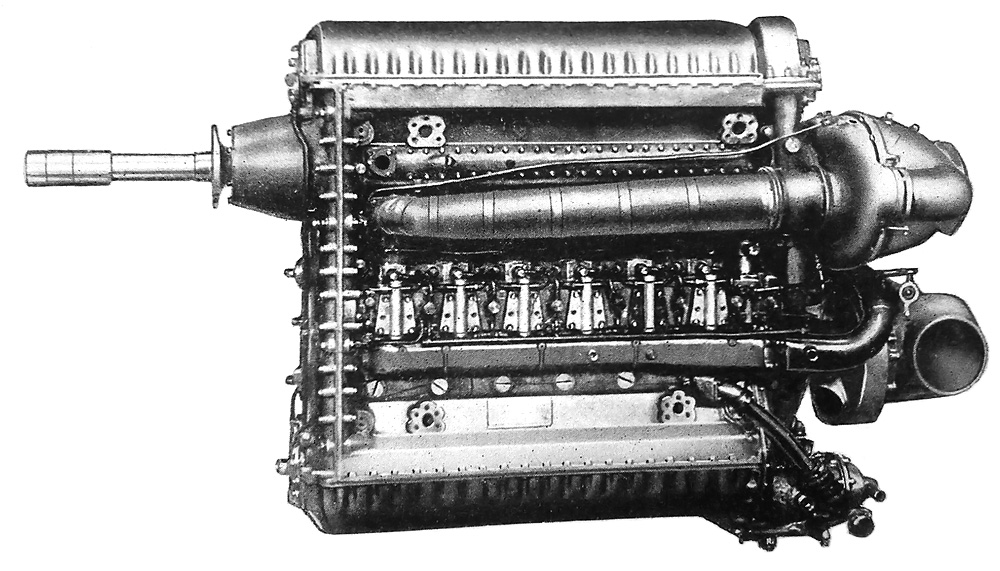
The Junkers Jumo 207C had an integral blower and turbocharger. The engine served as the foundation for the Jumo 224; its cylinder dimensions and various components were used.

The Jumo 224 had a bore of 4.13 in (105 mm) and a stroke of 6.30 in (160 mm) x 2 (for the two pistons per cylinder). Total displacement was 4,058 cu in (66.50 L). Without turbochargers, the engine was 111.4 in (2.83 m) long, 66.9 in (1.70 m) wide, 73.6 in (1.87 m) tall, and weighed 5,732 lb (2,600 kg). The opposed pistons created a compression ratio of 17 to 1. The planned output of the Jumo 224 was initially 4,400 hp (3,280 kW) at 3,000 rpm. However, many different combinations of intercooling, multiple-stage turbocharging, turbocompounding, and using exhaust thrust for up to 400 hp (300 kW) of extra power were proposed that gave the engine a variety of different outputs at critical altitudes up to 49,210 ft (15,000 m). Specific fuel consumption was estimated as .380 lb/hp/hr (231 g/kW/hr), and the engine’s average piston speed was 3,150 fpm (16.0 m/s) at 3,000 rpm.

From mid-1942 on, design work on the complex Jumo 224 moved ahead but often at a very slow pace. Developmental work on the 24-cylinder Jumo 222 and turbojet Jumo 004 engines took up all of the engineers’ time and Junkers Company resources, leaving little of either for the Jumo 224. The RLM (Reichsluftfahrtministerium or German Ministry of Aviation) was interested in the Jumo 224 engine for the six-engine Blohm & Voss BV 238 long-range flying boat, the eight-engine Dornier Do 214 long-range flying boat, and other post-war commercial and military aircraft projects. Even so, the RLM was more interested in the other Jumo engines, and they were given priority over the Jumo 224.

junkers-jumo-224-gears

Gearing schematic of the Jumo 224 showing left and right propeller rotation. The drawing indicates the number of teeth (z) and their height (m) on each gear.

By October 1944, the Jumo 207D engine had proven itself reliable. This engine had a bore of 4.33 in (110mm)—.20 in (5 mm) more than the Jumo 207C. Thought was given to using Jumo 207D cylinders for the Jumo 224. This change would have increased the engine’s displacement by 396 cu in (6.5 L), resulting in a total displacement of 4,454 cu in (73.0 L). However, it is not clear if the larger bore was ever incorporated into the Jumo 224.

In November 1944 the RLM ordered the material for five Jumo 224 engines. At this stage in the war, with streams of Allied bombers overhead, it was nearly impossible for Junkers to find contractors able to produce the specialized components needed for the Jumo 224 engine. Even under ideal conditions, it would be years before the Jumo 224 engine would be ready for production. By the end of the war, the first Jumo 224 engine was around 70% complete. As Allied troops neared the Junkers factory in Dessau, Germany in late April 1945, almost all of the Jumo 224 plans, blueprints, and documents were destroyed to prevent the information from falling into the hands of the Allies.

After the Junkers plant was captured, the Jumo 207C that produced 2,210 hp was sent to the United States for study. The plant, Dessau, and all of eastern Germany was handed over to the Soviet Union. In March 1946, the Soviets expressed interest in the Jumo 224 (and 223) engine, and development continued in May 1946. Gerlach was still at the Junkers plant and continued to oversee the Jumo 224. However, building the engine in post-war, Soviet-occupied Germany proved to be more of a challenge than building the engine during the war. Jumo 224 development continued but at a very slow pace. In October 1946, Gerlach and a number of others were relocated to Tushino (now part of Moscow), Russia to continue work on the Jumo 224.

Junkers Jumo 224 installation

Installation drawing for the Jumo 224. Clearly seen are the four turbochargers and contra-rotating propellers. The inside cowling diameter is listed as 72.8 in (1.85 m).

Operating out of State Factory No. 500, the group was to continue development of the Jumo 224 engine, now designated M-224. The M-224 was turbocharged, 123.1 in (3.13 m) long, 66.9 in (1.70 m) wide, 74.7 in (1.90 m) tall, and weighed 6,063 lb (2,750 kg). Gerlach believed in the M-224 and did what he could to continue its development, but the Germans did not find themselves very welcome at the factory, and nearly everything they requested was slow in coming. To make matters worse, Jumo 224 parts and equipment that the Soviets had captured and sent from Dessau never arrived in Tushino.

Junkers Jumo 224 advert

Junkers post-World War II advertisement for the Jumo 224 stating the high performance diesel aircraft engine was for large, long-distance aircraft.

Factory No. 500 was headed by Vladimir M. Yakovlev (no relation to the aircraft designer), who was hard at work on his own large diesel aircraft engine—the 6,200 hp (4,620 kW), 8,760 cu in (143.6 L), 42-cylinder M-501. Yakovlev was critical of the work done on the M-224; he felt that the engine took resources away from the M-501. With little progress on the M-224, Yakovlev was able to convince Soviet officials that his engine had the greater potential, and all development on the M-224 was stopped in mid-1948.

No parts or mockups of the Jumo 224 / M-224 are known to exist. The Yakovlev M-501 engine was run in 1952. The engine was not produced for aircraft, but it was built in the 1970s as the Zvezda M503 marine engine and is still used today for tractor pulling.

Sources:
Junkers Flugtriebwerke by Reinhard Müller (2006)
Flugmotoren und Strahltriebwerke by Kyrill von Gersdorff, et. al. (2007)
Russian Piston Aero Engines by Vladimir Kotelnikov (2005)
Opposed Piston Engines by Jean-Pierre Pirault and Martin Flint (2010)
https://ru.wikipedia.org/wiki/%D0%9C-224

Junkers Jumo 223 front

Junkers Jumo 223 Aircraft Engine

By William Pearce

In 1892, Hugo Junkers began experimental development of two-stroke, opposed-piston, gas engines. By 1910, Junkers had combined the opposed-piston principal with the diesel combustion cycle (compression ignition). Junkers investigated adapting this style of engine for aircraft use, but World War I and its aftermath prolonged development. In 1923, Junkers formed the Junkers Motorenbau (Jumo) to construct aircraft engines. Jumo’s first two-stroke, opposed-piston, diesel aircraft engine was commercially available in 1930. Originally known as the Jumo 4, the engine’s designation was changed in 1932 to Jumo 204.

Junkers Jumo 223 front

The 24-cylinder Junkers Jumo 223 two-stroke, opposed-piston, diesel aircraft engine was one of the most unusual engines ever built. The engine’s coolant exit ports can be seen by the upper crankshaft. The two starters at the front of the engine engaged the propeller shaft.

Throughout the 1930s, Junkers developed a number of two-stroke, opposed-piston, diesel aircraft engines. There is no cylinder head on an opposed-piston engine. Rather, each cylinder has two pistons that move toward the center of the cylinder during the compression stroke. Ports in the cylinder wall allow the admission of air and expulsion of exhaust. These ports are covered and uncovered by the pistons as they move. The Junkers opposed-piston diesels were six-cylinder, inline engines with two crankshafts—one at the top of the engine and one at the bottom. Each crankshaft had a complete set of six pistons.

For installation in aircraft, there were practical limits to the Junker’s inline, opposed-piston engine configuration. Its double piston design made it a very tall engine, adding more cylinders to the Junkers diesels would have created a very long engine with a long crankshaft susceptible to torsional stresses. Increasing the engine’s bore and/or stroke would result in a larger engine with a lot of rotating mass, necessitating relatively low rpm. Engines capable of a continuous 2,000 hp (1,490 kW) output were needed for proposed large transoceanic aircraft, but an inline, opposed-piston aircraft engine able to produce 2,000 hp (1,490 kW) of continuous power was simply not feasible.

Junkers Jumo 204

The Jumo 204 was the first diesel aircraft engine commercially available from Junkers. Its basic configuration was repeated in later Jumo diesels—collectively the most successful diesel aircraft engines produced.

By 1936, Junkers engineer Dr. Johannes Gasterstädt had come up with an opposed-piston engine configuration that would enable 2,000 hp (1,490 kW) in a compact package suitable for aircraft use. The configuration consisted of four cylinder banks positioned 90 degrees to each other so that they formed a rhombus—a square balanced on one point (◇). The pistons for two adjacent cylinder banks were connected to a crankshaft positioned at each corner of the rhombus. Each cylinder bank had six cylinders. The complete engine had four crankshafts, 24 cylinders, and 48 pistons.

Junkers’ rhombus-configured engine investigation was designated P2000. Dr. Gasterstädt passed away in 1937, and Prof. Otto Mader and Manfred Gerlach took over the P2000 project. By the end of 1937, a single cylinder test engine and a complete six-cylinder block had been built and run. In April 1938, the RLM (Reichsluftfahrtministerium or German Ministry of Aviation) redesignated the P2000 engine as the Jumo 223. By December 1939, a full-scale Jumo 223 engine was completed, and that engine was run-in by a dyno (the dyno turning the engine) in January 1940.

Junkers Jumo 223 split case

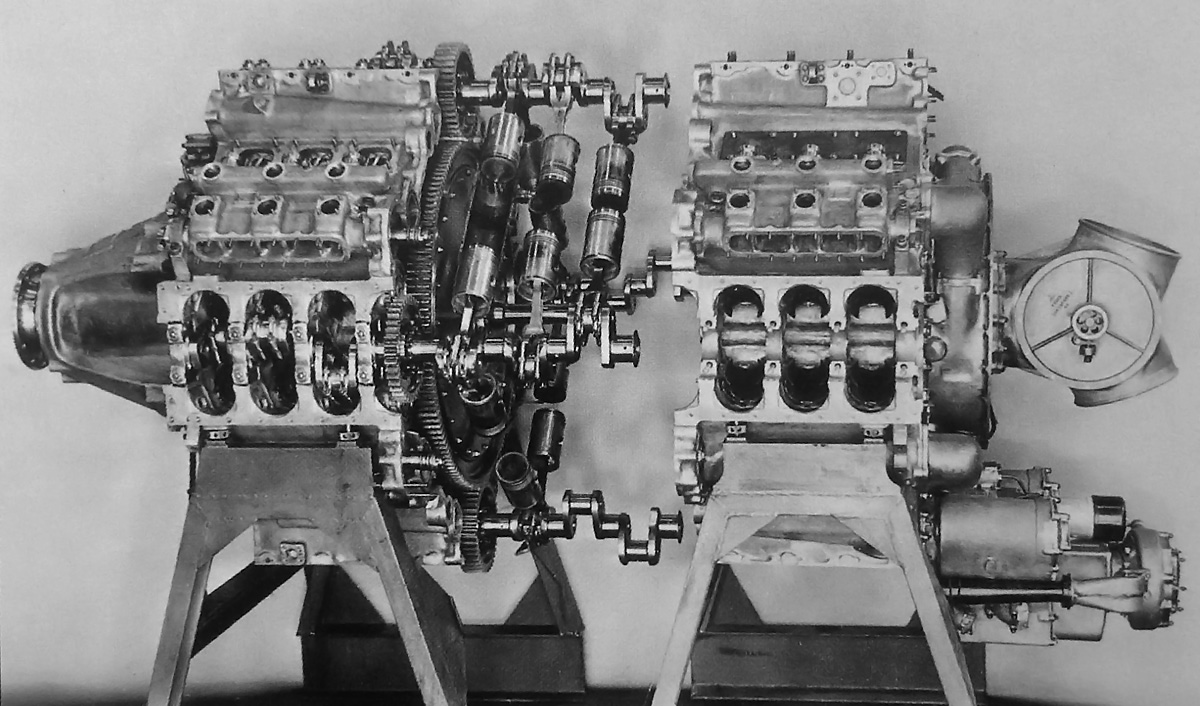
This picture of the separate castings that made up the Jumo 223 helps to illustrate the engine’s complexity. Note the scuffing and carbon deposits on the pistons, indicating they have been run.

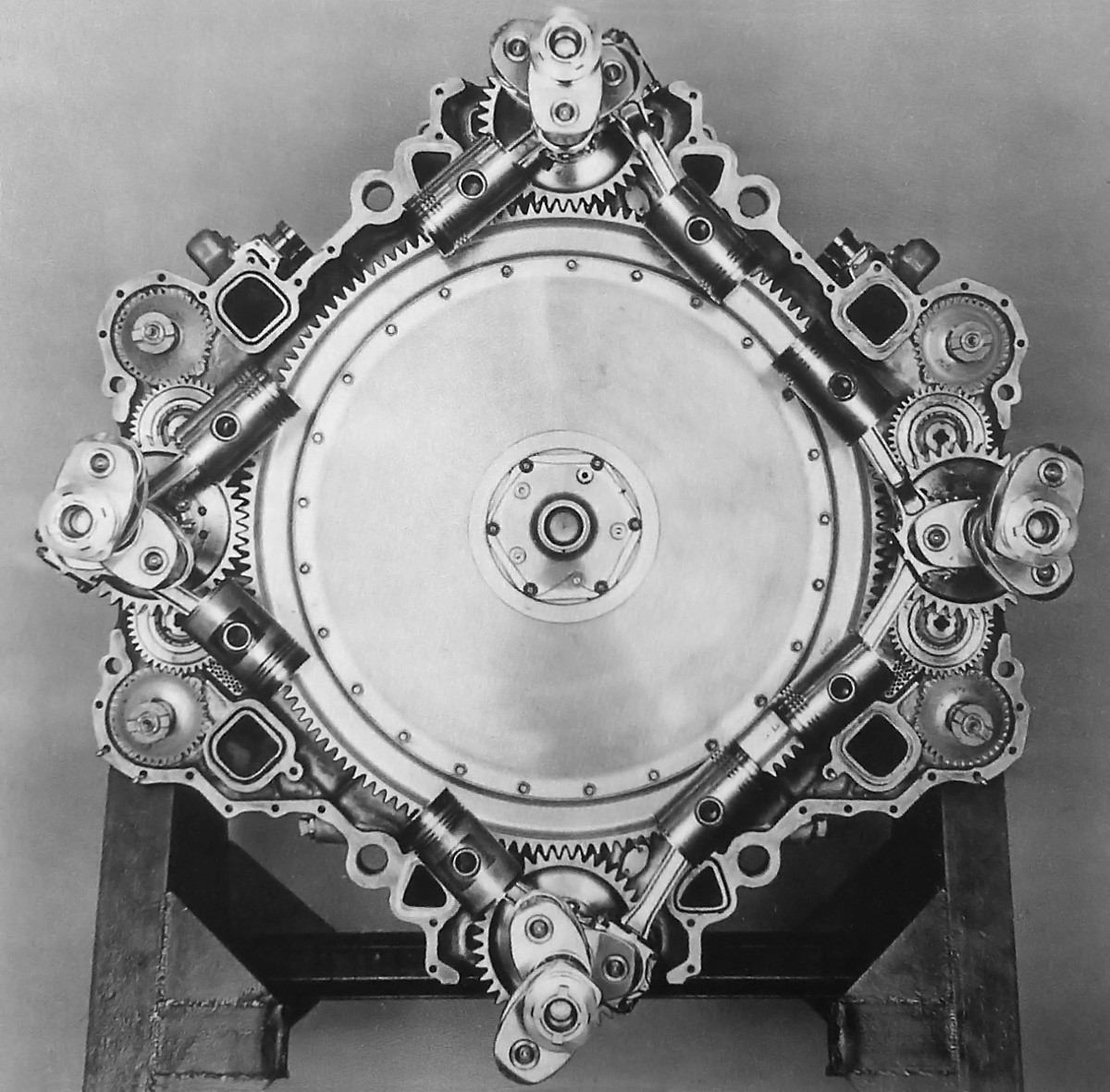
The Jumo 223 was one of the most unusual engines ever built. The engine was constructed from two large and complex aluminum castings—one for the front of the engine and one for the rear. Each casting had four banks of three-cylinders. A large central gear was at the center of the engine where the two castings joined. Each crankshaft was made up of two main sections bolted together via a gear at its center. The gear on each crankshaft meshed with the central gear to transfer power from the crankshafts to the central gear. Drive shafts extended through the center of the engine from the front and rear of the central gear. The rear shaft powered the engine’s blower (weak supercharger) and accessories via a series of other gears. The front shaft led to the propeller. The central gear provided a .26 reduction in engine speed. At the front of the engine were two starters that engaged the propeller shaft to start the engine.

Junkers Jumo 223 cranks gear

The Jumo 223’s central gear was powered by gears at the center of the engine’s four crankshafts. Note the fork-and-blade connecting rods.

The left and right crankshaft gears each drove separate camshafts for an upper and lower row of fuel injection pumps. These camshafts and the injection pumps were located near the left and right crankshafts. Cast directly under each row of injection pumps was a square port that ran along the engine. This port took air from the blower and delivered it to a small chamber around each steel cylinder liner. Air entered the cylinders via a series of holes around the cylinder liner’s circumference. The fuel injectors were located in the center of the cylinder. As the pistons moved toward each other, the intake holes were covered and the air was compressed. Diesel fuel was injected and ignited by the heat of compression. The expanding gases forced the pistons away from each other, uncovering the intake holes (for scavenging) and then the exhaust ports, which were located near the upper and lower crankshafts. Exhaust gases flowed out the ports in the cylinder liner into a small chamber surrounding the liner. The exhaust gases for each cylinder bank were collected by a manifold that led to a turbocharger at the rear of the engine. It is not clear if the turbocharger was ever tested, but there is one photo that shows a Jumo 223 with the turbocharger or a mockup of it. The pistons were connected to the crankshaft via fork-and-blade connecting rods. Each crankshaft was secured in the crankcase by eight main bearings.

A triangular port for coolant was cast on both sides of the engine near the upper and lower crankshafts. Coolant flowed from the coolant pump located on the bottom rear of the engine and into the lower triangular ports. The coolant circulated throughout the engine and exited near the upper crankshaft via the coolant ports at the front of the engine.

Junkers Jumo 223 central gear

The central gear and front half of the engine is shown in this picture. Note the gears for the fuel injection pump camshafts by the left and right crankshafts. Coolant flowed through the triangular ports near the upper and lower crankshafts. Air flowed through the square ports near the left and right crankshafts.

The Jumo 223 engine had a 3.15 in (80 mm) bore and a 4.72 in (120 mm) stroke x 2 (for the two pistons per cylinder). Total displacement was 1,767 cu in (28.95 L). Without the propeller, the engine was 81.5 in (2.07 m) long, 48.8 in (1.24 m) wide, 53.0 in (1.345 m) tall, and weighed 3,086 lb (1,400 kg). The opposed pistons created a compression ratio of 17 to 1. With its planned intercooled turbocharger, the Jumo 223 was designed to produce 2,500 hp (1,860 kW) at an astonishing 4,400 rpm. That rpm would yield a fairly high average piston speed of 3,465 fpm (17.6 m/s). The Jumo 223 had a critical altitude rating of 1,800 hp (1,340 kW) at 16,404 ft (5,000 m) with the possibility of increasing the altitude to 32,808 ft (10,000 m) as the engine was further developed. Specific fuel consumption was .391 lb/hp/hr (238 g/kW/hr). The engine was contemplated for use in the four-engine Messerschmitt Me 264 long-range bomber, the six-engine Junkers EF100 commercial airliner, and other military aircraft projects.

The Jumo 223 engine ran for the first time on 27 February 1940. Without the turbocharger, the only boost came from the engine’s blower that was just intended to scavenge the cylinders. Peak high temperatures of 2,552 degrees F (1,400 degrees C) were encountered in the cylinders during combustion and caused pitting and seizure of the pistons. The issue was caused by the asymmetrical injection of fuel, a result of locating the injectors only on the outside of the engine, for ease of service, rather than having additional injectors inside the engine’s “square.”

Junkers Jumo 223 rear

The blower at the rear of the Jumo 223 can clearly be seen in this picture. The pipes leading away from the blower provided air to the passageways cast in the engine. The coolant pump is at the bottom of the engine.

Fuel injectors were modified, and tests continued throughout 1940. Three engines had been built by early 1941. In February 1941, the second engine was run for 100 hours and achieved a peak of 1,830 hp (1,360 kW) at 3,810 rpm. On 20 March 1941, the Jumo 223 passed the 2,000 hp (1,490 kW) mark by producing 2,040 hp (1,520 kW) at 3,980 rpm. During a 100 hour engine run in July 1941, crankshaft bolts and crankshafts were broken, indicating resonance vibration issues. In October 1941, the third engine completed a 100 hour test run at 1,500 hp (1,115 kW). The engine was run at a lower power because of the issues encountered when the Jumo 223 engine produced more power. The second engine was back in the test cell for a short run on 23 December 1941. The run set the mark for the highest power achieved by the Jumo 223 engine, producing 2,380 hp (1,770 kW) at 4,200 rpm.

Tests continued into 1942, but the engine’s reliability was a concern. The vibration issues seemed to be a result of the two-piece crankshafts and crankcase and the high rpm needed to produce the desired power. Along with the Jumo 223, Junkers was developing the Jumo 222—a 24-cylinder, spark ignition engine close to the same power and physical size as the Jumo 223, but lighter and of greater displacement. The Jumo 222 engine had more than its share of problems, and it made little sense to develop two engines in the same power class at the same time. In addition, developmental engines capable of more power than the Jumo 223 were needed.

Junkers Jumo 223 with turbo

This photo shows a Jumo 223 with a turbocharger. The exhaust manifolds can be seen leading to the turbocharger at the rear of the engine. Unfortunately, no information has been found regarding tests of this engine. It is possible that the turbocharger was only a mockup.

Development of the Jumo 223 as a production engine was halted in mid-1942. However, work on the engine continued, as it would serve as a model for a new, larger engine—the Jumo 224. By October 1942, six Jumo 223 engines were completed and two more were under construction. The eighth and last Jumo 223 prototype engine was run up to 2,200 hp (1,640 kW) on 28 February 1943. While this run was intended to be the last, Soviet forces had different ideas after the war. The Junkers factory was in Dessau, Germany and was part of the territory occupied by Soviet troops. The Soviets were interested in the Jumo 223 engine. The eighth example was run again on 23 March 1946 and for the last time on 4 April 1946. The last run was for a Soviet delegation and lasted 73 minutes. The run was halted after two pistons failed. Reportedly, at least one of the Junkers Jumo 223 engines was taken to State Factory No.500 in Tushino (now part of Moscow), Russia for further research, but no Jumo 223 engines are known to exist.

Note: There is no doubt that the Junkers Jumo opposed-piston engines in some way inspired the Napier Deltic, especially since Napier purchased licenses to build the Jumo 204 and 205 engines (to be built as the Culverin and Cutlass) in the 1930s. However, there is no indication that information on the Jumo 223 or 224 engines was applied to the design of the Deltic. In fact, the Deltic possessed many unique design characteristics, such as one crankshaft rotating the opposite direction compared to the other two.

Junkers Jumo 223 test run

The first Jumo 223 engine running on a test stand at the Junkers works in Dessau, Germany in early 1940.

Sources:
Junkers Flugtriebwerke by Reinhard Müller (2006)
Flugmotoren und Strahltriebwerke by Kyrill von Gersdorff, et. al. (2007)
Opposed Piston Engines by Jean-Pierre Pirault and Martin Flint (2010)
http://histomobile.com/dvd2.php?lien2=usa/tech/121-2.htm
http://p-d-m.livejournal.com/28230.html

Reggiane Re 103 left side 1943

Reggiane Re 101 to Re 105 Aircraft Engines

By William Pearce

In 1936, the Italian aircraft manufacturer Officine Meccaniche Reggiane (Reggiane) branched out to produce aircraft engines. Initially, Reggiane produced Piaggio and FIAT engines under license, but it was not long before the company began to develop its own aircraft engines. As world events unfolded in the 1940s, only one model of Reggiane’s aircraft engines was built, and it did not proceed beyond the testing phase.

Reggiane Re 103 April 1942

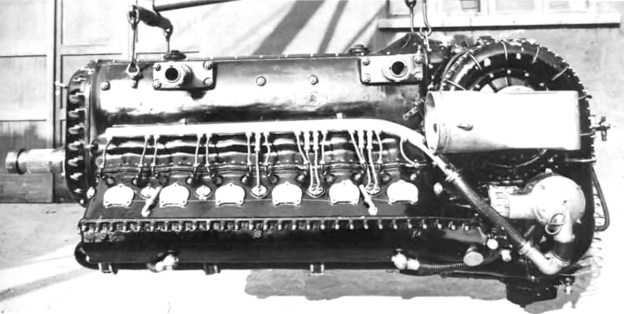
The Reggiane Re 103 RC50 I engine in April 1942 before spark plug wires and fuel lines were added. Note the two spark plugs per cylinder.

Reggiane’s first aircraft engine design was the Re 101 RC50 I*. The “R” in the engine’s designation meant that it had gear reduction (Riduttore de giri); the “C” meant that it was supercharged (Compressore); the “50” stood for the engine’s critical altitude in hectometers (as in 5,000 meters), and the “I” meant the engine was inverted (Invertita). Occasionally, a letter was added to designate the engine’s configuration, as in “L” for inline (Linea) appearing as Re L 101 RC50. Proposed in the late 1930s, the Re 101 RC50 I was an inverted, liquid-cooled V-12 of 1,635 cu in (26.8L). Although its bore and stroke have not been found, they were probably around 5.51 in (140 mm) and 5.71 in (145 mm) respectively. The engine produced 1,200 hp (895 kW) for takeoff, 1,100 hp (820 kW) at 16,400 ft (5,000 m), and weighed 1,477 lb (670 kg). The Re 101 RC50 I engine possessed similar specifications to the Rolls-Royce Merlin but did not proceeded beyond its initial design.

Reggiane’s next engine, also designed in the late 1930s, was the Re 102 RC50 I. The engine was an inverted W-18 (sometimes called an M-18, “M” being an inverted “W”), with three banks of six cylinders. The Re 102 RC50 I displaced 2,075 cu in (34 L), produced 1,550 hp (1,156 kW) for takeoff and 1,350 hp (1,007 kW) at 16,400 ft (5,000 m), and weighed 1,676 lb (760 kg). The engine’s bore and stroke have not been found, but were probably around 5.28 in (134 mm). The Re 102 RC50 I did not proceeded beyond the design phase.

Reggiane Re 103 3-view

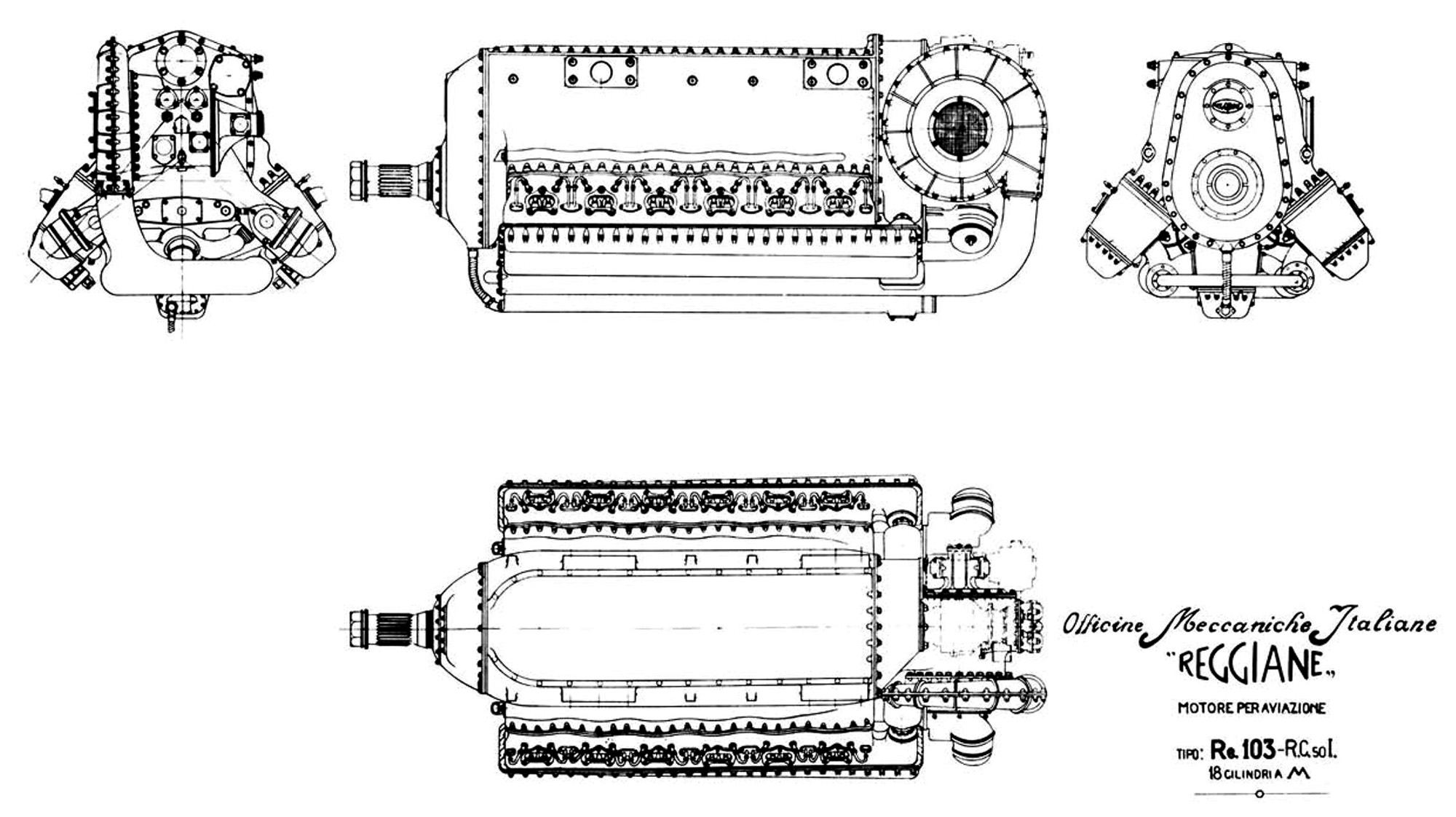
Undated three-view drawing of the Re 103 RC50 I engine. Note that it is listed as “18 Cilindri a M,” referring to its M-18 engine configuration.

In 1940, Reggiane focused on their next engine design, the Re 103. Like the Re 102 RC50 I, the Re 103 was an inverted W-18. However, with a bore of 5.51 in (140 mm), a stroke of 5.67 in (144 mm), and a total displacement of 2,435 cu in (39.9 L), the Re 103 was a larger engine than the Re 102 RC50 I. The Re 103 had a 6 to 1 compression ratio and a .511 propeller gear reduction. The engine was 91 in (2.33 m) long, 38 in (.97 m) wide, 36 in (.91 m) tall, and weighed 1,874 lb (850 kg). The Re 103 RC50 I was a candidate for the Reggiane RE 2005 fighter, along with a few other projects.

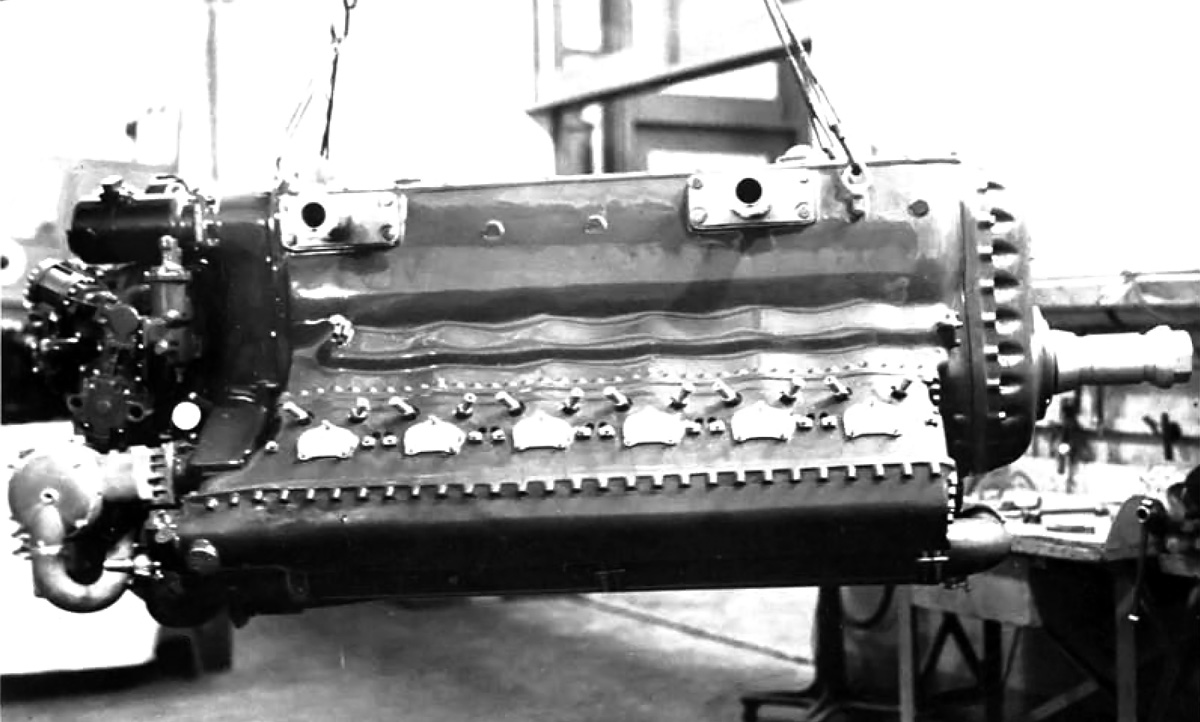
Although an independent design, the Reggiane Re 103 was in some ways similar to the Daimler-Benz DB 600 series engines. Both the DB 600 series engines and the Re 103 were inverted, had the supercharger impeller mounted parallel to the crankshaft on the upper left side of the engine, and featured fuel injection controlled by a module at the rear of the engine. Reggiane did have access to DB engines because licensed-built versions of the DB 601 (Alfa Romeo RA 1000 RC41 I) and DB 605 (FIAT RA 1050 RC58 I) were used in the RE 2001 and RE 2005 fighters respectively.

Reggiane Re 103 front-back 1943

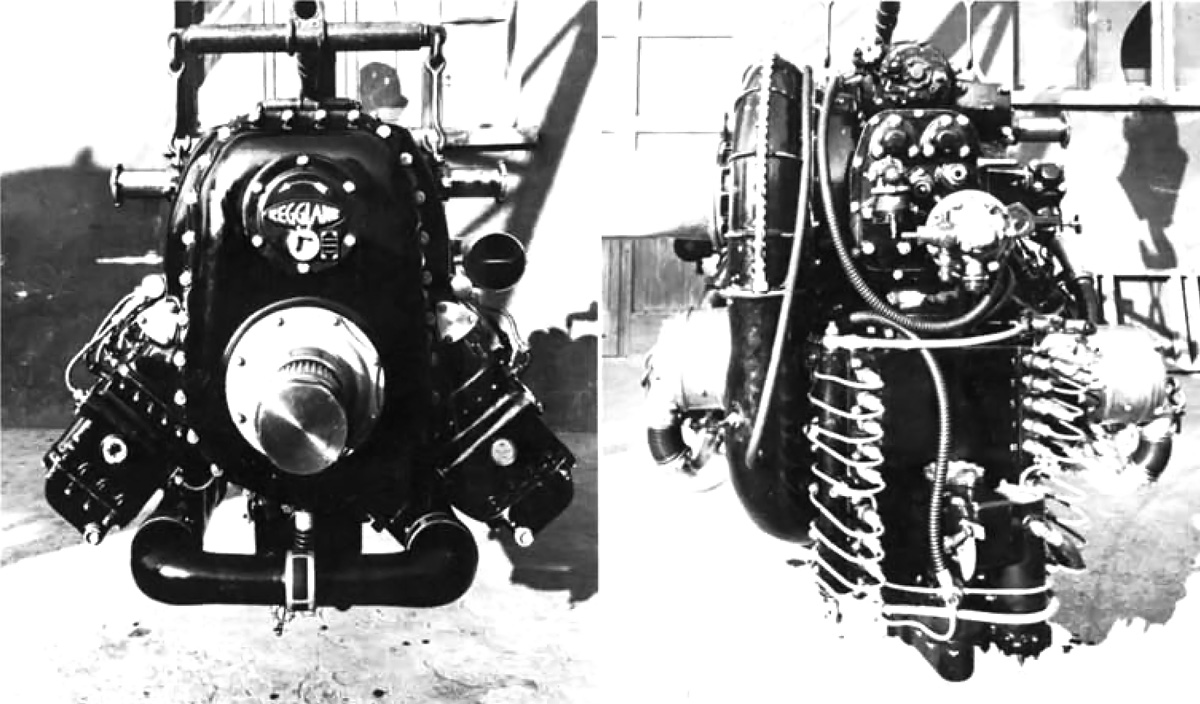
Front and rear of the Re 103 RC50 I engine. In the front view, note how the intake manifold feeds the individual cylinder banks. In the rear image, note the fuel injector distribution pump and the various fuel lines leading to each cylinder.

Air from the Re 103’s supercharger flowed through two manifolds positioned in between the engine’s cylinder banks. The left manifold supplied air to the left and center cylinder banks, while the right manifold provided air to the right cylinder bank. The manifolds met at the front of the engine, forming a loop. To keep frontal area to a minimum, the cylinder banks were positioned 40 degrees apart. Each cylinder had two intake and two exhaust valves. The valves were actuated by a single overhead camshaft. Each of the three camshafts (one for each cylinder bank) was driven by a vertical shaft at the rear of the engine. Also driven from the rear of the engine were the two magnetos that fired two spark plugs for each cylinder. The spark plugs were positioned on the outer side of the left and right cylinder banks and on the left side of the center cylinder bank. The fuel injectors were positioned on the inner side of the left and right cylinder banks and on the right side of the center cylinder bank.

Two versions of the Re 103 were initially proposed. The Re 103 RC50 I had a three-speed supercharger and was intended for fighter aircraft, while the Re 103 RC40 I had a two-speed supercharger and was intended for bombers. The supercharger was designed to automatically change speed according to the aircraft’s altitude. The Re 103 RC50 I used 100 octane fuel and produced 1,740 hp (1,298 kW) for takeoff at 2,840 rpm with 7.2 psi (.49 bar) boost and 1,600 hp (1,193 kW) at 16,400 ft (5,000 m) with 4.6 psi (.32 bar) boost. The Re 103 RC40 I used 87 octane fuel and produced 1,700 hp (1,298 kW) for takeoff at 2,840 rpm with 6.4 psi (.44 bar) boost and 1,500 hp (1,119 kW) at 13,123 ft (4,000 m) with 3.4 psi (.24 bar) boost.

Reggiane Re 103 left side 1943

Left side of the Re 103 RC50 I engine displaying the supercharger mounted in a very similar manner as on the DB 600 series engines. Of course, no engine mounted cannon could be used on the W-18 Re 103 engine.

Three Reggiane Re 103 RC50 I engines were ordered by the Ministero dell’Aeronautica (Air Ministry) for the Regia Aeronautica (Royal Italian Air Force). A prototype Re 103 RC50 I was built by April 1942 and ran later that year. Development of the Re 103 inspired two additional and very similar engines, the Re 103 RC57 I and the Re 105 RC100 I. Both of these engines had the same configuration and displacement as the Re 103. The Re 103 RC57 I weighed 2,061 (935 kg), and its supercharger was optimized for 18,700 ft (5,700 m), where the engine produced 1,405 hp (1,048 kW). No orders were placed for the Re 103 RC57 I.

The Re 105 RC100 I engine had a two-stage supercharger and was optimized for 32,808 ft (10,000 m), at which altitude the engine produced 1,310 hp (977 kW). The two-stage supercharger was essentially made up of two separate superchargers. The first stage was located on the right side of the engine and mirrored the second stage, which was located in the original Re 103 supercharger position on the left side of the engine. Air flowed through a tube from the first stage, around the back of the engine, and into the inlet of the second stage. The Re 105 RC100 I weighed 1,984 lb (900 kg). Three Re 105 RC100 I engines were ordered in 1943.

Reggiane Re 103 right side 1943

The complete Reggiane Re 103 RC50 I engine in October 1943. The 18-cylinder engine produced 1,740 hp (1,298 kW) for takeoff.

Three other engine designs were studied in 1941 while the Re 103 was being built. The Re 104 RC38 was the first, and it was a V-12 that produced 1,100 hp (820 kW) at sea level. The engine was derived from the Isotta Fraschini Asso L.121 RC40 but with a two-speed supercharger. The Re 104 RC38 had a 5.75 in (140 mm) bore and 5.67 in (160 mm) stroke. Its total displacement was 1,765 cu in (28.9 L), and the engine was intended as a possible alternative to the DB 601. No examples were built.

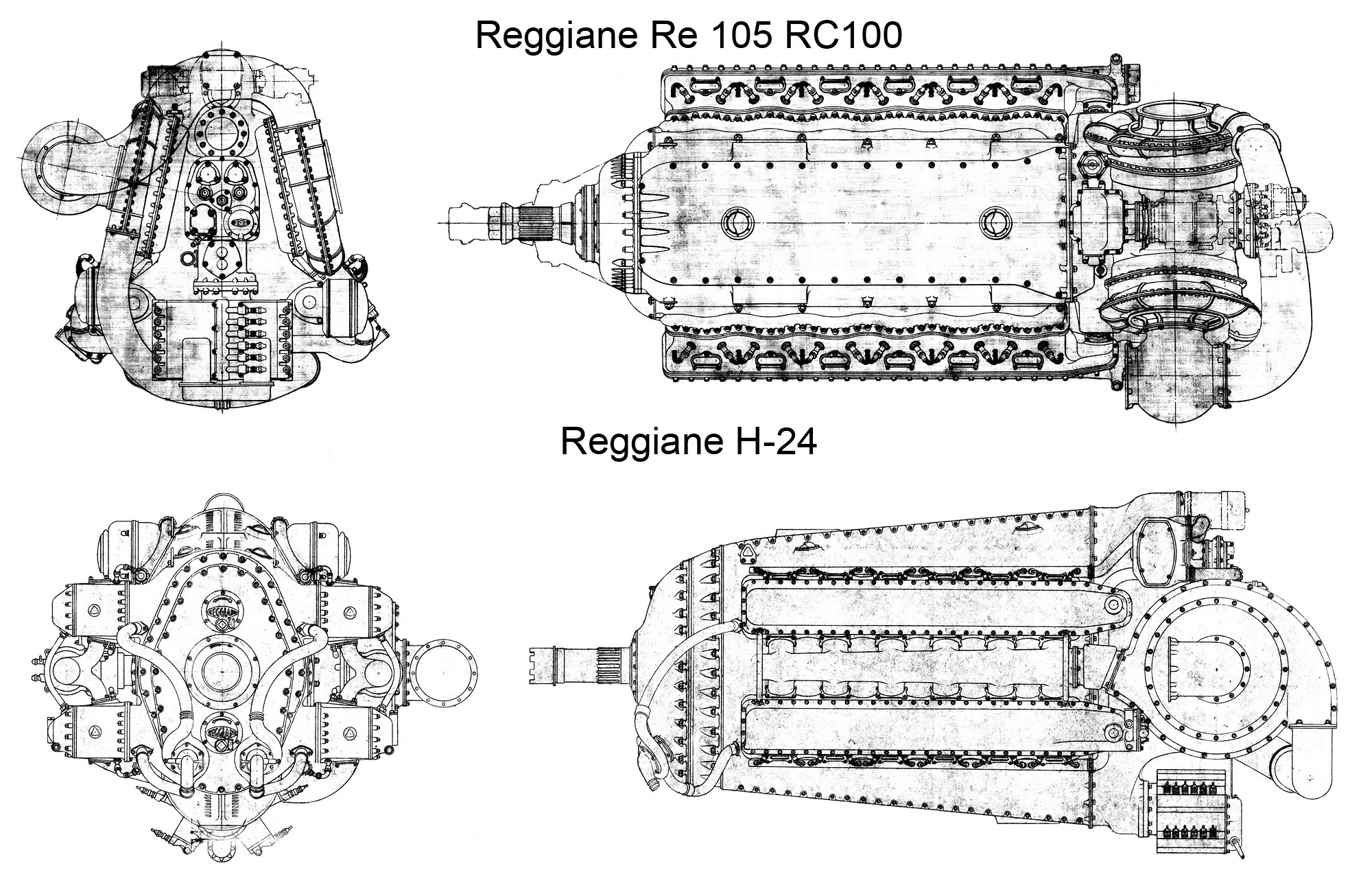
The second design study was for a 24-cylinder engine using four Re 103 cylinder banks in a horizontal H configuration. This design allowed many parts to be interchangeable with the Re 103 engines. Reggiane’s H-24 engine produced 2,200 hp (1,621 kW) at 19,685 ft (6,000 m). If the 24-cylinder engine had the same bore and stroke as the Re 103, it would have had a displacement of 3,247 cu in (53.2 L). The last engine under study was a two-stroke diesel of unknown specifics. The H-24 and the diesel did not progress beyond the initial design.

Reggiane Re 105 RC100 and H-24

Top—rear and top views of the Re 105 RC100 engine. Note the two-stage supercharger arrangement. The outline around the front of the engine was for a proposed long gear reduction that added 6 in (.15 m) to the engine’s length. Bottom—front and side views of the H-24 engine. Note the crankshafts rotated clockwise (when viewed from the rear), and the propeller shaft rotated counterclockwise, just like the Re 103 and Re 105 engines.

At least two Re 103 engines were built, and most likely they were both Re 103 RC50 I engines, but development was slow. Construction had also begun on the Re 105 RC100 I. Italy’s surrender on 8 September 1943 brought an end to all of Reggiane’s engine programs. After the surrender, Reggiane’s northern factories were under German control and manufactured parts for the Daimler-Benz DB 605 and other engines. The Germans were not interested in the Re 103 or other Reggiane engines, and developmental activity was not continued.

*Italian aircraft engine naming convention varies by source. As an example, the punctuation, capitalization, and spacing of the Re 101 RC50 I designation can vary and still refer to the same engine, as in RE-101R.C.50 I or Re.L 101 R.C. 50 I.

Reggiane RE 2005

The Reggiane RE 2005 fighter was a potential candidate to be powered by the Re 103 engine. Only about 48 examples of the aircraft were built, and they were powered by the 1,475 hp (1,100 kW) FIAT RA 1050 RC58 I (licensed-built Daimler-Benz DB 605).

Sources:
I Reggiane dall’ A alla Z by Sergio Govi (1985)
– “I Motori Alle Reggiane” by Adriano and Paolo Riatti, Associazione Amici del Corni (March 2013)
The Caproni-Reggiane Fighters 1938-1945 by Piero Prato (1969)
https://it.wikipedia.org/wiki/Reggiane_RE_103
http://www.webalice.it/paolo.riatti/motori.html

Dobrynin VD-4K CPO Saturn

Dobrynin M-250, VD-3TK, and VD-4K Aircraft Engines

By William Pearce

In early 1939, Soviet authorities sought the design and development of a new aircraft engine rated in excess of 2,000 hp (1,491 kW). Soviet aircraft engine technology was falling behind that of the western powers at the time, and this new engine was intended to close the gap. Gleb S. Skubachevskiy at the Moskovskiy Aviatsionniy Institut (Moscow Aviation Institute or MAI) completed the preliminary design of the new 2,000+ hp (1,490+ kW) engine, and development of a prototype was approved in July 1939. The new engine was given the designation M-250. Vladimir A. Dobrynin was brought in to assist Skubachevskiy on the M-250.

Dobrynin M-250

The six bank, 24-cylinder, 3,111 cu in (51.0 L) M-250 aircraft engine with contra-rotating propeller shafts.

The M-250 was a 24-cylinder, water-cooled engine with six cylinder banks, each with four cylinders. The inline cylinder banks were spaced radially around the crankcase at 60 degree intervals, giving the engine an inline radial configuration. One cylinder bank extended horizontally from the crankcase on each side of the engine. A hexagon was formed by connecting the outer points of the six cylinder banks, making the M-250 part of the hexagonal engine family. Other hexagonal engines include the Curtiss H-1640 Chieftain, the Wright H-2120, the SNCM 137, and the Junkers Jumo 222. The M-250 employed a master/articulating connecting rod arrangement as used in a typical radial engine. The engine had a single-stage, three-speed supercharger mounted at its rear. A carbureted version of the engine was built along with a direct fuel injected version. The engine had a compression ratio of 6.2 to 1.

Each cylinder bank had a single overhead camshaft that was driven by a vertical shaft at the front of the bank. Intake and exhaust manifolding occupied the space between alternating cylinder banks, and the spark plugs were located in the intake Vee. At the front of the engine, the crankshaft drove contra-rotating propeller shafts via a reduction gearing. The M-250 had a 5.5 in (140 mm) bore and a 5.4 in (138 mm) stroke. The total displacement from the 24-cylinder engine was 3,111 cu in (51.0 L), and the engine weighed 2,822 lb (1,280 kg). The M-250 produced 2,200 to 2,500 hp (1,640 to 1,864 kW).

Dobrynin VD-3TK

The M-250 was developed into the 3,628 cu in (59.5 L), 3.500 hp (2,610 kW) Dobrynin VD-3TK.

Dobrynin was sent to Voronezh, Russia to assist with the M-250’s construction and testing while Skubachevskiy remained at the MAI. The M-250 was first run on 22 June 1941. However, the M-250 development team was evacuated from Voronezh in October 1941 because of advancing German troops. Skubachevskiy was also evacuated from the MAI in Moscow and was no longer involved with the M-250 as a result. After the evacuation from Voronezh, the M-250 design team and the manufacturing team were split, which caused long delays in further engine testing and the completion of additional prototypes.

M-250 development and testing was continued at what later became OKB-36 (Opytno-Konstruktorskoye Byuro-36 or Experimental Design Bureau-36) in Rybinsk, Russia. However, the M-250 engine program was never able to fully recover after the evacuation, and the project was cancelled on 25 June 1946. A total of 10 M-250 prototype engines were built. The M-250 engine was proposed for use in several projects: a version of the Ilyushin Il-2 Sturmovik attack aircraft, an undesignated Yakovlev heavy fighter, the Alekseyev I-218 attack aircraft, and an undesignated Alekseyev fighter. However, none of these projects progressed beyond the drawing board, and the M-250 was never installed in any aircraft.

Tu-4LL Dobrynin VD-3TK

A Tupolev Tu-4LL testbed with a contra-rotating Dobrynin VD-3TK engine installed in each outer position. The LL in the aircraft’s designation stood for “letayushchaya laboratoriya,” which means flying laboratory.

While at OKB-36 and under Dobrynin’s supervision, A. L. Dynkin developed the M-251TK from the M-250. Compared to the M-250, the M-251TK had a larger bore and stroke, a higher compression ratio of 6.6 to 1, and strengthened internal components. In addition, the engine was fitted with fuel injection, a single-speed supercharger, and two turbosuperchargers. Two versions of the M-251TK were developed—one with a standard propeller shaft and one with contra-rotating propeller shafts.

After the M-250 was cancelled, the M-251TK was approved for prototype manufacture in late 1946 and was first run in August 1947. The M-251TK passed various certification tests throughout 1948, including 50 and 100 hour tests. The engine was approved for manufacture in January 1949 as the VD-3TK. The VD-3TK had a 5.8 in (148 mm) bore and a 5.7 in (144 mm) stroke. The engine’s total displacement was 3,628 cu in (59.5 L), and it weighed 3,351 lb (1,520 kg). The VD-3TK had a takeoff rating of 3,500 hp (2,610 kW) and a continuous rating of 2,500 hp (1,864 kW).

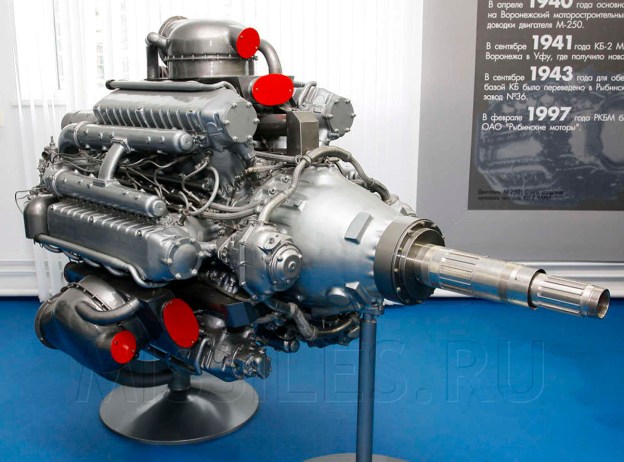
Dobrynin VD-4K CPO Saturn

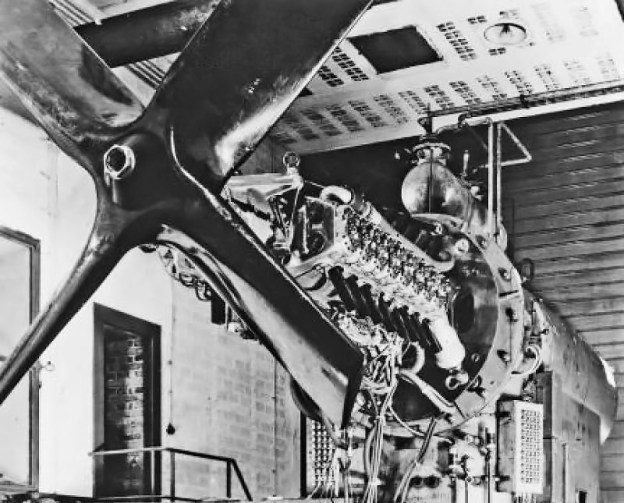
The restored Dobrynin VD-4K engine preserved at the CPO Saturn facility in Rybinsk, Russia. The power recovery turbines are mounted in the exhaust Vees of the engine. The red plates cover inlets through which air flowed to cool the units. The 4,300 hp (3,207 kW) VD-4K represented the pinnacle of piston-engine development in the Soviet Union. (www.missiles.ru image)

In the first half of 1950, VD-3TK engines were test-flown in the outboard positions on a Tupolev Tu-4 bomber. The engine was also proposed for the Alekseyev Sh-218 attack aircraft, which was never built. The VD-3TK did not enter series production, and only 34 engines were made.

In 1949, Dobrynin’s team at OKB-36 had begun further engine development, this time based on the M-251TK. The intent was to create an engine with improved fuel economy to be used for a new long range, strategic bomber. The new engine was known as the M-253K, and its development proceeded under chief designer P. A. Kolesov. Along with other modifications, the engine’s compression ratio was raised to 7.0 to 1, and three power recovery turbines were installed in the exhaust Vees. These turbines would recover energy from the exhaust gases and feed that power back to the engine’s crankshaft. The two turbosuperchargers used with the M-251TK engine were replaced by a single, large unit that incorporated an adjustable jet outlet to harness thrust from the exhaust gases.

Tupolev Tu-85

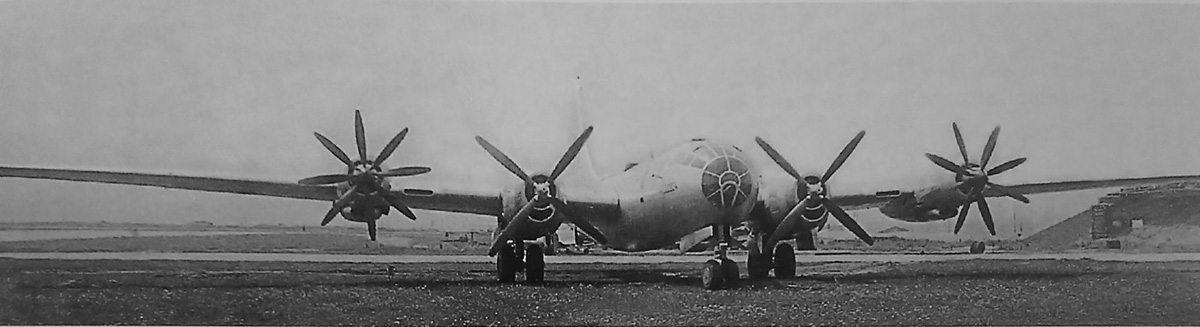
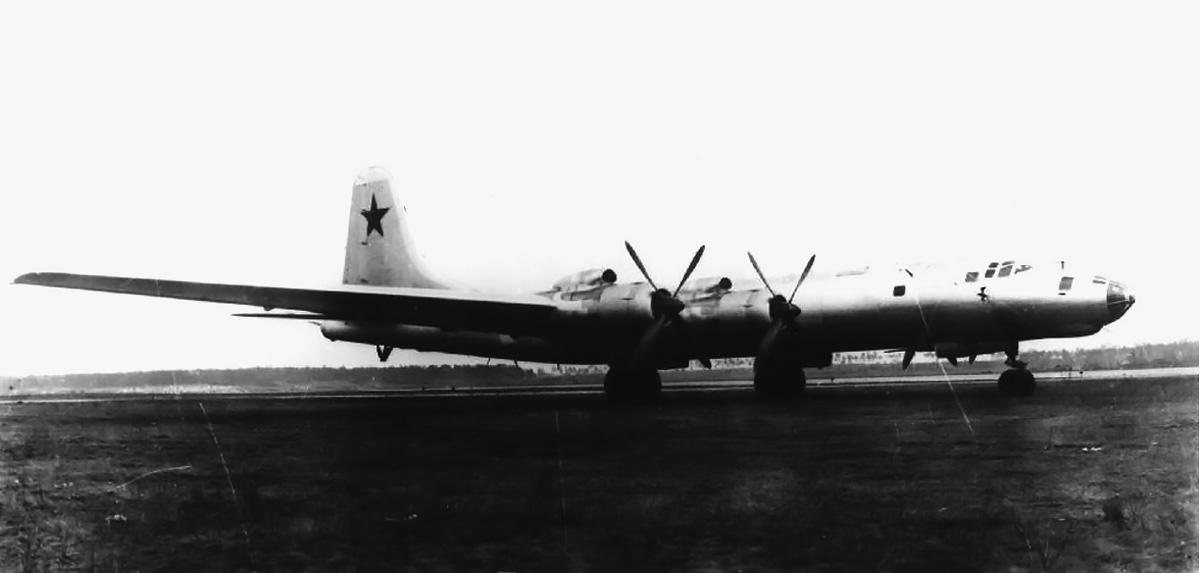
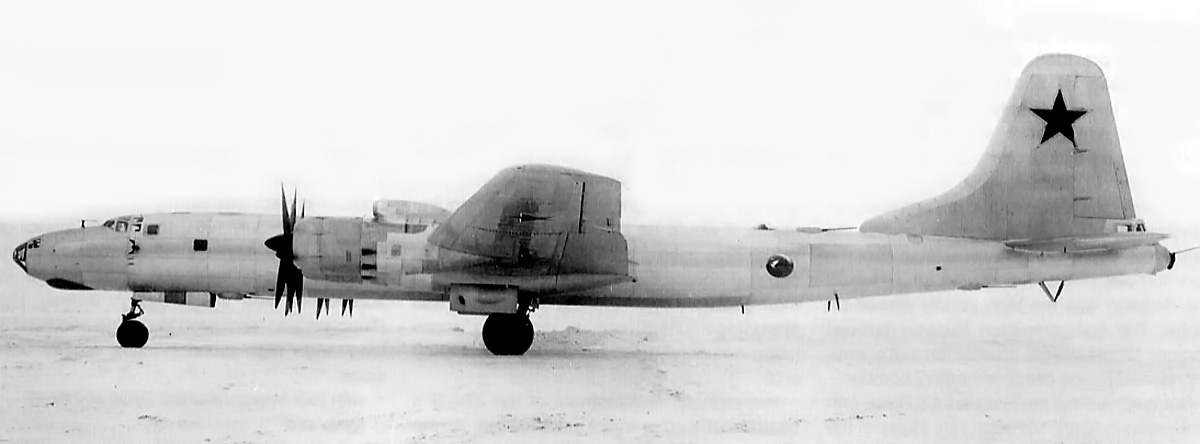
The Tupolev Tu-85 strategic bomber was the only aircraft powered by VD-4K engines. The engines and aircraft preformed well, but the future lay with turboprop and jet engines. Note the turbosupercharger housing above each engine nacelle.

The first M-253K was completed in January 1950. Prototype engines were tested and developed throughout 1950. During this time, test engines passed 50 and 100 hour tests and were flown as the No. 3 engine on a Tu-4. Twenty-three engines were built and given the designation VD-4K. While the VD-4K had the same bore and stroke as the VD-3TK, the VD-4K produced a lot more power. The engine had a takeoff rating of 4,300 hp (3,207 kW) at 2,900 rpm and a continuous rating of 3,800 hp (2,834 kW) at 2,700 rpm. The VD-4K was fuel injected and achieved a specific fuel consumption of .408 lb/hp/hr (284 g/kW/hr) at cruse power. The engine was 63 in (1.6 m) in diameter, 119 in (3.0 m) long, and weighed 4,552 lb (2,065 kg). The turbosupercharger weighed an additional 485 lb (220 kg).

VD-4K engines were installed in Tupolev’s new strategic bomber, the Tu-85. The Tu-85 was ordered in 1949 and made its first flight on 9 January 1951—Aleksei Perelyot was at the controls. The Tu-85 had a 183.5 ft (55.9 m) wingspan and was 130.9 ft (39.9 m) long. The aircraft had a maximum speed of 396 mph (638 km/h) at 32,810 ft (10,000 m). Designed to counter the long-range Convair B-36 Peacemaker, the Tu-85 could deliver 11,000 lb (1,000 kg) of bombs 7,580 mi (12,300 km) or carry 44,000 lb (20,000 kg) of bombs.

Dobrynin VD-4K

A diagram showing the VD-4K’s installation in the Tu-85 and its intake and exhaust paths. Note the cooling fan and how air is diverted from the turbosupercharger inlet to flow through an aftercooler.

In the Tu-85, an annular radiator was installed around the front of the VD-4K engine. An axillary fan was added behind the spinner to increase the flow of cooling air, but it appears no other major improvements were needed. The turbosupercharger for the VD-4K engine was positioned on top of the nacelle, and the engine exhaust flowed back over the wing. Incoming air to the engine was compressed by the turbosupercharger, flowed through an aftercooler, and was then delivered to the engine.

While the Tu-85 and its VD-4K engines achieved excellent test results, the Tupolev Tu-95 “Bear” strategic turboprop bomber was under development and showed greater promise than the Tu-85. As a result, development of the Tu-85 and the VD-4K engine was stopped. Both Tu-85 prototypes were later scrapped.

The VD-4K was the last piston engine developed by Dobrynin and OKB-36; their efforts shifted to designing and building turbojets engines. A VD-4K engine is preserved at the NPO Saturn (former OKB-36) facility in Rybinsk.

Tupolev Tu-85 side

With its impressive range and payload, the Tu-85 was one of the most capable piston-engine bombers ever built. Because of the transition to turbine engines, the Tu-85 was outclassed and never went into production.

Sources:
Russian Piston Aero Engines by Vladimir Kotelnikov (2005)
Unflown Wings by Yefim Gordon and Sergey Komissarov (2013)
Soviet and Russian Testbed Aircraft by Yefim Gordon and Dmitriy Komissarov (2011)
Tupolev Aircraft since 1922 by Bill Gunston (1995)
http://www.redov.ru/transport_i_aviacija/aviacija_i_kosmonavtika_1997_07/p3.php

KHD Dz 710 test stand crop

Klöckner-Humboldt-Deutz (KHD) Dz 700, Dz 710, and Dz 720

By William Pearce

The German engine manufacturer Deutz AG can trace its roots back to the inventor of the four-stroke internal combustion engine, Nicolaus Otto. Gottlieb Daimler, Wilhelm Maybach, Rudolf Diesel, Robert Bosch, and Ettore Bugatti all worked for progenitors of Deutz at one time or another. In 1935, the company, then known as Humboldt-Deutz, was commissioned by the RLM (Reichsluftfahrtministerium or German Ministry of Aviation) to develop experimental two-stroke diesel engines.

KHD Dz 700 front

The eight-cylinder KHD Dz 700 two-stroke diesel before the engine was returned to Germany. Note the manifolds in between the cylinders for the incoming fresh air and the exhaust ports on the front of the cylinders. (Joe Gertler/Memaerobilia image)

This new line of engines was, in part, to compete with Junkers’ Jumo two-stroke diesels. The Junkers engines used two opposed pistons in the same cylinder which moved toward each other for the compression stroke. These pistons also covered and uncovered the intake and exhaust ports. Dr. Ing (Engineer) Adolf Schnürle, who was employed by Humboldt-Deutz, had earlier developed a new method for two-stroke cylinder porting. Schnürle’s method became known as Schnürle porting (or Schnuerle porting) and used reverse loop scavenging. In the cylinder, the exhaust port was positioned in between and slightly higher than the two intake ports. When the piston uncovered the ports, the charge of fresh air would enter and flow to the back of the cylinder. The fresh air would then reverse direction and push all remaining gases out the exhaust port. Being higher on the cylinder, the exhaust port was uncovered longer than the intake ports; this allowed the incoming fresh air charge to fully evacuate the exhaust gases from the cylinder.

Schnürle was put in charge of the new Humboldt-Deutz diesel engine project. Preliminary tests were conducted in Cologne, Germany on small single-cylinder and two-cylinder engines. In 1937, the Dz 700 was built. It was an eight-cylinder, two-stroke, air-cooled, diesel engine. The engine had a 3.15 in (80 mm) bore and a 3.94 in (100 mm) stroke, giving a total displacement of 245 cu in (4.0 L). The Dz 700 produced 158 hp (118 kW) at 2,800 rpm. The Dz 700 had a diameter of around 38 in (1 m) and weighed only around 120 lb (55 kg). A blower (weak supercharger) forced air through manifolds in between and then into the cylinders. Utilizing Schnürle porting, the two intake ports were positioned slightly lower in the cylinder than the two exhaust ports, and all were covered and uncovered by the piston.

KHD Dz 710 side

The 16-cylinder KHD Dz 710 two-stroke diesel. Note the blower at the end of the engine with the coolant pump below and the fuel injection pumps under the engine.

In 1938, a six-cylinder engine was designed for use in training aircraft. A merger occurred in 1939, and the company became Klöckner-Humboldt-Deutz (KHD). The diesel engine projects were relocated to Oberursel, Germany. Shortly after, development of the six-cylinder engine and the Dz 700, which was then under tests, was abandoned. With the start of World War II, the RLM was interested in engines of higher power.

In 1939, Schnürle began work on the Dz 710—a 16-cylinder, liquid-cooled, engine. The original design was a fuel injected, spark ignition engine, but the design was developed into a two-stroke diesel. The Dz 710 was a horizontally opposed (or boxer/flat) engine with two banks of eight cylinders. Again, the cylinders were equipped with Schnürle’s reverse loop scavenge porting, but the system was doubled with four intake ports and two exhaust ports for each cylinder. The intake ports were 2.02 in (51.2 mm) tall and the exhaust ports were 2.65 in (67.2 mm) tall. Intake air came through a blower geared to the crankshaft at the rear of the engine that charged the air to 7.4 psi (.51 bar). The air then flowed through passageways into both sides of the cylinders. Exhaust gases were expelled both above and below the cylinder banks.

KHD Dz 710 test stand

The horizontally opposed 16-cylinder KHD Dz 710 engine on a test stand in Oberursel, Germany. Note the exhaust pipes both above and below the cylinder bank.

The Dz 710 had a bore and stroke of 6.30 in (160 mm), giving a total displacement of 3,141 cu in (51.5 L). Direct fuel injection at 400 psi (27.58 bar) was used, and the compression ratio was 15 to 1. The engine also had a 0.4 to 1 propeller gear reduction. Recorded dimensions for the Dz 710 were a length of 94.5 in (2.40 m), a width of 53.1 in (1.35 m), and an estimated height of 39.4 in (1.00 m). The engine weighed 2,866 lb (1,300 kg).

Completed in 1943, the Dz 710 had a planned output of around 2,700 hp (2,013 kW), but development and testing was delayed by other war priorities; KHD was involved in the production of diesel truck engines. Two Dz 710 engines were built with a third partially completed. In 1944, a Dz 710 test engine achieved 2,360 hp (1,760 kW) at 2,700 rpm, and both engines had accumulated a total of about 150 hours of operation. A very good specific fuel consumption of 0.34 lb/hp/hr (207 g/kW/hr) was recorded at cruise power. However, the Dz 710 had trouble with its pistons and ultimately used a bolted steel plate piston crown. In addition, two crankshafts failed due to torsional vibrations.

A turbocharged version of the Dz 710 was planned with an estimated output of 3,060 hp (2,280 kW). Either a mockup or actual parts for the turbocharger installation were built, but it is not clear if this engine ran. The turbocharger would have increased the intake air pressure to 23.5 psi (1.6 bar).

KHD Dz 720 front

The 32-cylinder KHD Dz 720 was quite literally two Dz 710 stacked on top of each other with the upper engine inverted. This arrangement formed an H-32 engine with an estimated max output of 5,900 hp (4,400 kW) with turbocharging.

By 1944, in the quest for more power, the two Dz 710 engines were stacked to form the Dz 720 (KHD actually referred to this engine as the Dz 710 P2). This 32-cylinder H engine had a displacement of 6,282 cu in (102.9 L). The turbocharged H-32 had an estimated output of 5,900 hp (4,400 kW) while the engine blower version was forecasted to produce 4,600 hp (3,430 kW). With a .3125 to 1 gear reduction for a single propeller, the engine was originally intended for use in large, long-range aircraft. However, the German Navy showed interest in utilizing it for high-speed boats. While the Dz 720 should have similar length and width as the Dz 710, the actual recorded dimensions were a length of 106.3 in (2.70 m), a width of 65.0 in (1.65 m), and an estimated height of 78.7 in (2.00 m). Perhaps the extra 11.8 in (0.3 m) length of the Dz 720 incorporated a combining gear converting the two Dz 710 power sections to a single output shaft. Dz 720’s weight was documented as 5,732 lb (2,600 kg) with engine blowers and 6,393 lb (2,900 kg) for the  turbocharged version.

Schnürle was very committed to the Dz 710 engine. At the end of World War II, he made it clear to the Army Air Force that he was willing to go to the United States with his engines and continue their research and development. While the Dz 700 and the two Dz 710 engines were taken to the United States, it was not for Schnürle to continue their development. The ultimate disposition of the Dz 710 engines has not been found, but the eight-cylinder Dz 700 radial engine ended up in a private collection in Florida. Around 1998, it was purchased by a private collector in Germany and returned to that country.

KHD Dz 720 side

Side view of the KHD Dz 720. Note the spacer placed in between the Dz 710 power sections to provide clearance for the blowers on the left of the image. The Dz 720 was a very tall engine which would have made installation in an aircraft difficult.

The Historical Society of the Motorenfabrik Oberursel is looking for any information regarding the KHD Dz 710 engines and their disposition in the United States. Please click here for details and contact information (PDF file).

Sources:
– Correspondence with Helmut Hujer, Motorenfabrik Oberursel Historian
– Correspondence with Joe Gertler of Memaerobilia and The Raceway Collection
Flugmotoren und Strahltriebwerke by von Gersdorff, Schubert, and Ebert (2007)
The Development of Piston Aero Engines by Bill Gunston (1993/2001)
Jane’s All the World’s Aircraft 1945-46 by Leonard Bridgman (1946)
http://www.secretprojects.co.uk/forum/index.php?topic=5288.0
http://www.gkmo.net/
http://en.wikipedia.org/wiki/Schnuerle_porting
http://www.ibiblio.org/pub/academic/history/marshall/military/airforce/engines.txt
http://en.wikipedia.org/wiki/Deutz_AG

Wright Aeronautical R-4090 Cyclone 22 Aircraft Engine

By William Pearce

In the early 1940s, Wright Aeronautical decided to utilize their 18-cylinder R-3350 engine as the basis for a new engine to compete with the Pratt & Whitney R-4360. The new engine developed by Wright was the R-4090 Cyclone 22 (Wright model no. 792C22AA). It used 22 R-3350 cylinders arranged in two rows of 11 cylinders. The R-4090 is one of only a few radial engines with 11 cylinders per row. It is also one of only three 22-cylinder aircraft engines ever built.

The 22-Cylinder Wright R-4090 engine. (Aircraft Engine Historical Society image)

The 22-Cylinder Wright R-4090 engine of 3,000 hp (2,237 kW). (Aircraft Engine Historical Society image)

The air-cooled Wright R-4090 had a 6.125 in (155.6 mm) bore and 6.3125 in (160.3 mm) stroke. Total displacement was 4,092 cu in (67.05 L) and the engine’s compression ratio was 6.85 to 1. The Cyclone 22 had a two-speed, single-stage supercharger and gave 3,000 hp (2,237 kW) at 2,800 rpm for takeoff. For continuous output, the engine produced 2,400 hp (1,790 kW) at 2,600 rpm. However, increased performance was expected with further engine development. The R-4090 had a diameter of 58 in (1.47 m), was 91 in long (2.31 m), and weighed 3,230 lb (1,465 kg).

The crankcase was a steel forging, following a construction practice pioneered by Wright and used on other Cyclone engines. The three-piece crankshaft was built up through the two one-piece master connecting rods. Ten articulating rods were attached to each master rod. Each cylinder was constructed in typical Wright fashion and had 3,900 sq in (2.52 sq m) of cooling fin area. Each cylinder’s hemispherical combustion chamber had two valves; the exhaust valve was sodium-cooled. It appears that the .333 to 1 propeller gear reduction was provided by Wright’s standard, multi-pinion planetary gear system. The supercharger and accessory drive section was very similar to that used on the R-3350 engine. However, the supercharger had a 14 in (356 mm) impeller and gear ratios of 5 to 1 and 7 to 1.

Front of view of the Cyclone 22 showing the 22 R-3350 cylinders tightly packed around the forged steel crankcase. (Aircraft Engine Historical Society image)

Front of view of the Cyclone 22 showing the 22 R-3350 cylinders tightly packed around the forged steel crankcase. (Aircraft Engine Historical Society image)

The R-4090 possessed similar power and weight characteristics to early Pratt & Whitney R-4360 engines. While developing the Cyclone 22, Wright was preoccupied with serious developmental issues of the very high priority R-3350 engine and ongoing development of the 42-cylinder R-2160 Tornado; not much time or manpower remained for the R-4090. As a result, only a few examples of the Cyclone 22 were built, and it is doubtful that the engine ever flew. Perhaps three R-4090 engines were completed: two XR-4090-1 engines with a single propeller shaft and one XR-4090-3 engine with a coaxial shaft for contra-rotating propellers. The XR-4090-3 weighed an additional 30 lb (13.6 kg) for a total of 3,260 lb (1,478 kg). In addition, the XR-4090-3 was to have a two-speed nose case to maximize propeller and engine speed efficiency for maximum power and cruise power. Ultimately, the R-4090 Cyclone 22 was abandoned so that more resources could be used for the R-3350 Cyclone 18.

Radial engines with 11-cylinder per row are very rare. With so many cylinders, the engine diameter becomes very large, and the valve train can be crowded and complex. In addition, difficulties can arise with so many power pulses on each crankpin.

The R-4090 was very close to the same power and weight as the Pratt & Whitney R-4360 at this stage of development.(Aircraft Engine Historical Society image)

The R-4090 was very close to the same power and weight as the Pratt & Whitney R-4360 at this stage of development. (Aircraft Engine Historical Society image)

During World War I, Clerget developed an 11-cylinder rotary engine of 200 hp (149 kW), designated the 11E. Another World War I-era 11-cylinder rotary of 200 hp (149 kW) was developed by Siemens-Halske and designated the Sh.III. The Sh.III was unusual in that its crankshaft rotated one direction within the engine while the crankcase, with propeller attached, rotated in the opposite direction. The result was 1,800 rpm of engine speed with only 900 rpm of propeller speed—an ideal speed in the days of fixed-pitch propellers and no gear reduction. Far removed from aviation, Nordberg Manufacturing Company made a successful 11-cylinder, two-stroke, diesel, stationary, radial engine of 1,655 hp (1,234 kW) at 400 rpm for industrial use.

Other examples of 22-cylinder, twin-row radial engines include the Mitsubishi A21 (Ha-50), with a displacement of 4,033 cu in (66.1 L) and an output of 2,600 hp (1,939 kW) and the Hitachi/Nakajima [Ha-51], with a displacement of 2,673 cu in (43.8 L) and an output of 2,450 hp (1,827 kW). Both of these engines were developed by the Japanese during World War II and, like the Wright R-4090, never entered production. Clerget also studied a 22-cylinder engine between the wars, but it never progressed beyond the design phase.

Rear view of the R-4090 showing the suppercharger and accessory section that appears to be the same as that found on the R-3350. (Aircraft Engine Historical Society image)

Rear view of the R-4090 showing the supercharger and accessory drive section which is very similar to that found on the R-3350. (Aircraft Engine Historical Society image)

Sources:
http://www.enginehistory.org/Piston/Wright/R-4090/Curtiss-WrightR-4090.shtml
Allied Aircraft Piston Engines of World War II by Graham White (1995)
R-4360: Pratt & Whitney’s Major Miracle by Graham White (2006)
http://www.ww2aircraft.net/forum/engines/11-22-cylinders-radials-33342.html
Model Designation of U.S.A.F. Aircraft Engines (1950)
The Wright Cyclones by Wright Aeronautical Corporation (1942)

Rolls-Royce Exe (Boreas) and Pennine Aircraft Engines

By William Pearce

Arthur Rowledge was one of the most prolific designers of piston aircraft engine in history. In 1913 he joined Napier & Son where he designed the firm’s first aircraft engine, the Lion, in 1917. This engine went on to achieve great success and was even used during World War II, but Rowledge moved on to Rolls-Royce (R-R) in 1921. While at R-R, Rowledge was very involved with the Condor III, Kestrel, “R” Schneider, and Merlin engines. Rowledge also designed the air-cooled and sleeve-valve Exe and Pennine engines. These two engines were quite a departure from standard R-R practice and never made it to production status.

Side view of the Rolls-Royce Exe engine. The cylinder baffling in the image is of a simple construction when compare to the other engine image below. It appears to be the same baffling as seen on the engine installed in the Battle.

In the 1930s Rowledge became seriously ill and took a leave from R-R. During his recovery, R-R decided not to bring him back to the main engine development programs but to give him complete control of designing a new engine. This new engine was based on a 1,000 hp (746 kW) requirement from the Fleet Air Arm for shipboard aircraft use where air-cooling was preferred. The new engine was sanctioned in February 1935 and originally called Boreas, but the name was later changed to Exe.

The Exe engine had four banks of six cylinders in an X configuration. Each bank was 90 degrees from the next. The cylinders had a 4.225 in (107.3 mm) bore and 4.0 in (101.6 mm) stroke, for a total displacement of 1,346 cu in (22.1 L). The Exe had a two-speed, single-stage supercharger, and the compression ratio was 8 to 1. The engine weighed 1,530 lb (694 kg). The two spark plugs for each cylinder were fired by coil ignition rather than standard magnetos. A 0.358 gear reduction to the propeller was achieved through spur gears; their arrangement elevated the propeller shaft centerline above the crankshaft.

Clear view of the Rolls-Royce Exe and the baffling around each cylinder to direct air for proper cooling. The baffling appears to be an updated version compared to the image above. Also note how the spur reduction gear has elevated the propeller thrust line.

The sleeve-valves, undoubtedly inspired by Harry Ricardo, followed the established Burt-McCollum/Bristol practice. Each cylinder barrel had three intake ports and two exhaust ports. The sleeve itself had only four ports, one was shared as an intake and exhaust port. The drive cranks for the sleeve valves were driven via spiral gears from a shaft that ran along each side of the engine. A.A. Rubbra states that these shafts were driven from the propeller gear reduction. The single sleeve for each cylinder was sealed by the use of a junk head. The entire system proved to be quite reliable.

The connecting rods consisted of one master rod and three articulating rods. The big end was essentially a square with the master rod extending from one corner and the three articulated rods attached to each of the other corners. The big end was split and bolted together around the crankshaft via four bolts.

A specialized pressure air-cooling method was used. Cooling air entered the engine cowling below the spinner. The air was then fed into the upper and lower Vees. Baffles attached to the individual cylinders caught and directed the air through the cylinder’s cooling fins. The air passed from the upper and lower Vees into the side Vees and exited toward the rear of the engine cowling. Reportedly, the arrangement worked very well with minimal drag and no cooling issues. Induction manifolds delivered the air/fuel mixture to the cylinders through the top and bottom Vees. Exhaust from the cylinders was collected in manifolds on the side Vees.

A great image of the Exe installed in the Battle with the cowling removed. Note early version of the cylinder baffling.

The Exe was originally rated at 920 hp (686 kW) at 3,800 rpm. The engine was first run in September 1936, and it had completed a 40-hour development test by the end of 1937. The Exe first took to the air in a modified Fairey Battle (K9222) on 30 November 1938. This particular aircraft was owned by R-R and was modified at the R-R Flight Development Establishment at Hucknell. Exe engine development continued with very little trouble; however, the engine did suffer from excessive oil consumption. Ultimately the engine’s output was increased to 1,200 hp (895 kW) at 4,200 rpm, and continued development to 1,500 hp (1,119 kW) was planned.

A liquid-cooled version of the engine was also studied. A four cylinder test engine representing an X configuration was run in 1938. Each cylinder of the test engine had its own steel water jacket. The program progressed, and a complete liquid-cooled X-24 engine was built; this engine featured normal cast aluminum cylinder blocks with integral water jackets. Reportedly, this engine was run and tested but never flew.

Rolls-Royce Exe installed in Fairey Battle K9222. Note the cooling air intake under the spinner and exit by the exhaust stacks. The Exe-powered Battle continued to fly long after the engine was cancelled.

The Exe was originally intended to power the Fairey Barracuda torpedo-bomber and the production Fairey F.C.1 four-engine transport. With the start of World War II, top priority was given to developing and producing Merlin and Griffon engines. Ernest Hives, R-R General Works Manager, estimated that building 275 Exe engines would be the production equivalent of 1,200 Merlins. At his request, work on the Exe program was suspended in September 1939 and stopped completely by 1941. Development was also discontinued on the liquid-cooled engine. The Barracuda was switched to Merlin power, and the F.C.1 was never built.

As an indicator of the engine’s sound design and reliability, the Exe-powered Battle continued to fly until 1943, long after the Exe program was cancelled. In addition, R-R’s Exe-powered Battle flew at higher speeds than the standard Merlin-powered Battles.

The encouraging results from the Exe compelled a small design team to continue work on the air-cooled, sleeve-valve engine concept. Around June 1943, design work was accepted on what was essentially an enlarged Exe. The new engine project was known as the Pennine and was headed by Dr. Sprinto Viale.

Rolls-Royce Pennine engine shown without any exhaust stacks or spark plug leads. The cylinders look very similar to those used by Bristol. The ring of studs around the propeller shaft is where the annular cooling fan would attach.

The Pennine had the same layout as the Exe, with the exception of the propeller gear reduction. Rather than spur gears, which would raise the propeller shaft as on the Exe, the Pennine used epicyclic (planetary) gears that allowed the propeller shaft to be in-line with the crankshaft. A propeller gear reduction of .3 or .4 was used. In addition, an annular cooling fan was driven from the gear reduction at 1.03 times crankshaft speed. Illustrations done by Lyndon Jones show the drive shafts for the sleeve valves geared to the rear of the crankshaft rather than to the gear reduction. It is possible this deviation from the Exe’s design was a result of the aforementioned changes to the gear reduction. Design work on the engine was completed by September 1944.

Another change from the Exe that can be seen in the Jones illustration was the connecting rod arrangement. Rather than having a split big end, the Pennine utilized a one piece master connecting rod with three articulated rods. The crankshaft’s crankpins were bolted together through the one piece master rods.

The Pennine engine had a 5.4 in (137.2 mm) bore and 5.08 in (129 mm) stroke, giving a total displacement of 2,792 cu in (45.8 L); this was over twice the displacement of the Exe. With a dry weight of 2,850 lb (1,293 kg), the Pennine was 106 in (2.69 m) long, 37.5 in (.95 m) tall, and 39 in (.99 m) wide. The engine was equipped with a single stage, two speed supercharger that provided 12 psi (.83 bar) of boost at takeoff and combat power settings. The Pennine developed 2,750 hp (2,051 kW) at 3,500 rpm at sea-level and up to 2,800 hp (2,088 kW) under combat settings. A reliable 3,000 hp (2,237 kW) was thought to be easily obtainable with further development.

Pennine sectional view from Sectioned Drawings of Piston Aero Engines* by Lyndon Jones. Note the annular fan and sleeve valve drives.

Only one or two Pennine test engines were built; the first was finished on 31 December 1944. The engine was run on teststands during 1945, and an engine cowling was developed to maximize the efficiently of the pressurized air-cooling. While the engine ran well, the end of piston-powered military aircraft and civil airliners was on the horizon, with piston engines being supplanted by jet engines. Possible applications for the Pennine engine were the Fairey Spearfish torpedo bomber and the Miles X.11 airliner. Ultimately, the Spearfish was powered by a Bristol Centaurus. The Miles aircraft lost out to the Bristol Brabazon and was never built. Development of the Pennine was stopped in mid to late 1945.

A further engine study was made where two 16-cylinder power sections (using Pennine cylinders) of an X configuration were attached to a common crankcase. This arrangement made an X-32 engine and was known as the Snowden. A shaft from the midsection, between the two X-16 power sections, was to travel forward along the top and bottom Vees of the engine to a gear reduction that drove half of a coaxial contra-rotating propeller unit. This engine would have displaced 3,723 cu in (61.0 L) and produced 4,000 hp (2,983 kW). Some testing was done, but a complete engine was never built.

Rear view of the Pennine engine and cowling. Note the baffling for each individual cylinder and the circular front of the cowling for the annular cooling fan..

Sources:
Rolls-Royce Piston Aero Engines — A Designer Remembers by A.A. Rubbra (1990)*
Rolls-Royce Aero Engines by Bill Gunston (1989)
British Piston Aero Engines and their Aircraft by Alec Lumsden (1994/2003)
Major Piston Engines of World War II by Victor Bingham (1998/2001)
Allied Aircraft Piston Engines of World War II by Graham White (1995)
Sectioned Drawings of Piston Aero Engines by Lyndon Jones (1995)*
Rolls-Royce — Hives, the Quiet Tiger by Alec Harvey-Bailey (1985)
http://www.secretprojects.co.uk/forum/index.php?topic=5375.0
– “Rolls-Royce and the Sleeve Valve” by Phil Kennedy, New Zealand Rolls-Royce & Bentley Club Inc, Issue 07-3 2007 (pdf)
http://en.wikipedia.org/wiki/Arthur_Rowledge

*Rolls-Royce Heritage Trust books that are currently in print and available from the Rolls-Royce Heritage Trust site.