Category Archives: World War II

CAC CA-15

Commonwealth Aircraft Corporation CA-15 ‘Kangaroo’

By William Pearce

In July 1942, Australia’s Commonwealth Aircraft Corporation (CAC) endeavored to improve the performance of their CA-12 (and CA-13) Boomerang fighter by installing a 1,700 hp (1,268 kW) Wright R-2600 engine in place of the 1,200 hp (895 kW) Pratt & Whitney (P&W) R-1830. However, the needed modifications to the Boomerang airframe proved to be too substantial. Since the need for an improved fighter was still pressing, CAC embarked to design an entirely new aircraft in November 1942. This new fighter aircraft was designated CA-15.
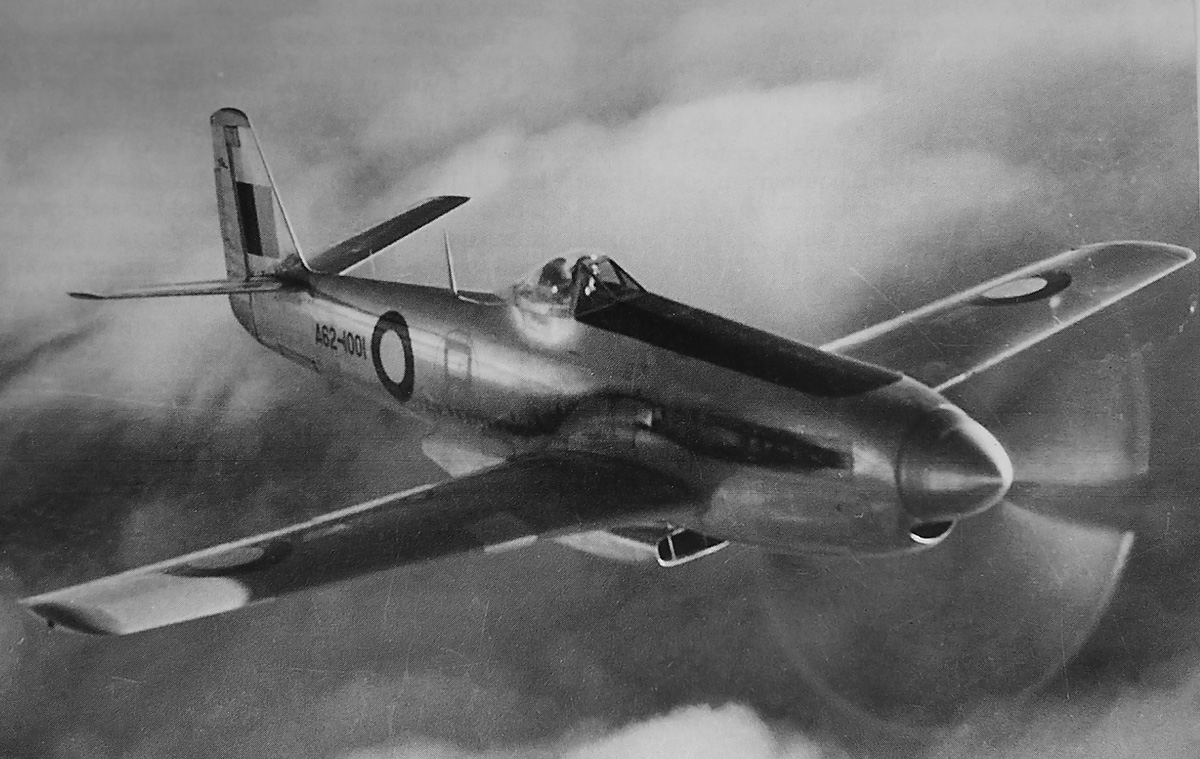
CAC CA-15 flight

The impressive Commonwealth Aircraft Corporation CA-15 on a test flight. Note the patches on the wings that replaced the gun ports for the .50 cal machine guns.

The preliminary design of the CAC CA-15 incorporated a Pratt & Whitney R-2800 engine, and the aircraft somewhat resembled a cross between a Boomerang and a Focke-Wulf Fw 190A. As the design was developed, the CA-15 changed to resemble a Hawker Tempest II with squared-off wings and tail, but with a General Electric (GE) C turbosupercharger installed in the rear fuselage, similar to the Republic P-47 Thunderbolt.

By mid-1943, a redesign was needed because the proposed power plant, the 2,000 hp (1,491 kW) R-2800-21, was not available. CAC selected the 2,200 hp (1,641 kW) R-2800-10W with a two-stage, two-speed supercharger as the new engine. With the engine change, the turbosupercharger was deleted, and a water-cooled intercooler was added in a large fairing under the engine. A geared cooling fan would help draw air in through the tight-fitting cowling. By December 1943, the R-2800-10W-powered CA-15 was estimated to have a maximum speed of 365 mph (587 km/h) at sea level, 436 mph (702 km/h) at 25,000 ft (7,620 m), and an initial climb rate of 4,200 fpm (21.3 m/s).

CAC CA-15 R-2800-21

The Pratt & Whitney R-2800-21-powered CA-15, with cutaway to show the fuselage fuel tank. The turbosupercharger installation in the rear fuselage is not visible. In this early 1943 drawing, the CA-15 has a passing resemblance to the Hawker Tempest II.

The switch to the R-2800-10W engine also shifted the CA-15’s area of maximum performance from high altitude to low/medium altitude. At the time, CAC had obtained a license to produce the North American P-51D Mustang as the CA-17 and CA-18; CA-17s would be assembled from parts, and CA-18s would be CAC-produced aircraft. Lawrence Wackett, CAC’s General Manager, envisioned the CA-17/CA-18 filling the high altitude fighter role and the CA-15 covering low and mid altitudes. From mid-1943, CAC was focused on CA-17 assembly and CA-18 production, and progress on the CA-15 slowed as a result.

With many components for the prototype CA-15 under construction, CAC was disappointed to learn in May 1944 that the R-2800-10W was no longer in production. CAC found a suitable replacement in the form of the 2,800 hp (2,088 kW) R-2800-57. With this engine change, the CA-15 was back to incorporating a turbosupercharger—now a GE CH-5 housed in a deeper fairing under the engine. The R-2800-57-powered CA-15 was estimated to have a maximum speed of 400 mph (644 km/h) at sea level, 480 mph (772 km/h) at 28,000 ft (8,534 m), and an initial climb rate of 5,700 fpm (29.0 m/s).

CAC CA-15 R-2800-57

A mid-1944 drawing of the CA-15 powered by a R-2800-57 engine. While the top view of the aircraft has not changed much, the bulky fairing under the engine has been added to house the intercooler and turbosupercharger.

By August 1944, the CA-15 prototype was around 50 percent complete. It was at this time that CAC was informed that supplies of the R-2800-57 could not be guaranteed. CAC again looked for an engine suitable for the CA-15 fighter. CAC found a new engine in the Griffon 125, then being developed by Rolls-Royce (R-R). The water-cooled Griffon 125 had a two-stage, three-speed supercharger and turned a single rotation propeller. The engine was capable of producing 2,440 hp (1,820 kW). A redesign of the CA-15 cowling was completed, and a scoop to house radiators for the engine coolant and oil was incorporated under the aircraft. With these changes, the CA-15 resembled a P-51D Mustang, but the resemblance was coincidental. The Griffon 125-powered CA-15 was estimated to have a maximum speed of 405 mph (652 km/h) at sea level, 467 mph (752 km/h) at 18,000 ft (5,487 m), and 495 mph (797 km/h) at 26,500 ft (8,077 m). The initial climb rate dropped slightly to 5,500 fpm (27.9 m/s).

Unfortunately, the Australian War Cabinet cancelled the CA-15 in September 1944. However, CAC continued work on the CA-15 at a reduced pace while it worked with the War Cabinet to reinstate the program. This was done in December, pending the approval of the Aircraft Advisory Committee, which followed in February 1945.

Work on the CA-15 now continued at a quicker pace, but engine issues surfaced again. R-R would not be able to provide a Griffon 125 until late 1945 at the earliest (but probably later). The CA-15 was ready for its engine, and CAC did not want to wait. As a substitute, two 2,035 hp (1,517 kW) Griffon 61s were loaned to CAC, the first being shipped in April 1945. The Griffon 61 had a two-stage, two-speed supercharger. As the CA-15 neared completion in December 1945, R-R informed CAC that the Griffon 125 would not be produced. The CA-15 used the Griffon 61 as its final engine, and the aircraft was completed in early 1946.
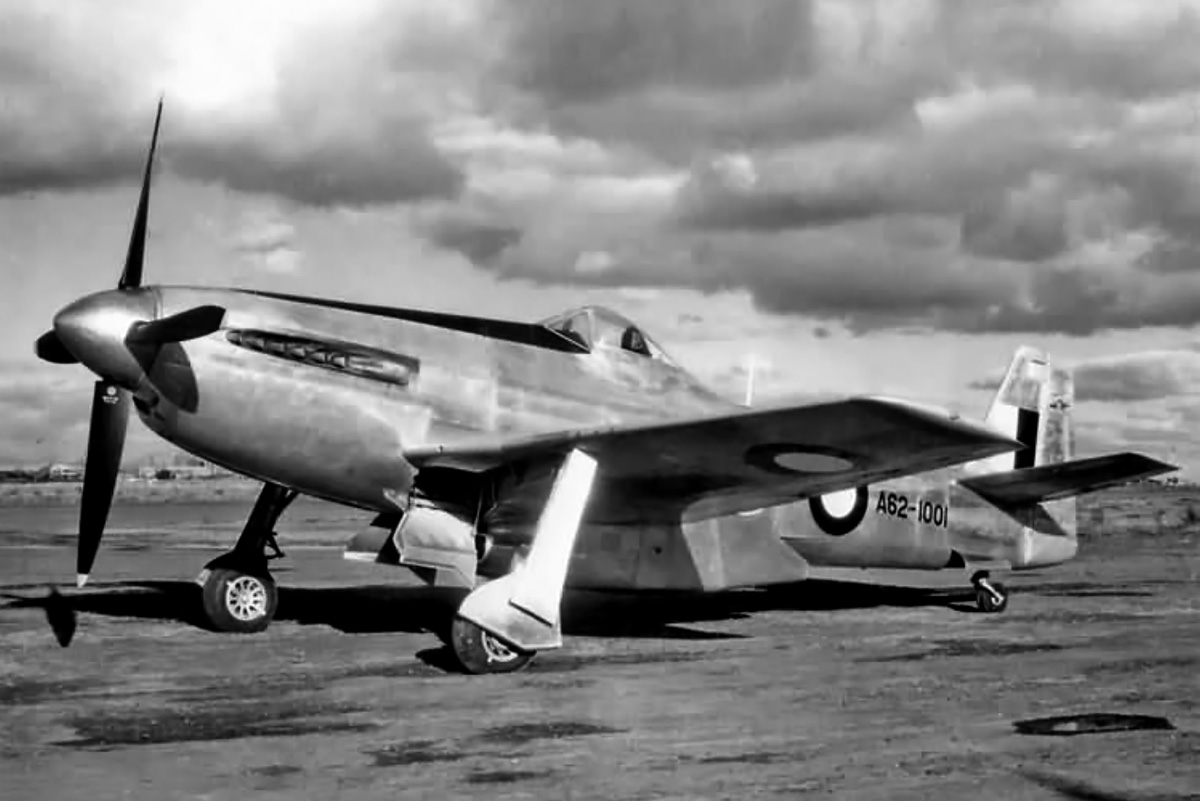
CAC CA-15

The completed CA-15 with its Griffon 61 engine bore a striking resemblance to the P-51D Mustang. However, the aircraft’s general layout changed little from the early 1943 drawing completed before CAC obtained a license for P-51 (CA-17/CA-18) production. Note the recessed engine exhaust stacks for improved aerodynamics.

The CA-15 was an all-metal aircraft of stressed-skin construction. The flaps and fully retractable gear were hydraulically operated. Various offensive armament combinations were considered, including four 20 mm cannons with 140 rpg, but six .50 cal machines guns were ultimately fitted with 250 rpg (various sources, including CAC documents, list 260, 280, or 290 rpg). The guns were not installed until a few months after the aircraft’s first flight. Underwing provisions existed for two 1,000 lb (454 kg) bombs or two 120 gal (100 imp gal / 454 L) drop tanks or 10 rockets.

In its final form, the CA-15 had a 36 ft (11 m) wingspan and was 36 ft 3 in (11 m) long. The aircraft’s internal fuel capacity was 312 gal (260 imp gal / 1,182 L), and it had a maximum range of 2,540 mi (4,088 km) with two drop tanks. The CA-15 weighed 7,540 lb (3,420 kg) empty, 10,764 lb (4,882 kg) with a normal load, and 12,340 lb (5,597 kg) at maximum overload. The Griffon 61-powered CA-15 had a maximum speed of 368 mph (592 km/h) at sea level, 448 mph (721 km/h) at 26,400 ft (8,047 m), and 432 mph (695 km/h) at 32,000 ft (9,754 m). The aircraft’s initial climb rate was 4,900 fpm (24.9 m/s), and it had a ceiling of 39,900 ft (12,162 m). The Griffon engine turned a 12 ft 6 in (3.81 m) diameter Rotol four-blade, wooden, constant-speed propeller. Initially, a 12 ft 1 in (3.68 m) propeller was used, the result of a damaged tip necessitating the blades being cut down. But a full-size propeller was fitted later during the flight test program.

CAC CA-15 side

This photo of the CA-15 illustrates the tailplane’s 10 degrees of dihedral and the relatively good view the pilot had over the nose of the aircraft.

Assigned serial number A62-1001, the CA-15 began taxi tests in February 1946. After a few modifications, the aircraft first flew on 4 March 1946 with Jim Schofield at the controls. The initial test flights went well, although the ailerons were noted as being heavy. Aileron control was improved, and numerous other refinements were made. Throughout the test flights, the CA-15 proved itself as an easy to fly aircraft with excellent performance and very good visibility.

After 16.5 hours of flying time, the CA-15 was handed over to the Royal Australian Air Force (RAAF) Aircraft Performance Unit (APU) No. 1 on 2 July 1946 for further flight testing. While at APU No. 1, the landing gear struts were over-pressurized, causing the CA-15 to bounce badly during taxi tests. The hopping action of the aircraft earned it the unofficial nickname “Kangaroo,” which has lasted over the years. Unfortunately, on 10 December 1946, a test gauge failed and resulted in the loss of all hydraulics. With no flaps and the unlocked gear partially extended, Flt. Lt. Lee Archer was forced to make an emergency landing that damaged the aircraft’s scoop and destroyed the wooden propeller. The failed gauge should have been removed before the aircraft was handed over to the RAAF. At the time, the CA-15 had 43.25 flying hours, and the damage was not too severe. However, with the war over and jets coming into service, there was no possibility of the CA-15 going into production. As a result, repairs to the one-off prototype were slow, after finally being approved in April 1947.

CAC CA-15 taxi

The CA-15 after a test flight. Note the scoop’s partially open cooling air exit flap. The aircraft in the background are most likely CAC-assembled CA-17s (P-51Ds), as the first CA-18 was not completed until 1947 (after the CA-15 was damaged).

CAC had repaired the CA-15’s airframe by October 1947, and the aircraft awaited a new propeller and radiator, which were the responsibility of the RAAF. The radiator was ready by February 1948, and the propeller followed in March. The CA-15 was returned to APU No. 1 on 19 May 1948. Later that month, the CA-15 grabbed headlines by achieving 502 mph (808 km/h) in a test flight over Melbourne, Victoria, Australia on 25 May 1948. This speed was recorded after Flt. Lt. Archer had leveled off at 5,000 ft (1,524 m) following a modest dive from 9,000 ft (2,743 m).

By February 1950, R-R wanted the two Griffon 61 engines back. In addition, there was no inventory of spare parts or any practical reason to continue flight testing of the CA-15. The engine was removed, and the CA-15 was scrapped, bringing an end to the highest performance aircraft ever designed and built in Australia.

CAC CA-15 rear

The CA-15 “Kangaroo” was a powerful fighter with performance rivaling that of the best piston-powered aircraft. Sadly, it was built too late for action in World War II and at a time when jet aircraft were the undeniable future.

Sources:
Wirraway, Boomerang & CA-15 in Australian Service by Stewart Wilson (1991)
Wirraway to Hornet by Brian L Hill (1998)
– “Commonwealth CA-15: The ‘Kangaroo’ Fighter” by David Donald Wings of Fame Volume 4 (1996)
R-2800: Pratt & Whitney’s Dependable Masterpiece by Graham White (2001)
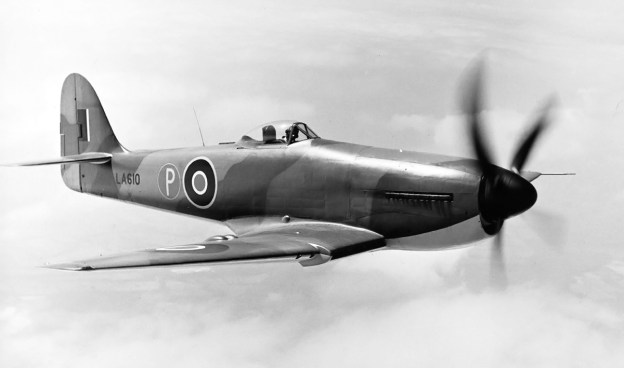
Hawker Fury Sabre LA610

Hawker Fury I (Sabre-Powered) Fighter

By William Pearce

While testing of the Tempest prototypes was still underway in 1942, the Hawker design team began to study ways to improve and lighten the fighter aircraft. Some of their ideas were influenced by the study of a German Focke-Wulf Fw 190 A-3 that had inadvertently landed in Britain in June 1942. The Fw 190 proved smaller and lighter that its Hawker-built contemporaries. In September 1942, the British Air Ministry issued Specification F.6/42 calling for a new fighter aircraft. Hawker proposed three versions of its improved Tempest, each to be powered by a different engine: the V-12 Rolls-Royce Griffon, the 18-cylinder Bristol Centaurus radial, and the H-24 Napier Sabre.

Hawker Fury Sabre LA610

The Napier Sabre-powered Hawker Fury LA610 in-flight exhibiting exactly what a high-performance aircraft should look like.

The Air Ministry supported Hawker’s designs under Specification F.2/43 issued in February 1943. In April 1943, Specification N.7/43 was issued for a new Navy fighter. Sydney Camm, Hawker’s chief designer, felt that arresting gear and folding wings could be added to the “improved Tempest” design to make it meet the requirements laid out in N.7/43. This plan was approved, and Specification N.22/43 was issued to Hawker for the new Navy fighter. Around this time, the two new Hawker aircraft received their official names: Fury (for the Royal Air Force’s land-based version) and Sea Fury (for the Fleet Air Arm’s naval version).

From the beginning, the preferred power plants were the Napier Sabre for the Fury and the Bristol Centaurs for the Sea Fury. Although the detailed design drawings for the Sabre-powered Fury were finished first, developmental delays of the new Sabre VII (NS.93/SM) engine resulted in the Centaurus- and Griffon-powered Furys being completed first. The Centaurus-powered Fury (NX798) first flew on 1 September 1944 followed by the Griffon-powered Fury (LA610) on 27 November 1944.

Hawker Fury Griffon LA610

The Hawker Fury LA610 originally flew with a Griffon engine and contra-rotating propellers. The large duct under the spinner housed the radiator, similar to that used on the Tempest V and VI.

Although the Air Ministry ordered 200 Sabre-powered Fury I aircraft in August 1944, there were rumors that Sabre production would be shut down following the war’s end. In October 1944, the Ministry of Aircraft Production (MAP) assured Hawker that Sabre production would continue. In November 1944, the MAP requested a Sabre-powered Fury prototype be built utilizing the Griffon-powered LA610 airframe. However, in February 1945 the Fury I order was reduced by 50 aircraft to 150. But in March 1945, two additional Sabre-powered prototypes (VP207 and VP213) were requested. Work to install a Sabre engine in LA610 began in July 1945. With the war over and the future of fighting aircraft pointing toward jet power, orders for the Fury I were reduced again in September 1945 to 120 units.

In December 1945, the Air Ministry had informed Hawker that ground attack would be the Fury I’s primary role. Hawker felt the aircraft was not suited for this because of its liquid-cooled engine, and it did not have the armor needed for a ground attacker. As a result, in February 1946, the number of Furys on order was further reduced to 60—and even those were in jeopardy. During this time, modifications of the LA610 airframe had been completed, but the Sabre VII engine was not ready. Rather than wait for the engine, a Sabre VA (2,600 hp / 1,939 kW) was substituted. Soon, a Sabre VII was installed, and Fury LA610 was flown for the first time with its intended power plant on 3 April 1946.

Hawker Tempest I HM599 flight

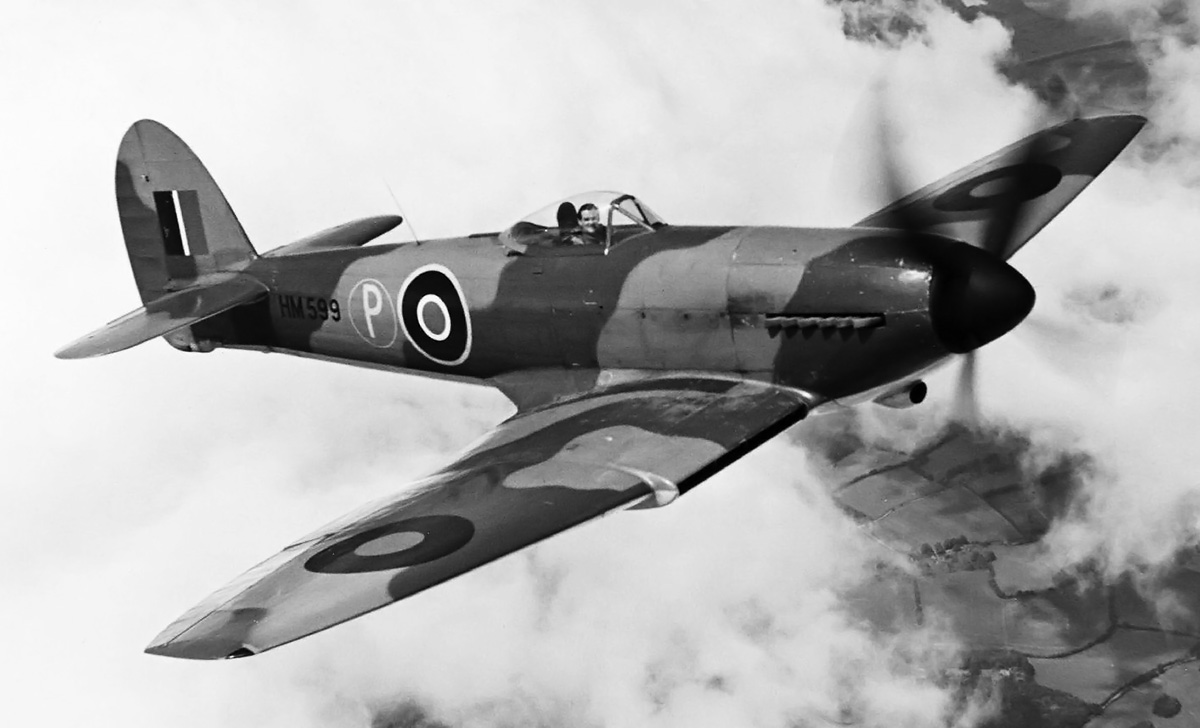
The Hawker Tempest I (HM599), with its close-fitting cowl and wing radiators, was a stepping stone to the Fury I.

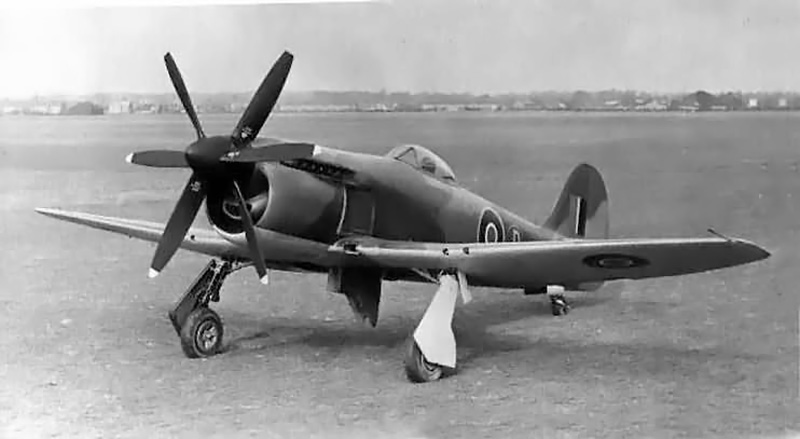
While the rest of the aircraft remained the same as the other prototypes, the power section of LA610 was completely different. A streamlined cowling was installed to cover the liquid-cooled Sabre engine. Coolant radiators were installed in the inboard wing sections, replacing additional fuel tanks. Cooling air would enter the wing’s leading edge, pass through the radiators, and exit via shutters under the wing. This configuration was similar to that used on the sole Tempest I prototype (HM599)—production did not occur because the Air Ministry perceived the wing radiators as too vulnerable to combat damage. The radiator shutters of the Fury I were automatically controlled based on engine temperature. A split duct under the spinner supplied intake air to the engine via the duct’s upper section. Air from the lower duct was directed through engine oil coolers and then out the bottom of the cowling.

Not only was it one of the most beautiful aircraft ever built, the Sabre-powered Fury proved to be the highest performance piston-engine aircraft built by Hawker. The 24-cylinder Napier Sabre engine was a horizontal H layout with two crankshafts. The engine had a 5.0 in (127 mm) bore, 4.75 in (121 mm) stroke, and displaced 2,238 cu in (36.7 L). The Sabre VII utilized water/methanol injection to boost power and was capable of 3,055 hp (2,278 kW) at 3,850 rpm with 17 psi (1.17 bar) of boost. To transfer this power to thrust, the Fury I used a 13 ft 3 in (4.0 m) four-blade Rotol propeller. A five-blade propeller like the Sea Fury’s 12 ft 9 in (3.9 m) Rotol unit was considered, but the decreased weight of the four-blade unit proved decisive in its adoption.

Hawker-Fury-Sabre-LA610-rear

This rear view of the LA610 Fury shows how well the 3,055 hp (2,278 kW) Sabre-engine was fitted to the airframe, enabling the aircraft to exceed 480 mph (775 km/h). Note the large 13 ft 3 in (4.0 m) four-blade propeller.

The Sabre-powered Fury had a top speed of 483 mph (777 km/h) at 18,500 ft (5,639 m) and 422 mph (679 km/h) at sea level. In contrast, the 2,560 hp (1,909 kw) Centaurus-powered Sea Fury had a top speed 460 mph (740 km/h) at 18,000 ft (5,487 m) and 380 mph (612 km/h) at sea level. The Sabre Fury’s initial rate of climb was 5,480 ft/min (27.8 m/s), and it could reach 20,000 ft (6,096 m) in 4.1 minutes. By comparison, The Sea Fury’s initial rate of climb was 4,320 ft/min (21.9 m/s), and it took 5.7 minutes to reach 20,000 ft (6,096 m). The Fury I’s service ceiling was 41,500 ft (12,649 m). All Fury and Sea Fury aircraft had the same 38 ft 5 in (11.7 m) wingspan. At 34 ft 8 in (10.6 m), the Sabre-powered Fury was 1 in (25.4 mm) longer than the Sea Fury. The Fury I had an empty weight of 9,350 lb (4,241 kg) and a loaded weight of 12,120 lb (5,498 kg).

On 14 August 1946, the remaining Fury I aircraft on order were cancelled. Of the three Fury I prototypes, LA610 would remain with Hawker for testing, VP207 would be completed and loaned to Napier for engine testing, and VP213 would be used for parts and not completed. VP207 was chosen to go to Napier because it had a larger radiator that could handle developmental power increases of the Sabre VII engine. With the cancellation of the Fury I there was no longer a need for the Sabre VII engine, and its development was stopped; Napier would not take over VP207. VP207 was completed by Hawker and first flew on 9 May 1947. Hawker retained the aircraft as a company demonstrator for a period of time. The final disposition of LA610 has not been definitively found, but it is believed that the aircraft was scrapped in the late 1940s. VP207 was stored and maintained in Hawker’s facility at Langley Airfield until the mid-1950s, when the aircraft was scrapped.

Hawker Fury Sabre LA610 taxi

Fury LA610 preparing for a flight. The air scoop under the spinner, and the wing radiators can clearly be seen in this image.

Although the Fury never progressed beyond the prototype phase, the Sea Fury did enter production, with some 789 aircraft built (number varies by source)—including prototypes and 61 two-seat T.20 trainers. Sea Furys served in Korea, were the last front-line piston-engine aircraft operated by the Royal Navy Fleet Air Arm, and were sold to and used by various other countries. A number still fly today, but due to the rarity of the Bristol Centaurus engine, many have been re-engined with Wright R-3350s. In addition, two Sea Furys have been built up for racing with Pratt & Whitney R-4360 engines, and one has a Pratt & Whitney R-2800. But none have looked quite as stunning or performed as well (in military trim) as the Napier Sabre-powered Hawker Fury I.

Hawker Fury Sabre VP207

The Sabre-powered Hawker Fury VP207 at the Society of British Aircraft Constructors show at Radlett in September 1947. Some believe the aircraft was painted silver with a red stripe, but the stripe was actually blue. (Robert Archer image via Victor Archer / American Motorsports Coverage)

Sources:
Sea Fury in British, Australian, Canadian & Dutch Service by Tony Buttler (2008)
British Secret Projects Fighters & Bombers 1935-1950 by Tony Buttler (2004)
Jane’s All the World’s Aircraft 1947 by Leonard Bridgman (1947)
Hawker Sea Fury (Warbird Tech Volume 37) by Kev Darling (2002)
RAF Fighters Part 2 by William Green and Gordon Swanborough (1979)
War Planes of the Second World War: Fighters Volume Two by William Green (1961)
Tempest: Hawker’s Outstanding Piston-Engined Fighter by Tony Buttler (2011)
Hawker Typhoon, Tempest and Sea Fury by Kev Darling (2003)
Aircraft Engines of the World 1947 by Paul H. Wilkinson (1947)

Skoda-Kauba V4

Skoda-Kauba V4, SK 257, and V5

By William Pearce

In early 1942, Austrian engineer Otto Kauba had interested the RLM (Reichsluftfahrtministerium or German Ministry of Aviation) in the design of a flying bomb. The RLM founded the Škoda-Kauba Flugzeugbau in German-occupied Prague, Czechoslovakia to produce the aircraft. Kauba was assigned to work out of the Škoda Auto Works, and the aircraft were to be built by the Czech company Avia. Although the flying bomb project was unsuccessful, Škoda-Kauba continued to design a series of small aircraft for the RLM, all of which were built by Avia. His next two designs yielded small and strangely shaped aircraft, but Kauba’s fourth design was a much more refined and sleek aircraft: the V4.

Skoda-Kauba V4

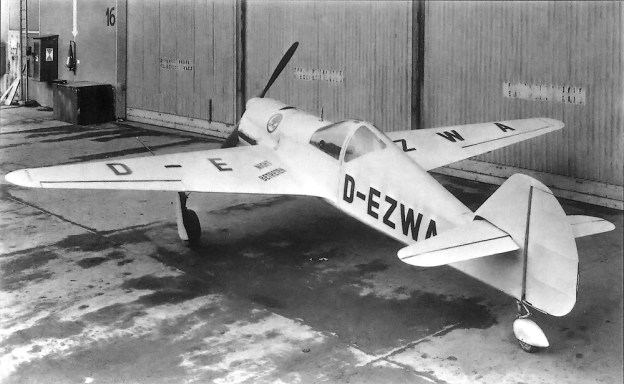
The Argus As 10C-3-powered Škoda-Kauba V4 was a sleek and attractive aircraft. Note the cut-out in the vertical stabilizer that allowed the variable incidence horizontal stabilizer to move.

The Škoda-Kauba V4 was designed to be a single-seat advanced trainer. It was an exceptionally clean low wing aircraft with retractable, wide-track main gear. The V4 employed simple construction and used non-strategic materials, such as steel, wood, and canvas. The wing’s leading edge was swept back and its tubular main spar tapered toward the rounded wingtip. Ribs were welded onto the main spar to form the basic frame of the wing, which was then covered with plywood. The fuselage had a welded steel-tube frame skinned with plywood. The V4 had a variable incidence horizontal stabilizer that was adjusted by the pilot via an electric motor for trim control. The V4 was powered by a 240 hp (179 kW) Argus As 10C-3 inverted, air-cooled, V-8 engine. Provisions were made to mount a single 7.9 mm machine gun.

The V4 had a wingspan of 24 ft 11 in (7.6 m) and a length of 18 ft 4 in (5.6 m). The aircraft’s maximum speed was 261 mph (420 km/h) at altitude and 236 mph (380 km/h) at sea level. Cruising speed was 196 mph (315 km/h). The SK 257’s initial rate of climb was 2,008 ft/min (10.2 m/sec). Its service ceiling was 24,600 ft (7,500 m), and it had a range of 578 miles (930 km). The aircraft weighed 2,249 lb (1,020 kg) empty and 2,756 lb (1,250 kg) loaded.

Skoda-Kauba V4 and SK 257

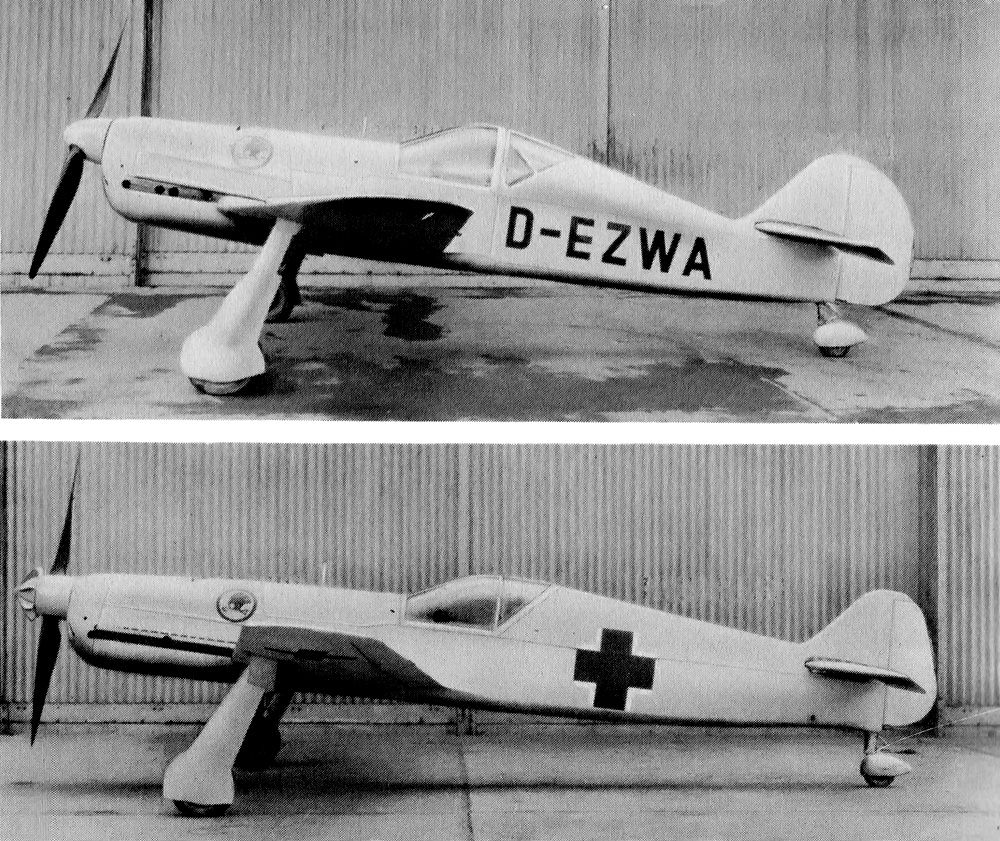
This image gives a good view of the differences between the V4 and the SK 257 prototype. Note the different wing shape and longer Argus As 410 engine and rear fuselage of the SK 257.

The V4, carrying the registration D-EZWA, exhibited good flying characteristics and performance. Since it was constructed from non-strategic materials, the RLM saw the makings of a good aircraft. However, the desire for more power could not be overlooked. The RLM awarded Škoda-Kauba a contract for the development of a more powerful advanced trainer, designated SK 257. The RLM believed the SK 257 would prepare new pilots for the challenging Messerschmitt Bf 109. Four SK 257 prototypes were ordered.

The SK 257 was very similar to the V4, although slightly longer and powered by a larger engine. The SK 257’s engine was an air-cooled, inverted, V-12 Argus As 410 that produced 485 hp (362 kW). Reportedly, the SK 257 had the same 24 ft 11 in (7.6 m) wingspan as the V4, but its wing had square tips and less sweep. At 23 ft 4 in (7.1 m), the SK 257 was 5 ft (1.5 m) longer than the V4. The aircraft had a maximum speed of 217 mph (350 km/h).

Skoda-Kauba SK 257 accident

Two production Škoda-Kauba SK 257 come to grief. Note the different tail and canopy when compared to the prototype and the absence of gear doors.

The four (some say two) SK 257 prototypes were completed and the first flew in 1943. The aircraft displayed excellent handling and performance. Subsequently, The RLM ordered 1,000 SK 257 trainers for the Luftwaffe. This order was quickly reduced to 100 aircraft. The production aircraft were built at Trenčin on the Biskupice airfield in Slovakia. The production SK 257 aircraft had a simplified square tail, whereas the prototypes had a curved tail. After five examples had been built, their construction was judged to be so poor that they did not pass the Luftwaffe quality control inspections, and the entire order was cancelled.

Undeterred, Kauba designed a fighter based on the V4/SK 257 aircraft. This fighter was designated V5 and was to be powered by a 1,750 hp (1,305 kW) Daimler-Benz DB 603 liquid-cooled inverted V-12 engine. The V5 was intended to out-perform the Focke-Wulf Fw 190 with a maximum speed of 475 mph (765 km/h). It would have a 40 ft (12.2 m) wingspan with two 20 mm cannons in each wing, be 32.8 ft (10 m) long, and weigh 9,920 lb (4,500 kg). However, the V5 progressed no further than a series of wind tunnel models and a full-scale mockup. The RLM was focused on other projects and felt the development of an entirely new piston-engine fighter was a waste of time, resources, and effort.

Skoda-Kauba V5 mock-up

The full scale mockup of the Škoda-Kauba V5 fighter. Note the Škoda-Kauba emblem that was also worn by all the prototypes and derived from the Škoda Auto Works emblem.

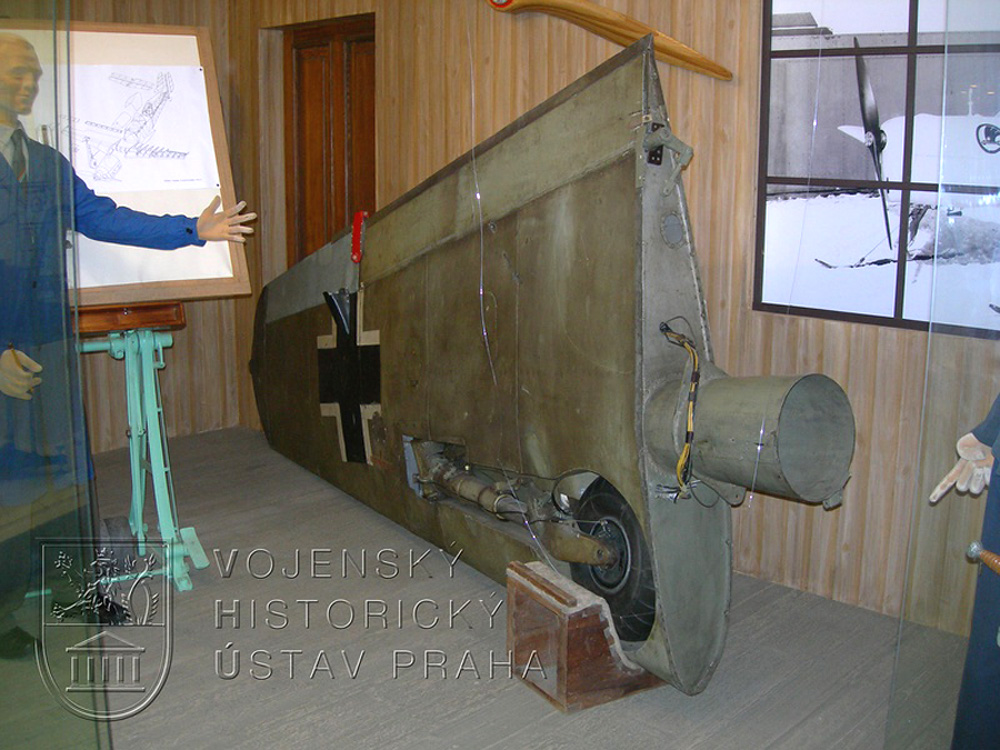
The only surviving piece of Škoda-Kauba’s efforts is the left wing, including landing gear, from a SK 257. This artifact is on display at the Vojenský Historický Ústav (Military History Institute) in Prague.

Skoda-Kauba SK 257 wing VHU

Preserved wing of a Škoda-Kauba SK 257 at Vojenský Historický Ústav in Prague. Note the tapered, tubular main spar protruding from the wing. (Vojenský Historický Ústav image)

Sources:
German Aircraft of the Second World War by J. R. Smith and Antony L. Kay (1972/1992)
Československá Letadla [1] 1918-1945 by Václav Němeček (1983)
http://www.histaviation.com/Skoda-Kauba.html and subpages
http://www.vhu.cz/exhibit/kridlo-z-nemeckeho-cvicneho-letounu-sk-257/

Republic XP-47J front

Republic XP-47J Superbolt Fighter

By William Pearce

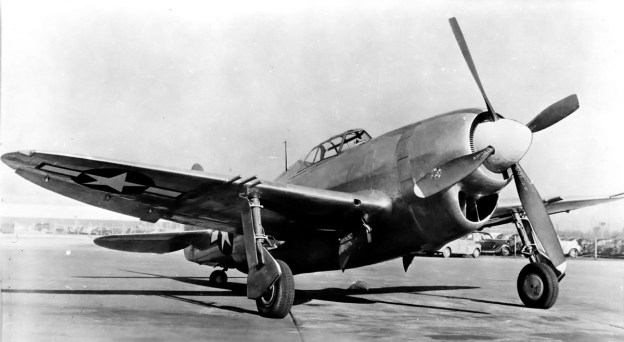
In mid-1942, Republic Aviation Corporation initiated a design study to lighten their P-47 Thunderbolt fighter for improved performance. The Thunderbolt had been steadily gaining weight as the design matured, while comparative enemy aircraft, like the Focke-Wulf FW 190A, were much lighter. Republic officially proposed a light-P-47 to the Army Air Force (AAF) on 22 November 1942. On 1 April 1943, the AAF gave Republic a letter of intent to purchase two light-weight P-47s, and the contract was officially approved on 18 June 1943. This new aircraft was designated the XP-47J.

Republic XP-47J front

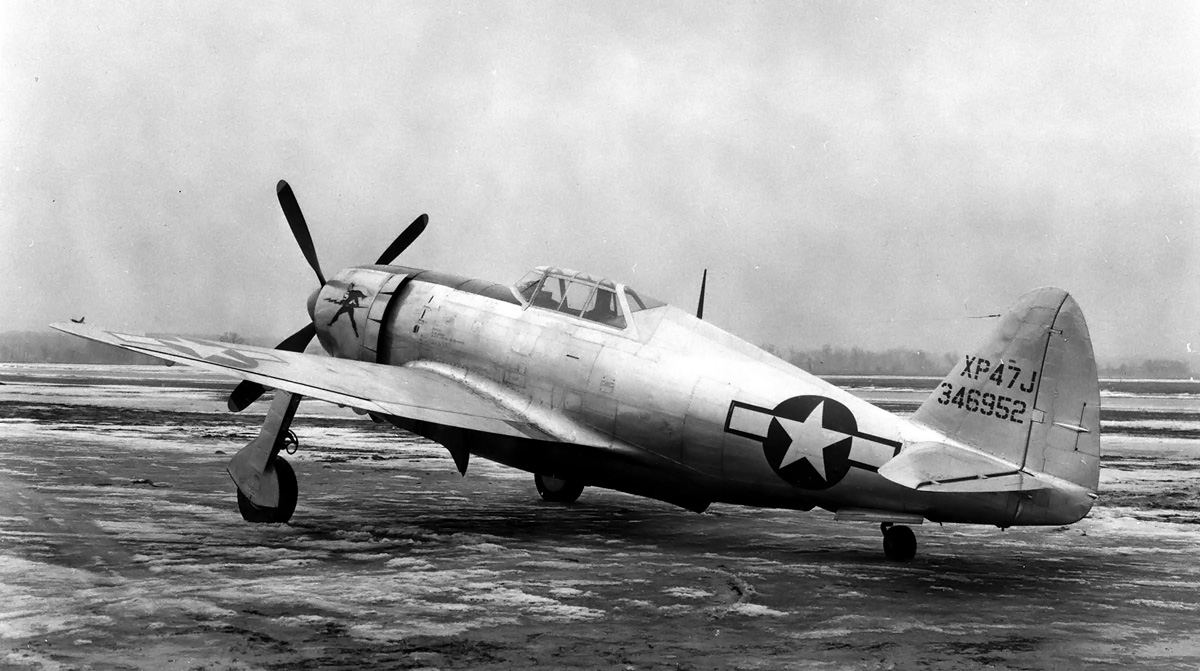
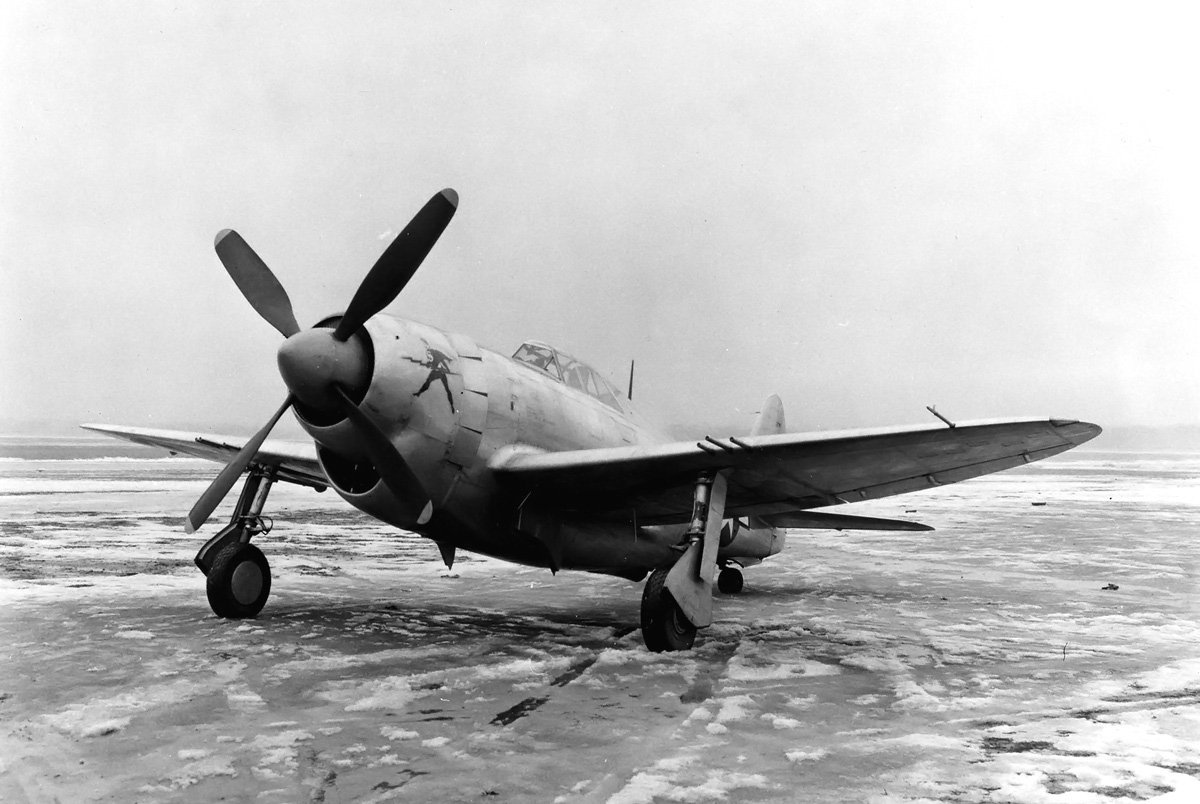
An early image of the Republic XP-47J before the Superman nose art was applied. Note the cooling fan vanes around the spinner inside the cowling.

As with all P-47s, Alexander Kartveli was the main designer of the XP-47J, and he was assisted by Murray Burkow. The XP-47J was similar in appearance to a P-47B, but it was a completely new aircraft. The XP-47J had a close-fitting cowl installed around its Pratt & Whitney (P&W) R-2800 engine of increased power output. A large spinner was added, along with a fan to aid engine cooling. The turbosupercharger’s intake had been refined, and the flow of its exhaust was directed to provide additional thrust. Two of the .50-cal machine guns were deleted (leaving six) in the XP-47J’s lightened wing, and the rounds per gun were reduced to 267. Other weight-saving measures were the omission of radio equipment and the aft fuel tank. To keep the aerodynamics clean, the XP-47J had no provisions for external stores under the wings or fuselage.

Originally, the AAF wanted the XP-47J to have contra-rotating propellers and a bubble canopy, like a late P-47D. To expedite the XP-47J, the decision was made for the first prototype to be a razorback version and the second prototype would include a bubble canopy. The six-blade contra-rotating propeller was test-flown on a P-47B but showed no increase in performance. This, combined with delays at P&W on the R-2800-61 engine with a contra-rotating gear reduction, resulted in the substitution of a R-2800-57 engine with a standard gear reduction. Both the -57 and -61 engines were rated at 2,100 hp (1,566 kW) and had a War Emergency Power (WEP) rating of 2,800 hp (2,088 kW). The -61 engine would be supplied later, when it was available. The engine, cowling, and cooling fan were installed and test flown on a P-47D-15.

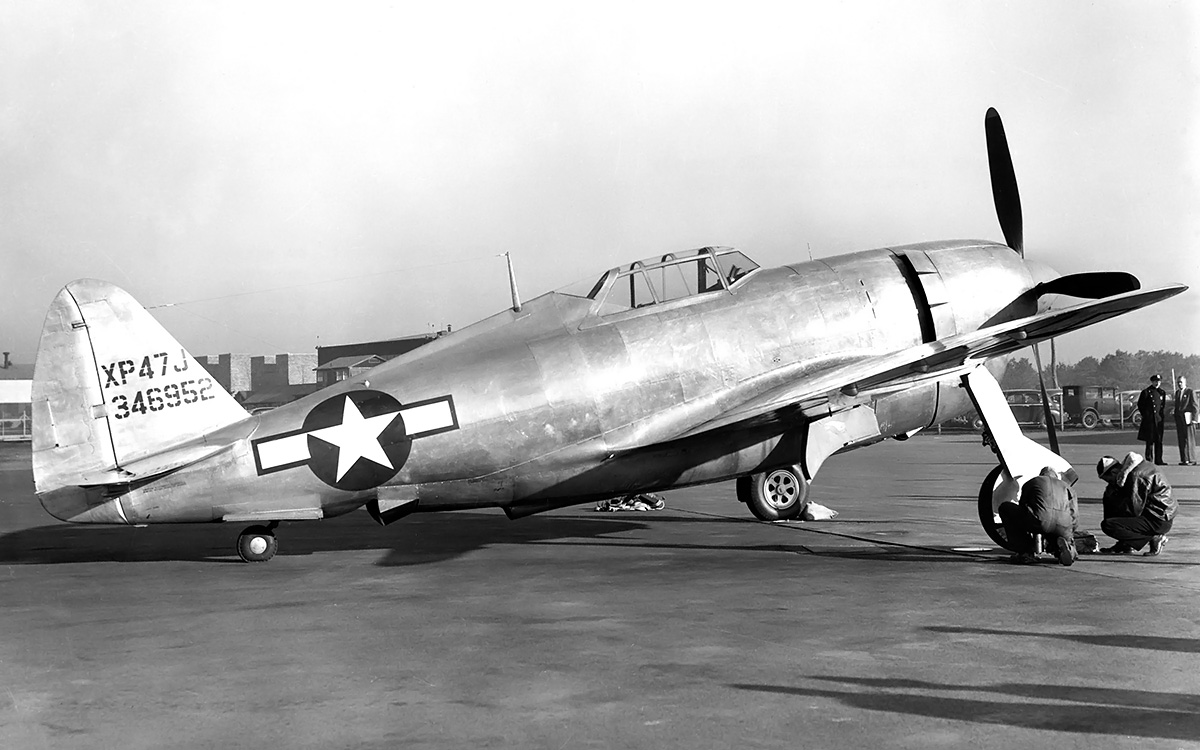
Republic XP-47J right

This side view of the XP-47J reveals its distinct intercooler air and exhaust exits under the rear fuselage.

The XP-47J had a wingspan of 40 ft 10 in (12.4 m) and a length of 33 ft 3 in (10.1 m). The aircraft had an empty weight of 9,663 lb (4,383 kg) and a design gross weight of 12,400 lb (5,625kg). Its service ceiling was 45,000 feet (13,716 m). The XP-47J had a range of 765 mi (1,231 km) at a cruising speed of 400 mph (644 km/h) and a range of 1,070 mi (1,722 km) at optimum cruising speed. Fuel capacity was 287 US gal (1,086 L).

On 31 July 1943, Republic issued a report comparing the estimated performance of the XP-47J with the P&W R-4360-powered XP-72 that was under development. The report concluded that the Republic XP-72 had more potential and recommended resources be focused on that aircraft. In addition, 70% of the P-47 production line needed to be re-tooled in order to produce the P-47J. Republic called for the cancellation of the second XP-47J prototype but encouraged the completion and testing of the first prototype. The AAF approved Republic’s plan and cancelled the second XP-47J.

The sole XP-47J prototype (serial number 43-46952) was completed in mid-November 1943 and made its first flight on the 26th of that month. The aircraft was quickly dubbed Superbolt and wore nose art on both sides of the cowling of Superman holding a lightning bolt. After about 10 hours of flying time, the R-2800-57 engine was making metal and was replaced by another engine of the same type in February 1944.

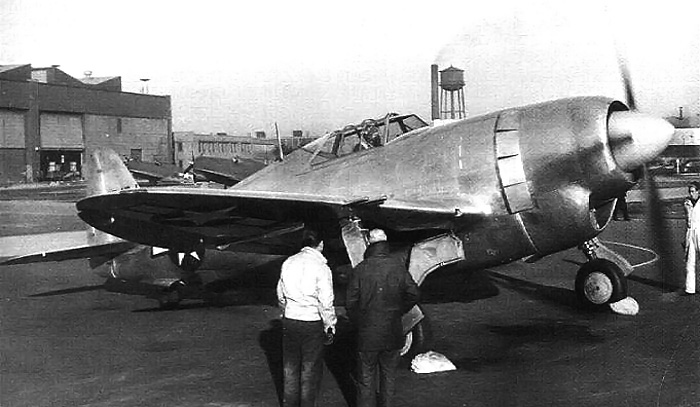
Republic XP-47J run-up

The factory-fresh Superbolt is being run-up outside of Republic’s plant in Farmingdale, New York. Unlike a standard P-47, the intake under the engine was separate and pushed back from the front of the cowling.

A short time later, P&W informed the AAF and Republic that the R-2800-57 engine was not compatible with the 2,800 hp (2,088 kW) WEP rating. A water-injected R-2800-14W was substituted in the XP-47J in April. Water injection is a system that sprays anti-detonation fluid (a mixture of alcohol and water) into the induction system to lower the charge temperature and prevent detonation in the cylinders. This allowed the -14W to produce 2,800 hp (2,088 kW). In March, P&W informed Republic that it was still having difficulty with the R-2800-61’s contra-rotating gear reduction and did not know when the engine would be available. This effectively put an end to the possibility that the XP-47J would have contra-rotating propellers anytime in the near future.

On 11 July 1944 and equipped with a General Electric CH-3 turbosupercharger, the XP-47J achieved 493 mph (793 km/h) at 33,350 feet (10,165 m). Although the engine was producing 2,800 hp (2,088 kW), Republic believed the aircraft had more potential. At its own expense, Republic installed a CH-5 turbosupercharger and a larger 13 ft (3.96 m) Curtiss propeller. The propeller was an experimental unit with 2 in (51 mm) added to its trailing edge to increase its width. With the changes, the engine producing 2,730 hp (2,036 kW), and 400 lb (1.78 kN) of jet thrust from the exhaust, Mike Ritchie flew the XP-47J over a calibrated course at 34,450 (10,500 m) feet on 4 August 1944* and achieved 505 mph (813 km/h). This is the highest speed recorded in level flight by any propeller-driven aircraft during World War II.

Republic XP-47J rear

The Republic XP-47J, now with the Superman nose art. Some differences from a standard P-47 are the additional plexiglass panel behind the pilot and the lack of intercooler exhaust doors on the sides of the rear fuselage.

The XP-47J was handed over to AAF and arrived at Wright Field, Ohio on 9 December 1944. During flight tests, the AAF was unable to get maximum power from the R-2800 engine. The AAF recorded a speed of only 484 mph (779 km/h) at 25,350 feet (7,727 m) and with the engine producing 2,770 hp (2,066 kW). Near the end of flight testing, the exhaust manifold system had a serious failure while the aircraft was at 36,000 ft (10,943 m). The cause of the failure was the increase in pressure and temperature from the CH-5 turbosupercharger acting upon the unstrengthened exhaust system. The Official Performance Summary report states the XP-47J had a max speed of 507 mph (816 km/h) and a 4,900 fpm (24.9 m/s) initial rate of climb. Republic’s Test Report No. 51 (27 January 1945) lists the max speed as 502 mph (808 km/h).

While the XP-47J Superbolt had remarkable performance, it was overshadowed by other aircraft, like the XP-72, that were under development. Work on the XP-72, which first flew on 2 February 1944, was not far behind that of the XP-47J, but as the war progressed and with the advent of jet fighters, neither aircraft were needed.

*Mike Ritchie’s report recording the 505 mph (813 km/h) speed was dated 5 August 1944, but it is believed the flight actually occurred on 4 August 1944.

Republic XP-47J front left

The six wing guns are evident in this image of the 500+ mph Republic XP-47J Superbolt.

Sources:
Republic’s P-47 Thunderbolt by Warren M. Bodie (1994)
US Army Air Force Fighters Part 2 by William Green and Gordon Swanborough (1978)
R-2800: Pratt & Whitney’s Dependable Masterpiece by Graham White (2001)
The American Fighter by Enzo Angelucci and Peter Bowers (1985/1987)
– “500-Mph. P-47 Disclosed by AAF” Aviation News (29 October 1945)
http://www.joebaugher.com/usaf_fighters/p47_9.html

Mitsubishi Ki-83 side

Mitsubishi Ki-83 Heavy Fighter

By William Pearce

In May 1943, the Japanese Army Air Force issued a specification for a high altitude, long range heavy fighter. Led by Tomio Kubo, a team at Mitsubishi began to design the single-engine Ki-73 (Allied codename: Steve) to meet this specification. However, the aircraft’s power plant, a 2,600 hp (1,939 kW) Mitsubishi Ha-203-II 24-cylinder “H” engine, suffered from severe developmental delays and was ultimately abandoned. As a result, the Ki-73 was abandoned as well.

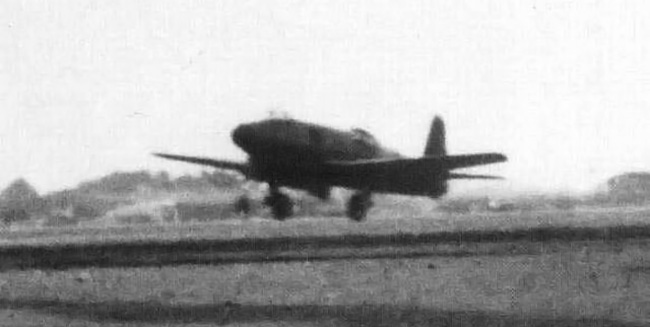
Mitsubishi Ki-83 flight

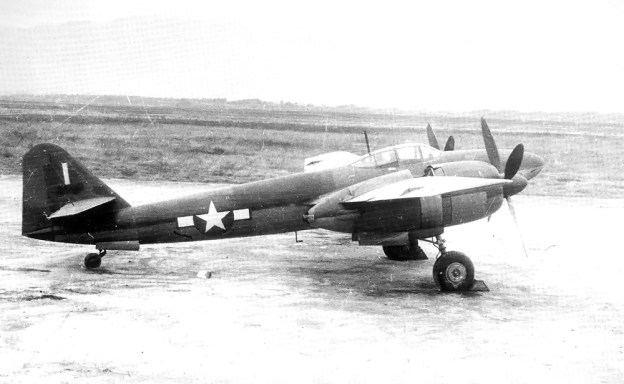
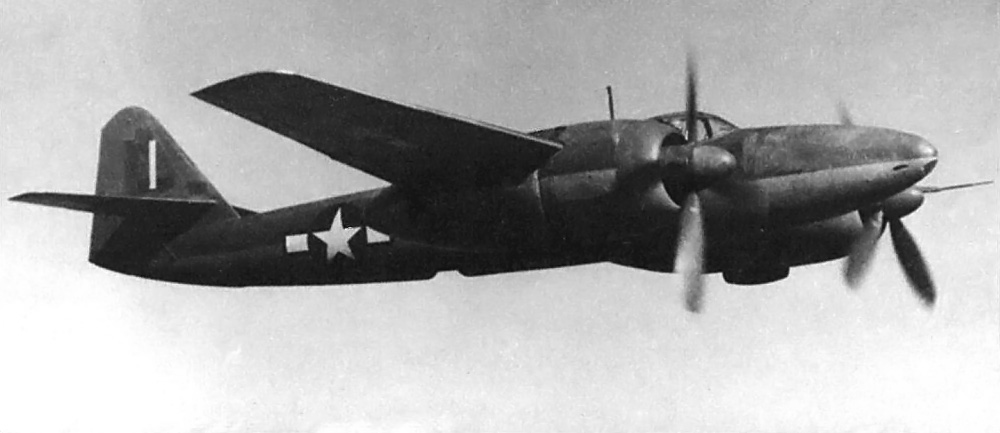
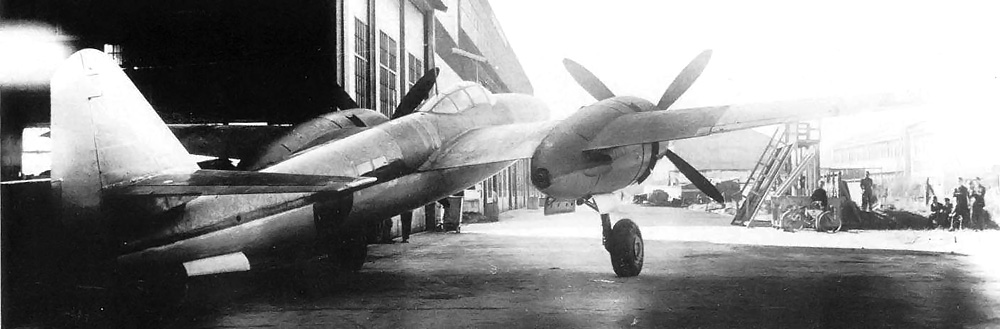
The Mitsubishi Ki-83 on a test flight with US markings on the fuselage. The brace from the horizontal stabilizer to the fuselage can barely be seen. The notch in the underside of the fuselage should be the access hatch for the second crew member. Apparently the hatch was missing on this flight, as a hatch made mostly of acrylic glass should be visible in other images.

Kubo went back to the drawing board and created another designed based on his experience with twin-engine aircraft, including the Mitsubishi Ki-46 (Allied codename: Dinah). What Kubo designed was perhaps the most advanced Japanese aircraft built during World War II: Mitsubishi Ki-83.

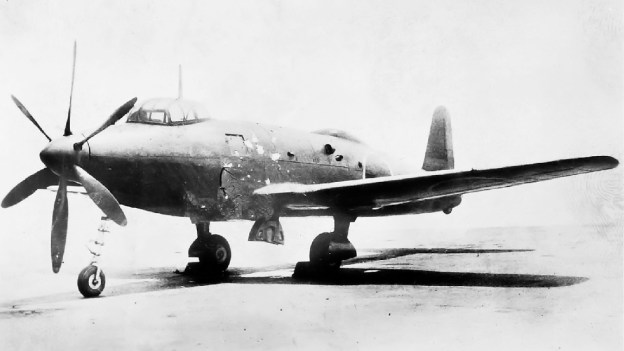
The Ki-83 was an aerodynamically clean, all metal aircraft with two crew stations. Its mid-fuselage mounted wings were equipped with Fowler-style flaps. The pilot had a 360-degree view, and the radio operator/navigator was positioned in the aircraft’s fuselage behind the wings. The second crew member had very cramped accommodations with small windows. However, the second crew member was not intended to be on every mission.

The aircraft featured fully retractable gear including the tailwheel. The main wheels retracted back into the engine nacelles. The Ki-83’s armament consisted of two 30 mm Ho-105 and two 20 mm Ho-105 cannons, all housed in the lower nose. In addition, two 110 lb (50 kg) bombs could be carried on under-wing hardpoints. Some sources say the bombs were carried internally, but this appears unlikely unless the bombs replaced the second crew member.

Mitsubishi Ki-83 rear

The Ki-83 still in Japanese markings. The windows for the second crewman can be seen just above the tip of the horizontal stabilizer. Presumably, this is an early photo of the Ki-83, because the brace for the horizontal stabilizer appears to be absent.

The Ki-83 was powered by two Mitsubishi Ha-211-IRu (joint designation [Ha-43] 12) air-cooled radial engines, each driving an 11.5 ft (3.5 m), four-blade propeller. The 18-cylinder engines had a bore of 5.51 in (140 mm), a stroke of 5.90 in (150 mm), and a total displacement of 2,536 cu in (41.6 L). The engine was turbosupercharged and produced 2,200 hp (1,640 kW) for takeoff and 1,750 hp (1,305 kW) at 31,170 ft (9,500 m). The turbocharger was placed in the rear of the engine nacelle. Fresh air would enter the turbocharger near the rear of the nacelle on the outboard side, be compressed, and then flow to the engine through an air box in the upper nacelle. The engine’s exhaust was expelled from the turbocharger on the inboard side of the nacelle, and a wastegate was positioned at the end of the nacelle. The exhaust arrangement provided some additional thrust. An engine oil cooler was positioned under the nacelle.

The Ki-83 had a 50.85 ft (15.5 m) wingspan, was 41.0 ft (12.5) long, and weighed 13,184 lb (5,980 kg) empty and 20,790 lb (9,430 kg) maximum. A speed of 426 mph (686 km/h) was recorded at 26,250 ft (8,000 m), but top speed rose to 438 mph (705 km/h) at 29,530 ft (9,000 m). Cruise speed was 280 mph (450 km/h) at 13,125 ft (4,000 m). The Ki-83 could climb to 32,810 ft (10,000 m) in 10 minutes and had a ceiling of 41,535 ft (12,660 m). Normal range was 1,214 mi (1,953 km), and maximum range was 2,175 mi (3,500 km).

Mitsubishi Ki-83 hangar

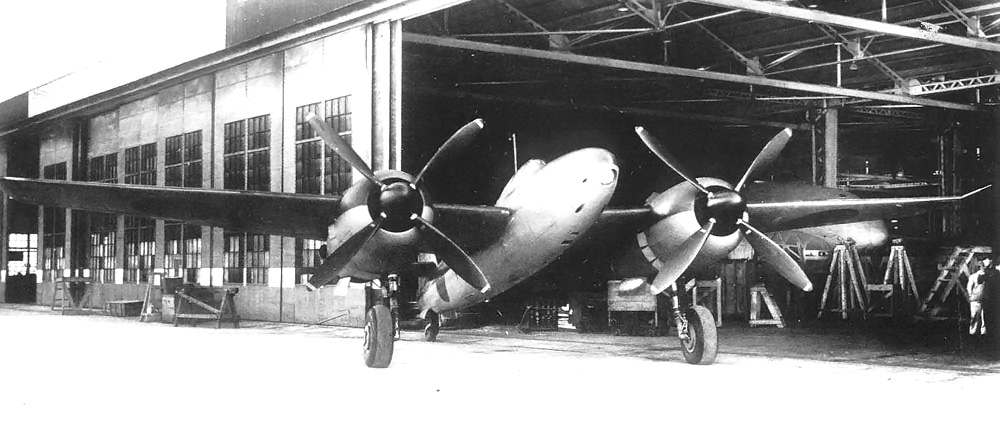
Another early image of the Mitsubishi Ki-83 in Japanese markings. Curiously, there seem to be no oil coolers under the engine nacelles.

The first Ki-83 prototype was completed in October 1944 and flew the following month on 18 November. Test flights were often interrupted by Allied bombing raids, but the Ki-83 demonstrated excellent maneuverability and performance. However, the prototype did experience tail and engine vibration issues and failures of the turbochargers. To cure the issues with the tail, an angled brace was added from the horizontal stabilizer down to the fuselage, and balance weights were added to the elevators. Based on the Ki-83’s performance, the Japanese Navy expressed interest in the aircraft, and the Army agreed to give the Navy some examples after production had started. Reportedly, 39 Ki-83 aircraft had been ordered.

Three additional prototypes were built that incorporated changes to fix the first Ki-83’s deficiencies. The second Ki-83 was completed in April 1945 and flew on 9 March 1945. The third and fourth prototypes had their first flights in the summer of 1945. However, the three additional prototypes were damaged (most likely destroyed) in Allied bombing raids. A fifth prototype was under construction at the end of the war.

Mitsubishi Ki-83 side

The captured Ki-83 while still in Japan. The wastegate exhaust is visible at the rear of the nacelle, and the air intake can be seen on the outboard side of the nacelle just below the trailing edge of the wing.

With the war situation deteriorating for Japan, their limited resources were dedicated to the production of interceptor fighters, and the Ki-83 never entered production. At the end of the war, US forces were surprised to find the Ki-83 because it was an aircraft they knew nothing about. In addition, an advanced high-altitude interceptor version, the Ki-103, and a reconnaissance version, the Ki-95, were under development. The original and sole remaining Ki-83 was flight tested by the Allies at the Matsumotu Army Air Base in Japan. On one of those flights and with the aid of high-performance US aviation fuel, the Ki-83 reportedly achieved a top speed of 473 mph (762 km/h) at 22,965 ft (7,000 m) and could climb to 32,810 ft (10,000 m) in 9 minutes, but a definitive source reporting this impressive performance has not been found.

After flight testing, the Allies came to the conclusion that the Ki-83 was a very maneuverable and high-performance aircraft. In December 1945, the Ki-83 was shipped to the Alameda Air Station near San Francisco, California aboard the USS Tulagi escort carrier. The Ki-83 was given the Foreign Evaluation number FE-151 and flown some in the US. By February 1946, it was at the Middletown Air Depot (now Harrisburg International Airport) at Middletown, Pennsylvania and available for examination by the US aircraft industry. In September 1946, the Ki-83 was allotted to the Air Force Museum, but evidently these plans fell through. The Ki-83’s last known whereabouts were at Orchard Field Airport (now O’Hare Airport) Special Depot in Park Ridge, Illinois in 1949. There are no further details of its fate and it is presumed to have been scrapped at Park Ridge in 1950.

Mitsubishi Ki-83 guard

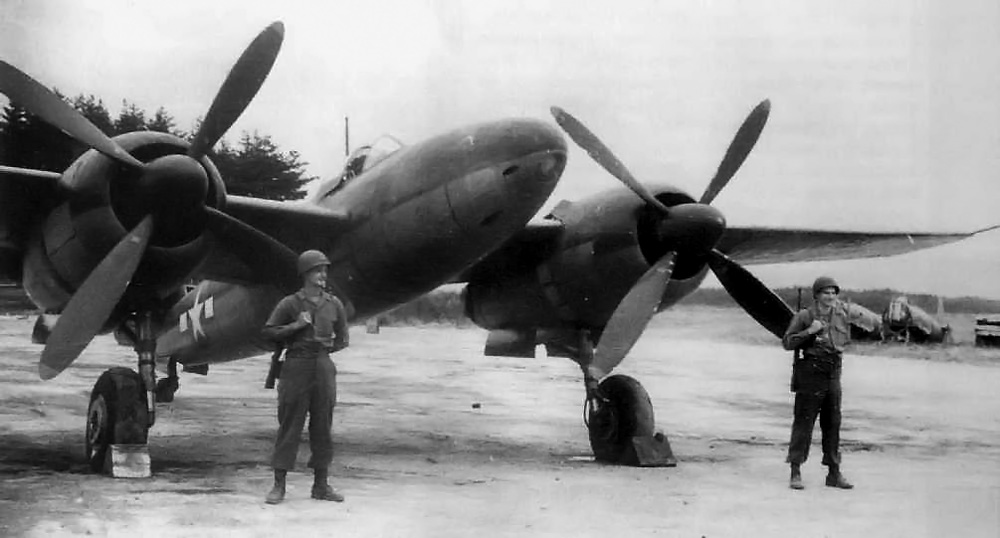
Mitsubishi Ki-83 under guard by US forces in Japan. The 30 mm cannons are in the lower nose with the 20 mm cannons above. The turbocharger exhaust can just be seen at the rear of the nacelle in the center of the image.

Sources:
Japanese Aircraft of the Pacific War by Rene J. Francillon (1970/2000)
Japanese Army Fighters Part 1 by William Green and Gordon Swanborough (1977)
Japanese Aircraft: Performance and Characteristics by Edward T. Maloney (2000)
War Prizes by Phil Butler (1994/1998)
http://www.secretprojects.co.uk/forum/index.php/topic,14960.0/all.html
http://www.secretprojects.co.uk/forum/index.php/topic,8898.0/all.html
http://forums.ubi.com/showthread.php/101463-Mitsubishi-Ki-83/page2

Bolkhovitinov S-2M-103 Sparka

By William Pearce

With the intention of creating a high speed light bomber, Viktor Bolkhovitinov designed what is commonly referred to as the Bolkhovitinov S or Sparka. During flight trials the Soviet Air Force (VVS) referred to the aircraft as S-2M-103, for skorostnoy (high speed) with two M-103 engines; however, a number of other designations have been applied over the years. The common “Sparka” designation means twin—because the aircraft had two engines mounted in tandem. Other designations are BBS-1 for blizhniy bombardirovshchik skorostnoy (short range bomber, high-speed), BB for blizhniy bombardovshchik (short range bomber), and LB-S for lyohkiy bombardirovshchik-sparka (light bomber-paired).

A good view of the twin engine Bolkhovitinov Sparka. Note the plexiglass glazing for the bombardier's downward view.

A good view of the twin-engine Bolkhovitinov Sparka. Note the plexiglass glazing for the bombardier’s downward view.

The Sparka was a low-wing aircraft of all-aluminum construction with stressed skin. The aircraft had a twin fin tail to increase the rear gunner’s field of fire. The undercarriage was fully retractable; the main gear retracted toward the rear, and the wheels rotated 90 degrees to lie flat within the wings. The pilot and navigator/bombardier/gunner sat in tandem under a long canopy. Between the pilot and second crew member was a small bomb bay for 882 lb (400 kg) of bombs. A plexiglass section on the bottom of the aircraft just aft of the bomb bay provided the bombardier a view of the ground. The aircraft was 43 ft 4 in (13.2 m) long and had a relatively short wingspan of 37 ft 4 in (11.38 m). The Sparka weighed 12,460 lb (5,652 kg).

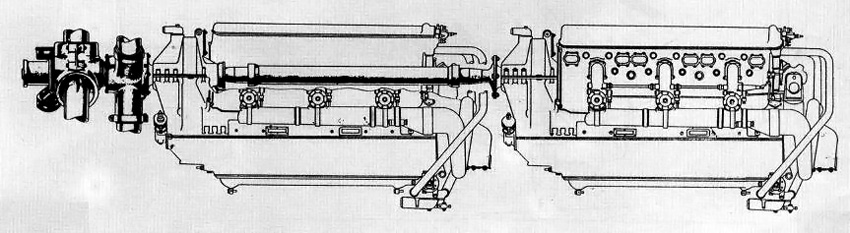
The Sparka was powered by two Klimov M-103A engines positioned in tandem in the aircraft’s nose. This coupled engine package was designated M-103SP. Each engine drove half of the aircraft’s six-blade, coaxial contra-rotating propeller unit. This engine and propeller arrangement was similar to the FIAT AS.6 installed in the Italian MC.72 and the Hispano-Suiza 12Y installed in the French Arsenal VB 10. With this engine arrangement, the front engine drove the rear propeller, and the rear engine drove the front propeller via a drive shaft that ran through the Vee of the front engine.

Schematic of the paired Kimlov M-103 engines installed in the Bolkhovitinov Sparka with the rear engine's drive shaft through the Vee of the front engine.

Schematic of the paired Klimov M-103 engines installed in the Bolkhovitinov Sparka with the rear engine’s drive shaft passing through the Vee of the front engine.

The Klimov M-103 engine was derived from the M-100, which was a licensed copy of the Hispano-Suiza 12Ybrs. The M-103SP had a 5.83 in (148 mm) bore and a 6.69 in (170 mm) stroke. Total displacement was 2,142 cu in (35.09 L). The engine produced 960 hp (716 kW). A radiator was installed in a large duct just below the rear engine, and it cooled both of the Sparka’s engines.

Bolkhovitinov started design work on the Sparka in 1937, and prototype construction began in July 1938. The aircraft made its first flight in January 1940 (some say late 1939) with B. N. Kudrin at the controls. VVS testing took place from March through July 1940. The Sparka showed good speed, reaching 354 mph (570 km/h). However, the takeoff run was excessive, landing speeds were high, and visibility over the nose was impaired. In addition, some trouble was encountered with the rear engine’s propeller drive shaft breaking due to excessive vibrations. Even so, the aircraft received a positive assessment, noting that the installation of the tandem engines eliminated a considerable amount of drag over two separate nacelles.

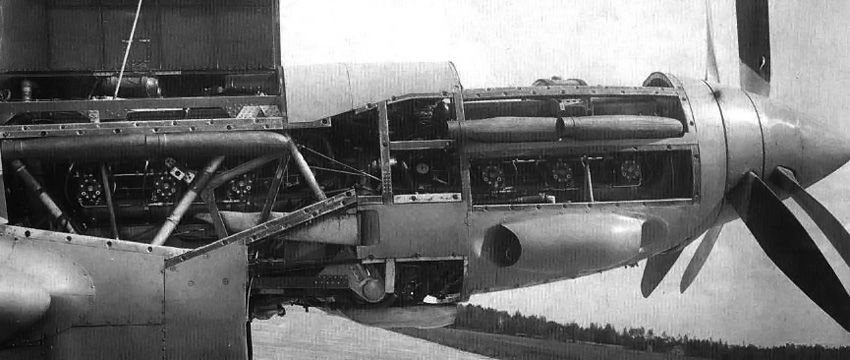
Engine bay view of the two Kimlov M-103 engines.

Engine bay view of the two Klimov M-103 engines.

A new wing was designed with a NACA-230 airfoil section to improve takeoff and landing performance. The aircraft was tested with this new wing from September to December 1940, and it did improve the aircraft’s takeoff and landing characteristics.

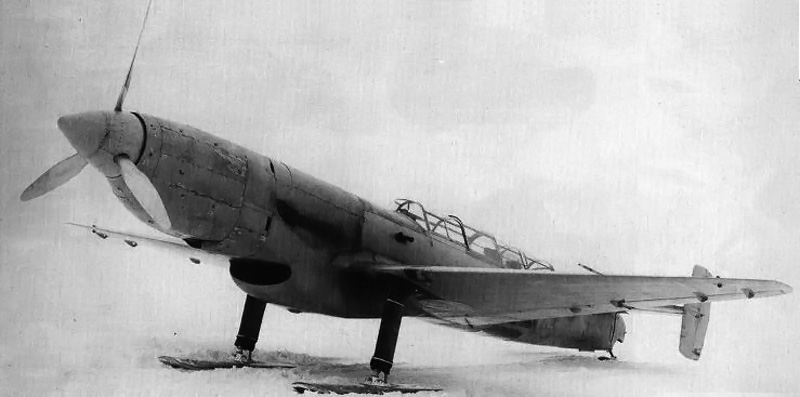
The Sparka was reconfigured for a single 1,050 hp (783 kW) Klimov M-105P (some say 103P) engine, which was installed in the forward engine bay. The M-105P was a development of the M-103P and could be fitted with a cannon in the engine’s Vee to fire through the propeller hub. The M-105P retained the bore and stroke of the earlier M-103P (and M-103SP) engine. The aircraft was tested on skis in early 1942 but was underpowered with the single M-105P, attaining a top speed of only 249 mph (400 km/h).

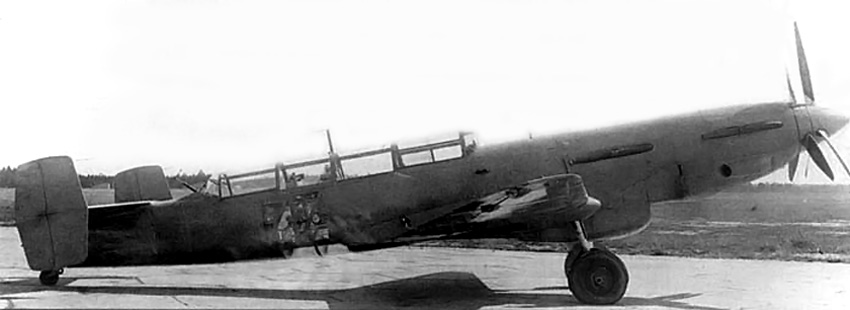
In this side view, the glazing on the bottom of the Sparka can clearly be seen.

In this side view, the glazing on the bottom of the Sparka can clearly be seen.

Some say the single engine version was really a separate aircraft (known as S-1) that flew in January 1940 to test the airframe configuration. This seems unlikely because of the time frame involved. The twin-engine Sparka (S-2) would have been nearly complete by the time the single engine airframe test ship first took to the air, making major changes impossible and minor changes difficult. If the airframe test ship had issues, there would not have been enough time for any changes to be made before the official trials took place in March 1940. Not to mention that adding the power and weight of another engine would change the aircraft’s flight dynamics considerably.
Bolkhovitinov S skis

The single-engined Bolkhovitinov S on skis.

Regardless, development on the Sparka was abandoned in mid-1941, partially a result of the German invasion. However, further studies were made on the feasibility of the tandem engine arrangement powering a fighter, but these studies did not lead to the production of any aircraft. In addition, the factory where the Sparka was built was needed to produce the Petlyakov Pe-2 attack bomber.

Rear view of the Sparka showing the defensive machine gun installation.

Rear view of the Sparka showing the defensive machine gun installation.

Sources:
Soviet X-Planes by Gordon and Gunston (2000)
Soviet Air Power in World War 2 by Yefim Gordon (2008)
Soviet Combat Aircraft of the Second World War, Vol. 2 by Gordon and Khazanov (1999)
Aircraft of the Soviet Union by Bill Gunston (1983)
Russian Piston Aero Engines by Vladimir Kotelnikov (2005)
http://www.secretprojects.co.uk/forum/index.php/topic,4532.msg152239.html#msg152239
http://en.wikipedia.org/wiki/Bolkhovitinov_S

Beech XA-38 Grizzly air 2

Beech Aircraft Company XA-38 Grizzly

By William Pearce

In March 1942, the Beech Aircraft Company began design work on a two-seat heavy fighter to destroy enemy bombers. Since the Curtiss XP-71 had already been delegated this task, the Beech developed the design into an attack aircraft to replace the Douglas A-20 Havoc. Beech gave this aircraft the in-house designation Model 28 and submitted its proposal to the US Army Air Force on 23 September 1942. On 2 December 1942, the AAF ordered two prototypes and designated the aircraft XA-38; this was Beech’s first combat aircraft. Beech originally called the aircraft Destroyer, but the AAF changed the name to Grizzly. The XA-38 was similar in appearance to the Beech 18, but it was an all-new aircraft. The project was led by Bill Cassidy, and the aircraft was to be strong, maneuverable, and well-armed. Its mission was to destroy fortified gun emplacements, armored vehicles, tanks, submarines, and coastal surface vessels.

Beech XA-38 Grizzly air

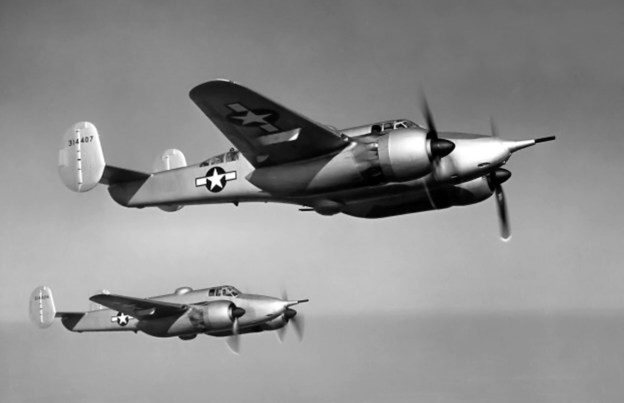
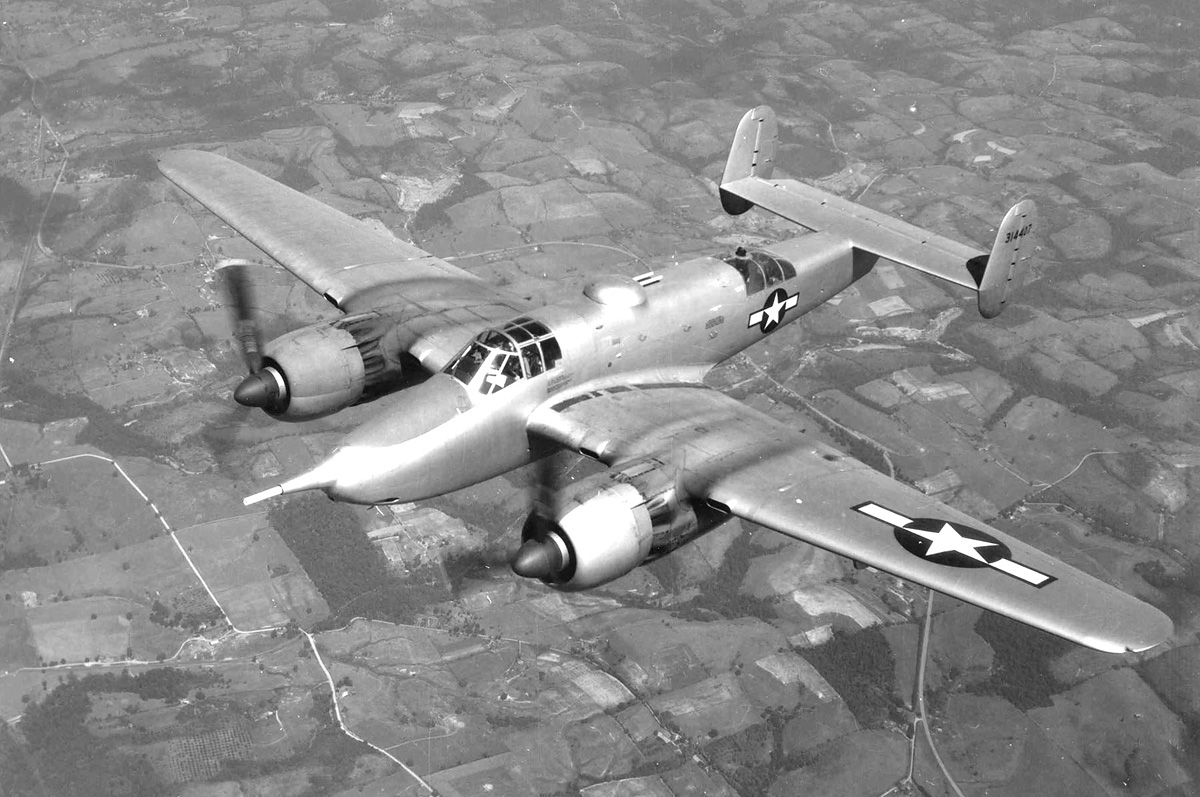
The second Beech XA-38 Grizzly (serial no 43-11407), with all guns installed.

The XA-38 was a two-place, mid-wing aircraft with a slim fuselage and twin tails. The gunner sat in the rear of the fuselage and operated remote upper and lower turrets, each fitted with two Browning .50 cal guns. The ventral turret could be locked in the forward position and fired by the pilot in strafing attacks. In the nose of the aircraft were another two Browning .50 cal guns and a T15E1 (M10) 75 mm cannon. The nose swung open to service the guns and was even removable so that different armament could be used. The .50 cal guns each had 500 rounds, and the 75 mm cannon had 20 rounds. Each wing supported two hard points that could carry a combined total of 2,650 lb (1,200 kg) of ordinance or 600 gal (2,270 L) of fuel.

The T15E1 75 mm cannon had an 84 in (2.13 m) barrel that extended about 2 ft (.61 m) beyond the aircraft’s nose. The cannon was self-loading, 144 in (3.66 m) long, and originally weighed 1,800 lb (816 kg). However, through further development, the weight was reduced to 1,138 lb (516 kg). It fired a 26 in (.66 m) shell with a 15 lb (6.8 kg) projectile. The cannon consisted of a 75 mm gun (T9E2), 75 mm feed mechanism (T13), and the 75 mm gun mount (T15E1).

Beech XA-38 Grizzly above

Excellent view of the second XA-38, showing the slim fuselage. The aircraft was on a test flight over Kansas.

The Grizzly’s aluminum skin was entirely flush riveted, and the fully retractable gear, including tailwheel, was engineered for operations out of unimproved airstrips. The aircraft was powered by two Wright R-3350-43 engines producing 2,300 hp (1,715 kW) each. Each engine turned a 14.2 ft (4.32 m), three-blade Hamilton Standard propeller. The XA-38 could carry 640 gal (2,423 L) of fuel in its wings and an additional 185 gal (700 L) in the fuselage behind the pilot. The aircraft had a wingspan of 67.3 ft (20.5 m) and was 51.8 ft (15.8 m) long. It weighed 22,480 lb (10,197 kg) empty and had a maximum takeoff weight of 35,265 lb (15,995 kg). The XA-38’s climb rate was 2,170 fpm (661 m/m), and it had a service ceiling of 27,800 ft (8,475 m). Maximum speed at 3,100 ft (945 m) was 376 mph (605 km/h), and cruise speed at 16,000 ft (4,877 m) was 344 mph (554 km/h). The 45-degree flaps allowed the aircraft to land at 97 mph and operate out of a 2,500 ft (762 m) runway.

Beech XA-38 Grizzly air 2

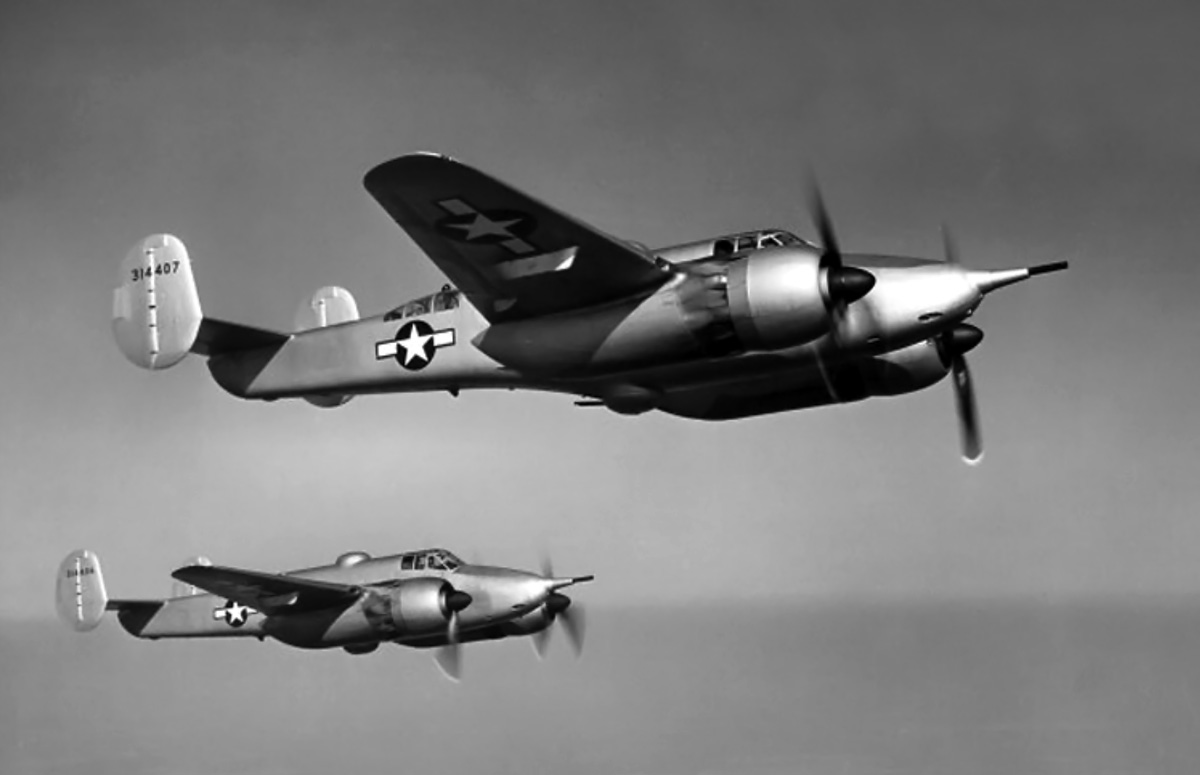
Both XA-38 aircraft in flight. The dummy turrets can be see on the first XA-38 to fly (furthest from camera).

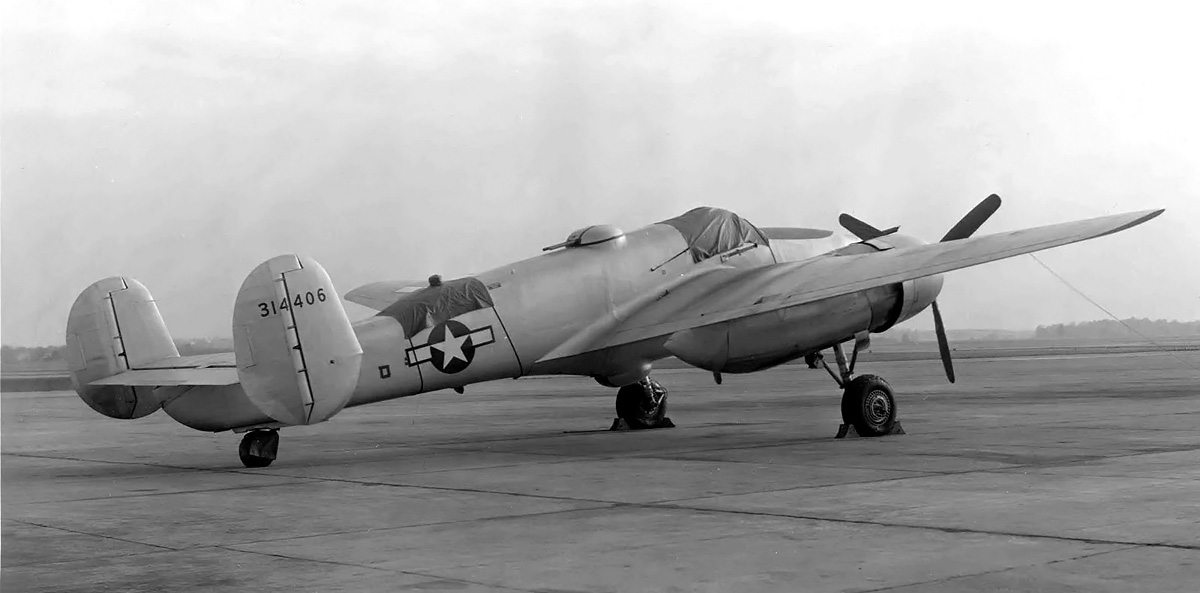
The aircraft program was met with long delays due to the unavailability of the R-3350 engines, remote turrets, and the 75 mm cannon. The Boeing B-29 had engine priority; the Douglas A-26 had the turrets; and the cannon was still being developed. The first XA-38 (serial no 43-14406) took to the air on 7 May 1944 with Vern Carstens at the controls. The turrets were still not available, so dummy turrets were substituted. In July 1944, the aircraft was flown to Tulsa, Oklahoma, where the 75 mm cannon was fitted and ground fired. Later in July, the Grizzly fired the cannon in-flight over Great Bend, Kansas.

Flight tests continued and minor issues were worked out. The aircraft performed very well, and during one early, low-level test flight, the XA-38 was able to pull away from the P-51B chase plane. Capt. Jack Williams evaluated the aircraft for the AAF and made 38 flights in the XA-38 between 13-24 October 1944. The aircraft was reported to be very maneuverable for an aircraft of its size and easy to fly through most aerobatic maneuvers. The aircraft was transferred to Dayton, Ohio for further evaluation on 7 July 1945. At some point, at least a mockup of the upper turret was added to the aircraft.

Beech XA-38 Grizzly 06

What must be a late image of the first Beech XA-38 Grizzly (serial no 43-14406) with what appears to be a mockup of the upper turret installed.

The second aircraft (serial no 43-11407) took to the air on 22 September 1945; Carstens was again at the controls. This aircraft had the correct turrets installed, and all weapons were operational. After initial flight tests, the XA-38 was transferred to Eglin Field, Florida for armament trials. Here, it amassed an additional 38 hours of flight tests, but there was little interest since the war was over.

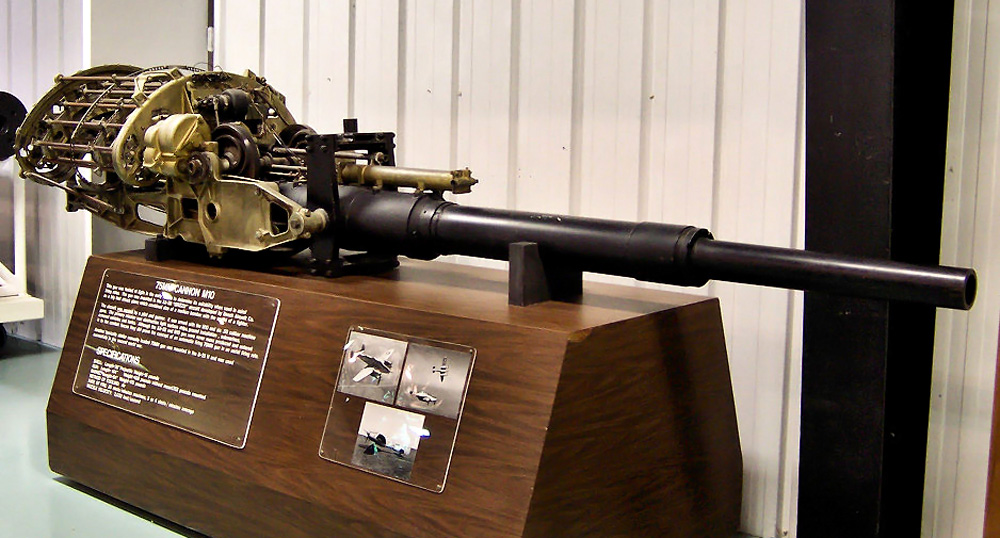
The Grizzly’s main problem was that its engines were needed elsewhere. B-29 production left no spare R-3350s available for any type of A-38 production until mid-1945. By that time, the war was winding down, and there was no foreseeable need for the A-38. One of the XA-38s reportedly went to Davis-Monthan AFB, Arizona, but its ultimate fate is not recorded. The other aircraft was believed to be scrapped. The only remnant of the XA-38 Grizzly is the T15E1 cannon on display at the United States Air Force Armament Museum in Eglin AFB, Florida.

The T15E1 (M10) 75 mm cannon from the XA-38 as displayed in the United States Air Force Armament Museum. (Tom Fey image)

The T15E1 (M10) 75 mm cannon from the XA-38 as displayed in the United States Air Force Armament Museum. (Tom Fey image)

Sources:
Beech Aircraft and their Predecessors by A.J. Pelleteir (1995)
U.S. Experimental & Prototype Aircraft Projects by Bill Noton (2008)
American Attack Aircraft Since 1926 by E.R. Johnson (2008)
U.S. Aerial Armament in World War II, Vol. 1 by William Wolf (2009)
American Combat Planes of the 20th Century by Ray Wagner (2004)
– 75MM Cannon M10 display in the United States Air Force Armament Museum in Eglin AFB, Florida

Yokosuka (Kugisho) R2Y1 Keiun

By William Pearce

Late in 1938, the Heinkel He 119 experimental high-speed reconnaissance aircraft was shown to a Japanese Naval delegation visiting Germany. The Japanese liked the speed and range of the He 119, and overall, were impressed by the aircraft. Based on the positive initial interest, the Japanese sent a group of technicians from the Yokosuka Naval Air Technical Arsenal (Yokosuka, also known as Kaigun Koku Gijutsusho or Kugisho) to Germany for a closer examination of the He 119. Eventually, Commander Hideo Tsukada was able to purchase two He 119 prototypes and a license to manufacture the aircraft in Japan.

The standard image of the Yokosuka R2Y1 Keiun. Speculation suggests the first scoop on the side of the aircraft provided cooling air for the engine's internal exhaust baffling, the second, larger scoop provided induction air for the normally aspirated Aichi [Ha-70] engine installed in the prototype, and the final two ports were for the engine's exhaust.

The standard image of the Yokosuka R2Y1 Keiun. Speculation suggests the first scoop on the side of the aircraft provided cooling air for the engine’s internal exhaust baffling, the second, larger scoop provided induction air for the normally aspirated Aichi [Ha-70] engine installed in the prototype, and the final two ports were for the engine’s exhaust.

The two He 119 prototypes were delivered via ship to Japan in 1941 (some say 1940). The aircraft were reassembled at Kasumigaura Air Field, and flight tests occurred at Yokosuka Naval Base. During an early test flight, one of the He 119s was badly damaged in a landing accident, and it is believed the other He 119 suffered a similar fate. Plans to produce the He 119 never moved forward, but the Japanese were still interested in a high-speed reconnaissance aircraft and felt the general configuration of the He 119 held promise.

Inspired by the Heinkel He 119, Yokosuka began to design an aircraft of a similar layout, known as the Y-40, in 1943. Headed by Commander Shiro Otsuki, the aircraft project was a pressurized, two-seat, unarmed, high-speed, reconnaissance aircraft of all-metal construction that featured tricycle retractable gear. The design was approved, and the Y-40 officially became known as the R2Y1 Keiun (Beautiful Cloud). The construction of two prototypes was ordered.

A good view of the R2Y1 where a radiator inlet can be seen under the wing and in front of the main gear. The ventral scoop was an intake for the turbocharger and intercooler but these were not installed on the prototype.

A good view of the R2Y1 where a radiator inlet can be seen under the wing and in front of the main gear. The ventral scoop was an intake for the turbocharger and intercooler but these were not installed on the prototype.

The R2Y1 had a 45.93 ft (14 m) wingspan and was 42.81 ft (13.05 m) long. The aircraft stood 13.91 ft (4.24 m) high, weighed 13,260 lb (6,015 kg) empty, and had a maximum weight of 20,725 lb (9,400 kg). The Keiun had an estimated top speed of 447 mph (720 km/h) at 32,810 ft (10,000 m) and a cruise speed of 288 mph (463 km/h) at 13,125 ft (4,000 m). Maximum range was an estimated at 2,240 mi (3,610 km). The pilot sat under a raised bubble-style canopy that was toward the extreme front of the aircraft. The radio operator/navigator occupied an area in the fuselage just behind and a little below the pilot.

The Keiun was powered by two 60-degree, inverted V-12 Aichi Atsuta 30 series engines, licensed-built versions of the Daimler-Benz DB 601. The engines were coupled together by a common gear reduction in a similar fashion as the DB 606. The resulting 24-cylinder power unit was known as the Aichi [Ha-70]. With a 5.91 in (150 mm) bore and 6.30 in (160 mm) stroke, the engine displaced 4,141 cu in (67.8 L) and was installed behind the cockpit and above the wings. The Aichi [Ha-70] engine was to be turbocharged and rated at 3,400 hp (2,535 kW) for takeoff and 3,000 hp (2,237 kW) at 26,247 ft (8,000 m). Without the turbocharger, the engine was rated at 3,100 hp (2,312 kW) for takeoff and 3,060 hp (2,282 kW) at 9,843 ft (3,000 m). The engine drove a 12.47 ft (3.8 m), six-blade propeller via a 12.8 ft (3.9 m) long extension shaft that ran under the cockpit. Engine cooling was achieved by radiators under the fuselage and inlets for oil coolers in the wing roots. A ventral air scoop was located behind the engine to provide induction air for the turbocharger and air for the intercooler.

The R2Y1 Keiun undergoing taxi tests in May 1945.

The R2Y1 Keiun undergoing taxi tests in May 1945.

By the fall of 1944, the direction of the war had changed, and Japan no longer needed a high-speed reconnaissance aircraft. The R2Y1 Keiun was all but cancelled when the design team suggested the aircraft could easily be made into a fast attack bomber. In addition, the Aichi [Ha-70] power plant would be discarded, and one 2,910 lb (1,320 kg) thrust Mitsubishi Ne 330 jet engine would be installed under each wing. A fuel tank would be installed in the space made available by the removal of the piston engine. This jet-powered attack bomber had an estimated top speed of 495 mph (797 km/h). The project was approved, and the new aircraft was designated R2Y2.

The decision was made to finish the nearly completed R2Y1 airframe and use it as a flight demonstrator to assess the flying characteristics of the aircraft. With pressurization, the turbocharger, and the intercooler omitted, the R2Y1 prototype was completed in April 1945 and transferred to Kisarazu Air Field for tests. Ground tests revealed that the aircraft suffered from nose-wheel shimmy and engine overheating.

Yokosuka R2Y1 Keiun taking off from Kisarazu Air Field for its first an only flight.

Yokosuka R2Y1 Keiun taking off from Kisarazu Air Field for its first an only flight.

Adjustments were made to overcome the issues, and the Keiun took to the air on 29 May 1945 (date varies by source and is often cited as 8 May 1945), piloted by Lt. Commander Kitajima. The flight proved to be very short because the engine quickly overheated, and a fire broke out in the engine bay. Lt. Commander Kitajima quickly returned to the field, and the R2Y1 suffered surprisingly little damage. On 31 May during a ground run to test revised cooling, the engine was mistakenly run at high power for too long and overheated. The engine was removed from the aircraft to repair the damage. The R2Y1 sat awaiting repair for some time before it was destroyed by Japanese Naval personnel to prevent its capture by American forces (some say it was destroyed in an Allied bombing raid). Because of the end of the War, the second R2Y1 prototype was never completed nor was the design work for the R2Y2.

The unfinished second R2Y1 prototype as seen at the end of WWII. Note the wing root and ventral intakes. The hole in the center of the bulkhead in the nose was for the propeller's drive shaft.

The unfinished second R2Y1 prototype as seen at the end of WWII. Note the wing root and ventral intakes. The hole in the center of the bulkhead in the nose was for the propeller’s drive shaft.

Sources:
– “Yokosuka R2Y1 Keiun: Japan’s mid-engined twin” Wings of Fame, Volume 12 (1998)
Japanese Secret Projects by Edwin Dyer (2009)
Japanese Aircraft of the Pacific War by Rene Francillon (1970/2000)
Japanese Aero-Engines 1910–1945 by Mike Goodwin and Peter Starkings (2017)
General View of Japanese Military Aircraft in the Pacific War by Airview (1956)
Japanese Aircraft Performance & Characteristics TAIC Manual by Edward Maloney (2000)
http://www.secretprojects.co.uk/forum/index.php/topic,15633.0/all.html

Heinkel He 119 V4 front

Heinkel He 119

By William Pearce

In the 1930s, brothers Siegfried and Walter Günter were pushing the limits of aerodynamics as they designed aircraft for Heinkel Flugzeugwerke in Germany. Perhaps the ultimate expression of their aerodynamic beliefs was the Heinkel He 119. The Günter brothers and Ernest Heinkel envisioned the He 119 as an unarmed, high-speed reconnaissance aircraft or light bomber.

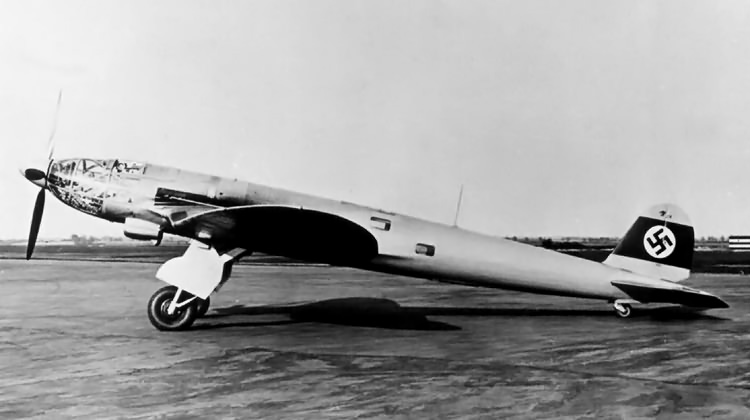
Heinkel He119 V1 side

Heinkel He 119 V1 prototype with the hastily installed radiator to augment the evaporate cooling system.

Work on the He 119 began in the summer of 1936 as a private venture funded by Heinkel Flugzeugwerke. The aircraft appeared to have a fairly standard layout as an all metal, low-wing monoplane with retractable gear. However, the very streamlined fuselage hid the He 119’s unorthodox power arrangement. To achieve the low-drag necessary for high-speed operations, the engine was buried in the fuselage, just behind the cockpit and above the wings. An enclosed drive shaft extended forward from the engine, through the cockpit, between the pilot and co-pilot, and to the front of the aircraft where it drove a 14 ft 1 in (4.30 m), metal, variable-pitch, four-blade propeller.

No engine produced the power needed for the He 119, so two Daimler-Benz DB 601 engines were placed side-by-side and coupled together through a common gear reduction. The DB 601 was a liquid-cooled, 12-cylinder, 60 degree, inverted Vee engine with a 5.91 in (150 mm) bore and 6.30 in (160 mm) stroke. When coupled, the 24-cylinder engine was known as the DB 606; it displaced 4,141 cu in (67.8 L) and produced 2,350 hp (1,752 kW). The inner banks of the DB 606 were pointed nearly straight down and exhausted under the aircraft. The side banks’ exhaust was expelled just above the He 119’s wings.

Daimler-Benz DB 606

The Daimler-Benz DB 606 engine was comprised of two DB 601 engines joined to a common gear reduction.

The DB 606 engine in the He 119 was to be cooled exclusively by surface evaporative cooling, where steam from the heated coolant was pumped under the skin of the wing’s center section. Here, the steam would cool and condense back into liquid. The liquid was then pumped back to the engine. However, during testing the system proved to be inadequate, and a radiator was added below the fuselage, just before the wings. The first prototype had a fixed radiator that was rather hastily installed. The subsequent prototypes included an improved radiator that was extended during low-speed operations but was semi-retracted into the fuselage as the aircraft’s speed increased.

The He 119’s cockpit formed the nose of the aircraft. The cockpit was entirely flush with the 48 ft 7 in (14.8 m) fuselage and was extensively glazed with heavily framed windows. The pilot and co-pilot accessed the cockpit by separate sliding roof panels. In the aft fuselage were provisions for a radio operator and a ventral bay for cameras. Another bay for either large cameras or a maximum of 1,200 lb (1,000 kg) of bombs was located in fuselage, just aft of the wing spar.

Heinkel He 119 nose radiator

A good view of the He 119’s glazed cockpit is provided in this image. Most sources state this aircraft is V4, but it possesses the exhaust ports of V1. Note the extended radiator.

The He 119 had a wingspan of 52 ft 6 in (16 m). To provide for proper ground clearance, conventional main landing gear would have been too long to fit in the inverted-gull, semi-elliptical wing. A telescoping strut was devised that would collapse as the gear retracted. This allowed the gear to fit within the wing and also extend to provide the needed ground clearance.

Heinkel kept the He 119 a secret during construction, and the first prototype (V1) flew in June 1937 with Gerhard Nitschke at the controls. Even with the bulk of the added radiator, the aircraft achieved 351 mph (565 km/h), which was faster than fighter aircraft of the day. This speed validated Heinkel and the Günter brothers’ position that the fast bomber did not need to be armed. However, when the aircraft was revealed to German officials, they insisted the aircraft be armed with upper and lower guns operated by separate gunners. German officials did allow the continued experimentation of the aircraft; at this point, the aircraft was officially designated He 119. The addition of the guns lowered the aircraft’s speed, and it appears that only the upper gun was included in other prototypes, housed under a sliding panel.

Heinkel He 119 V2 with windows in the rear fuselage for the radio operator.

Heinkel He 119 V2 with windows in the rear fuselage for the radio operator. Reportedly, this is the last He 119 built with the semi-elliptical wing.

It is at this point that sources disagree on the He 119’s history. One theory is that the second prototype (V2) first flew in September 1937, followed by the fourth prototype (V4) in October 1937. The He 119 V4 set a speed record on 22 November 1937 and was destroyed in a follow-up attempt on 16 December. A total of eight aircraft were built; the seventh (V7) and eighth (V8) were purchased by and subsequently shipped to Japan.

The other theory, supported by German Heinkel expert Dr. Volker Koos, is that the V1 was prepared (which included the installation of a new radiator as used on the subsequent prototypes) for the record flight. The V1 flew the record flight and crashed during the follow-up attempt. The first flight of V2 was in 1938, and V4 first flew in May 1940. Most likely, only four aircraft were built, and V2 and V4 were shipped to Japan.

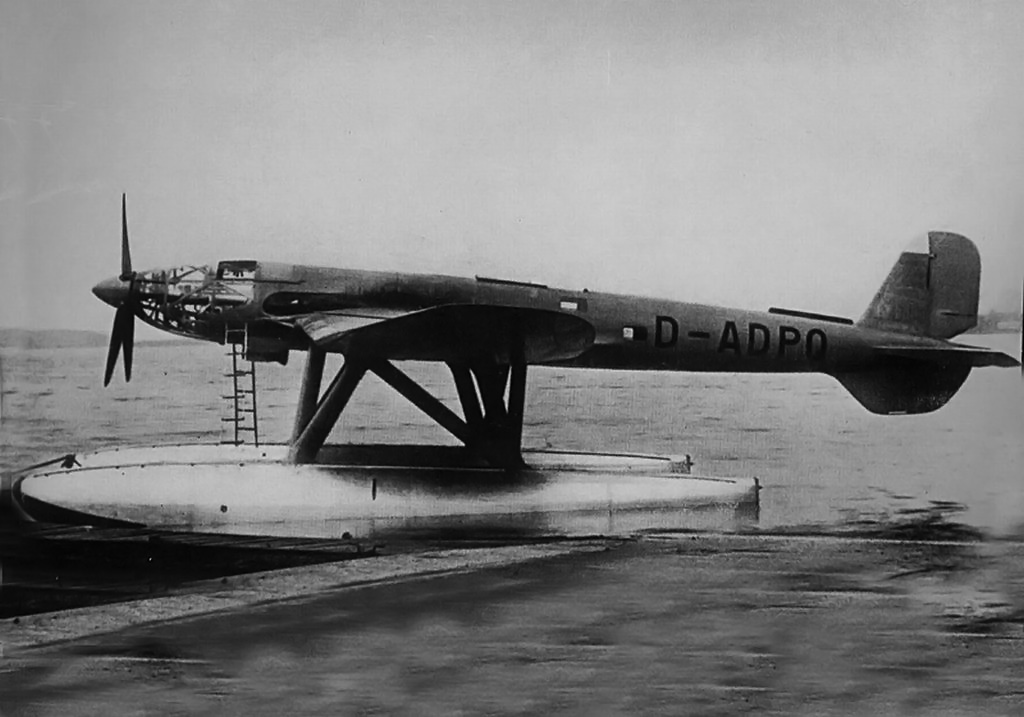
Side view of the He 119 V3. The updated wing used on the V3 and all further He 119 aircraft can be seen as well as tail modifications to increase the seaplanes stability.

Side view of the He 119 V3. The updated wing used on the V3 and all further He 119 aircraft can be seen as well as tail modifications to increase the seaplane’s stability.

All sources agree that the He 119 carrying the registration D-AUTE made the record flights. The third prototype (V3) was first flown after V4 because V3 was built as a seaplane. All prototypes from V3 on were built with a new wing that had a straight leading edge and a slightly reduced span of 52 ft 2 in (15.9 m).

After careful examination of various photos, it appears that the He 119 registered at D-AUTE had the semi-elliptical wing as used on the first two prototypes. It also appears that the exhaust ports above the wing on V1 were unique and at an angle, with each port slightly higher (relative to the fuselage) than the port preceding it. All other He 119s had exhaust ports in a straight line relative to the fuselage. D-AUTE appears to have the ports as seen on V1. Based on the information available, it seems more likely that V1 did indeed make the record flights. Sadly, given the secrecy under which the He 119 was built, the propaganda subterfuge surrounding the record flights, and the destruction of German documents during World War II, the exact aircraft identities as well as the number built may never be definitively known.

Heinkel He 119 V3 b

The Heinkel He 119 V3 seaplane taxiing under its own power. This aircraft was to be used on an attempt to set a new 1000 km (621 mi) seaplane record, but such plans were cancelled after the other He 119’s crash.

Regardless of the specific airframe, on 22 November 1937, the He 119 set a world record for flying a payload of 1,000 kg (2,205 lb) over a distance of 1,000 km (621 mi). For propaganda purposes, the He 119 was labeled He 111U and also He 606. Due to weather, the He 119 was forced to fly lower than anticipated which reduced its airspeed. Even though the He 119 set the record at 313.785 mph (504.988 km/h), the speed was seen as a disappointment that did not represent the He 119’s true capabilities. Indeed, the record was broken about two weeks later by an Italian Breda Ba 88.

A follow-up flight to reclaim the record occurred on 16 December 1937.  With over half the distance flown and the He 119 averaging just under 370 mph (595 km/h), the DB 606 engine quit. The pilots, Nitschke and Hans Dieterle, attempted an emergency landing at Travemünde but hit a drainage ditch. The He 119 was destroyed; Nitschke and Dieterle were injured, but they survived. The engine failure was a result of a faulty fuel transfer switch. After the crash, Heinkel was ordered not to attempt any further record flights with the He 119.

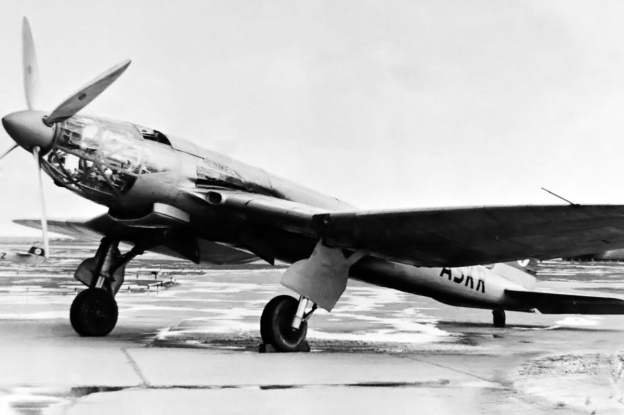
Heinkel He 119 V4 front

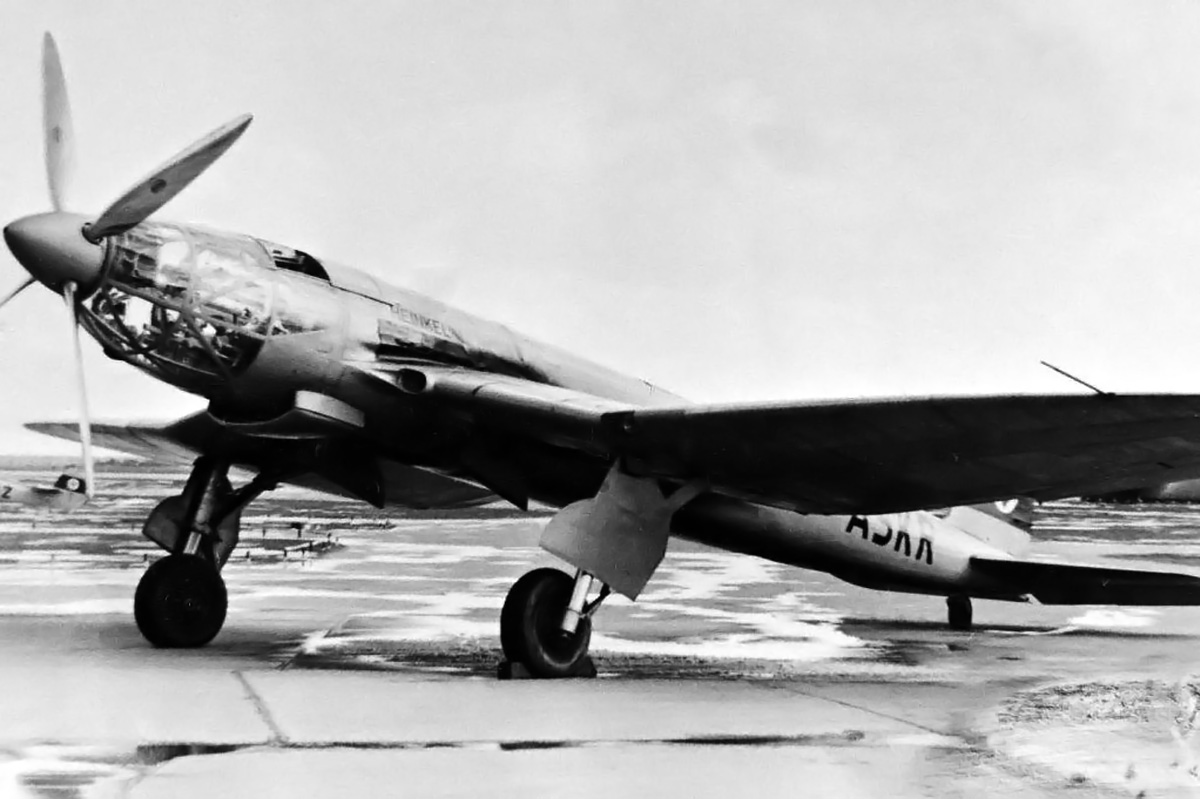
Many sources identify this aircraft (D-ASKR) as the He 119 V2. Interestingly, the wing root intake for the supercharger and lower lip of the radiator do not match those found on other images of V2. The features do match those found on V3.

Other He 119 prototypes took over the test flights. He 119s with the new wing demonstrated a top speed of around 370 mph (595 km/h) and a range of 1,865 mi (3,000 km). Despite the floats, the He 119 V3 seaplane had a top speed of 354 mph (570 km/h) and a range of 1,510 mi (2,430 km). The V3 aircraft also had a ventral fin added to counteract the destabilizing effects of the floats. Unfortunately, the German authorities did not have any interest in producing the He 119 in any form because of its unorthodox features. Reportedly, some of the remaining aircraft served as test-beds for the DB 606 and DB 610 engines. The remaining He 119s in Germany were scrapped during World War II.

Late in 1938, the He 119 was shown to a Japanese Naval delegation that expressed much interest in the aircraft. In 1940 the Japanese purchased a manufacturing license for the He 119 along with two of the prototype aircraft. These aircraft were delivered via ship to Japan in 1941 (some say 1940). The aircraft were reassembled at Kasumigaura Air Field, and flight tests occurred at Yokosuka Naval Base. During an early test flight, one of the He 119s was badly damaged in a landing accident, and it is believed the other He 119 suffered a similar fate. While it was not put into production, the He 119 did provide the Japanese with inspiration for the Yokosuka (Kugisho) R2Y1 Keiun high-speed reconnaissance aircraft.

Heinkel He 119 V2 with the Japanese Naval delegation.

The Heinkel He 119 with the Japanese Naval delegation. The sliding roof panel for the pilot’s cockpit access can clearly be seen. Note the differences with the wing root intake and lower lip of the radiator compared to the D-ASKR aircraft.

Sources:
– “An Industry of Prototypes – Heinkel He 119”, Wings of Fame, Volume 12 by David Donald (1998)
Warplanes of the Third Reich by William Green (1970/1972)
http://www.whatifmodelers.com/index.php/topic,21627.0/
http://forum.12oclockhigh.net/showthread.php?t=14198

Kawasaki Ki-78 (KEN III)

By William Pearce

In the 1930s, Japanese aviation began to make strides toward closing the technological gap with the Western World. In 1938, the Aeronautical Research Institute of the University of Tokyo, led by Shoroku Wada, began a high-speed aircraft research program. Gathering data on high-speed flight was the primary objective, but it was felt that an attempt on the 3 km absolute world speed record was an obtainable goal.

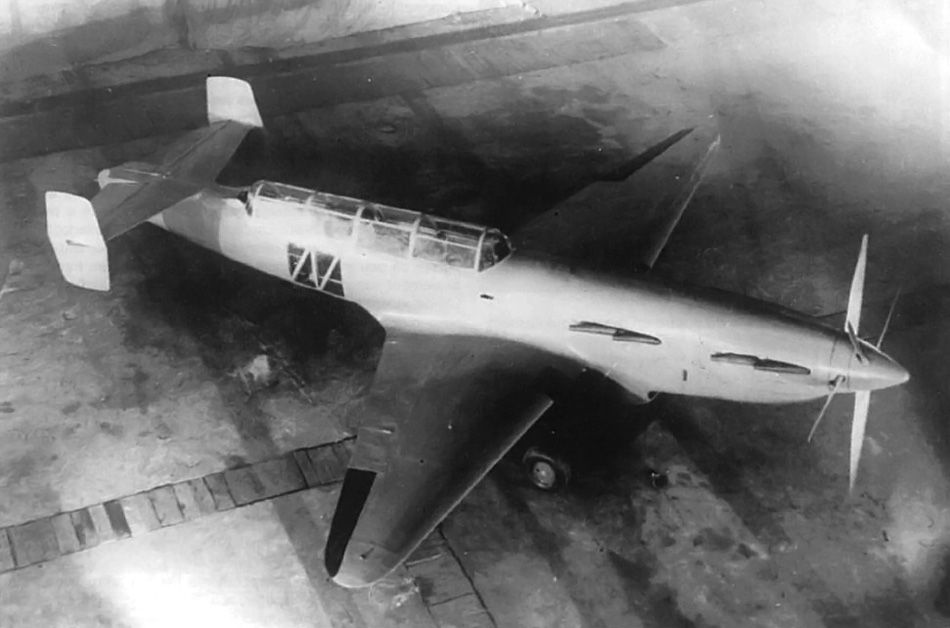
The nearly complete and unpainted high-speed research aircraft, the Kawasaki Ki-78. Note the radiator housing on the fuselage side.

The aircraft project was known as KEN III (for Kensan III or Research III) and incorporated numerous advanced features new to Japanese aircraft. Approval was given for the aircraft’s development and a full-scale wooden mockup was finished in May 1941. Because of the outbreak of World War II, the project was taken over by the Imperial Japanese Army and designated Ki-78. A production contract for two prototypes was awarded to Kawasaki, under the direction of Isamu Imashi. Construction of the first prototype began in September 1941 at Kawasaki’s plant at Gifu Air Field.

The Ki-78 was an all-metal, low wing monoplane of conventional layout. The small streamlined fuselage was made as narrow as possible and was 26 ft 7 in (8.1 m) long. The wings possessed a laminar flow airfoil with a span of 26 ft 3 in (8 m) and an area of 118.4 sq ft (11 sq m). To reduce landing speed and improve low-speed handling, the wings incorporated drooping ailerons along with a combination of Fowler and split flaps, which was a first for a Japanese aircraft. When the Fowler flaps were deployed, the split flaps opened simultaneously to a similar extent. When the flaps were fully deployed, the ailerons automatically drooped down 10 degrees.

Factory fresh and unpainted view of the Ki-78. The aircraft is missing its outer gear doors and there is no horn-balance on the elevator.

Power for the Ki-78 was provided by an imported Daimler-Benz DB 601A inverted V-12 engine driving a three-blade metal propeller. The engine was not a Kawasaki Ha-40, a licensed copy of the DB 601. The DB 601 had a 5.91 in (150 mm) bore and 6.30 in stroke (160 mm), giving a total displacement of 2,070 cu in (33.9 L). It produced 1,175 hp (876 kW) at 2,500 rpm. The engine was modified by Kawasaki with the addition of a water-methanol injection system (another Japanese first) to boot the power output to 1,550 hp (1,156 kW) for short periods. The Ki-78 carried 66 gal (250 L) of fuel and 16 gal (60 L) of water-methanol.

The freshly-painted Ki-78 running-up its DB 601A engine. Note the hinge in the outer gear door to account for extension of the gear strut.

The freshly-painted Ki-78 running-up its DB 601A engine. Note the hinge in the outer gear door to account for extension of the gear strut.

Engine cooling was provided by two radiators: one mounted on each side of the rear fuselage. The radiators had a wide air inlet protruding slightly out from the fuselage. Airflow through each radiator was controlled by an actuated exit door. In addition, within the fuselage a small 60 hp (45 kW) turbine drove a fan to further assist cooling. The aircraft stood 10 ft 7/8 in (3.07 m) tall and weighed 4,255 lb (1,930 kg) empty.

The Ki-78 first flew on 26 December 1942 and was found to be extremely difficult to fly at low speeds and had poor stall characteristics. The aircraft was heavier than the design estimates, which increased the wing loading. Even with the special flaps and drooping ailerons, takeoff and landing speeds were both high at 127 mph (205 km/h) and 106 mph (170 km/h) respectively. In addition, elevator flutter was experienced at the relatively low speed of 395 mph (635 km/h) but was subsequently cured by fitting a horn-balance to the elevator.

Rear view of the Kawasaki Ki-78 as found by American troops after the war. Note the flat tailwheel and missing cockpit glass, flight instruments, and starboard tire. This view also displays the radiator exit door and elevator horn-balance.

High-speed flight tests were started in April 1943, and during the Ki-78’s 31st flight on 27 December, the aircraft achieved its maximum speed of 434.7 mph (699.6 km/h) at 11,572 ft (3,527 m). This was considerably less than the program’s speed goal of 528 mph (850 km/h). A study showed that extensive airframe modifications were needed to improve the Ki-78 flight performance. Consequently, the project was officially terminated after the aircraft’s 32nd flight on 11 January 1944. Only one prototype was built.

The unique Ki-78 survived the war but was crushed by American forces at Gifu Air Field in 1945.

The sole Ki-78 being crushed by American forces at Gifu Air Field, after the war, in 1945.

Sources:
World Speed Record Aircraft by Ferdinand Kasmann (1990)
Japanese Aircraft of the Pacific War by Rene Francillon (1970/2000)
General View of Japanese Military Aircraft in the Pacific War by Airview (1956)
http://forum.axishistory.com/viewtopic.php?t=32870
http://www.letletlet-warplanes.com/2008/06/04/the-kawasaki-ki-78-ken-iii-research-plane/