Category Archives: Aircraft Engines

Deschamps V 3050 Diesel Aircraft Engine

By William Pearce

In the late 1920s, Desire Joseph Deschamps moved forward with his vision of an inverted, two-stroke, high-speed, diesel aircraft engine. Deschamps had immigrated to the United States from Belgium, where he had worked for the Minerva Company. Reportedly, Deschamps had a hand in designing Minerva’s first aircraft engine, which was also the first aircraft engine to incorporate Knight sleeve-valves (two sleeves).
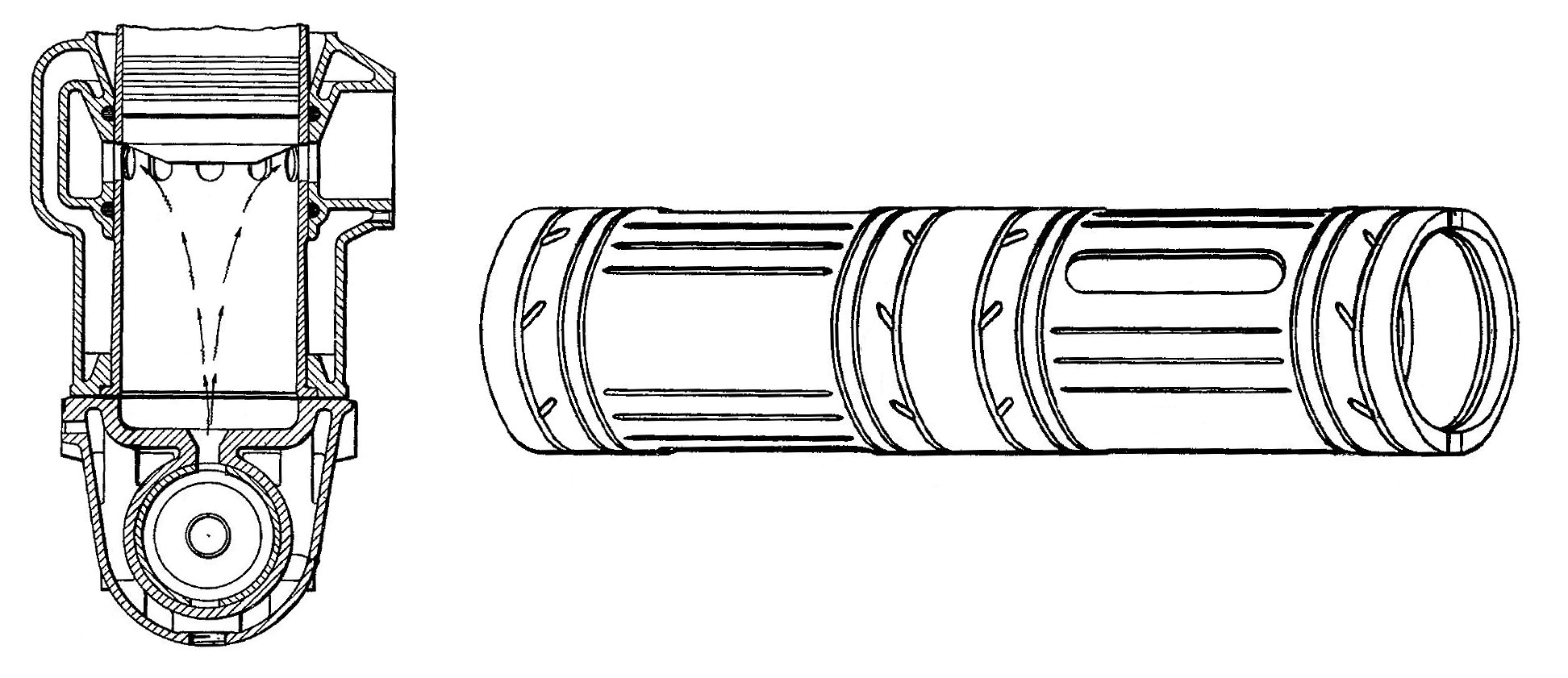
Deschamps rotary valve as outlined in U.S. patent 2,064,196. On the left is a transverse sectional view of the cylinder with the rotary valve below (inverted engine) and feeding to the combustion chamber. On the right is a side view of the rotary valve for two cylinders revealing the various ports in the valve.

Working out of St. Louis, Missouri, Deschamps began the design of an inverted, liquid-cooled, straight six-cylinder, diesel aircraft engine. Outlined in U.S. patent 2,064,196, what was unique about this diesel engine was the use of a rotary sleeve valve. This rotary valve was essentially a cylindrical tube that ran the length of the engine below (inverted engine) the combustion chamber. Induction air flowed through the tube that rotated at half crankshaft speed. As the tube rotated, ports in the tube aligned with a port to the cylinder, allowing fresh air to force the exhaust gases out of the cylinder and provide air for the next combustion cycle. The exhaust ports were around the cylinder wall and covered/uncovered by the piston.

From all accounts, the rotary valve engine was never built. A more conventional valve arrangement was adopted, utilizing poppet-valves, rather than the rotary valve, for the intake . A two-cylinder test engine was built and run in the early 1930s. The test engine engine developed 174 hp (130 kW) at 1,600 rpm. This two-cylinder engine was expressly for the development of the Deschamps inverted V-12 diesel, having the same bore, stroke, and general configuration of the larger engine to come.

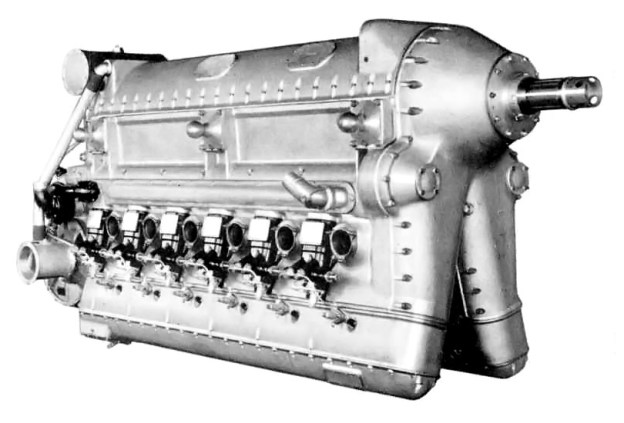
Deschamps V 3050 inverted V-12 aircraft diesel engine of 1934.

The Deschamps V 3050 was an inverted, 12-cylinder, diesel aircraft engine of all aluminum construction. The engine was built by the Lambert Engine and Machine Company in Moline, Illinois and completed in 1934. The cylinder banks were arranged in a 30-degree Vee to minimize the engine’s frontal area. With a 6.0 in (152 mm) bore and 9.0 in (229 mm) stroke, the engine had a total displacement of 3,053 cu in (50.0 L). The liquid-cooled, direct drive engine produced 1,200 hp (895 kW) at 1,600 rpm for takeoff and 950 hp (708 kW) at 1,500 rpm for cruise. Fuel consumption was 0.41 lb/hp/hr (249 g/kW/h). When built, it was one of the largest and most powerful diesel aircraft engines in the world.

The compression ratio of the V 3050 was 16 to 1, and air was forced into the cylinders by two gear-driven GE superchargers. The centrifugal superchargers were driven at 13.5 times crankshaft speed (21,600 rpm) and provided air at 12 psi (0.83 bar). Cylinder scavenging for the two-stroke cycle required eight psi, leaving four psi for boost. A small portion of the air entering the superchargers was taken from the crankcase to provide ample ventilation and burn away any fuel vapors. Sea-level power could be maintained to an altitude of 10,000 ft (3,048 m).

Each bank of cylinders had an intake manifold on the inside of the Vee to deliver air from the superchargers to the cylinders. The compressed air entered each cylinder via two poppet valves actuated simultaneously by an overhead camshaft driven at crankshaft speed.
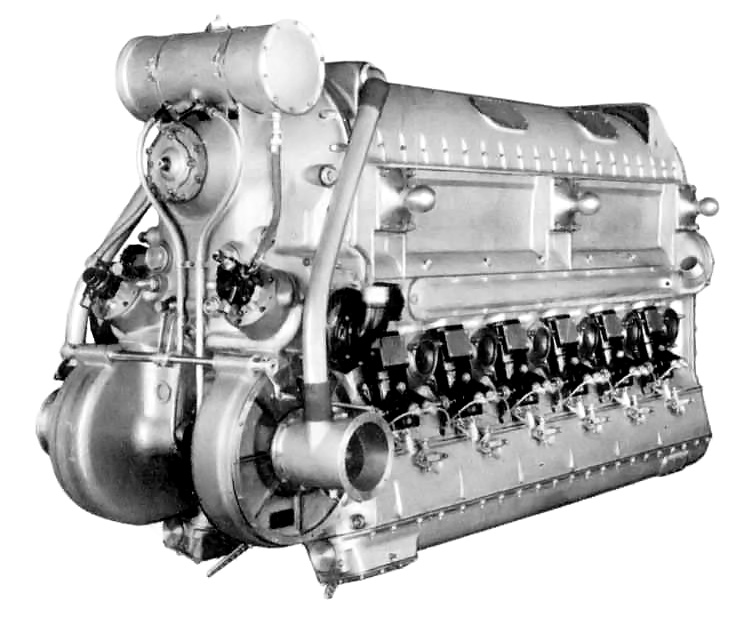
Rear view for the Deschamps diesel highlighting the two GE superchargers. The glow plugs are also visible on the right cylinder bank.

A ring of 12 exhaust ports was located in the cylinder wall and exposed by the piston. To prevent excessive oil consumption and exhaust smoke, a small horizontal groove was cut in the cylinder wall just below each of the 12 exhaust ports. The grooves in the cylinder liner aligned with an annular groove in the cylinder casing wall. The annular grooves for all 12 cylinders were connected to a vacuum pump that scavenged oil from the pistons. The amount of oil stripped from the pistons was controlled by the amount of vacuum.

The superchargers and camshafts were driven from the crankshaft via separate vertical shafts with bevel gears. A Lanchester type torsional vibration damper was incorporated on the rear of the crankshaft to protect the gear drives. The damper was combined with a torque limiter clutch that would slip momentarily under sudden changes in torque.

Each bank of cylinders had independent intake delivery, exhaust, liquid-cooling connections, oil connections, oil and fuel pumps, and fuel injectors. In theory, each bank could be operated independently of the other bank, sharing only a common crankshaft. At 1,600 rpm, oil was circulated at 80–100 psi (5.5–6.9 bar) while coolant circulation was at 230 gpm (871 l/m).
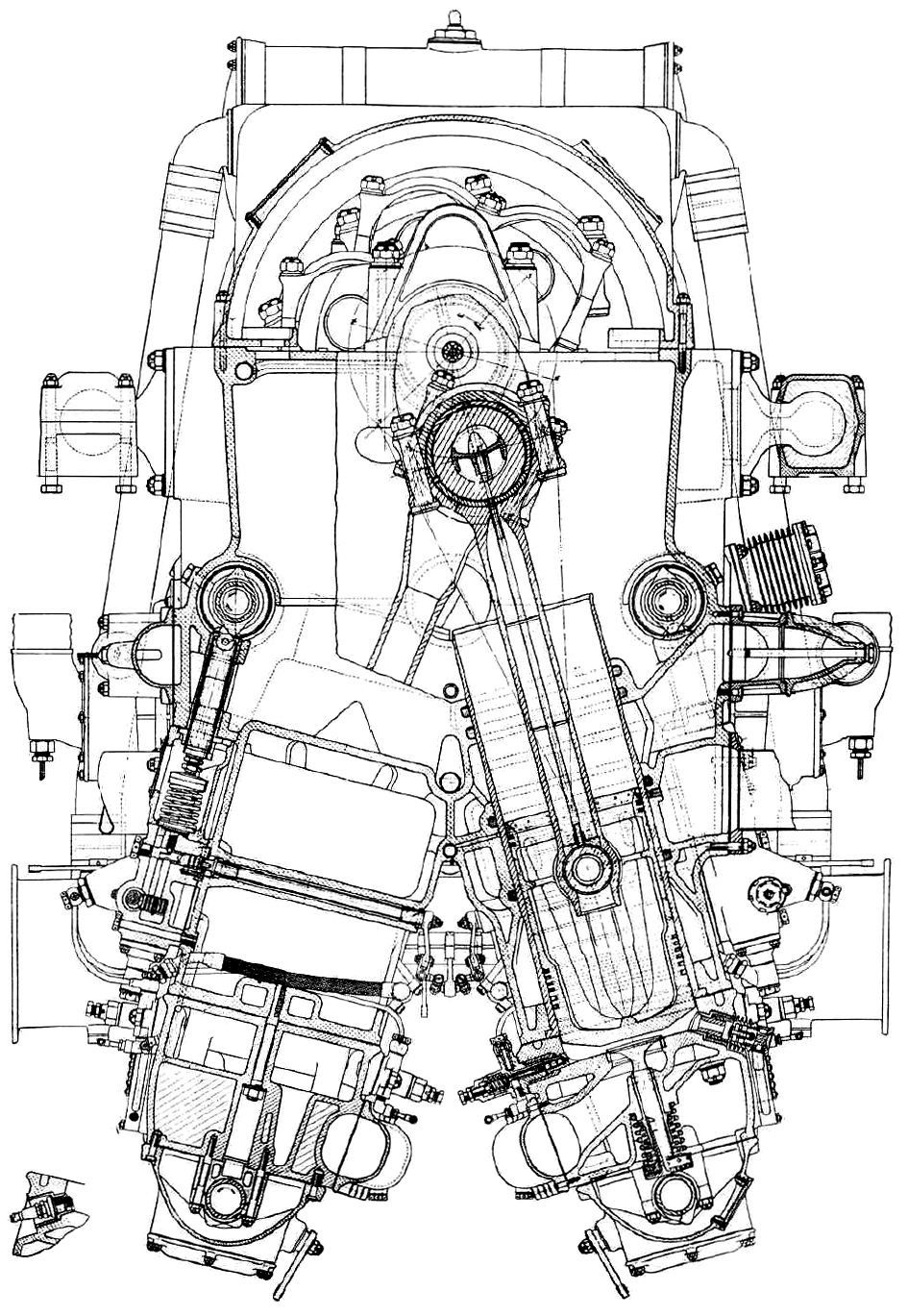
Sectional view of the Deschamps V 3050 diesel with the glow plug detailed on the lower left.

Fuel was injected directly into each cylinder via two Deschamps-designed (U.S. patent 2,020,302) fuel injectors operating at 3,500 psi (241.3 bar). The two injectors per cylinder alternated supplying fuel into the cylinder, each firing every-other compression stroke. For slow rpm operation, one injector was shut off, essentially making the engine a four-stroke. This kept the engine running smoothly and the cylinders warm for instant application of more power. One fuel pump for each engine bank was used and supplied fuel at 15 psi (1.0 bar) with a maximum flow of 150 gph (9.4 l/m).

The engine was air-started by a compressor charged to 850 psi (58.6 bar). For staring the engine in cold weather, glow plugs were provided in the right cylinder bank while the left bank’s intake valves were kept open with the fuel shut off. A reversing gear could be fitted for utilizing the engine in airships. The V 3050 was 26.5 in (0.67 m) wide, 49.5 in (1.26 m) tall, and 99 in (2.52 m) long. It weighed 2,400 lb (1,089 kg) with all accessories, giving it 2.0 lb/hp (1.2 kg/kW).

After completing the engine, no funds remained for testing. Deschamps met with the Army Air Corps Power Plant Laboratory in June 1934, but it seems no further testing was done on the engine. Deschamps went on to work for various aviation corporations, patenting a number of fuel injectors and pumps along the way. Amazingly, the Deschamps V 3050 diesel engine survives and is in storage at the National Air and Space Museum’s Garber Facility in Silver Hill, Maryland.
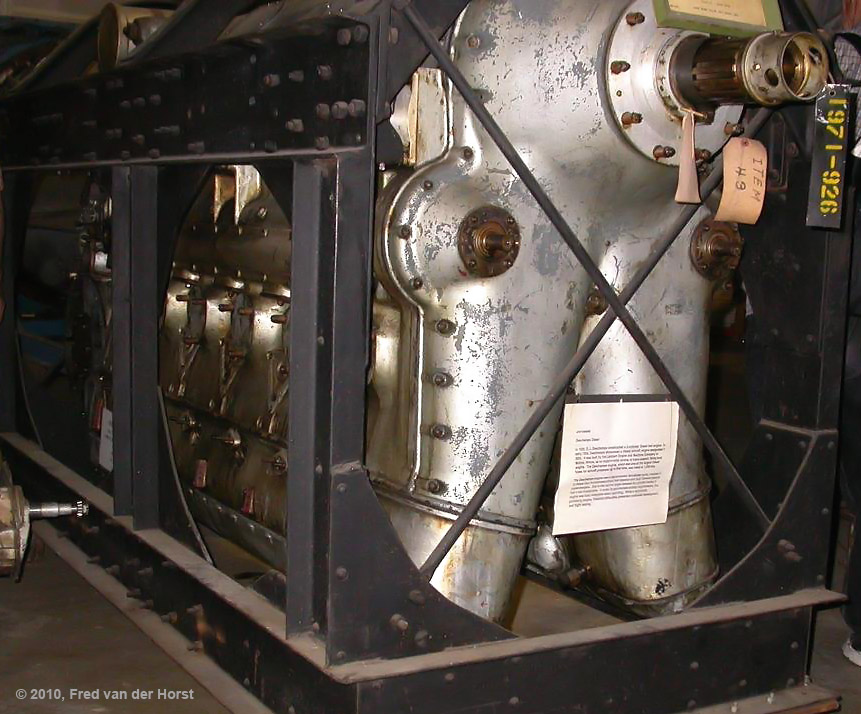
Deschamps Diesel in storage at the National Air and Space Museum’s Garber Facility in Silver Hill, Maryland. (Fred van der Horst image via the Aircraft Engine Historical Society)

Sources:
Aircraft Diesels by Paul H. Wilkinson (1940)
Aerosphere 1939 by Glenn Angle (1940)
Diesel Aviation Engines by Paul H. Wilkinson (1942)
Jane’s All the World’s Aircraft 1934 by C. G. Grey (1934)
– “A 1,200 H.P. Diesel Engine.” Flight. May 24, 1934
– “Internal Combustion Engine” U.S. Patent 2,064,196 by Desire J. Deschamps (1930) pdf

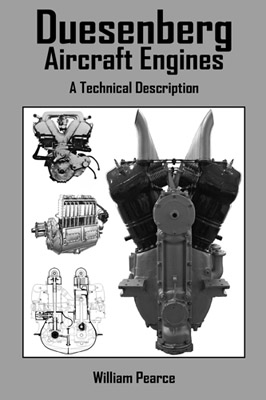
Duesenberg Aircraft Engines: A Technical Description

By William Pearce

The Duesenberg name became legendary in early auto racing and is now known around the world as one of the most sought after classic cars. For a brief period, encompassing World War I, Fred and Augie Duesenberg turned their attention to aircraft engines. In the span of five years, their company created four unique aircraft engines and was involved in the development of others.

Duesenberg Aircraft Engines: A Technical Description contains over 100 illustrations and describes the aircraft engines from this nearly forgotten chapter in Duesenberg and aviation history.

Contents:

Preface
1.  Fred and Augie Duesenberg
2.  Duesenberg “Walking Beam” Valve Gear
3.  Straight-Four Engine of 1915
4.  V-12 Engine of 1916
5.  Sixteen-Valve Straight-Four Engine
6.  The King-Bugatti U-16 Engine
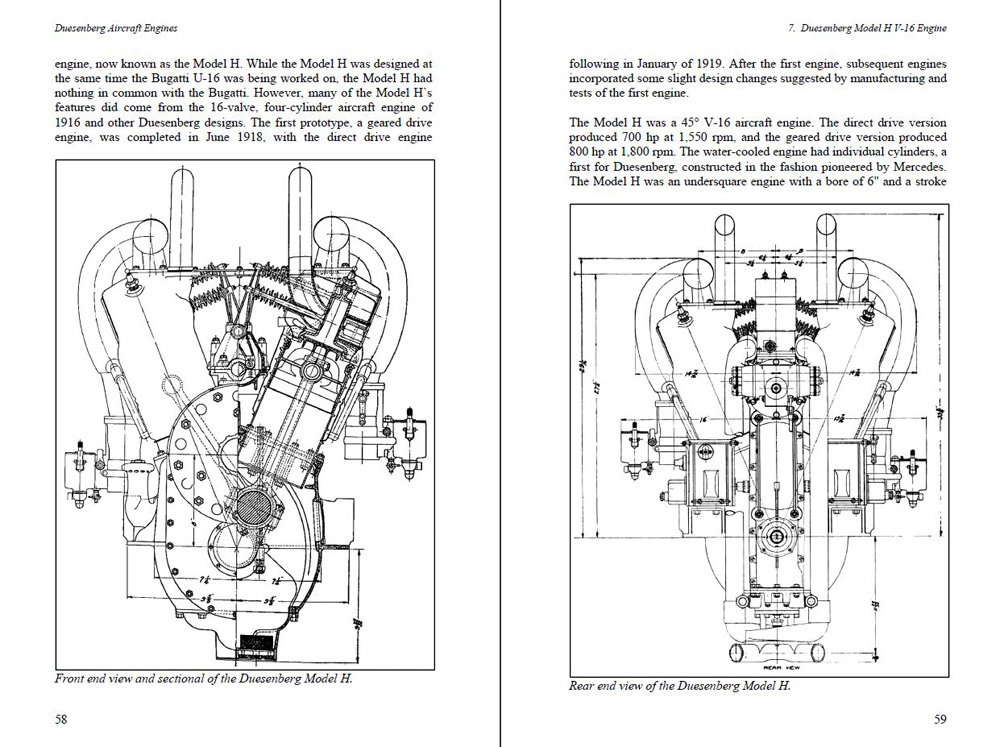
7.  Duesenberg Model H V-16 Engine
Epilogue
Appendix A – Duesenberg Aircraft Engine Comparison
Appendix B – Duesenberg Valve Gear Patent
Appendix C – The King V-12 Aero Engine
Appendix D – Duesenberg Engine Test House
Appendix E – Christensen Self-Starter
Appendix F – Notes on Descriptions and Conflicting Information
Bibliography

$12.99 USD
Softcover
6 in x 9 in
112 pages (122 total page count)
ISBN 978-0-9850353-0-3

Duesenberg Aircraft Engines: A Technical Description is available at Amazon.com. If you wish to purchase the book with a check, please contact us for arrangements.

Sample Pages:
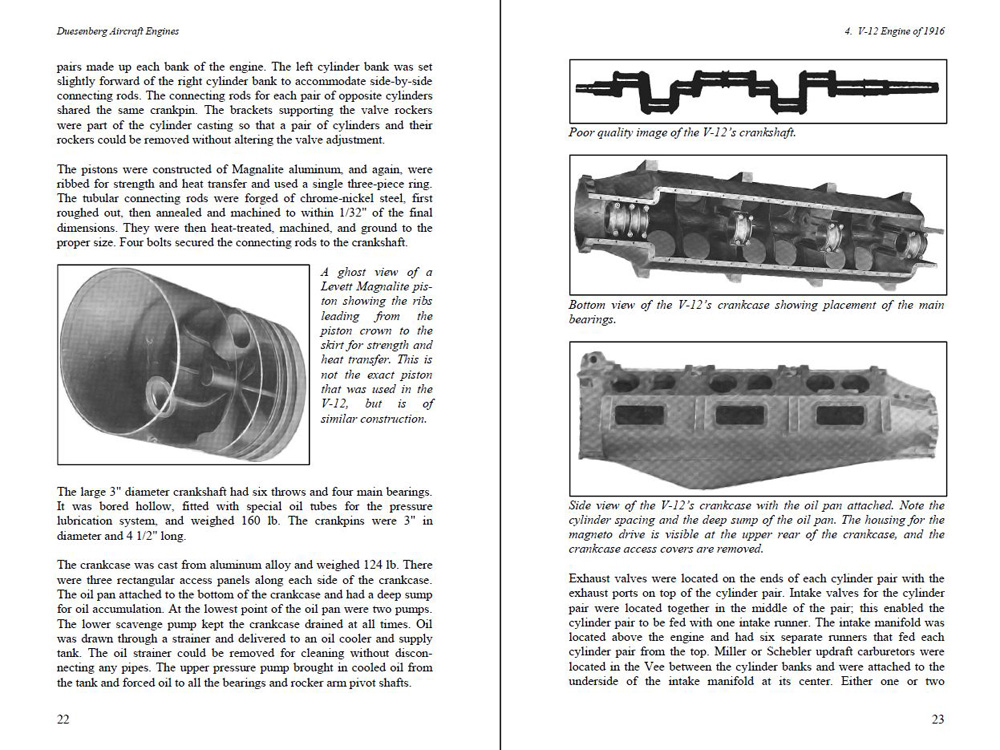
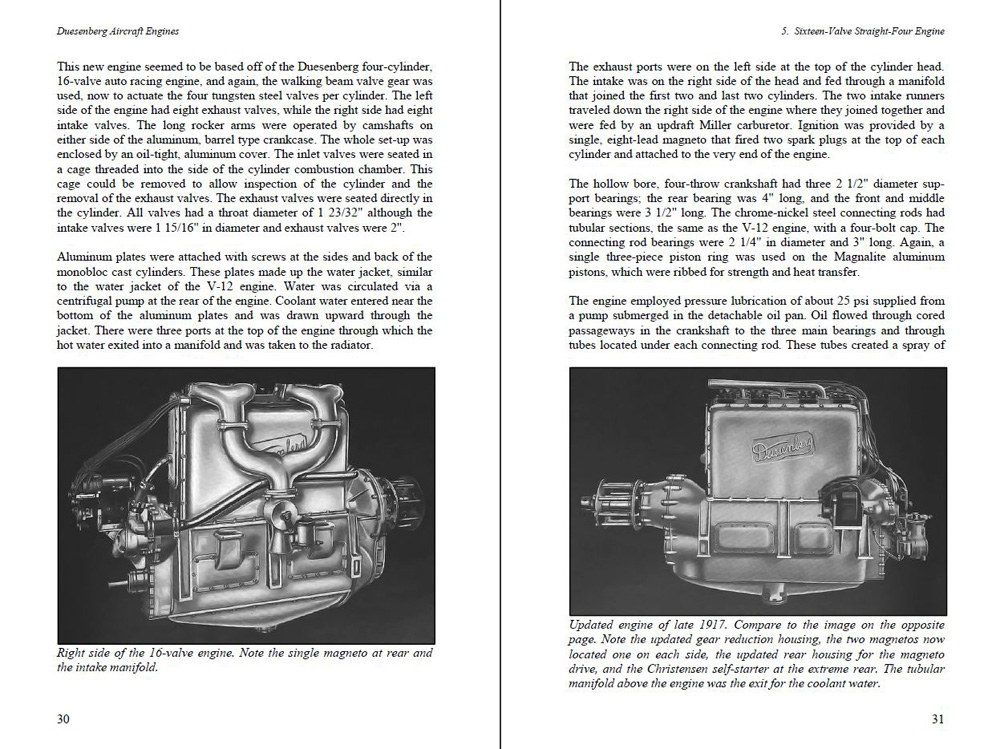
Duesenberg Aircraft Engines sample Duesenberg Aircraft Engines sample Duesenberg Aircraft Engines sample.

.

.


The revisions below are formatted to be printed and added to your copy of Duesenberg Aircraft Engines. Check the revision number on the copyright page and download any new revisions.
Revision 20130329
Revision 20150122

Duesenberg Motors New York Aero Show

A recently discovered image of the Duesenberg Motors Corporation display at the New York Aeronautical Exhibition, held in Madison Square Garden from 1 to 15 March 1919. From left to right is a complete King-Bugatti U-16 engine built by Duesenberg, the Duesenberg Model H V-16 engine with gear reduction, the sixteen-valve four-cylinder Duesenberg engine with gear reduction, and a partially assembled King-Bugatti engine.

Dreadnought at speed

One Second on the Course with Dreadnought – by Tom Fey

At a race weight of 6.25 tons, the trick Pratt & Whitney R-4360-63 powered T.20 Sea Fury “Dreadnought” is truly the big kid on the air racing block. Built, owned, and flown by the late Frank and sons Brian and Dennis Sanders, this two-seat masterpiece has turned the pylons as fast as 458.9 mph by virtue of the clean, highly detailed airframe and the 3,800 horses that tread within her custom cowling. Dreadnought has won the National Championship Reno Air Races twice, and finished second 13 times. To simply call this airplane large and fast, while certainly accurate, diminishes the fantastic complexity required to attain such impressive performance. If you could examine a single second of time while Dreadnought is hard at work, engine at 3000 rpm and 72 inches of manifold pressure, just 70 feet off the deck at 450 mph on the Reno course, what would you find?

Dreadnought at speed

Brian and Dennis Sanders’ Pratt & Whitney R-4360 powered Hawker Sea Fury, Dreadnought.

In that one second, the thundering, 4,290 lb R-4360 radial has gone through 50 revolutions, with each of the 28 finely-finned cylinders firing 25 times. Inside each cylinder of 156 cubic inch (2.6L) displacement (same as the entire V-6 powerplant in a C class Mercedes-Benz) a piston the diameter of a coffee saucer has transmitted close to 140 horsepower to the master rod. Seven cylinders drive each crankpin through one master and six link rods, with each of the four crankpins transmitting 900+ horsepower to the crankshaft. Seven hundred power pulses, one pulse for each 9.5° of propeller arc, have been transmitted to the six foot long, one-piece, forged, four throw steel crankshaft. Each piston has traveled 50 feet in linear distance, changing direction 100 times per second, with the total linear travel of all 28 pistons adding up to a ¼ mile. Each sodium-filled exhaust valve the diameter of a beer can (2.5 inches) has required 2.1 tons of initial force to open the port to expel the 1600° F gasses into the 14 exhaust stacks specifically choked to maximize jet thrust from the exhaust. The single-stage supercharger rotor, 14 inches in diameter, has spun 348 times, delivering 98 cubic feet of air at 72 inches of manifold pressure, equivalent to 21 psi above ambient pressure. Seven intake trunks, 2.75 inches in diameter, undulate forward from the supercharger housing to supply the compressed mixture to the intake valves perched atop the forged aluminum heads. The pressure within each cylinder will approach 235 psi before the four, low tension magnetos on the nose case supply the 1400 sparks per second, 20,000+ volts per spark, to the 56 individual spark plugs that fire off the charge.

In that one second, almost 14 fluid ounces of 115/145 performance number aviation  gasoline have been injected into the gaping Bendix PR-100 carburetor with an intake throat the size of a tool box. Five fluid ounces of anti-detonant water/methanol mixture have been force-fed into the intake system to assure the supercharged mixture, heated by compression, does not exceed 194°F, thereby moderating the charge to burn at the proper rate and at a sub-solar temperature. More than 12,408 BTU’s of heat energy (3.1 million calories) have been released into the engine, enough to raise the temperature of a 55 gallon drum of water 27° F. Approximately 8.6 fluid ounces of water has been sprayed at 35 psi from 14 nozzles placed in the narrow, 3.75 inch gap of the cowling inlet to atomize the fluid and dissipate heat directly from the otherwise air-cooled cylinders. In that thousand milliseconds, approximately 60 lbs of cooling air have entered through the three square feet of inlet area (area of a pizza box), its temperature raised 45° F by ram pressure alone, then cleverly guided by a tapered spinner afterbody, shrouds, hoods, and baffles to flow across the four rows of seven cylinders, expand across the engine, absorb heat, and exit the cowling exhaust chute.

Dreadnought takeoff

Installation of the R-4360 required a longer cowling to cover the engine and a taller tail to counteract torque.

In that one second, tucked inside the forged aluminum R-4360 nose case, 10 hefty steel planet gears, an inch thick with 23 teeth each, caged in the propeller reduction unit, have spun on their own plain bearings 50 times and orbited inside the ring gear close to 19 times to slow the speed of the propeller relative to the engine. The 13.5 foot diameter, four-bladed Aeroproducts propeller and regulator, some 528 pounds altogether, have made 18.75 revolutions, the tips arcing through 795 feet of linear distance and subjected to 2700 times the force of gravity. Each furnace-brazed, hollow steel propeller blade has a chord (width) of 15 inches and sports a custom contour at the outer trailing edge to reduce tip load vibration as it strains to efficiently convert 900 horsepower into thrust, speed, and victory.

In that one second, the 2 pressure oil pumps have sent 148 fluid ounces, almost 1.2 gallons, of 60 weight, W120 aviation oil at 90 psi through the engine to lubricate and cool the reciprocating symphony, while seven scavenge pumps have collected the oil, circulated it through the dual oil coolers, and back to 30 gallon oil tank. A lonely tablespoon of oil has escaped past the piston rings, burned, and been blown overboard.  Approximately 4.3 fluid ounces of spray bar water have been ejected from 56 ports at 15 psi.; 14 pairs of diametrically opposed ports for each of the two oil coolers, one cooler tucked into each wing root. The spray bar water is directed onto metal tabs welded to the stainless steel spray bar tubing, fracturing the stream and turbulating the mist, essential for removing 270 BTUs of heat per second from the oil.

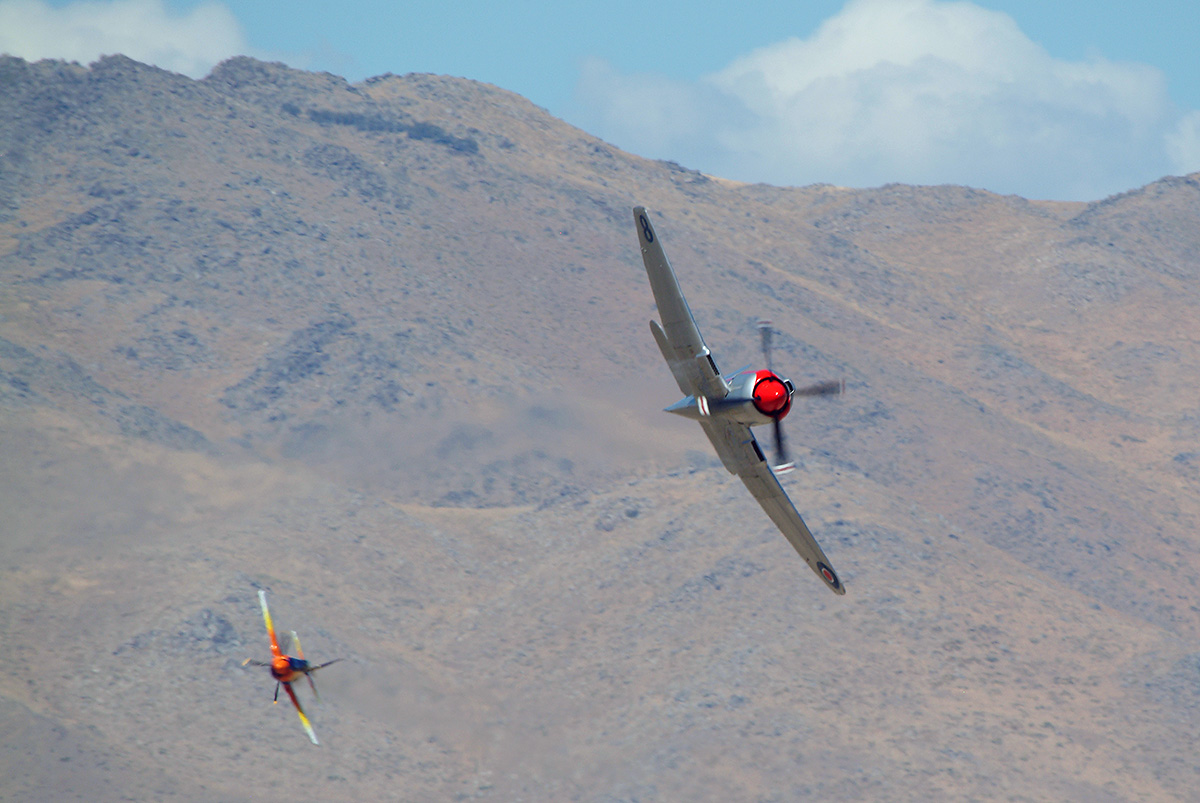
Dreadnought and Rare Bear

Dreadnought and Rare Bear on the course at Reno in 2012.

In that one second, over 1.72 million, yes million, foot/lbs of work have been done, enough to raise a 150 lb. man 2.2 miles into the air or lift a 60 ton Abrams battle tank through a football goal post. The mighty aircraft has covered 660 feet, roughly 1.5% of the current 8.48 mile Reno Unlimited course. Each second approximately 2 lbs of fluids are consumed and ejected, reducing the racer’s 45 lbs per square foot takeoff wing loading by 10% at touch down. In that single second, coming off Pylon 6, g force easing, wings almost level, the pilot begins a quick scan of the 9, 2.5 inch diameter analog gauges essential for racing (induction temperature, cylinder head temperature, oil temperature, oil pressure, torque pressure, cylinder head temperature, anti-detonant injection pressure, cylinder cooling spray pressure, fuel flow, oil cooler spray bar pressure, spray bar pressure, oil cooler door position indicator) aligned across the top 2 rows of the panel. The wide eyed but extremely focused pilot, Brian or Dennis Sanders, dodging dust devils, scanning the sky for aircraft and the ground for their shadows, is reassured to find all is well within the thundering juggernaut as it rat races over the mile high desert outside Reno, Nevada.

In just one second of the 535 seconds it takes to complete the 66.9 mile race, man and machine, wind and air, water and oil, speed and gravity, combine to make air racing the most elite motorsport of all. Despite engines and airframes that haven’t been manufactured since 1960, Unlimited-class air racing remains the World’s Fastest Motor Sport, and an experience of sight and sound unique in all of racing. Long live the big iron.

Dreadnought R-4360

With the cowling removed one can see the tight fit of the R-4360 and the baffles to direct the cooling air over the cylinders.

My thanks to Brian Sanders, Graham White, Pete Law, Bill Pearce, and Hewlett-Packard for their expert and most welcome assistance. – © Tom Fey  8-28-06

One hundred twenty-four seconds on the course with Dreadnought, qualifying for Reno at 449.357 mph in 2009, are captured in the video below. The video was uploaded by warbirdphotos and taken from the Valley of Speed. The vapor seen trailing the aircraft is from the spraybars.

Voodoo Air Racer

One Second in the Life of a Racer – by Tom Fey

Dago Red and Rare Bear

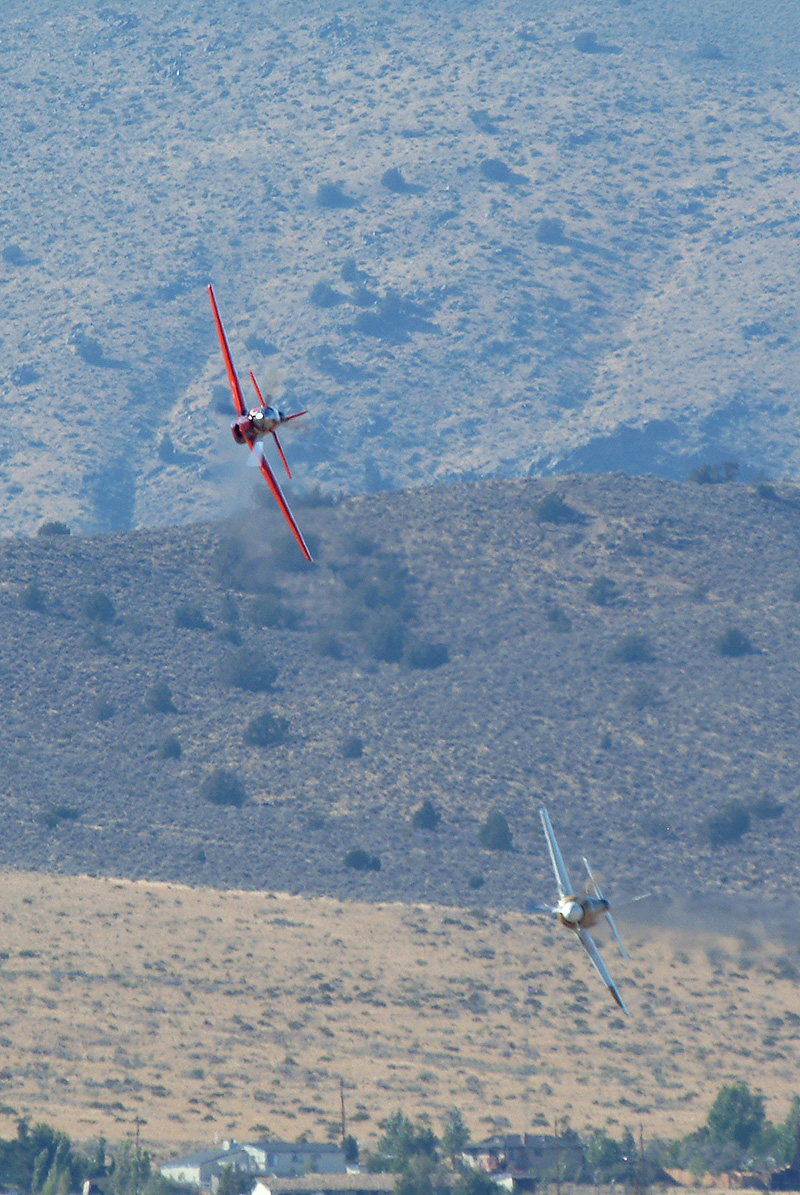
Dago Red leading Rare Bear toward the Home Pylon at the start of Sunday’s Unlimited Gold race in 2003.

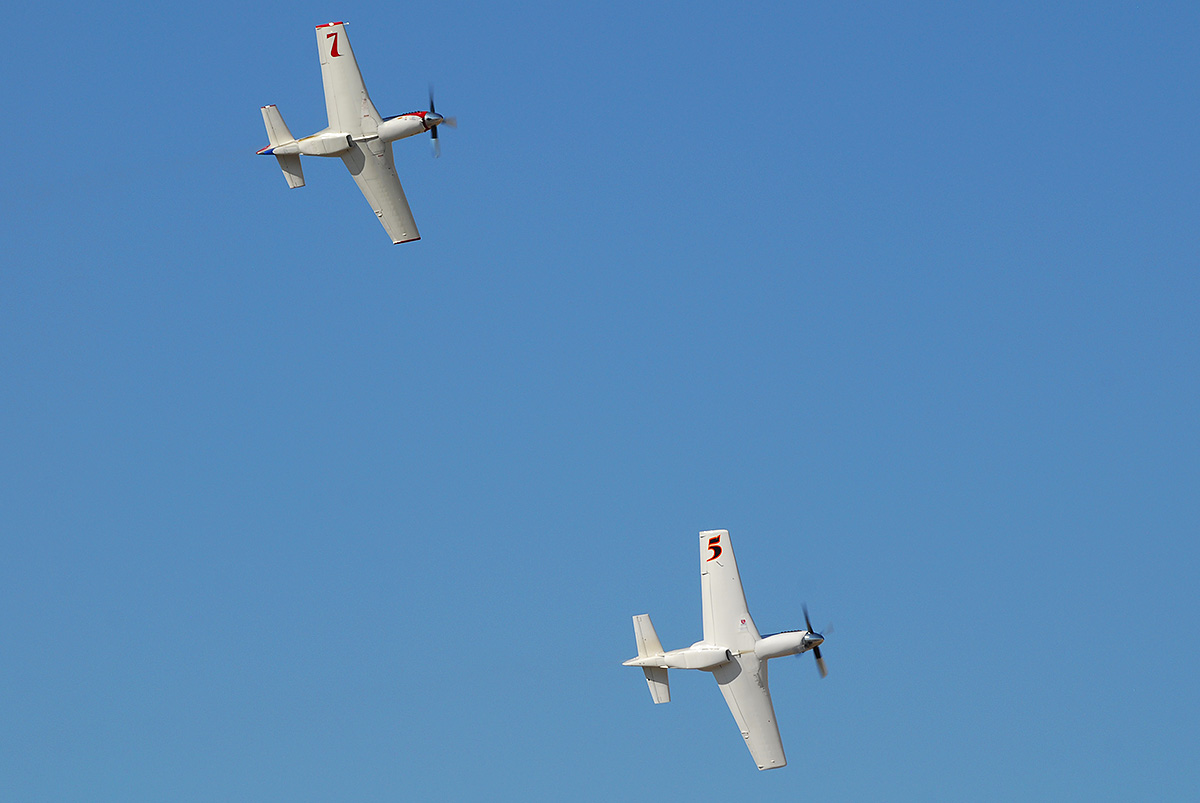
The Unlimiteds go flashing through the racecourse, engines howling, air shearing, heat waves streaming. Four hundred eighty miles an hour is 8 miles a minute, and the elite racers take about 70 seconds to cover the 9.1 mile Reno course. If you could take a souped P-51 racer flying the circuit at Reno, slow time down, and examine just one second, what would you find?

In that one second, the V-12 Rolls-Royce Merlin engine would have gone through 60 revolutions, with each of the 48 valves slamming open and closed 30 times. The twenty four spark plugs have fired 720 times. Each piston has traveled a total of 60 feet in linear distance at an average speed of 41 miles per hour, with the direction of movement reversing 180 degrees after every 6 inches. Three hundred and sixty power pulses have been transmitted to the crankshaft, making 360 sonic booms as the exhaust gas is expelled from the cylinder with a velocity exceeding the speed of sound. The water pump impeller has spun 90 revolutions, sending 4 gallons of coolant surging through the engine and radiators. The oil pumps have forced 56 fluid ounces, over four-tenths of a gallon, of oil through the engine, oil cooler, and oil tank, scavenging heat and lubricating the flailing machinery. The supercharger rotor has completed 348 revolutions, it’s rim spinning at Mach 1, forcing 4.2 pounds or 55 ft³ of ambient air into the combustion chambers under 3 atmospheres of boost pressure. Around 9 fluid ounces of high octane aviation fuel, 7843 BTU’s worth of energy, has been injected into the carburetor along with 5.3 fluid ounces of methanol/water anti-detonant injection fluid. Perhaps 1/8 fluid ounce of engine oil has been either combusted or blown overboard via the crankcase breather tube. Over 1.65 million foot pounds of work have been done, the equivalent of lifting a station wagon to the top of the Statue of Liberty.

Voodoo vs Strega 2017

Steven Hinton in Voodoo leads Jay Consalvi in Strega at the 2017 Reno Air Races. Consalvi went on to pass Hinton and won the Unlimited Gold Race by one second, averaging 481.340 mph (774.642 km/h).

In that one second, the hard-running Merlin has turned the propeller through 25 complete revolutions, with each of the blade tips having arced through a distance of 884 feet at a rotational velocity of 0.8 Mach. Fifteen fluid ounces of spray bar water has been atomized and spread across the face of the radiator to accelerate the transfer of waste heat from the cooling system to the atmosphere.

In that one second, the aircraft itself has traveled 704 feet, close to 1/8 mile, or roughly 1.5% of a single lap. The pilot’s heart has taken 1.5 beats, pumping 5.4 fluid ounces of blood through his body at a peak pressure of 4.7 inches of mercury over ambient pressure. Our pilot happened to inspire during our measured second, inhaling approximately 30 cubic inches (0.5 liter) of oxygen from the on-board system, and 2.4 million, yes million, new red blood cells have been formed in the pilot’s bone marrow.

In just one second, an amazing sequence of events have taken place beneath those polished cowlings and visored helmets. It’s the world’s fastest motorsport. Don’t blink!

© Tom Fey

Voodoo Air Racer

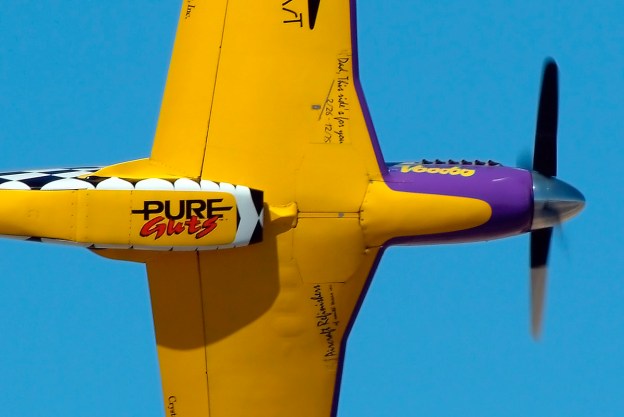
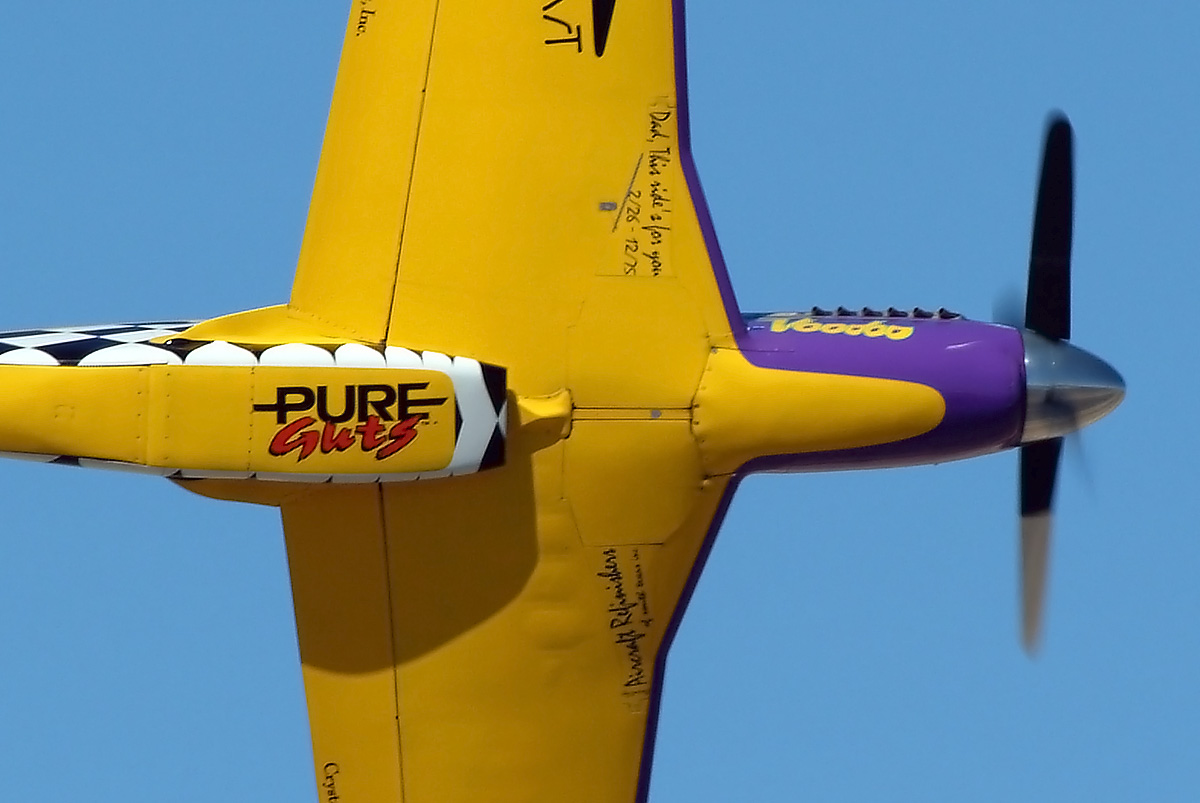
Voodoo, a highly modified North American P-51 Mustang competing in the Unlimited Air Racing Class at Reno, Nevada in 2003.