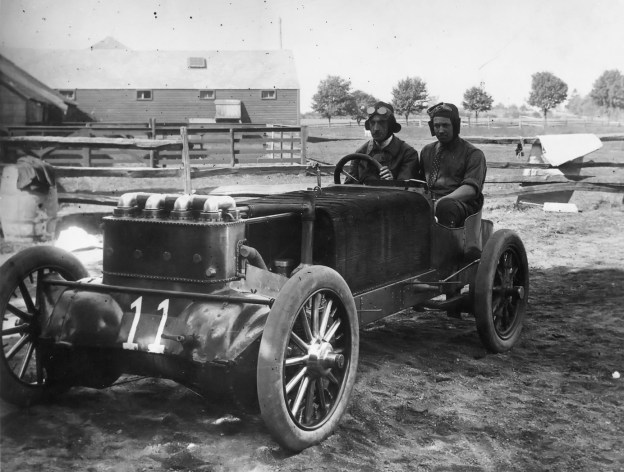
Christie 1905 racer and Robertson

Christie Inline Engine Race Cars

By William Pearce

John Walter Christie was born in New Milford, New Jersey on 6 May 1865. From 1881 to 1900 (age 16 to 25), he worked in and was a consultant for various engineering firms. During this time, he designed a new style of gun turret for Navy ships. This design proved lucrative, and in 1900, Christie opened his own machine shop, Walter Christie Machinery, in New York City, New York. He opened the Christie Iron Works the very next year in 1901. As the dawn of the automotive age shone on the United States, the successful Christie was able to own an automobile, but the engineer in him could not help but see ways to improve its design.

Christie 1903 Auto side

J. Walter Christie in his 1903 front-wheel drive auto, the first built in the United States. Just visible behind the rear wheel is the radiator. Christie took this car to Ormond Beach, Florida in January 1904.

By late 1903, Christie had built his own automobile, and it was unlike any other. He designed not only the car but also its engine and transmission. Christie felt that an automobile drive system should pull the vehicle (like a train or carriage), not push it (like a boat). As a result, Christie focused on a front-wheel drive system in which the engine was situated transversely between the front wheels. He believed this arrangement would create a light, simple, high-speed auto. Christie’s first vehicle design closely followed a patent that he took out in 1904. Christie’s front-wheel drive car was the first of its kind built in the United States.

The front axle of Christie’s auto was also the engine’s crankcase and housed its transmission. The cylinder block was mounted atop the axle housing. The auto had a low gear and a reverse gear; both provided a five to one reduction and enabled the drive wheels to slip relative to one another. For normal (high-speed) operation, the drive wheels were coupled to the crankshaft and wheel slip was limited. Each drive wheel had a clutch to facilitate the gear change. In addition, each drive wheel had two universal joints, and shafts that allowed for steering and independent coil spring suspension. The rear axle used leaf spring suspension.

Christie 1904 patent drive

A drawing from Christie’s 1904 patent illustrating the front-wheel drive system’s drive shafts, universal joints, and coil spring suspension. Note the offset X-beams of the connecting rods.

The 1903 car originally accommodated a driver and passenger (or mechanic, which for Christie was often his nephew Lewis Strang), but it was later fitted with a second row of seats for three passengers. The car only had rear brakes, and they were operated by a hand lever or a foot pedal. The auto weighted about 1,400 lb (635 kg). The engine for the 1903 car is believed to have had a 5.0 in (127 mm) bore and a 6.0 in (152 mm) stroke. It displaced 471 cu in (7.7 L) and produced around 30 hp (22 kW). The connecting rods were of the X-beam type. The X-beam was offset relative to the crankpin to allow for a shorter crankshaft and to provide clearance for the crankshaft’s three main bearings. A handle for crank-starting the engine protruded from the front of the axle, but the car was typically push started.

The engine had an intake over exhaust (F-head) valve arrangement. A set of four intake valves with a small combustion chamber space beneath them was positioned adjacent to the cylinder. The intake valves were atmospheric (or automatic): they were held closed by a weak spring and pulled open by the vacuum created during the piston’s downward stroke. A single, large exhaust valve was situated under the intake valves. The exhaust valves were mechanically operated. They were actuated by pushrods driven by a camshaft geared to the engine’s crankshaft. Each cylinder had a single spark plug positioned in the combustion chamber space between the exhaust valve and intake valves. The spark plugs were fired by a communicator (distributor) driven from an auxiliary shaft.

Christie 1903 Auto front

The 606 cu in (9.9 L), 30 hp (22 kW) engine of the 1903 Christie car. The spark plugs are in the center of the combustion chamber space adjacent to the cylinders. A set of four intake valves are above each spark plug, with a single exhaust valve below. Note the exhaust manifold. The hand crank on the front of the car was used to start the engine.

For induction, the air/fuel mixture flowed from a remote carburetor and through a long intake pipe to the engine. The intake manifold sat atop the engine and was split into four runners. Each runner connected to one group of four intake valves

The engine’s cylinders were covered by water jackets formed from sheet copper and screwed to the cylinder block. A remote water pump drew cooling water from the radiator and sent it to the engine. After flowing through the engine, the cooling water was taken from the top of the engine and sent to the radiator. The radiator was positioned under the rear of the car for better weight distribution. The water pump was driven from the same shaft that drove the ignition system’s communicator.

Christie 1904 racer

Christie’s 1904 racer with its unusual radiator and eight-intake-valves-per-cylinder engine. Christie sits in the driver’s seat.

Christie took the 1903 car to Ormond Beach, Florida (just north of Daytona Beach) in January 1904. In his car, Christie averaged 63.1 mph (101.5 km/h) in a 10 mile (16 km) race and completed a 25 mile (40 km) endurance race. However, the engine did experience some issues from lack of lubrication. Christie continued to campaign this car at a few events, but he also built a larger car more dedicated to racing in 1904.

Christie’s 1904 racer used an engine of similar configuration to the 1903 engine. However, each cylinder had two sets of intake valves, for a total of eight per cylinder. The new set of four intake valves was positioned directly above the piston. Each of the four intake runners that sat atop the engine had two outlets, one for each set of four valves. The engine’s bore and stroke were 6.25 in (159 mm) and 6.75 in (171 mm) respectively. The engine had a total displacement of 828 cu in (13.6 L) and produced 70 hp (52 kW). Its crankshaft and pistons were made of carbon steel, and its crankcase and flywheels were made of a manganese bronze alloy. The spark plugs were fired from a battery powered coil ignition.
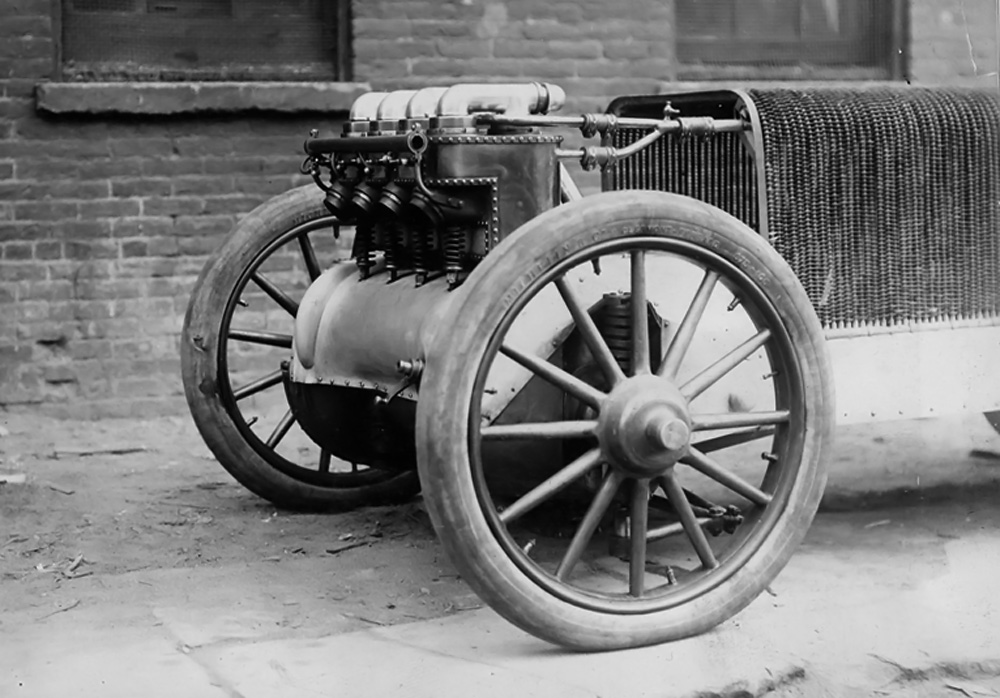
Christie 1904 racer engine

A close up of the engine in the 1904 Christie racer. Note the springs for the mechanical exhaust valves, the lack of an exhaust manifold, and the outlet for the sheet copper water jacket.

In the 1904 car, the driver and passenger were moved to the extreme rear of the vehicle for better weight distribution. In addition, the fuel tank was situated under the seat. A new radiator was installed in the middle of the auto. It consisted of around 60 long, copper tubes shaped in an inverted “U” extending from one side of the car to the other. The radiator was positioned so that air passed over it rather than through it; this configuration limited its effectiveness. No information regarding where or if the 1904 car was raced has been found. Some believe that it was a modification of the 1903 car, but it was not; the engine, axle, and frame were all different.

Christie continued to develop his concept of the front-wheel drive racer and built another car toward the end of 1904. The car, sometimes referred to as the Blue Flyer, made its debut at Ormond Beach in January 1905. It was very similar to the 1904 racer but had a new frame and axle. The car was powered by the same 70 hp, 36-valve (four being exhaust), four-cylinder engine used in the 1904 car. However, its orientation had been changed so that the exhaust valves were toward the rear of the vehicle.

Christie 1905 racer engine

The engine of the 1905 Christie racer was the same used in the 1904 racer; it was repositioned so that the exhaust valves faced toward the rear of the vehicle. The protuberance on the front of the engine was the water jacket outlet used on the 1904 car. The two sets of four valves for one cylinder are visible in the right image.

A new radiator was developed consisting of 12 sections (although photos seem to indicate only eight sections). Each of the sections was made up of eight copper tubes that were 5/16 in (8 mm) in diameter and 64 in (1.63 m) long. Attached to each section were 340 aluminum fins that were 5 in (127 mm) long and 1 in (25 mm) wide. Reportedly, this gave the radiator a surface area of some 20,000 sq in (12.9 sq m), but as with the earlier radiator, air flowed over its surface. Cooling water was taken from the water jacket between the cylinders and delivered to an expansion tank in front of the radiator. The water then flowed through the radiator and into the bottom of the water jacket on both sides of the engine. The 1905 racer had a 96 in (2.44 m) wheel base, a 57.5 in (1.46 m) track, and weighed 1,800 lb (816 kg).

For each revolution of its 40 in (1 m) wheels, the car travel 10 feet (3 m) forward. Given the car’s direct drive, 90 mph (145 km/h) would be achieved at 792 rpm. Christie raced the car on Ormond Beach in January 1905 and covered a mile in 42.2 seconds (85.3 mph / 137.3 km/h). Christie went on to win a 50 mile (80 km) race and received the Lozier Trophy. However, his was the only car to finish the race. Regardless, people were impressed by Christie and his automobiles. Based on the interest in his vehicles, Christie formed the Christie Direct Action Motor Car Company in March 1905 to manufacture passenger and race cars.

Christie 1905 twin engine racer

This image shows Christie’s 1905 racer modified with a second engine. The rear engine appears to be identical to the engine used in the 1903 car. The radiator appears to have eight sections.

In search of more power, Christie installed a second engine in the 1905 car. The car was lengthened, and the second engine was installed behind the driver and passenger. The second engine produced around 30 hp and powered the rear wheels. The engine appears to be the same four intake and one exhaust valve engine used in the 1903 car (and used in the 1906 car described below). The two engines provided a total of around 100 hp (75 kW). The twin-engined car made its debut on 4 July at Morris Park, New York. The car proved to be a handful but went on to run at Cape May, New Jersey in July, where it covered a mile in 37.0 seconds (97.3 mph / 156.6 km/h). In August, Christie ran a km in 25 seconds (89.5 mph / 144.0 km/h). In September, that flying km time was lowered to 23.25 seconds (96.2 mph / 154.8 km/h), for which Christie won the Cape May Trophy. Later in September, the rear engine was removed from the racer after it failed while Christie was attempting a new mile record. (It appears two additional radiator sections were added at this time, bringing the total to 10.)

Christie then set his sights on the Vanderbilt Cup race scheduled for 14 October in Long Island, New York. George Robertson was selected to drive the car in the race, but he was not familiar with the peculiarities of the car and its front-wheel drive. Robertson had trouble during qualifications on 23 September and ultimately crashed the car. The needed repairs took too long, and Christie’s car was out. However, the Cup Commission made a bizarre decision that is still not understood. Three qualified cars were removed from the race, and three cars that did not qualify were reinstated; Christie’s racer was one of the three reinstated cars.

Christie 1905 racer and Robertson

Christie and George Robertson sit in the 1905 racer ready for a Vanderbilt Cup practice run . The rear engine has been removed, and the radiator now has 10 sections. Robertson crashed the car a short time later.

Christie worked feverishly, almost up to the start of the race, to completely repair his racer, which had suffered some engine damage. Christie drove his car in the race due to Robertson’s inexperience with the unique racer. At the start, Christie’s 1905 racer ran poorly and completed the first lap at only 29.2 mph (47.0 km/h). The engine then smoothed out, and the second lap passed at 56.0 mph (90.1 km/h). On the fourth lap, Italian driver, and race leader, Vincenso Lancia left the pits right as Christie was speeding by. Christie tried unsuccessfully to avoid a collision. Both drivers and their mechanics escaped with only minor injuries. Christie’s car was damaged beyond repair, and the time needed to repair Lancia’s car effectively took him out of contention.

Christie rebuilt the 1905 racer with a new V-4 engine. The car made its debut in January 1906. Unfortunately, it crashed on 16 September during qualification for the 1906 running of the Vanderbilt Cup. Christie quickly took stock of his resources to find a new car for the races held on 6 October.

Christie 1906 touring car

The Christie Direct Action Motor Car Company’s 1906 touring car. This car was stripped of its body and modified to race in the 1906 Vanderbilt Cup. Note the stripe painted on the axle.

The Christie Direct Action Motor Car Company had just completed a seven-passenger touring car. With no other car available, it was the only option for the race. Christie quickly returned to his New York shop and removed the touring car’s blue painted body and black leather seats. A new body was fabricated with the seats over the rear axle. The steering was redone and the steering shaft extended. Other efforts were made to lighten the 2,300 lb (1,043 kg) touring car.

The touring car’s radiator was removed and a new one installed. The new radiator was similar to those used in the previous Christie cars but had a header tank at its center. The engine of the touring car was very similar to the original Christie F-head engine from 1903 and to the engine used in the rear of the 1905 car—all had four atmospheric intake valves and one mechanical exhaust valve. It is possible that these three engines were actually the same engine. However, the bore and stroke of the touring car’s engine was increased from the 1903 engine by .375 in (10 mm) and 1.0 in (25 mm) respectively. The touring car’s engine had a 5.375 in (137 mm) bore and a 7.0 in (178 mm) stroke. The engine produced 50 hp (37 kW) at 1,200 rpm from its 635 cu in (10.4 L). The car had a 102 in (2.59 m) wheel base and a 56 in (1.42 m) track. In race trim, the touring car’s weight was dropped to 1,895 lb (860 kg) race-ready.
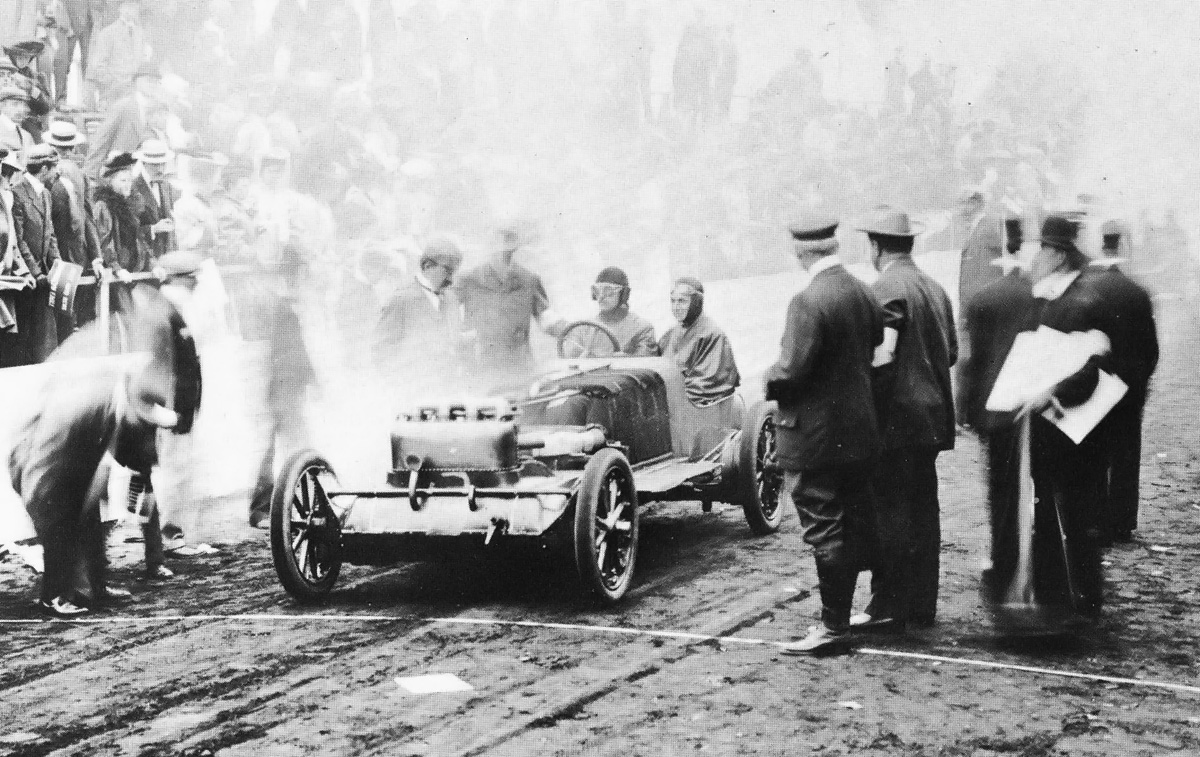
Christie 1906 Vanderbilt start

Christie and his nephew Lewis Strang sit in the race-ready touring car stripped for the 1906 Vanderbilt Cup race. This image was taken at the start of an elimination trial. The stripe on the axle noted in the previous image is just visible.

At less than half the power of most of the other cars in the Vanderbilt Cup, Christie did not stand much of a chance. After running for a while in seventh place, Christie had slipped back to 13th place out of the 18 competitors, averaging 44.7 mph (71.9 km/h) when the race was called. Even so, Christie had shown that his front-wheel drive cars were as reliable and competitive as those of other manufacturers that used a conventional powertrain. After the race, Christie refocused on his V-4 racers.

Christie’s 1906 touring-car-turned-racer was eventually sold to William Gould Brokaw. The car reappeared in March 1908 at Ormond Beach, Florida and was driven by R. G. Kelsey. The racer failed to finish a 125 mile (201 km) race but placed second and averaged 62.4 mph (100.4 km/h) in a 256 mile (412 km) race held two days later. Also, Kelsey covered a mile in 42.8 seconds (84.1 mph / 135.3 km/h). The further activities and ultimate disposition of the racer is unknown.

Christie 1906 Vanderbilt

Christie and Strang taking a turn during the 1906 Vanderbilt Cup race. Although the bore had been increased, the engine could very well be the same as the original 1903 engine.

Sources:
– “The Front-Wheel-Drives of John Walter Christie, Inventor” by Stan Grayson Automobile Quarterly Volume 14, Number 3 (1976)
– “Motor-Vehicle” US patent 761,657 by Walter Christie (granted 7 June 1904) 2.7 MB pdf
– “A New American Automobile” Scientific American (28 January 1905)
– “The First Christie Front Drive Touring Car” The Automobile (13 September 1906)
– “Now for the Selection of the American Cup Team” The Motor Way (20 September 1906)
– “Christie’s New 100-Horsepower Racer” The Automobile (5 August 1909)
– “Florida’s Meet Supplied More Records than Races” by John C. Wetmore The Automobile (12 March 1908)
http://www.stohrdesign.com/christie-automobiles-1903-1909-a-blog (various pages)
http://www.vanderbiltcupraces.com (various pages)

Roberts 6-X engine side

Roberts Motor Company Aircraft Engines

By William Pearce

In the early 1900s, the Roberts Motor Company of Sandusky, Ohio made a series of two-stroke engines for boats. With aviation gaining popularity, it was only natural for the company to adapt its engines for aircraft use. Roberts aircraft engines first appeared in 1911 and were designed by the company’s founder and president Edmund W. Roberts.

Roberts 4-X engine Smithsonian

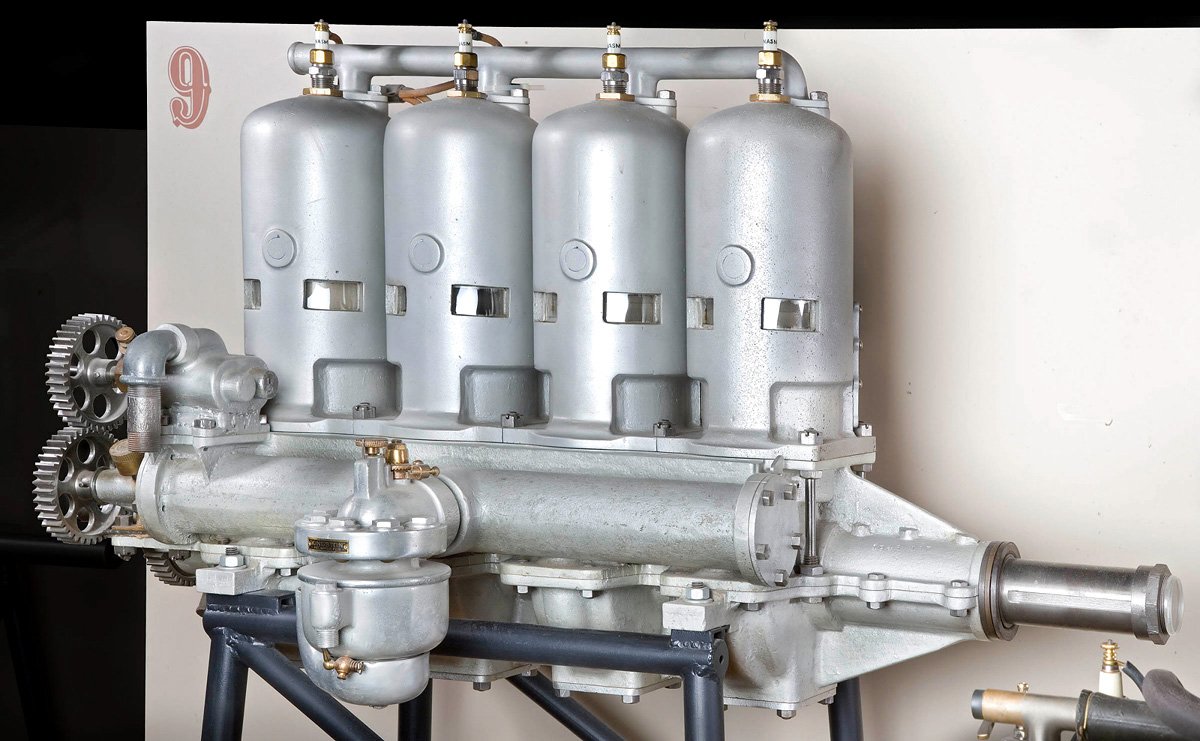
A four-cylinder Roberts 4-X engine on display at the Smithsonian National Air and Space Museum in Washington, DC. Note the tubular housing to which the carburetor is attached. Inside the housing is the tubular distributor sleeve for delivering the air/fuel mixture to the cylinders. The water pump is mounted on the upper rear of the housing. (National Air and Space Museum image)

Roberts Motor Company’s aircraft engines differed from their marine counterparts in that they were engineered to be as light as possible. To keep parts (and associated points of failure) to a minimum, the Roberts two-stroke engines did not use poppet valves. In addition, Roberts’ engines incorporated unique designs to overcome drawbacks generally found with two-stroke engines, namely the air/fuel mixture pre-igniting as it entered the cylinder, causing a backfire.

The engines’ cast cylinder liners were constructed of a proprietary alloy called “Aerolite,” which Roberts said was as light as aluminum but twice as strong and had the wear properties of cast iron. The individual cylinder liners were covered by an aluminum water jacket. A ring around the base of the cylinder liner would fit into a recess around the bottom of the water jacket, securing the two together. The cylinder liner’s spark plug boss (and that of the decompressor if present) passed through the water jacket casting. The outer diameter of the boss was threaded, and a nut secured the top of the water jacket and cylinder liner. This nut would also draw up the base of the liner into the water jacket, securing the whole cylinder assembly.

Roberts 6-X engine side

The six-cylinder Roberts 6-X engine. The crankcase casting provided a space under each cylinder for the air/fuel mixture. Each space was sealed by crankshaft main bearings. Note the two exhaust ports for each cylinder.

The pistons were made of cast iron and were attached to drop forged I-beam connecting rods made of vanadium steel. The connecting rods were attached to the crankshaft by a bronze strap about a third the size of the crankpin. (Firing every revolution, the pistons of a two-stroke engine are not pulled down by the crankshaft and therefore do not need a full-size connecting rod bearing cap.) The crankshaft was hollow and made of drop forged steel. The cylinders were secured to the crankcase by four bolts, with adjacent cylinders sharing their bolts. The crankcase was made from Magnalium, an aluminum and magnesium alloy that made it lighter and stronger than an aluminum crankcase of the same thickness.

The carburetors were mounted to a tubular housing that ran along the right side of the engine. Inside of this housing was a tubular distributor sleeve (also called a rotary induction valve) driven by an intermediate gear that engaged the accessory drive gear mounted on the end of the crankshaft. The distributor sleeve rotated at crankshaft speed and had ports to control the air/fuel mixture flow from the carburetor into the crankcase. The crankcase was constructed so that a small space existed under each cylinder for the incoming charge. The carburetor aligned with multiple ports in the distributor sleeve to allow a constant flow into the distributor, but each cylinder matched up with a single port to control air/fuel delivery. For each cylinder, the incoming charge passed from the distributor though a port in the side of the crankcase. The distributor helped eliminate the risk of backfires and distributed the air/fuel mixture equally to all the cylinders, allowing the engine to run smoothly.

Roberts 4-X Rotary Distributor

The tubular distributor sleeve of a Roberts 4-X engine. The ports at the center of the tube aligned with the carburetor.

The distributor port opened as the piston moved up and drew in the air/fuel mixture. The port then closed as the piston moved down on its power stroke, compressing the incoming charge underneath. Two ports in the piston aligned with ports in the cylinder wall when the piston was near bottom dead center. This alignment allowed the pressurized, incoming air/fuel mixture to flow from the crankcase into a space on the outer side of the cylinder. In this space, Roberts installed what they called a “cellular by-pass” to prevent backfires. The incoming charge flowed through the cellular by-pass and then through another set of ports positioned above the piston. The piston’s top had a large deflector to send the incoming air charge toward the top of the combustion chamber to improve exhaust gas scavenging. This deflector was positioned on the intake port side of the piston. Two exhaust ports were located on the opposite side of the cylinder from the intake ports and were also controlled by the piston so that all ports were uncovered when the piston was near bottom center.

The cellular by-pass was a series of flat and corrugated plates creating a honeycomb mesh. The large surface area of the cellular by-pass extinguished any flame should a backfire occur, but it did not decrease the engine’s efficiency in normal operation. The Roberts engine’s resistance to backfiring allowed a leaner mixture to be used, thus increasing the engine’s fuel economy. The cellular by-pass also helped mix and vaporize the fuel in the incoming charge.

Roberts 6-X parts Weeks

Various parts for one of the two Roberts 6-X replica engines built for Kermit Weeks. Note the deflector on the top of the pistons and the two ports in the side of the pistons. A decompressor valve can be seen on the top of the cylinder in the lower left corner. (Fantasy of Flight image)

The water pump was mounted at the right rear of the engine and was driven from the gear driving the tubular distributor sleeve. The pump drew water from the radiator and then pushed it through a passageway on the right side of the crankcase. Each cylinder had an open port that aligned with a coolant passageway in the crankcase. The water flowed into a small channel in the cylinder and then around the exhaust ports and up into the cylinder’s water jacket. It then flowed out the top of the cylinder and into a manifold that led back to the radiator. The engine was lubricated by the oil and fuel mixing and via splash lubrication. Grease cups were used to lubricate the main bearings.

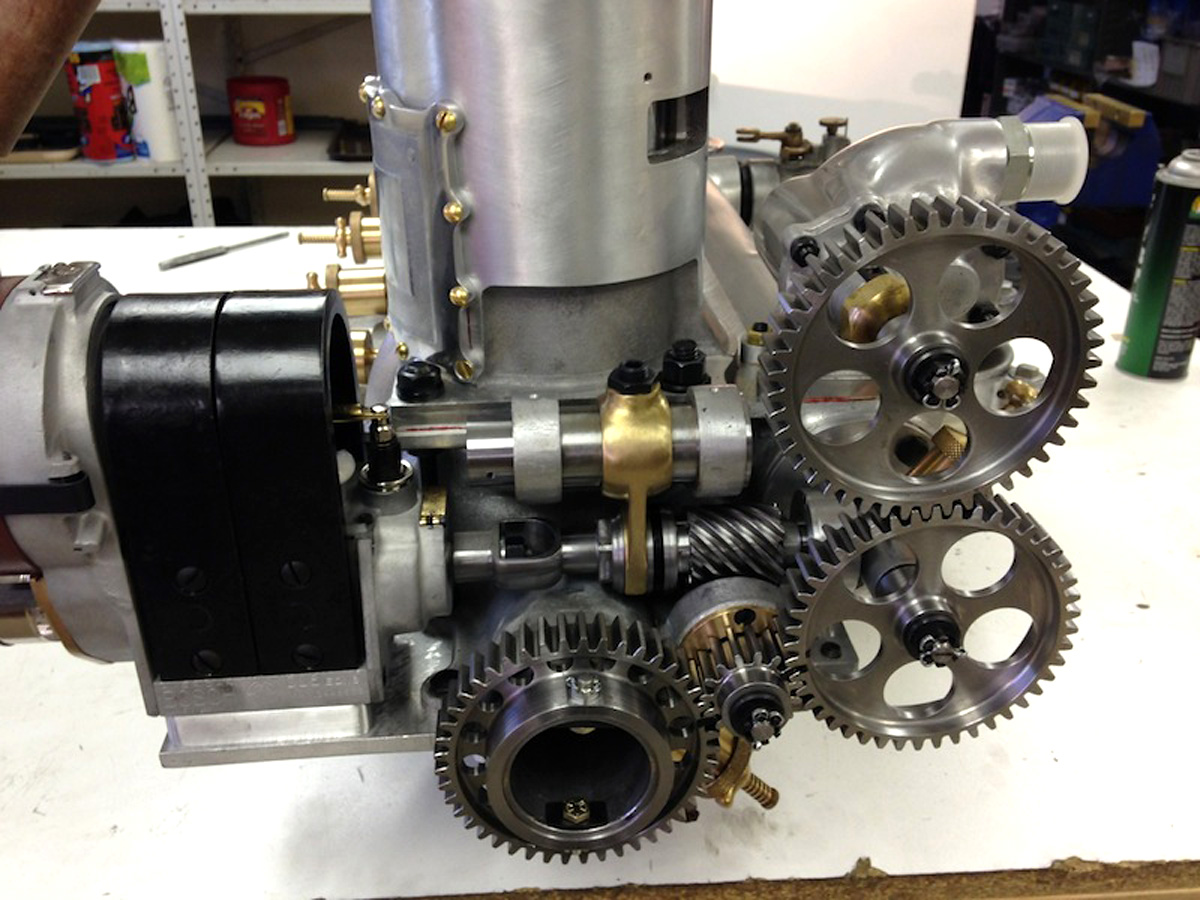
A single spark plug was mounted in the center of each cylinder’s semi-hemispherical combustion chamber. The spark plug was fired by a Bosch magneto mounted at the rear of the engine. The magneto was driven by a helical gear via the intermediate gear that meshed with the accessory drive gear on the end of the crankshaft. An advance fork mounted above the magneto shaft moved the helical gear of the magneto along its shaft to either advance or delay ignition—an adjustment that could be made by the pilot while in flight.

Roberts 6-X gears Weeks

The exposed accessory gears of the Robert 6-X replica. The crankshaft drove an intermediate gear, the backside of which engaged the magneto drive shaft. To advance or delay the timing, the helical gear for the magneto drive shaft could be adjusted by the brass advance fork above it. The intermediate gear drove the gear for the tubular distribution sleeve, which in turn drove the gear for the water pump. (Fantasy of Flight image)

The Roberts four-cylinder engine was known as the 4-X. It had a 4.5 in (114 mm) bore, a 5 in (127 mm) stroke, and a total displacement of 318 cu in (5.2 L). The engine produced 50 hp (37 kW) at 1,200 rpm. It used one carburetor, and its magneto turned at twice crankshaft speed. Its crankshaft was 2.5 in (64 mm) in diameter, with crankpins 1.75 in (44 mm) in diameter and 2.5 in (64 mm) long. The crankshaft was supported by five main bearings; the one toward the propeller was 6.375 in (162 mm) long. The crankshaft was 40 in (1,016 mm) long and weighed 17.5 lb (7.9 kg). The 4-X was 40.5 in (1.03 m) long, 25 in (.64 m) tall, 24 in (.61 m) wide, and weighed 170 lb (77 kg).

The six-cylinder engine was known as the 6-X. Like the 4-X, it had a 4.5 in (114 mm) bore and a 5 in (127 mm) stroke. The engine’s total displacement was 477 cu in (7.8 L), and it produced 75 hp (56 kW) at 1,200 rpm. The 6-X used two carburetors, and its magneto turned at three times crankshaft speed. Its crankshaft and crankpins were the same size as the 4-X’s. The crankshaft was supported by seven main bearings, was 52 in (1,321 mm) long, and weighed 27.5 lb (12.5 kg). The 6-X was 52.5 in (1.33 m) long, 25 in (.64 m) tall, 24 in (.60 m) wide, and weighed 240 lb (109 kg).

Roberts 6-XX engine

The Roberts 6-XX engine with exhaust manifolds and enclosed accessory gears.

A further development of the six-cylinder engine was the 6-XX. This engine had its accessory gears covered and bathed in oil. Its bore and stroke were enlarged to 5.5 in (140 mm) and 6 in (152 mm) respectively. The 6-XX’s total displacement was 588 cu in (14.0 L), and it produced 125 hp (93 kW) at 1,100 rpm. The engine used two carburetors. Its Bosch HL magneto turned at 1.5 times crankshaft speed to fire one of the two spark plugs in each cylinder. The other spark plug was fired by a Delco distributor. The 6-XX’s crankshaft was 3 in (76 mm) in diameter, with crankpins 2.5 in (64 mm) in diameter and 3.5 in (99 mm) long. The crankshaft was supported by seven main bearings; the one toward the propeller was 12 in (305 mm) long. The 6-XX was approximately 60.5 in (1.54 m) long, 27.5 in (.70 m) tall, 24 in (.60 m) wide, and weighed 390 lb (177 kg).

The Roberts engines were refined over time and used by a good number of early aviation pioneers. By 1913, all Roberts engines had the exposed accessory gears enclosed like those on the 6-XX engine. This change necessitated the magneto be repositioned. The cylinder liners were now made of cast iron, and the water jackets were made of Aerolite. The pistons were also made of Aerolite, which reduced their weight by over 2 lb (.9 kg) each. The tubular distributor sleeve was mounted on four sets of ball bearings to reduce friction. Dual ignition, like that used on the 6-XX, was available as an option on the 6-X engine. A starting crank attached to the end of the crankshaft was also an option.

Roberts 6-X 1913 rear

The rear of the 1913 Roberts 6-X engine showing the enclosed accessory gears, repositioned magneto, and optional hand starting crank on the end of the engine. The decompressors can be seen on the top of the cylinders. These were used to make starting the engine easier.

As two-stroke Roberts engines were surpassed by new four-stroke engines, like the Curtiss OX-5 and Hispano-Suiza 8, the company struggled to keep up. By 1918, the 6-X engine had its bore and stroke increased to 5 in (127 mm) and 5.5 in (140 mm) respectively, giving a total displacement of 648 cu in (10.6 L). The tubular distributor was replaced by more conventional intake manifolds, and the engine produced 100 hp (75 kW) at 1,200 rpm. The 6-X now weighed 368 lb (167 kg).

There is also some indication that a V-12 was planned and possibly constructed by Roberts in the late 1910s. This engine was known as the E-12. It had a 6 in (152 mm) bore, a 6.5 in (165 mm) stroke, and a total displacement of 2,205 cu in (36 L). The engine produced 350 hp (261 kW) at 1,200 rpm. Each cylinder had its own crankpin, and 13 main bearings supported the crankshaft. The E-12 weighed 990 lb (490 kg).

Roberts 6-X Weeks

One of Weeks’ Roberts 6-X replica engines. The engines were built to power a replica Benoist XIV flying boat. The Benoist is a pusher, which is why the outlet for the coolant pipe is toward the propeller shaft. Note the brass grease cups for lubricating the crankshaft main bearings. The cover on each cylinder is for the cellular by-pass. (Fantasy of Flight image)

The Roberts Motor Company left the aviation field by 1919 to focus on marine engines. Around this time, the company changed its name to Roberts Motors. A few years later, Roberts Motors went out of business. A number of early Roberts four- and six-cylinder aircraft engines still exist in museums.

Recently, Kermit Weeks of Fantasy of Flight in Polk City, Florida commissioned the creation of two replica Roberts 6-X engines. One of the engines was a test engine, and the other would be installed in a Benosit XIV flying boat replica. An original engine was reverse engineered, allowing these engines to be built. Below is a video from 2013 of Mr. Weeks checking on the progress of the Roberts 6-X engine construction at Vintage & Auto Rebuilds in Chardon, Ohio. Both Roberts 6-X replica engines have since been completed and test run.


Sources:
Roberts Aviation Motors by The Roberts Motor Co. (1912)
– “Construction of Cylinder of Internal Combustion Engines” US patent 1,210,537 by Edmund W. Roberts (granted 2 January 1917)
The 1913 Model 6-X by The Roberts Motor Co. (1913)
Fantasy of Flight Blog (various entries relating to the Roberts engine and Benoist flying boat replica)
Aerosphere 1939 by Glenn Angle (1940)
(Jane’s) All the World’s Aircraft 1918 by C. G. Grey (1918)
Hawker Fury Sabre LA610

Hawker Fury I (Sabre-Powered) Fighter

By William Pearce

While testing of the Tempest prototypes was still underway in 1942, the Hawker design team began to study ways to improve and lighten the fighter aircraft. Some of their ideas were influenced by the study of a German Focke-Wulf Fw 190 A-3 that had inadvertently landed in Britain in June 1942. The Fw 190 proved smaller and lighter that its Hawker-built contemporaries. In September 1942, the British Air Ministry issued Specification F.6/42 calling for a new fighter aircraft. Hawker proposed three versions of its improved Tempest, each to be powered by a different engine: the V-12 Rolls-Royce Griffon, the 18-cylinder Bristol Centaurus radial, and the H-24 Napier Sabre.

Hawker Fury Sabre LA610

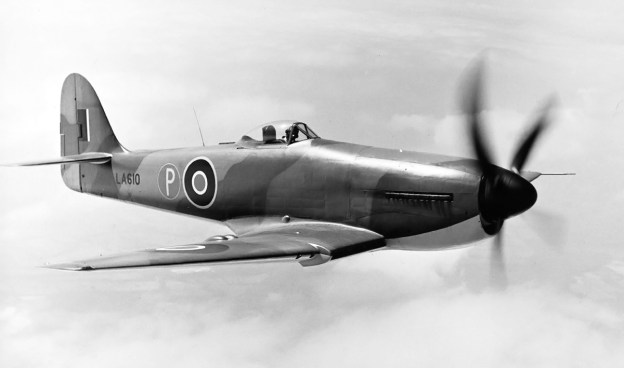
The Napier Sabre-powered Hawker Fury LA610 in-flight exhibiting exactly what a high-performance aircraft should look like.

The Air Ministry supported Hawker’s designs under Specification F.2/43 issued in February 1943. In April 1943, Specification N.7/43 was issued for a new Navy fighter. Sydney Camm, Hawker’s chief designer, felt that arresting gear and folding wings could be added to the “improved Tempest” design to make it meet the requirements laid out in N.7/43. This plan was approved, and Specification N.22/43 was issued to Hawker for the new Navy fighter. Around this time, the two new Hawker aircraft received their official names: Fury (for the Royal Air Force’s land-based version) and Sea Fury (for the Fleet Air Arm’s naval version).

From the beginning, the preferred power plants were the Napier Sabre for the Fury and the Bristol Centaurs for the Sea Fury. Although the detailed design drawings for the Sabre-powered Fury were finished first, developmental delays of the new Sabre VII (NS.93/SM) engine resulted in the Centaurus- and Griffon-powered Furys being completed first. The Centaurus-powered Fury (NX798) first flew on 1 September 1944 followed by the Griffon-powered Fury (LA610) on 27 November 1944.

Hawker Fury Griffon LA610

The Hawker Fury LA610 originally flew with a Griffon engine and contra-rotating propellers. The large duct under the spinner housed the radiator, similar to that used on the Tempest V and VI.

Although the Air Ministry ordered 200 Sabre-powered Fury I aircraft in August 1944, there were rumors that Sabre production would be shut down following the war’s end. In October 1944, the Ministry of Aircraft Production (MAP) assured Hawker that Sabre production would continue. In November 1944, the MAP requested a Sabre-powered Fury prototype be built utilizing the Griffon-powered LA610 airframe. However, in February 1945 the Fury I order was reduced by 50 aircraft to 150. But in March 1945, two additional Sabre-powered prototypes (VP207 and VP213) were requested. Work to install a Sabre engine in LA610 began in July 1945. With the war over and the future of fighting aircraft pointing toward jet power, orders for the Fury I were reduced again in September 1945 to 120 units.

In December 1945, the Air Ministry had informed Hawker that ground attack would be the Fury I’s primary role. Hawker felt the aircraft was not suited for this because of its liquid-cooled engine, and it did not have the armor needed for a ground attacker. As a result, in February 1946, the number of Furys on order was further reduced to 60—and even those were in jeopardy. During this time, modifications of the LA610 airframe had been completed, but the Sabre VII engine was not ready. Rather than wait for the engine, a Sabre VA (2,600 hp / 1,939 kW) was substituted. Soon, a Sabre VII was installed, and Fury LA610 was flown for the first time with its intended power plant on 3 April 1946.

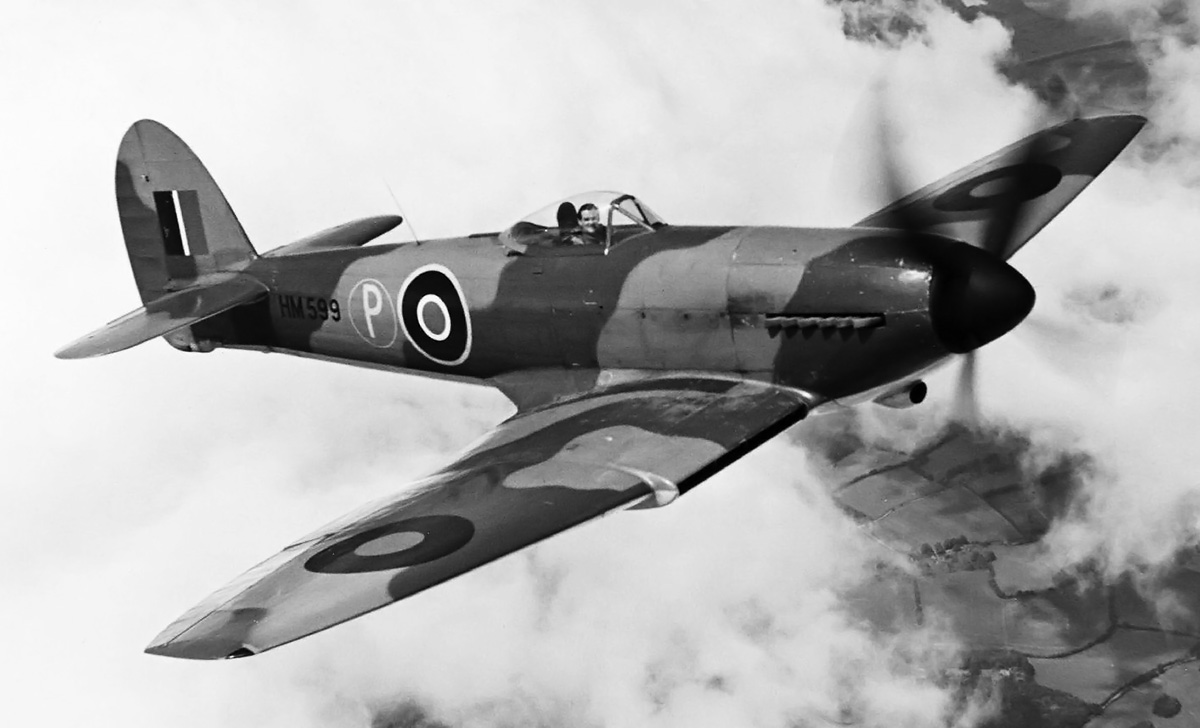
Hawker Tempest I HM599 flight

The Hawker Tempest I (HM599), with its close-fitting cowl and wing radiators, was a stepping stone to the Fury I.

While the rest of the aircraft remained the same as the other prototypes, the power section of LA610 was completely different. A streamlined cowling was installed to cover the liquid-cooled Sabre engine. Coolant radiators were installed in the inboard wing sections, replacing additional fuel tanks. Cooling air would enter the wing’s leading edge, pass through the radiators, and exit via shutters under the wing. This configuration was similar to that used on the sole Tempest I prototype (HM599)—production did not occur because the Air Ministry perceived the wing radiators as too vulnerable to combat damage. The radiator shutters of the Fury I were automatically controlled based on engine temperature. A split duct under the spinner supplied intake air to the engine via the duct’s upper section. Air from the lower duct was directed through engine oil coolers and then out the bottom of the cowling.

Not only was it one of the most beautiful aircraft ever built, the Sabre-powered Fury proved to be the highest performance piston-engine aircraft built by Hawker. The 24-cylinder Napier Sabre engine was a horizontal H layout with two crankshafts. The engine had a 5.0 in (127 mm) bore, 4.75 in (121 mm) stroke, and displaced 2,238 cu in (36.7 L). The Sabre VII utilized water/methanol injection to boost power and was capable of 3,055 hp (2,278 kW) at 3,850 rpm with 17 psi (1.17 bar) of boost. To transfer this power to thrust, the Fury I used a 13 ft 3 in (4.0 m) four-blade Rotol propeller. A five-blade propeller like the Sea Fury’s 12 ft 9 in (3.9 m) Rotol unit was considered, but the decreased weight of the four-blade unit proved decisive in its adoption.

Hawker-Fury-Sabre-LA610-rear

This rear view of the LA610 Fury shows how well the 3,055 hp (2,278 kW) Sabre-engine was fitted to the airframe, enabling the aircraft to exceed 480 mph (775 km/h). Note the large 13 ft 3 in (4.0 m) four-blade propeller.

The Sabre-powered Fury had a top speed of 483 mph (777 km/h) at 18,500 ft (5,639 m) and 422 mph (679 km/h) at sea level. In contrast, the 2,560 hp (1,909 kw) Centaurus-powered Sea Fury had a top speed 460 mph (740 km/h) at 18,000 ft (5,487 m) and 380 mph (612 km/h) at sea level. The Sabre Fury’s initial rate of climb was 5,480 ft/min (27.8 m/s), and it could reach 20,000 ft (6,096 m) in 4.1 minutes. By comparison, The Sea Fury’s initial rate of climb was 4,320 ft/min (21.9 m/s), and it took 5.7 minutes to reach 20,000 ft (6,096 m). The Fury I’s service ceiling was 41,500 ft (12,649 m). All Fury and Sea Fury aircraft had the same 38 ft 5 in (11.7 m) wingspan. At 34 ft 8 in (10.6 m), the Sabre-powered Fury was 1 in (25.4 mm) longer than the Sea Fury. The Fury I had an empty weight of 9,350 lb (4,241 kg) and a loaded weight of 12,120 lb (5,498 kg).

On 14 August 1946, the remaining Fury I aircraft on order were cancelled. Of the three Fury I prototypes, LA610 would remain with Hawker for testing, VP207 would be completed and loaned to Napier for engine testing, and VP213 would be used for parts and not completed. VP207 was chosen to go to Napier because it had a larger radiator that could handle developmental power increases of the Sabre VII engine. With the cancellation of the Fury I there was no longer a need for the Sabre VII engine, and its development was stopped; Napier would not take over VP207. VP207 was completed by Hawker and first flew on 9 May 1947. Hawker retained the aircraft as a company demonstrator for a period of time. The final disposition of LA610 has not been definitively found, but it is believed that the aircraft was scrapped in the late 1940s. VP207 was stored and maintained in Hawker’s facility at Langley Airfield until the mid-1950s, when the aircraft was scrapped.

Hawker Fury Sabre LA610 taxi

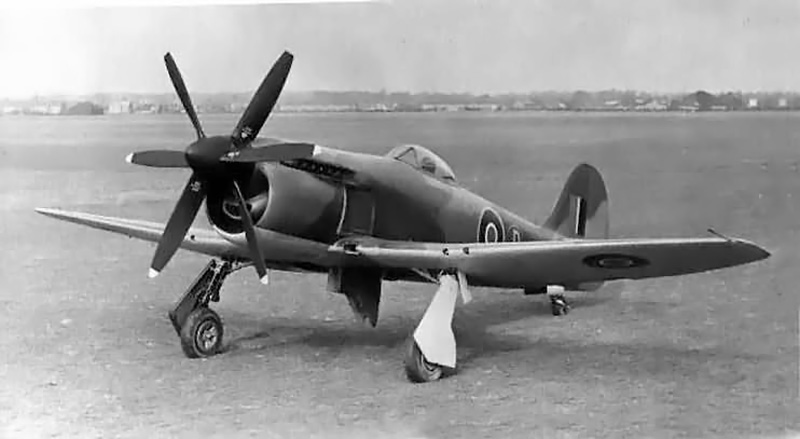
Fury LA610 preparing for a flight. The air scoop under the spinner, and the wing radiators can clearly be seen in this image.

Although the Fury never progressed beyond the prototype phase, the Sea Fury did enter production, with some 789 aircraft built (number varies by source)—including prototypes and 61 two-seat T.20 trainers. Sea Furys served in Korea, were the last front-line piston-engine aircraft operated by the Royal Navy Fleet Air Arm, and were sold to and used by various other countries. A number still fly today, but due to the rarity of the Bristol Centaurus engine, many have been re-engined with Wright R-3350s. In addition, two Sea Furys have been built up for racing with Pratt & Whitney R-4360 engines, and one has a Pratt & Whitney R-2800. But none have looked quite as stunning or performed as well (in military trim) as the Napier Sabre-powered Hawker Fury I.

Hawker Fury Sabre VP207

The Sabre-powered Hawker Fury VP207 at the Society of British Aircraft Constructors show at Radlett in September 1947. Some believe the aircraft was painted silver with a red stripe, but the stripe was actually blue. (Robert Archer image via Victor Archer / American Motorsports Coverage)

Sources:
Sea Fury in British, Australian, Canadian & Dutch Service by Tony Buttler (2008)
British Secret Projects Fighters & Bombers 1935-1950 by Tony Buttler (2004)
Jane’s All the World’s Aircraft 1947 by Leonard Bridgman (1947)
Hawker Sea Fury (Warbird Tech Volume 37) by Kev Darling (2002)
RAF Fighters Part 2 by William Green and Gordon Swanborough (1979)
War Planes of the Second World War: Fighters Volume Two by William Green (1961)
Tempest: Hawker’s Outstanding Piston-Engined Fighter by Tony Buttler (2011)
Hawker Typhoon, Tempest and Sea Fury by Kev Darling (2003)
Aircraft Engines of the World 1947 by Paul H. Wilkinson (1947)

Marchetti MP Cam Action

Marchetti Cam-Action Engines

By William Pearce

Paul J. Marchetti was born in Italy in 1889. In his adolescence, he became interested in machines, engineering, and aircraft. In 1910, when he was 21 years old, Marchetti emigrated from Lucca, Italy to the United States in search of greater opportunities. He worked his way west and supported himself as a logger, all the while dreaming of entering the aviation business.

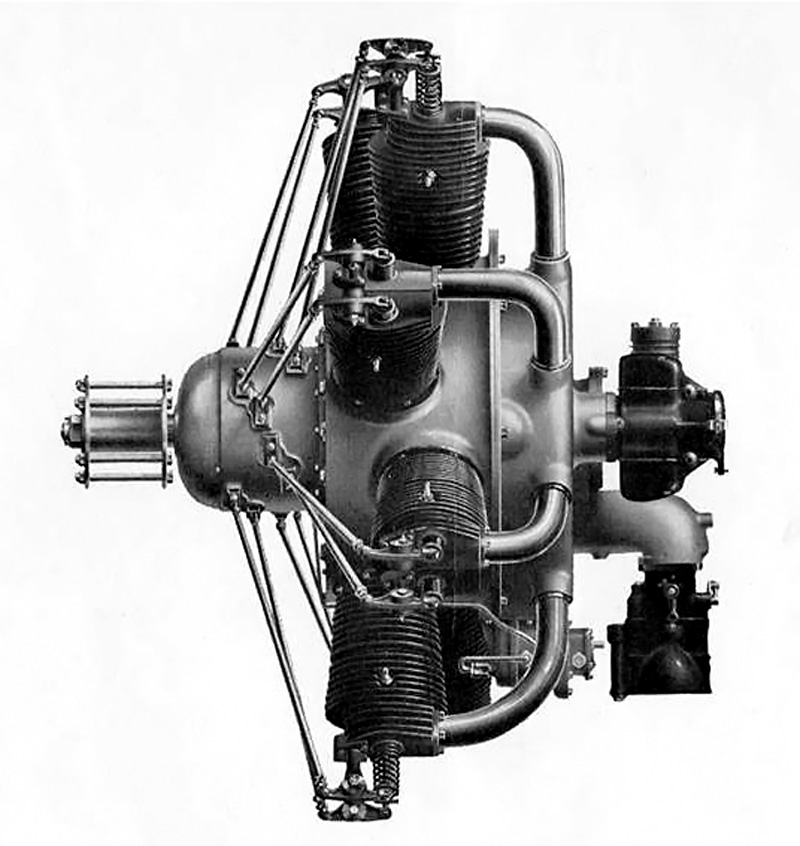
Marchetti MP Cam Action side

The Marchetti eight-cylinder, cam-action aircraft engine of 1927. Note the stagger of the front and rear cylinders.

Unfortunately, there is little information about Marchetti, his life, and his inventions. By 1922, he was working with Henry A. Nordwick in Stockton, California. Nordwick was working on designing a radial engine in which the crank throw was replaced by a cam with four lobes. A roller on the big end of the connecting rod made contact with the cam, its points creating the piston strokes. Another Nordwick and Marchetti engine design dating from 1923 had the big end of each connecting rod attached to its own crank, which was geared to a main central gear.

By 1924, Marchetti was in San Francisco, California and filed a patent of his own for a broad-arrow engine using either a three- or four-lobe cam in place of the crankshaft. Still working with Nordwick, another patent was filed for an eight-cylinder radial with a two-lobe cam. A lever extended from the big end of each connecting rod and was attached to the crankcase. Also connected to this lever was an auxiliary piston. Fed by pressurized air, the auxiliary piston forced the connecting rod to be in contact with the cam at all times. One auxiliary piston was positioned between each main piston.

Nordwick Marchetti cam engine patents

Drawings from Nordwick and Marchetti cam engine patents. The patent for the four-lobe cam design (left) was filed in 1922, and the patent for the eight-cylinder engine with auxiliary pistons (right) was filed in 1924.

Nordwick and Marchetti focused on inline engines in 1925. They designed a two-lobe cam engine, again using a lever extending from the big end of the connecting rod to the crankcase. That same year, Marchetti patented an inline engine under his business name: Marchetti Motor Patents. For this engine, the crankshaft throws were replaced with disks, offset to the crankshaft’s centerline. A connecting rod ran in a grove in each disk, and the disk’s offset would create the up and down strokes for the piston. The circular disk could also be substituted in favor of a lobed design for increased engine performance.

In 1926, Marchetti took out a patent on an inline engine with a two-lobe cam driving the pistons. The connecting rods were paired together via a rocker so that when one piston was at top dead center the other piston would be at bottom dead center. This configuration was also suggested for a U engine with two separate cam (crank) shafts.

Marchetti Motor Patents

Drawings from the Marchetti cam engine patents. The 1924 broad-arrow engine design is on the left, and the 1925 inline cam disk design is on the right.

1927 saw Marchetti focus on the business side of his dreams. His company, Marchetti Motor Patents, Inc., was officially formed with $2,000,000 of capital and operated out of the newly completed Russ Building, the tallest building in San Francisco until 1964. Marchetti worked on new engines and aircraft. In 1928, ground was broken for the Marchetti Motor Patents factory at Mills Field (now San Francisco International Airport). The factory had an expected output of 100 aircraft and 1,000 engines per year.

With his business established, Marchetti designed and built a new cam engine. While incorporating some aspects of the previous engine designs, this engine also had some unique features that are not found in any of the patents filed by Marchetti. However, the connecting rod arrangement and cam were similar to those found in a patent filed solely by Nordwick in 1926.

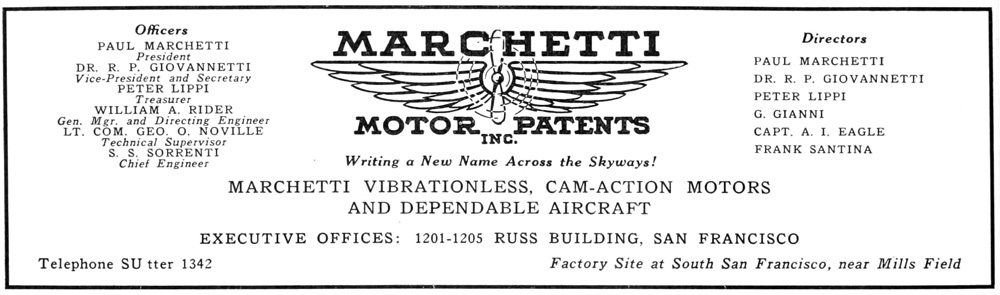
Marchetti MP info

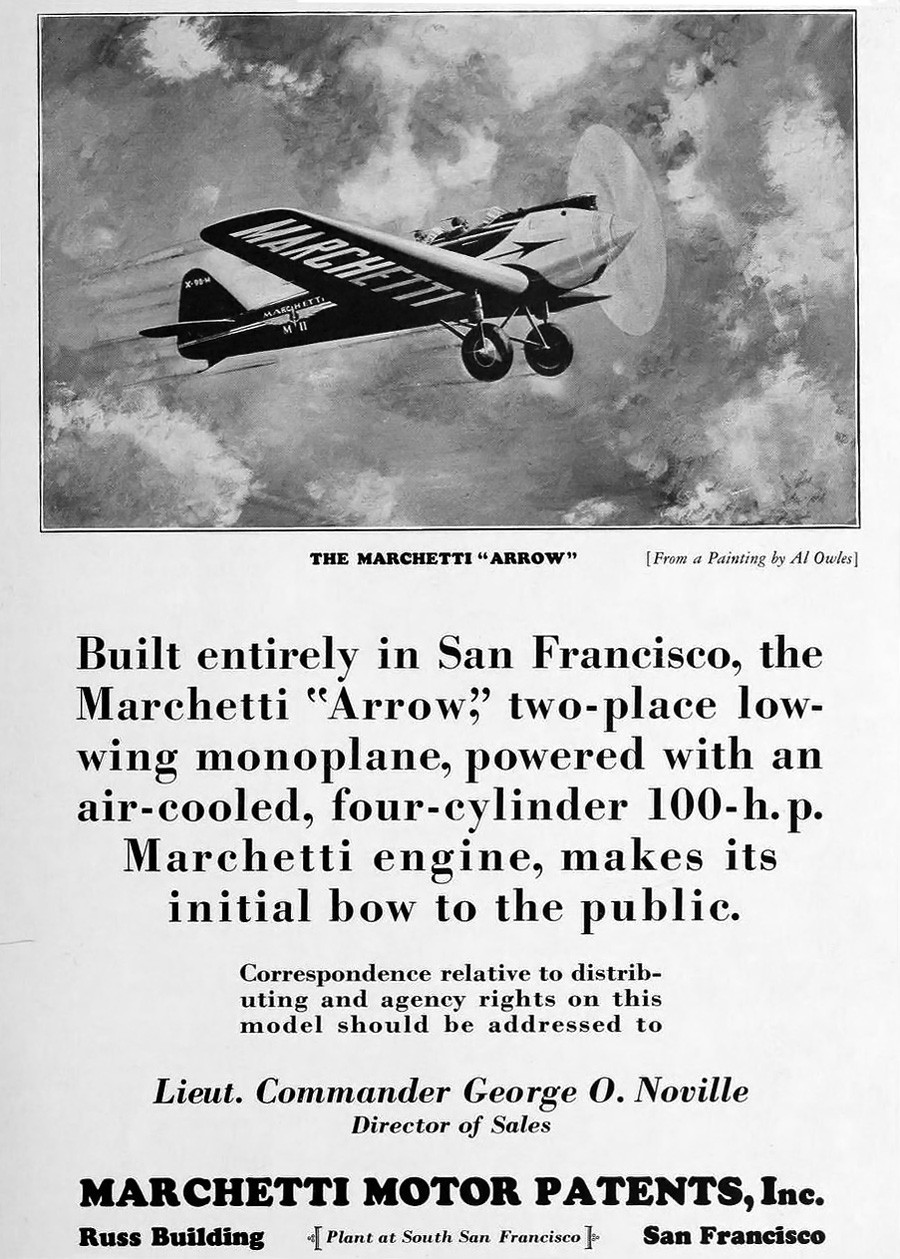
Marchetti Motor Patents Inc. advertisement from 1929.

The new engine was an air-cooled, eight-cylinder radial. The cylinders were slightly staggered, making two rows of four cylinders. Twin two-lobe cams replaced the conventional crankshaft. Via roller bearings, the front cam actuated the connecting rods for the front cylinders, and the rear cam actuated the connecting rods for the rear cylinders. One fore and one aft cylinder were paired together by a common bell crank attached to the big end of the connecting rods. The center of this bell crank was the pivot point and was attached to the crankcase. The cams were staggered so that when one of the paired cylinders was at top dead center, the other cylinder was at bottom dead center. Since each cam had two lobes, there would be four piston strokes (or one power stroke) for each revolution. Marchetti referred to this design as a “cam-action” engine.

Each of the engine’s cylinders had one intake and one exhaust valve at the center of its head. The valves were actuated by pushrods driven at the front of the engine. Two spark plugs were located just below the valves of each cylinder and were fired by a magneto driven from the rear of the engine. A carburetor attached to the lower rear of the engine fed the air/fuel charge into a blower (weak supercharger). The blower helped mix the air/fuel charge, which was then distributed to the cylinder via separate manifolds. The engine had a 4.0 in (102 mm) bore, a 4.25 in (108 mm) stroke, and a total displacement of 427 cu in (7.0 L). Initially, 135 hp (101 kW) was expected from the engine, but 160 hp (119 kW) was achieved after testing. The engine weighed 350 lb (159 kg).

Marchetti MP Cam Action

Cutaway view of the Marchetti cam-action engine. The rear cam can barely be seen in the rear of the crankcase. Note how each cam actuates one “row” of cylinders. The bell crank for the upper right cylinder pair can be seen clearly. The bell crank attached to the connecting rods and pivoted in the middle, where it was mounted to the crankcase.

The eight-cylinder engine was first run in 1927. Most sources say only one engine was built, but some claim more were built. The engine passed a 400 hour maximum load test, and 2,200 hours were accumulated with no apparent signs of wear. Marchetti modified a Cessna AW for flight testing the eight-cylinder radial, but it is not known if the engine was ever installed. This aircraft was designated Marchetti M-I

Marchetti MP M-II Arrow advert

Advertisement from September 1929 for the Marchetti M-II Arrow and its four-cylinder engine cam-action engine.

Another Marchetti aircraft was the M-II Arrow—a two-place monoplane to be powered by a Marchetti inline, four-cylinder, air-cooled, cam-action engine of 100 hp (75 kW). The M-II was constructed of wood covered by fabric. On the drawing board was the Marchetti M-III—an eight passenger, all metal aircraft intended for passenger service. It was to be powered by two Marchetti eight-cylinder cam-action radials.

With his aircraft and aircraft engine manufacturing plans underway, Marchetti continued to chase his dream of becoming a pilot. On 31 August 1929, one week before the plant opened, Marchetti took off from Mills Field to look over his nearly finished factory and log some of the two hours remaining before he could get his pilot’s license. He flew into a fog bank, and what happened next is not known. A short time later, Marchetti’s aircraft was seen falling from under the fog bank in an inverted flat spin. The aircraft crashed half a mile (.8 km) from shore into San Francisco Bay. Rescue boats reached the scene as fast as possible, but it was too late. Marchetti’s body was found in the submerged fuselage.

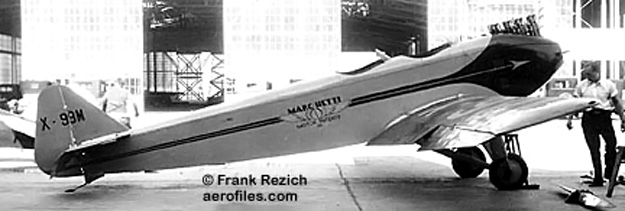
The Marchetti M-II Arrow was completed and flown, but it is not known which engine powered it. While it is possible that it flew with a Marchetti inline cam engine, it is more likely that another four-cylinder engine was installed. Marchetti’s grand aviation plans drifted into oblivion after his death. Marchetti Engine Patents Inc. was sold to William Rider and then resold to United Aircraft Sales where it faded to obscurity. What happened to the M-I, M-II Arrow, or any of the cam-action test engines is not known. It is believed that the M-III transport never progressed beyond the design phase.

Marchetti MP M-II Arrow

The complete Marchetti M-II Arrow with its unidentified engine. The aircraft carried the registration X-98M. (Frank Rezich image via www.aerofiles.com)

Sources:
– “Falls to Death: Paul Marchetti” Oakland Tribune (1 September 1929)
– “Marchetti Motor to Revolutionize Airplane Industry” Ukiah Dispatch Democrat (12 May 1928)
– “The Business of Building Aircraft” San Francisco Business (11 September 1929)
– “Internal Combustion Engine” US patent 1,374,164 by H. A. Nordwick (granted 5 April 1921)
– “Internal Combustion Engine” US patent 1,528,164 by H. A. Nordwick (granted 3 March 1925)
– “Internal Combustion Motor” US patent 1,538,208 by H. A. Nordwick et al (19 May 1925)
– “Engine” US patent 1,654,378 by P. Marchetti (granted 27 December 1927)
– “Internal Combustion Engine” US patent 1,597,474 by H. A. Nordwick et al (granted 24 August 1926)
– “Internal Combustion Engine” US patent 1,624,277 by H. A. Nordwick et al (granted 12 April 1927)
– “Internal Combustion Motor” US patent 1,667,213 by P. Marchetti (granted 24 April 1928)
– “Motor” US patent 1,624,269 by P. Marchetti (granted 12 April 1927)
– “Duplex Cam Motor” US patent 1,630,273 by H. A. Nordwick (granted 31 May 1927)
Aerosphere 1939 by Glenn Angle (1940)
http://www.aerofiles.com/_ma.html

REP 7-cylinder

R.E.P. Fan (Semi-Radial) Aircraft Engines

By William Pearce

Robert Esnault-Pelterie was born in France on 8 November 1881. In the early 1900s, he began experimenting with a glider modeled after the Wright Brothers’ glider of 1902. Esnault-Pelterie had experienced trouble with the Wrights’ wing warping technique and switched to ailerons in 1903. In 1906, Esnault-Pelterie began constructing a powered aircraft of his own design as well as an engine to power it. Esnault-Pelterie named the aircraft the R.E.P. 1 and it first flew in 1907. A new feature of the aircraft was a control stick, which Esnault-Pelterie patented. That patent made Esnault-Pelterie a rich man once royalties were paid after World War I. While the unique engine that he designed was the first in a family of engines known as R.E.P., their success would not endure like that of the control stick.

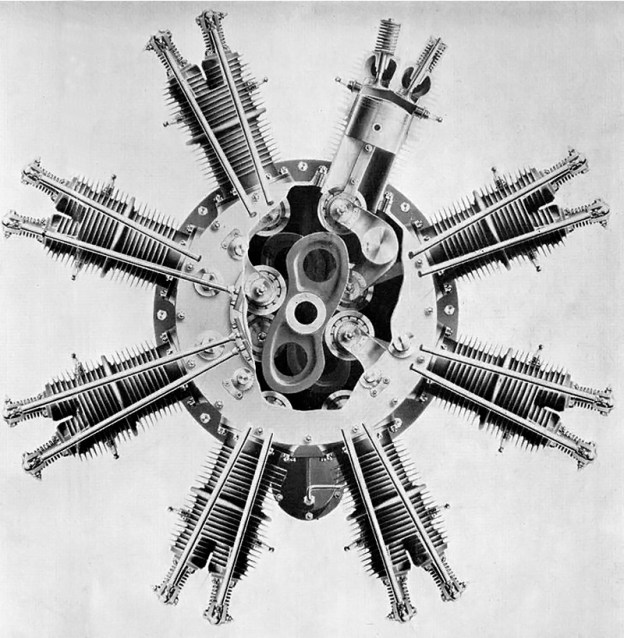
REP 7-cylinder

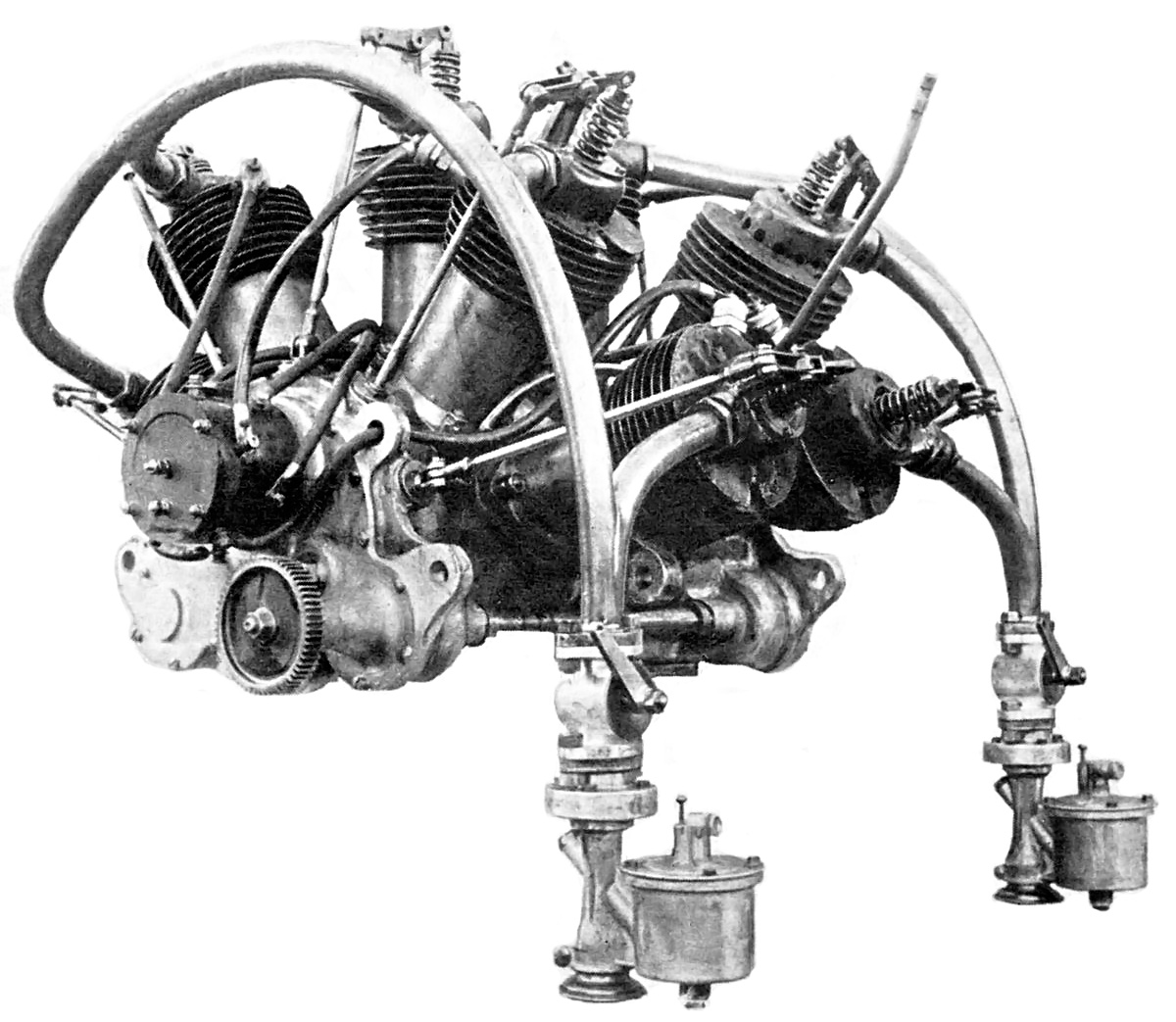
Front view of the R.E.P. seven-cylinder fan engine. Exhaust gases flowed out the holes around the top of the cylinders. The intake manifold can barely be seen behind the cylinders. In this view, the four cylinders on the right shared an intake manifold as did the three cylinder on the left.

Esnault-Pelterie’s first engine was an air-cooled, seven-cylinder fan engine. Sometimes referred to as a semi-radial, this engine had cylinders that were fanned-out on the top of the crankcase and not positioned around its entirety like a true radial. The cylinders were arranged in two rows—the front had four cylinders, and the rear had three cylinders. This configuration solved lower cylinder lubrication issues of radial engines, and air-cooling issues of inline engines.

The cast iron cylinders were attached to an aluminum crankcase. The upper part of the cylinder had cooling fins to dissipate heat. At the very top of the cylinder was a large, single valve. The valve was shaped like a piston and inverted, with the valve stem attached to underside of the head. When the valve was completely closed, a flange on its head would seat against the cylinder head and seal the cylinder. When the valve was partially open, exhaust gases flowed around the flange and escaped through ports in the cylinder head. When the valve was completely open, ports in its sides aligned with ports in the cylinder head to allow the intake mixture to flow into the cylinder.

REP 7-cylinder section

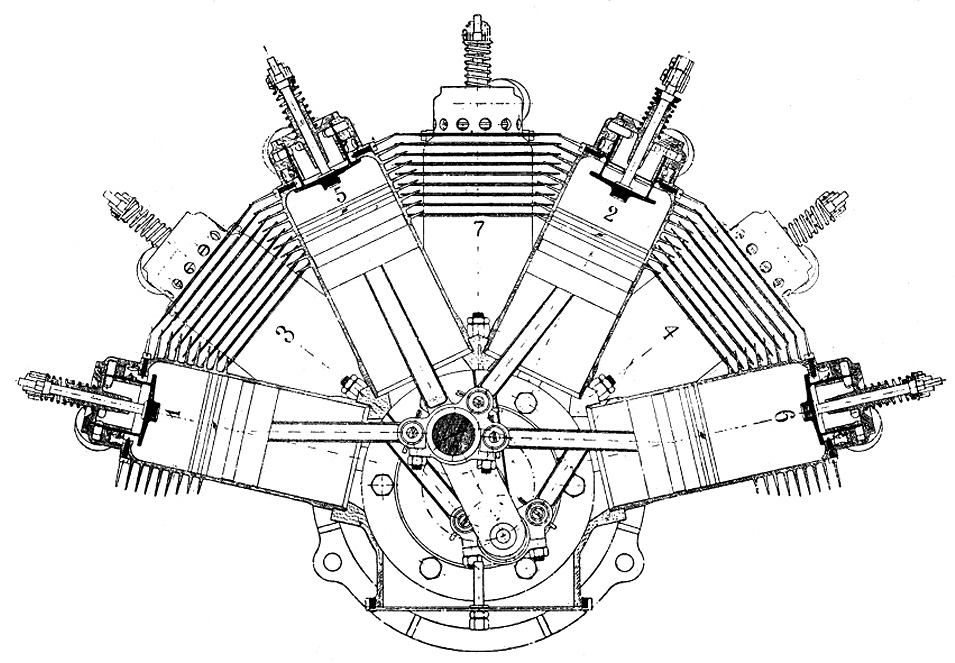
In this section view of the R.E.P. seven-cylinder engine, the cylinders are numbered by firing order. Cylinder 5 has the intake/exhaust valve completely closed. Cylinder 1 shows the valve partially open to allow exhaust gases to exit the cylinder. Cylinder 2 shows the valve completely open to allow the air/fuel mixture into the cylinder. Note the master/articulated connecting rod arrangement.

The valve was actuated by a rocker arm attached to the cylinder. The rocker arm was moved via a pushrod that was operated by a cam ring inside the engine. Each row of cylinders had its own cam ring positioned at the rear of the engine, and the cam rings had stepped lifts. The first step opened the valve part way to allow the exhaust gases to vacate the cylinder. The second, higher lift completely opened the valve to allow the fresh air/fuel mixture into the cylinder. For the intake, the cylinders were separated into left and right groups, with the left group (when viewing the engine from the rear) having an additional cylinder. Each group shared a common intake manifold with a carburetor attached to its end. The intake manifold was attached to the upper rear of the cylinder. Exhaust gases flowed out though ten holes around the cylinder’s top; there were no exhaust stacks.

A single spark plug was installed in the side of the cylinder and fired by an ignition coil powered by a battery. The pistons were made of steel and had two oil rings. They were attached to the connecting rods by trunnions bolted to the underside of the piston. The connecting rod for each row of cylinders had one master rod, and the rest were articulating rods. The crankshaft had two throws offset 180 degrees and was supported by two main bearings. To balance the crankshaft, Esnault-Pelterie left the crankpin solid for the row with an additional cylinder, and the crankpin for the row with one fewer cylinder was drilled hollow.

REP 10-cylinder side

This side view of the R.E.P. 10-cylinder engine illustrates how it was comprised of two five-cylinder engines bolted front-to-front. Note the rocker arm arrangement and the single valve. The pictured engine was equipped with magnetos.

The engine had a 3.35 in (85 mm) bore and 3.74 in (95 mm) stroke. The seven cylinders displaced a total of 230 cu in (3.8 L). The engine produced 30 hp (22 kW) at 1,500 rpm and weighed 150 lb (68 kg). A five-cylinder version was also built with three cylinders in the first row and two in the second. It produced 20 hp (15 kW) at 1,500 rpm from its 164 cu in (2.7 L) and weighed 118 lb (54 kg). Another version consisted of two five-cylinder engines joined at their front to create a 10-cylinder engine. Each engine group had its own intake manifold feeding five cylinders. The 10-cylinder engine produced 50 hp (37 kW) at 1,500 rpm from its 329 cu in (5.4 L) and weighed 214 lb (97 kg). Some sources indicate the same coupling treatment was applied to the seven-cylinder engine to create a 14-cylinder engine, but this cannot be confirmed. A 14-cylinder engine would have displaced 461 cu in (7.5 L) and produced around 70 hp (52 kW).

The five- and seven-cylinder engines powered a number of early aircraft (R.E.P.s, Bléroits, Kapferer-Paulhans, and Breguets), but it is unlikely the 10-cylinder engine ever flew. Esnault-Pelterie received an award in 1908 from the Société des ingénieurs civils de France (Society of Civil Engineers of France) for his seven-cylinder R.E.P. engine. However, the cylinder’s single valve proved unsatisfactory, and the engines were redesigned in 1909.

REP 10-cylinder back

Rear view of the R.E.P. 10-cylinder engine equipped with a coil ignition. Note that each engine section has its own intake manifold and carburetor.

The updated engines had two valves per cylinder, but they were still operated by a single rocker arm. The intake valve was in the front of the cylinder, and the exhaust valve was in the rear. The rocker arm pivoted between the valves so that it pushed the intake valve open and then rocked back to pull down on the exhaust valve to open it. This was achieved by a grooved cam-disc that could “pull” and “push” the pushrod.

The engine’s bore and stroke were increased to 3.94 in (100 mm) and 5.51 in (140 mm). The five-cylinder engine displaced 335 cu in (5.5 L) and produced 60 hp (45 kW) at 1,400 rpm. The seven-cylinder engine displaced 470 cu in (7.7 L) and produced 90 hp (67 kW) at 1,400 rpm. There is no indication that any attempt to couple the engines was made. The cylinders had revised cooling fins, and the spark plug was repositioned to the cylinder head. Magnetos were used in place of the coil ignition.

REP 5-cylinder Type D

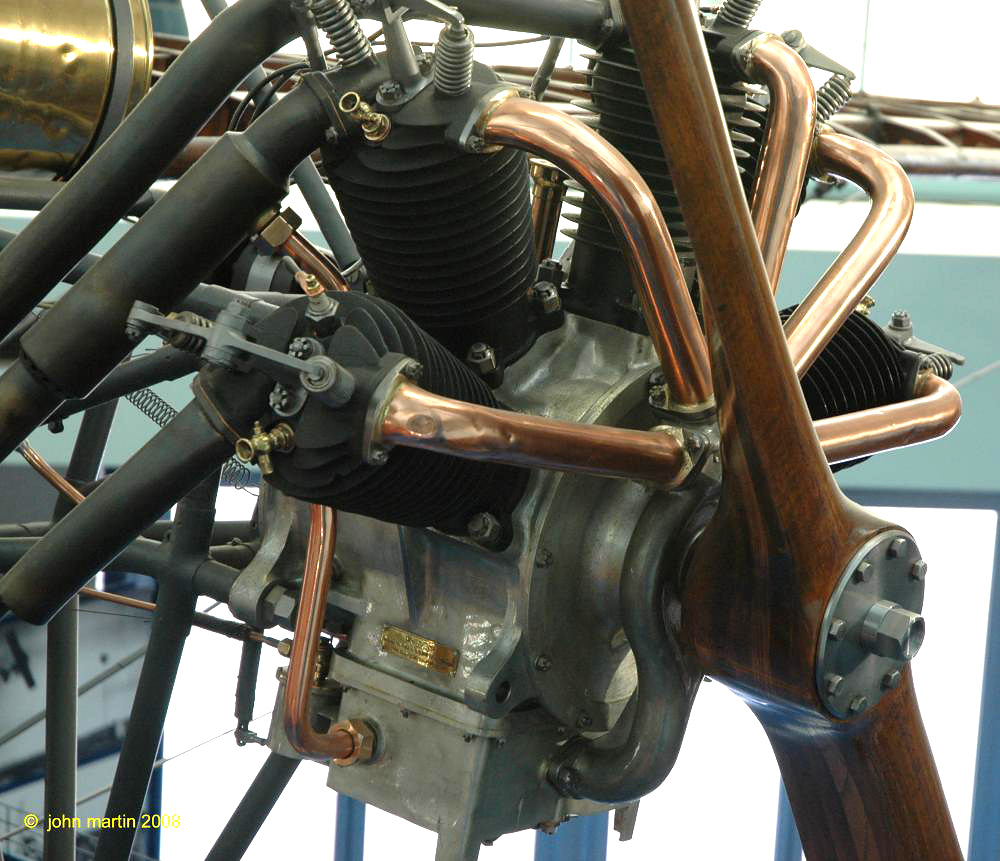
An updated R.E.P. five-cylinder engine preserved in a R.E.P. Type D monoplane at the Musée de l’Air et de l’Espace. Note the two valves per cylinder and rocker arm arrangement. The unique induction system can be seen in which it drew air from the crankcase and delivered it to the cylinders via the copper pipes. The individual exhaust pipes can be seen at the rear of the engine. (John Martin image via the Aircraft Engine Historical Society)

Induction and exhaust were also updated. Intake air was fed from the crankcase (where it was warmed), through a distributor, and then to the front of each cylinder. Exhaust gases were collected in pipes at the rear of each cylinder and directed away from the cockpit. The many changes increased the weight of the engines to 243 lb (110 kg) for the five-cylinder and 287 lb (130 kg) for the seven-cylinder. The updated R.E.P. fan engine had no trouble running for 10 hours non-stop during various bench tests.

The five-cylinder engine seemed the more successful of the two and was installed in a number of aircraft (R.E.P.s and Farman-Neubauers). It was used in the Vickers R.E.P., which was the first aircraft made by Vickers and would have been the first aircraft to fly in Antarctica had its wings not been damaged during a demonstration flight in Australia. Even so, the wingless Vickers was taken to Antarctica and used as a powered sled, but with not much success. The remains of this aircraft were rediscovered there in January 2010.

Vickers REP in Antarctica

The Vickers R.E.P. in Antarctica in 1911. The engine clearly has two valves per cylinder and the unique induction system of the updated fan engine.

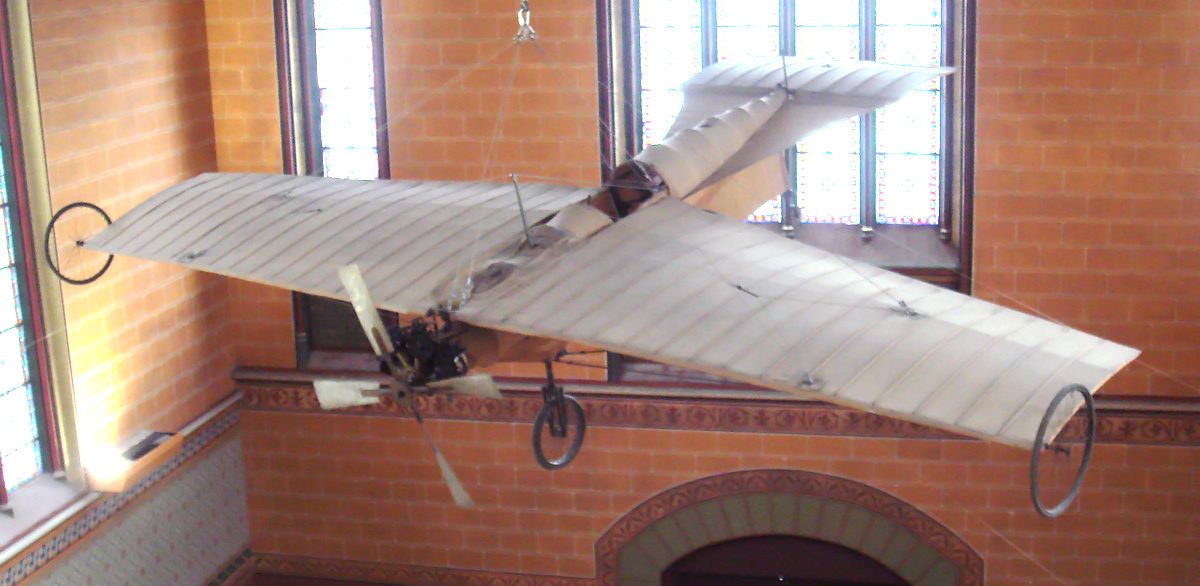
In 1911, Esnault-Pelterie refocused his design efforts on true radial engines, constructing five- and seven-cylinder engines. The fan/semi-radial engines were phased out in 1912. Over the next few years, Esnault-Pelterie stopped designing piston engines as he became more interested in rocketry. A few R.E.P. fan engines still exist in museums, including a seven-cylinder engine in Esnault-Pelterie’s original R.E.P. 1 aircraft from 1907 displayed at the Musée national des Arts et Métiers (National Museum of Arts and Crafts) in Paris, France. This museum may also hold another original seven-cylinder engine cutaway. An updated five-cylinder engine exists installed in an uncovered R.E.P. Type D monoplane from 1910 at the Musée de l’Air et de l’Espace (Air and Space Museum) in Le Bourget, France.

Note: Many sources list a variety of different bore and stroke combinations for the R.E.P. fan engines. Some sources list some of the early engines as having a 3.54 in (90 mm) stroke, while others list the updated engines as having a 4.33 in (110 mm) bore or 6.30 in (160 mm) stroke. While it is possible that such bore and stroke combinations were built, little supporting information has been found.

REP 1 with 7-cylinder engine

Esnault-Pelterie’s original R.E.P. 1 aircraft and its engine preserved in the Musée national des Arts et Métiers. (PHGCOM image via Wikimedia Commons)

Sources:
– “Moteur Extra-Léger a Explosion” by Robert Esnault-Pelterie, Mémoires et Compte Rendu des Travaux de la Société des ingénieurs civils de France Bulletin (December 1907)
Les aéroplanes et moteurs R.E.P. by Gérard Hartmann (4 MB pdf)
Les Moteurs a Pistons Aeronautiques Francais Tome I by Alfred Bodemer and Robert Laugier (1987)
– “The First Paris Aeronautical Salon: Engines for Aeroplanes” Flight (16 and 23 January 1909)
Aero Engines by G. A. Burls (1916)
http://aviatechno.net/bib/001n_les_moteurs_aviation.php
http://www.nmspacemuseum.org/halloffame/detail.php?id=7
http://en.wikipedia.org/wiki/Vickers_R.E.P._Type_Monoplane

Alkett VsKfz 617 NK-101 Kubinka front

Alkett VsKfz 617 / NK-101 Minenräumer

By William Pearce

Safely clearing land mines has been a challenge vexing militaries since shortly after the devices’ first widespread use in World War I. Methods to clear land mines have included heavy rollers or flailing chains positioned in front of vehicles and designed to detonate the mines without it damaging the vehicle. In the midst of World War II, the German firms Alkett, Krupp, and Daimler-Benz designed a new vehicle to detonate land mines and clear a path for men and machines to follow.

Alkett VsKfz 617 NK-101 Kubinka front

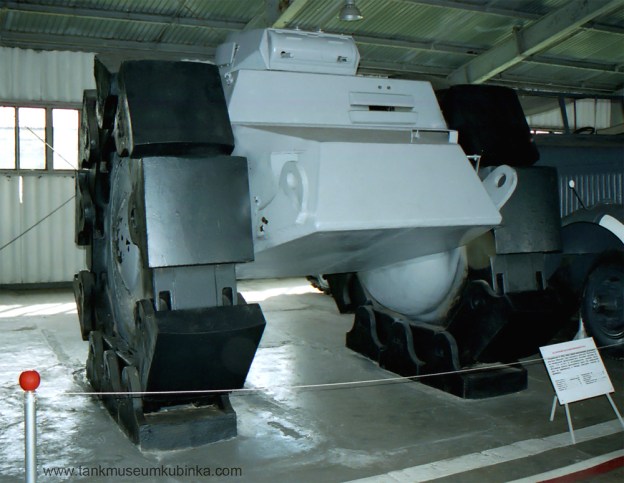
The strange looking Alkett VsKfz 617 (NK-101), preserved at the Kubinka Tank Museum. Note the small slit in the armor for the driver’s view. The small structure in front of the driver’s window was a position indicator for the rear wheel.  (Kubinka Tank Museum image)

Built in the Alkett factory near Berlin, the VsKfz 617 Minenräumer was heavily armored and designed to detonate mines by simply rolling over them. (VsKfz is short for Versuchs Kraftfahrzeug, meaning “test vehicle.”) The three-wheeled vehicle’s wide track was designed to clear a mine-free path for other vehicles to safely travel. The sole prototype carried the Alkett chassis number of 9537 and was registered as NK-101. Unfortunately, much solid information on this vehicle has been lost to history.

The Alkett VsKfz 617 had two large main power wheels at its front. A smaller, caster-style rear wheel was used for turning. Via power take offs and clutches, turning the steering wheel engaged worm shafts on both sides of the hull. The worm shafts operated in opposite directions—one side drew in a chain while the other slackened a separate chain. The chains extended through the VsKfz 617’s hull and were connected to each side of the rear wheel, rotating it as the driver turned the steering wheel. There is no indication that any differential steering was available.

Alkett VsKfz 617 NK-101 side

The rear wheel of the VsKfz 617 digging into the ground can be seen in this image. Note the large shoes of the main wheel.

Each wheel was made up of 10 links and 10 thick, heavy, solid shoes. The pin that connected two links also attached a shoe. Three of the shoes would come together on the ground for each wheel. The total of nine shoes gave the VsKfz 617 ample ground contact. The thick shoes were also resistant to damage from mine blasts. Damaged individual shoes and links could be easily replaced.

The VsKfz 617’s transmission was positioned in middle of the vehicle. A shaft led from each side of the transmission and engaged the gearing for the main wheels. A Maybach HL-120 V-12 engine was situated transversely behind the transmission. This gasoline engine produced 300 hp (224 kW) from its 4.13 in (105 mm) bore and 4.53 (115 mm) stroke cylinders. Its total displacement was 729 cu in (11.9 L). Two radiators were positioned behind the engine. Cooling air was brought in from ducts on the upper middle of the VsKfz 617 and expelled through vents on its upper rear. A 190 gallon (720 L) fuel tank was positioned above the rear wheel.

Alkett VsKfz 617 NK-101 front

This poor quality image of the VsKfz 617 still conveys the vehicle’s rather imposing appearance. Only one machine gun is in the turret, which is how it was found by Russian forces.

The VsKfz 617’s hull had about 39 in (1 m) of ground clearance that helped protect the crew from mine detonations. Furthermore, the bottom of the vehicle’s hull consisted of 1.58 in (40 mm) thick armor plating, with an additional 0.79 in (20 mm) of armor sheeting inside—creating a double hull. The rest of the vehicle’s hull thickness varied from 0.39 to 1.58 in (10 to 40 mm).

For defensive armament, the VsKfz 617 prototype had a Panzer I turret with two 7.92 mm MG 34 machine guns. However, the production version would have a Panzer II turret with a single 20 mm KwK 30 L/55 cannon and one MG 34 machine gun. The driver occupied the left side of the vehicle and saw out via a small slit in the upper armor. A rear wheel position indicator was just in front of the driver’s view. The vehicle’s commander was on the right, operating the turret. The VsKfz 617 was 20.6 ft (6.28 m) long, 10.6 ft (3.22 m) wide, and 9.5 ft (2.90 m) tall. It weighed 55 tons (50 tonne).

Alkett VsKfz 617 NK-101

This view of the VsKfz 617 displays its unique side profile.

Testing of the VsKfz 617 started as soon as it was completed in 1942. It was quickly found that the VsKfz 617’s method for steering was unsatisfactory and that the vehicle was slow and hard to handle. To make matters worse, its immense weight caused the vehicle to easily get bogged down. The VsKfz 617 and plans for its manufacture were abandoned after the tests.

The sole VsKfz 617 was captured by the Russians in late World War II, possibly in April 1945. The vehicle was inspected and tested in Kubinka near Moscow in early 1947. The Russians came to the same conclusions as the Germans regarding the VsKfz 617’s use, also finding that its slow speed and lack of maneuverability would make it an easy target for artillery. The VsKfz 617 was preserved and is currently on display in the Kubinka Tank Museum.

Alkett VsKfz 617 NK-101 Kubinka rear

The Alkett VsKfz 617 (NK-101) Minenräumer on display in the German pavilion of the Kubinka Tank Museum. Note the steering chain passing through the hull. The scoops on the top of the vehicle are the cooling air exits from the radiators. (Kubinka Tank Museum image)

Sources:
http://ww2history.ru/3909-nemeckijj-minnyjj-tral-minenraumer.-nemeckie.html
http://www.rumaniamilitary.ro/enciclopedia-armelor-roboti-terestrii-in-ww-ii-2
http://www.taringa.net/posts/apuntes-y-monografias/14137217/Vehiculos-extranos-2gm-Kfz-617-MINENR-UMER.html
http://strangevehicles.greyfalcon.us/Alkett.htm
http://www.tankmuseumkubinka.com/?cat=3

GM EM 16-184 x section

General Motors / Electro-Motive 16-184 Diesel Engine

By William Pearce

GM EM 16-184 maintenance

This image shows an Electro-Motive-built 16-184A engine (since the triangular access ports have flanges around them). The top of the cylinder barrels, each with four exhaust valves, can be seen in the middle cylinder bank. The engine’s coolant manifolds are still in place. Note the two water pumps.

In 1937, the United States Navy visited the General Motors Research Laboratories (GMRL) in Detroit, Michigan. Since 1934, GMRL had been involved in experimental, single-cylinder testing of a new light-weight diesel engine. The Navy was interested in a light and powerful diesel and contracted GMRL to develop an engine that would produce 1,200 hp (895 kW). With an output of around 75 hp (56 kW) per cylinder, an engine with 16 cylinders would be needed. However, a V-16 would be too long and too heavy. Led by Charles Kettering, the GMRL designed the unique 16-184 engine to meet the Navy’s needs. The 16-184 engine designation stood for 16 cylinders, with each displacing 184 cu in (3.0 L).

The two-stroke 16-184 diesel had four banks of four cylinders situated at 90 degrees around the crankshaft. A unique feature of the engine was its vertical configuration in which the rows of cylinders were stacked above one another. Because of the stacked cylinder arrangement, this engine configuration was called a “pancake.” A centrifugal blower to feed air into the cylinders sat on top of the engine, and the engine was mounted on top of its right angle gear reduction for the propeller shaft. The 2 to 1 gear reduction was achieved by a pinion on the end of the crankshaft engaging a ring gear mounted on the propeller shaft. No reversing gear was incorporated, because the engine was used in conjunction with variable-pitch propellers.

The 16-184’s crankcase was constructed of steel plates welded together to form a single structure. It was built-up of four “X” elements, each consisting of four cylinders. A static strength report on two of the crankcases noted that they were “…truly remarkable pieces of engineering, and they will well repay careful study by anyone whose work involves mechanical design, welding design, welding techniques and weight saving.

GM 16-184 crankcase

This image of a General Motors 16-184 crankcase undergoing a stress test reveals many unique aspects of the engine. An exhaust housing has been installed on the upper cylinder bank. The top of the engine is on the left side. The intake passageway can be seen in the upper Vee. The camshaft housing can be seen in the lower Vee. The cylinder liners are not installed. Note that the triangular access ports do not have flanges, making this a General Motors-built crankcase.

The crankshaft was supported in and attached to the crankcase by four main bearing carriers and the timing gear housing at the top of the engine. The connecting rods were of the slipper type, which allowed for equal articulation for each cylinder’s rod and reduced the load on the individual crankpins. Each forged-steel piston was attached to its connecting rod by two trunnions positioned on either side of the connecting rod and bolted to the piston.

The blower on the top of the engine fed air into two crankcase passageways on opposite sides of the engine. The blower spun at ten times crankshaft speed and delivered around 4,000 cu ft (113.27 cu m) of air per minute at 6 psi (0.4 bar). The air flowed through ports in each cylinder barrel that were uncovered by the piston. The top of the cylinder barrel was enclosed by a housing for the fuel injector (at center) and four exhaust valves (surrounding the fuel injector). This housing made up the cylinder’s combustion chamber. The exhaust valves opened into a space above the cylinders where exhaust flowed into an exhaust manifold. The exhaust manifold was positioned in the engine’s Vee and above the intake passageway. The cylinders used uniflow scavenging, in which fresh air would flow through the intake ports in the lower cylinder barrel and push the exhaust gases out the open valves at the top of the cylinder.

GM EM 16-184 x section

A sectioned view of one of the 16-184 X cylinder groups. The propeller shaft drive is at the top of the image. Note the camshaft in the upper and lower Vees. The dark areas in the left and right Vees are the intake air passageways. The cylinder ports can be seen in the lower left cylinder.

Two camshafts were geared to the crankshaft via an idler gear in the timing gear housing at the top of the engine. One camshaft was situated in each non-intake/exhaust engine Vee. The camshafts controlled three pushrods for each cylinder via roller cam followers. One pushrod controlled the fuel injector while the other pushrods each controlled two exhaust valves. The pushrods articulated rocker arms that were bolted to the top of a cast iron exhaust housing attached over each cylinder bank. The top of the cylinder barrel assembly passed through the exhaust housing. This configuration allowed exhaust gases from the cylinder to be collected by the exhaust housing and delivered to the exhaust manifold via three ports for each cylinder.

Each piston was cooled by a jet of oil impinging on its underside. Two centrifugal water pumps were driven by the lower accessory section. The upper pump circulated coolant through each exhaust housing. The upper part of the cylinder barrel had a welded sheet metal water jacket. Via a special connection, coolant flowed from the exhaust housing into the cylinder barrel water jacket. The lower pump circulated sea water through the jacketed exhaust manifolds.

The 16-184 engine had a 6.0 in (152 mm) bore and 6.5 in (165 mm) stroke, giving a total displacement of 2,941 cu in (48.2 L). The complete engine was roughly 11 ft (3.4 m) tall, 4 ft (1.2 m) wide, and weighed 4,800 lb (2,177 kg). The 16-184 developed 1,200 hp (895 kW) at 1,800 rpm.

GM EM 16-184 installed

This view of an installed 16-184A engine shows the three pushrods for each cylinder. The middle pushrod controlled the fuel injector. Note the pedal and lever in the Vee. The pedal engaged a clutch and the lever connected the engine to or disconnected the engine from the propeller shaft.

By 1938, single cylinder test engines were operating reliably and achieving the design goals necessary for a complete, 1,200 hp (895 kW) engine. The design for the complete 16-cylinder engine had been completed and prototype construction was underway. The 16-184 was first run in June 1939, and it completed the Navy’s 168-hour endurance test on 31 October 1940. In 1941, two test engines were installed in an experimental submarine chaser: USS PC-453 designed by Captain A. Loring Swasey. PC-453 served as the prototype for a class of wooden submarine chasers during World War II. The boat was re-designated SC-453 and transferred to the Coast Guard after the war.

In 1941, 16-184 engine production was undertaken by the Electro-Motive Division of General Motors. Electro-Motive originally produced railcars and was purchased by General Motors in 1930 as the latter looked to expand into the diesel engine and rail marketplaces. The production engines built by Electro-Motive were designated 16-184A and had some minor changes to their crankcases, including welded-in cylinder liners where the prototype’s were screwed-in. In addition, triangular access ports on the General Motors 16-184 crankcase did not have flanges, while the Electro-Motive 16-184A crankcase did. The Electro-Motive 16-184A engines were built in La Grange, Illinois, and the first engine started test runs on 11 October 1941. The Navy accepted the first 16-184A engine on 5 February 1942.

Two pancake engines were installed in each of the 253 110-foot (33.5 m) submarine chasers built during World War II. After the war, several of these boats were sold to other nations. The 16-184A engines were noted for their reliable operation and good service life. Some of these engines continued to operate (occasionally) into the year 2000. Approximately 544 16-184A engines were built.

GM 16-338

This image shows the intake side of the General Motors 16-338 engine installed on its generating unit. This arrangement led to issues, for any liquids that leaked from the engine would drain down into the generator.

The 16-184A engine design was used as the basis for the General Motors 16-338 engine built in the late 1940s. The 16-338 had the same bore and stroke as the 16-184A and produced 1,000 hp (746 kW) at 1,600 rpm. Four 16-338 engines were installed in the Tench- and Tang-class submarines, and two were installed in the USS Albacore—the Navy’s first “teardrop” hull submarine, which paved the way for modern sub design.

The 16-338 engines sat atop a generator to provide power to electric motors that drove the ship’s propellers. The engine also had a different intake and exhaust arrangement in which the manifolds were situated in separate Vees of the engine. The 16-338 engines proved somewhat unreliable in service and required excessive maintenance. Some of the 16-338’s issues were due to the Navy using standard diesel lubricating oil rather than the special oil specified for use in the engine. Ultimately, the Tench- and Tang-class submarines were re-engined and their 16-338 parts were used as spares to keep the USS Albacore running until it was withdrawn from service in 1972.

Sources:
– “Development of a Light Weight Diesel Engine” by J. C. Fetters, Diesel Power & Diesel Transportation (August 1942)
Parts Book GM Diesel Engine, Model 16-184A by Electro-Motive Division (1944)
Static Strength Tests of Diesel Engine Crankcases GMC 16-184 and EMC 16-184-A for 110-Foot Patrol Boats by J. W. Day (August 1943)
Diesel War Power by Electro-Motive Division, General Motors (1944)
Engines Afloat Volume II by Stan Grayson (1999)
http://usautoindustryworldwartwo.com/General%20Motors/electro-motive.htm
http://en.wikipedia.org/wiki/Electro-Motive_Diesel
http://www.navsource.org/archives/12/150453.htm
http://www.ss563.org/t-class.html
http://nonplused.org/panos/uss_albacore/12/engine_01.html

FIAT AS8 V-16 side

FIAT AS.8 Engine and CMASA CS.15 Racer

By William Pearce

Since 10 April 1933, Italy had enjoyed ownership of the 3 km absolute world speed record for aircraft. Warrant Officer Francesco Agello set the record at 423.824 mph (682.078 km/h) in the Macchi-Castodi MC.72 seaplane built for the Schneider Trophy Contest. The MC.72 was powered by a 24-cyllinder FIAT AS.6 engine. Agello went on to raise the record to 440.682 mph (709.209 km/h) on 23 October 1934 in another MC.72.

FIAT AS8 V-16 side

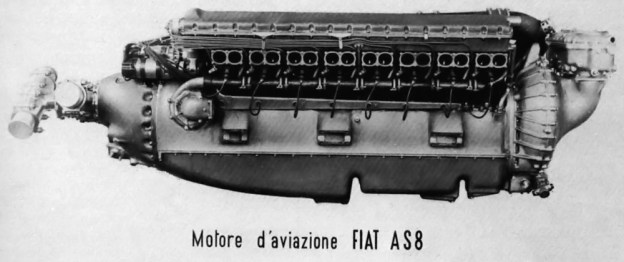
Side view of the FIAT AS.8 V-16 engine specifically designed for the CMASA CS.15 racer.

However, Germany captured the world speed record on 30 March 1939, when Hans Dieterle flew 463.919 mph (746.606 km/h) in the Heinkel He 100 (V8). Germany raised the record a month later on 26 April 1939, when Fritz Wendel traveled 469.221 mph (755.138 km/h) in the Messerschmitt Me 209 (V1).

Even before Dieterle’s record flight, the Italians had considered building an aircraft specifically for a new record attempt. FIAT, with the support of the Italian government, wanted to win the record back and had initiated an aircraft and engine design that was somewhat finalized before Wendel’s record flight. The new record aircraft was designed and built by Costruzioni Meccaniche Aeronautiche SA (CMASA), a FIAT subsidiary in Pisa. The engine would be designed and built at FIAT’s headquarters in Turin.

FIAT AS8 rear

A rear view of the FIAT AS.8 showing the valley between the engine’s banks. The small manifolds on each bank are to take the cooling water from the cylinders. They are installed backward in this photo; the outlet should be at the engine’s rear. The long intake manifold is reminiscent of the even-longer manifold used on the AS.6. The large port in the manifold elbow, seen just above the carburetor, is a relief valve to prevent over pressurization of the manifold (perhaps in the event of a backfire—a major issue in the early development of the AS.6).

The aircraft was designed by Manlio Stiavelli and was known as the Corsa (meaning Race) Stiavelli 15, or just CS.15. Lucio Lazzarino, an engineer at CMASA, analyzed and tested various aspects of the CS.15 design. The CS.15 was a small, mid-wing, all-metal aircraft with a very low frontal area. Its 29.5 ft (9.0 m) monospar wing had conventional flaps and ailerons. The cockpit was situated far aft on the 29.2 ft (8.91 m) fuselage and was faired into the long tail.

To keep the wing thin and the fuselage narrow, the main wheels of the CS.15 folded toward each other before retracting aft into the fuselage. The CS.15’s fuel tank was situated behind the engine, in front of the cockpit, and above the main landing gear well. Fuel capacity was very limited, and the CS.15 was only meant to have enough endurance to capture the speed record—about 30 minutes of flight time. The estimated empty weight of the CS.15 was 4,213 lb (1,910) kg, and its total weight was 5,000 lb (2,270 kg).

To power the CS.15, Antonio Fessia and Carlo Bona laid out the AS.8 (Aviazione Spinto 8) engine design at FIAT. The AS.8 was a completely new design but had many common elements with the AS.6 engine used in the MC.72. The AS.6 was designed by Tranquillo Zerbi, and Fessia had taken over Zerbi’s position at FIAT when he passed away on 10 March 1939. The AS.8 was a liquid-cooled engine with cylinders very similar to the AS.6’s, utilizing two intake and two exhaust valves actuated by dual overhead camshafts. The AS.6 and AS.8 shared the same 5.51 in (140 mm) stroke, but the AS.8’s bore was increased .08 in (2 mm) to 5.51 in (140 mm). Reportedly, the AS.6 and AS.8 used the same connecting rods and both engines were started with compressed air.

FIAT AS8 front

This view displays the four magnetos of the FIAT AS.8 just above the propeller gear reduction. Note the the air distribution valves driven by the exhaust camshafts for starting the engine. The outlet of the water pumps can be seen in the forward position, which differs from the first image on this page.

The AS.8 was unusual in many ways. Its two banks of eight individual cylinders were set at 45 degrees. The 16 cylinders gave a total displacement of 2,104 cu in (34.5 L). The cylinders had a 6.5 to 1 compression ratio. The single-stage supercharger was geared to the rear of the engine and provided pressurized air to the cylinders via a long intake manifold between the cylinder banks. The carburetors were mounted above the supercharger. Unlike the AS.6, which used independent coaxial propellers, the AS.8 featured contra-rotating propellers geared to the front of the engine at a 0.60:1 reduction. Two sets of two-blade propellers 7.2 ft (2.2 m) in diameter could convert the AS.8’s power into thrust for the CS.15. The engine weighed 1,742 lb (790 kg).

Nine main bearings were used to support the long crankshaft and to alleviate torsional vibrations. In addition, drives for the camshafts, magnetos, and water pumps were mounted at the front of the engine. Each cylinder bank had two magnetos to fire the two spark plugs per cylinder. The distributor valve for the air starter was driven from the front of the exhaust camshaft for each cylinder bank. The exhaust gases of the AS.8 were utilized to add propulsive thrust through specially designed exhaust stacks on each cylinder.

FIAT AS8 bank

A detailed view of the AS.8’s right cylinder bank. Each cylinder had one spark plug on the outside of the engine and one in the Vee. The pipe next to the spark plug is for the air starter. The manifold at the bottom fed cool water into the cylinder jacket. (Emanuele image via Flickr)

For cooling, pressurized water was drawn into a pump on each side of the engine, near its front. A manifold delivered the water to each cylinder on the outside of the bank. The water then flowed through the cylinders and exited their top into another manifold situated in the Vee of the engine. The heated water, still under pressure, was taken back to the CS.15’s tail, where it was depressurized and allowed to boil. The steam then flowed through the CS.15’s wings, where 80% of their surface area was used to cool the steam and allow it to condense back into water. The water was then re-pressurized and fed back to the engine. Engine oil was also cooled by surface cooling in the rear and tail of the aircraft.

CMASA CS15

A three-view drawing of the CMASA CS.15 racer. Note the thin wings, minimal frontal area, and main gear retraction.

By early 1940, full-scale mockups of various CS.15 components were built and the construction of the CS.15 was underway. Wind tunnel tests indicated the CS.15 would reach a speed of 528 mph (850 km/h). The AS.8 engine was running on the test stand at this time. During these tests, the AS.8 achieved an output of 2,500 hp (1,864 kW), but the engine was rated at 2,250 hp (1,678 kW) at 3,200 rpm. The engine accumulated tens of hours running on the test stand and encountered few, if any, major failures. It is not known how many AS.8 engines were built, but the number is thought to be very small. The AS.8 was also the starting point of another V-16 engine, the FIAT A.38.

After Italy entered World War II in June 1940, progress on the CS.15 and AS.8 continued but at a much reduced pace. The CS.15 was damaged in various air raids, and it was further wrecked by the Germans as they exited Italy in late 1943. Some believe that whatever remained of the CS.15 was taken to Germany, as the aircraft essentially disappeared. As for the AS.8 engine, one example survived the war and is on display (or in storage) at the Centro Storico Fiat (Fiat Historic Center) in Turin, Italy.

The AS.8 achieved a power output greater than 1 hp/cu in and 1 hp/lb—accomplishments that were sought after by engine designers around the world.

Sources:
MC 72 & Coppa Schneider Vol. 2 by Igino Coggi (1984)
Aeronuatica Militare Museo Storico Catalogo Motori by Oscar Marchi (1980)
World Speed Record Aircraft by Ferdinand Kasmann (1990)
Italian Civil and Military Aircraft 1930-1945 by Jonathan W. Thompson (1963)

Bennie Railplane test

Bennie Railplane

By William Pearce

George Bennie was born near Glasgow, Scotland in 1892 (some say 1891). From a young age, he became interested in rail travel. By the age of 34, he had patented his idea for a new form of public rail transportation. He envisioned a combination airplane and locomotive—an aircraft that flew on rails. This vehicle would be capable of high speeds and would operate independently of standard rail transportation.

Bennie Railplane poster

A poster forecasting the George Bennie Railplane (G•B•R) line.

In his System of Aerial Transport patent from 1923, Bennie describes a vehicle suspended between two rails positioned above the ground. A single bogie attached the vehicle to the upper rail. This rail would support the vehicle while it was at rest and at slow speeds. The lower rail would stabilize the vehicle via a set of guide wheels at each end of the carriage and would also prevent the body from swinging out as it traveled around curves.

A propeller was situated at each end of the vehicle. In the patent, only one of the fixed pitch propellers would be used to pull the vehicle along the track. The propeller at the opposite end would be used for breaking or pulling the vehicle in the opposite direction. The propellers could be driven by internal combustion engines or by electric motors powered via an electrified rail. As the vehicle’s speed increased, lifting planes positioned on the roof would support some of the craft’s weight, increasing its efficiency by decreasing the friction from the rails.

Bennie Railplane test

The Railplane moves away for the platform along the short test line.

Working with consultant engineer Hugh Fraser, Bennie’s vision became a reality in 1929. A test track for the George Bennie Railplane System of Transport, also known as the Railplane Line, was built in Milngavie, near Glasgow. The test track was about 425 ft (130 m) long and was built over a section of the London and North Eastern Railway (LNER) line. The elevated track was built by Teesside Bridge and Engineering Company. It had a 16 ft (4.9 m) vertical clearance above the railway (standard bridge clearance at the time), and each of its five spans was 80 ft (24.4 m) long. The elevated track would allow the Railplane to traverse geography not traditionally covered by a standard railroad track. In addition, utilities such as telephone and electricity could be incorporated into the elevated track.

The Railplane test car differed from the original patent in a number of ways. No lifting planes were incorporated into the Railplane, and it was suspended from the upper rail by two bogies. The bogies had laminated springs to dampen the ride. The two-blade, 9 ft (2.7 m) propellers worked together to send the Railplane along the line. Electric motors were used and they received their power through the rail. The motors provided a continuous 60 hp (44.7 kW) at 1,200 rpm but could be operated at 240 hp (179 kW) for up to 30 seconds. For braking, the propellers’ rotation could be reversed and the bogies had provisions to grip the rails.

Bennie Railplane

The Bennie Railplane on its elevated track as seen from the ground. The two-blade propellers can be see on both ends of the Railplane.

The Railplane test car was built by William Beardmore & Company Ltd. It was skinned in aluminum over an aluminum frame with a steel keel. The Railplane was 52 ft (15.8 m) long, 8 ft (2.4 m) in diameter, and weighed 12,000 lb (5,443 kg) complete. Two sliding doors with stained glass windows allowed passengers to enter and exit the Railplane. The plush interior of its 24 seat passenger area was outfitted by Waring & Gillow.

On 8 July 1930, the Railplane Line was officially opened to the press and invited members of the public. Although the rail and subsequent ride were short, they did illustrate the service a full Railplane Line would provide. It was noted that the Railplane was very smooth in both acceleration and ride. Bennie estimated the top speed of the Railplane as 120 mph (193 km/h). However, higher speeds could be obtained with increased power to the propellers.

Bennie Railplane interior

The plush interior of the Railplane which accommodated at least 24 passengers.

Other power arrangements were proposed. The Railplane’s electric motors could be powered by an onboard internal combustion engine connected to a generator. Alternatively, internal combustion engines could be directly connected to the propellers. Bennie also designed a way to couple multiple Railplanes together via their propeller hubs. It appears this system incorporated a four-blade propeller with an extended hub. A single engineer in the lead Railplane would control all of the propellers.

A Railplane Line was seen as a way to ease congestion by operating above and much faster than freight trains. Although there was considerable interest and various Railplane Line proposals, no main financial backers were found, and none of the proposals moved forward. By 1937, Bennie was bankrupt and the Railplane was abandoned. The Bennie Railplane track and carriage remained in place until 1956, when it was disassembled and scrapped.

Bennie Railplane four blade

The Railplane outfitted with a four-blade propeller and a special hub to couple to another Railplane.

In the intervening years, Bennie continued with the Railplane concept. In 1946, the George Bennie Airspeed Railway Ltd was founded, followed by the George Bennie Airspeed Railway (Iraq) Ltd in 1951. As with the original Bennie Railplane Line, these endeavors failed to move forward. George Bennie passed away in 1957, never having achieved his goal of creating a high speed public rail system.

Below is a video of the Bennie Railplane in action uploaded to YouTube by British Pathé.


Sources:
– “System of Aerial Transport” US patent 1,459,495 by George Bennie (granted 19 June 1923)
http://mikes.railhistory.railfan.net/r069.html
http://www.secretscotland.org.uk/index.php/Secrets/BennieRailplane
http://www.gearwheelsmag.co.uk/archive/the_bennie_railplane_feature_13.htm
http://www.dewi.ca/trains/bennie/index.html
http://www.dailymail.co.uk/sciencetech/article-2154361/The-REAL-flying-Scotsman-120mph-propeller-driven-Railplane-left-inventor-dreamed-revolutionising-commuting-1930s-Britain-penniless.html
http://www.edlc.co.uk/heritage/local_history/local_history___heritage/local_heroes/george_bennie___railplan.aspx

Jenkins Mormon Meteor III restored

Jenkins Mormon Meteor III

By William Pearce

Ab (David Abbott) Jenkins was a devout Mormon who did not drink or smoke. He was interested in pushing endurance records beyond what his Mormon Meteor II racer could achieve. The Duesenberg J chassis of the Mormon Meteor II simply could not handle its heavy, 750 hp (559 kW) Curtiss Conqueror V-12 aircraft engine. In 1937, Jenkins commissioned Augie Duesenberg to design a new car able to accommodate the 1,570 cu in (25.7 L) Curtiss Conqueror or an Allison V-1710 engine. The new endurance racer was known as the Mormon Meteor III.

jenkins mormon meteor iii indy in

The newly completed Mormon Meteor III at the Indianapolis Motor Speedway in 1938. Note the original exhaust manifold that was later replaced by individual stacks.

The Mormon Meteor III was built in Augie Duesenberg’s shop in Indianapolis, Indiana. Jenkins wanted the car to be able to accommodate both of his Curtiss Conqueror engines, one powering each axle. However, the initial build would be with just one engine powering the rear axle. The Mormon Meteor III was a large vehicle and designed specifically for endurance record runs. The chassis was offset 6 in (152 mm) to the left on the running gear to aid in the constant turn encountered on the 10 and 12 mi (16 and 19 km) circular record courses.

The Mormon Meteor III was an evolution of the Mormon Meteor II. The car was nearly 21 ft (6.4 m) long and had a streamlined, narrow body with an enclosed cockpit. A tall fin was incorporated behind the cockpit, and two fuel tanks were positioned above the rear axle. Power was delivered from the Conqueror engine to the rear wheels via a three-speed transmission. At speed, the 112 gal (424 L) of fuel the Mormon Meteor III carried would be nearly exhausted in around two hours after traveling 400 miles (644 km). Four headlights to provide ample illumination of the track during the night hours were faired into the sloped radiators. The Mormon Meteor III had independent front suspension and specially made Firestone tires mounted on 22 in (.56 m) wheels. The car weighed 4,800 lb (2,177 kg). Marvin Jenkins, Ab’s son, assisted with the build.

Jenkins Mormon Meteor III loading

The Mormon Meteor III being rolled out of Augie Duesenberg’s shop to be taken to the Speedway for testing. The canopy has not been installed, and the truck it is being loaded onto is still painted “Mormon Meteor II.” (V. J. Horvath image via www.AutoGiftGarage.com)

The Mormon Meteor III was finished in 1938 and tested at the Indianapolis Motor Speedway. The car was painted orange and blue: the colors of the Firestone Tire & Rubber Company, its primary sponsor. The racer made its debut at the Bonneville Salt Flats in July 1939. The conditions at Bonneville were not the best, but Jenkins and the Mormon Meteor III set a 1,000 km (638 mi) record, averaging 171.30 mph (275.68 km/h). Jenkins intended to run the car longer but a fire changed his plans. The fire started when fuel leaked out of an overfilled tank and came in contact with an overheating universal joint. Marvin had to pry the canopy open in order to free Ab. Jenkins had suffered minor burns and was taken to the hospital. A few weeks later Jenkins was back and, with relief driver Rex Mays, set a 12 hour record covering some 2,040 mi (3,283 km) at 169.99 mph (273.57 km/h). Racing was halted due to a cracked exhaust manifold that allowed fumes to enter the cockpit.

The Mormon Meteor III was back on the Bonneville Salt Flats in August 1940. Marvin Jenkins was too young to race the car, but he was able to extensively test the Mormon Meteor III to make sure all was in order. Marvin drove the car for over 2,000 mi (3,200 km) in the course of his testing.

Jenkins Mormon Meteor III top

The Mormon Meteor III’s narrow body and its 6 in (152 mm) left offset are visible in this image.

At 57 years old, Jenkins climbed back in the Mormon Meteor III to again challenge endurance records. With relief driver Cliff Bergere, Jenkins and the Mormon Meteor III set some 21 speed records for just about everything up to 24 hours and 10,000 km (6,214 mi). For the first hour, Jenkins averaged 190.680 mph (306.87 km/h). At six hours, 1,034 mi (1,664 km) had been covered at 172.380 mph (277.419 km/h). After twelve hours, the Mormon Meteor III had covered 2,042 mi (3,286 km) at 170.210 mph (273.927 km/h). After 24 hours, 3,868 miles (6,225 km) had been traveled at 161.180 mph (259.394 km/h). At 5,000 mi (8,047 km), the Mormon Meteor III had averaged 149.420 mph (240.468 km/h). By the 10,000 km (6,214 mi) mark, the speed had dropped to 148.970 mph (239.744 km/h).

The Mormon Meteor III did not race in 1941. Jenkins had been elected mayor of Salt Lake City, Utah and was preoccupied with his duties there. World War II then began and put an end to all racing activities. In 1943, Jenkins sold the Mormon Meteor III to the State of Utah for $1.00 on the conditions that he could borrow it for future record runs and that it would be properly cared for. The Mormon Meteor III was put on display in the Capitol building in Salt Lake City.

In 1946, after the war, Marvin bought a war-surplus Lockheed P-38 Lightning for $1,250. The intention was to use the two 1,300 hp (969 kW) Allison V-1710 engines from the P-38 in the Mormon Meteor III and make an attempt at the absolute land speed record. However, Briton John Cobb set a new speed record in 1947. In his twin Napier Lion-powered Railton Mobil Special, Cobb raised the record to 394.196 mph (634.397 km/h). Ab Jenkins felt the Mormon Meteor III would not be able to best that mark even with the two Allisons.

jenkins mormon meteor iii bonneville ut

Ab Jenkins and the Mormon Meteor III on the Bonneville Salt Flats. Note the individual exhaust stacks for the Curtiss Conqueror engine.

In 1949, Jenkins thoughts returned to racing the Mormon Meteor III. It was taken out of the Capitol and prepped for another run at Bonneville. However, the weather that year did not permit suitable conditions to race, and the Mormon Meteor III was returned to the Capitol. In 1950, the car was again taken out and readied for the Bonneville Salt Flats.

In September 1950, Jenkins set off in the Mormon Meteor III. The 67-year-old Jenkins climbed out of the Mormon Meteor III after setting 30 records during the run. His top recorded speed was 199.190 mph (320.565 km/h), and he covered 195.95 mi (315.35 km) in an hour. Jenkins was at it again in 1951, breaking 22 records. For these runs, the Mormon Meteor III was painted light beige and red for its main sponsor, D-X Oil. Jenkins was trying to set a new one hour record averaging over 200 mph (322 km/h) when the clutch locked up. The Mormon Meteor III went out of control and hit a course marker that punctured the car’s radiator, putting an end to the 1951 Bonneville attempt.

Jenkins Mormon Meteor III D-X

Ab Jenkins in the Mormon Meteor III in 1951. The car is painted in the colors of D-X Oil, and the top two headlights have been removed for better streamlining.

The Mormon Meteor III was returned to the Utah Capitol, where it sat on display for all to see. Jenkins continued to race, and his last records were in 1956 for a 24 hour run in a Pontiac sedan. Pontiac would later name the new car Bonneville in honor of the Salt Flats and all that they inspire. Later in 1956, Ab Jenkins passed away. Over his lifetime, Jenkins had set more records than anyone else and had traveled two million miles (3.2 million km) without getting into an accident or even getting a ticket.

The Mormon Meteor III stood proud in the Utah Capitol, but as the years passed, the memory of the car, its records, and the incredible men who made it all possible began to fade. In 1971, the Mormon Meteor III was taken from the Capitol to be used in a parade. Once the parade was over, no one claimed the car and it was left out in the elements. Marvin Jenkins was living in Texas at the time. He received a call from a friend who found the car in a deteriorating state. Marvin immediately flew to Utah.

Jenkins Mormon Meteor III NBC

A detailed view of the Conqueror engine in the restored Mormon Meteor III. (NBC/Jay Leno’s Garage image)

The Mormon Meteor III had been vandalized, and its magnesium components were corroding from exposure to the elements. The car was moved back to the Capitol, and the next 25 years passed with the Jenkins family working with the state government to restore the car. However, some in the Capitol just did not care. In 1996, with the State of Utah having broken the terms of the agreement, Marvin Jenkins took possession of the Mormon Meteor III.

Jenkins Mormon Meteor III restored

The restored Mormon Meteor III back on the Bonneville Salt Flats.

Restoration of the Mormon Meteor III continued for several years and the car was returned to working order, but it would not return to the Capitol. The restored Mormon Meteor III, repainted orange and blue, was run on the Bonneville Salt Flats for the filming of Boys of Bonneville, a documentary about Ab and Marvin Jenkins. Marvin Jenkins passed away in 2008, a few weeks before the car returned to the salt. The Mormon Meteor III is currently owned and displayed by the Price Museum of Speed in Salt Lake City, Utah. Ab Jenkins and the Mormon Meteor III still hold about a dozen speed records.

Jenkins Ab Marv Mormon Meteor III

Ab and Marv Jenkins and the hard-run Mormon Meteor III at Bonneville circa 1939.

Sources:
Ab & Marvin Jenkins by Gordon Eliot White (2006)
– “They Always Called Him Augie” by George Moore, Automobile Quarterly, Vol. 30, No. 4 (1992)
http://www.barracudamagazine.com/ab-jenkins.htm
http://www.deseretnews.com/article/779737/Mormon-Meteor-III-restored.html?pg=all