Duesenberg W-24 Marine Engine

By William Pearce

Although his father was a co-founder of the Dodge Brothers Company, progenitor to today’s Dodge automobile company, Horace Elgin Dodge Jr. did not follow his father into the automobile business. But like his father, he was very interested in watercraft. In 1923, after his father had passed, he founded Dodge Boat Works in Detroit, Michigan. This venture was backed by a $2 million investment from his mother, Anna Thompson Dodge.
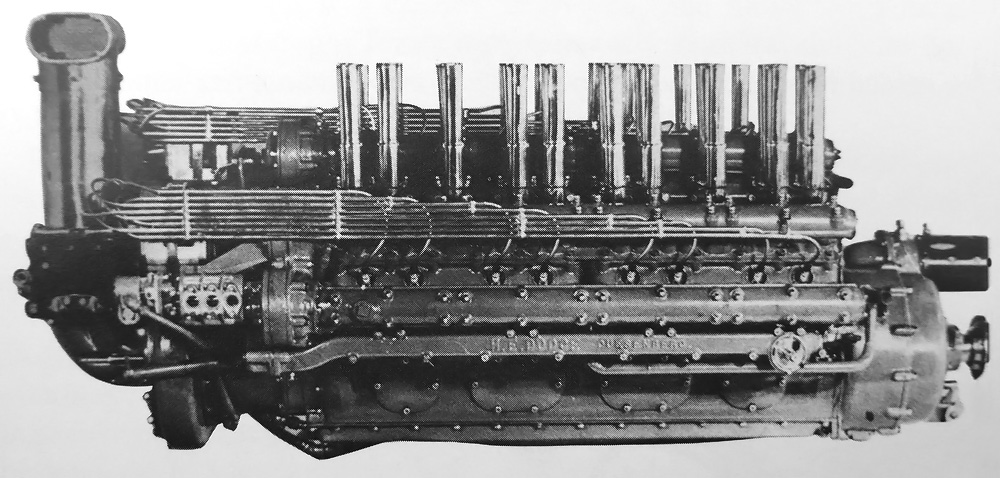
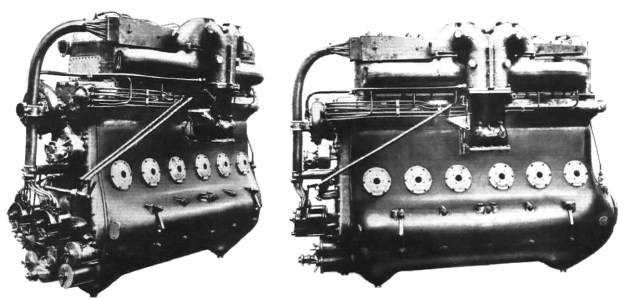
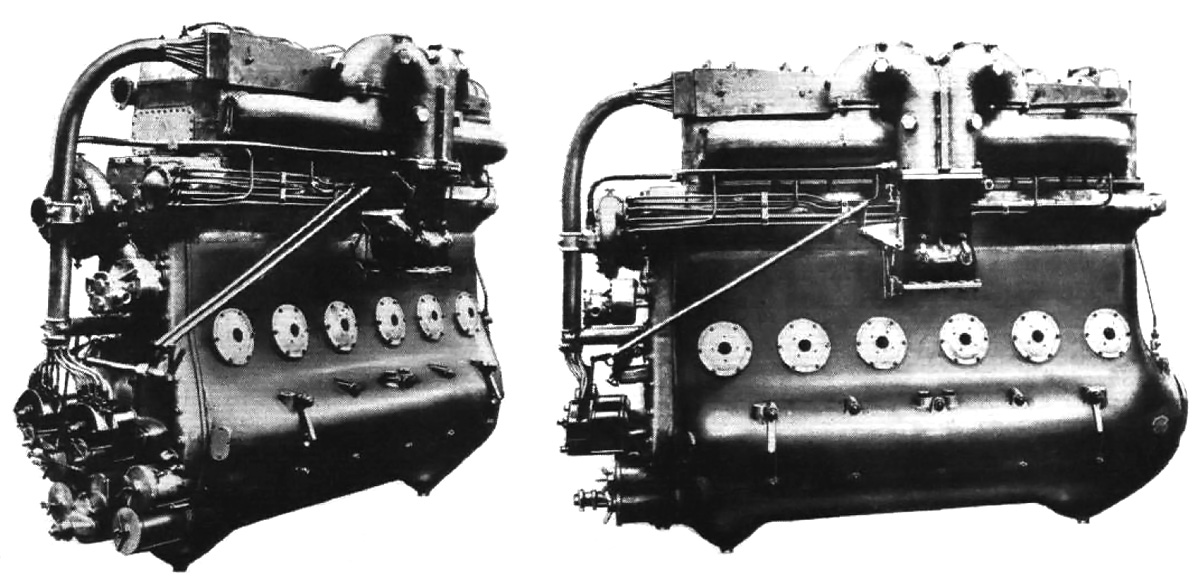
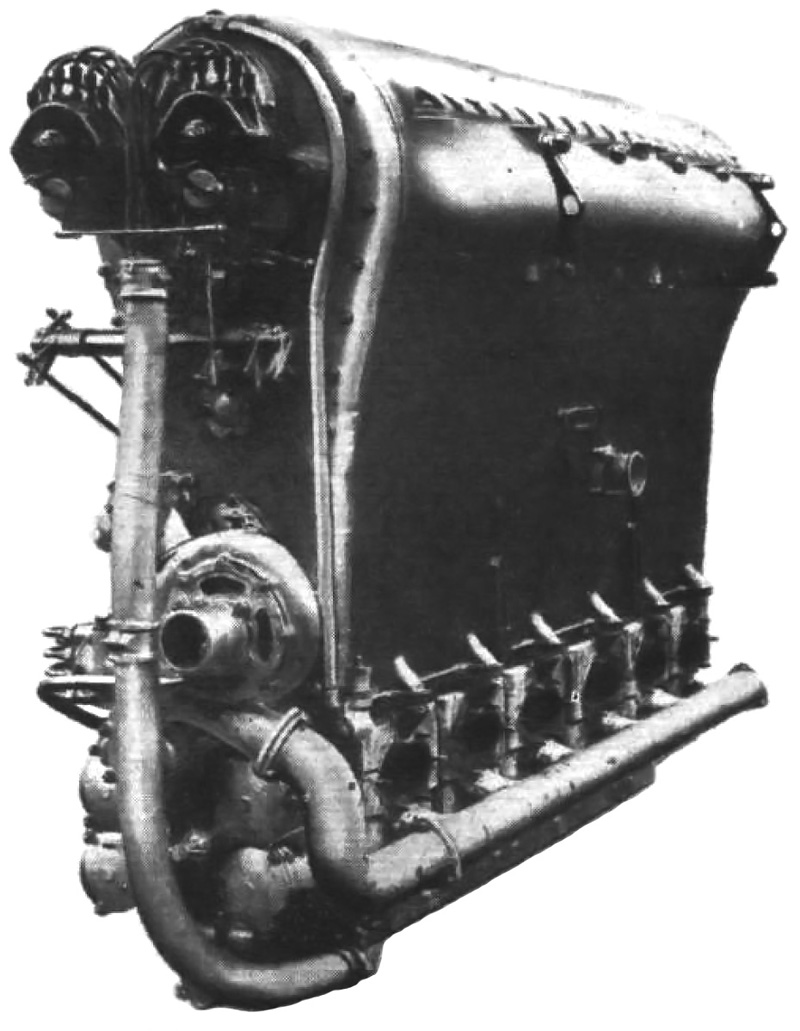
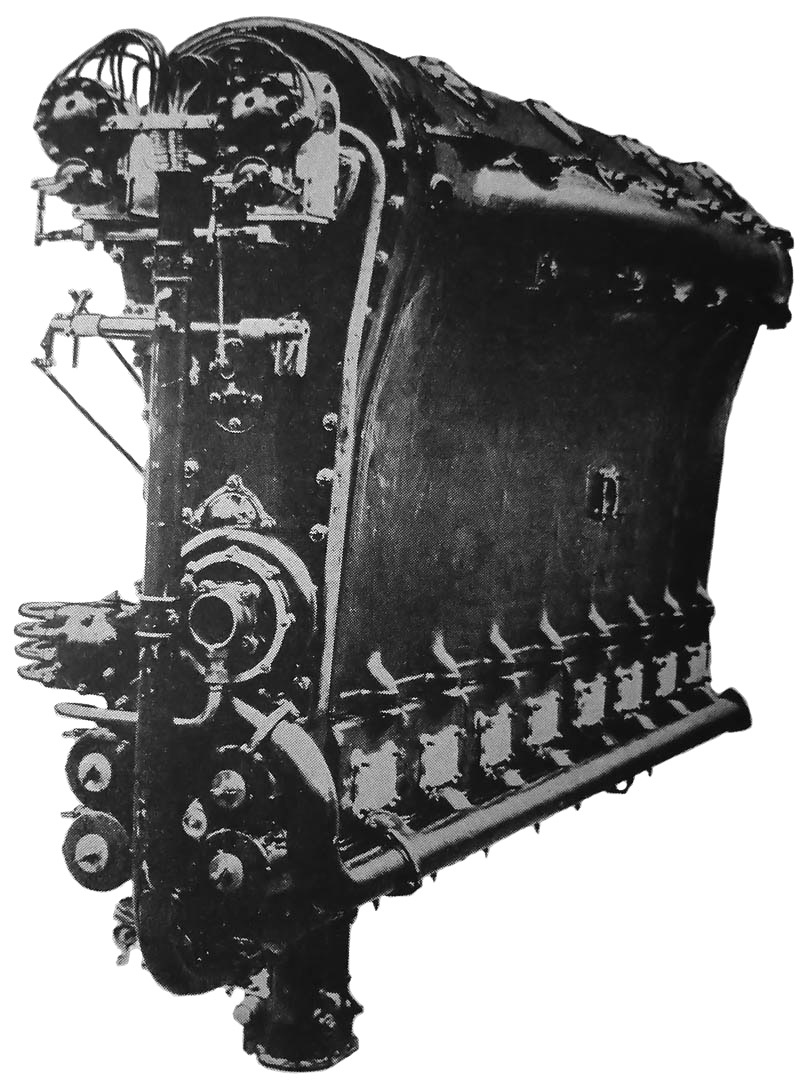
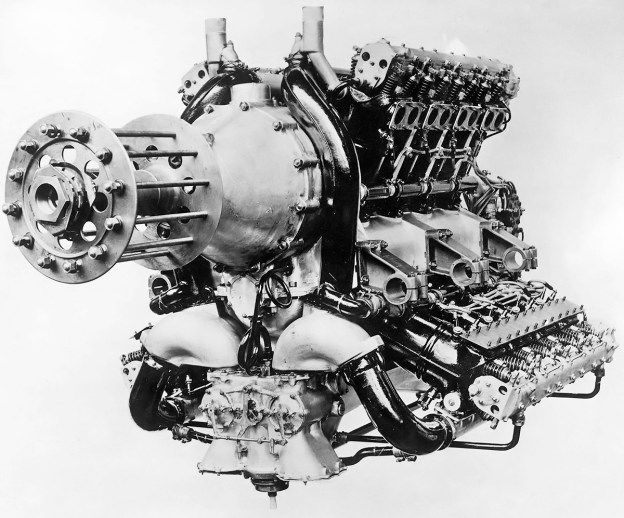
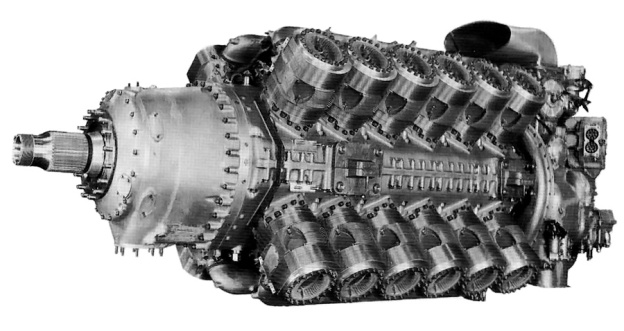
Side view of the J. Paul Miller-developed Duesenberg W-24 engine.

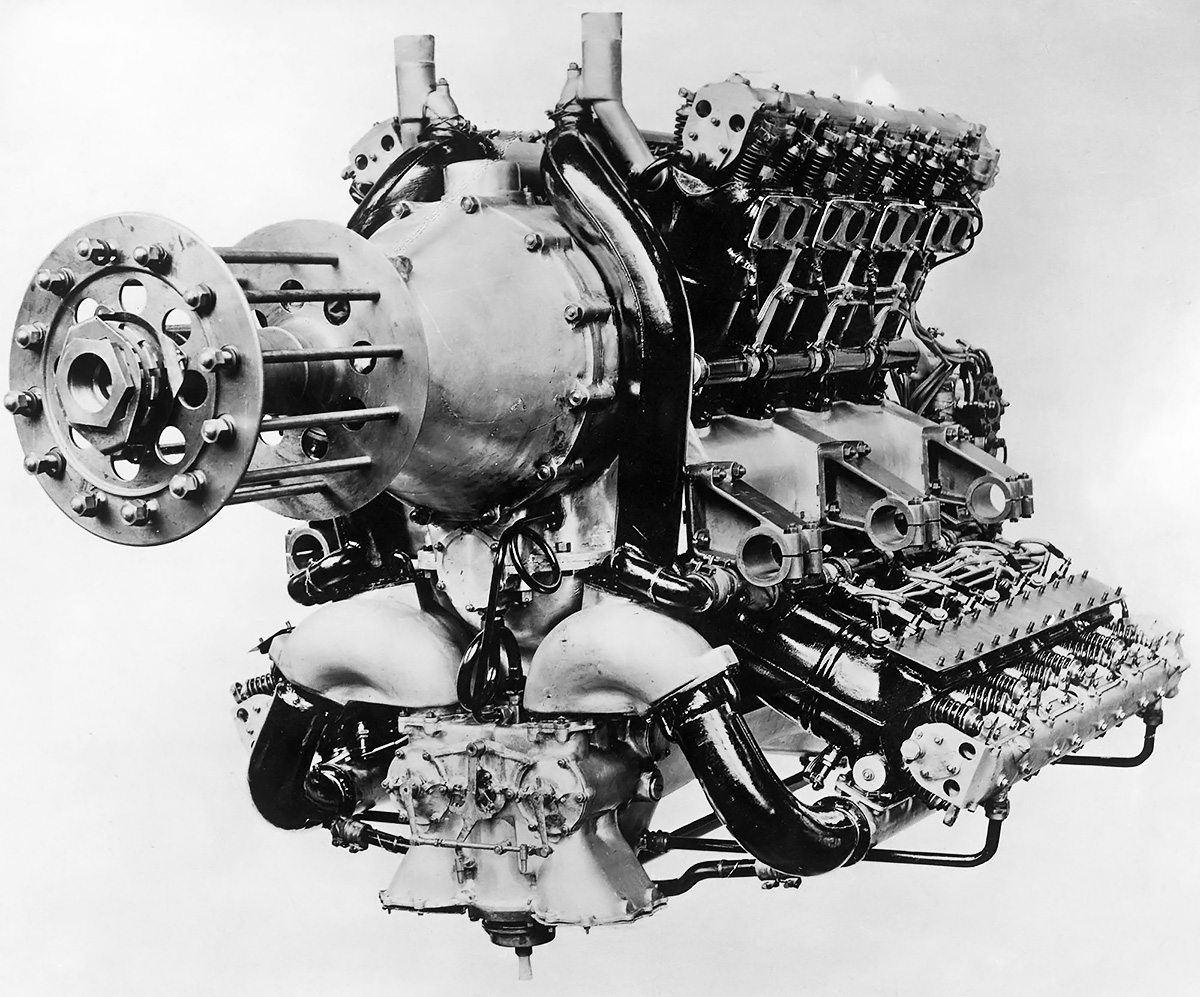
Side view of the J. Paul Miller-developed Duesenberg W-24 engine.

Dodge was very involved in boat racing, and he wanted to create a boat that would be unbeatable. In 1925, Dodge approached Duesenberg Brothers Racing to build an engine to propel him to victory in the Gold Cup race. An agreement was made, and a contact was signed on 27 January 1926—$32,500 for the construction of two complete engines with enough spare parts to build a third. The first engine was to be delivered on 15 June 1926, with the second following on 6 July 1926. Although Fred Duesenberg was involved with the engine project, it was most likely Augie Duesenberg who did the majority of the work.

The contracted engine was essentially three straight-eight engines on a common aluminum crankcase, creating a W-24. Why a “W” engine configuration was chosen is not known, but it does provide for a powerful engine in a fairly compact space. At this same time in history, the Napier Lion W-12 engine was powering record-setting air, land, and marine speed machines, and it is easy to see how the Lion could have served as inspiration.
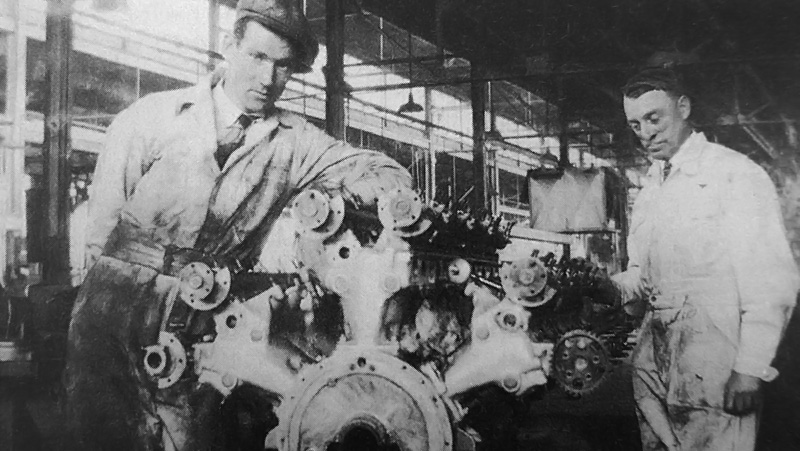
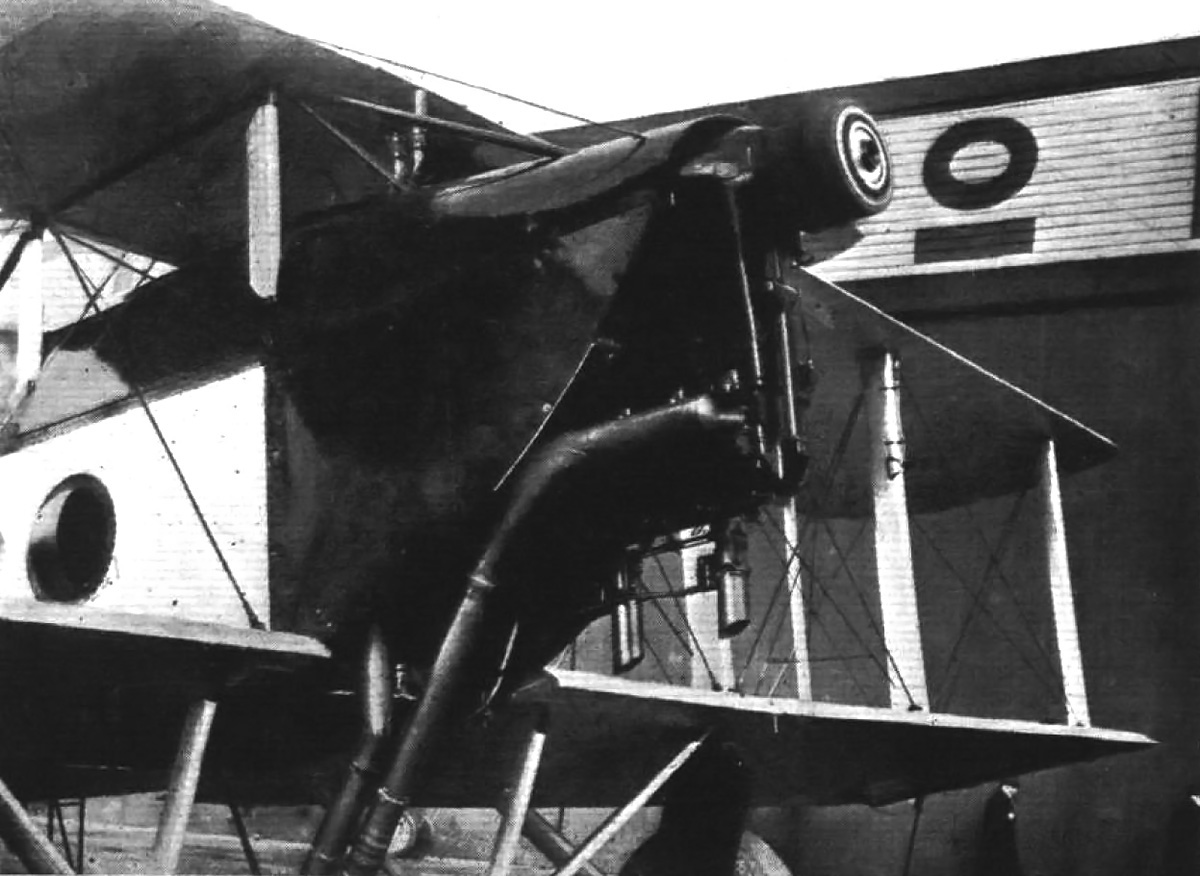
Front view of the Duesenberg W-24 under construction.

View of the Duesenberg W-24 under construction.

The engine’s bore was 2.875 in (73 mm) and stroke was 4.0 in (102 mm), giving a total displacement of 623 cu in (10.2 L). The two side banks were angled 60 degrees from the center vertical bank. Each of the W-24’s engine banks was made up of two four-cylinder blocks with integral heads. The first four-cylinder blocks were supposedly made of cast iron, but later cylinder blocks were cast aluminum with steel cylinder liners. The engine’s single crankshaft was supported by five main bearings. The connecting rods were of the tubular type, with the master rod in the center bank and an articulated rod for each outer bank.

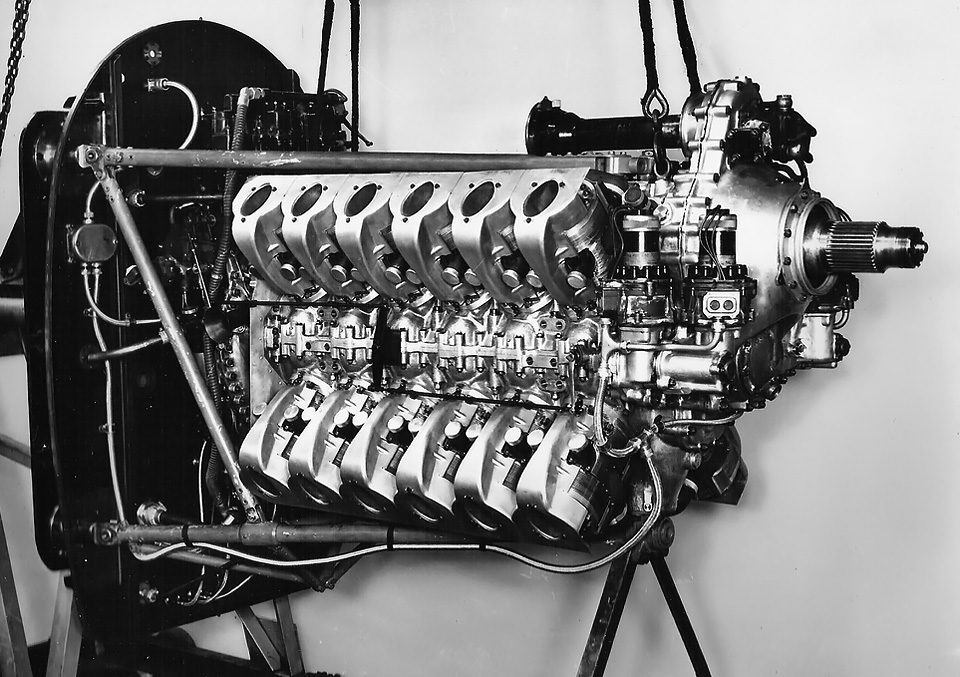
Four valves per cylinder operated in a pentroof combustion chamber. All together, the engine’s 96 valves took about a week of labor to adjust. The valves were actuated in each engine bank by dual overhead camshafts that extended the length of the engine. The camshafts were geared to the crankshaft via idler gears. Each block of four cylinders had five exhaust ports. The three middle exhaust ports each shared two exhaust valves. Exhaust from each bank was collect in a single water jacketed manifold. One spark plug was installed in each cylinder and fired by a camshaft-driven Delco distributor mounted at the rear of each cylinder bank.
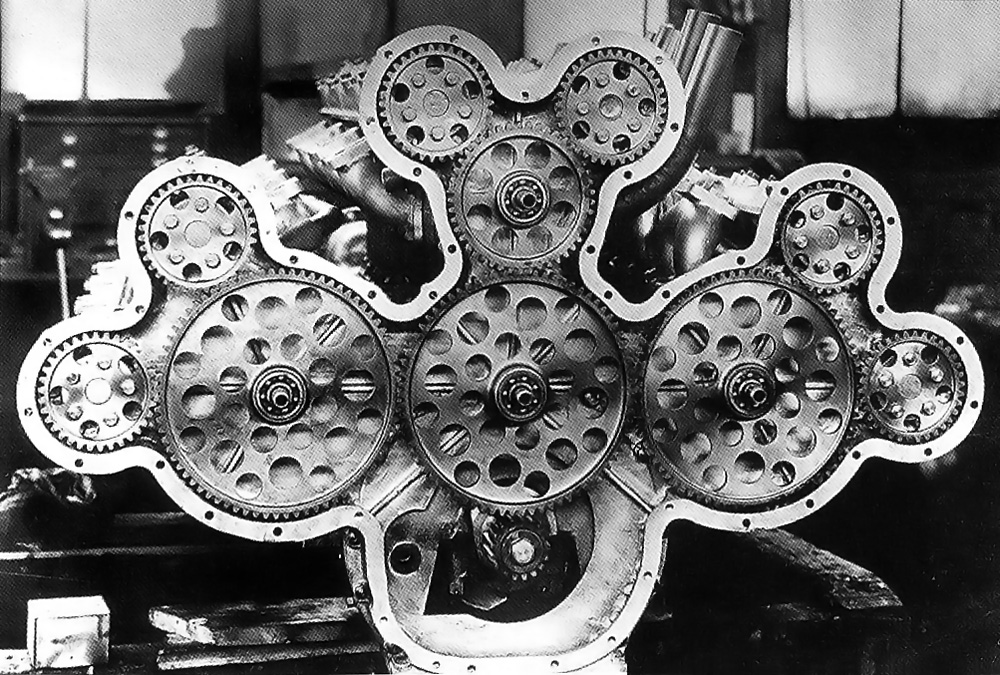
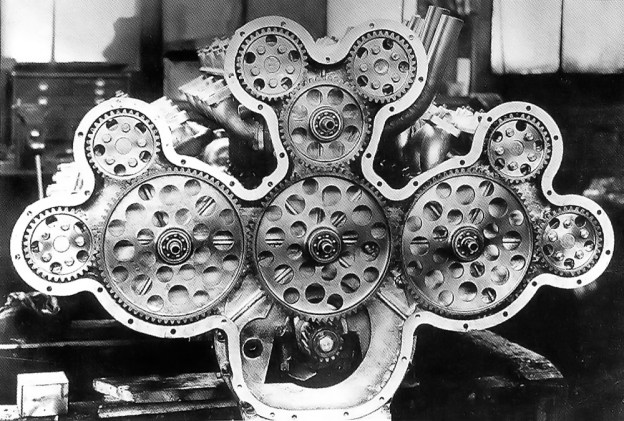
The complex gear-drive arrangement for the camshafts at the rear of the 24-cylinder Duesenberg.

The complex gear-drive arrangement for the camshafts at the rear of the 24-cylinder Duesenberg. The pinion on the crankshaft had 17 teeth, the intermediate gears had 74 teeth, and the camshaft gears had 34 teeth. The center intermediate gear engaged an idler gear that had 45 teeth. The gearing drove the camshafts at half engine speed.

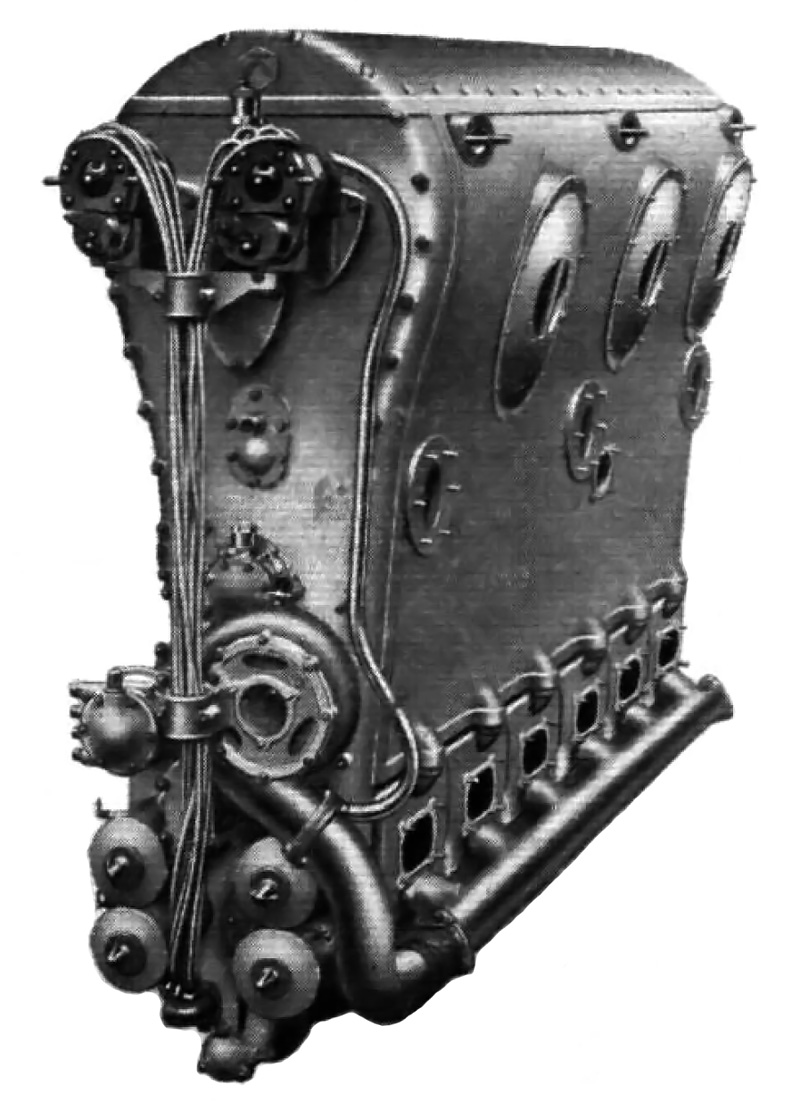
Initially, one updraft carburetor fed air to each of the six four-cylinder blocks. Poor fuel distribution resulted, and the engine never ran well. The updraft carburetors were replaced with downdraft carburetors, and the W-24’s running improved, but it was still not perfect. The six downdraft carburetors were replaced by 12 Zenith downdraft carburetors, improving performance yet again. Finally, 12 Holley downdraft carburetors replaced the Zeniths, and the engine began to run smoothly. Although running better than ever, the W-24 only produced a disappointing 475 hp (354 kW).

The first engine was delivered to Dodge in 1927. Earlier that year, J. Paul Miller began working at the Duesenberg factory and was involved with W-24 engine for many years. Some of Miller’s first changes were installing I-beam connecting rods in place of the tubular ones and replacing the Delco distributors with Bosch magnetos. From 1929 to 1935, Miller worked for Dodge and continued to develop the engine. Unfortunately for Dodge, the 24-cylinder engines brought nothing but frustration. As a result, he never paid Duesenberg the last $2,000 for the engines.
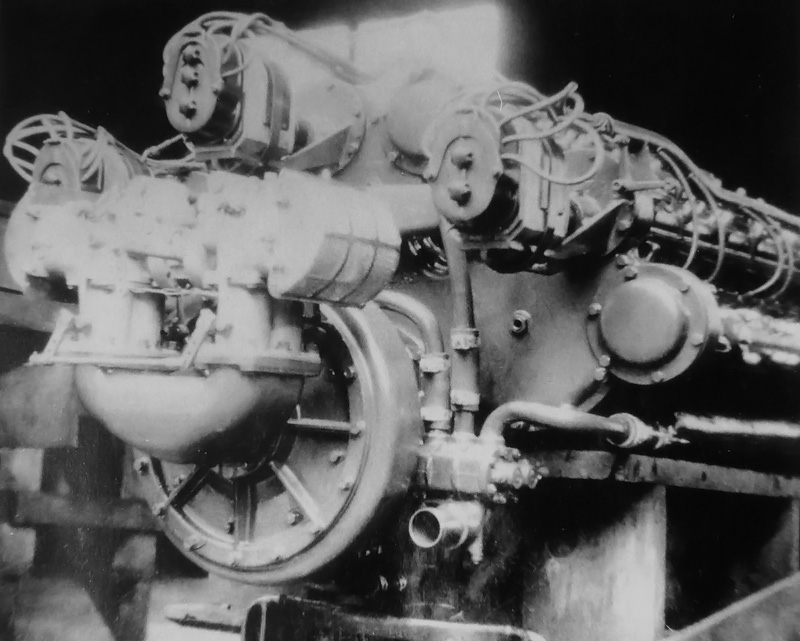
Rear of the 24-cylinder Duesenberg showing two two-barrel carburetors feeding the supercharger. Note the Bosch magnetos mounted driven by the camshafts.

Rear of the 24-cylinder Duesenberg showing two two-barrel carburetors feeding the supercharger. Note the camshaft-driven Bosch magnetos.

The 1931 Gold Cup race was held on Lake Montauk in New York, and the W-24 engine was installed in Dodge’s Miss Syndicate III boat. Miss Syndicate III failed to finish the first heat. In 1932, Miss Syndicate III had been renamed Delphine V. Dodge Sr. had named a yacht after his daughter, and Dodge Jr. continued the “Delphine tradition,” naming numerous boats after his sister. Again, the Gold Cup race was held on Lake Montauk in New York. During the first heat race, the W-24-powered Delphine V dropped out after three laps. Dodge entered five boats for the 1933 Gold Cup race held on the Detroit River. A 24-cylinder Duesenberg was installed in two of the entries: the new Delphine VIII and the new Delphine IX. That year, Delphine VIII failed to start, and Delphine IX did not finish a single heat. In 1934, in disgust, Dodge sold one (but probably both) W-24 engine to Herb Mendelson.

Before the sale, Dodge was inspired by the performance of the supercharged Packard engine in one of this other boats, Delphine IV. Since a rule change allowed superchargers to be used starting in 1935, Dodge had commissioned Miller to design a supercharger for the W-24. This unfinished project was sold to Mendelson, and Miller was retained by Mendelson to continue the work on the engine. It was Miller’s refinements of the supercharged engine that really brought the W-24 to life. The supercharger used an 8 in (203 mm) impeller and spun at 6.5 times crankshaft speed (32,500 rpm at 5,000 rpm engine speed), creating 15 psi (1.03 bar) of boost. Initially, two two-barrel carburetors were used on the supercharged engine, but these were replaced by a single four-barrel Stromberg carburetor. Along with new Miller-designed intake manifolds, the fuel distribution problems were finally solved. The exhaust manifolds were discarded and replaced by 30 vertical exhaust stacks extending into the air. With the changes, the engine weighed 1,400 lb (635 kg) and was referred to as the “Mendelson-Duesenberg W-24.” The engine began to run like a champion and now produced over 850 hp (634 kW) at 5,000 rpm. Reportedly, at full song the engine produced a sound like nothing else on earth.
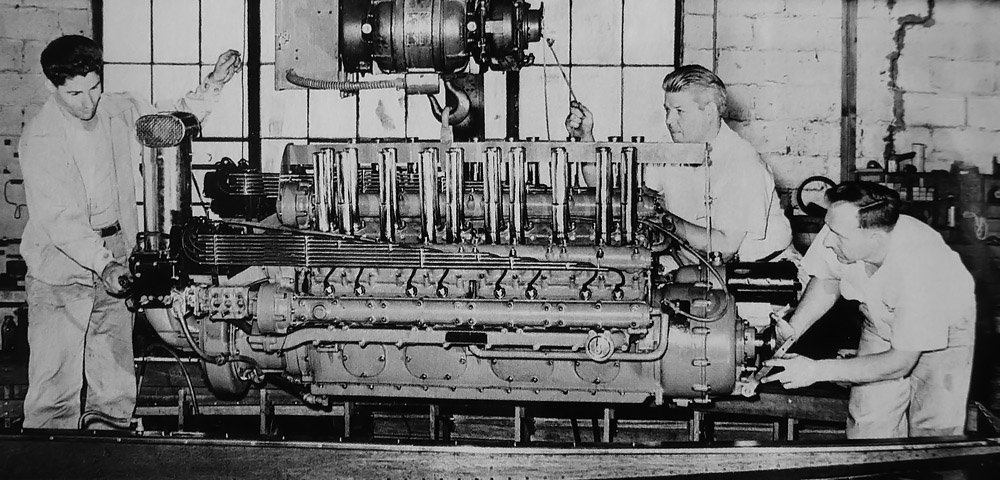
The W-24 being installed in in the Arena-designed Notre Dame by Gene Arena, Walter Schmid, and Bert MacKenzie.

The W-24 being installed in in the Arena-designed Notre Dame by Gene Arena, Walter Schmid, and Bert MacKenzie.

Mendelson installed the W-24 into his boat, the Clell Perry-designed rear-engined Notre Dame (the first). Its first competition was the 1935 President’s Cup race on the Potomac River. Perry was the driver and won the race. In 1937, Perry was again at the controls when the W-24-powered Notre Dame won the Gold Cup race, held on the Detroit River, averaging 63.68 mph (102.48 km/h) over the 90 mile (145 km) course.

While making a high speed run on the Detroit River in preparation for the 1938 Gold Cup race, Perry was injured when the new Notre Dame (the second) boat went out of control and flipped over. (This accident possibly destroyed one of the W-24 engines.) The new Notre Dame was repaired, and Dan Arena took over the driving duties. He finished second in the President’s Cup race but did not like the boat’s stability. Mendelson asked Arena what he thought was needed to cure the stability issues, and Arena said, “Build another boat.” Mendelson agreed, and Arena designed a new 22 ft (6.7 m) boat, again named Notre Dame (the third), with the W-24 engine placed in front of the driver.
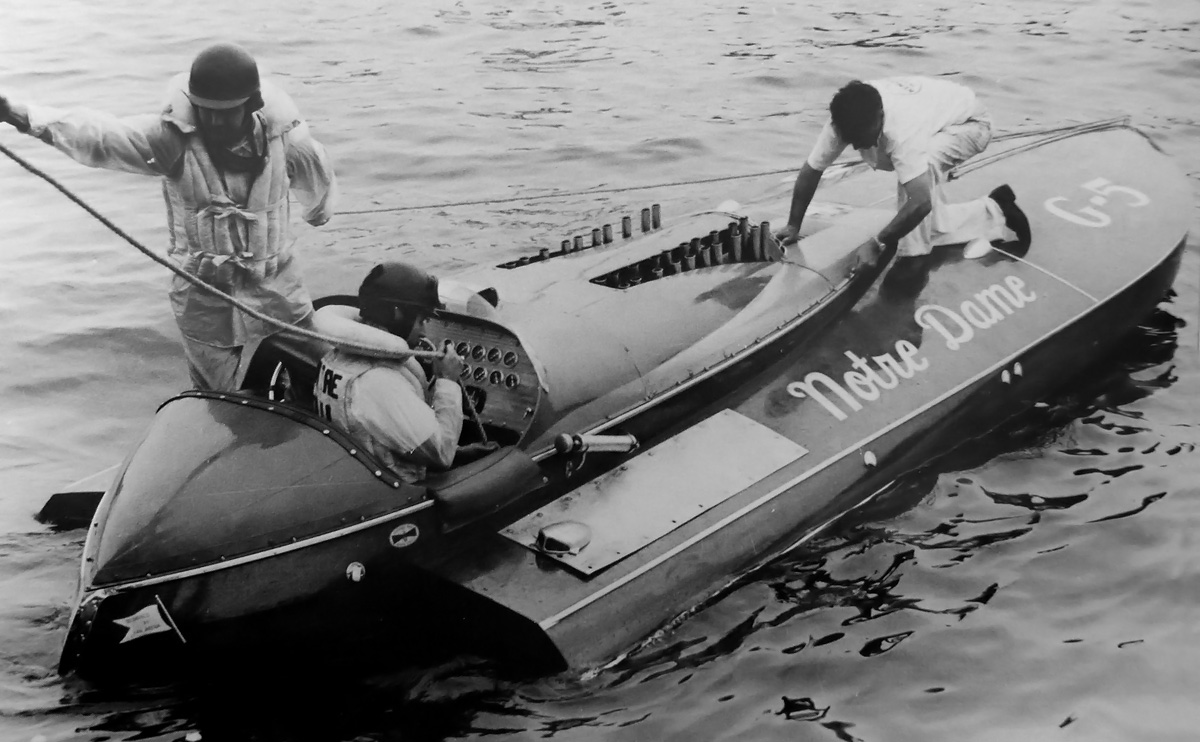
Dan Arena (standing) preparing to run the W-24-powered Notre Dame with his brother Gene as the riding mechanic, as Bert MacKenzie makes final preparations.

Dan Arena (standing) preparing to run the W-24-powered Notre Dame with his brother Gene as the riding mechanic, as Bert MacKenzie makes final preparations.

After a bit of a rough start, Arena won the 1939 and 1940 President’s Cup races in the new Notre Dame. In 1940 on the Detroit River, the W-24 powered the Notre Dame to a new class speed record of 100.987 mph (162.523 km/h). The boat was placed in storage during World War II but was taken out in 1947 and won the Silver Cup race on the Detroit River and finished second in the President’s Cup race. By this time, competitors were installing WWII surplus Allison engines in their boats, and the Duesenberg W-24 could no longer compete. The engine was removed and placed in storage.

At least one Duesenberg W-24 engine survives along with many spare parts. As of 2013, the engine is owned by Gerard Raney and has been rebuilt for installation in a Notre Dame (the third) replica that is under construction. In the mid-1990s, Miller and Arena were both involved in the project, which is based out of the San Francisco Bay Area. Undoubtedly, the engine and boat combination will be quite a sight when the project is finished.
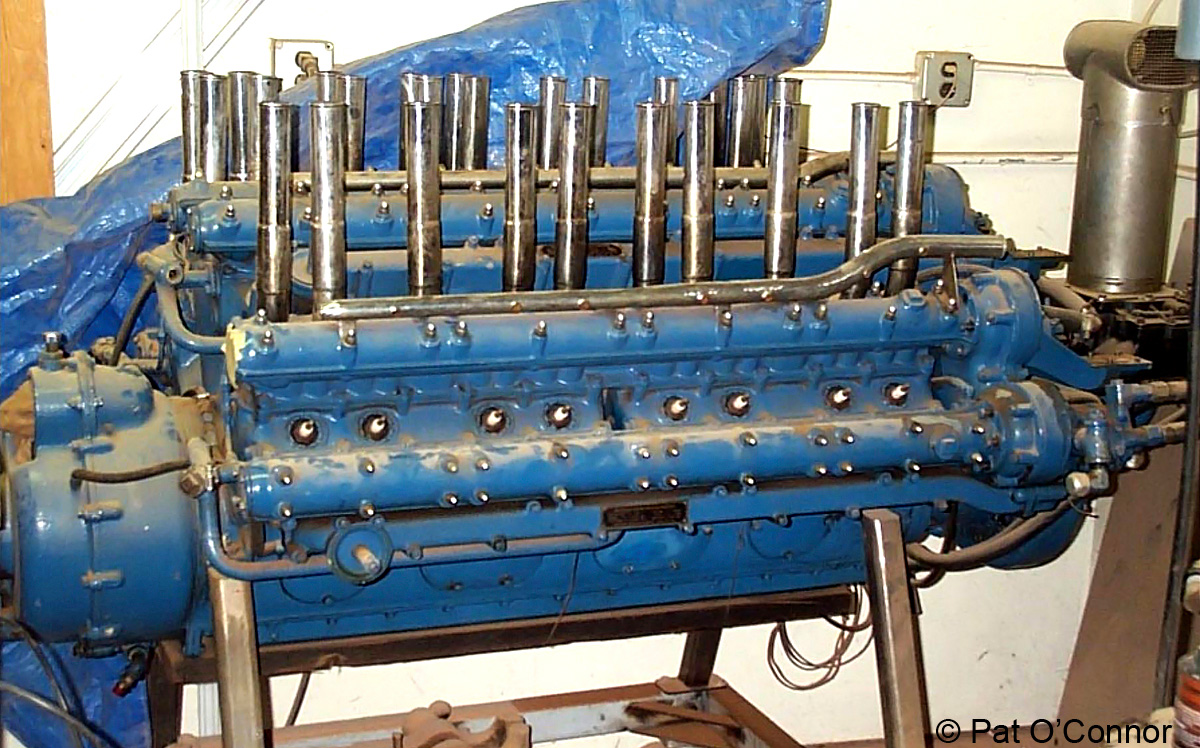
Duesenberg W-24 1996 copy

The surviving Duesenberg W-24 engine owned by Gerard Raney as seen in 1996. Note that each cylinder bank is made up of two four-cylinder blocks; the gap between the blocks is visible on the bank nearest the camera. The camshaft housings extend the length of the engine. (Pat O’Connor image)

Sources:
– “The Duesenberg W-24” by Dean Batchelor, Road & Track, August 1992
– “That Kid From Oakland” by Frank Gudaitis, Nautical Quarterly, No. 40, Winter 1987
– “They Always Called Him Augie” by George Moore, Automobile Quarterly, Vol. 30, No. 4 (1992)
The Classic Twin-Cam Engine by Griffith Borgeson (1979/2002)
Classic American Runabouts: Wood Boats, 1915-1965 by Ballantyne and Duncan (2005)
http://www.vintagehydroplanes.com/apba_history/notebook/1996_08.html
The Dan Arena Story by Fred Farley – ABRA Unlimited Historian
The Notre Dame Story by Fred Farley – ABRA Unlimited Historian
1933 – The Year of the Dodge Navy by Fred Farley – ABRA Unlimited Historian
http://www.findagrave.com/cgi-bin/fg.cgi?page=sh&GRid=14820517
Lockhart Stutz Black Hawk Indy

Lockhart Stutz Black Hawk LSR Car

By William Pearce

Perhaps the only thing faster than Frank Lockhart’s phenomenal rise on the early auto racing scene, was the tragic end of his career. Nicknamed “Boy Wonder” by the press, Lockhart only raced at the Indianapolis 500 twice. His first run was in 1926 when he took the place of an injured driver in a 183 cu in (3.0 L) Miller race car. During practice, he set a one-lap track record of 115.488 mph (185.86 km/h). During the race, he passed 14 cars on the fifth lap as he made his way to the front from starting 20th. He went on to win the race with over a two lap lead.

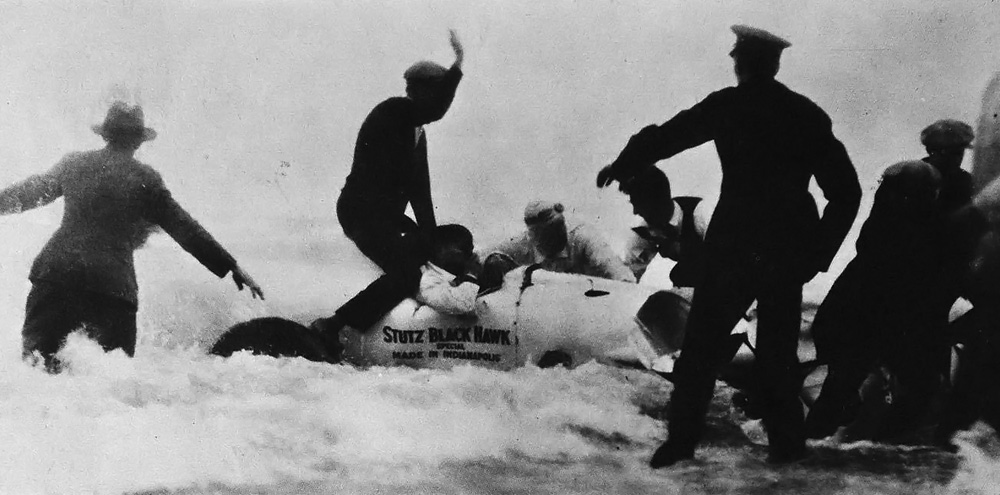
Lockhart and Stutz Black Hawk

Frank Lockhart and the Stutz Black Hawk Special at Daytona Beach, Florida in April 1928.

At Indianapolis in 1927, Lockhart qualified first, at 120.100 mph (193.28 km/h). At the time, it was the fastest lap ever recorded on the track. He led the first 81 laps of the race, a record that would stand for 64 years. After a pit stop, he regained the lead on lap 91, only to have a connecting rod break on lap 120 and take him out of the race. Of the 280 laps he ran at Indy, he led 205 (73.21%) of them. Lockhart is one of only three drivers to have led more than 45% of their laps at Indy, and he has the second highest percentage overall (Juan Pablo Montoya has the highest percentage of laps led at 83.50%, for 167 laps led of 200 run).

In May of 1927, Lockhart set a qualifying record of 147.729 mph (237.74 km/h) on the 1.5-mile (2.4 km) board track at Atlantic City, New Jersey in his 91 cu in (1.5 L) Miller race car. It wasn’t until 1960, 33 years later, that another driver turned a faster lap at an American speedway. In his short American Automobile Association (AAA) career, Lockhart started 61 races, won 27 of them and finished in the top three 37 times.

Lockhart Stutz Black Hawk Indy

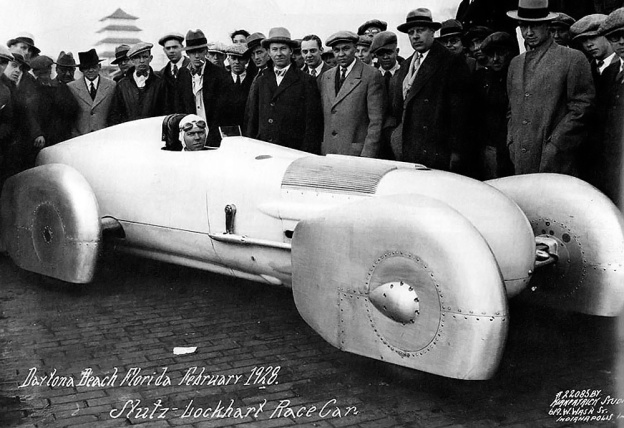
Lockhart sits in the Stutz Black Hawk LSR car during its unveiling at the Indianapolis Motor Speedway.

But Lockhart was more than just a race car driver; he was an innovator with the mind of an experimental engineer. Between the 1926 and 1927 season, Lockhart and his team, which included Zenas and John Weisel and Ernie Olsen, developed an intercooler for Lockhart’s supercharged 91 cu in (1.5 L) Miller engine. They had noticed that while the supercharger pressurized the air, it also heated it, making it less dense. If the air could be cooled, the denser air would allow the engine to create more power. Later in the year on 13 June 1927, Lockhart filed a patent for his intercooler, and U.S. patent no. 1,807,042 was issued on 26 May 1931.

On 11 April 1927, Lockhart took his standard Miller race car to the Muroc Dry Lake in California for an International Class F record attempt. This race car was powered by a supercharged Miller 91 cu in (1.5 L) engine equipped with Lockhart’s intercooler. Lockhart established a new class record, averaging 164.009 mph (263.947 km/h). At that speed, Lockhart became the fourth fastest driver ever, behind only Henry Segrave’s 203.793 mph (327.973 km/h) run in the Sunbeam 1000 HP Mystery (The Slug), Malcolm Campbell’s 174.883 mph (281.447) run in the Napier-Campbell Blue Bird, and J.G. Parry-Thomas’s 171.019 mph (275.229 km/h) run in Babs. All of the faster vehicles were purpose-built Land Speed Record (LSR) cars powered by large, powerful aircraft engines.

Lockhart Stutz Black Hawk side

Lockhart ready for a run in the Black Hawk at Daytona Beach in February 1928, as spectators look on. The hole on the top of the car, in front of the cockpit, was the carburetor inlet for the right engine bank. There was another hole on the other side for the left engine bank.

By mid-1927, Lockhart had become focused on building a LSR car to break Segrave’s current world speed record of 203.793 mph (327.973 km/h). Lockhart partnered with Fred Moskovics, President of the Stutz Motor Car Company, to build the special LSR car. Lockhart and the Weisel brothers designed the LSR car. The Stutz Company funded about half of the project, so the LSR car would wear the Stutz name. Lockhart funded the rest of the project from his race winnings.

A team was assembled in Indianapolis to build the LSR car. What emerged on 12 February 1928 was the Stutz Black Hawk Special—a comparatively small streamlined car powered by a 180.4 cu in (2.96 L) Miller V-16 (more accurately a U-16) engine with intercooled twin superchargers. The intercooler was formed into the engine cover, allowing air flowing over the car’s body to cool the air/fuel mixture before it entered the engine. The car was made up of a central body, with each wheel housed in its own streamlined fairing. The Black Hawk was perhaps the first car to be designed with the aid of a wind tunnel. Scale models were tested in both the Curtiss and the Army Air Services wind tunnels. Reportedly, the car’s wind resistance was measured as .0061 lb/mph². The Black Hawk was 15 ft 9 in (4.80 m) long with a 112 in (2.84 m) wheelbase. The body was only 24 in (0.61 m) wide, and the car’s total width including the wheels was around 60 in (1.52 m).

Lockhart Stutz Black Hawk engine

Seen here are the two Miller straight-eight engines mounted on a common crankcase that made up the Black Hawk’s 16-cylinder engine. In this rear view, one can see the gears of the crankshafts are geared to the lower, central gear.

The engine was basically two 91 cu in (1.5 L) Miller inline-eight engines installed 30-degrees apart on a common crankcase. Each straight-eight engine’s crankshaft was geared to a central gear at the rear of the engine. The flywheel was attached to the central gear. To cool the engine, a tank in the font of the car held a radiator that was cooled with 80 lb (36 kg) of ice. The engine’s bore was 2.1875 in (55.56 mm), stroke was 3.0 in (76.2 mm), and weight was around 630 lb (286 kg). The engine produced more than 550 hp (410 kW) at 8,300 rpm and, utilizing the wind tunnel data, was predicted to propel the 2,800 lb (1,270 kg) Black Hawk LSR car to a maximum speed over 280 mph (450 km/h). The estimated cost of the LSR car was between $70,000 and $100,000 ($0.9 to $1.3 million in 2013 USD).

Lockhart joined Campbell and other racers at Daytona Beach, Florida in mid-February 1928 for speed record runs sanctioned by the AAA. On 19 February, Campbell set a new record at 206.956 mph (333.064 km/h) in the now more-streamlined Napier-Campbell Blue Bird. The next day, Lockhart made one run against the wind at 200.222 mph (322.226 km/h). This was slightly faster than Campbell’s against the wind run from the previous day. Unfortunately, clutch issues prevented Lockhart from making the return run.

Lockhart Stutz Black Hawk beach

An optimistic Lockhart in the cockpit of the Stutz Black Hawk on the beach at Daytona in February 1928. Bill Sturm is at the front of the car adding ice to the cooling tank, as Jean Marcenac approaches with more. Ray Keech is standing next to Lockhart. Note the finning on the engine cover that served as the intercooler.

With the sanctioned event coming to a close, Lockhart made another run on 22 February in bad weather conditions. During the run at over 200 mph (322 km/h), Lockhart encountered a rain-squall that reduced his visibility to nothing. He lost control of the car, and the Black Hawk spun into the sea, rolling over several times. Lockhart was pinned in the car as the waves crashed over his head. Spectators rushed to his aid, shielding him from the incoming waves and holding his head above the water while others attached ropes to the car. More spectators joined in and began dragging the car to the beach, until a tow truck arrived to pull it the rest of the way in. Lockhart had to be freed from the wreck with the aid of crowbars and blowtorches. He suffered three severed tendons in his left wrist, some bad bruising, and was in shock.

The Black Hawk was transported back to Indianapolis where it was quickly rebuilt and repaired. Lockhart, his car, and his team arrived back at Daytona Beach on 20 April 1928, only two months after his accident. Again, the speed record runs were sanctioned by the AAA, and other racers were present. Also making runs was Ray Keech in the White Triplex, a vehicle powered by three Liberty V-12 aircraft engines.

Lockhart Stutz Black Hawk crash1

Spectators, press, and police rush to the aid of Frank Lockhart after his car has rolled into the surf. Lockhart could have drowned had it not been for O.D. Craig holding his head above water.

On 20 April 1928, Lockhart made a run and achieved 200.33 mph (322.40 km/h) on the return leg. The Black Hawk’s Miller engine was suffering carburation problems. Meanwhile, Keech made a series of runs, steadily improving in speed. On 22 April 1928, Keech got the Triplex up to an average of 207.55 mph (334.02 km/h), setting a new world record.

On 25 April 1928, Lockhart made a test run during which his rear right tire locked up under braking during the return. The carburation problems seemed to be resolved, and by 7:30 AM, Lockhart was making another run. The first leg was recorded at 203.50 mph (327.50 km/h), and everything went well. As the Black Hawk was prepared for the return run, Lockhart told his team that he was going to go for the record. Screaming down the beach at over 220 mph (355 km/h), about 700 ft (213 m) before the end of the course, the right rear tire blew, and the Black Hawk went out of control. The car skidded in the sand for about 400 feet (122 m), went sideways, and became airborne. The Black Hawk traveled another 503 ft (153 m), crashing down on the beach several times as it rolled. Lockhart was thrown 51 ft (15 m) from the vehicle. He was transported to a hospital where he was pronounced dead, Lockhart was only 25 years old.

Lockhart Stutz Black Hawk run

Lockhart flies the Black Hawk south down the beach at Daytona during a run.

Subsequent investigation revealed that the right rear tire had been damaged at some point during earlier runs. The tire had continued to deteriorate as the additional passes were made. The 16-cylinder engine was salvaged from the Black Hawk wreck. It was rebuilt and installed in the Sampson “16” Special, owned by Alden Sampson. Bob Swanson raced the car in the 1939 and 1940 Indy 500, finishing sixth in 1940. The car was also driven by Deacon Litz in 1941 and Sam Hanks in 1946. The Sampson “16” Special, with the 16-cylinder engine still installed, is currently on display at the Indianapolis Motor Speedway Hall of Fame Museum in Indianapolis, Indiana.

There are two Lockhart Stutz Black Hawk replicas. One replica is owned and displayed by Turner Woodward in his historic Stutz Building in Indianapolis, Indiana. The second is a running (but not with a 16-cylinder engine) replica that is being finished by Jeb Scolman of Jebs Metal and Speed in Long Beach, California.

The following is a YouTube video (sorry for the music) of the ill-fated speed run uploaded by SportingHistory. The south-bound (ocean on the left) run is shown from the air first, and then the north-bound return crash. The crash is very violent.

This article is part of an ongoing series detailing Absolute Land Speed Record Cars.

Sources:
Frank Lockhart: American Speed King by Morgan-Wu and O’ Keefe (2012)
The Miller Dynasty by Mark Dees (1981/1994)
http://gordonkirby.com/categories/columns/archive/lockhart_legend.html by Gordon Kirby
http://en.wikipedia.org/wiki/Frank_Lockhart
http://en.wikipedia.org/wiki/List_of_Indianapolis_500_lap_leaders
http://blog.hemmings.com/index.php/2011/09/28/replica-of-the-ill-fated-stutz-black-hawk-special-to-debut-at-long-beach-motorama/
http://www.autoweek.com/article/20061222/free/61206028

FMA IAe 30 Ñancú

By William Pearce

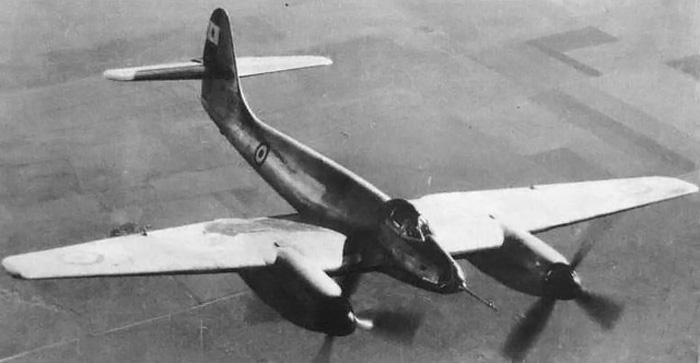
Following World War II, Argentina experienced an influx of former German and Italian engineers. One such engineer was Cesare Pallavicino, formally with the Italian aircraft firm Caproni. Pallavicino was brought into the Instituto Aerotécnico (IAe) to design a twin-engine escort fighter. This project would become the IAe 30 Ñancú.

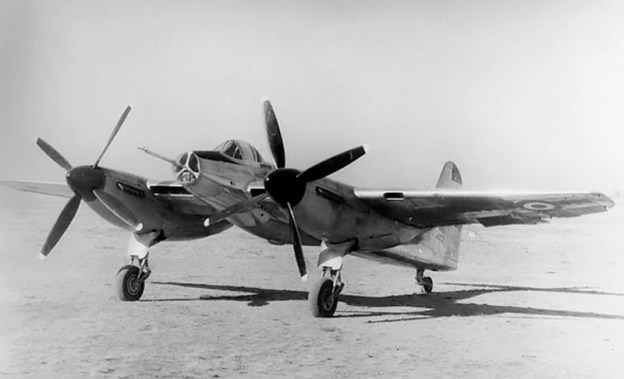
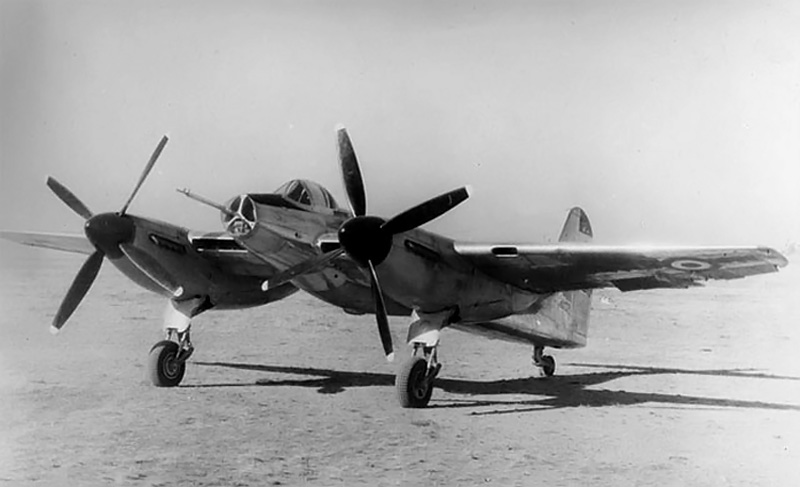
The sleek Argentine FMA IAe30 Namcu with what appears to be a damaged aileron.

The sleek Argentine FMA IAe 30 Ñancú with what appears to be a damaged aileron.

Initially, Pallavicino submitted two jet-powered designs and one piston-powered design. The piston-powered design was chosen for development as the IAe 30. In addition to Argentine engineers, Pallavicino was also able to bring on a number of former Caproni engineers to work on the project. Three IAe 30s were ordered and construction of the first prototype began in July 1947.

Powered by two 1649 cu in (27.0 L) Rolls-Royce Merlin 134/135 engines that produced 2,035 hp (1,517 kW) each, the Ñancú resembled the de Havilland Hornet, but it was an original, all-metal design. The propellers were four-blade de Havilland units, 12 ft (3.66 m) in diameter. The aircraft had a wingspan of 49 ft 3 in (15 m) and a length of 37 ft 10 in (11.52 m). The aircraft’s empty weight was 12,313 lb (5,585 kg), and it had a gross weight of 19,301 lb (8,755 kg). The IAe 30’s top speed was 460 mph (740 km/h) and cruise speed was 311 mph (500 km/h). Range was 1,678 mi (2,700 km).

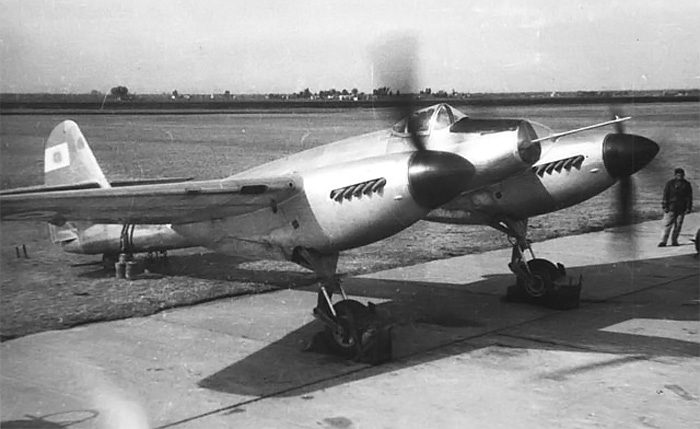
The IAe 30 during a ground run of its Merlin engines.

The IAe 30 during a ground run of its Merlin engines. Note the streamlined engine nacelles.

The proposed armament consisted of four 20 mm Hispano-Suiza cannons mounted in the aircraft’s lower fuselage, under the wings. In addition, a 550 lb (250 kg) bomb could be carried under the fuselage, and five 3.25 in (83 mm) rockets could be fitted under each wing. However, the prototype was never armed.

The IAe 30 team was under a lot of pressure to quickly complete the aircraft. A few corners were cut during design and testing but the aircraft, mostly complete, was ready for ground tests on 8 June 1948 (some say 9 June). Despite wind tunnel tests not being completed, the IAe 30 took to the air for the first time with Captain Edmundo Osvaldo Weiss at the controls on 18 July 1948 (some say 17 July). Initial flight tests revealed that the aircraft performed well and possessed good handling characteristics.

On a cross country flight from Córdoba to Buenos Aires on 8 August 1948, the Ñancú averaged 404 mph (650 km/h) at only 60% power. While flying level at 18,370 ft (5,600 m) during the flight, the aircraft reached 485 mph (780 km/h) with the aid of a strong tail wind. Based on the initial performance of the aircraft, an order for 210 IAe 30s was placed.

The Ñancú in flight displaying is resemblance to a de Havilland Hornet.

The Ñancú in flight, displaying is resemblance to the de Havilland Hornet.

During  continued testing the aircraft achieved 560 mph (900 km/h) in a dive. Only minor changes of the aircraft were required, but it took a long time for the changes to be implemented. Part of the delay was poor communication between the test pilots and the design staff. One pilot who flew the Ñancú and reported very favorable results was Professor Matthies, better known as Kurt Tank. Tank was a German aircraft designer who had worked for Focke-Wulf during World War II, designing the Fw 190 fighter, among others. After the war, he immigrated to Argentina and assumed the pseudonym Pedro Matthies.

In early 1949, the prototype was badly damaged when test pilot Carlos Fermín Bergaglio misjudged a landing. Although the aircraft could have been repaired, there was no interest in doing so. The prototype had achieved its design goals and showed great potential. However, the jet age had arrived, and the Fuerza Aérea Argentina (Argentine Air Force) was focused on jet aircraft for their future fighters. Argentina had purchased 100 Gloster Meteor jet fighters, which were delivered by September 1948. Citing “financial reasons,” the order for the IAe was cancelled in late April 1949. The Fabrica Militar de Aviones (FMA), the state-run overseer of the IAe, made the decision to abandon the project. The damaged prototype and the two unfinished prototypes were scrapped, ending the story of one of the last piston-engine fighters to be developed.

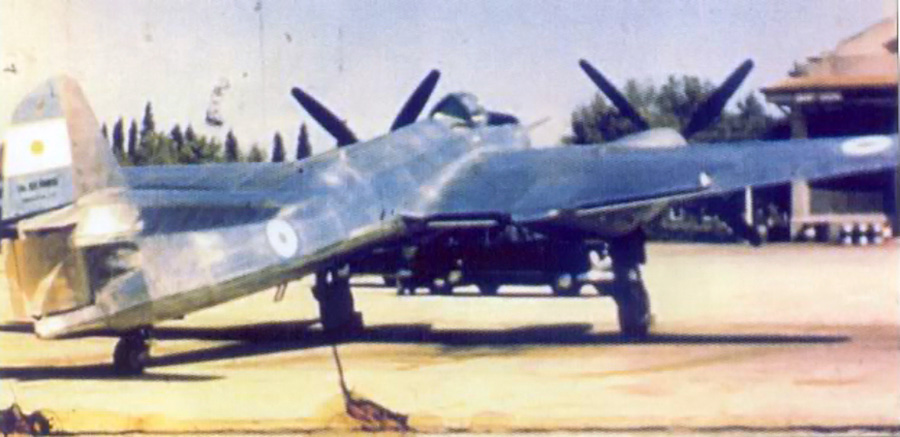
A rare color image of the IAe 30.

A rare color image of the IAe 30. Note the split rudder.

Sources:
– “IAe Ñancú: Argentinian Eaglet,” Wing of Fame Volume 5 by Jim Winchester (1996)
The Complete Book of Fighters by Green and Swanborough (1994)
Jane’s All the World’s Aircraft 1949-1951 by Leonard Bridgham (1949)
http://en.wikipedia.org/wiki/IAe_30_%C3%91anc%C3%BA

Beardmore Cyclone, Typhoon, and Simoon Aircraft Engines

By William Pearce

In the early 1920s, William Beardmore & Company Ltd. began to design a series of high-power aircraft engines. One of the major problems facing aircraft designers at that time was converting the relatively high rpm of the engine to the low speed needed for a fixed-pitch propeller. Adding a propeller gear reduction increased the engine’s weight, complexity, and potential points of failure.

The 4207 cu in (68.9 L), straight-six Beardmore Cyclone.

The 4,207 cu in (68.9 L), straight-six Beardmore Cyclone.

Alan Chorlton, head of the Beardmore engine department, sought an alternative to the propeller reduction gear by having a relatively slow turning engine. In order for an engine to generate high power at low rpm, its cylinder must have a very large displacement.

Beardmore’s first high-power, low rpm aircraft engine designed by Chorlton was really two engines, the Cyclone and the Typhoon, whose development ran parallel. The Beardmore Cyclone was a water-cooled, straight-six engine with a 8.625 in (219 mm) bore and a 12 in (305 mm) stroke, giving it a total displacement of 4,207 cu in (68.9 L). The Beardmore Typhoon was essentially the same engine but in an inverted configuration. Almost all parts were interchangeable between the two engines.

The Beardmore Typhoon inverted engine.

The Beardmore Typhoon inverted engine.

Both the Cyclone and Typhoon used an aluminum crankcase that also formed the cylinder block. Thin steel Cylinder liners were inserted into the crankcase toward the crankshaft. The cylinder liners were supported by a flange toward the cylinder head and sealed by a ring toward the crankshaft. Each cylinder had its own detachable head. The four valves per cylinder were actuated via rockers and short pushrods from the single camshaft, which ran along the side of the engine just below the head. For the Cyclone, the camshaft was on the right side of the engine but, being rotated 180-degrees to the inverted position, the camshaft was on the left side of the Typhoon (both when viewed from the rear).

Two spark plugs were fitted to the top of each cylinder and fired by two Watford C6SM magnetos. The magnetos along with the water, oil, and fuel pumps were driven off the rear of the engines by a series of intermediate gears. Aluminum pistons with three compression rings and one oil-scrapper ring were used. The compression ratio was 5.25 to 1.

The Cyclone I was first run in 1922 and generated 700 hp (522 kW) at 1,220 rpm. Development continued, and by 1927, the Cyclone II was producing 850 hp (634 kW) at 1,350 rpm but could produce 950 hp (708 kW) at the same rpm with a larger carburetor. Fuel consumption was .48 lb/hp/hr (292 g/kW/h), and the engine weighed 2,150 lb (975 kg). The Cyclone was 80.3 in (2 m) long, 35 in (.9 m) wide, and 61.125 in (1.55 m) tall. Reportedly, only one Cyclone II was built, and it was sold to Heinkel Flugzeugwerke in Germany.

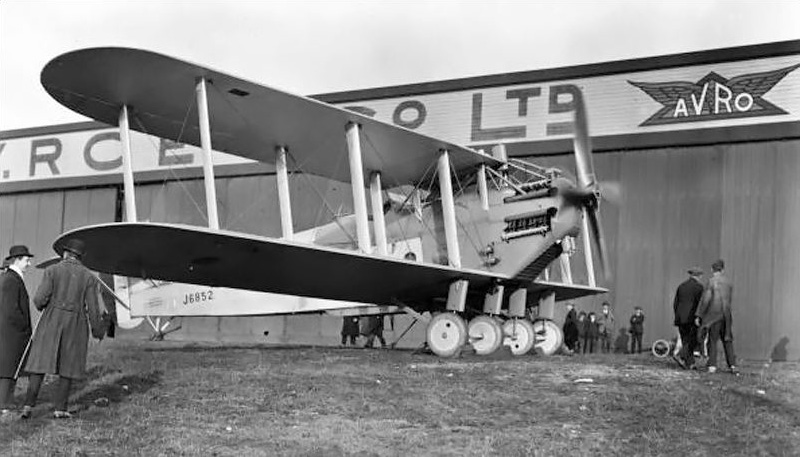
The Typhoon in the Avro 549C Aldershot IV during an engine run.

The Typhoon in the Avro 549C Aldershot IV during an engine run.

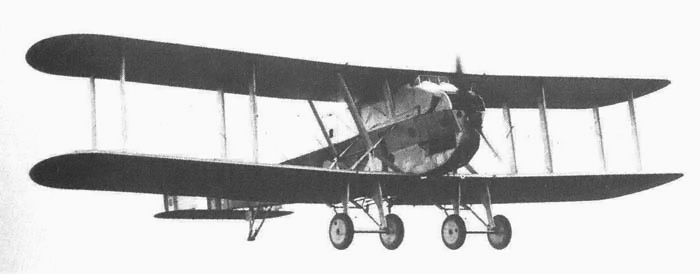
As already mentioned, the Typhoon was an inverted version of the Cyclone. The date the engine was first run is not clear, but the Typhoon was mentioned along with the Cyclone in a Beardmore brochure from 1924. The Typhoon I (some say Typhoon II) originally produced 800 hp (597 kW) at 1,350 rpm but was developed to 925 hp (690 kW) at the same rpm by 1926. Fuel consumption was .46 lb/hp/hr (280 g/kW/h), and the engine weighed 2,233 lb (1,013 kg). The Typhoon was 80.3 in (2 m) long, 38.5 in (.98 m) wide, and 59.3 in (1.5 m) tall. The Typhoon was installed in an Avro 549 Aldershot (J6852), replacing the Napier Cub engine. The Typhoon-powered aircraft, re-designated Avro 549C Aldershot IV, first flew on 10 January 1927. After a demonstration flight on 24 January 1927, pilot Bert Hinkler reported that the Typhoon engine was remarkably smooth.

The Beardmore Typhoon-powered Avro 549C Aldershot IV flown by Bert Hinkler during a flight demonstration on 24 January 1927. The inverted engine allows a good view from the cockpit.

The Beardmore Typhoon-powered Avro 549C Aldershot IV flown by Bert Hinkler during a flight demonstration on 24 January 1927.

Reportedly, this image is of the 750 hp (559 kW), semi-diesel Beardmore Typhoon.

Reportedly, this image is of the 750 hp (559 kW), compression ignition Beardmore Typhoon.

A low-speed, large displacement engine design was very suitable for compression ignition, and another Typhoon engine was built as a diesel. Some sources report this engine as the Typhoon I, while others simply refer to it as the Typhoon C.I. In addition, the engine was sometimes noted as a semi-diesel (surface ignition). However, the power output of 750 hp (559 kW) at 1,400 rpm suggests that it was a true compression ignition diesel. Regardless, the diesel Typhoon was dimensionally the same as the standard Typhoon. The engine was under development along with the Cyclone and standard Typhoon and is mentioned in some of the articles regarding those engines. Some sources state that this engine was installed in the Avro 549 Aldershot, but that does not seem to be the case. No evidence has been found that this engine ever flew. However, in 1924, the Air Ministry ordered nine compression ignition Typhoons to be used in the R101 airship under construction. By 1926, the Air Ministry felt the Typhoon had reached its development potential and changed the order to the Beardmore Tornado engine, then under development.

The 1,100 hp (820 kW), 5528 cu in (90.6 L), inverted, straight-eight, Beardmore Simoon aircraft engine.

The 1,100 hp (820 kW), 5,528 cu in (90.6 L), inverted, straight-eight, Beardmore Simoon aircraft engine.

The Beardmore Simoon engine was a further development of the standard Typhoon but was designed at the same time. Compared to the Typhoon, the Simoon’s bore was reduced to 8.5625 in (217.5 mm), but the stroke remained the same at 12 in (305 mm). However, two additional cylinders were added. This gave the inverted, straight- eight Simoon engine a total displacement of 5,528 cu in (90.6 L). The Simoon maintained the 5.25 to 1 compression ratio of the previous engines, and fuel consumption was .48 lb/hp/hr (292 g/kW/h). Normal output was 1,100 hp (820 kW) at 1,250 rpm, but 1,200 hp (895 kW) could be achieved at 1,350 rpm. The Simoon was 98 in (2.5 m) long, 37.6 in (.96 m) wide, and 72.6 in (1.84 m) tall. The Simoon’s height increase over the Cyclone and Typhoon was due to an additional sump protruding from the lower rear of the engine. The engine weighed 2,770 lb (1,256 kg). The Simoon was installed in the second Blackburn T.4 Cubaroo (N167), replacing a Napier Cub engine. The Simoon-powered Cubarro first flew early in 1927.

None of these large, low-speed, high power engines were a success, and only a small number were made.

Sources:
Aerosphere 1939 by Glenn Angle (1940)
Beardmore Aviation 1913-1930 by Charles Mac Kay (2012)
Jane’s All the World’s Aircraft 1928 by C.G. Grey (1928)
British Piston Aero Engines and their Aircraft by Alec Lumsden (1994/2003)
Avro Aircraft since 1908 by A J Jackson (1965/1990)
Blackburn Aircraft since 1909 by A J Jackson (1968/1989)
– “The Beardmore “Cyclone’ Aero Engine,” Flight (4 November 1926)
– “The Beardmore ‘Typhoon’ Mark I Engine,” Flight (27 January 1927)
– “The Beardmore Cyclone and Typhoon,” Flight (5 July 1928)
– “British Aero Engines,” Flight (29 May 1924)

Inside the Cylinder of a Diesel Engine – by Harry Ricardo

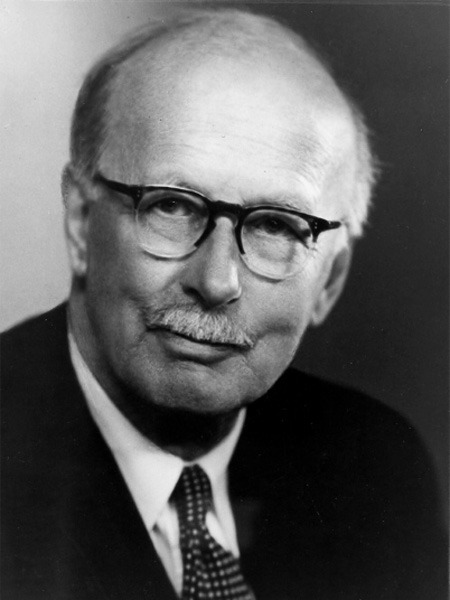
Sir Harry Ricardo as seen in 1955 at age 70.

Sir Harry Ricardo as seen in 1955 at age 70.

Sir Harry Ricardo (26 January 1885 – 18 May 1974) was one of the foremost engine designers and researchers of the internal combustion engine. During the First World War, Ricardo designed significantly improved engines for early British tanks. Between the wars, he researched the physics of internal combustion and the design of combustion chambers. This work led to the use of octane ratings, stratified charge, and intake swirl (vortex). Ricardo was instrumental in the development of the sleeve valve engine, particularly for aircraft use. His work and research contributed greatly to the high-power aircraft engines of World War II. After the war, he continued to develop the Diesel pre-combustion chamber (Comet), originally designed in the 1930s, which made high-speed diesel engines possible.

The following excerpt is from a lecture Harry Ricardo gave to the Royal Society of Arts on 23 November 1931.

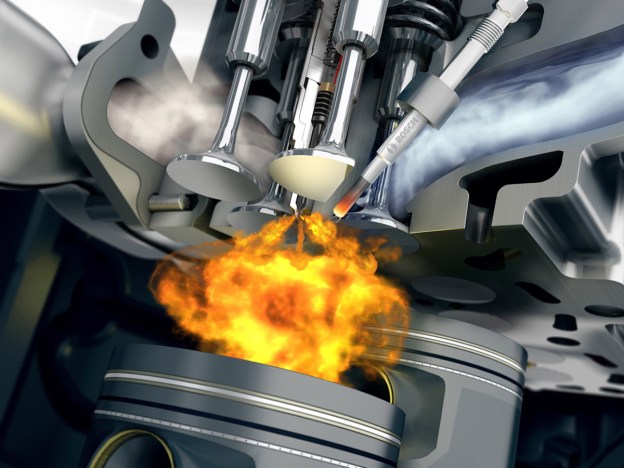
I am going to take the rather unconventional course of asking you to accompany me, in imagination, inside the cylinder of a diesel engine. Let us imagine ourselves seated comfortably on the top of the piston, at or near the end of the compression stroke. We are in complete darkness, the atmosphere is a trifle oppressive, for the shade temperature is well over 500 Celsius – almost a dull red heat – and the density of the air is such that the contents of an average sitting-room would weigh about a ton; also it is very draughty, in fact, the draught is such that, in reality, we should be blown off our perch and hurled about like autumn leaves in a gale. Suddenly, above our heads, a valve opens and a rainstorm of fuel begins to descend. I have called it a rainstorm, but the velocity of droplets approaches much more nearly that of rifle bullets than of raindrops.

For a while nothing startling happens, the rain continues to fall, the darkness remains intense. Then suddenly, away to our right perhaps, a brilliant gleam of light appears, moving swiftly and purposefully; in an instant this is followed by a myriad others all around us, some large and some small, until on all sides of us the space is filled with a merry blaze of moving lights; from time to time the smaller lights wink and go out, while the larger ones develop fiery tails like comets; occasionally these strike the walls, but, being surrounded by an envelope of burning vapour, they merely bounce off like drops of water spilt on a red hot plate.

Right overhead all is darkness still, the rainstorm continues, and the heat is becoming intense; and now we shall notice that a change is taking place. Many of the smaller lights around us have gone out, but new ones are beginning to appear, more overhead, and to form themselves into definite streams shooting rapidly downwards or outwards from the direction of the injector nozzles.

Fuel being burnt as it is injected into a diesel cylinder. (Bosch image)

Fuel igniting as it is injected into a diesel cylinder. (Bosch image)

Looking round again we see that the lights around are growing yellower; they no longer move in a definite direction, but appear to be drifting listlessly hither and thither; here and there they are crowding together in dense nebulae, and these are burning now with a sickly, smoky flame, half suffocated for want of oxygen. Now we are attracted by a dazzle, and looking up we see that what at first was cold rain falling through utter darkness, has given place to a cascade of fire as from a rocket. For a little while this continues, then ceases abruptly as the fuel valve closes.

Above and all around us are still some lingering fire balls, now trailing long tails of sparks and smoke and wandering aimlessly in search of the last dregs of oxygen which will consume them finally and set their souls at rest. If so, well and good; if not, some unromantic engineer outside will merely grumble that the exhaust is dirty and will set the fuel valve to close a trifle earlier.

So ends the scene, or rather my conception of the scene, and I will ask you to realise that what has taken me nearly five minutes to describe may all be enacted in one five hundredth of a second or even less.

– Harry Ricardo

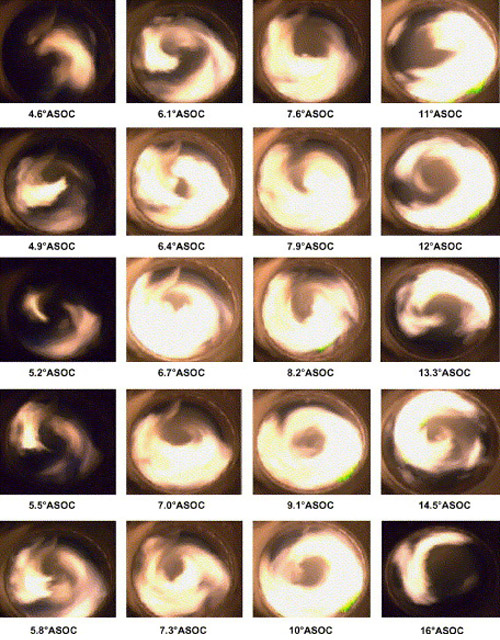
View of a diesel combustion chamber showing the combustion sequence (ASOC: After Start of Combustion).

View of a diesel combustion chamber showing the combustion sequence (ASOC: After Start of Combustion).

More on Sir Harry Ricardo:
Engines & Enterprise: The Life and Work of Sir Harry Ricardo by John Reynolds (1999)

Napier Cub E66 engine

Napier Cub (E66) – First 1,000 hp Aircraft Engine

By William Pearce

Early in 1919, Montague Napier, President of D. Napier & Son Ltd., decided that his company should focus entirely on aircraft engines. The company’s first aero-engine, the very successful 450 hp (336 kW) Lion, was in full production. Napier began to think about its replacement, or at least a complementary engine to diversify the product line. Napier approached the British Air Ministry with his new engine plans, and in September 1919, his company was awarded a contract to build six of these new engines at 10,000 GBP each.

Napier Cub E66 engine

The 1,000 hp (746 kW), 16-cylinder Napier Cub. Below the propeller gear reduction are the two duplex carburetors with an induction pipe leading to each cylinder bank.

What Napier had envisioned, and the Air Ministry purchased, was a large power plant of 1,000 hp (746 kW)—enough power for one engine to propel a large bomber aircraft. The engine was given the Napier designation E66 but was referred to as the Cub. Despite its diminutive name, the Cub was a much larger engine than the Lion. The Napier Cub was unlike any engine before or since.

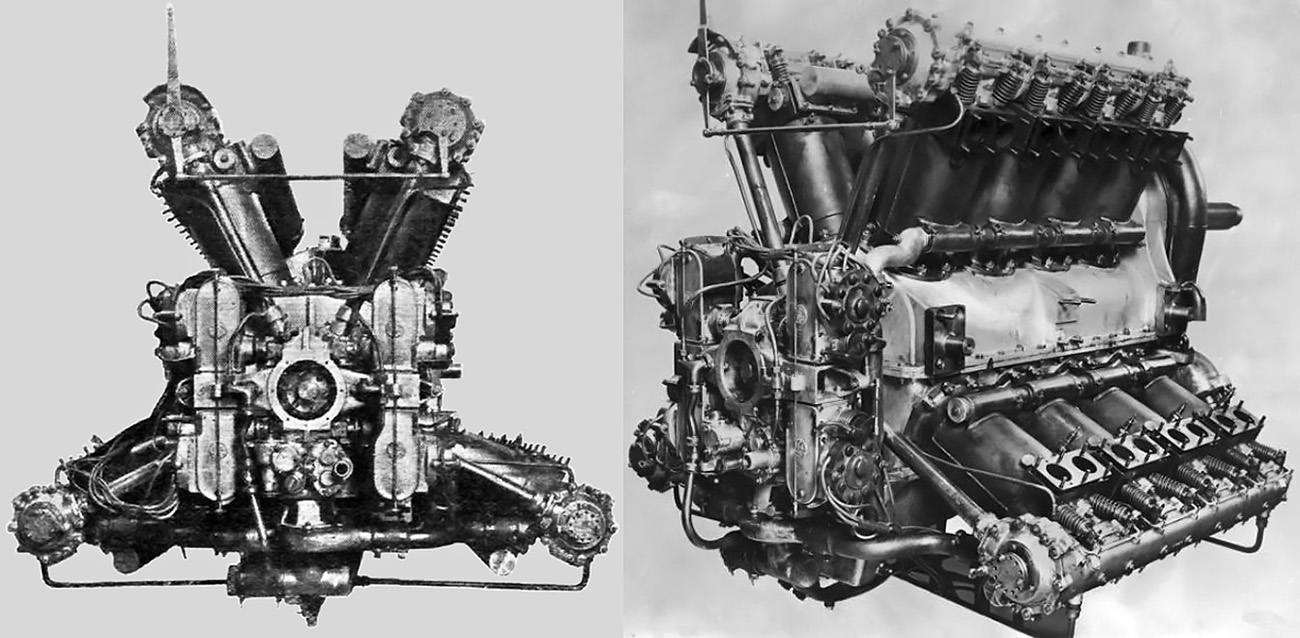
The Napier Cub was a liquid-cooled, 16-cylinder engine with four banks of four cylinders arranged in an X configuration on an aluminum crankcase. The banks were not equally spaced: the angle between the top banks was 52.5 degrees; the banks on either side were angled at 90 degrees; and the angle between the bottom banks was 127.5 degrees. Reportedly, the engine was so arranged to relieve stress on the crankshaft and to ease the engine’s installation in aircraft.

Napier Cub E66 rear

The Napier Cub was the first aircraft engine to exceed 1,000 hp (746 kW). These rear views illustrate the cylinder bank angles, the four magnetos on the back of the engine, the housings for the camshaft drive, and the exposed valves.

The Cub used individual steel cylinders of a 6.25 in (158.75 mm) bore and 7.5 in (190.5 mm) stroke and were encased in separate welded-steel water jackets. The engine displaced 3,682 cu in (60.3 L). The Cub’s compression ratio was 5.3 to 1. The engine was 57 in (1.45 m) wide, 64.25 in (1.63 m) tall, 71.8125 in (1.9 m) long, and weighed 2,450 lb (1,111 kg).

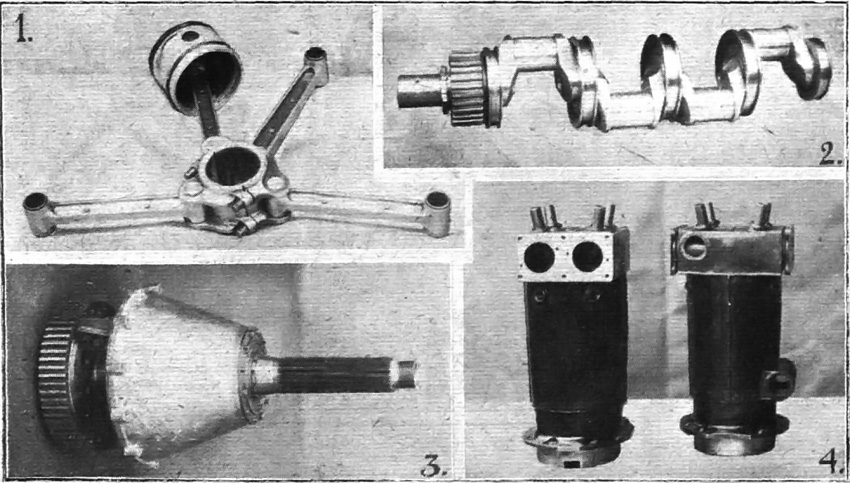
Each of the Cub’s four connecting rods consisted of one master rod and three articulated rods. The pistons were aluminum and had two compression and two oil-scrapper rings. Each cylinder bank had a single overhead camshaft that was driven via a vertical shaft. The vertical shafts were at the rear of the engine and driven from the crankshaft. The overhead camshaft actuated four exposed valves per cylinder. The Cub had a 0.49 propeller gear reduction through the use of spur gears that raised the propeller shaft. The propeller shaft’s bearing arrangement allowed the engine to be used in either a tractor or pusher configuration.

Various parts of the Napier Cub: 1) Connecting rod assembly with one articulated rod attached to the bearing cap. 2) Four-throw crankshaft with roller bearings and spur reduction gear. 3) Propeller shaft with large spur reduction gear. 4) Two of the Cub's cylinders with the valve ports visible on the left cylinder and the water-cooling ports visible on the right cylinder.

Various parts of the Napier Cub: 1) connecting rod assembly with one articulated rod attached to the bearing cap; 2) four-throw crankshaft with roller bearings and spur reduction gear; 3) propeller shaft with large spur reduction gear; 4) two of the Cub’s cylinders with the valve ports visible on the left cylinder and the water-cooling ports visible on the right cylinder.

Dual ignition was provided by four magnetos geared off the rear of the engine. The single water circulation pump was located at the lower rear of the engine, was driven at 1.5 times camshaft speed, and had one outlet to supply each cylinder bank. Two duplex carburetors were located under the gear reduction at the front of the engine. Each carburetor fed two manifolds: one for an upper cylinder bank and the other for a lower bank.

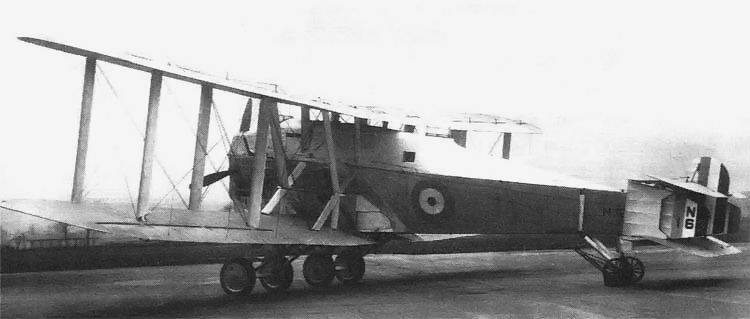
The Napier Cub was first run in late 1920. It was the first aircraft engine to surpass the 1,000 hp (746 kW) mark, achieving 1,057 hp (788 kW) at 1,900 rpm during an early test. The second Cub engine built was first run in early 1922. That same year, the Cub was installed in a modified Avro 549 Aldershot I (J6852, the first prototype) and re-designated Aldershot II. The Aldershot was a long-range, heavy bomber bi-plane. It had a 68 ft (20.7m) wingspan, was 45 ft (13.7 m) long, and weighed around 6,200 lb (2,812 kg). The Cub-powered Aldershot II first flew on 15 December 1922, piloted by Bert Hinkler. The Aldershot II continued to fly for about four years before the Napier Cub was removed and another test engine (an 800 hp / 597 kW Beardmore Typhoon) was installed.

Napier Cub-powered Avro Aldershot II (J6852). This was the first Aldershot prototype, originally powered by a 650 hp Rolls-Royce Condor V-12 engine. To support the Cub, the aircraft had its main gear doubled to four wheels. After three years of Cub-power, the aircraft was re-engined with an 800 hp Beardmore Typhoon (straight-six semi-diesel).

Napier Cub-powered Avro Aldershot II (J6852). This was the first Aldershot prototype, originally powered by a 650 hp (485 kW) Rolls-Royce Condor V-12 engine. To support the Cub, the aircraft was strengthened and had its main gear doubled to four wheels. After two years of Cub-power, the aircraft was re-engined with an 800 hp (597 kW) Beardmore Typhoon.

A Napier Cub was also installed in both of the two Blackburn T.4 Cubaroos built. The Cubaroo was a long-range coastal defense bi-plane capable of carrying a 21-in (.533 m) torpedo or equivalent bomb load of 2,000 lb (907 kg). The aircraft had an 88 ft (26.8 m) wingspan, was 54 ft (16.5 m) long, and weighed 9,632 lb (4,396 kg) empty and 19,020 lb (8,709 kg) fully loaded. The Cubaroo was possibly the largest single-engine aircraft in its day. The first Cubaroo (N166) took to the air in the summer of 1924, piloted by P.W.S. ‘George’ Bulman. The aircraft was delivered to Martlesham Heath for flight trials in October 1924. Several engine failures were noted as well as a tendency for the engine to overheat during a high-power climb.

The second Cubaroo (N167) had a revised radiator and first flew in early 1925. Both Cubaroo aircraft were flown in various aviation displays and used for testing. N166 was damaged beyond repair in a landing accident on July 16, 1926. N167 continued to fly with Cub-power until 1927, when it was re-engined to test the 1,100 hp (820 kW) Beardmore Simoon.

The first Blackburn Cubaroo (N166) in flight. The 1,000 hp Cub seemed to be quite adequate for the aircraft.

The first Blackburn Cubaroo (N166) in flight. The 1,000 hp (746 kW) Cub seemed to be quite adequate for the large aircraft.

Another aircraft designed to use the Napier Cub was the Avro 556. With a wingspan over 95 ft (30 m), this aircraft was even larger than the Cubaroo, although intended for the same purpose of carrying a 21-in (.533 m) torpedo. This aircraft was never built; instead, the basic design was used for the twin Rolls-Royce Condor-powered Avro 557 Ava.

By June 1925, the concept of a single, large aircraft engine powering a very large aircraft fell to the wayside in favor of multiple engines, which gave some degree of enhanced safety. The Air Ministry lost its interest in the Napier Cub, and the world’s first 1,000 hp (746 kW) aircraft engine faded to obscurity.

The second Blackburn Cubaroo (N167) with the revised radiator to cool the Napier Cub.

The second Blackburn Cubaroo (N167) with the revised radiator to cool the Napier Cub.

Sources:
Aerosphere 1939 by Glenn Angle (1940)
Men and Machines by Wilson and Reader (1958)
By Precision Into Power by Alan Vessey (2007)
Avro Aircraft since 1908 by A J Jackson (1965/1990)
Blackburn Aircraft since 1909 by A J Jackson (1968/1989)
The British Bomber since 1914 by Francis Mason (1994)
British Flight Testing: Martlesham Heath 1920-1939 by Tim Mason (1993)

Yokosuka (Kugisho) R2Y1 Keiun

By William Pearce

Late in 1938, the Heinkel He 119 experimental high-speed reconnaissance aircraft was shown to a Japanese Naval delegation visiting Germany. The Japanese liked the speed and range of the He 119, and overall, were impressed by the aircraft. Based on the positive initial interest, the Japanese sent a group of technicians from the Yokosuka Naval Air Technical Arsenal (Yokosuka, also known as Kaigun Koku Gijutsusho or Kugisho) to Germany for a closer examination of the He 119. Eventually, Commander Hideo Tsukada was able to purchase two He 119 prototypes and a license to manufacture the aircraft in Japan.

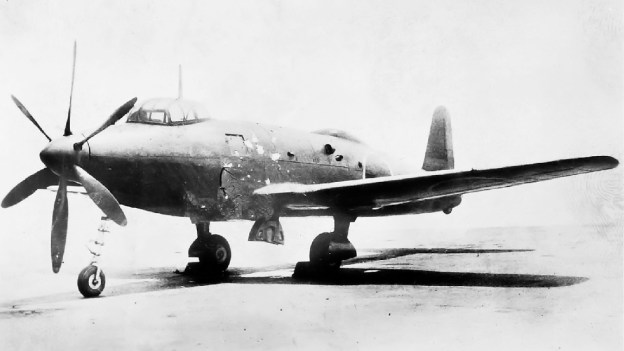
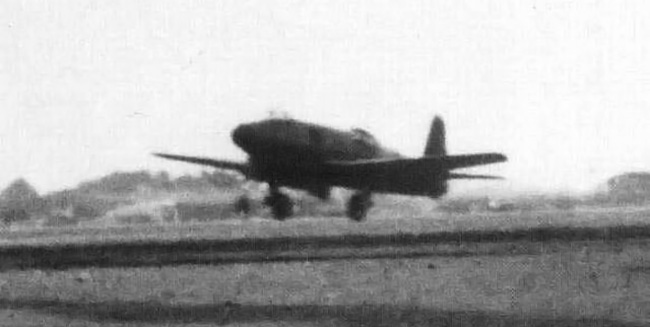
The standard image of the Yokosuka R2Y1 Keiun. Speculation suggests the first scoop on the side of the aircraft provided cooling air for the engine's internal exhaust baffling, the second, larger scoop provided induction air for the normally aspirated Aichi [Ha-70] engine installed in the prototype, and the final two ports were for the engine's exhaust.

The standard image of the Yokosuka R2Y1 Keiun. Speculation suggests the first scoop on the side of the aircraft provided cooling air for the engine’s internal exhaust baffling, the second, larger scoop provided induction air for the normally aspirated Aichi [Ha-70] engine installed in the prototype, and the final two ports were for the engine’s exhaust.

The two He 119 prototypes were delivered via ship to Japan in 1941 (some say 1940). The aircraft were reassembled at Kasumigaura Air Field, and flight tests occurred at Yokosuka Naval Base. During an early test flight, one of the He 119s was badly damaged in a landing accident, and it is believed the other He 119 suffered a similar fate. Plans to produce the He 119 never moved forward, but the Japanese were still interested in a high-speed reconnaissance aircraft and felt the general configuration of the He 119 held promise.

Inspired by the Heinkel He 119, Yokosuka began to design an aircraft of a similar layout, known as the Y-40, in 1943. Headed by Commander Shiro Otsuki, the aircraft project was a pressurized, two-seat, unarmed, high-speed, reconnaissance aircraft of all-metal construction that featured tricycle retractable gear. The design was approved, and the Y-40 officially became known as the R2Y1 Keiun (Beautiful Cloud). The construction of two prototypes was ordered.

A good view of the R2Y1 where a radiator inlet can be seen under the wing and in front of the main gear. The ventral scoop was an intake for the turbocharger and intercooler but these were not installed on the prototype.

A good view of the R2Y1 where a radiator inlet can be seen under the wing and in front of the main gear. The ventral scoop was an intake for the turbocharger and intercooler but these were not installed on the prototype.

The R2Y1 had a 45.93 ft (14 m) wingspan and was 42.81 ft (13.05 m) long. The aircraft stood 13.91 ft (4.24 m) high, weighed 13,260 lb (6,015 kg) empty, and had a maximum weight of 20,725 lb (9,400 kg). The Keiun had an estimated top speed of 447 mph (720 km/h) at 32,810 ft (10,000 m) and a cruise speed of 288 mph (463 km/h) at 13,125 ft (4,000 m). Maximum range was an estimated at 2,240 mi (3,610 km). The pilot sat under a raised bubble-style canopy that was toward the extreme front of the aircraft. The radio operator/navigator occupied an area in the fuselage just behind and a little below the pilot.

The Keiun was powered by two 60-degree, inverted V-12 Aichi Atsuta 30 series engines, licensed-built versions of the Daimler-Benz DB 601. The engines were coupled together by a common gear reduction in a similar fashion as the DB 606. The resulting 24-cylinder power unit was known as the Aichi [Ha-70]. With a 5.91 in (150 mm) bore and 6.30 in (160 mm) stroke, the engine displaced 4,141 cu in (67.8 L) and was installed behind the cockpit and above the wings. The Aichi [Ha-70] engine was to be turbocharged and rated at 3,400 hp (2,535 kW) for takeoff and 3,000 hp (2,237 kW) at 26,247 ft (8,000 m). Without the turbocharger, the engine was rated at 3,100 hp (2,312 kW) for takeoff and 3,060 hp (2,282 kW) at 9,843 ft (3,000 m). The engine drove a 12.47 ft (3.8 m), six-blade propeller via a 12.8 ft (3.9 m) long extension shaft that ran under the cockpit. Engine cooling was achieved by radiators under the fuselage and inlets for oil coolers in the wing roots. A ventral air scoop was located behind the engine to provide induction air for the turbocharger and air for the intercooler.

The R2Y1 Keiun undergoing taxi tests in May 1945.

The R2Y1 Keiun undergoing taxi tests in May 1945.

By the fall of 1944, the direction of the war had changed, and Japan no longer needed a high-speed reconnaissance aircraft. The R2Y1 Keiun was all but cancelled when the design team suggested the aircraft could easily be made into a fast attack bomber. In addition, the Aichi [Ha-70] power plant would be discarded, and one 2,910 lb (1,320 kg) thrust Mitsubishi Ne 330 jet engine would be installed under each wing. A fuel tank would be installed in the space made available by the removal of the piston engine. This jet-powered attack bomber had an estimated top speed of 495 mph (797 km/h). The project was approved, and the new aircraft was designated R2Y2.

The decision was made to finish the nearly completed R2Y1 airframe and use it as a flight demonstrator to assess the flying characteristics of the aircraft. With pressurization, the turbocharger, and the intercooler omitted, the R2Y1 prototype was completed in April 1945 and transferred to Kisarazu Air Field for tests. Ground tests revealed that the aircraft suffered from nose-wheel shimmy and engine overheating.

Yokosuka R2Y1 Keiun taking off from Kisarazu Air Field for its first an only flight.

Yokosuka R2Y1 Keiun taking off from Kisarazu Air Field for its first an only flight.

Adjustments were made to overcome the issues, and the Keiun took to the air on 29 May 1945 (date varies by source and is often cited as 8 May 1945), piloted by Lt. Commander Kitajima. The flight proved to be very short because the engine quickly overheated, and a fire broke out in the engine bay. Lt. Commander Kitajima quickly returned to the field, and the R2Y1 suffered surprisingly little damage. On 31 May during a ground run to test revised cooling, the engine was mistakenly run at high power for too long and overheated. The engine was removed from the aircraft to repair the damage. The R2Y1 sat awaiting repair for some time before it was destroyed by Japanese Naval personnel to prevent its capture by American forces (some say it was destroyed in an Allied bombing raid). Because of the end of the War, the second R2Y1 prototype was never completed nor was the design work for the R2Y2.

The unfinished second R2Y1 prototype as seen at the end of WWII. Note the wing root and ventral intakes. The hole in the center of the bulkhead in the nose was for the propeller's drive shaft.

The unfinished second R2Y1 prototype as seen at the end of WWII. Note the wing root and ventral intakes. The hole in the center of the bulkhead in the nose was for the propeller’s drive shaft.

Sources:
– “Yokosuka R2Y1 Keiun: Japan’s mid-engined twin” Wings of Fame, Volume 12 (1998)
Japanese Secret Projects by Edwin Dyer (2009)
Japanese Aircraft of the Pacific War by Rene Francillon (1970/2000)
Japanese Aero-Engines 1910–1945 by Mike Goodwin and Peter Starkings (2017)
General View of Japanese Military Aircraft in the Pacific War by Airview (1956)
Japanese Aircraft Performance & Characteristics TAIC Manual by Edward Maloney (2000)
http://www.secretprojects.co.uk/forum/index.php/topic,15633.0/all.html

Heinkel He 119 V4 front

Heinkel He 119

By William Pearce

In the 1930s, brothers Siegfried and Walter Günter were pushing the limits of aerodynamics as they designed aircraft for Heinkel Flugzeugwerke in Germany. Perhaps the ultimate expression of their aerodynamic beliefs was the Heinkel He 119. The Günter brothers and Ernest Heinkel envisioned the He 119 as an unarmed, high-speed reconnaissance aircraft or light bomber.

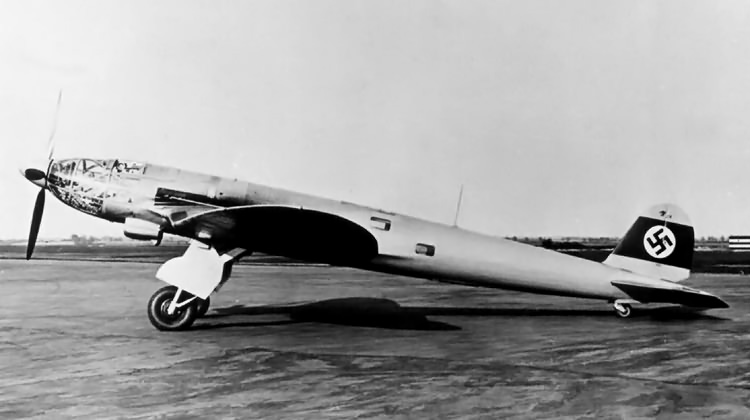
Heinkel He119 V1 side

Heinkel He 119 V1 prototype with the hastily installed radiator to augment the evaporate cooling system.

Work on the He 119 began in the summer of 1936 as a private venture funded by Heinkel Flugzeugwerke. The aircraft appeared to have a fairly standard layout as an all metal, low-wing monoplane with retractable gear. However, the very streamlined fuselage hid the He 119’s unorthodox power arrangement. To achieve the low-drag necessary for high-speed operations, the engine was buried in the fuselage, just behind the cockpit and above the wings. An enclosed drive shaft extended forward from the engine, through the cockpit, between the pilot and co-pilot, and to the front of the aircraft where it drove a 14 ft 1 in (4.30 m), metal, variable-pitch, four-blade propeller.

No engine produced the power needed for the He 119, so two Daimler-Benz DB 601 engines were placed side-by-side and coupled together through a common gear reduction. The DB 601 was a liquid-cooled, 12-cylinder, 60 degree, inverted Vee engine with a 5.91 in (150 mm) bore and 6.30 in (160 mm) stroke. When coupled, the 24-cylinder engine was known as the DB 606; it displaced 4,141 cu in (67.8 L) and produced 2,350 hp (1,752 kW). The inner banks of the DB 606 were pointed nearly straight down and exhausted under the aircraft. The side banks’ exhaust was expelled just above the He 119’s wings.

Daimler-Benz DB 606

The Daimler-Benz DB 606 engine was comprised of two DB 601 engines joined to a common gear reduction.

The DB 606 engine in the He 119 was to be cooled exclusively by surface evaporative cooling, where steam from the heated coolant was pumped under the skin of the wing’s center section. Here, the steam would cool and condense back into liquid. The liquid was then pumped back to the engine. However, during testing the system proved to be inadequate, and a radiator was added below the fuselage, just before the wings. The first prototype had a fixed radiator that was rather hastily installed. The subsequent prototypes included an improved radiator that was extended during low-speed operations but was semi-retracted into the fuselage as the aircraft’s speed increased.

The He 119’s cockpit formed the nose of the aircraft. The cockpit was entirely flush with the 48 ft 7 in (14.8 m) fuselage and was extensively glazed with heavily framed windows. The pilot and co-pilot accessed the cockpit by separate sliding roof panels. In the aft fuselage were provisions for a radio operator and a ventral bay for cameras. Another bay for either large cameras or a maximum of 1,200 lb (1,000 kg) of bombs was located in fuselage, just aft of the wing spar.

Heinkel He 119 nose radiator

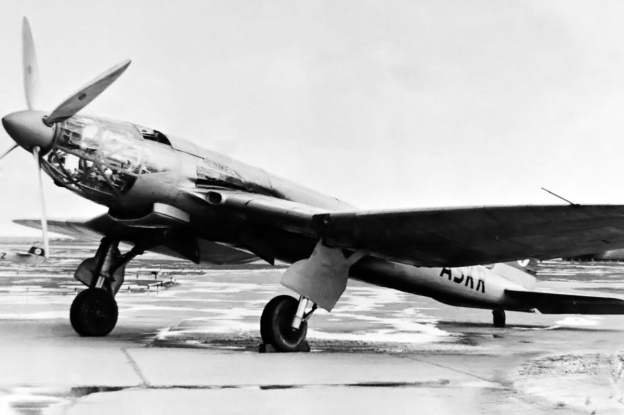
A good view of the He 119’s glazed cockpit is provided in this image. Most sources state this aircraft is V4, but it possesses the exhaust ports of V1. Note the extended radiator.

The He 119 had a wingspan of 52 ft 6 in (16 m). To provide for proper ground clearance, conventional main landing gear would have been too long to fit in the inverted-gull, semi-elliptical wing. A telescoping strut was devised that would collapse as the gear retracted. This allowed the gear to fit within the wing and also extend to provide the needed ground clearance.

Heinkel kept the He 119 a secret during construction, and the first prototype (V1) flew in June 1937 with Gerhard Nitschke at the controls. Even with the bulk of the added radiator, the aircraft achieved 351 mph (565 km/h), which was faster than fighter aircraft of the day. This speed validated Heinkel and the Günter brothers’ position that the fast bomber did not need to be armed. However, when the aircraft was revealed to German officials, they insisted the aircraft be armed with upper and lower guns operated by separate gunners. German officials did allow the continued experimentation of the aircraft; at this point, the aircraft was officially designated He 119. The addition of the guns lowered the aircraft’s speed, and it appears that only the upper gun was included in other prototypes, housed under a sliding panel.

Heinkel He 119 V2 with windows in the rear fuselage for the radio operator.

Heinkel He 119 V2 with windows in the rear fuselage for the radio operator. Reportedly, this is the last He 119 built with the semi-elliptical wing.

It is at this point that sources disagree on the He 119’s history. One theory is that the second prototype (V2) first flew in September 1937, followed by the fourth prototype (V4) in October 1937. The He 119 V4 set a speed record on 22 November 1937 and was destroyed in a follow-up attempt on 16 December. A total of eight aircraft were built; the seventh (V7) and eighth (V8) were purchased by and subsequently shipped to Japan.

The other theory, supported by German Heinkel expert Dr. Volker Koos, is that the V1 was prepared (which included the installation of a new radiator as used on the subsequent prototypes) for the record flight. The V1 flew the record flight and crashed during the follow-up attempt. The first flight of V2 was in 1938, and V4 first flew in May 1940. Most likely, only four aircraft were built, and V2 and V4 were shipped to Japan.

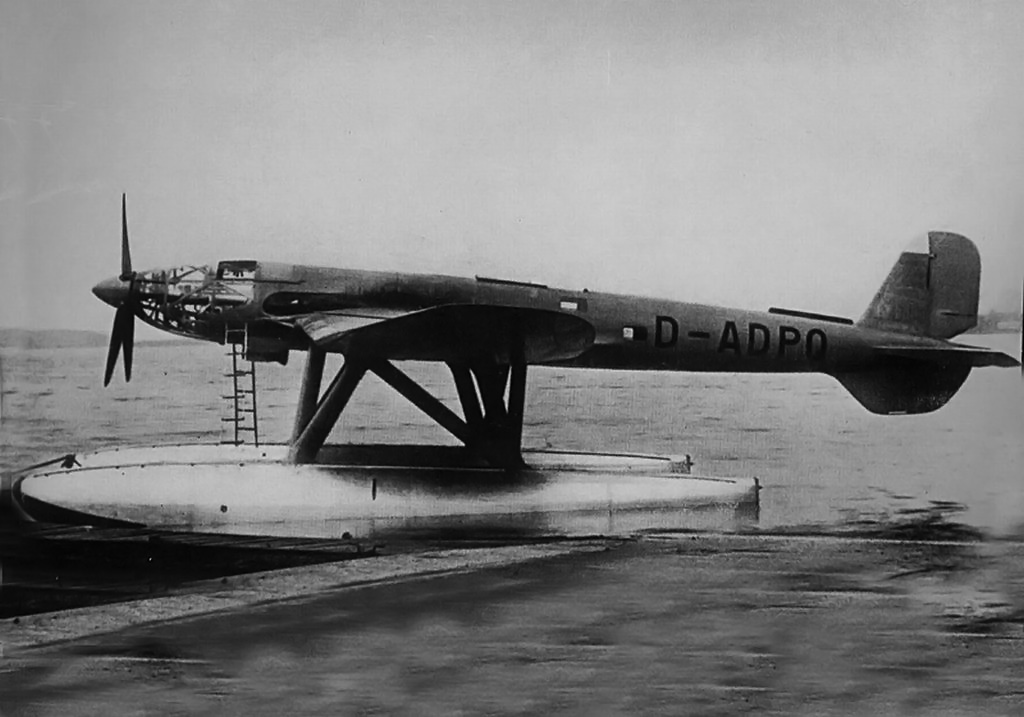
Side view of the He 119 V3. The updated wing used on the V3 and all further He 119 aircraft can be seen as well as tail modifications to increase the seaplanes stability.

Side view of the He 119 V3. The updated wing used on the V3 and all further He 119 aircraft can be seen as well as tail modifications to increase the seaplane’s stability.

All sources agree that the He 119 carrying the registration D-AUTE made the record flights. The third prototype (V3) was first flown after V4 because V3 was built as a seaplane. All prototypes from V3 on were built with a new wing that had a straight leading edge and a slightly reduced span of 52 ft 2 in (15.9 m).

After careful examination of various photos, it appears that the He 119 registered at D-AUTE had the semi-elliptical wing as used on the first two prototypes. It also appears that the exhaust ports above the wing on V1 were unique and at an angle, with each port slightly higher (relative to the fuselage) than the port preceding it. All other He 119s had exhaust ports in a straight line relative to the fuselage. D-AUTE appears to have the ports as seen on V1. Based on the information available, it seems more likely that V1 did indeed make the record flights. Sadly, given the secrecy under which the He 119 was built, the propaganda subterfuge surrounding the record flights, and the destruction of German documents during World War II, the exact aircraft identities as well as the number built may never be definitively known.

Heinkel He 119 V3 b

The Heinkel He 119 V3 seaplane taxiing under its own power. This aircraft was to be used on an attempt to set a new 1000 km (621 mi) seaplane record, but such plans were cancelled after the other He 119’s crash.

Regardless of the specific airframe, on 22 November 1937, the He 119 set a world record for flying a payload of 1,000 kg (2,205 lb) over a distance of 1,000 km (621 mi). For propaganda purposes, the He 119 was labeled He 111U and also He 606. Due to weather, the He 119 was forced to fly lower than anticipated which reduced its airspeed. Even though the He 119 set the record at 313.785 mph (504.988 km/h), the speed was seen as a disappointment that did not represent the He 119’s true capabilities. Indeed, the record was broken about two weeks later by an Italian Breda Ba 88.

A follow-up flight to reclaim the record occurred on 16 December 1937.  With over half the distance flown and the He 119 averaging just under 370 mph (595 km/h), the DB 606 engine quit. The pilots, Nitschke and Hans Dieterle, attempted an emergency landing at Travemünde but hit a drainage ditch. The He 119 was destroyed; Nitschke and Dieterle were injured, but they survived. The engine failure was a result of a faulty fuel transfer switch. After the crash, Heinkel was ordered not to attempt any further record flights with the He 119.

Heinkel He 119 V4 front

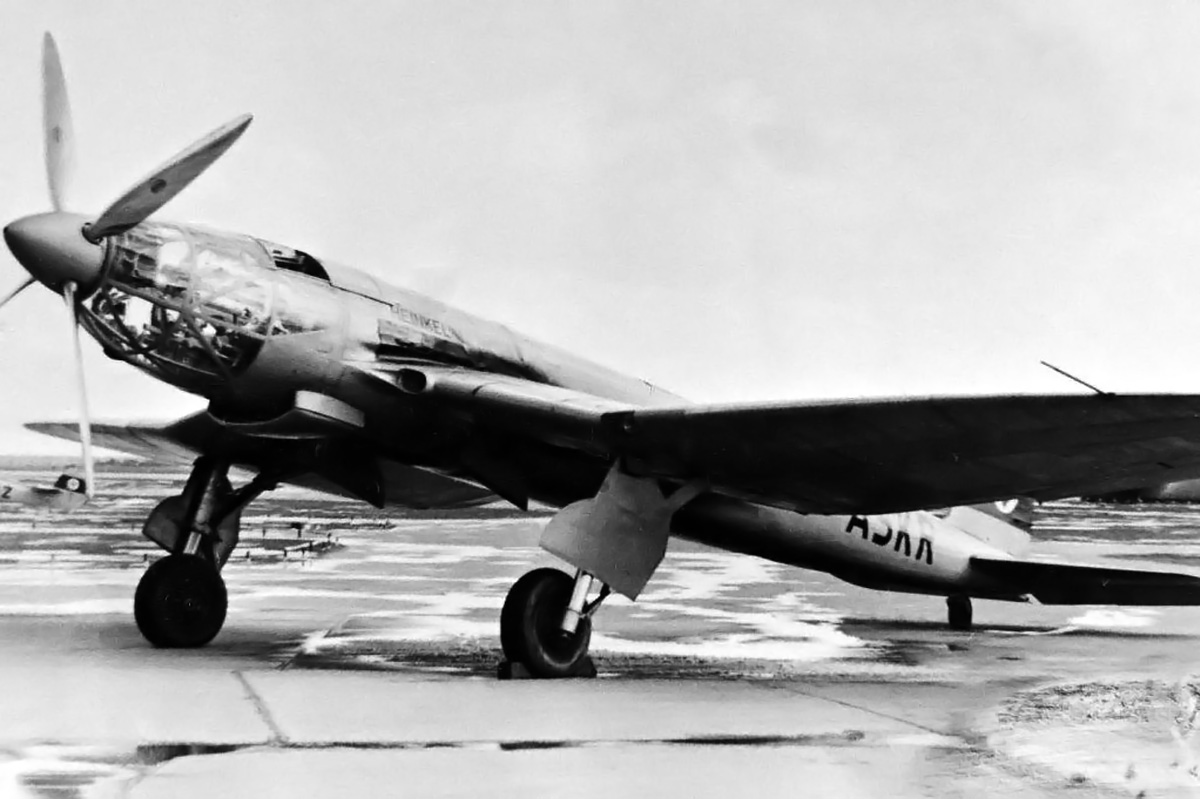
Many sources identify this aircraft (D-ASKR) as the He 119 V2. Interestingly, the wing root intake for the supercharger and lower lip of the radiator do not match those found on other images of V2. The features do match those found on V3.

Other He 119 prototypes took over the test flights. He 119s with the new wing demonstrated a top speed of around 370 mph (595 km/h) and a range of 1,865 mi (3,000 km). Despite the floats, the He 119 V3 seaplane had a top speed of 354 mph (570 km/h) and a range of 1,510 mi (2,430 km). The V3 aircraft also had a ventral fin added to counteract the destabilizing effects of the floats. Unfortunately, the German authorities did not have any interest in producing the He 119 in any form because of its unorthodox features. Reportedly, some of the remaining aircraft served as test-beds for the DB 606 and DB 610 engines. The remaining He 119s in Germany were scrapped during World War II.

Late in 1938, the He 119 was shown to a Japanese Naval delegation that expressed much interest in the aircraft. In 1940 the Japanese purchased a manufacturing license for the He 119 along with two of the prototype aircraft. These aircraft were delivered via ship to Japan in 1941 (some say 1940). The aircraft were reassembled at Kasumigaura Air Field, and flight tests occurred at Yokosuka Naval Base. During an early test flight, one of the He 119s was badly damaged in a landing accident, and it is believed the other He 119 suffered a similar fate. While it was not put into production, the He 119 did provide the Japanese with inspiration for the Yokosuka (Kugisho) R2Y1 Keiun high-speed reconnaissance aircraft.

Heinkel He 119 V2 with the Japanese Naval delegation.

The Heinkel He 119 with the Japanese Naval delegation. The sliding roof panel for the pilot’s cockpit access can clearly be seen. Note the differences with the wing root intake and lower lip of the radiator compared to the D-ASKR aircraft.

Sources:
– “An Industry of Prototypes – Heinkel He 119”, Wings of Fame, Volume 12 by David Donald (1998)
Warplanes of the Third Reich by William Green (1970/1972)
http://www.whatifmodelers.com/index.php/topic,21627.0/
http://forum.12oclockhigh.net/showthread.php?t=14198

Rolls-Royce Exe (Boreas) and Pennine Aircraft Engines

By William Pearce

Arthur Rowledge was one of the most prolific designers of piston aircraft engine in history. In 1913 he joined Napier & Son where he designed the firm’s first aircraft engine, the Lion, in 1917. This engine went on to achieve great success and was even used during World War II, but Rowledge moved on to Rolls-Royce (R-R) in 1921. While at R-R, Rowledge was very involved with the Condor III, Kestrel, “R” Schneider, and Merlin engines. Rowledge also designed the air-cooled and sleeve-valve Exe and Pennine engines. These two engines were quite a departure from standard R-R practice and never made it to production status.

Side view of the Rolls-Royce Exe engine. The cylinder baffling in the image is of a simple construction when compare to the other engine image below. It appears to be the same baffling as seen on the engine installed in the Battle.

In the 1930s Rowledge became seriously ill and took a leave from R-R. During his recovery, R-R decided not to bring him back to the main engine development programs but to give him complete control of designing a new engine. This new engine was based on a 1,000 hp (746 kW) requirement from the Fleet Air Arm for shipboard aircraft use where air-cooling was preferred. The new engine was sanctioned in February 1935 and originally called Boreas, but the name was later changed to Exe.

The Exe engine had four banks of six cylinders in an X configuration. Each bank was 90 degrees from the next. The cylinders had a 4.225 in (107.3 mm) bore and 4.0 in (101.6 mm) stroke, for a total displacement of 1,346 cu in (22.1 L). The Exe had a two-speed, single-stage supercharger, and the compression ratio was 8 to 1. The engine weighed 1,530 lb (694 kg). The two spark plugs for each cylinder were fired by coil ignition rather than standard magnetos. A 0.358 gear reduction to the propeller was achieved through spur gears; their arrangement elevated the propeller shaft centerline above the crankshaft.

Clear view of the Rolls-Royce Exe and the baffling around each cylinder to direct air for proper cooling. The baffling appears to be an updated version compared to the image above. Also note how the spur reduction gear has elevated the propeller thrust line.

The sleeve-valves, undoubtedly inspired by Harry Ricardo, followed the established Burt-McCollum/Bristol practice. Each cylinder barrel had three intake ports and two exhaust ports. The sleeve itself had only four ports, one was shared as an intake and exhaust port. The drive cranks for the sleeve valves were driven via spiral gears from a shaft that ran along each side of the engine. A.A. Rubbra states that these shafts were driven from the propeller gear reduction. The single sleeve for each cylinder was sealed by the use of a junk head. The entire system proved to be quite reliable.

The connecting rods consisted of one master rod and three articulating rods. The big end was essentially a square with the master rod extending from one corner and the three articulated rods attached to each of the other corners. The big end was split and bolted together around the crankshaft via four bolts.

A specialized pressure air-cooling method was used. Cooling air entered the engine cowling below the spinner. The air was then fed into the upper and lower Vees. Baffles attached to the individual cylinders caught and directed the air through the cylinder’s cooling fins. The air passed from the upper and lower Vees into the side Vees and exited toward the rear of the engine cowling. Reportedly, the arrangement worked very well with minimal drag and no cooling issues. Induction manifolds delivered the air/fuel mixture to the cylinders through the top and bottom Vees. Exhaust from the cylinders was collected in manifolds on the side Vees.

A great image of the Exe installed in the Battle with the cowling removed. Note early version of the cylinder baffling.

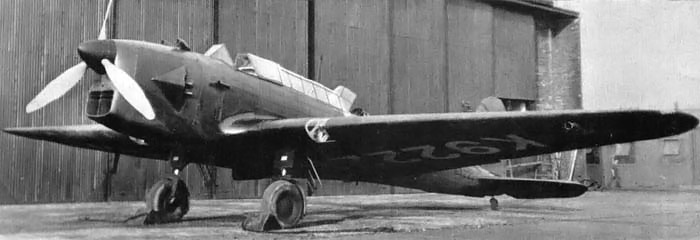
The Exe was originally rated at 920 hp (686 kW) at 3,800 rpm. The engine was first run in September 1936, and it had completed a 40-hour development test by the end of 1937. The Exe first took to the air in a modified Fairey Battle (K9222) on 30 November 1938. This particular aircraft was owned by R-R and was modified at the R-R Flight Development Establishment at Hucknell. Exe engine development continued with very little trouble; however, the engine did suffer from excessive oil consumption. Ultimately the engine’s output was increased to 1,200 hp (895 kW) at 4,200 rpm, and continued development to 1,500 hp (1,119 kW) was planned.

A liquid-cooled version of the engine was also studied. A four cylinder test engine representing an X configuration was run in 1938. Each cylinder of the test engine had its own steel water jacket. The program progressed, and a complete liquid-cooled X-24 engine was built; this engine featured normal cast aluminum cylinder blocks with integral water jackets. Reportedly, this engine was run and tested but never flew.

Rolls-Royce Exe installed in Fairey Battle K9222. Note the cooling air intake under the spinner and exit by the exhaust stacks. The Exe-powered Battle continued to fly long after the engine was cancelled.

The Exe was originally intended to power the Fairey Barracuda torpedo-bomber and the production Fairey F.C.1 four-engine transport. With the start of World War II, top priority was given to developing and producing Merlin and Griffon engines. Ernest Hives, R-R General Works Manager, estimated that building 275 Exe engines would be the production equivalent of 1,200 Merlins. At his request, work on the Exe program was suspended in September 1939 and stopped completely by 1941. Development was also discontinued on the liquid-cooled engine. The Barracuda was switched to Merlin power, and the F.C.1 was never built.

As an indicator of the engine’s sound design and reliability, the Exe-powered Battle continued to fly until 1943, long after the Exe program was cancelled. In addition, R-R’s Exe-powered Battle flew at higher speeds than the standard Merlin-powered Battles.

The encouraging results from the Exe compelled a small design team to continue work on the air-cooled, sleeve-valve engine concept. Around June 1943, design work was accepted on what was essentially an enlarged Exe. The new engine project was known as the Pennine and was headed by Dr. Sprinto Viale.

Rolls-Royce Pennine engine shown without any exhaust stacks or spark plug leads. The cylinders look very similar to those used by Bristol. The ring of studs around the propeller shaft is where the annular cooling fan would attach.

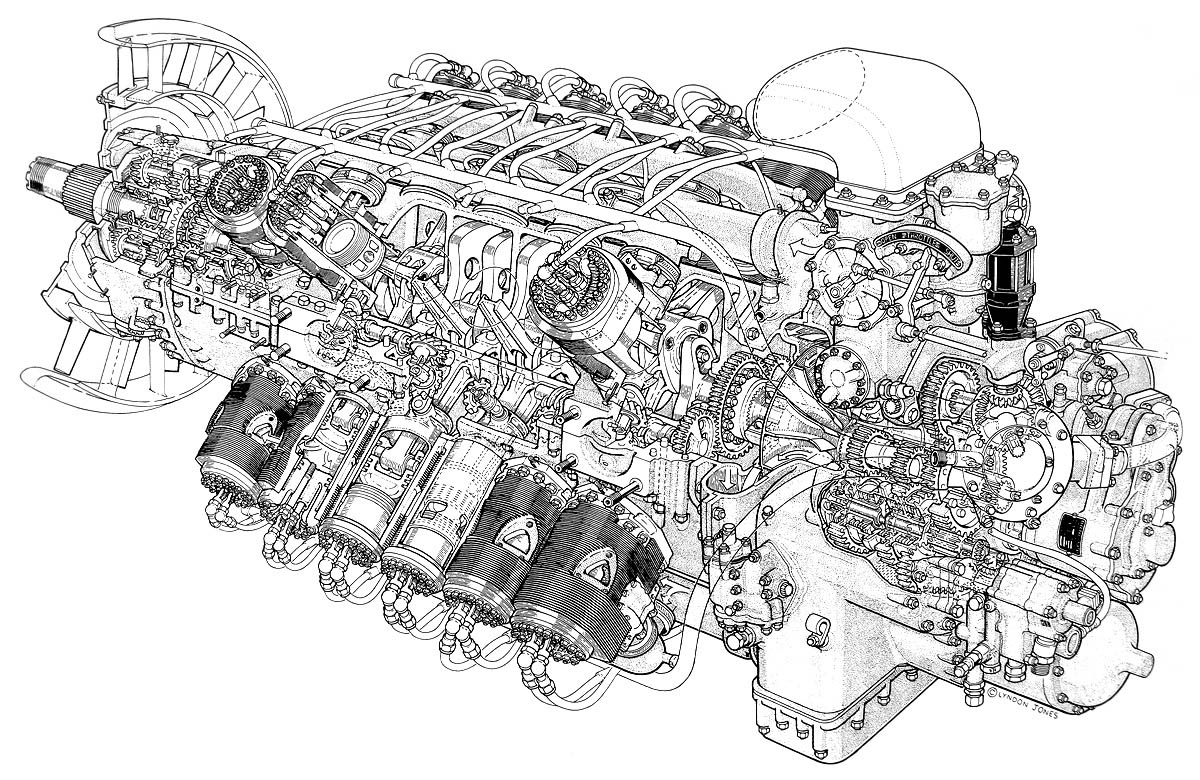
The Pennine had the same layout as the Exe, with the exception of the propeller gear reduction. Rather than spur gears, which would raise the propeller shaft as on the Exe, the Pennine used epicyclic (planetary) gears that allowed the propeller shaft to be in-line with the crankshaft. A propeller gear reduction of .3 or .4 was used. In addition, an annular cooling fan was driven from the gear reduction at 1.03 times crankshaft speed. Illustrations done by Lyndon Jones show the drive shafts for the sleeve valves geared to the rear of the crankshaft rather than to the gear reduction. It is possible this deviation from the Exe’s design was a result of the aforementioned changes to the gear reduction. Design work on the engine was completed by September 1944.

Another change from the Exe that can be seen in the Jones illustration was the connecting rod arrangement. Rather than having a split big end, the Pennine utilized a one piece master connecting rod with three articulated rods. The crankshaft’s crankpins were bolted together through the one piece master rods.

The Pennine engine had a 5.4 in (137.2 mm) bore and 5.08 in (129 mm) stroke, giving a total displacement of 2,792 cu in (45.8 L); this was over twice the displacement of the Exe. With a dry weight of 2,850 lb (1,293 kg), the Pennine was 106 in (2.69 m) long, 37.5 in (.95 m) tall, and 39 in (.99 m) wide. The engine was equipped with a single stage, two speed supercharger that provided 12 psi (.83 bar) of boost at takeoff and combat power settings. The Pennine developed 2,750 hp (2,051 kW) at 3,500 rpm at sea-level and up to 2,800 hp (2,088 kW) under combat settings. A reliable 3,000 hp (2,237 kW) was thought to be easily obtainable with further development.

Pennine sectional view from Sectioned Drawings of Piston Aero Engines* by Lyndon Jones. Note the annular fan and sleeve valve drives.

Only one or two Pennine test engines were built; the first was finished on 31 December 1944. The engine was run on teststands during 1945, and an engine cowling was developed to maximize the efficiently of the pressurized air-cooling. While the engine ran well, the end of piston-powered military aircraft and civil airliners was on the horizon, with piston engines being supplanted by jet engines. Possible applications for the Pennine engine were the Fairey Spearfish torpedo bomber and the Miles X.11 airliner. Ultimately, the Spearfish was powered by a Bristol Centaurus. The Miles aircraft lost out to the Bristol Brabazon and was never built. Development of the Pennine was stopped in mid to late 1945.

A further engine study was made where two 16-cylinder power sections (using Pennine cylinders) of an X configuration were attached to a common crankcase. This arrangement made an X-32 engine and was known as the Snowden. A shaft from the midsection, between the two X-16 power sections, was to travel forward along the top and bottom Vees of the engine to a gear reduction that drove half of a coaxial contra-rotating propeller unit. This engine would have displaced 3,723 cu in (61.0 L) and produced 4,000 hp (2,983 kW). Some testing was done, but a complete engine was never built.

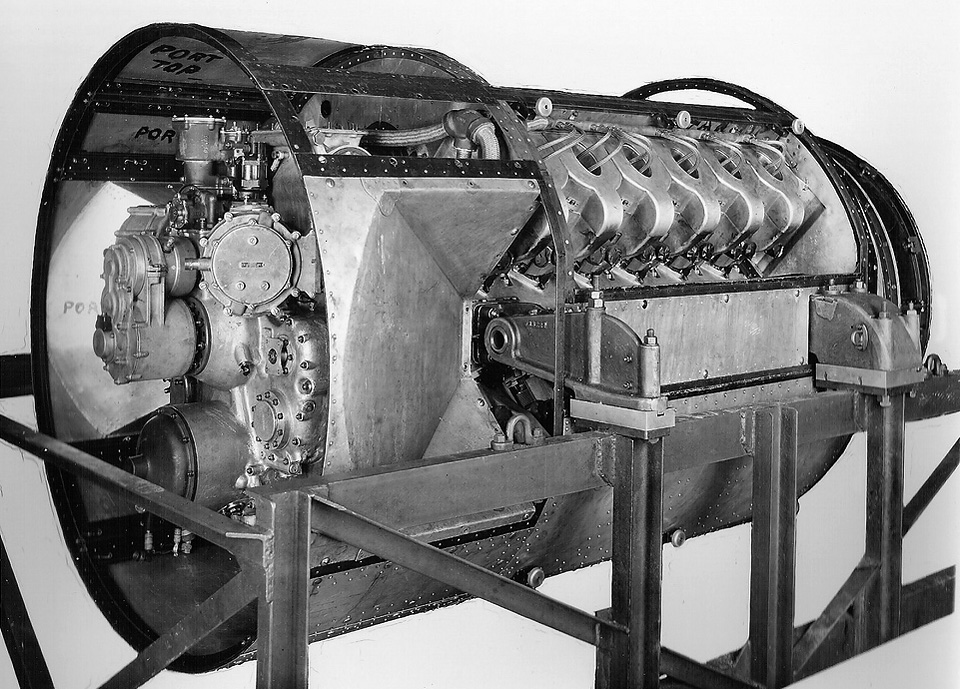
Rear view of the Pennine engine and cowling. Note the baffling for each individual cylinder and the circular front of the cowling for the annular cooling fan..

Sources:
Rolls-Royce Piston Aero Engines — A Designer Remembers by A.A. Rubbra (1990)*
Rolls-Royce Aero Engines by Bill Gunston (1989)
British Piston Aero Engines and their Aircraft by Alec Lumsden (1994/2003)
Major Piston Engines of World War II by Victor Bingham (1998/2001)
Allied Aircraft Piston Engines of World War II by Graham White (1995)
Sectioned Drawings of Piston Aero Engines by Lyndon Jones (1995)*
Rolls-Royce — Hives, the Quiet Tiger by Alec Harvey-Bailey (1985)
http://www.secretprojects.co.uk/forum/index.php?topic=5375.0
– “Rolls-Royce and the Sleeve Valve” by Phil Kennedy, New Zealand Rolls-Royce & Bentley Club Inc, Issue 07-3 2007 (pdf)
http://en.wikipedia.org/wiki/Arthur_Rowledge

*Rolls-Royce Heritage Trust books that are currently in print and available from the Rolls-Royce Heritage Trust site.

Fokker F.XX Zilvermeeuw Transport

By William Pearce

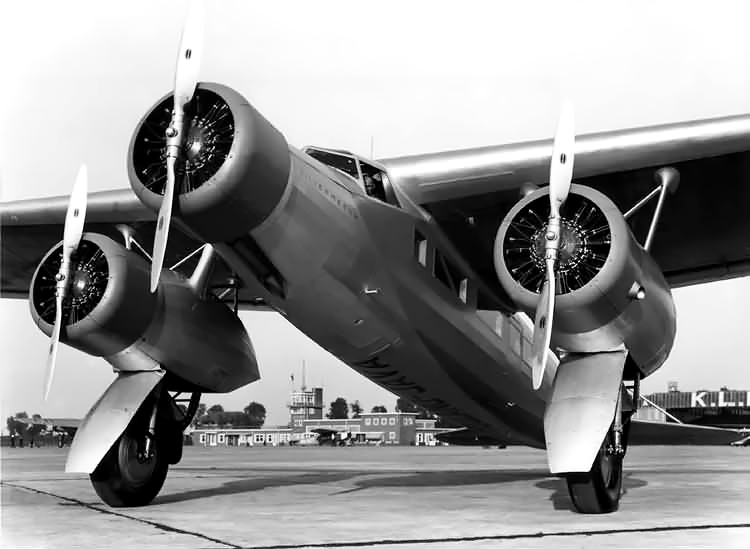
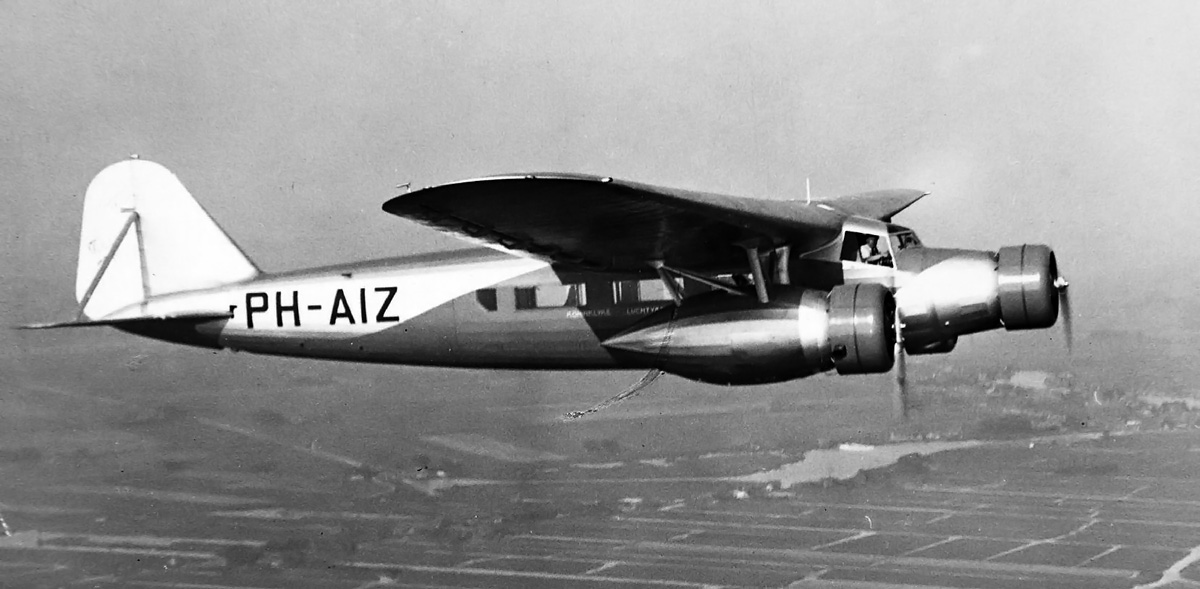
In the never-ending quest for speed, KLM (Royal Dutch Airlines) asked the Fokker Aircraft Corporation to design an aircraft for its East Indies route that could fly some 35 mph (56 km/h) faster than the Fokker F.XVIII then in service. Fokker’s response was a trimotor design that could accommodate 12 passengers and three crew members. The new aircraft, the Fokker F.XX Zilvermeeuw (Herring Gull), was the last wooden aircraft and last trimotor built by Fokker. However, it was the first Fokker-built aircraft with retractable landing gear.

The Fokker F.XX: the pinnacle of the Fokker trimotors.

The Fokker F.XX was revealed on 20 December 1932. The aircraft was built under the direction of Marius Beeling and featured a fabric covered fuselage of steel tube construction. The fuselage used an elliptical cross section, another design-first for Fokker, who had used rectangular fuselages on their earlier aircraft. The F.XX’s high-wing had a wooden structure and was plywood covered. The plywood skin was omitted from the lower wing section running through the cabin so that more headroom was available for the passengers.

The aircraft was originally powered by three 650 hp (485 kW), nine-cylinder, air-cooled Wright Cyclone R-1820-F engines, all housed in NACA cowlings. One engine was in the nose of the aircraft, and the others were each in a nacelle suspended under each wing by struts. Later, KLM replaced the engines with more powerful 690 hp (515 kW) Wright Cyclone R-1820-F.2 engines. Metal, two-blade, ground-adjustable propellers were initially used. However, when the uprated engines were installed, metal Hamilton Standard propellers that were adjustable in-flight were used.

The Fokker F.XX under constructions in 1933.

The Fokker F.XX was 54.8 ft (16.7 m) long and had a span of 84.3 ft (25.7 m). The aircraft weighed 11,795 lb (5,350 kg) empty and 19,510 lb (8,850 kg) loaded. Range with full fuel was 1,056 mi (1,700 km), and range with full payload was 400 mi (645 km). The aircraft’s service ceiling was 21,650 ft (6,600 m). Maximum speed of the F.XX was 190 mph (305 km/h), and cruise speed was 155 mph (250 km/h).

The F.XX carried the Dutch registration PH-AIZ and made its first flight on 3 June 1933, piloted by Emil Meineche. For this first flight, the engine cowlings were omitted and the undercarriage was not retracted. During a test on 29 June 1933, it was found that heavy aileron vibration occurred as speed was increased. This phenomenon was solved by adding 70 lb (32 kg) of balance weights to the ailerons. Flight testing resumed on 11 August 1933.

The F.XX probably undergoing early flight tests with the large gear doors still installed and short engine nacelles.

It was also discovered that when the landing gear was deployed, the large door in front of each main wheel caused turbulence that resulted in severe vibrations of the tail section. The doors were reduced in size, but the problem persisted. Eventually, the doors were removed altogether. During the flight test program, the engine nacelles were lengthened to reduce drag. The flight test program, the airworthiness trials, and the acceptance flights were completed over the course of four months, encompassing 62 flights that totaled 37 hours in the air.

On 18 December 1933, the Fokker F.XX made its KLM debut on a special Christmas mail flight to the East Indies. The objective was to fly as fast as possible to the Dutch colonies in competition with another aircraft, the Pander S.4 Postjager, to inaugurate a special mail service.

Inflight image of the Fokker F.XX showing its graceful lines.

The Pander Postjager had departed earlier but was stranded in Italy because of an engine failure, leaving the Fokker F.XX poised to win the competition. However, engine trouble was experienced during a warm-up, and the F.XX was grounded. Work to repair the F.XX would take too much time, and KLM quickly prepared a Fokker F.XVIII for the Christmas flight. It was a disastrous public failure for the new F.XX, one from which it never fully recovered.

Although the F.XX was a more advanced design than earlier Fokker aircraft, the eminent arrival of twin-engine, low-wing, metal aircraft (like the Douglas DC-2) rendered it obsolete. In addition, the negativity surrounding the failed Christmas flight meant that there would no production contract for the Fokker F.XX. Quietly and shrewdly, Fokker Aircraft Corporation obtained manufacturing rights for the DC-2.

The F.XX with the gear doors removed and lengthened engine nacelles.

However, the F.XX’s reputation was boosted when KLM began using the aircraft on a fast London-Amsterdam-Berlin service starting 1 March 1934. On the Amsterdam-Berlin leg of the flight, the aircraft achieved an impressive average speed of 157 mph (253 km/h). Also in 1934, the F.XX flew 1,535 hours; this was nearly double KLM’s 850 flight hour average with the F.XVIII.

The F.XX was in service with KLM for only a few years. In September 1936, the aircraft was sold to Alain Pilain of France and registered as F-APEZ. Mr. Pilain represented the fictitious airline Air Tropique, which was a cover for another organization: the Société Française de Transports Aériens (SFTA). SFTA was a purchasing agent for the Spanish Republicans disguised as a French air transport service.

The Fokker F.XX in service with the Spanish Republicans and with a camouflage paint scheme as seen at Le Bourget, France in 1937.

SFTA flew the aircraft to Spain in October 1936, where it carried the governmental registration EC-45-E and was used in the Spanish Civil War. The F.XX was painted in a camouflaged scheme and used to transport various cargoes (including gold bullion and jewelry) between Spain and France.

It was not a very popular aircraft, especially after one of its Wright engines was replaced with a Walter-built Mercury engine from a Letov S-231 fighter, and at least one other engine was replaced with a Shvetsov M-25 engine from Polikarpov I-16 fighter. The engine changes resulted in a vicious yaw on takeoff. The F.XX served with the Republicans until early February 1938 when, piloted by Eduardo Soriano, it was destroyed in a crash near Barcelona at Prat de Llobregat Airport.

The following is a video of the Fokker F.XX Zilvermeeuw filmed in 1933 and uploaded by BeeldenGeluid.

Sources:
– “The Fokker F.XX,” Flight (5 October 1933)
– “Fokker’s Trimotors Go To War,” Air Enthusiast, No. 13 August–November 1980 by Gerald Howson
Jane’s All the World’s Aircraft 1934 by C.G. Grey (1934)
Aircraft of the Spanish Civil War 1936-1939 by Gerald Howson (1990)
Fokker: Aircraft Builders to the World by Thijs Postma (1979/1980)
http://www.dutch-aviation.nl/index5/Civil/index5-2%20F20.html