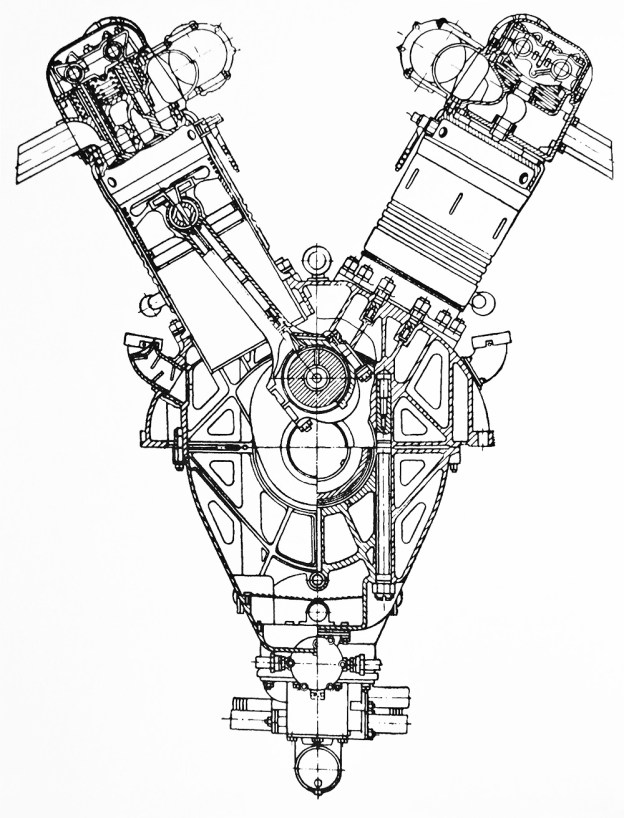
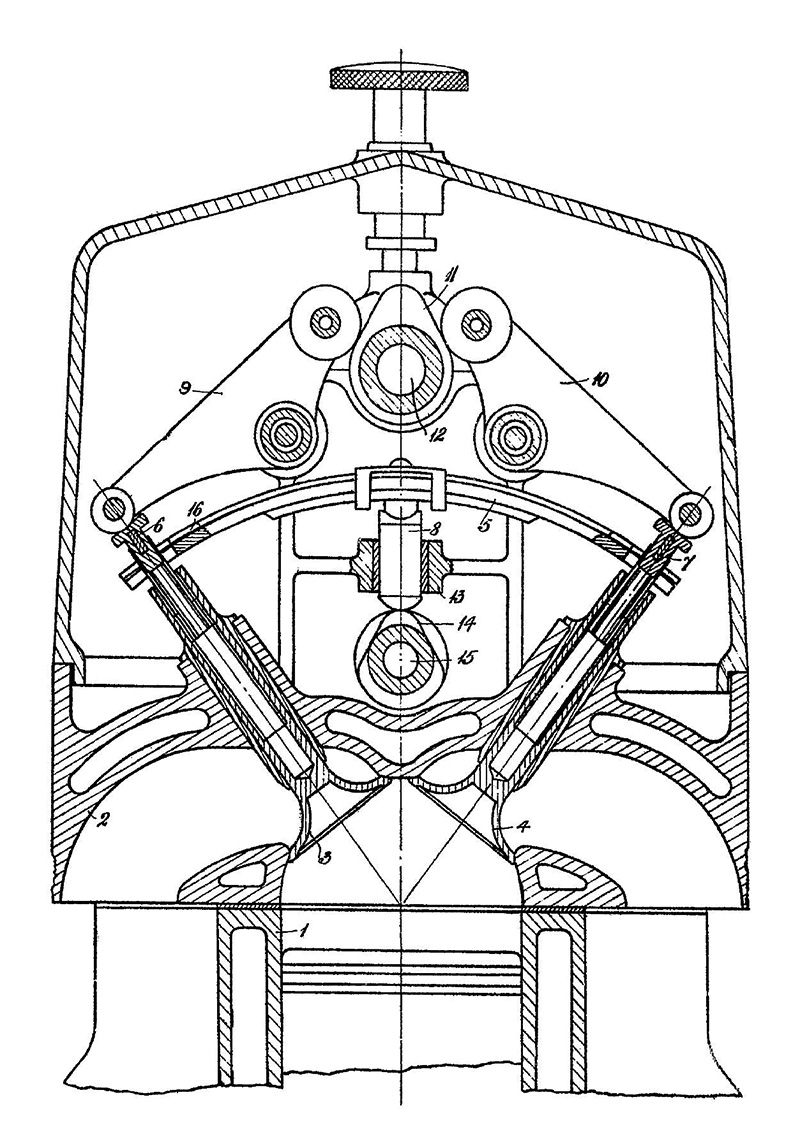
IAM M-44 sectional view

IAM M-44 V-12 Aircraft Engine

By William Pearce

In 1925, the Soviet Air Force (Voyenno-Vozdushnye Sily or VVS) approached the TsAGI (Tsentral’nyy Aerogidrodinamicheskiy Institut, the Central Aerohydrodynamic Institute) and requested proposals for a large, heavy bomber. Under the direction of Andrei Nikolayevich Tupolev, the Tupolev OKB (Opytno-Konstruktorskoye Byuro, the Experimental Design Bureau) started design work on the aircraft in 1926, and the government finalized the aircraft’s operational requirements in 1929. The aircraft created from this program was the Tupolev ANT-6, which was given the military designation TB-3.

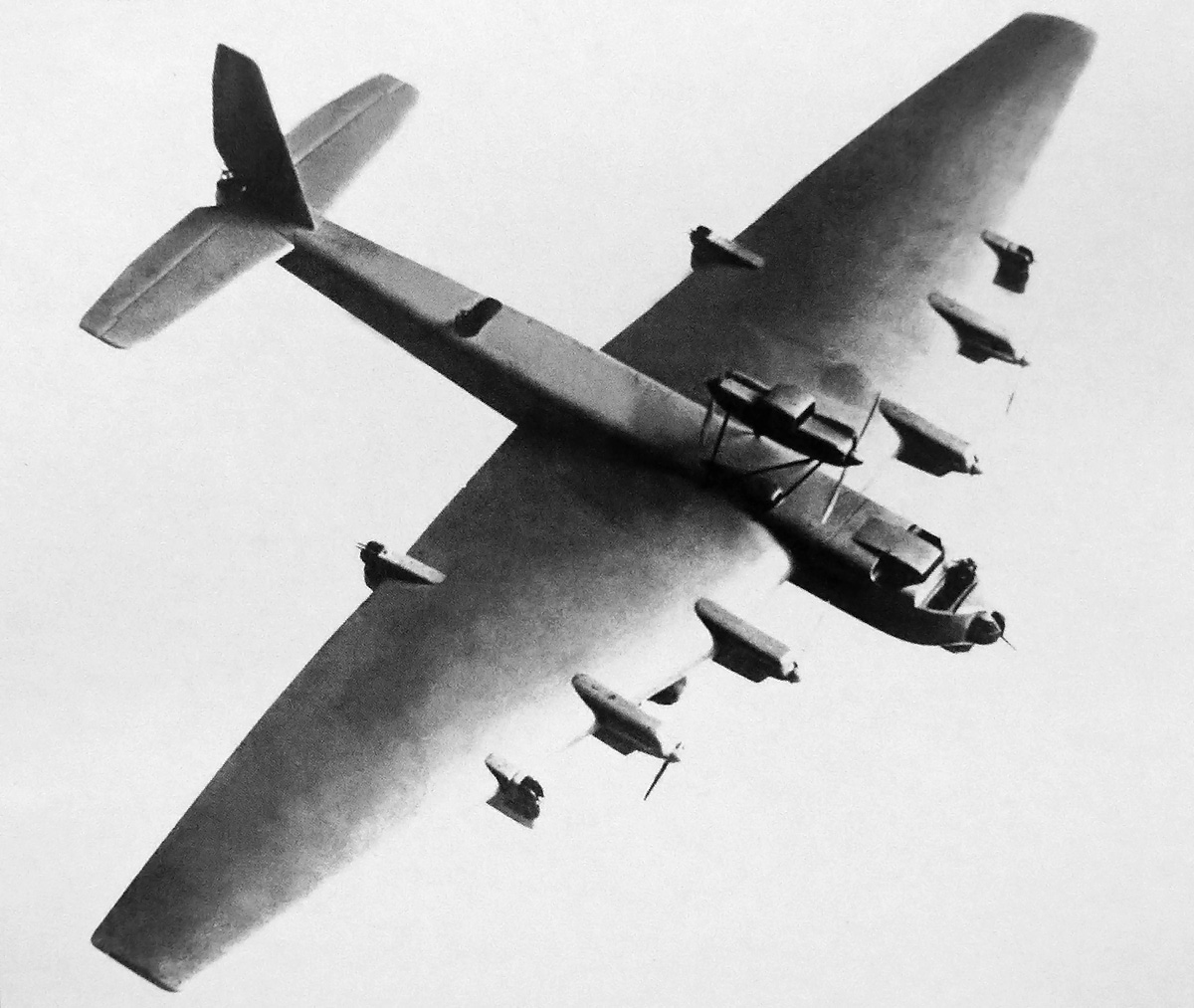
Tupolev TB-6 6M-44 top

Model of the Tupolev TB-6 6M-44 with its six M-44 engines. Gunner stations are seen outside of the outer engines and in the wing’s trailing edge.

The large, four-engine TB-3 lifted its 137 ft 2 in (41.80 m) wingspan from earth for the first time on 22 December 1930, but plans for even larger and more ambitious aircraft were underway. In October 1929, the Scientific and Technical Committee of the Air Force (Nauchno-tekhnicheskiy komitet upravleniya Voyenno-Vozdushnye Sily or NTK UVVS) instructed Tupolev to design bombers capable of carrying a 10-tonne (22,046 lb) and a 25-tonne (55,116 lb) payload. With a 177 ft 2 in (54 m) wingspan, the 10-tonne bomber became the ANT-16, which was given the military designation TB-4. The 25-tonne bomber had a 311 ft 8 in (95 m) wingspan and became the ANT-26, which was given the military designation TB-6. However, this line of developing very large aircraft, the TB-6 in particular, quickly illustrated that there was a lack of powerful engines and that numerous smaller engines were required for the aircraft. The TB-4 required six 800 hp (597 kW) engines, and the TB-6 required twelve 830 hp (619 kW) engines. If an engine with a 2,000 hp (1,491 kW) output could be built, not only could it power these large aircraft, but it would also simplify their construction, maintenance, and control.

Back in 1928, the TsAGI had realized the need for more powerful engines and initiated work on a single-cylinder test engine to precede the design of a large, high-power bomber engine. This test engine was designated M-170; “170” was the anticipated horsepower (127 kW) output of the cylinder. The results were encouraging, and in 1930, the Institute of Aviation Motors (Institut aviatsionnogo motorostroyeniya or IAM) was tasked with the construction of a V-12 engine based on the M-170 cylinder. The 12-cylinder engine was designated M-44, and the single-cylinder test engine was renamed M-170/44.

The design of the M-44 was initiated in February 1931 under the supervision of N. P. Serdyukov. The design progressed rapidly and was completed in May. The M-44 was a four-stroke, water-cooled, 60-degree V-12. Based on a sectional drawing, the crankcase was split horizontally with main bearing caps for the crankshaft machined integral into the lower half of the case. The main bearings were secured by long bolts that passed through the lower crankcase half and screwed into the upper half. The crankshaft accommodated side-by-side connecting rods with flat-top aluminum pistons.

IAM M-44 sectional view

Sectional drawing of the IAM M-44 reveals some of the engine’s inner workings. The design was fairly conventional, just extremely large. Unfortunately, no images or other drawings of the engine have been found.

The individual steel cylinders were secured to the crankcase via hold down studs. A steel water jacket surrounded the cylinder barrel. The cylinder had a flat-roof combustion chamber, and four spark plugs were positioned horizontally at its top, just below the valves. Two spark plugs were on the outer side of the cylinder and the other two on the Vee side. Each cylinder bank was capped by a monobloc cylinder head with dual overhead camshafts. One camshaft operated the two intake valves for each cylinder, and the other camshaft operated the two exhaust valves for each cylinder. An intake manifold was attached to the Vee side of the cylinder head, and individual exhaust stacks were attached to the outer side of the cylinder head.

The normally aspirated M-44 had a compression ratio of 6 to 1 (some sources state 5 to 1). A propeller gear reduction (most likely using spur gears) was incorporated onto the front of the engine. The IAM M-44 had an 8.74 in (222 mm) bore and a 11.26 in (286 mm) stroke. Each cylinder displaced 675.6 cu in (11.07 L), and the engine’s total displacement was 8,107 cu in (132.9 L). The M-44 was the largest V-12 aircraft engine ever built. The engine produced 2,000 hp (1,491 kW) for takeoff and 1,700 hp (1,268 kW) for continuous operation. Some sources indicate that 2,400 hp (1,790 kW) was expected out of the engine after it was fully developed. The M-44 was approximately 118 in (3.00 m) long, 46 in (1.16 m) wide, and 65 in (1.66 m) tall. The engine weighed around 3,858 lb (1,750 kg).

With development of the 2,000 hp (1,491 kW) M-44 engine underway, studies were started to incorporate the engine into the ANT-16 (TB-4) and ANT-26 (TB-6) aircraft designs. Proposals to re-engine the ANT-16 with four M-44s were quickly abandoned so that work could focus on using six M-44 engines to power the ANT-26. This version of the aircraft is often cited as TB-6 6M-44. The ANT-26 design was ordered in July 1932, with construction starting soon after. Delivery of the ANT-26 prototype was expected in December 1935. Some sources state that an even larger, 30-tonne (66,139 lb) bomber with a 656 ft (200 m) wingspan and powered by eight M-44 engines was conceived, but it appears this aircraft never progressed beyond the rough design phase.

The Tupolev TB-6 6M-44 had two engines installed in each wing and two engines positioned back-to-back and mounted above the aircraft’s fuselage. The aircraft had a 311 ft 8 in (95 m) wingspan and was 127 ft 11 in (39 m) long. The TB-6 6M-44’s top speed was 155 mph (250 km/h), and it had a ceiling of 22,966 ft (7,000 m). The aircraft had a maximum bomb load of 48,502 lb (22,000 kg) and could carry a 33,069 lb (15,000 kg) bomb load 2,051 miles (3,300 km). Its maximum range was 2,983 miles (4,800 km).

Tupolev TB-6 6M-44 side

This rear view of the TB-6 6M-44 illustrates the tandem engines mounted above the fuselage.

The construction of three M-44 prototypes was planned, but the first engine was delayed by continued trials of the M-170/44 test engine, which was given a higher priority. The manufacture of the first M-44 engine began in early 1933, and the engine was first run later that year. The second engine was built and run in 1934. Plans to build the third M-44 engine were suspended on account of issues with the first two engines. The M-44 test engines had trouble producing the desired power and suffered from reliability issues. It became clear that the engine was not going to be successful, and the program was cancelled in 1934.

A supercharged version of the engine, known as the M-44H, had undergone preliminary design work in 1932. However, performance specifications for this engine have not been found, and it is doubtful that detailed design work was completed. In 1935, a decision was made to build the third M-44 engine, modified for marine use. This engine was designated GM-44 and incorporated a reversing gearbox. The GM-44 produced 1,870 hp (1,394 kW), but it was no more reliable than the M-44 aircraft engine. The GM-44 engine was cancelled in 1936.

With the M-44 engine program dead, the ANT-26 design reverted back to using 12 engines (1,200 hp / 895 kW Mikulin M-34FRN). However, studies concluded that the multitude of engines created additional drag that impacted the aircraft’s performance, and the engines added so much complexity that the ANT-26 would be difficult to fly and very difficult to maintain. Simply put, the giant aircraft was impractical, and it was subsequently cancelled in July 1934. A transport/commercial version of the aircraft, designated ANT-28, was also cancelled. The ANT-26’s airframe was 75 percent complete at the time of cancellation.

Tupolev TB-6 12M-34FRN

With the M-44 cancelled, the 12-engine TB-6 12M-34FRN was designed to preserve the aircraft’s capabilities with reliable engines. However, one would question the practicality of such an aircraft. Note the set of tandem engines that was placed above each wing.

Sources:
Russian Piston Aero Engines by Vladimir Kotelnikov (2005)
Самолеты- гиганты СССР by Vladimir Kotelnikov (2009)
Unflown Wings by Yefim Gordon and Sergey Komissarov (2013)
OKB Tupolev by Yefim Gordon and Vladimir Rigmant (2005)

Caproni Ca90 side

Caproni Ca.90 Heavy Bomber

By William Pearce

Giovanni (Gianni) Caproni founded his first aircraft company in 1908. From the start, Caproni and his company leaned toward the production of large aircraft, typically bombers. By 1929, Caproni and engineer Dino Giuliani had designed the world’s largest biplane, the Caproni Ca.90.

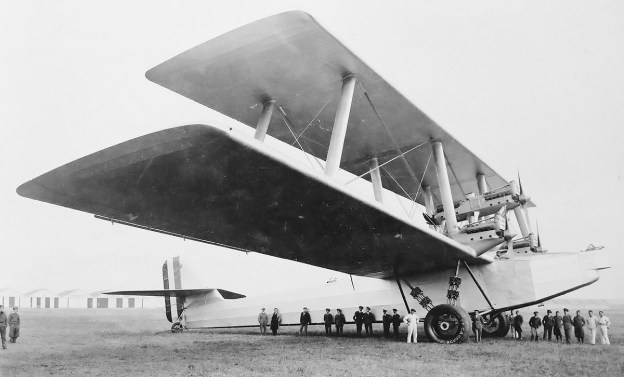
Caproni Ca90 side

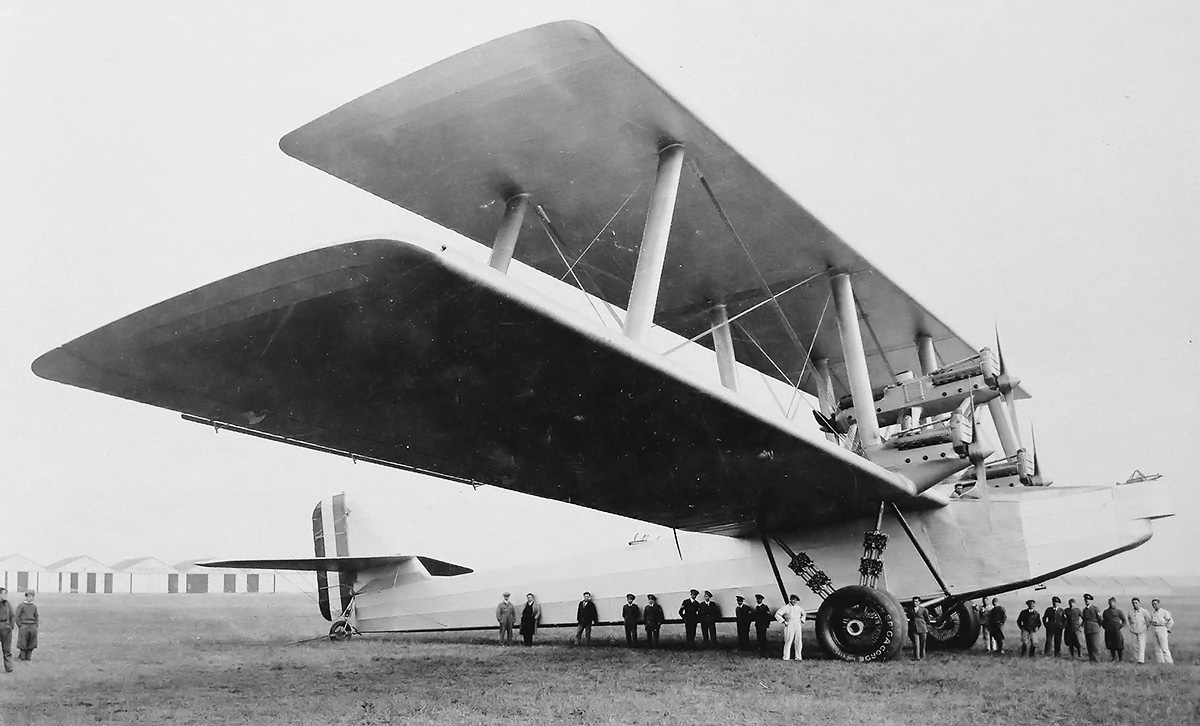
The Caproni Ca.90 was a huge aircraft. The aircraft’s tires are taller than the bystanders. Note the servo tab trailing behind the aileron used to balance the aircraft’s controls. Note the radiators for the front engines immediately behind the propellers.

The Ca.90 was conceived as a heavy bomber and was often referred to as the Ca.90 PB or 90 PB. The “PB” stood for Pesante Bombardiere (Heavy Bomber). The aircraft was a large biplane taildragger powered by three pairs of tandem engines. The Ca.90 was built upon lessons learned from the smaller (but still large) Ca.79. The wings, fuselage, and tail were constructed with steel tubes connected by joints machined from billets of chrome-nickel steel. The steel frame was then covered with fabric and doped, except for the fuselage by the cockpit and the aircraft’s extreme nose, which were covered with sheets of corrugated aluminum.

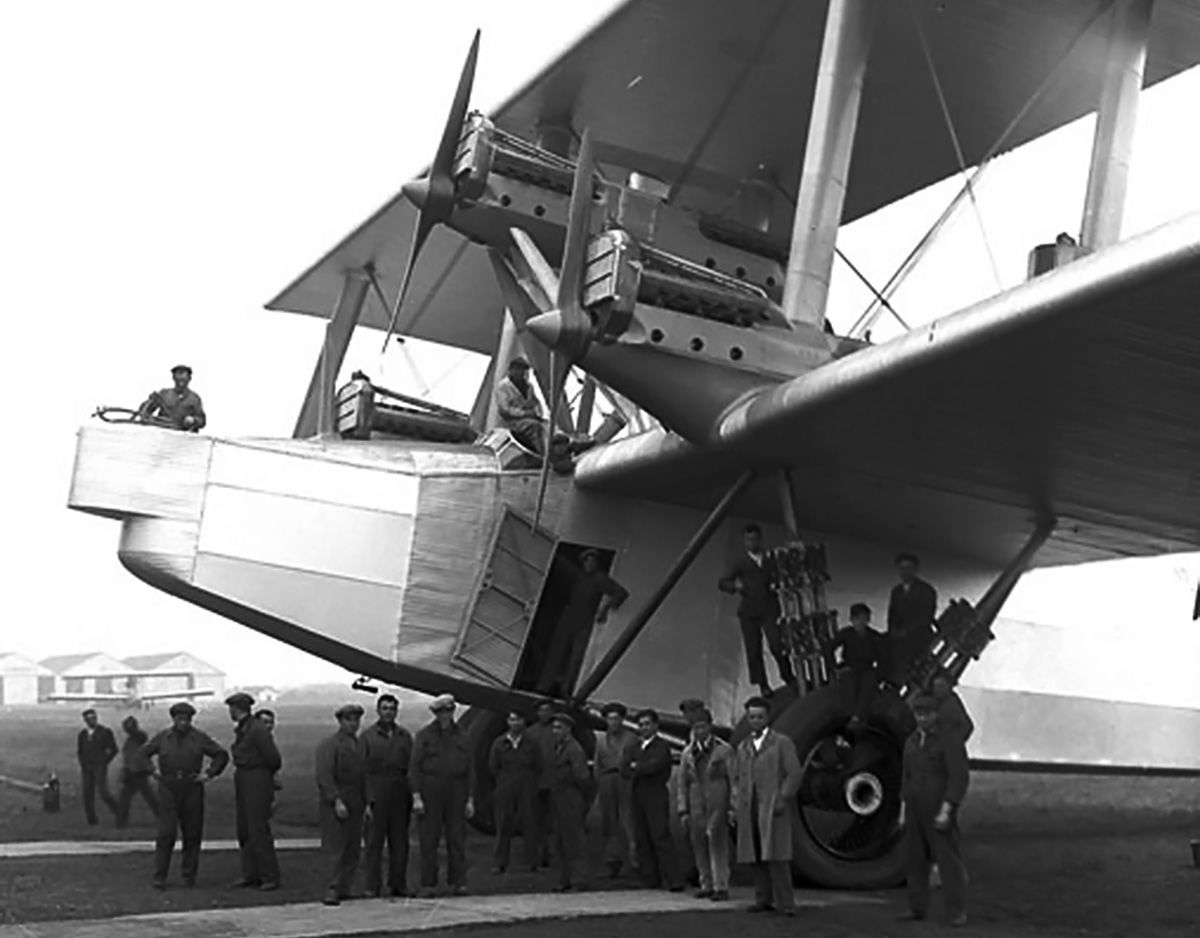
The biplane arrangement of the Ca.90 was an inverted sesquiplane with the span of the upper wing 38 ft 4 in (11.68 m) shorter than the lower wing. The lower wing was mounted to the top of the fuselage so that its center section was integral with the airframe. The upper wing was supported by struts and braced by wires about 18 ft 8 in (5.7 m) above the lower wing. The ailerons were on the lower wing only. All control surfaces were balanced, and the ailerons and rudder featured servo tabs to assist their movement. The design of the control surfaces and the cockpit layout enabled the aircraft be flown by just one pilot. The open, side-by-side cockpit was located just before the leading edge of the lower wing. Access to the fuselage interior was gained by a large door on either side of the aircraft below the cockpit.

Caproni Ca90 frame

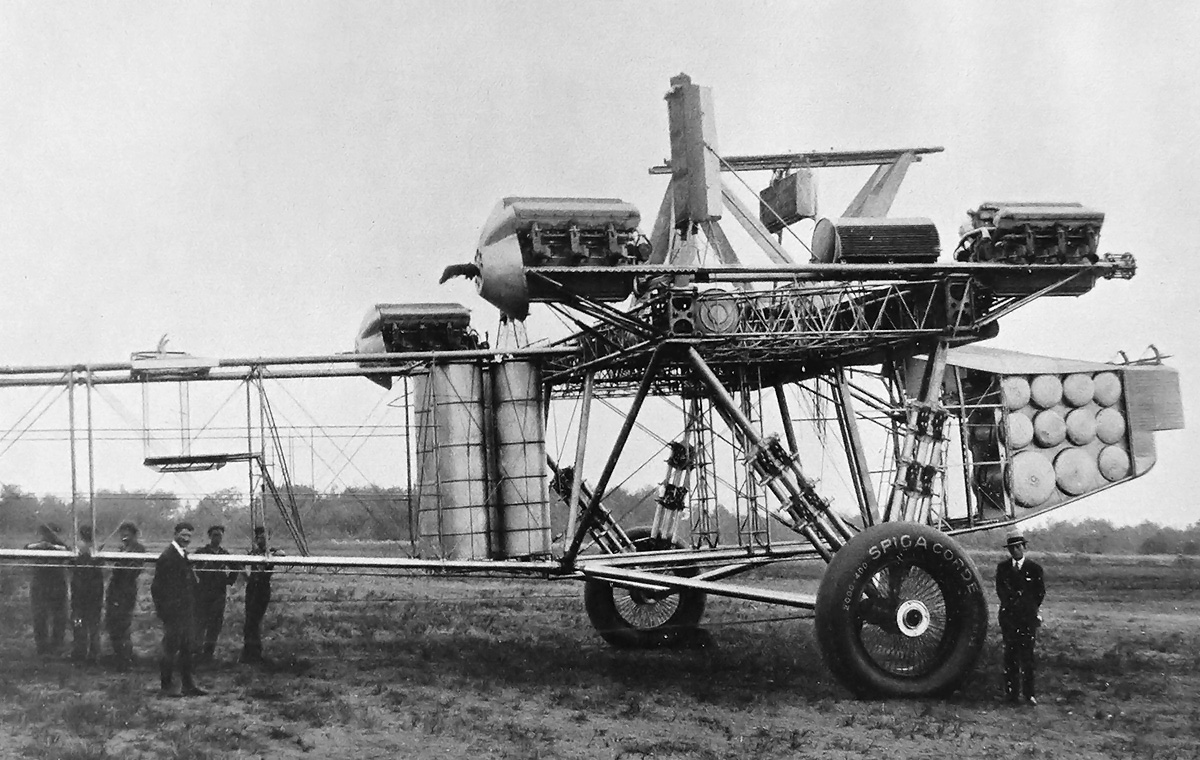
The partially finished airframe of the Ca.90. The cylindrical tanks are for fuel, with 11 in the nose, one visible in wing center section, and four vertically mounted between the rear engines. The open space in the middle of the fuselage is the bomb bay. An oil tank can be seen between the engines. The radiator for the rear engine is in place. Note the radiator under the struts for the center engines.

The Ca.90 was powered by six Isotta Fraschini Asso 1000 direct-drive engines. The Asso 1000 was a water-cooled W-18 engine that produced 1,000 hp (746 kW). The six engines were mounted in three push-pull pairs. A pair of engines was mounted on each wing just above the main landing gear. Another pair of engines was mounted on struts midway between the upper and lower wings. The front engines all had radiators mounted behind their propellers. The rear, wing-mounted engines had radiators attached to wing-support struts. The rear-facing center engine had its radiator positioned under the suspended engine gondola. All radiators had controllable shutters to regulate engine temperature. Engine oil tanks were positioned between each engine pair. The front engines turned two-blade propellers, and the rear engines turned four-blade propellers. All propellers had a fixed pitch and were made of wood.

The bomber was protected by seven gunner stations: one in the nose, one atop the upper wing, two in the upper fuselage, one on each side of the fuselage, and one in a ventral gondola that was lowered from the fuselage. However, it appears only the nose, upper wing, and upper fuselage stations were initially completed, with the side stations completed later. It is doubtful that machine guns were ever installed. The Ca.90 was designed to carry up to 17,637 lb (8,000 kg) of bombs in an internal bomb bay that was located behind the cockpit.

Caproni Ca90 close

Close-up view of the Ca.90’s nose illustrates the corrugated aluminum sheets covering the nose, fuselage under the cockpit, and top of the fuselage between the nose and cockpit. Note the large access door. The three holes under each engine are carburetor intakes.

The aircraft’s fuel was carried in 23 cylindrical tanks—11 tanks were positioned between the nose gunner station and the cockpit; eight tanks were located in the lower wing center-section just behind the cockpit; and four tanks were immediately aft of the bomb bay. The aircraft was supported by two sets of fixed double main wheels. The strut-mounted main gear was positioned below the wing-mounted engines. The main landing gear was given a wide track of about 16 ft 3 in (8 m) to enable operating from rough ground. The main wheels were 6 ft 7 in (2.0 m) in diameter and 16 in (.4 m) wide. The tailwheel was positioned below the rudder.

The Caproni Ca.90 had a lower wingspan of 152 ft 10 in (46.58 m) and an upper wingspan of 114 ft 6 in (34.90 m). The aircraft was 88 ft 5 in (26.94 m) long and stood 35 ft 5 in (10.80 m) tall. The Ca.90 had a top speed of 127 mph (205 km/h) and a landing speed of 56 mph (90 km/h). The aircraft had a ceiling of 14,764 ft (4,500 m) and a maximum range of 1,243 miles (2,000 km), or a range of approximately 870 miles (1,400 km) with a 17,637 lb (8,000 kg) bomb load. Empty, the Ca.90 weighed 33,069 lb (15,000 kg). Its useful load was 33,069–44,092 lb (15,000–20,000 kg) depending on which safety factor was used, giving the aircraft a maximum weight of 66,137–77,162 lb (30,000–35,000 kg).

Caproni Ca90 side paint

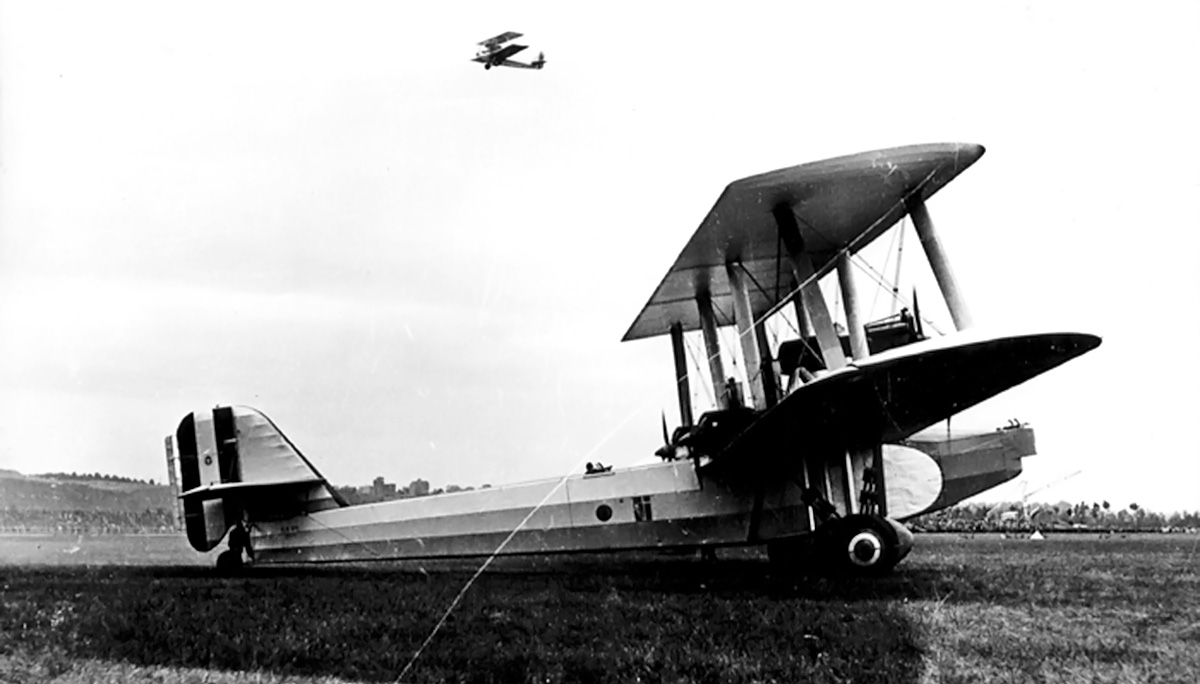
The Ca.90 in its final form with a (blue) painted nose, side gunner positions, and aerodynamic fairings for the main wheels. Note the dorsal gunner positions in the upper fuselage, and the new servo tab on the rudder. Another Caproni aircraft (Ca.79?) can be seen flying in the background.

The Ca.90 was first flown on 13 October 1929. Domenico Antonini was the pilot for that flight, and he conducted all test flying, which demonstrated that the massive aircraft had light controls and did not have any major issues. On 22 February 1930, Antonini took off in the Ca.90 with a 22,046 lb (10,000 kg) payload and set six world records:
1) 2) Altitude with 7,500 and 10,000 kg (16,535 and 22,046 lb) of unusable load at 3,231 m (10,600 ft);
3) 4) 5) Duration with 5,000; 7,500; and 10,000 kg (11,023; 16,535; and 22,046 lb) of unusable load at 1 hour and 31 minutes;
6) Maximum unusable load at 2,000 m (6,562 ft) of altitude at 10,000 kg (22,046 lb).

The aircraft was passed to the 62ª Squadriglia Sperimentale Bombardamento Pesante (62nd Heavy Bombardment Experimental Squadron) for further testing. Around this time, the aircraft was repainted, side (waist) gunner positions were completed, and aerodynamic fairings were added to the main wheels.

Italo Balbo, head of the Ministero dell’Aeronautica (Italian Air Ministry), was not a supporter of large-scale bombing using heavy bombers and did not pursue the Ca.90. Caproni had proposed that the aircraft could be reconfigured to cover long-distance international routes as a transport with up to 100 seats or as a mail plane, but no conversion took place. An attempt to market the Ca.90 in the United States was made under a joint venture with the Curtiss Airplane and Motor Company, but the Great Depression had curtailed military spending, and there was little interest in the aircraft. A flying boat version was designed and designated Ca.91, but this aircraft was never built. Only one Ca.90 prototype was built, and it remains the largest biplane ever flown.

Caproni Ca90 takeoff

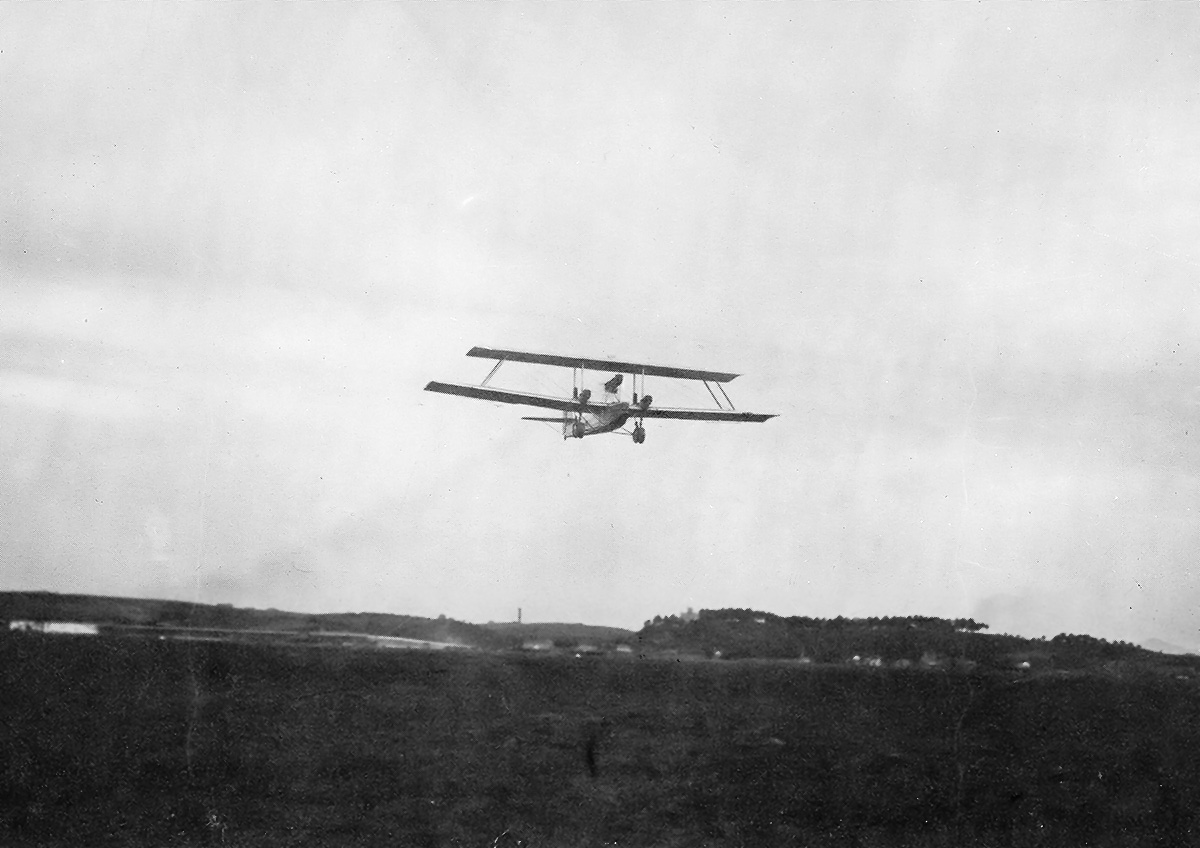
A rare image of the Ca.90 airborne shortly after takeoff. A slight trail of dark smoke is visible from the engines, perhaps from a rich mixture.

Sources:
The Caproni “90 P.B.” Military Airplane, NACA Aircraft Circular No. 121 (July 1930)
Gli Aeroplani Caproni by Gianni Caproni (1937)
– Jane’s All the World’s Aircraft 1931 by C. G. Grey (1931)
Italian Civil and Military Aircraft 1930-1945 by Jonathan W. Thompson (1963)
Aeroplani Caproni by Rosario Abate, Gregory Alegi, and Giorgio Apostolo (1992)
– “The Caproni 90 PB” Flight (9 January 1931)
https://it.wikipedia.org/wiki/Caproni_Ca.90

Isotta Fraschini Asso 750 front

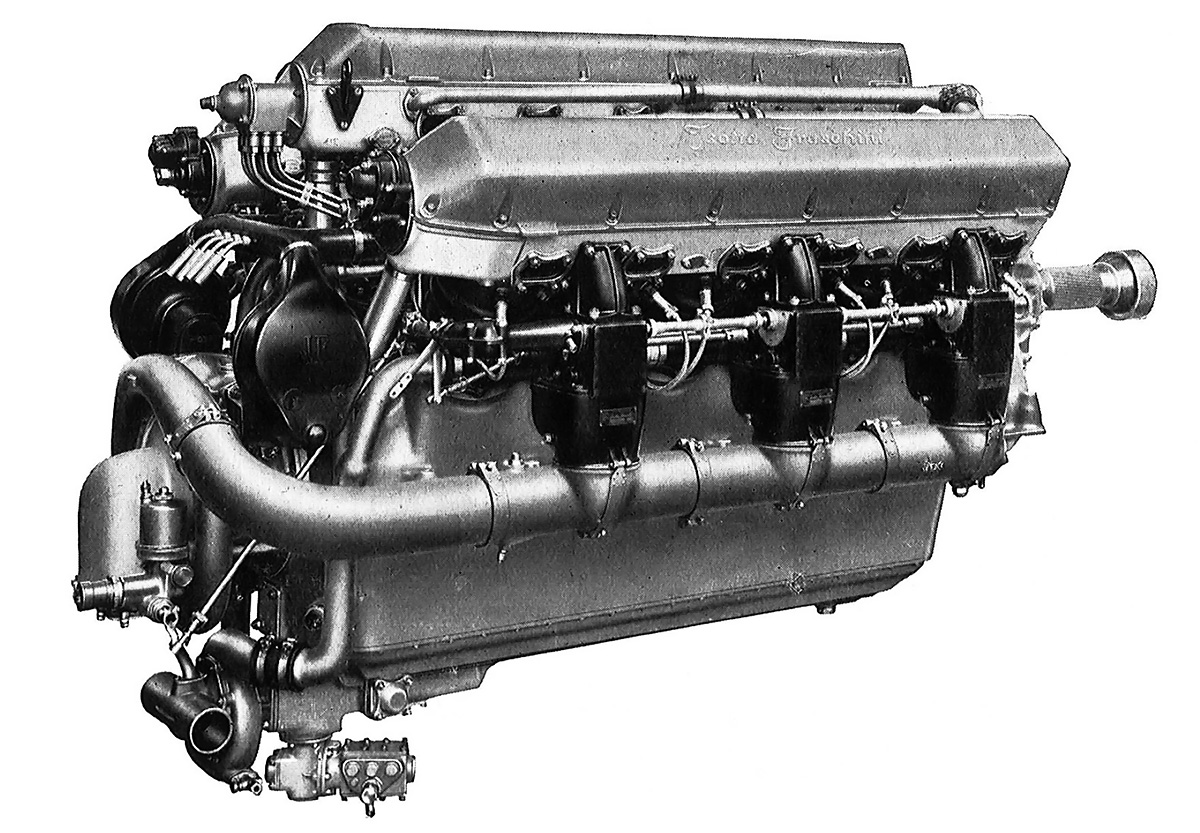
Isotta Fraschini W-18 Aircraft and Marine Engines

By William Pearce

In late 1924, the Italian firm Isotta Fraschini responded to a Ministero dell’Aeronautica (Italian Air Ministry) request for a 500 hp (373 kW) aircraft engine by designing the liquid-cooled, V-12 Asso 500. Designed by Giustino Cattaneo, the Asso 500 proved successful and was used by Cattaneo as the basis for a line of Asso (Ace) engines developed in 1927. Ranging from a 250 hp (186 kW) inline-six to a 750 hp (559 kW) W-18, the initial Asso engines shared common designs and common parts wherever possible.

Isotta Fraschini Asso 750 front

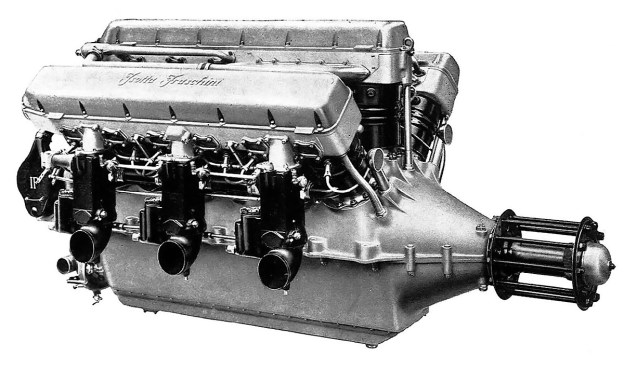
The direct drive Isotta Fraschini Asso 750 was the first in a series of 18-cylinder engines that would ultimately be switched to marine use and stay in some form of production for over 90 years.

The Isotta Fraschini Asso 750 W-18 engine consisted of three six-cylinder banks mounted to a two-piece crankcase. The center cylinder bank was in the vertical position, and the two other cylinder banks were spaced at 40 degrees from the center bank. The cylinder bank spacing reduced the 18-cylinder engine’s frontal area to just slightly more than a V-12.

The Asso 750’s crankcase was split horizontally at the crankshaft and was cast from Elektron, a magnesium alloy. A shallow pan covered the bottom of the crankcase. The six-throw crankshaft was supported by eight main bearings. On each crankshaft throw was a master rod that serviced the center cylinder bank. Articulating rods for the other two cylinder banks were mounted on each side of the master rod. A double row ball bearing acted as a thrust bearing on the propeller shaft and enabled the engine to be installed as either a pusher or tractor.

The individual cylinders were forged from carbon steel and had a steel water jacket that was welded on. The cylinders had a closed top with openings for the valves. The monobloc cylinder head was mounted to the top of the cylinders, with one cylinder head serving each bank of cylinders. The cylinder compression ratio was 5.7 to 1. The cylinder head was made from cast aluminum and held the two intake and two exhaust valves for each cylinder. The valves were actuated by dual overhead camshafts, with one camshaft controlling the intake valves and the other camshaft controlling the exhaust valves (except for the center bank). A single lobe on the camshaft acted on a rocker and opened the two corresponding valves for that cylinder. The camshafts for each cylinder bank were driven at the rear of the cylinder head. One camshaft of the cylinder bank was driven via beveled gears by a vertical drive shaft, and the second camshaft was geared to the other driven camshaft. The valve cover casting was made from Elektron.

Isotta Fraschini Asso 750 RC35 crankcase

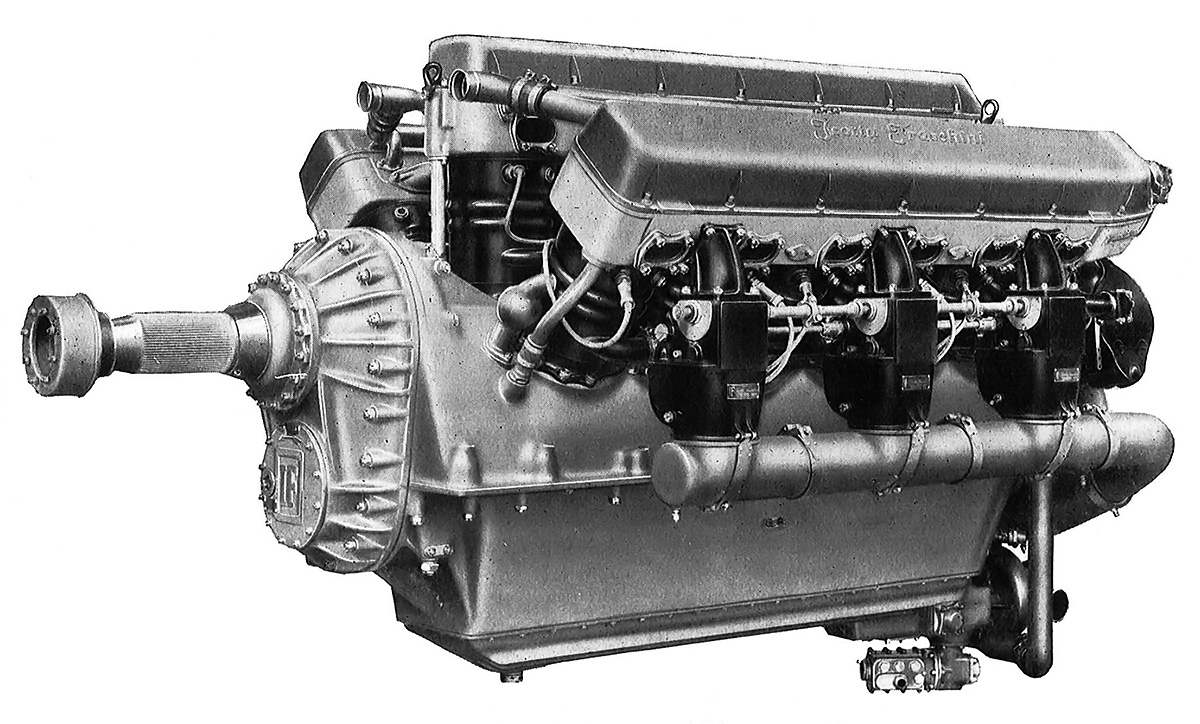
The cylinder row, upper crankcase, and cylinder head (inverted) of an Asso 750 RC35 with gear reduction. The direct drive Asso 750 was similar except for the shape of the front (right side) of the crankcase. Note the closed top cylinders. The small holes between the studs in the cylinder top were water passageways that communicated with ports on the cylinder head.

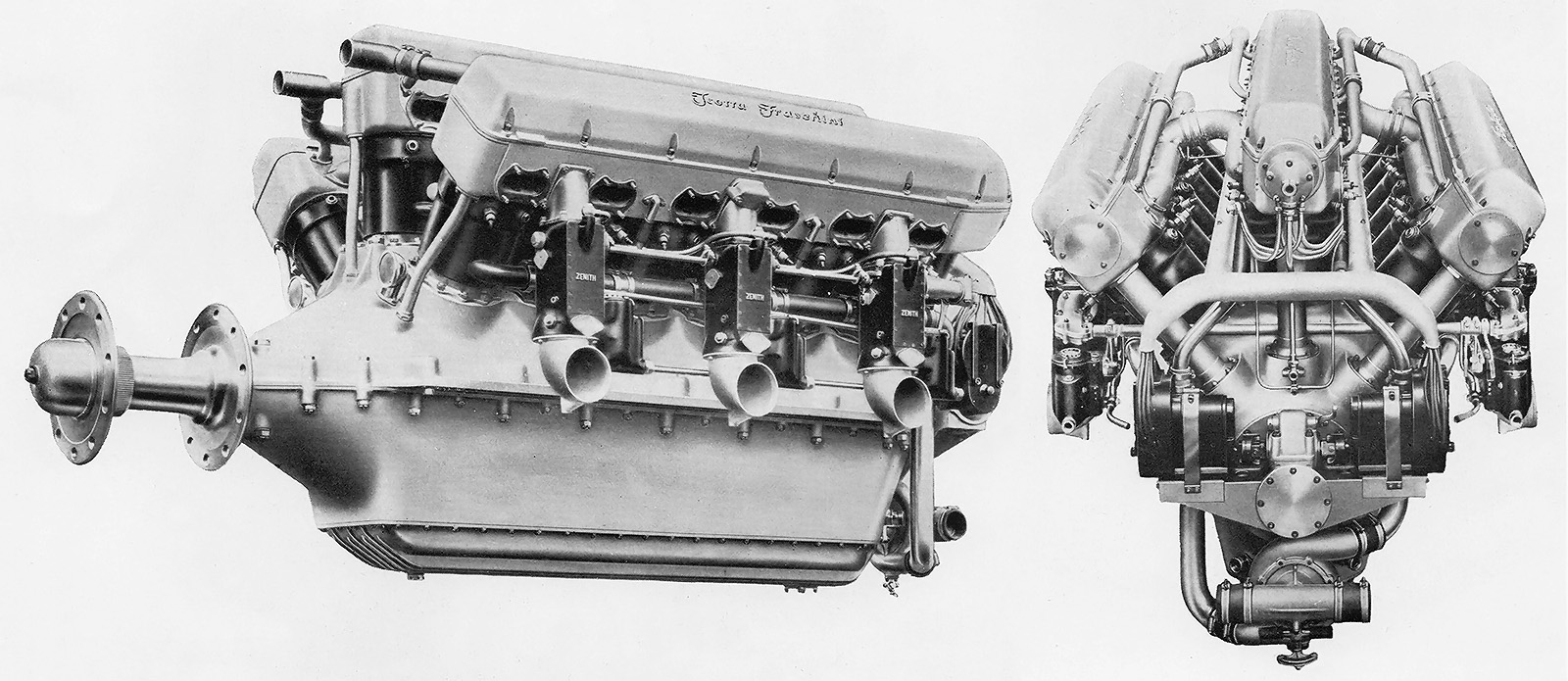
Three carburetors were mounted to the outer side of each outer cylinder bank. The intake and exhaust ports of the outer cylinder banks were on the same side. The intake and exhaust ports of the center cylinder bank were rather unusual. When viewed from the rear, the exhaust ports for the rear three cylinders of the center bank were on the right, and the intake ports were on the left. The front three cylinders were the opposite, with their exhaust ports on the left and their intake ports on the right. This configuration gave the cylinders for the center bank crossflow heads, but it also meant that each camshaft controlled half of the intake valves and half of the exhaust valves. A manifold attached to the inner side of the left cylinder bank collected the air/fuel mixture that had flowed through passageways in the left cylinder head and delivered the charge to the rear three cylinders of the center bank. The right cylinder bank had the same provisions but delivered the mixture to the front three cylinders of the center bank. Presumably, the 40-degree cylinder bank angle did not allow enough room to accommodate carburetors for the middle cylinder bank.

The two spark plugs in each cylinder were fired by two magnetos positioned at the rear of the engine and driven by the camshaft drive. From the rear of the engine, the firing order was 1 Left, 6 Center, 1 Right, 5L, 2C, 5R, 3L, 4C, 3R, 6L, 1C, 6R, 2L, 5C, 2R, 4L, 3C, and 4R. A water pump positioned below the magnetos circulated water into a manifold along the base of each cylinder bank. The manifold distributed water into the water jacket for each individual cylinder. The water flowed up through the water jacket and into the cylinder head. Another manifold took the water from each cylinder head to the radiator for cooling. Starting the Asso 750 was achieved with an air starter.

Motore Isotta Fraschini Asso 750

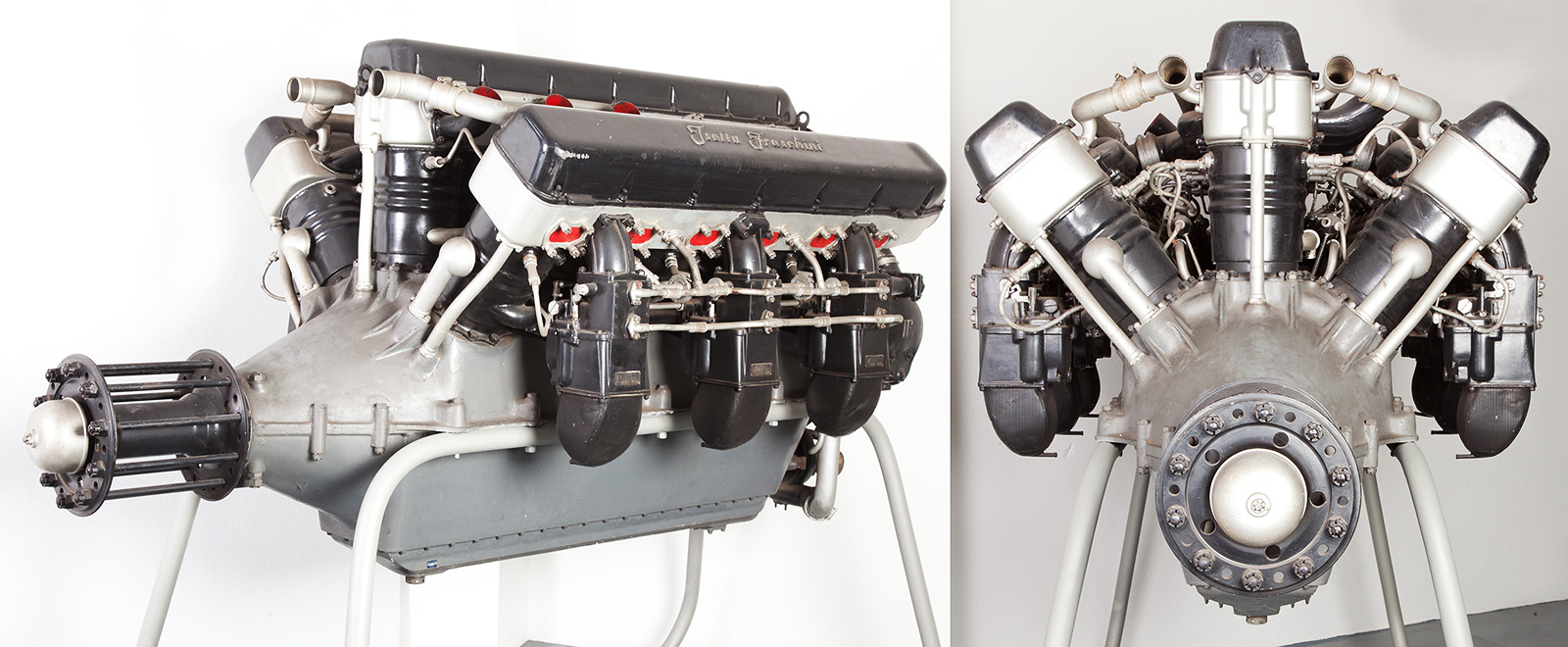
Two views of the direct drive Asso 750 displayed at the Museo nazionale della scienza e della tecnologia Leonardo da Vinci in Milan. Note the three exhaust stacks visible on the center cylinder bank. The front image of the engine illustrates the lack of space between the cylinder banks, which were set at 40 degrees. (Alessandro Nassiri images via Wikimedia Commons)

The Isotta Fraschini Asso 750 had a bore of 5.51 in (140 mm), a stroke of 6.69 in (170 mm), and a total displacement of 2,875 cu in (47.1 L). The original, direct drive Asso 750 produced 750 hp (599 kW) at 1,600 rpm, and weighed 1,279 lb (580 kg). An improved version of the Asso 750 was soon built that produced 830 hp (619 kW) at 1,700 rpm and 900 hp (671 kW) at 1,900 rpm. This engine weighed 1,389 lb (630 kg). The direct drive Asso 750 was 81 in (2.06 m) long, 40 in (1.02 m) wide, and 42 in (1.07 m) tall.

A version of the Asso 750 with a spur gear reduction for the propeller was developed and was sometimes referred to as the Asso 850 R. Available gear reductions were .667 and .581, and the gear reduction resulted in the crankshaft having only seven main bearings. The Asso 850 R produced 850 hp (634 kW) at 1,950 rpm, and weighed 1,455 lb (660 kg). This engine was also further refined and given the more permanent designation of Asso 750 R. The 750 R had a .658 gear reduction. The engine produced 850 hp (634 kW) at 1,800 rpm and 930 hp (694 kW) at 1,900 rpm. The Asso 750 R was 83 in (2.12 m) long and weighed 1,603 lb (727 kg).

Isotta Fraschini Asso 750 rc35 front

Front view of the Asso 750 RC35. The gear reduction required new upper and lower crankcase halves and a new crankshaft, but the other components were interchangeable with the direct drive engine.

Around 1933 the Asso 750 R engine was updated to incorporate a supercharger. The new engine was designated Asso 750 RC35. The “R” in the engine’s designation meant that it had gear reduction (Riduttore de giri); the “C” meant that it was supercharged (Compressore); and the “35” stood for the engine’s critical altitude in hectometers (as in 3,500 meters). The engine’s water pump was moved to a new mount that extended below the oil pan. The supercharger was mounted between the water pump and the magnetos, which were moved to a slightly higher location. The supercharger was meant to maintain sea level power up to a higher altitude, and it provided .29 psi (.02 bar) of boost up to 11,483 ft (3,500 m). The Asso 750 RC35 produced 870 hp (649 kW) at 1,850 rpm at 11,483 ft (3,500 m). The engine was 87 in (2.20 m) long, 41 in (1.03 m) wide, 48 in (1.21 m) tall, and weighed 1,724 lb (782 kg).

In 1928, Isotta Fraschini designed a larger, more powerful engine that had both its bore and stroke increased by .39 in (10 mm) over that of the Asso 750. The larger engine was developed especially for the Macchi M.67 Schneider Trophy racer. The M.67’s engine was initially designated Asso 750 M (for Macchi) but was also commonly referred to as the Asso 2-800. The “2” designation was most likely applied because the engine was a “second generation” and differed greatly from the original Asso 750 design.

Isotta Fraschini Asso 750 rc35 rear

The single-speed supercharger on the Asso 750 RC35 is illustrated in this rear view. Note the relocated and new mounting point for the water pump. The supercharger forced-fed air to the engine’s six carburetors.

The Asso 2-800 had a bore of 5.91 in (150 mm), a stroke of 7.09 in (180 mm), and a total displacement of 3,434 cu in (57.3 L). The engine used new crossflow cylinder heads and a new crankcase. The cylinder heads had intake ports on one side and exhaust ports on the other. Air intakes for the engine were positioned behind the M.67’s spinner, with one intake on the left side for the left cylinder bank and two intakes on the right side for the center and right cylinder banks. Ducts delivered the air to special carburetors positioned between the cylinder banks. The modified engine also had a higher compression ratio and used special fuels. Under perfect conditions, the special Asso 2-800 engine produced up to 1,800 hp (1,342 kW), but it was rarely able to achieve that output. An output of 1,400 hp (1,044 kW) was more typical and still impressive. At speed, the Asso 2-800 in the M.67 reportedly made a roar like no other engine.

Isotta Fraschini made a commercial version of the larger engine, designated Asso 1000. With the same bore, stroke, and displacement as the Asso 2-800, the Asso 1000 is often cited as the engine powering the M.67. However, the Asso 1000 retained the same configuration and architecture as the Asso 750, except the Asso 1000 had a compression ratio of 5.3 to 1. Development of the Asso 1000 trailed slightly behind that of the Asso 750.

The direct drive Isotta Fraschini Asso 1000 produced 1,000 hp (746 kW) at 1,600 rpm and 1,100 hp (820 kW) at 1,800 rpm. The engine was 86 in (2.19 m) long, 42 in (1.06 m) wide, and 44 in (1.12 m) tall. The Asso 1000 weighed 1,764 lb (800 kg). Like with the original Asso 750, a gear reduction version was designed. This engine was sometimes designated as the Asso 1200 R. The gear reduction speeds available were .667 and .581. The Asso 1200 R produced 1,200 hp (895 kW) at 1,950 rpm and weighed 2,116 lb (960 kg).

Isotta Fraschini Asso 1000

The Isotta Fraschini Asso 1000 was very similar to the Asso 750. Note the intake manifolds between the cylinder banks, each taking the air/fuel mixture from one of the outer banks and feeding half of the center bank.

The Asso 750 and Asso 1000 engines were used in a variety of aircraft, but most of the aircraft were either prototypes or had a low production count. For the Asso 750, its most famous applications were the single engine Caproni Ca.111 reconnaissance aircraft (over 150 built) and the twin engine Savoia-Marchetti S.55 double-hulled flying boat. Over 200 S.55s were built, but only the S.55X variant was powered by the Asso 750. Twenty-five S.55X aircraft were built, and in 1933, 24 S.55X aircraft made a historic formation flight from Orbetello, Italy to Chicago, Illinois. The Asso 750 powered many aircraft to numerous payload and distance records. Six direct-drive Asso 1000 engines were used to power the Caproni Ca.90 bomber, which was the world’s largest landplane when it first flew in October 1929. The Ca.90 set six payload records on 22 February 1930.

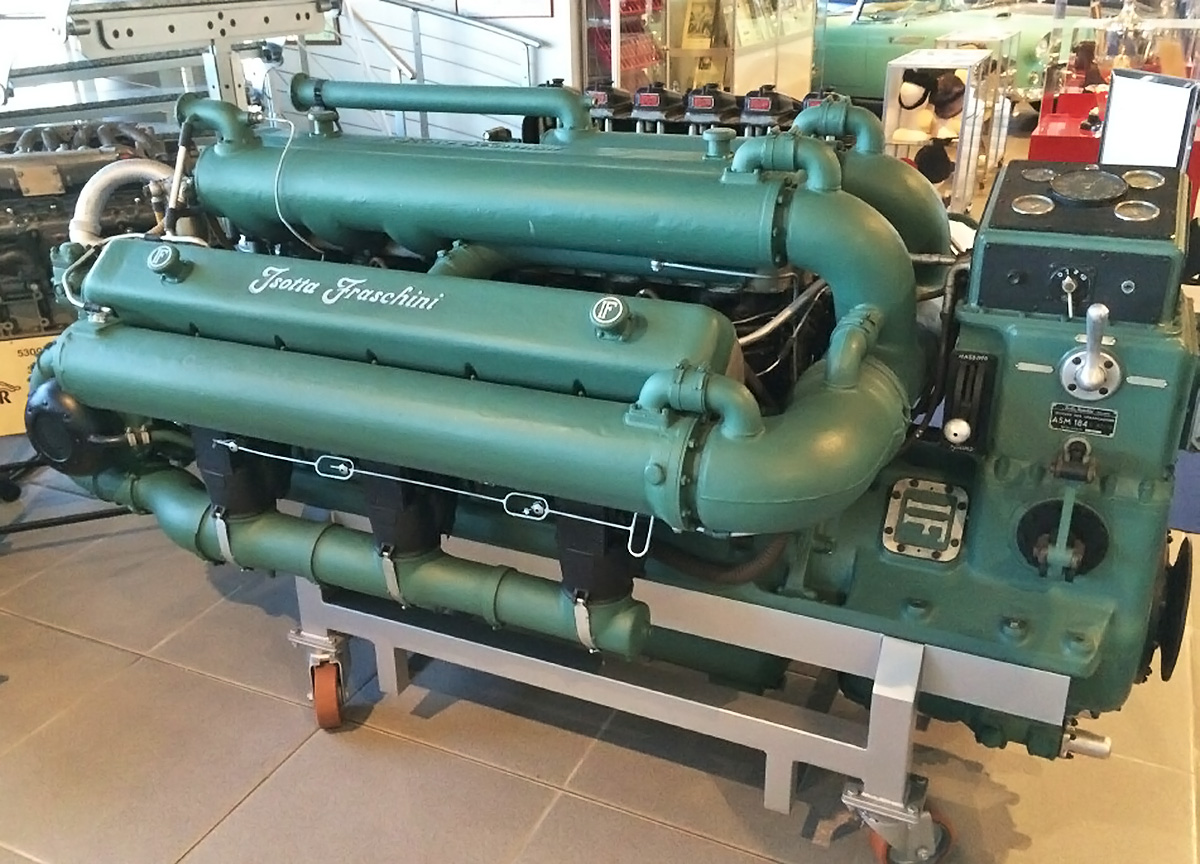
Although not a complete success in aircraft, the Asso 1000 found its way into marine use as the Isotta Fraschini ASM 180, 181, 183 and 184 engines. ASM was originally written as “As M” and stood for Asso Marini (Ace Marine). The marine engines had water-cooled exhaust pipes and a reversing gearbox coupled to the propeller shaft. The Isotta Fraschini marine engines were used in torpedo boats before, during, and after World War II by Italy, Finland, Sweden, and Britain. Some of the engines and boats remained in service into the mid-1960s.

Isotta Fraschini ASM 184

The Isotta Fraschini ASM 184 engine with its large, water-cooled exhaust manifolds and drive gearbox. Note that the center bank only has its rear (left) cylinders feeding into the visible exhaust manifold. One of the two centrifugal superchargers can be seen at the rear of the engine. The engine is on display at the Museo Nicolis in Villafranca di Verona. (Stefano Pasini image)

The ASM 180 and 181 were developed around 1933, and produced 900 hp (671 kW) at 1,800 rpm. Refinement of the ASM 181 led to the ASM 183, which produced 1,150 hp (858 kW) at 2,000 rpm. Development of the ASM 184 started around 1940; it was a version of the ASM 183 that featured twin centrifugal superchargers mounted to the rear of the engine. The ASM 184 engine produced 1,500 hp (1,119 kW) at 2,000 rpm. Around 1950, production of the ASM 184 was continued by Costruzione Revisione Motori (CRM) as the CRM 184. In the mid-1950s, the engine was modified with fuel injection into the supercharger compressors and became the CRM 185. The CRM 185 produced 1,800 hp (1,342 kW) at 2,200 rpm.

CRM continued development of the W-18 platform and created a diesel version of the engine. Designated 18 D, the engine retained the same bore, stroke, and basic configuration as the Asso 1000 and earlier ASM engines. However, the 18 D was made of cast iron, had revised cylinder heads, and had a compression ratio of 14 to 1. The revised cylinder head was much taller and incorporated extra space between the valve springs and the valve heads. The valve stems were elongated, and a pre-combustion chamber was positioned between the valve stems and occupied the extra space in the head. Some versions of the engine have a fuel injection pump consisting of three six-cylinder distributors driven from the rear of the engine, while other versions have a common rail fuel system.

CRM 18 D engines

Four CRM 18 D engines, which can trace their heritage back to the Asso 1000. The three engines on the left use mechanical fuel injection with three distribution pumps. The engine on the right has a common fuel rail. Note the three turbochargers at the front of each engine. (CRM Motori image)

The exhaust gases for each bank were collected and fed through a turbocharger at the front of the engine (some models had just two turbochargers). Pressurized air from the turbochargers passed through an aftercooler and was then fed into two induction manifolds. Each of the manifolds had three outlets. The front and rear outlets were connected to the outer cylinder bank, and the middle outlet was connected to the center bank. For the center bank, induction air for the rear three cylinders was provided by the left manifold, and the front three cylinder received their air from the right manifold.

Various versions of the 18 D were designed, the most powerful being the 18 D BR3-B. The BR3-B had a maximum output of 2,367 hp (1,765 kW) at 2,300 rpm and a continuous output of 2,052 hp (1,530 kW) at 2,180 rpm. The engine had a specific fuel consumption of .365 lb/hp/hr (222 g/kW/h). The BR3-B was 96 in (2.45 m) long, 54 in (1.37 m) wide, 57 in (1.44 m) tall, and weighed 4,740 lb (2,150 kg) without the drive gearbox. CRM, now known as CRM Motori Marini, continues to market 18 D engines.

Isotta Fraschini Asso L180

Other than having a W-18 layout, the Isotta Fraschini L.180 did not share much in common with the Asso 750 or 1000. However, the two-outlet supercharger suggests a similar induction system to the earlier engines. Note the gear reduction’s hollow propeller shaft and the mounts for a cannon atop the engine.

In the late 1930s, Isotta Fraschini revived the W-18 layout with an entirely new aircraft engine known as the Asso L.180 (or military designation L.180 IRCC45). The Asso L.180 was an inverted W-18 (sometimes referred to as an M-18) that featured supercharging and a propeller gear reduction. The engine’s layout and construction were similar to that of the earlier W-18 engines. One source states the cylinder banks were spaced at 45 degrees. With nine power pulses for each crankshaft revolution, this is off from the ideal of having cylinders fire at 40-degree intervals (like the earlier W-18 engines) and may be a misprint. The crankshaft was supported by seven main bearings in a one-piece aluminum crankcase. The spur gear reduction turned at .66 crankshaft speed and had a hollow propeller shaft to allow an engine-mounted cannon to fire through the propeller hub. The single-speed supercharger turned at 10 times crankshaft speed.

The Isotta Fraschini L.180 had a 5.75 in (146 mm) bore and a 6.30 in (160 mm) stroke. The engine displaced 2,942 cu in (48.2 L) and had a compression ratio of 6.4 to 1. The L.180 had a takeoff rating of 1,500 hp (1,119 kW) at 2,360 rpm, a maximum output of 1,690 hp (1,260 kW) at 2,475 rpm at 14,764 ft (4,500 m), and a cruising output of 1,000 hp (746 kW) at 1,900 rpm at 14,764 ft (4,500 m). It is doubtful that the L.180 proceeded much beyond the mockup phase.

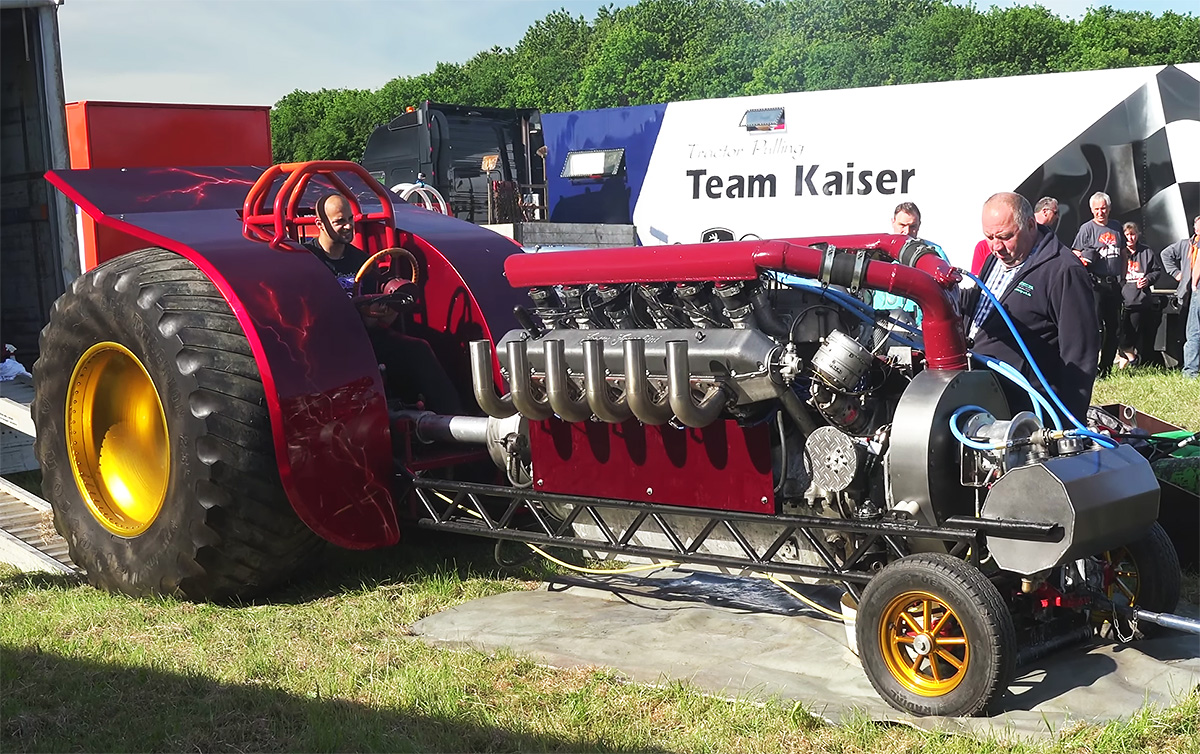
A number of Isotta Fraschini aircraft and marine engines are preserved in various museums and private collections. Some marine engines are still in operation, and the German tractor pulling group Team Twister uses a modified Isotta Fraschini W-18 engine in its Dabelju tractor.

Dabelju IF W-18 57L

The modified Isotta Fraschini W-18 in Team Twister’s Dabelju. The engine’s heads have been modified to have individual intake and exhaust ports. These crossflow heads are similar in concept to the heads used on the Macchi M.67’s engine. (screenshot of Johannes Meuleners Youtube video)

Sources:
Isotta Fraschini Aviation (undated catalog, circa 1930)
Isotta Fraschini Aviation (1929)
Isotta Fraschini Aviazione (undated catalog, circa 1931)
Istruzioni per l’uso del motore Isotta-Fraschini Tipo Asso 750 (1931)
Istruzioni per l’uso del motore Isotta-Fraschini Tipo Asso 750 R (1934)
Istruzioni per l’uso del motore Isotta-Fraschini Tipo Asso 750 RC 35 (1936)
Istruzioni per l’uso del motore Isotta-Fraschini Tipo Asso 1000 (1929)
Aeronuatica Militare Museo Storico Catalogo Motori by Oscar Marchi (1980)
Aircraft Engines of the World 1941 by Paul H. Wilkinson (1941)
Jane’s All the World’s Aircraft 1931 by C. G. Grey (1931)
https://www.t38.se/marinens-motortyper-i-mtb/
http://www.crmmotori.it/interna.asp?tema=16

LWF H Owl nose 1923

LWF Model H Owl Mail Plane / Bomber

By William Pearce

In 1915, the Lowe, Willard & Fowler Engineering Company was formed in College Point, Long Island, New Work. Of the founders, Edward Lowe, provided the financing; Charles Willard was the engineer and designer; and Robert Fowler served as the shop foreman, head pilot, and salesman. Willard was previously employed by the Curtiss Aeroplane and Motor Company and had developed a technique for molding laminated wood to form a monocoque fuselage. Willard was eventually granted U.S. patent 1,394,459 for his fuselage construction process. Previously in 1912, Fowler became the first person to fly west-to-east across the United States.

LWF H Owl nose

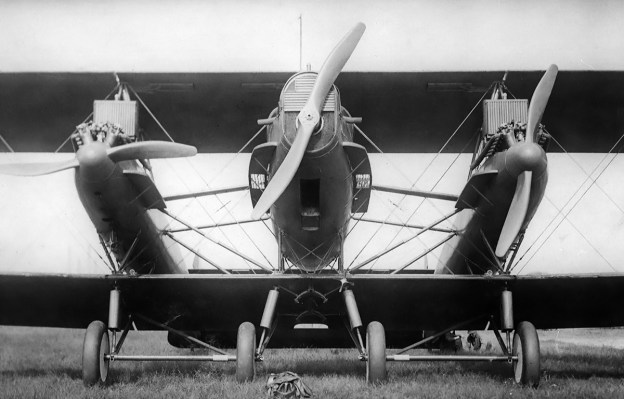
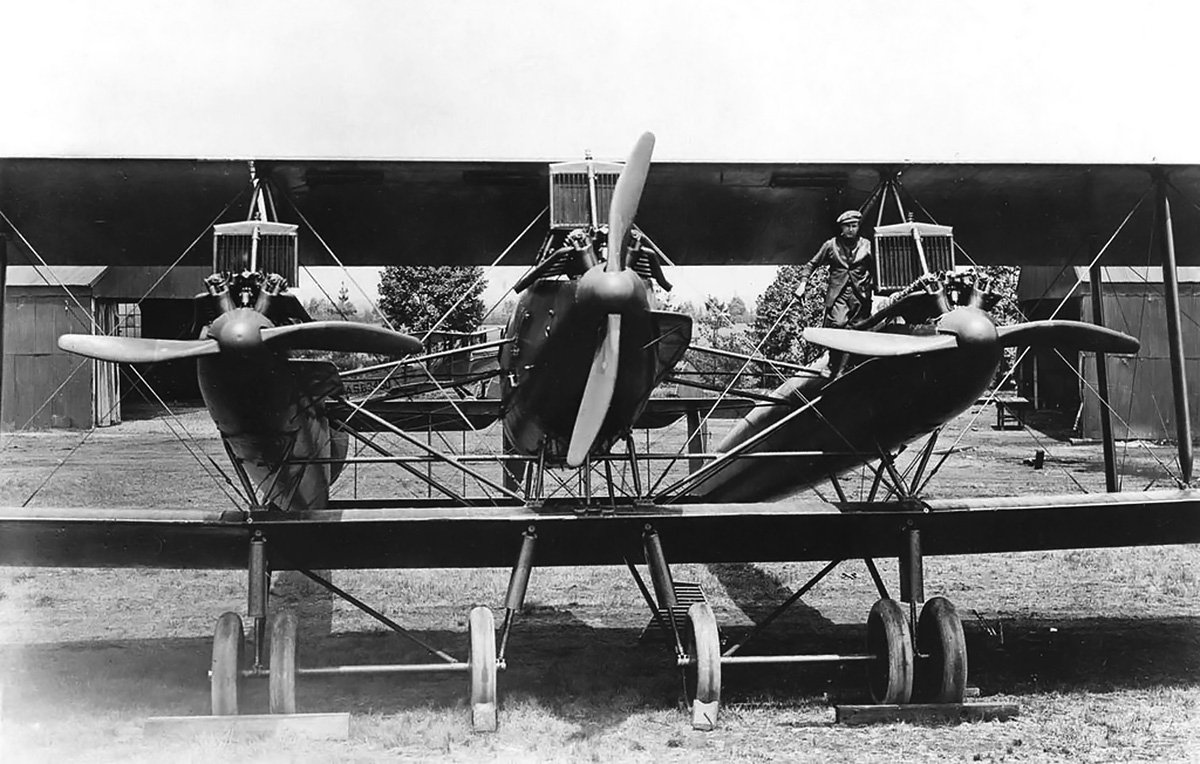
The LWF Model H Owl in its original configuration with six main wheels. The engine on the central nacelle has a spinner, a single service platform, and a separate radiator. Note the numerous drag inducing struts and braces for the wings, nacelle, and booms.

The business partnership was short-lived. In 1916, Fowler and Willard left the company, and Lowe assumed control, renaming the company LWF Engineering. By this time, LWF had become well-known for its molded wood construction process. However, management changed again as other financiers forced Lowe out. In 1917, the firm was reorganized as the LWF Engineering Company, with “Laminated Wood Fuselage” taking over the LWF initials.

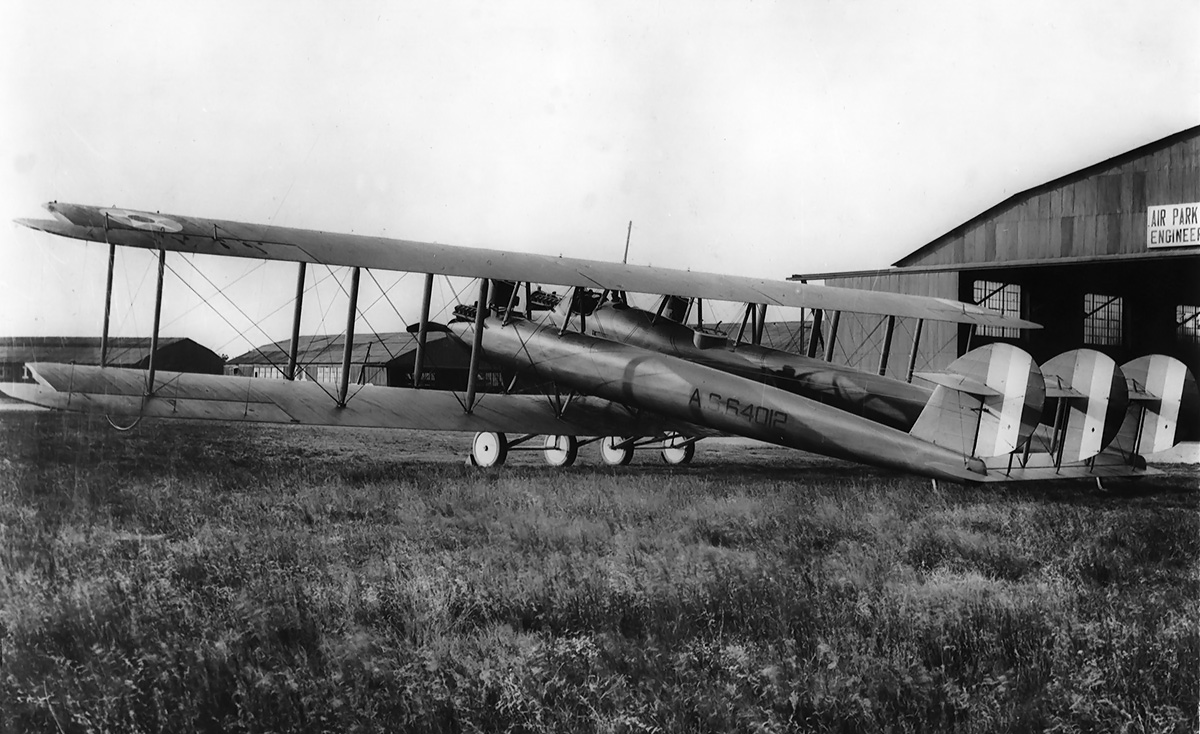
By 1919, LWF began design work on a large trimotor aircraft intended for overnight mail service between New York City and Chicago, Illinois. Other uses for the aircraft were as a transport or bomber. Designated the Model H (some sources say H-1), construction began before an interested party came forward to finance the project. Because of its intended use for overnight mail service, the aircraft was given the nickname “Owl.” As construction continued, the United States Post Office Department declined to support the Model H. However, LWF was able to interest the United States Army Air Service, which purchased the aircraft on 16 April 1920. The Model H was assigned the serial number A.S.64012.
LWF H Owl rear

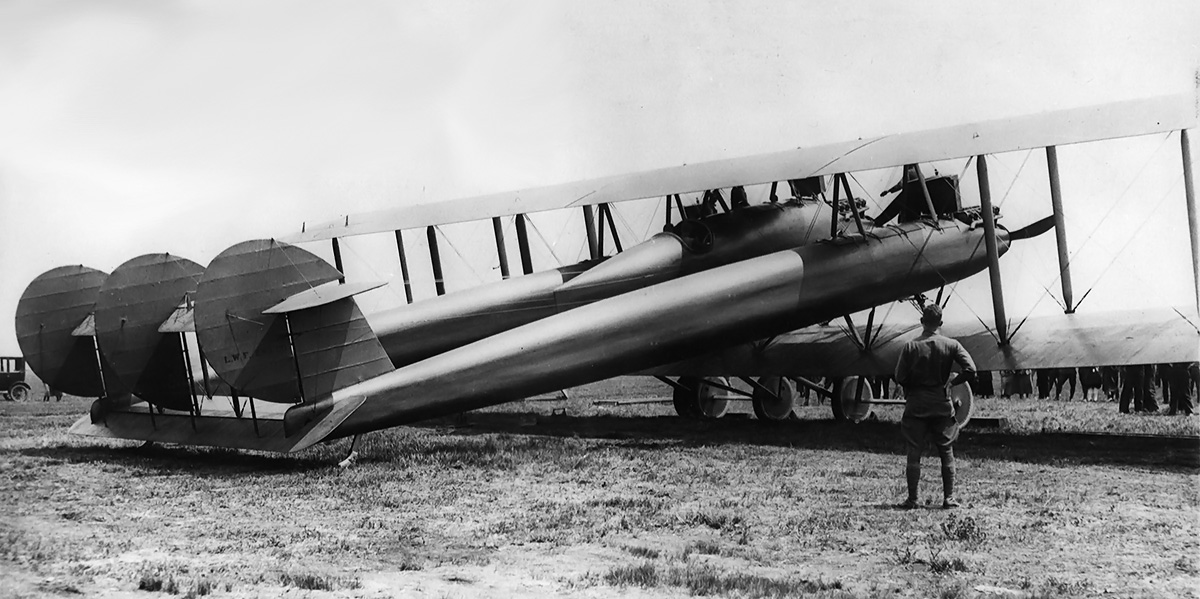
In the original configuration, the Owl’s cockpit was just behind the trailing edge of the wing, and visibility was rather poor. Note the aircraft’s two horizontal stabilizers and three rudders. The smooth surface finish of the booms is well illustrated.

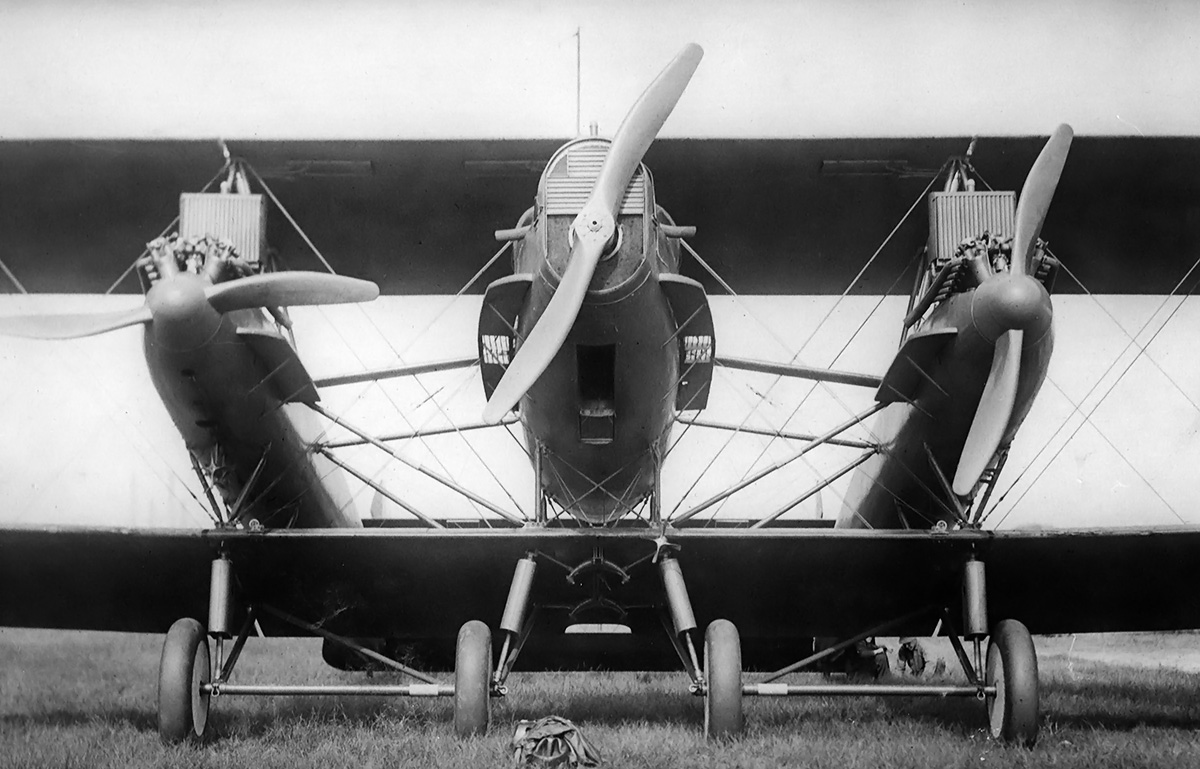
The LWF Model H Owl was designed by Raoul Hoffman and Joseph Cato. Although the Owl’s design bore some resemblance to contemporary large aircraft from Caproni, there is nothing that suggests the similarities were anything more than superficial. The Model H had a central nacelle pod that was 27 ft (8.23 m) long and contained a 400 hp (298 kW) Liberty V-12 positioned in the nose of the pod. The cockpit was positioned in the rear half of the pod, just behind the wing’s trailing edge. The cockpit’s location did not result in very good forward visibility. Accommodations were provided for two pilots, a radio operator, and a mechanic. Mounted 10 ft (3.05 m) to the left and right of the central pod were booms measuring approximately 51 ft (15.54 m) long. The booms were staggered 24 in (.61 m) behind and 16 in (.41 m) below the central pod and extended back to support the tail of the aircraft. At the front of each boom was a 400 hp (298 kW) Liberty V-12 engine. Each boom housed fuel tanks and small compartments for cargo. The main load was carried in the central nacelle.
The monocoque central nacelle and booms were made using LWF’s laminated wood process. The construction method consisted of a mold covered with muslin cloth. Strips of thin spruce were then laid down and spiral wrapped with tape. Another layer of spruce was laid in the opposite direction and spiral wrapped with tape. The final, outer layer of spruce was laid straight. The assembly was then soaked in hot glue and covered with fabric and doped. The resulting structure was about .25 in (6.4 mm) thick, was very strong, and had a smooth exterior. Where reinforcement was needed, formers were attached to the inside of the structure.

LWF H Owl in flight

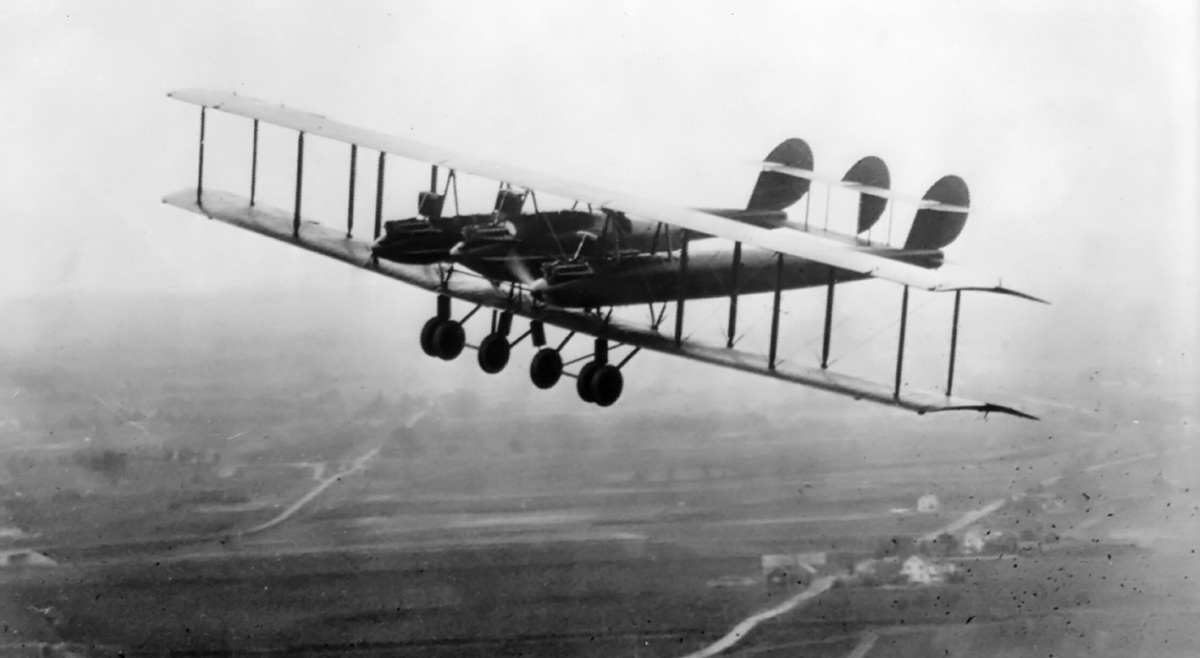
The Owl was a somewhat sluggish flier and reportedly underpowered. However, its flight characteristics were manageable. It was the largest aircraft in the United States at the time.

The nacelle and booms were mounted on struts and suspended in the 11 ft (3.35 m) gap between the Model H’s biplane wings. The wings were made of a birch and spruce frame that was then covered in fabric, except for the leading edge, which was covered with plywood. The upper and lower wing were the same length and were installed with no stagger. The wings were braced by numerous struts and wires. Large ailerons were positioned at the trailing edge of each wing. The wings were 100 ft 8 in (30.68 m) long with an additional 26 in (.66 m) of the 17 ft 8 in (5.38 m) ailerons extending out on each side. The incidence of the upper and lower wings was 4.5 and 3.5 degrees respectively. A bomb of up to 2,000 lb (907 kg) could be carried under the center of the lower wing.

A horizontal stabilizer spanned the gap between the rear of the booms. A large, 24 ft (7.32 m) long elevator was mounted to the trailing edge of the stabilizer. Mounted at the rear of each boom was a vertical stabilizer with a large 6 ft 9.75 in (2.08 m) tall rudder. A second horizontal stabilizer 28 ft (8.53 m) long was mounted atop the two vertical stabilizers. A third (middle) rudder was positioned at the midpoint of the upper horizontal stabilizer. Attached to the upper horizontal stabilizer and mounted between the rudders were two elevators directly connected to the single, lower elevator. The lower stabilizer had an incidence of 1.5 degrees, while the upper stabilizer had an incidence of 4 degrees.

LWF H Owl crash 1920

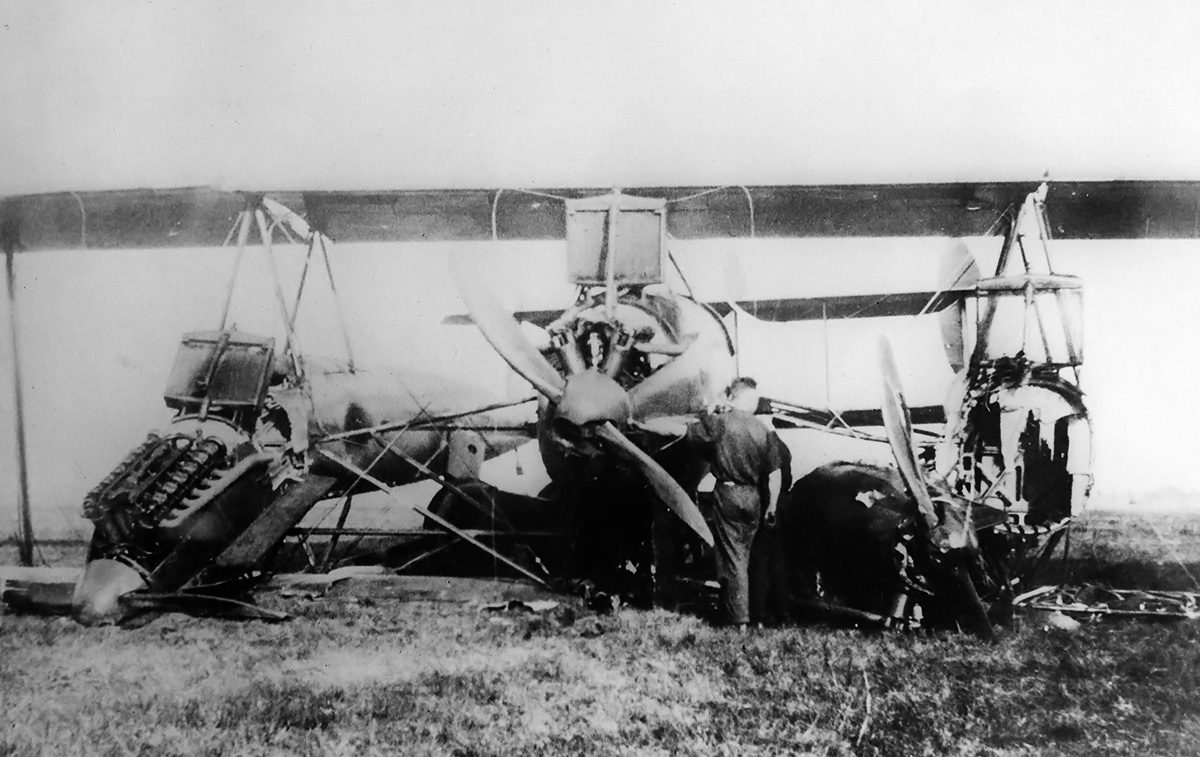
The Model H was heavily damaged following the loss of aileron control and subsequent hard landing on 30 May 1920. However, the booms, central nacelle, and tail suffered little damage.

The Owl’s ailerons and rudders were interchangeable. Each engine was installed in an interchangeable power egg and turned a 9 ft 6 in (2.90 m) propeller. Engine service platforms were located on the inner sides of the booms and the left side of the central nacelle. The Owl was equipped with a pyrene fire suppression system. The aircraft was supported by a pair of main wheels under each boom and two main wheels under the central nacelle. At the rear of each boom were tailskids.

The LWF Owl had a wingspan of 105 ft (32 m), a length of 53 ft 9 in (16.38 m), and a height of 17 ft 6 in (5.33 m). The aircraft had a top speed of 110 mph (117 km/h) and a landing speed of 55 mph (89 km/h). The Model H had an empty weight of 13,386 lb (6,072 kg) and a maximum weight of 21,186 lb (9,610 kg). The aircraft had a 750 fpm (3.81 m/s) initial rate of climb and a ceiling of 17,500 ft (5,334 m). The Owl had a range of approximately 1,100 miles (1,770 km).

LWF H Owl crash 1921

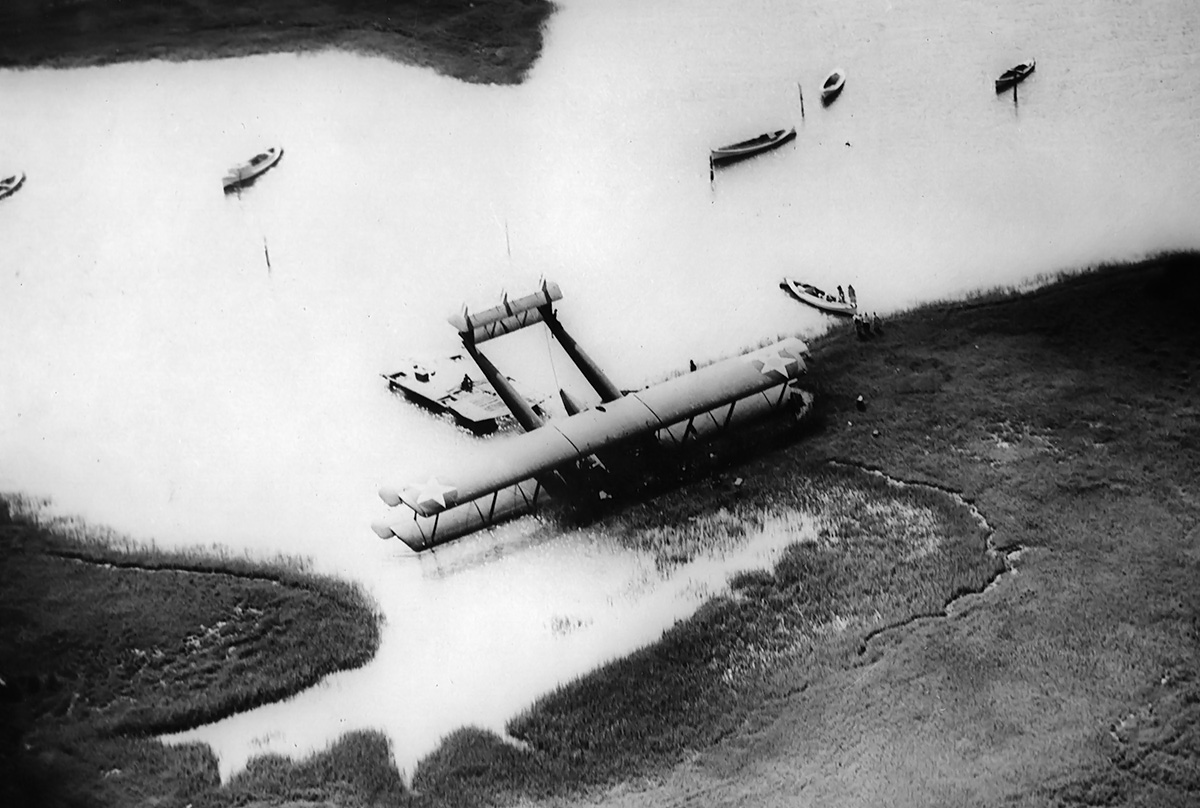
The Owl on its nose in the marshlands just short of the runway at Langley Field on 3 June 1921. The nose-over kept the tail out of the water and probably prevented more damage than if the tail had been submerged.

Although not complete, the Model H was displayed at the New York Aero Show in December 1919. On 15 May 1920, the completed Owl was trucked from the LWF factory to Mitchel Field. Second Lt Ernest Harmon made the aircraft’s first flight on 22 May. The aircraft controls were found to be a bit sluggish, but everything was manageable. An altitude of 1,300 ft (396 m) was attained, but one engine began to overheat, and the aircraft returned for landing. The second and third flights occurred on 24 May, with a maximum altitude of 2,600 ft (792 m) reached. The fourth flight was conducted on 25 May. Water in the fuel system caused the center engine to lose power, and an uneventful, unplanned landing was made at Roosevelt Field. Modifications were made, and flight testing continued.

On the aircraft’s sixth flight, it had a gross weight of 16,400 lb (7,439 kg). The Owl took off and climbed to 6,000 ft (1,829 m) in 15 minutes. The engines were allowed to cool before another climb was initiated, and 11,000 ft (3,353 m) was reached in seven minutes. No issues were encountered, and the aircraft returned to base after the successful flight.

LWF H Owl nose 1923

The Owl in its final configuration with four main wheels. On the central nacelle, note the new radiator, lack of a spinner, service platforms on both sides of the engine, and the opening for the bombsight under the nacelle. A bomb shackle is installed under the wing on the aircraft’s centerline.

On 30 May, a turnbuckle failed and resulted in loss of aileron control while the Owl was on a short flight. A good semblance of control was maintained until touchdown, when the right wing caught the ground and caused the aircraft to pivot sideways. The right wheels soon collapsed, followed by the left. The owl then smashed down on the right engine, rotated, and then settled down on the left engine, tearing it free from its mounts. The cockpit located near the center of the isolated central nacelle kept the crew safe, allowing them to escape unharmed.

The Model H was repaired, and flight testing resumed on 11 October 1920. Tests continued until 3 June 1921, when Lt Charles Cummings encountered engine cooling issues followed by engine failure. The Owl crashed into marshland just short of the runway at Langley Field, Virginia. The aircraft ended up on its nose, but the crew was uninjured. The Owl was recovered and returned to the LWF factory for repairs.

LWF H Owl rear 1923

The new cockpit position just behind the engine can be seen in this rear view of the updated Owl. In addition, the gunner’s position is visible at the rear of the central nacelle.

While being repaired, various modifications were undertaken to better suit the aircraft’s use in a bomber role. The cockpit was revised and moved forward to directly behind the center Liberty engine. The middle engine had a new radiator incorporated into the nose of the central pod. An engine service platform was added to the right side of the central pod so that both sides had platforms. A gunner’s position, including a Scraff ring for twin machine guns, was added to the rear of the nacelle pod. A bombing sight opening was added in the central nacelle. The ailerons were each extended 10 in (.25 m), increasing their total length to 18 ft 6 in and increasing the wingspan to 106 ft 8 in (32.51 m). The landing gear was modified, and a single wheel replaced the double wheels for the outer main gear. A bomb shackle was added between the center main wheels.

The Owl flew in this configuration in 1922. To improve the aircraft’s performance, some consideration was given to installing 500 hp (373 kW) Packard 1A-1500 engines in place of the Libertys, but this proposal was not implemented. In September 1923, the Owl was displayed at Bolling Air Field in Washington, DC. The aircraft had been expensive, and it was not exactly a success. Quietly, in 1924, the LWF Model H Owl was burned as scrap along with other discarded Air Service aircraft.

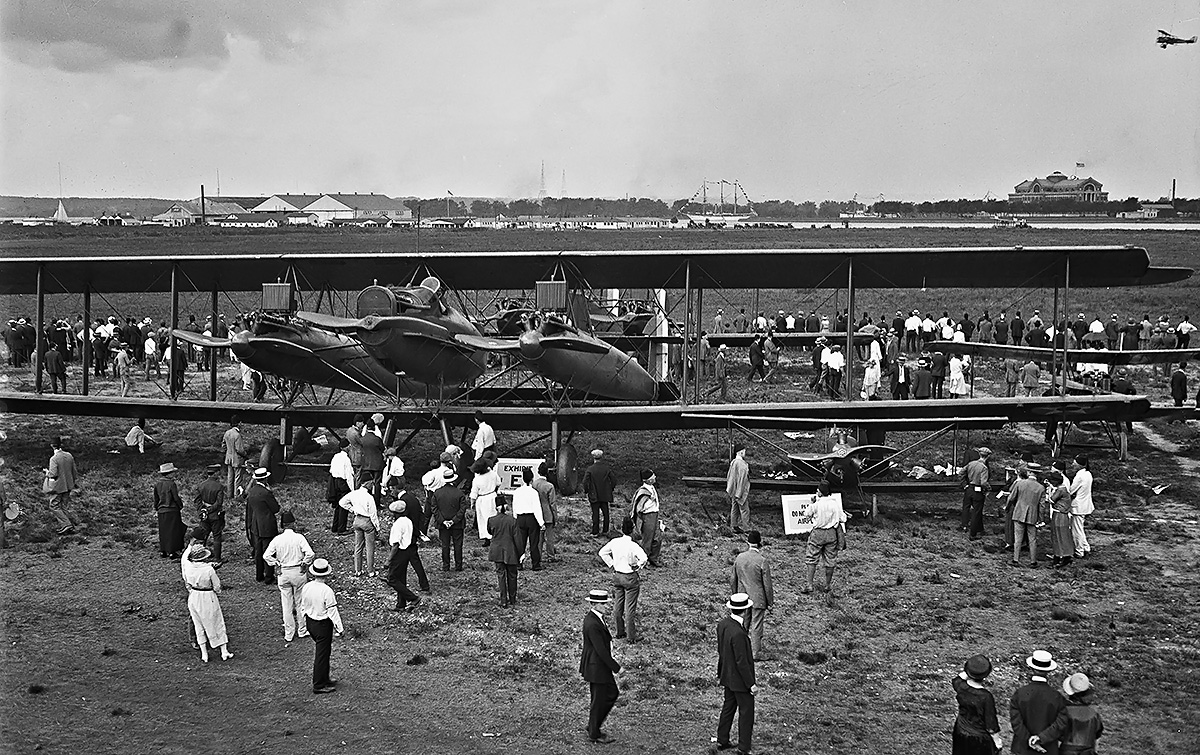
LWF H Owl Bolling 1923

The Owl on display at Bolling Field in September 1923. Note the windscreen protruding in front of the cockpit. The large aircraft dwarfed all others at the display.

Sources:
– “The Great Owl” by Walt Boyne, Airpower (November 1997)
– “The 1,200 H.P. L.W.F. Owl” Flight (14 April 1921)
– “The L.W.F. Owl Freight Plane” Aviation (1 March 1920)
Aircraft Year Book 1920 by Manufacturers Aircraft Association (1920)
Aircraft Year Book 1921 by Manufacturers Aircraft Association (1921)
American Combat Planes of the 20th Century by Ray Wagner (2004)

arsenal vg 33 rear

Arsenal VG 30-Series (VG 33) Fighter Aircraft

By William Pearce

In the early 1930s, some in France felt that French aviation was falling behind the rest of the world. French aircraft manufacturers were not experimenting much on their own, and government-funded conventional aircraft projects were not pushing the technical boundaries of aeronautics. On 2 July 1934, Pierre Renaudel proposed creating a state research institution to study and develop modern aircraft for the French military. The Arsenal du matériel aérien (Arsenal aerial equipment) was formed later that year with engineer Michel Vernisse as its director. When the French aviation industry was nationalized in 1936, the organization was renamed Arsenal de l’aéronautique (Arsenal aeronautics) and took over the Bréguet works at Villacoublay, near Paris, France.

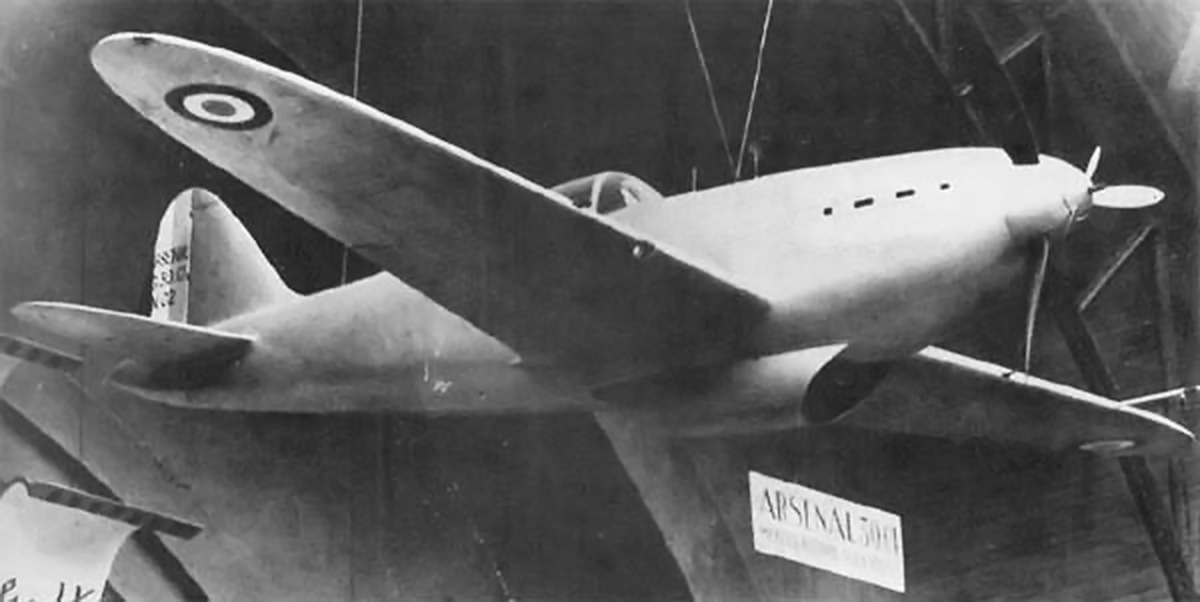
arsenal vg 30

The mockup of the Arsenal VG 30 as displayed at the 1936 Salon d’Aviation in Paris. Note the location of the radiator housing. Otherwise, the aircraft was very similar to subsequent VG 30-series fighters.

One of Arsenal’s first designs was the tandem-engine VG 10 fighter. Designed by Michel Vernisse and Jean Galtier, the initials of their last names formed the ‘VG’ of the aircraft’s designation. The VG 10 was never built and was redesigned and redesignated as the VG 20, which was also never built. However, the design was reworked again and eventually emerged as the Arsenal VB 10, first flown in 1945.

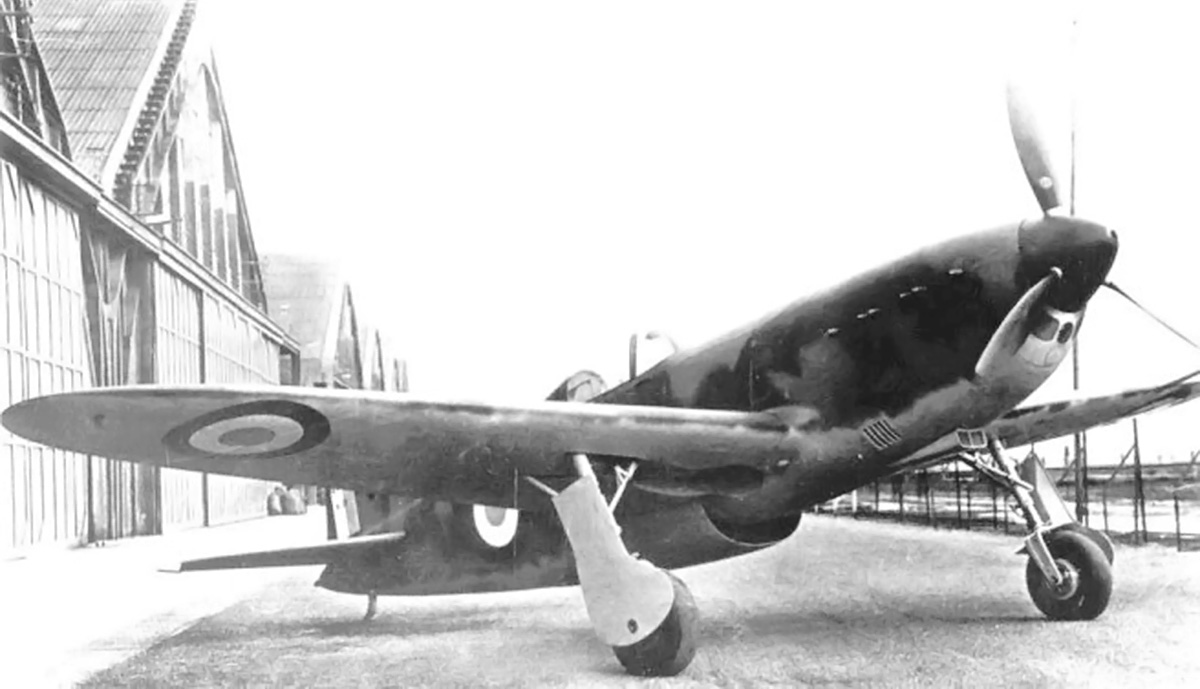
In 1936, the Ministère de l’Air (French Air Ministry) was interested in the concept of a light-fighter built from non-strategic materials. As a result, Arsenal designed the VG 30, a single-seat fighter constructed mostly of wood. The aircraft had a conventional taildragger layout with a low wing and featured retractable main undercarriage. At the rear of the aircraft was a non-retractable tailskid. Originally, the VG 30 was to be powered by the Potez 12 Dc: a 610 hp (455 kW), air-cooled, horizontal, 12-cylinder engine. However, delays with the 12 Dc resulted in a switch to the Hispano-Suiza 12Xcrs: a 690hp (515 kW), liquid-cooled, V-12 engine.

The wood used in the VG 30’s construction was primarily spruce, and the aircraft’s wooden frame was covered with molded sprue plywood to form the aircraft’s stressed-skin. The skin was then covered with canvas and varnished. The wings consisted of two spars and incorporated hydraulically operated flaps. The fuselage was mounted atop the wings, which were made as a single structure. The cockpit was positioned above the wing’s trailing edge and featured a rearward-sliding canopy. The engine’s cowling was made of aluminum, and to cool the engine, a radiator was housed in a duct positioned under the fuselage between the wings. Proposed armament consisted of a 20 mm cannon firing through the hub of the three-blade propeller and four 7.5 mm machine guns, with two housed in each wing. The cannon had 60 rounds of ammunition, and the wing guns each had 500 rounds.

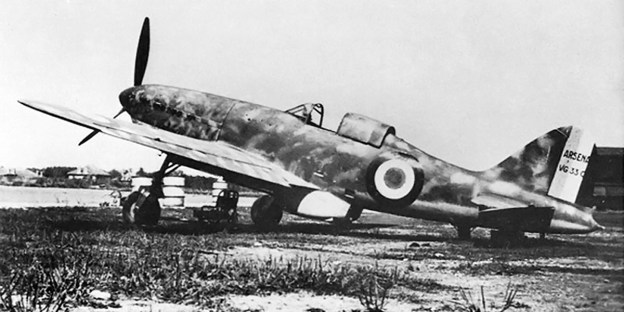
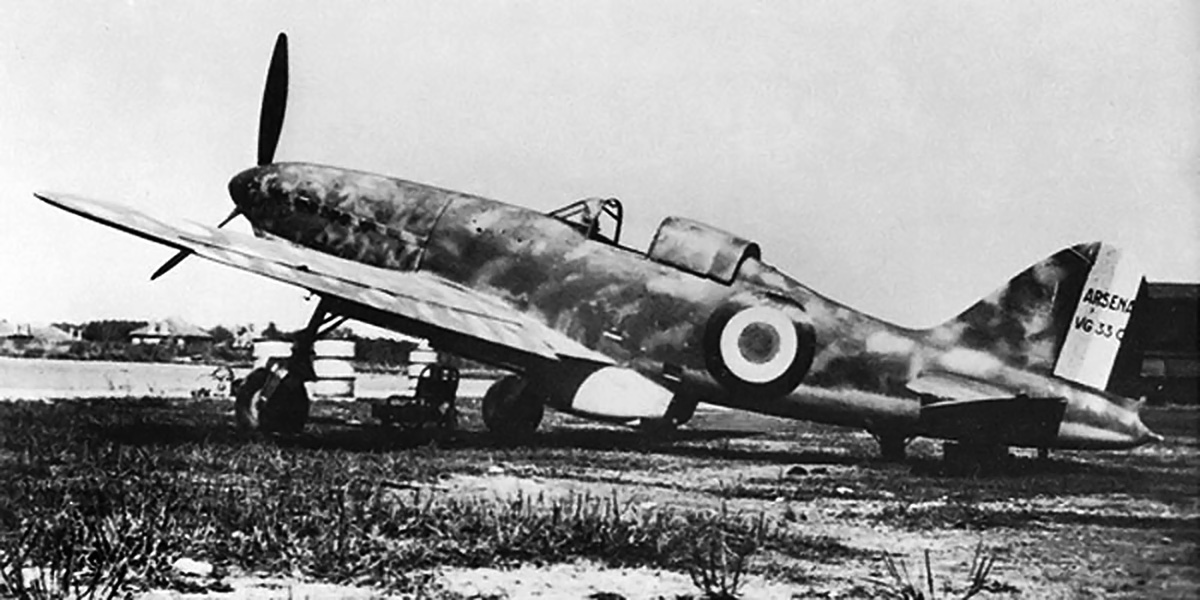
arsenal vg 33 two

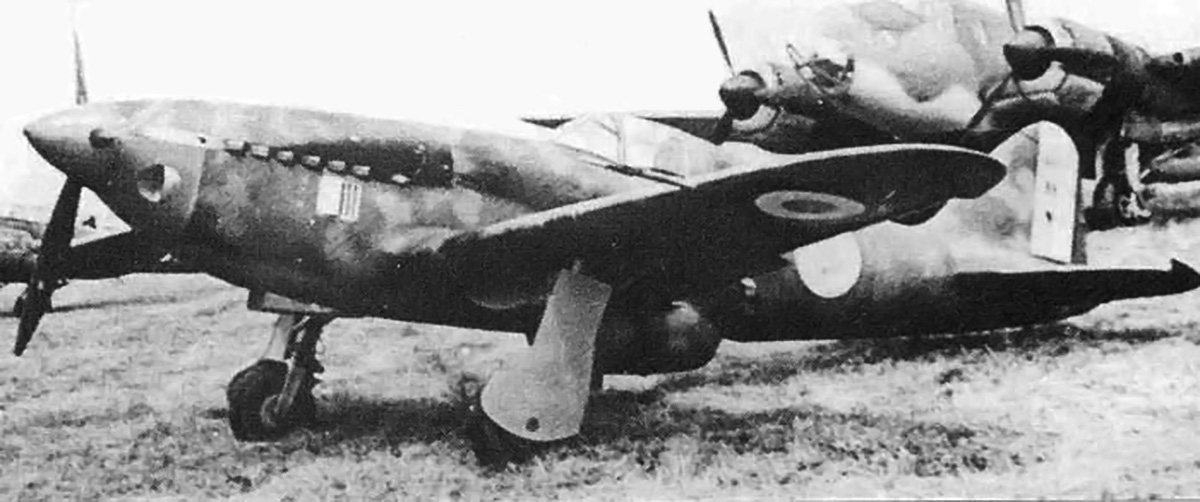
The VG 33 prototype sits complete with main gear doors on a muddy airfield. Many of the completed VG 33s, like the second aircraft in the image, were finished without gear doors.

A mockup of the VG 30 was displayed in November 1936 at the Salon d’Aviation in Paris. The Air Ministry found the mockup sufficiently impressive to issue specification A.23, requesting proposals for a light-fighter. A prototype of the Arsenal VG 30 was ordered in early 1937, and construction of the aircraft commenced in June. Some delays were encountered, and the VG 30 was first flown on 6 October (some sources state 1 October) 1938. The pilot for the flight was Modeste Vonner, and the aircraft took off from Villacoublay. Official tests were carried out from 24 March to 17 July 1939, during which the VG 30 reportedly reached 500 mph (805 km/h) in a dive. Overall, the tests revealed that the VG 30 had very good performance and was faster than the more-powerful Morane-Saulnier MS 406, France’s premier fighter just entering service.

The VG 30 had a wingspan of 35 ft 5 in (10.80 m), a length of 27 ft 7 in (8.40 m), and a height of 10 ft 10 in (3.31 m). The aircraft’s wing area was 150.69 sq ft (14.00 sq m). It had a top speed of 301 mph (485 km/h) at 16,240 (4,950 m) and climbed to 16,404 ft (5,000 m) in 7 minutes and 15 seconds. Despite the aircraft’s performance, VG 30 production was passed up in favor of more advanced models, and only the prototype was built.

The Arsenal VG 31 was a development of the VG 30 intended to enhance the aircraft’s speed. An 860 hp (641 kW) Hispano-Suiza 12Y-31 replaced the 690 hp (515 kW) engine; the radiator was relocated further back; two of the wing guns were removed; and a smaller wing was designed, resulting in 19.9–21.2 sq ft (1.85–2.0 sq m) less wing area. Wind tunnel tests indicated the aircraft would have reduced stability, reduced maneuverability, and an increased landing speed. The small gain in top speed was not worth all of the drawbacks. The VG 31 was never completed. The wings were used for static testing, and the fuselage was used on the third VG 33 aircraft, which became the VG 34.

arsenal vg 33 rear

A completed VG 33 without gear doors seen at Toulouse-Blagnac airport in June 1940. Note the radiator housing under the fuselage.

The Arsenal VG 32 was an attempt to secure a second source of power for the VG 30 aircraft. A 1,040 hp (776 kW) Allison V-1710-C15 (-33) replaced the Hispano-Suiza engine, requiring the fuselage to be lengthened by 16.5 in (.42 m) to 28 ft 11 in (8.82 m). The wings were modified to accommodate one 20 mm cannon and one 7.5 mm machine gun. Because of delays with acquiring the V-1710 engine, the VG 32 project followed after the VG 33. The fifth VG 33 airframe formed the basis for the VG 32, and a desperate France ordered 400 copies of the aircraft in 1940. However, the Germans arrived before the V-1710 engine, and the VG 32 was never completed. The aircraft was captured at Villacoublay in June 1940.

The Arsenal VG 33 was an enhancement to the basic VG 30 aircraft. The VG 33 used the 860 hp (641 kW) Hispano-Suiza 12Y-31 from the VG 31 but retained the larger wing of the VG 30. The engine turned a 12 ft 4 in (3.75 m) diameter three-blade, adjustable-pitch, metal propeller. An oil cooler was incorporated into the engine cowling just below the spinner, and a scoop for engine induction was located on the bottom of the cowling. The aircraft’s fuselage was lengthened slightly to 28 ft .5 in (8.55 m), and its height was 11 ft (3.35 m). The VG 33 prototype made its first flight on 25 April 1939 from Villacoublay. Official trials spanned from August 1939 to March 1940. The VG 33 was stable, maneuverable, easy to fly, and possessed good control harmony. The aircraft’s maneuverability and speed were superior to that of the more-powerful, all-metal Dewoitine D.520, France’s newest fighter.

arsenal vg 33 front captured

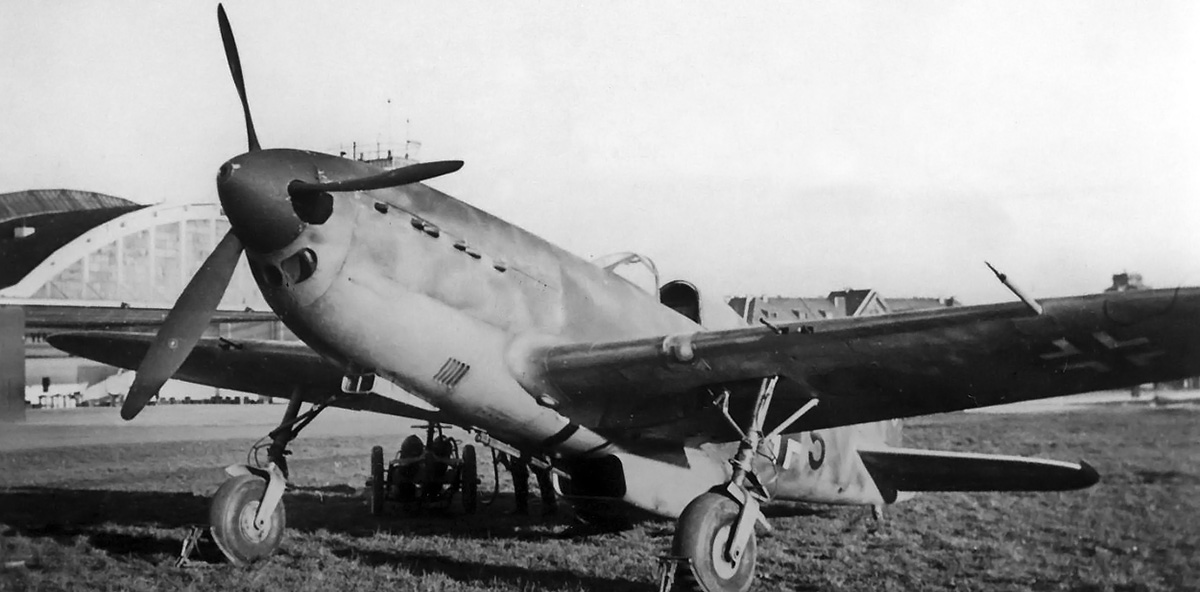
A VG 33 aircraft captured by the Germans and being tested at Rechlin, Germany. The captured aircraft carried the designation 3+5. The inlets for the oil cooler can bee seen just under the spinner. Under the cowling is the engine’s intake. Note the machine guns mounted in the wings.

The VG 33 had a maximum speed of 347 mph (558 km/h) at 17,060 ft (5,200 m) and a ceiling of 36,089 ft (11,000 m). The aircraft weighed 4,519 lb (2,050 kg) empty and 6,063 lb (2,750 kg) fully loaded. Its range was 746 miles (1,200 km) with 106 gallons (400 L) of internal fuel. Two fixed 26-gallon (100 L) external tanks could be attached under the wings to extend the aircraft’s range to 1,118 miles (1,800 km).

Before the flight trials were over, the Air Ministry ordered at least 200 VG 33s in September 1939. Another purchase request was submitted a short time later placing a total of approximately 720 VG 33 aircraft on order. The first deliveries were scheduled for January 1940, and the first fighter group equipped with VG 33 aircraft was to be operational in April 1940. The bulk of the orders went to SNCAN (Société nationale des constructions aéronautiques du Nord or National Society of Aeronautical Constructions North) at Sartrouville, with Michelin at Clermont-Ferrand expected to start production later.

Ironically, delays with acquiring enough non-strategic spruce resulted in the first production VG 33 aircraft not making its first flight until 21 April 1940. Production numbers for the VG 33 vary by source. By the time France surrendered to Germany on 22 June 1940, only about seven aircraft had been delivered to the Armée de l’Air (French Air Force) out of a total of 19 VG 33s that had been flown. Approximately 160 airframes were in various stages of completion at SNCAN, and at least 20, which were basically complete, were destroyed by the French before German forces could capture them. The French managed to fly out 12 VG 33 aircraft to Châteauroux, where they were placed into storage. By November 1942, the Germans had managed to seize around 5 VG 33 aircraft, and at least one underwent testing at Rechlin, Germany. All VG 33s were eventually scrapped.

arsenal vg 34

The engineless VG 34 prototype sits derelict at what is most likely Toulouse-Blagnac airport. Note the additional supports on the canopy.

The Arsenal VG 34 was the second VG 33 re-engined with the more powerful Hispano-Suiza 12Y-45 that used a Szdlowski-Planiol supercharger and produced 910 hp (679 kW). First flown on 20 January 1940, the VG 34 achieved 357 mph (575 km/h) at 20,341 ft (6,200 m). Only one example was built. The VG 34 was flown to Toulouse-Blagnac airport on 18 June 1940 and was presumably captured there by the Germans.

The Arsenal VG 35 was the fourth (some sources say third) VG 33 airframe but with a 1,100 hp (820 kW) Hispano-Suiza 12Y-51 engine installed. The aircraft was first flown on 25 February 1940 and eventually reached 367 mph (590 km/h). However, flight testing was never completed, and the sole prototype was seized by the Germans.

The Arsenal VG 36 was a more developed and refined VG 35. The aircraft had a modified rear fuselage and used a shallower and more streamlined radiator duct. The VG 36 was first flown on 14 May 1940 and was later destroyed at La Roche-sur-Yon in western France.

arsenal vg 36 front

On first glance, the VG 36 was very similar to the VG 33. The most notable difference was the redesigned radiator housing, which was shallower than the housing used on earlier VG 30-series aircraft and required a redesign of the rear fuselage.

The VG 37 was a proposal for a long-range VG 36, and the VG 38 was a VG 35 with a more powerful Hispano-Suiza 12Y engine that incorporated two Brown-Boveri turbosuperchargers. Neither of these aircraft projects were built.

The Arsenal VG 39 was based on the VG 33. The wing had a new internal structure that accommodated three 7.5 mm machine guns in each wing. The fuselage was slightly modified and lengthened to 28 ft 8 in (8.75 m) to accommodate a 1,200 hp (895 kW) Hispano-Suiza 12Zter engine. The inlets and position of the oil cooler at the front of the engine cowling were revised, and the radiator housing under the aircraft was also slightly smaller. The 20 mm engine cannon was omitted. First flown on 3 May 1940, the VG 39 achieved 388 mph (625 km/h) at 18,865 ft (5,750 m) during initial tests. Only one VG 39 was built. It made its last flight on 15 June 1940 and was destroyed by the French at Toulouse-Blagnac airport before the Germans captured the field. The planned production version was designated VG 39bis, used the fuselage of the VG 36 with its shallow radiator, was powered by a 1,300 hp (969 kW) Hispano-Suiza 12Z-17 engine, and included a 20 mm engine cannon. No VG 39bis aircraft were built.

The VG 40 was a study to power the VG 33 with a Rolls Royce Merlin III engine. Compared to the VG 33, the VG 40 had a larger wing. The aircraft did not progress beyond the design stage.

The VG 50 design incorporated the fuselage of the VG 36 with the six-gun wings of the VG 39. This package would be powered by a 1,200 hp (895 kW) Allison V-1710 engine. The VG 50 was never built.

Of the series, only the Arsenal VG 33 entered production. On paper, it was one of the best French fighters of World War II and on par with the frontline fighters of other nations. However, the aircraft never had the opportunity to be tested in combat. The VG 33’s slightly protracted development and production delays resulted in none of the type being available at the start of hostilities and too few being delivered during the Battle of France to have any impact on the conflict.

arsenal vg 39

The VG 39 prototype probably at the Toulouse-Blagnac airport. Note the exhaust stains on the engine cowling. The cowling was revised to accommodate the new oil cooler and the evenly-spaced exhaust stacks of the 12Z engine.

Sources:
French Fighters of World War II in Action by Alan Pelletier (2002)
French Aircraft 1939–1942 Volume I: From Amoit to Curtiss by Dominique Breffort and André Jouineau (2004)
The Complete Book of Fighters by William Green and Gordon Swanborough (1994)
War Planes of the Second World War: Fighters – Volume I by William Green (1960)
Hispano Suiza in Aeronautics by Manuel Lage (2004)
https://fr.wikipedia.org/wiki/Arsenal_VG_33

daimler-mercedes d vi back

Daimler-Mercedes D VI W-18 Aircraft Engine

By William Pearce

By 1915, the Germans had begun to experiment with very large aircraft known as Riesenflugzeug (giant aircraft). These aircraft had been developed from the G-class bombers and are often referred to as R-planes. In 1916, the potential of such an aircraft to carry heavy bombloads into enemy territory was recognized, and the deficiencies of airships that had been developed to serve in that same role was apparent. Efforts were undertaken to increase R-plane production and withdraw airships from long-range bomber missions.

mercedes d.vi (2)

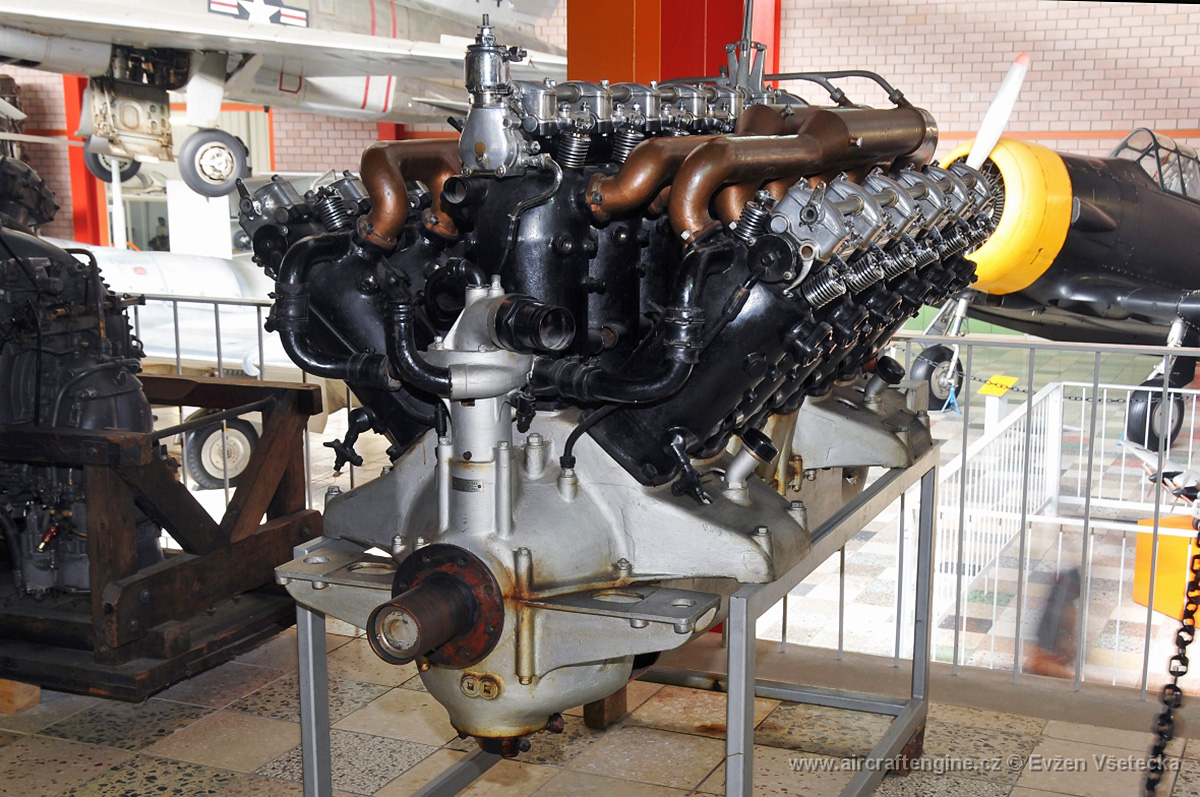
The preserved Daimler-Mercedes D VI W-18 engine. The individual cylinders on each bank were linked by a common overhead camshaft housing. Note the water-jacketed copper intake manifolds. (Evžen Všetečka image via www.aircraftengine.cz)

To promote the development of larger and more capable R-planes, larger and more powerful aircraft engines were needed. As early as 1915, the Idflieg (Inspektion der Fliegertruppen or Inspectorate of Flying Troops) had encouraged various German engine manufacturers to develop large aircraft engines capable of 500 hp (375 kW). These engines were known as Class VI engines and would be used to power R-planes. Daimler Motoren Gesellschaft (Daimler) was one of the companies that worked to build a large Class VI aircraft engine.

Daimler’s design was known as the D VI, but it is also referred to as the Mercedes D VI or Daimler-Mercedes D VI. Daimler often used the Mercedes name for many of its products. The D VI engine utilized the basic cylinder from the 180 hp (134 kW) Daimler-Mercedes D IIIa engine and incorporated features from the 260 hp (194 kW) D IVa engine. Both of those engines were six-cylinder inlines. However, the D VI had three rows of six-cylinders, creating a W-18 engine. The center cylinder row was vertical, and the left and right rows were angled 40 degrees from the center row.

mercedes d.vi (3)

Front view of the D VI illustrates the water pump mounted directly in front of the center cylinder bank. Note the direct drive crankshaft. (Evžen Všetečka image via www.aircraftengine.cz)

The D VI engine used individual steel cylinders with one intake and one exhaust valve. The valves of each cylinder row were actuated by a single overhead camshaft driven from the rear of the engine via a vertical shaft. The camshaft acted upon rocker arms that protruded from the camshaft housing above each cylinder to the exposed cylinder valves. A water jacket made of pressed steel was welded to the cylinder. Each piston was made of a forged-steel head screwed and welded onto a cast iron skirt. The cylinder’s compression ratio was 4.7 to 1.

Each cylinder was attached to the two-piece steel crankcase via four studs. Most likely, the studs for the center cylinder row extended into the bottom half of the crankcase and helped secure the two crankcase halves. The crankshaft was supported by seven main bearings and was connected directly to the propeller. A water pump was driven by the crankshaft at the front of the engine. At the rear of the engine, a vertical shaft extending from the crankshaft drove a magneto for each cylinder bank and an oil pump. Each of the cylinders had two spark plugs.

Induction air was drawn into an air chamber inside the crankcase where it was warmed. The air then passed through two water-jacketed pipes cast integral with the lower crankcase half at the rear of the engine. The two pipes split into three inline carburetors, each feeding one cylinder bank via an intake manifold. The intake manifold was made of copper and was water-jacketed. The left cylinder bank had its intake manifold positioned on the right side. The center and right cylinder banks had their intake manifolds positioned on the left side. The exhaust was expelled from each cylinder via an individual stack on the side opposite the intake.

daimler-mercedes d vi back

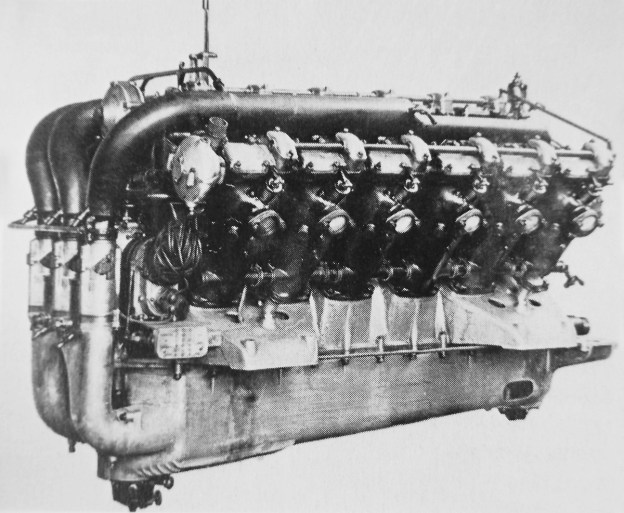
Rear view of the D VI shows the engine’s induction stemming from the lower crankcase housing and feeding into the three carburetors.

The D VI had a 5.51 in (140 mm) bore and a 6.30 in (160 mm) stroke. The engine’s total displacement was 2,705 cu in (44.3 L). The D VI produced 513 hp (382 kW) at 1,440 rpm for takeoff and had a maximum continuous output of 493 hp (368 kW) at 1,400 rpm. Specific fuel consumption was .477 lb/hp/hr (290 g/kW/h). The engine weighed 1,636 lb (742 kg).

The Daimler D VI engine was first run in 1916. However, development of the D IIIa and D IVa engines took priority, causing the D VI to lag behind. The D VI passed a certification test in December 1918, but World War I was over by that time, and such and engine was no longer needed. Military restrictions imposed on Germany by the Treaty of Versailles most likely influenced the abandonment of the D VI engine, and no further work was undertaken.

The sole surviving D VI engine has been preserved and is on display at the Flugausstellung L.+ P. Junior museum in Hermeskeil, Germany.

mercedes d.vi (1)

The D VI engine had mounts cast integral with the upper crankcase, but the engine was never installed in any aircraft. Note the pedestal pads onto which the cylinders were mounted. (Evžen Všetečka image via www.aircraftengine.cz)

Sources:
Flugmotoren und Strahltriebwerke by Kyrill von Gersdorff, et. al. (2007)
Report on the 180 H.P. Mercedes Aero Engine by the Ministry of Munitions Technical Department, Aircraft Production (March 1918)
Report on the 260-H.P. Mercedes Aero Engine by the Technical Information Section of the Air Board (July 1917)
http://www.aircraftengine.cz/Hermeskeil/

timossi-verga laura 3 front

Timossi-Verga Laura 3 Hydroplane

By William Pearce

Mario Verga was a successful silk merchant born in Milan, Italy in 1910. In the late 1940s, he became a well-known Italian speedboat racer, competing in the 450 kg (992 lb) class. He left boat racing in 1950 when he married Liliana Burlazzi, but the pull of the sport was too strong for Verga to stay away.

abbate-verga laura i

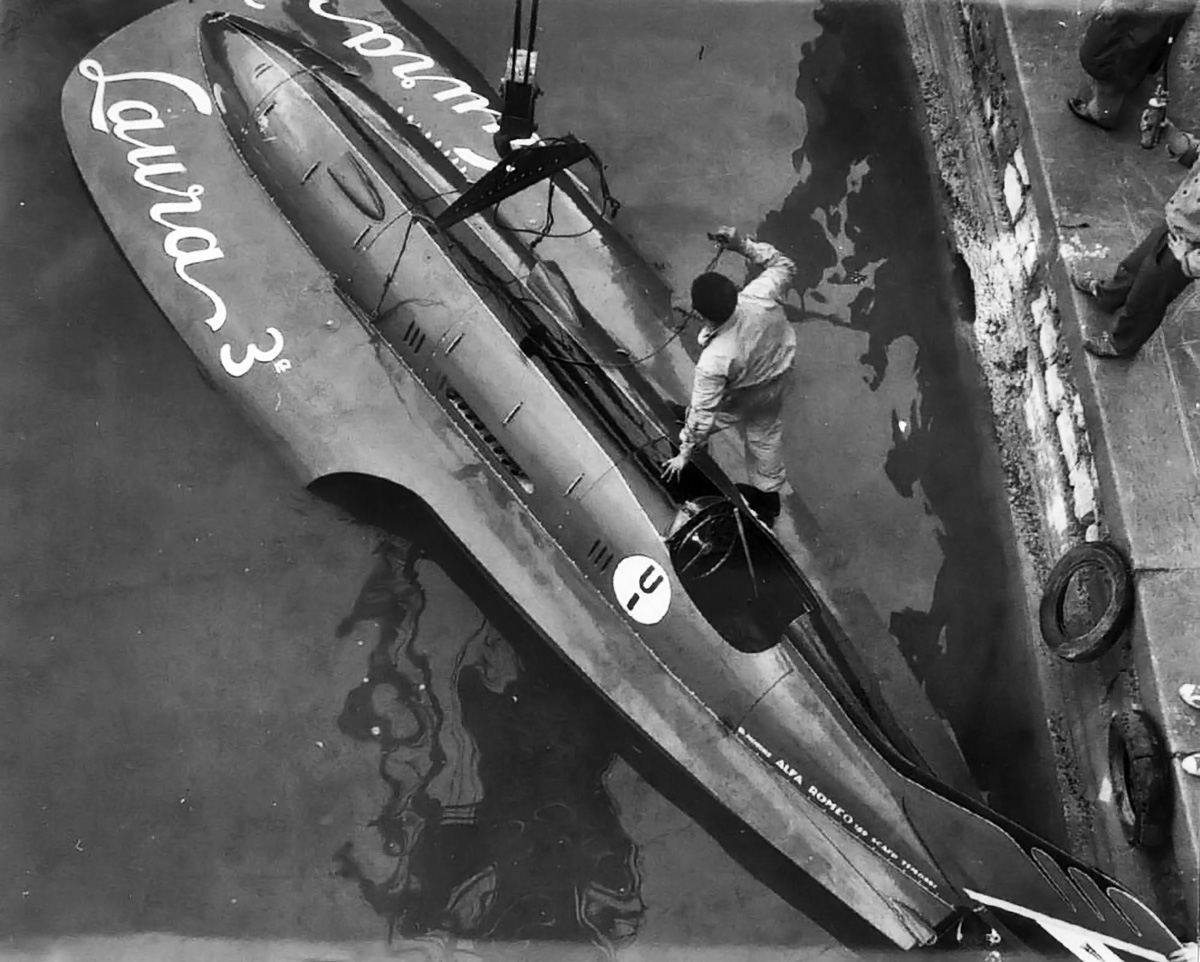
The Abbate-built Laura I was a sleek design. Aluminum bodywork covered the Alfa Romeo Typo 159 engine. Note the step between the sponson and the hull.

In 1952, Verga returned to the speedboat world with his 450 kg (992 lb) class Laura I racer. Named after Verga’s young daughter, the boat was built by Guido Abbate at Lake Como and was 17 ft 3 in (5.25 m) long and 7 ft 6 in (2.28 m) wide. The Laura I was powered by an Alfa Romeo Typo (Type) 159 engine, the same type of engine that propelled auto racing legends Nino Farina and Juan Manuel Fangio to respective Formula 1 World Championships in 1950 and 1951. The “a” after the number in the boat’s name designated the Alfa Romeo engine. Verga and the Laura I captured the 450 kg (992 lb) class championship in 1952.

On 7 July 1952, and half the world away on Lake Washington’s East Channel near Mercer Island in the Pacific Northwest, Stanley Sayres and Elmer Leninschmidt set a new world absolute water speed record at 178.497 mph (287.263 km/h) in the three-point hydroplane Slo-mo-shun IV. Sayres, Ted Jones, and Slo-mo-shun IV had set the previous record at 160.323 mph (258.015 km/h) on 26 June 1950, the first post-World War II water speed record. For both records, Slo-mo-shun IV was powered by an Allison V-1710 engine.

timossi-verga laura ii

The Laura II used the same bodywork as the Laura I. However, the sponsons had no step between them and the hull, and the hull had larger fuel tanks. Note the engine’s eight exhaust stacks.

Modifications to Laura I had increased the boat’s weight, and it fell within the 800 kg (1,764 lb) class. On 29 January 1953, Verga set an 800 kg (1,764 lb) class speed record of 125.670 mph (202.247 km/h) in Laura I. He increased the record to 140.737 mph (226.495 km/h) on 15 February 1953. Both records were set on Lake Lugano.

Verga had a new 800 kg (1,764 lb) class boat built by Carlo Timossi at Lake Como. The new boat was named Laura II, and it was 17.5 ft (5.33 m) long and powered by the same Typo 159 engine that powered Laura I. Images indicate that the aluminum bodywork of Laura I was used on Laura II. Verga and the Laura II won the 800 kg (1,764 lb) class championship in Europe on October 1953 and then traveled to the United States. The Laura II won the Orange Bowl International Regatta Grand Prix held at Miami Beach, Florida in December 1953, and also set a speed record for the 151 cu in (2.47 L) hydroplane class, averaging 131.680 mph (211.919 km/h).

Verga’s speed records and the records of other Italian speedboat racers (Achille Castoldi averaged 150.188 mph / 241.704 km/h in the 800 kg class, Ferrari-powered Arno XI on 15 October 1953 at Lake Iseo) inspired the Italian Motornautical Federation to offer a £5,000,000 prize to the sportsman that surpassed Slo-mo-shun’s 178.497 mph (287.263 km/h) record. Stipulations for the prize were that the boat had to be made in Italy, powered by an Italian engine using Italian fuel, and driven by an Italian driver. Verga and a couple of other Italian racers accepted the challenge. However, the other contenders soon dropped out as complications were encountered.

timossi-verga laura 3 engines

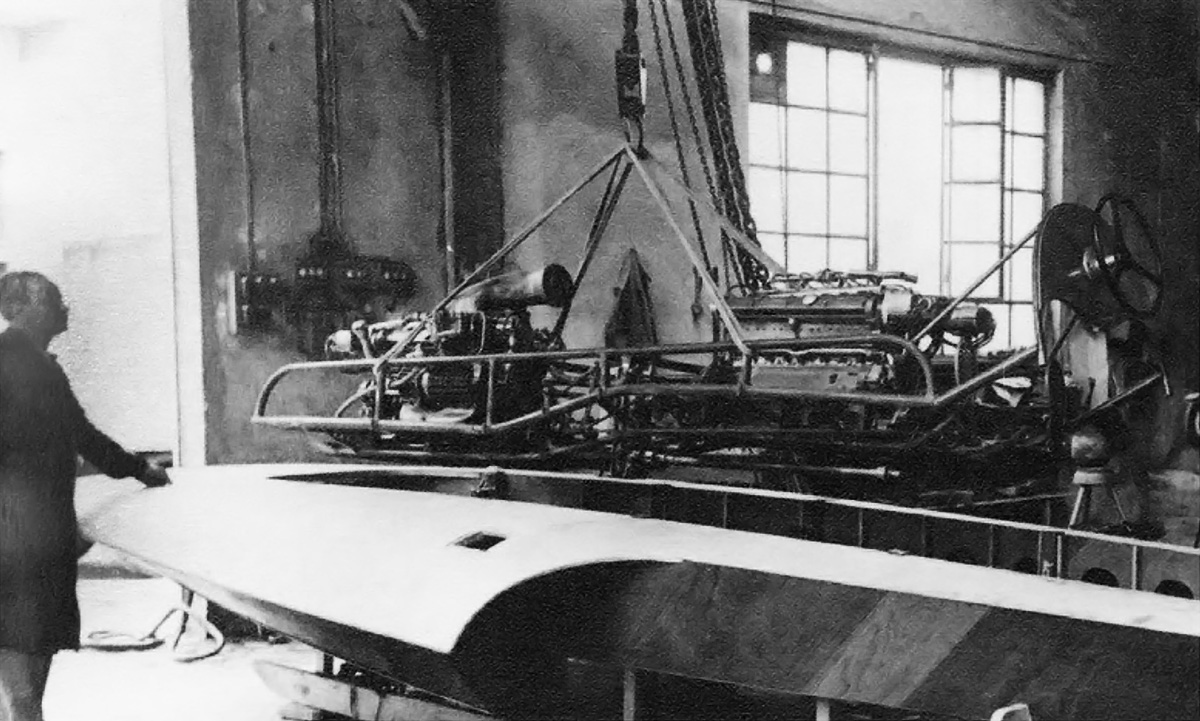
The two Typo 159 engines mounted in their frame, as the frame is installed in the Timossi-built Laura 3. The two-stage Roots-type supercharger can be seen on the front engine. Note the propeller shaft extending below the rear engine.

For the water speed record challenge, Vega turned to Timossi for a specially-built boat, named Laura 3. Verga continued with the Typo 159 power plant but decided to use two of the engines. The Typo 159 design stemmed from the Alfa Romeo Typo 158, originally designed in 1937. Commonly called an Alfetta, for Little Alfa, the engine was a straight-eight that used a one-piece aluminum cylinder head and block mounted to a magnesium alloy crankcase. The cylinders had a 2.28 in (58 mm) bore and a 2.76 in (70 mm) stroke, making the engine’s total displacement 90 cu in (1.48 L). The Typo 159 employed a two-stage Roots-type supercharger that enabled the engine to produce an impressive 420 hp (313 kW) at 9,300 rpm.

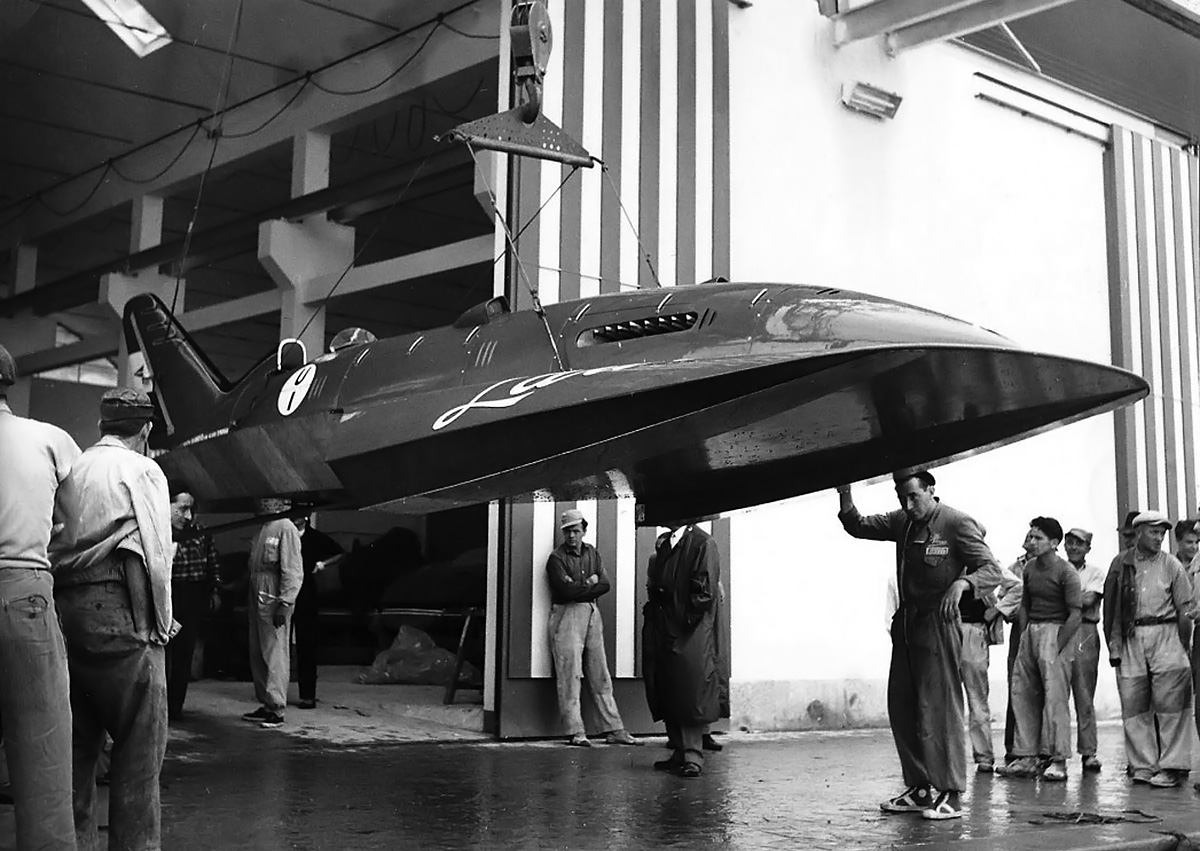
The two Typo 159 engines were positioned back-to-back, with a 2-into-1 gearbox positioned between the engines. Combined, the engines produced over 800 hp (597 kW). The gearbox increased input speed so that the propeller shaft turned at 1.133 times engine rpm. The engines and gearbox were mounted in a special, tubular-steel frame built by Alfa Romeo. The wooden Laura 3 was a three-point hydroplane built around the steel power train frame, which was installed in the front of the boat. Aluminum body panels covered the engines and cockpit. Extending behind the cockpit was an aluminum tail that had a ground adjustable rudder for stability. The Laura 3 was 23 ft 7.5 in (7.20 m) long and 8 ft .5 in (2.45 m) wide. The boat weighed 2,028 lb (920 kg).

timossi-verga laura 3 hoist

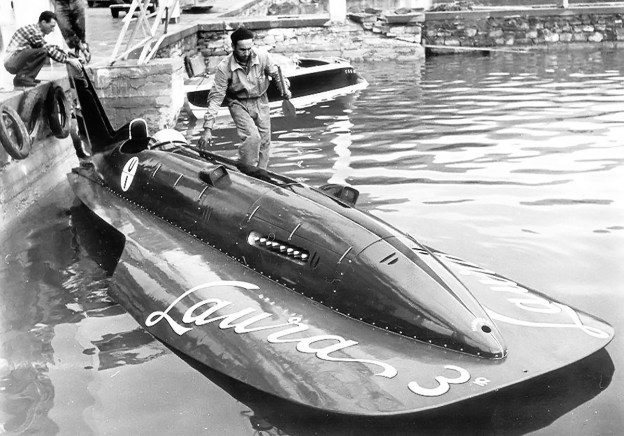
The completed Laura 3 was an elegant hydroplane. Note the tail extending behind the cockpit. The rudder on the tail was ground-adjustable, and its angle could not be changed while the boat was in motion.

In July 1954, Verga and the Laura 3 made a series of test runs up to 100 mph (160 km/h) on Lake Pusiano. The boat was then moved to the larger Lake Iseo. The testing continued in August, and 165 mph (265 km/h) was reached. Verga made a record attempt on 28 August, hitting 170 mph (274 km/h), but a cooling issue was encountered that resulted in damage to one of the engines. Repairs were made, and testing resumed in September. At higher speeds, Verga fought against the boat’s tendency to pull to the left, but was unable to keep the Laura 3 traveling in a straight line. Efforts to correct the issue had been unsuccessful, and it was decided that modifications to the hull were needed before a record attempt could be made safely. Changes to both sponsons were made, and the boat was completed on 8 October.

timossi-verga laura 3 top

Top view of the Laura 3 illustrates the long bodywork needed to enclose the two Typo 159 engines. Note the eight exhaust stack on both sides of the cowling. The writing behind the cockpit reads Bi Motore Alfa Romeo 159 Scarfo Timossi, with “scafo” meaning “hull.”

Although full testing of the modifications had not been conducted, Verga was confident that Laura 3 could break Slo-mo-shun IV’s record. On 9 October 1954, Verga had waited until midday for the Il Trvano wind to die down over Lake Iseo and settle its waters, but the wind persisted. Verga decided to make a run anyway. As Verga and the Laura 3 sped over Lake Iseo at a speed of approximately 190 mph (305 km/h), the boat hit a couple of small waves that raised its bow. At speed, the aerodynamic forces caught the bow and lifted the Laura 3 out of the water. The boat flipped and rolled before smashing back down into Lake Iseo and sinking. Verga was instantly killed in the crash, and the Laura 3 was destroyed. Verga’s run in the Laura 3 was the last time an Italian tried to set an absolute world water speed record.

timossi-verga laura 3 front

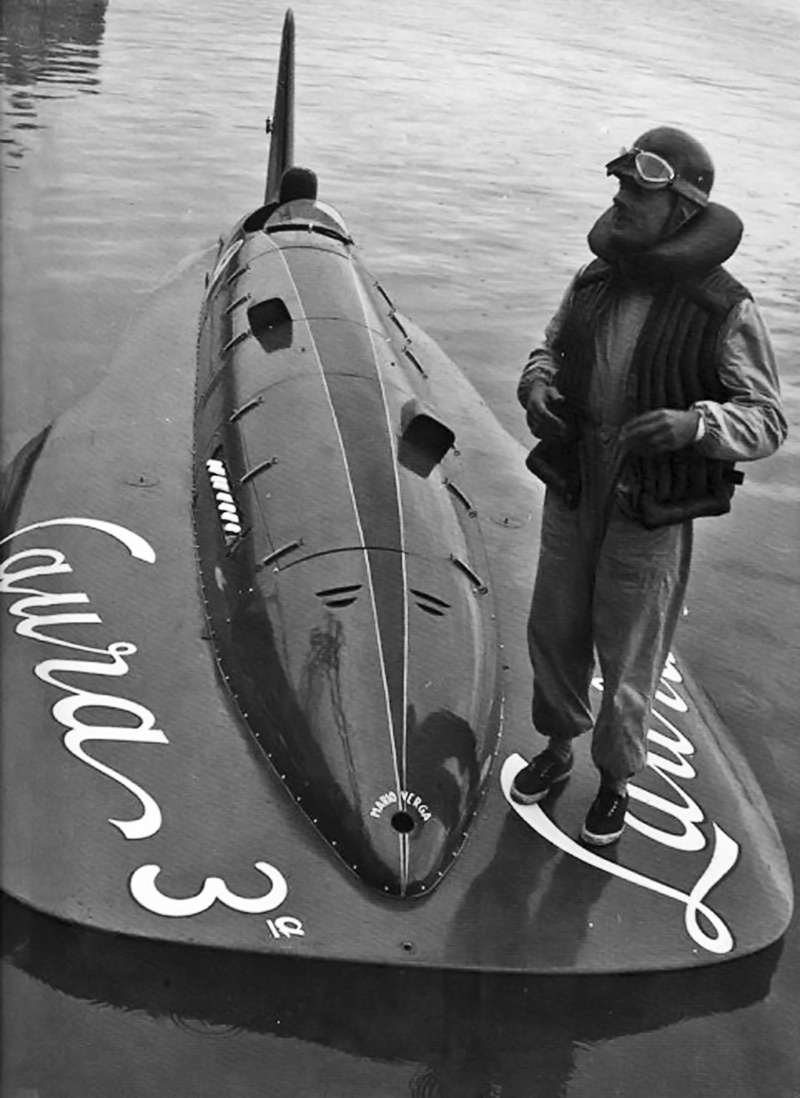
The beautiful Laura 3 sits ready for a test run. Note the individual induction scoops for the Typo 159 engines.

In 2015, the Laura I was restored by Tullio Abbate, Guido’s son, with a non-original (2.5 L Alfa Romeo V-6) engine installed. The boat is on display at the Museo della Barca Lariana on Lake Como. The fate of the Laura II is not known. The tail of Laura 3 was salvaged and preserved.

Note: As previously mentioned, the Laura I and Laura II used the same aluminum bodywork. The boats were very similar but had different sponsons. Some sources state that Laura II set the 800 kg record in 1953. However, newsreel footage and the museum housing the preserved Laura I credit the Laura I with the record.

timossi-verga laura 3 front 2

Mario Verga prepares to make a run in Laura 3. Note the “Mario Verga” text on the front of the boat.

Sources:
Risk Takers and Record Breakers by Doug Ford (2012)
Classic Racing Engines by Karl Ludvigsen (2001)
– “The Glorious Obsession of Mario Verga” by David Tremayne, Veloce via www.lesliefield.com
– “Aqua Romeo!” by Doug Nye, Motor Sport (February 2013)
– “Southward Ho!” by Solly Hall, Motor Boating (December 1953)
http://www.vintagehydroplanes.com/boats/laura_3/laura3.html
https://www.threepointhydroplanes.it/abbate-guido-1953-62_c140_en.htm
https://www.threepointhydroplanes.it/timossi-1953-1_c229_en.htm
https://www.threepointhydroplanes.it/timossi-1954-1_c230_en.htm

America’s Round-Engine Airliners

By Craig Kodera
and William Pearce

Some of the most significant engineering and technological breakthroughs of the 20th century centered on the development of piston aero engines from 1920 to 1957. America’s Round-Engine Airliners explains in detailed, well-illustrated, and easy-to-understand terms how these piston-powered radial-engine airliners advanced rapidly. The aircraft originated with fabric-covered fuselages with wooden wings and morphed into all-metal Ford Trimotors as the world’s first true “modern airliner,” the Douglas DC-3, long-range four-engine transoceanic flying boats. Finally, the ultimate “Queens of the skies” Lockheed Constellations, Douglas DC-7s, and Boeing Stratocruisers flew at the zenith of the piston age in the mid-to-late 1950s.

Many magnificent aircraft bridged the gap from small single-engine airliners carrying six passengers in the 1920s to large long-range, four-engine landplanes carrying 60-to-80 passengers and linking all the world’s continents by air in the 1950s. This book not only traces the technical evolution of every radial-engine powerplant used over that time span but also includes interesting and fact-filled sidebars that detail what it was like flying aboard each generation of these aircraft. In 1948, the largest radial piston engine ever produced entered airline service, the mighty 3,500-hp 28-cylinder Pratt & Whitney R-4360; it is one of 12 different radial engines covered in-depth by the authors of this book.

Contents:

Forward by Jon Proctor
Introduction
1. From Inline to Round
2. One Wing, Two Engines, All Metal
3. Presenting the Ship as an Airplane
4. Landplanes Become Viable Contenders
5. Expanding the Envelope
6. Some Serious Air Transports
7. Shrinking the Envelope
8. The Big Time
9. Twilight of the Goddesses
Epilogue: From Best of the Radials to the First Jets
Bibliography
Index

Specialty Press
$46.95 USD
Hardcover
10 in x 10 in
216 pages
500 illustrations
ISBN 978-1580072571
Sample pages (2 MB pdf)

America’s Round-Engine Airliners: Air Frames and Powerplants in the Golden Age of Aviation is available from Specialty Press, Amazon.com, and other retailers.

cummins 1952 28 start

Cummins Diesel Indy 500 Racers

By William Pearce

Clessie Lyle Cummins was a self-taught engineer. In 1911, he served on the pit crew for Ray Harroun’s #32 Marmon Wasp racer, which won the inaugural Indianapolis 500 race. Clessie went on to start the Cummins Engine Company in 1919 and specialized in diesel engines. The Cummins company struggled in its early years. Initially, Cummins engines found success powering yachts, but the company made efforts to break into the automotive field.

cummins 1931 record dc

Clessie Cummins in Washington D.C. on tour after setting the diesel speed record at 100.755 mph (162.150 km/h) on 7 February 1931 in Daytona Beach, Florida. The car was slightly modified and entered in the 1931 Indianapolis 500 race. (Indiana Public Media image via flickr.com)

The Great Depression took its toll on Cummins and also affected auto racing. To increase race participation, Eddie Rickenbacker, then-owner of the Indianapolis Speedway and American Automobile Association Contest Board president, relaxed the racing rules to allow stock-block engines up to 366 cu in (6.0 L) in 1930. Cummins saw an opportunity to help fill the racing field and gain publicity in the Indianapolis 500 by fielding a diesel-powered racer in the 1931 race. Rickenbacker agreed to the plan and offered Cummins a provisional spot provided the racer could top 80 mph (129 km/h). However, the Cummins entry would not be entitled to any winnings, because of its guaranteed entry into the field.

Cummins contracted Augie Duesenberg to modify a Duesenberg Model A chassis and install a 4-cylinder Cummins Model U engine. The Model U was a marine engine with a 4.5 in (114 mm) bore, a 6.0 in (152 mm) stroke, and a displacement of 382 cu in (6.3 L). To make the engine conform to the displacement limit, the bore of the race engine was decreased by .125 in (3 mm), resulting in a bore of 4.375 in (111 mm). This resulted in a displacement of 361 cu in (5.9L). The engine had been modified with aluminum pistons and two intake valves but retained a single exhaust valve. The race engine produced 85 hp (63 kW) at 1,500 rpm and weighed about 1,600 lb (726 kg).

cummins 1931 8 indy

Clessie Cummins stands behind the Cummins Diesel Special #8 entered in the 1931 Indy 500. Dave Evans and Thane Houser are in the cockpit. Note the racer’s height. (IMS image)

To test the powertrain, Clessie drove the car to Daytona Beach, Florida and set a diesel flying-mile (1.6-km) speed record at 100.755 mph (162.150 km/h) on 7 February 1931. The racer was then driven to Washington D.C. and back to the Cummins factory, where it was modified in accordance with the Indy 500 rules. Its completed weight was a hefty 3,389 lb (1,537 kg).

For the Indy 500, the car was named the Cummins Diesel Special and given race #8. Dave Evans was the driver with Thane Houser as the riding mechanic / co-driver. The Cummins Diesel Special was regularly driven the 45 miles (72 km) from the Cummins factory in Columbus, Indiana to the Indianapolis Motor Speedway. The Cummins racer qualified at 96.871 mph (155.899 km/h), which was the 43rd fastest car. Since Rickenbacker had guaranteed a spot in the 40-car field, the Cummins Diesel Special was the slowest car in the 1931 Indianapolis 500. However, the Cummins team had a plan to pick up a few spots during the race.

cummins 1931 8 display

The restored #8 displayed in the Indianapolis Motors Speedway Museum. Note the engine’s four individual cylinders. (Doctorindy image via Wikimedia Commons)

On race day, 30 May 1931, the Cummins Diesel Special was driven from the factory to the raceway. The racer proved to be slow during the 500-mile (805-km) competition, but the fuel-efficient engine enabled the Cummins Diesel Special to run the entire race without stopping, the first and only racer to accomplish such a feat during the Indy 500. In those days, the race continued after the first-place car finished until each car that could finish had completed the 200 laps. The Cummins Diesel Special completed its 200th lap and finished the race 38 minutes after the race leader, which was enough to secure a 13th place finish. The diesel-powered racer averaged 86.170 mph (138.677 km/h) over the 500-mile (805-km) distance, and the amount of fuel used reportedly cost $1.40 ($23 in 2018 USD).

In 1932, Clessie Cummins and William G. Irwin (Cummins’ main financial backer) took the racer on a 5,000-mile (8,047-km) tour of Europe. This trip resulted in some modifications to the racer, such as the addition of a windshield and headlights. The Duesenberg-built Cummins Diesel Special was preserved by Cummins and restored to its Indy-race configuration. The car is often displayed in various museums and run on rare occasion at special events.

cummins 1934 6 indy

Dave Evans and Jigger Johnson in the four-stroke #6 at Indy in 1934. The Roots supercharger can just be seen at the front of the car. (IMS image)

The Cummins Team returned in 1934 to race in the Indy 500. Cummins fielded two Duesenberg-chassis cars for the race, each powered by an experimental, supercharged, aluminum, inline-four engine. The engine had a 4.875 in (124 mm) bore and stroke and displaced 364 cu in (6.0L). The difference between the cars was primarily a difference in engines, with one car using a four-stroke engine and the other car using a two-stroke engine. The Indy 500 race served as a test to compare the two different combustion cycle engines. The Roots-type supercharger was driven from the engine and installed at the front of the car. The supercharger in the four-stroke car took about 7 hp (5 kW) to run, compared with 37 hp (28 kW) for the two-stroke car, which also used the supercharger for cylinder scavenging. The four-stroke engine had one intake valve and one exhaust valve. The two-stroke engine had two exhaust valves and intake ports in the cylinder that were uncovered by the piston. Each engine produced approximately 135 hp (101 kW) at 2,500 rpm. The engines each weighed about 1,000 lb (454 kg), and each car weighed around 3,200 lb (1,451 kg).

cummins 1934 6 engine

The #6 car with the Roots supercharger passing induction air through the radiator and to the engine. (IMS image)

The four-stroke car, race #6, was driven by Dave Evans with John ‘Jigger’ Johnson as the riding mechanic. It qualified in 22nd place at 102.414 mph (164.819 km/h). During the race, #6 made its first pitstop after 200 miles (322 km). Unfortunately, engine torque damaged the transmission as the racer quickly accelerated to reenter the track. This forced Evans and Johnson to retire from the race, and #6 was awarded 19th place. The engine in #6 had operated flawlessly during the race. The car has been preserved by Cummins and is occasionally displayed for special events.

cummins 1934 6 display

The restored #6 car displayed in the Cummins Museum at the Company’s corporate headquarters in Columbus, Indiana. (Ricky Berkey image)

cummins 1934 5 daytona clessie

Clessie Cummins stands by the two-stroke #5 racer at Indy in 1934 with Stubby Stubblefield and Bert Lustig in the cockpit. The Roots supercharger can be seen through the car’s grille. The racer’s 12th place finish is the best for a diesel-powered car in the Indy 500. (Indiana Public Media image via flickr.com)

The two-stroke car, race #5, was driven by Stubby (Wilburn Hartwell) Stubblefield with Bert Lustig as the riding mechanic. The car qualified 29th at 105.921 mph (170.463 km/h). Although the two-stroke engine was temperamental, #5 went the distance and finished the 500-mile (805-km) race in 12th place, averaging 88.566 mph (142.533 km/h). Evans took over driving duties from Stubblefield around mid-race. Race #5 was the last car to complete the 200 laps—finishing the race trailing smoke and overheating. After the racer was shut down, the pistons seized in the cylinders. Some sources indicate that Clessie was so displeased with the two-stroke engine that it was tossed into a river as the team made its way back to Columbus. Because of the issues with the two-stroke engine, Cummins subsequently abandoned two-stroke development and focused on four-stroke engines.

cummins 1934 5 daytona

After Indy, a four-stroke, six-cylinder engine was installed in the #5 racer. Wild Bill Cummings set diesel speed records on Daytona Beach Florida in 1935 and is seen behind the wheel. The front of the car was stretched to accommodate the longer engine. Note the six-to-one exhaust manifold. (Cummins image)

Race #5 was later modified (lengthened) to accommodate a four-stroke, six-cylinder engine. Wild Bill Cummings used the updated #5 to set a flying-mile (1.6 km) diesel speed record of 133.023 mph (214.080 km/h) on 1 March 1935. The following day, Cummings increased the record speed to 137.195 mph (220.794 km/h). Cummings in Race #5 also set 5 km (3.1 mi) and 5 mi (8.0 km) records of 126.99 mph (204.37 km/h) and 112.07 mph (180.36 km/h) respectively. However, the event was not sanctioned, and none of these records were internationally recognized. Race #5 was preserved by Cummins in its record-setting form and is occasionally displayed in various museums.

Cummins 1934 5 Amelia Island

The restored #5 in its Daytona configuration with a four-stroke, six-cylinder engine. The car was displayed for a time at the Auburn-Cord-Duesenberg Museum on account of its Duesenberg chassis. As seen above, #5 is at the Amelia Island Concours d’Elegance in April 2019. (The Southern Concours / John E. Adams image)

It was not until 1950 that Cummins returned to the Indy 500. The car was called the Cummins Diesel Special (just like the 1931 entry) and wore race #61. Because of its green color, driver Jimmy Jackson referred to the car as the Green Hornet. The racer consisted of a modified Kurtis Kraft chassis powered by a supercharged inline-six engine based on the Cummins JBS-600 truck engine. The car used disc brakes, which was a first at Indy.

cummins 1950 61 indy

Jimmy Jackson sits in the 1950 Cummins Diesel Special #61 at Indy. Although much more refined compared to the earlier racers, #61 was still a heavy brute compared to the rest of the field. Induction air was brought in via the front tunnel. The scoop on the engine cowling provided clearance for the cylinder head and airflow to help cool the engine, but overheating was still a problem. (IMS image)

The Roots-type supercharger was crankshaft-driven and mounted in front of the engine. The special engine had four-valves per cylinder and used an aluminum crankcase, cylinder block, and head. Two injectors delivered fuel into each cylinder, and the engine used an early design of what would become Cummins’ PT (Pressure-Timed) fuel injection. The engine had a 4.125 in (105 mm) bore and a 5.0 in (127 mm) stroke. It displaced 401 cu in (6.6 L) and produced 320 hp (239 kW) at 4,000 rpm. With the ram-air effect of the racer at speed providing additional boost, the engine’s output increased to 340 hp (254 kW) at 4,000 rpm. The engine weighed 860 lb (390 kg).

cummins 1950 61 engine

The uncowled #61 with Jackson in the cockpit. Note the crossflow head with the intake manifold on one side and the exhaust manifold on the other. The earlier Indy racers had the intake and exhaust manifolds on the same side (passenger) of the engine. The car’s independent front suspension was a first at Indy. (Motor Trend image)

Despite some difficulty, the diesel-powered Green Hornet eventually qualified for the Indy 500 at 129.208 mph (207.940 km/h), the slowest qualifying speed of the grid. During the race, the car was retired on lap 52, while in 29th place, because of issues with the engine’s vibration damper and supercharger drive. Repaired, and at the Bonneville Salt Flats on 11 September 1950, Jackson and the Green Hornet set six International diesel speed records: 163.82 mph (263.64 km/h) over 1 km (.6 mi), 165.23 mph (265.91 km/h) over 1 mile (1.6 km), 164.25 mph (264.33 km/h) over 5 km (3.1 mi), 161.92 mph (260.59 km/h) over 5 mi (8.0 km), 147.63 mph (237.59 km/h) over 10 km (6.2 mi), and 148.14 mph (238.41 km/h) over 10 mi (16 km). The previous diesel records up to 5 km (3.1 mi) were set by George Eyston and the Flying Spray in April 1936. The previous 5 km (3.1 mi) and 5 mi (8.0 km) records were those set by Wild Bill Cummings and Race #5 in March 1935. The Green Hornet was preserved by Cummins and is often displayed in various museums. On rare occasions, the car is run at special events.

cummins 1950 61 display

The 1950 racer was nicknamed Green Hornet on account of its paint. After Indy, #61 and Jackson set six diesel speed records at the Bonneville Salt Flats in Utah. The Green Hornet is pictured as displayed in the Indianapolis Motors Speedway Museum. (AutoDesign image)

In 1951, Cummins decided to make a serious attempt for the 1952 Indy 500. Clessie’s brother Don Cummins headed the team, with Nev Reiners as the chief engineer. Also on the team were Thane Houser (riding mechanic / co-driver for the 1931 Indy effort), Bill Doup, Mike Fellows, Art Eckleman, and Joe Miller. The Cummins Team worked directly with Frank Kurtis of Kurtis Kraft to design a low-slung chassis, and every opportunity was taken to exploit the chassis-engine combination.

cummins 1952 28 indy

Freddie Agabashian and crew with the 1952 Cummins Diesel Special #28 at Indy. The engine installed on its side made the car a low and sleek racer. Compare #28’s height with that of the earlier racers. (IMS image)

Powering the new racer was a further development of the JBS-600-based engine used in the Green Hornet. Since the new engine was turbocharged, it is often referred to as a modified JT-600. The engine consisted of a magnesium crankcase with an aluminum cylinder bank and head. Concepts from Cummins’ NHH-series engines (inline-six laid on its side) were applied to the race engine, and it was installed in the racer’s chassis laid over at an 85-degree angle—nearly on its side. This resulted in a very low engine cowling about 23 in (.58 m) above the ground. The turbocharger was installed in front of the engine on the right side of the car and provided up to 20 psi (1.38 bar) of boost. Like with the Green Hornet, a precursor to the Cummins’ PT fuel injection system was employed. The engine had a 4.125 in (105 mm) bore, a 5.0 in (127 mm) stroke, and a displacement of 401 cu in (6.6 L). The power produced was 380 hp (283 kW) at 4,000 rpm and 430 hp (321 kW) at 4,500 rpm. The engine weighed around 750 lb (340 kg).

The crankshaft, transmission, and driveline were on the left side of the car, putting 150 lb (68 kg) of weight bias on the left side of the car for better handling around the oval track. The cockpit was offset to the right, and the driver’s position was very low, only 4 in (102 mm) off the ground. The racer’s configuration resulted in a very low center of gravity, but the car was quite heavy at around 3,100 lb (1,406 kg). The turbocharger was a first at Indy, as was the offset drivetrain and the car’s independent front suspension. The aerodynamics of the chassis and bodywork were fine-tuned in a wind tunnel, which was reportedly another Indy first.

cummins 1952 28 no body

With the body removed, the compact nature of #28’s chassis is revealed. The turbocharger can just be seen between the front tires. On the left side of the car, note the underside of the crankcase and the driveline extending to the rear. (Cummins image)

The car was completed in late 1951, and testing began in November. Again christened as the Cummins Diesel Special, the car was given race #28 and was driven by Freddie Agabashian. Early testing indicated a very fast car, and Agabashian was careful not to reveal the racer’s full potential during practice sessions at Indy. Agabashian would not run full power for complete laps because there was some concern that the car would be banned had its true, competitive speed been reached. Fifteen minutes before the end of Pole Day qualifying, Agabashian took #28 out and set a one-lap record at 139.104 mph (223.866 km/h) and a
four-lap record at 138.010 mph (222.106 km/h). Agabashian and #28 had qualified in 1st place in a diesel. Agabashian had pushed the racer so hard that he tore the tread off some of the tires. The qualifying record was short-lived, as two cars later qualified with faster speeds, but it was still a major accomplishment for the Cummins Team.

On 30 May 1952, the Indy 500 was run. Agabashian in #28 found the diesel slower to accelerate than the other cars. Another problem cropped up with a buildup of tire rubber debris clogging the turbocharger intake. This issue ultimately caused the turbocharger to fail and forced #28 to retire on lap 71. At that point, Agabashian was in 5th place and had averaged 131.5 mph (211.6 km/h). The race was eventually won at a 130.843 mph (210.571 km/h) average, indicating #28 was keeping pace. Race #28 was credited with a 27th place finish. In short order, rules were changed, and the Cummins Diesel Special was the last diesel-engine racer to compete in the Indy 500.

cummins 1952 28 start

Agabashian and #28 set off from the pits at Indy for a practice run. Unlike racers of today, the smoke at the back of the car is diesel smoke exhaust and not tire smoke. Note the indentation ahead of the front tire. The body was so wide that body indentations were needed for full lock tire clearance. (Cummins image)

Race #28 was returned to the Cummins factory in Columbus, Indiana where it was preserved. A restoration in 1968 revealed that the crankshaft had cracked and would have failed completely had the turbocharger issues not brought a halt to #28’s race. The racer was occasionally run for special events until 1999. In 2016, the Cummins Diesel Special underwent a restoration and was run for the first time since 1999. The racer is often displayed at the Cummins Museum and run on rare occasion at special events.

In each of its four outings at Indy, Cummins took advantage of rules that enabled the displacement of diesels to be up to twice that of spark-ignition engines. While this did offer an advantage for diesels, nearly everything else about the engine was a disadvantage compared to the standard racers. Cummins used the Indy 500 to showcase its diesel engines, test new technology, and make a statement about diesel power.

cummins 1952 28 goodwood

After its 2016 restoration, #28 participated in the 2017 Goodwood Festival of Speed in Chichester, UK. Bruce Watson, a retired Cummins Engineer, is driving the racer and also led the car’s restoration. (Steve Siler / Car and Driver image)

A sponsorship agreement between Cummins and the Indianapolis Motor Speedway will provide for all five diesel Indy cars to make a parade lap before the 2019 Indy 500. The event, which coincides with Cummins’ 100-year anniversary, will be the first time that the five cars have run together.

Cummins Diesel Indy Cars 2019

All five of the Cummins Diesel Indy Cars on display in May 2019 prior to the Indy 500 race. (Cummins image)

Sources:
– “Cummins at the Brickyard” by Karl Ludvigsen, Car Life (July 1969)
– “Diesels at Speed” by Griffith Borgeson, Motor Trend (December 1950)
– “The Triumph of the Diesel” Popular Mechanics (July 1934)
http://www.trucktrend.com/cool-trucks/0808dp-cummins-diesel-race-car/
http://www.trucktrend.com/news/1605-cummins-wakes-1952-diesel-special-indy-car-after-years-of-slumber/
http://triplettracehistory.blogspot.com/2016/01/the-1931-cummins-diesel-photo-by-author.html
https://www.allpar.com/corporate/bios/cummins.html
https://stevemckelvie.wordpress.com/2011/06/05/the-cummins-diesel-special-at-the-1952-indianapolis-500/
https://www.thetruthaboutcars.com/2015/10/clessie-cummins-made-diesels-king-road-almost-indy-part-one/
https://www.thetruthaboutcars.com/2015/10/clessie-cummins-made-diesels-king-road-almost-indy-part-two/
https://www.cummins.com/company/history/indianapolis-500
https://www.caranddriver.com/features/when-cummins-diesels-assaulted-indy-feature
https://www.conceptcarz.com/vehicle/z15198/duesenberg-cummins-diesel-indy-racer.aspx
https://www.hemmings.com/blog/index.php/2011/08/02/diesels-at-daytona/
https://cumminsengines.com/No-28-cummins-diesel-special-to-run-with-moto
https://www.hotrodhotline.com/feature/heroes/landspeedracing/2009/09newsletter122/

Thomas X-8 engine

Thomas / Leyland X-8 Aircraft Engine

By William Pearce

John Godfrey Parry Thomas was a British engineer and was widely known as Parry Thomas. During World War I, Thomas was a member of the Munitions Invention Board and was brought on as the chief engineer at Leyland Motors in 1917 to help the firm develop an aircraft engine.

Allan Ferguson had been working at Leyland on the design of the aircraft engine. The engine Ferguson had designed was a 450 hp (336 kW), water-cooled W-18 with banks set at 40 degrees. Each bank consisted of two three-cylinder blocks, and there were plans to make a W-9 engine with just three banks of three cylinders. Long pushrods extended from camshafts in the crankcase between the cylinder banks to the top of the cylinders to actuate the overhead valves. Thomas felt that the W-18 engine would not be successful and proposed his own design, which won the approval of Leyland management.

Thomas X-8 engine

The Thomas (Leyland) X-8 engine was made from aluminum and had many interesting features. At the rear of the engine, the handle is attached to a dynamo for starting. Just above the dynamo is the crankshaft-driven water pump. The engine’s carburetors are mounted on either side of the water pump. Note the integral passageways leading from the carburetor to the cylinders. The oil sump tank is positioned in the lower engine Vee.

Assisted by Fred Sumner and Reid Railton, Thomas’ engine design was an X-8 with cylinder banks spaced at 90 degrees. Each cylinder bank consisted of two paired cylinders. The cylinder banks were cast integral with the aluminum crankcase, and nickel-chrome cylinder wet liners were heat-shrunk into the cylinder banks. An aluminum cylinder head was attached to each cylinder bank via eight bolts. A propeller gear reduction was incorporated into the engine. The gear reduction used bevel gears and reduced the propeller speed to .50 times crankshaft speed. The gear reduction kept the propeller position in line with the crankshaft.

A single overhead camshaft operated the two intake and two exhaust valves for each cylinder. The camshaft was driven via a vertical shaft at the rear of the engine. The valves were closed by leaf springs. Via adjustable screws, one end of a leaf spring was attached to an intake valve while the other end of the spring was attached to an exhaust valve. The springs were allowed to articulate at their mounting point so that as one valve was opened, additional tension was applied to the closed valve for an even tighter seal.

Two carburetors were positioned at the rear of the engine, with each carburetor providing the air/fuel mixture for one side of the engine. Each carburetor was mounted to an integral intake passageway in the crankcase, with four individual ducts branching off from the passageway. Each duct connected one cylinder to the intake passageway. Exhaust was expelled from the upper and lower engine Vees. Each cylinder had two spark plugs fired by either a magneto or battery ignition.

A water pump driven at the rear of the engine by the crankshaft circulated water through the engine at around 48 gpm (182 L). The coolant flowed into the cylinder banks and around the exhaust ports to keep the exhaust valves cool. A pipe system enabled water to flow through the hollow crankshaft at 10 gpm (36 L), cooling the three main bearings and two connecting rod bearings. The water also cooled the oil that flowed through the crankshaft and to the bearings. To further cool the oil, the water and oil flowed into the propeller gear reduction, where the oil passed along the finned outer side of the water-cooled propeller shaft.

Thomas leaf spring valves

While not of the X-8 engine, this drawing does depict the leaf spring valves, similar to the setup used in the X-8 engine. The leaf spring (5) held the valves (3 and 4) closed. Lobes (11) on the camshaft (12) acted on the rockers (9 and 10) to open the valves. The leaf spring mount (8) could move up and down to add tension on the closed valve for a tighter seal. (GB patent 216,607, granted 5 June 1924)

Attached to each of the crankshaft’s two crankpins was a master connecting rod, and three articulated rods were attached to each master rod. The crankshaft had both of its crankpins inline, which meant that the pistons for one cylinder bank would both be at top dead center at the same time. One source states that the crankpins were in the same phase, meaning the two cylinders of the same bank would be on the same stroke, essentially making the X-8 engine operate like two synchronized X-4 engines. This was reportedly done to prevent any rocking motion created by the front X-4 firing followed by a rear X-4-cylinder firing 90 degrees later. However, a different source says the cylinders were phased 360 degrees apart, which would make more sense. While the pistons of one cylinder bank were both at top dead center, one cylinder was starting the intake stroke while the other was starting the power stroke. The 360-degree phasing would create a rather smooth firing order, such as bank 1 front cylinder (1F), bank 2 rear cylinder (2R), 3F, 4R, 1R, 2F, 3R, and 4F. However, the engine’s true firing order is not known.

A dry-sump lubrication system was used. Oil from the engine was collected in a one gallon (4.5 L) tank mounted in the lower engine Vee. The oil was then returned to a main oil tank of approximately eight gallons (32 L) installed in the aircraft. For starting, the X-8 engine used an electric starter motor or a hand-cranked dynamo. The engine incorporated an interrupter gear for firing guns through the propeller arc.

The X-8 engine had a 6.0 in (152 mm) bore and a 4.5 in (114 mm) stroke. The engine displaced 1,018 cu in (16.7 L) and produced 300 hp (224 kW) at 2,500 rpm and 10,000 ft (3,048 m). Maximum engine speed was around 3,500 rpm. The X-8 engine weighed around 500 lb (227 kg). For the time, 500 lb (227 kg) was remarkably light for a 300 hp (224 kW) engine. The X-8 was noted as being very compact, but a list of engine dimensions has not been found.

Thomas X-8 drawing

Patent drawing of the X-8’s crankshaft with its inline crankpins. The water pump (4) housed the crankshaft-driven impeller (9). Water was pumped through an inlet (11), through a passageway (10), and into the pipe built-up in the hollow crankshaft. The water then flowed through the propeller shaft (36) to cool oil in an adjacent passageway (45).

The design of the Thomas X-8 was completed in December 1917 and submitted to the Air Ministry. Thomas initiated an extensive part-testing program that resulted in the creation of numerous test fixtures. In conjunction with the test-fixtures, A single-cylinder test engine was built and tested in 1918. The single-cylinder produced 37 hp (28 kW) at 2,500 rpm and 53 hp (40 kW) at 3,700 rpm. These outputs equated to 296 hp (221 kW) and 424 hp (316 kW) respectively for the complete eight-cylinder engine. However, the piston in the single-cylinder engine failed after five minutes of running between 3,500 and 3,700 rpm.

A complete X-8 engine was built and run for the first time in August 1918. Compression ratios of 5.8 and 6.3 were used on the single-cylinder engine, but the compression ratio of the complete engine has not been found. Reportedly, the engine was hastily assembled because government inspectors wanted the test two weeks earlier than planned. The X-8 engine’s lightly-built crankcase deformed and closed in the crankshaft bearing clearance, resulting in the engine seizing after a few hours of running.

With the end of World War I on 11 November 1918, further work on the Thomas X-8 engine was abandoned. A number of features from the aircraft engine were later used on the Leyland automotive straight-eight engine developed in 1920. Thomas went on to become a legend at the Brooklands Raceway, campaign one of the first aero-engined Land Speed Record (LSR) monster cars, and set a flying-mile (1.6 km) LSR of 170.624 mph (274.593 km/h) on 28 April 1926. Thomas tragically died in a crash attempting another LSR on 3 March 1927. His death marked the first time a driver was killed while in direct pursuit of a LSR.

Parry Thomas at Brooklands Getty

Thomas behind the wheel of his Leyland-Thomas racer at Brooklands on 4 October 1926. (Getty image)

Sources:
– “AIR: Parry Thomas’s Aero-Engine” by William Boddy, Motor Sport (February 1995)
– “The Life Story of Parry-Thomas” by Fred Sumner, Motor Sport (November 1941)
– “Internal Combustion Engine,” US patent 1,346,280 by John Godfrey Parry Thomas (granted 13 July 1920)
Reid Railton: Man of Speed by Karl Ludvigsen (2018)
Parry Thomas by Hugh Tours (1959)